CHAPTER 21 THE EVOLUTION OF POPULATIONS
Scientific Skills Exercise
Teaching objective: Students build scientific skills by interpreting data to determine whether a
soybean population is evolving.
Teaching tip: A version of this Scientific Skills Exercise can be assigned in MasteringBiology.
Answers:
1. Each individual has two alleles, so the total number of alleles at day 7 is 432. To calculate the
frequency of the CG allele, note that each of the 49 individuals of genotype CGCG has two CG
4. At day 21, the observed genotype frequency of CGCG = 47/173 = 0.272, while the frequency of
CGCY = 106/173 = 0.613 and the frequency of CYCY= 20/173 = 0.116. These results differ from
5. When a population is in Hardy-Weinberg equilibrium, its allele and genotype frequencies do
Interpret the Data
Figure 21.16 At each of three time periods when the phenotypes of breeding adults were
assessed, a majority of the adults that reproduced (represented by green dots) had the opposite
phenotype of that which was most common in the population (represented by red dots). This
suggests that left-mouthed individuals were favored by selection when right-mouthed individuals
were more common, and vice versa.
Suggested Answers for End-of-Chapter Essay Questions
See the general information on grading short-answer essays and a suggested rubric at the
beginning of this document.
7. Scientific Inquiry/Interpret the Data
(a) and (b)
The frequency of the lap94 allele increases as one moves from southwest to northeast across
Long Island Sound. The frequency of the lap94 allele is higher at sites 9-11 (open ocean) than it
8. Focus on Evolution
Although natural selection can improve the match between organisms and their environments,
the evolutionary process can also lead to imperfections in organisms. A central reason for this is
9. Focus on Organization
Sample key points:
In sickle-cell heterozygotes, red blood cells that contain relatively large amounts of sickle–
cell hemoglobin are prone to sickling.
Sickled cells are rapidly destroyed by the body.
common.
Sample top-scoring answer:
In a sickle-cell heterozygote, red blood cells that contain relatively large amounts of sickle-cell
hemoglobin are prone to sickling, and sickled cells are rapidly destroyed by the body. Malaria
10. Synthesize Your Knowledge
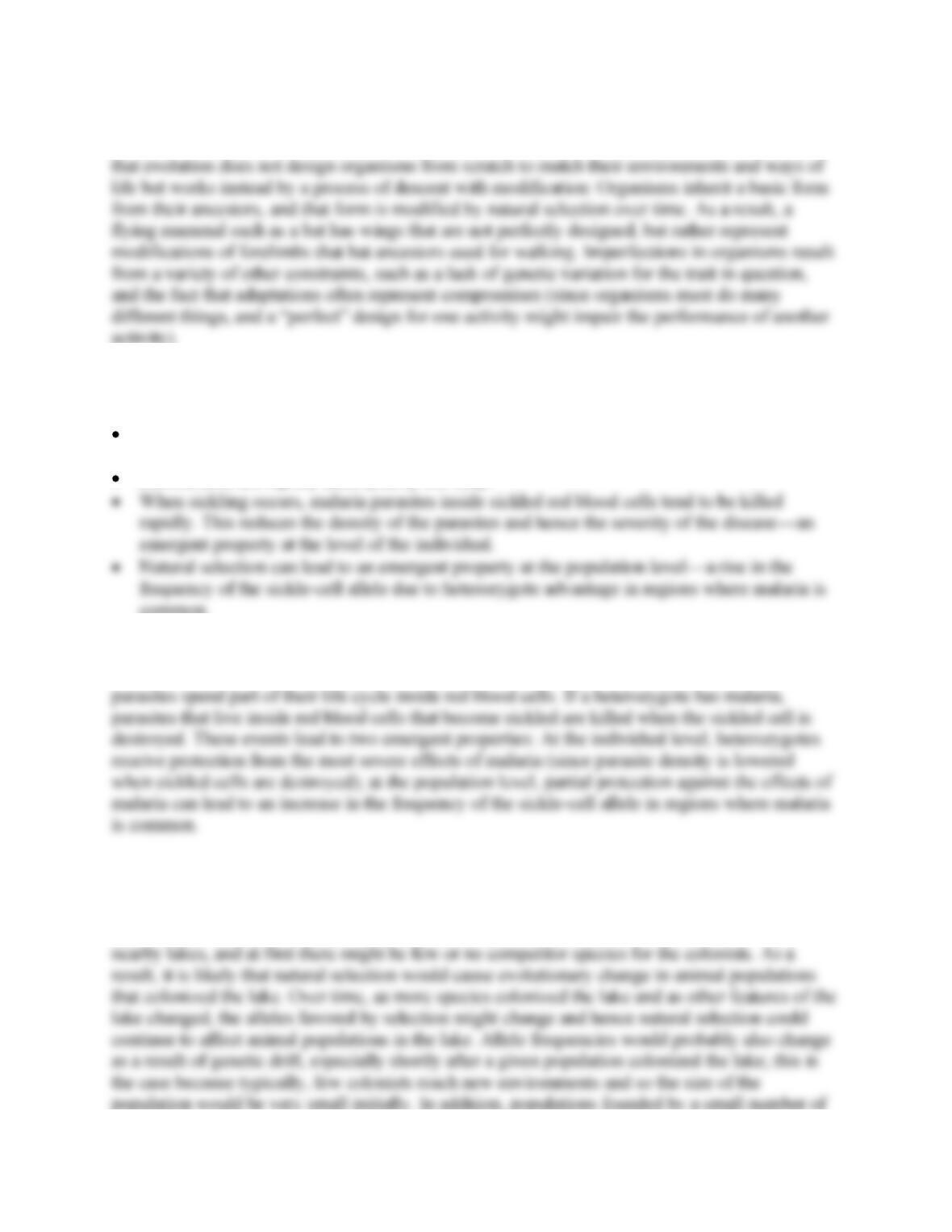
Members of a species that colonize a new environment often face environmental conditions that
differ from those found in their home (original) population. For example, in the kettle lake
shown here, the depth, temperature, and quality of the water might differ from those in other