CHAPTER 20 PHYLOGENY
Scientific Skills Exercise
Teaching objective: The main objectives of this exercise are to give students practice in
working with protein (polypeptide) sequence data and to help them appreciate how such data can
be used to suggest and test hypotheses about evolution. A secondary objective is to reinforce
what students have read about the idea of horizontal gene transfer.
Teaching tips: A version of this Scientific Skills Exercise can be assigned in MasteringBiology.
The instructor may want to point out that the data shown in this exercise are very limited: only
part of one polypeptide is shown and only for six species. For this reason, any conclusions
students may draw from the data can only be tentative. However, this exercise does provide an
opportunity to discuss the different ways that horizontal gene transfer might occur and the
possible role of horizontal gene transfer in evolution.
Answers:
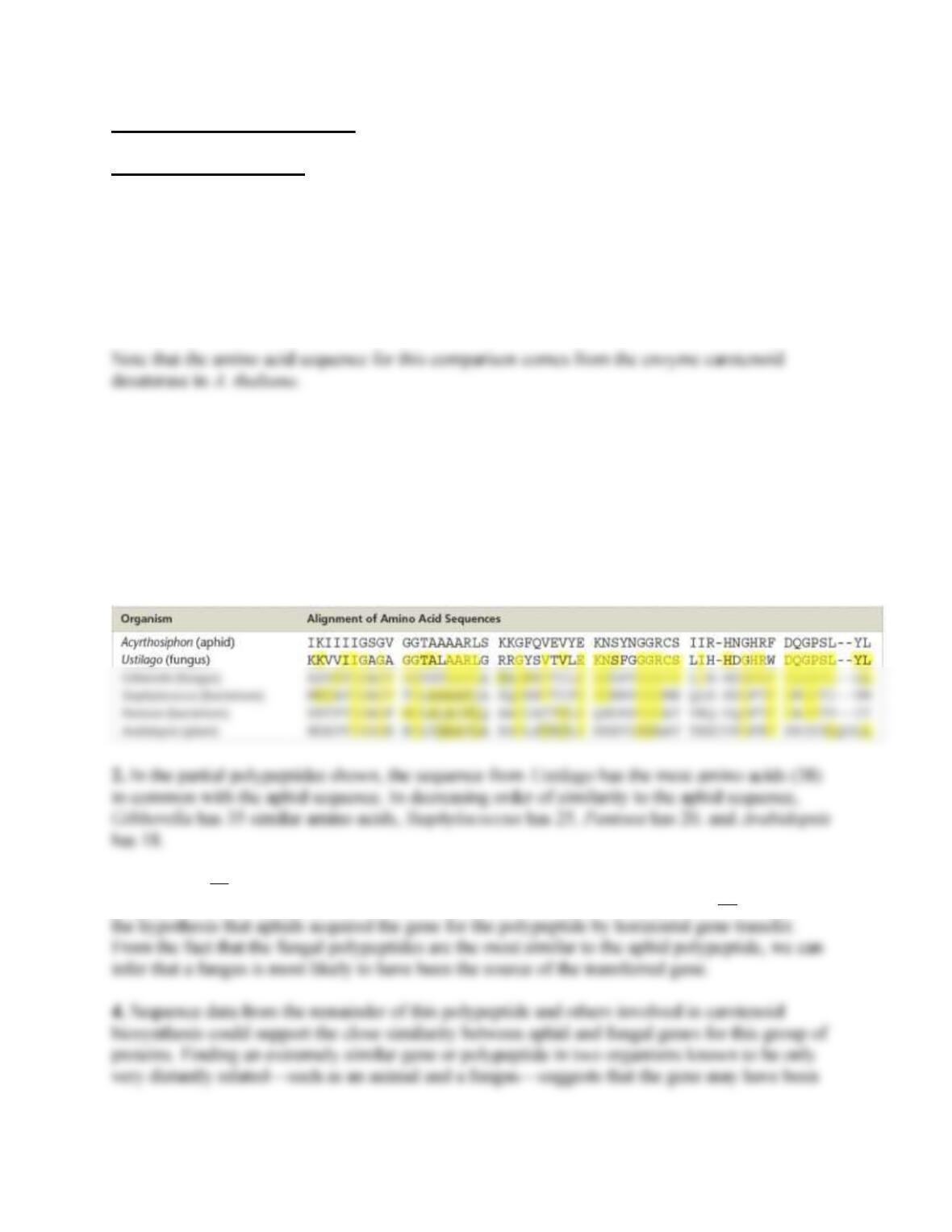
1.
3. These data in particular, the similarity in amino acid sequence between the aphid
polypeptide and the polypeptides from the other, only distantly related organisms do support
Interpret the Data
Figure 20.13 The zebrafish lineage; of the five vertebrate lineages shown, its branch is the
longest, indicating that it has undergone the most change since diverging from the common
vertebrate ancestor.
Figure 20.19 The molecular clock indicates that the divergence time is roughly 45 50 million
years.
Suggested Answers for End-of-Chapter Essay Questions
See the general information on grading short-answer essays and a suggested rubric at the
beginning of this document.
9. Focus on Evolution
characteristics of organisms in a clade to make predictions about the common ancestor of the
10. Focus on Information
Sample key points:
All organisms are composed of cells.
DNA is the hereditary material.
By descent with modification, newly formed species share many similarities with parent
construct phylogenies.
Sample top-scoring answer:
All organisms are composed of cells and have their genetic information encoded in DNA. One
result of this fact is that by descent with modification (see Chapter 19), the cells and DNA of
11. Synthesize Your Knowledge
Organisms are classified within groups such as the tetrapods based on their evolutionary history
rather than on whether they possess all of the traits typically found in other members of the