b 17
As with all the cases in this book, please read the preface if you have not
already done so. In the preface you will find suggestions for using Investigative
Case Based Learning (ICBL) in different instructional situations such as starting
a new lecture topic, assessing what students already know, setting a context for
and Chapter 7: Membrane Structure and Function. There are four strands in
the case:
• Fermentation
• Glycolysis
• Enzymeactions
• Osmosis
StudentsshouldcompletetheCaseAnalysisimmediatelyfollowingtheread–
ingofthecase.Westronglysuggestthatstudentsworkingroupstocomplete
Chapter 2:
Bean Brew
InstruCtor’s GuIde
M02_REEC4164_04_IE_CH02.indd 17 24/01/14 6:01 PM
18 a BIoloGICal InquIry: A Workbook of Investigative Cases
table IG2.1 Bean Brew Case overview.
Investigation learning Goals Inquiry skills used
II. Fermentation of
Grapes
Students use output of a model of
grape fermentation to further extend
their understanding of fermentation.
They then apply this information to
the case.
• interpretinggraphs
• applyingfermentationand
respiration concepts to new
situations
additional Investigation
IV. More Human
Uses of
Fermentation
Students must meet identified criteria as
they prepare a paper discussing a prod–
uct that undergoes fermentation.
• identifying,evaluating,and
managing information, including
primary literature
• extendinggeneralideasof
fermentation to additional
specific settings
Core Investigations
Chapter 2: Bean Brew b 19
TableIG2.2containsseveralresourcesrelatedtoCampbell Biology,10thedition,thatwillhelpyour
students further their understanding of this case.
table IG2.2 Campbell-related resources.
resource Chapter/activity topics Covered/activity titles
Critical Reading
from Campbell
Biology, 10th edition
MasteringBiology
Study Area
Chapter 7: Membrane Structure and
Function
Chapter 7 activity
Chapter 7 Video
Chapter 8 activity
Fluidity of membranes
(Concept 7.1); effects of osmosis
on water balance (Concept 7.3)
Osmosis and Water Balance in
Cells
Plasmolysis
HowEnzymesWork
20 a BIoloGICal InquIry: A Workbook of Investigative Cases
Case narrative
Students were asked to underline terms or phrases
in the introductory narrative that they think are
important to understanding the case. Suggested
terms and phrases that students might have cho-
sen are in bold type below.
“Excuseme,” Sallybeganwith asmile when
there was a break in the animated conversation.
“What’s all the fuss about a new strain of trans-
genic fungus? I can’t imagine how this would
affect me . . .”
Taki reached for the small container of soy
sauce on the table and held it up. “It turns out
thatthisfunguswillincreasetheefciencyofthe
first stage of brewing soy sauce.Didyouknow
spoilage. Salt was added as a preservative, but
over time the beans fermented.”
“Likepicklesandsauerkraut?”Henryasked.
Takinoddedandcontinued,“Exceptthebeans
softenedastheyfermented.Thispastewaseasier
to digest, so people started to eat it. Then, about
the fungi Aspergillus oryzae and Aspergillus
sojae. The new mixture, called koji, is left uncov-
eredforacoupleofdays,whilethefungipartially
digestthesoyandwheat.”
“So,isthetransgenicfungusyouweretalking
about Aspergillus?”askedSally.
“Exactly,”Takireplied.“Okay,inthenextstage,
youmix the koji with water and a lot of salt to
form a mash called moromi.Theyputthemoromi
into airtight containers and let them ferment for
M02_REEC4164_04_IE_CH02.indd 20 24/01/14 6:01 PM
Chapter 2: Bean Brew b 21
suggested answers for Case analysis
1. Recognize potential issues and major topics in the case. What is this case about? Underline
terms or phrases that seem to be important to understanding this case. Then list 3 or 4biology-
related topics or issues in the case.
Biology-related topics or issues: biotechnology and new strains of fungi; production of soy sauce;
2. What specific questions do you have about these topics?Byyourself,orbetteryet,inagroup,
makealistofwhatyoualreadyknowaboutthiscaseinthe“WhatDoIKnow?”column.Listques–
tionsyouwouldliketolearnmoreaboutinthe“WhatDoINeedtoKnow?”column.
There are many possible answers, depending on the experiences of your students. Below are some
likely responses:
3.Putacheckmarkbyone to threequestionsorissuesinthe“WhatDoINeedtoKnow?”listthat
youthinkaremostimportanttoexplore.
You should expect a range of responses. Most students will use the contextual clues of being in a
4. What kinds of references or resources would help you answer or explore these questions?
Identifytwodifferentresourcesandexplainwhatinformationeachresourceislikelytogivethatwill
helpyouanswerthequestion(s).Choosespecicresources.
Accept any reasonable resource (e.g., text, other book, Internet sites, maps, data tables, and so on)
What do I need to Know?
• Does soy sauce contain alcohol?
• Whatistheroleofsaltinfermentation?
• Whydoessoysauceneedtwoproduction
stages?
What do I Know?
• Many Asian dishes use soy sauce.
• Thebasicprocessesofmakingsoysauce.
Soy sauce is made of soybeans, wheat, water,
salt, and microbes.
suggested answers for Core Investigations
I. Critical Reading
To complete this investigation, you should have already read Chapter 7: Membrane Structure and Func–
tion (specifically Concepts 7.1 and 7.3); Chapter 8: An Introduction to Metabolism (specifically Concept
8.4); and Chapter 9: Cellular Respiration and Fermentation.
a. the Koji phase. In the koji phase of soy sauce production, fungi produce enzymes that break down
the carbohydrate and protein in the soybeans and wheat, thereby obtaining energy and molecules
1.Describe a typical enzyme-substrate complex. What mechanisms do enzymes use to lower
activationenergyandspeedupareaction?
Enzymes are proteins that contain a pocket or groove known as the active site. The active site is the
areaoftheenzymethatbindstospecicsubstratemolecules.Whensubstratesareintheactivesite
(forming the enzyme-substrate complex), the enzyme undergoes a conformational change, which
2.Explain howenzymesbreak downmacromolecules.What istherole ofwater?Whatbondsare
broken,whatbondsareformed?ExamineFigure8.16asyoudevelopyouranswer.
When breaking down macromolecules, the enzyme “holds” the substrate molecule so that the bond
3.Inthekojistageofsoysauceproduction,Aspergillusfungidigestsoybeansandwheat.Aspergillus
usessomeoftheglucoseproducedbythebreakdownofthecarbohydratestogenerateATPthrough
cellularrespirationorfermentation.ExamineFigure9.9andanswerthefollowingquestionsabout
glycolysis,therststageofrespiration.
22 a BIoloGICal InquIry: A Workbook of Investigative Cases
M02_REEC4164_04_IE_CH02.indd 22 24/01/14 6:01 PM
a. HowmanydifferentenzymesshowninFigure9.9areusedtotransformglucoseintopyruvate?
10
b.Whattypesofreactionsdoisomerasescatalyze?
c. What kinds of enzymes catalyze reactions that transfer a phosphate group from ATP to
another molecule?
kinases
d.Ifyouaddedanaldolaseinhibitor,whatkeyreactionwouldbeunlikelytooccur?Explain.
The splitting of fructose-1,6-bisphosphate into two 3-carbon isomers, dihydroxyacetone phosphate
B. the Moromi phase. Once Aspergillus has broken down the macromolecules in the soybeans and
wheat into monomers, the koji phase ends. Moromi is then made by mixing the koji with water and
enough salt to make a 16–20% concentrated salt solution, or brine.
1.Inthemoromiphaseofsoysauceproduction,theosmoticconditionsformicrobesaredrastically
changed.Sketchagenericcellshowingwhathappenstomostcellswhentheyareplacedinbrine.
Explainyoursketch.(Hint:Considerthemovementofwater.)
Students should sketch a shrinking cell showing water moving out of the cell and into the hypertonic
2. Somemicrobeshaveadaptationsforosmoregulationinordertolivesuccessfullyinhigh-saltenviron–
ments. When the brine is added, the populations of bacteria and fungi found in the koji change. Do
youexpectgreaterorlessermicrobialdiversity?Why?
3. Yet another challenge faces the microbes in moromi. After the brine is added, workers place the
moromiinairtightcontainersforseveralmonths.Whichtypesofmicrobeswillsurviveunderthese
conditions?Explainhowtheywillobtainenergyforlifeprocesses.
The microbes that survive are those that can produce ATP in the absence of oxygen—facultative
4. Tetragenococcus halophilus(abacterium)andZygosaccharomyces rouxii(afungus)aretwofaculta–
tivelyanaerobicspeciesthatthriveinmoromi.Throughfermentation,Tetragenococcus produces
lacticacid(lactateinitsionizedform)andZygosaccharomyces produces ethanol. What molecule
is transformed into these waste products? Describe the two processes. What other waste products
are produced?
Chapter 2: Bean Brew b 23
5. Are ethanol and lactate oxidized or reduced in these reactions?
II. Fermentation of Grapes
a. yeast and rising alcohol Concentrations. One of the oldest uses of fermentation by people is to
make alcoholic beverages such as wine. However, fermentation also occurs without human intervention.
Once grapes ripen on the vine, tiny breaks in the skin of the fruit enable the entry of microbes such as
bacteria and fungi. The interior of the grape provides both a high concentration of sugars and low pH.
24 a BIoloGICal InquIry: A Workbook of Investigative Cases
100
75
20
15
Yeast (10
Grape Sugar
M02_REEC4164_04_IE_CH02.indd 24 24/01/14 6:01 PM
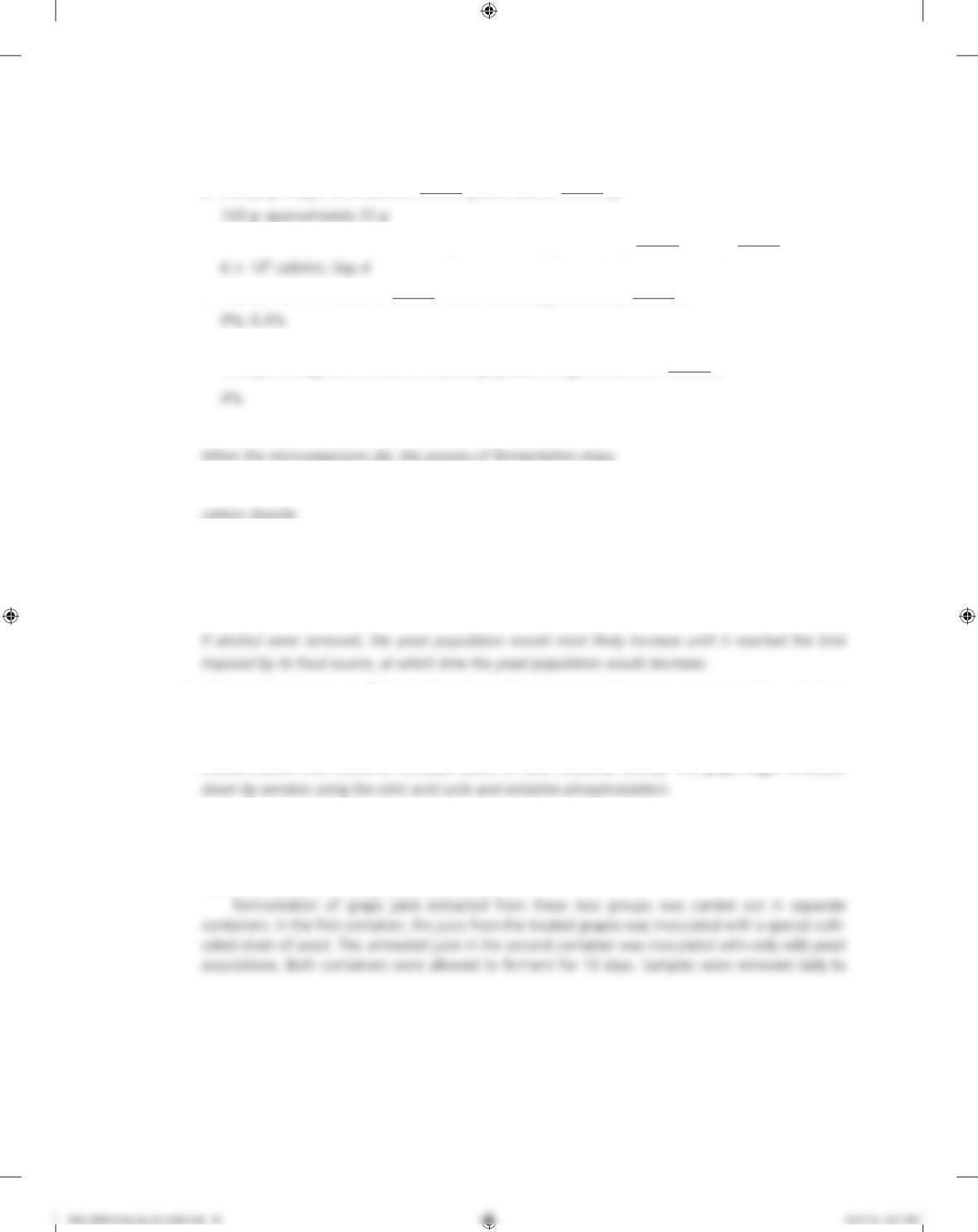
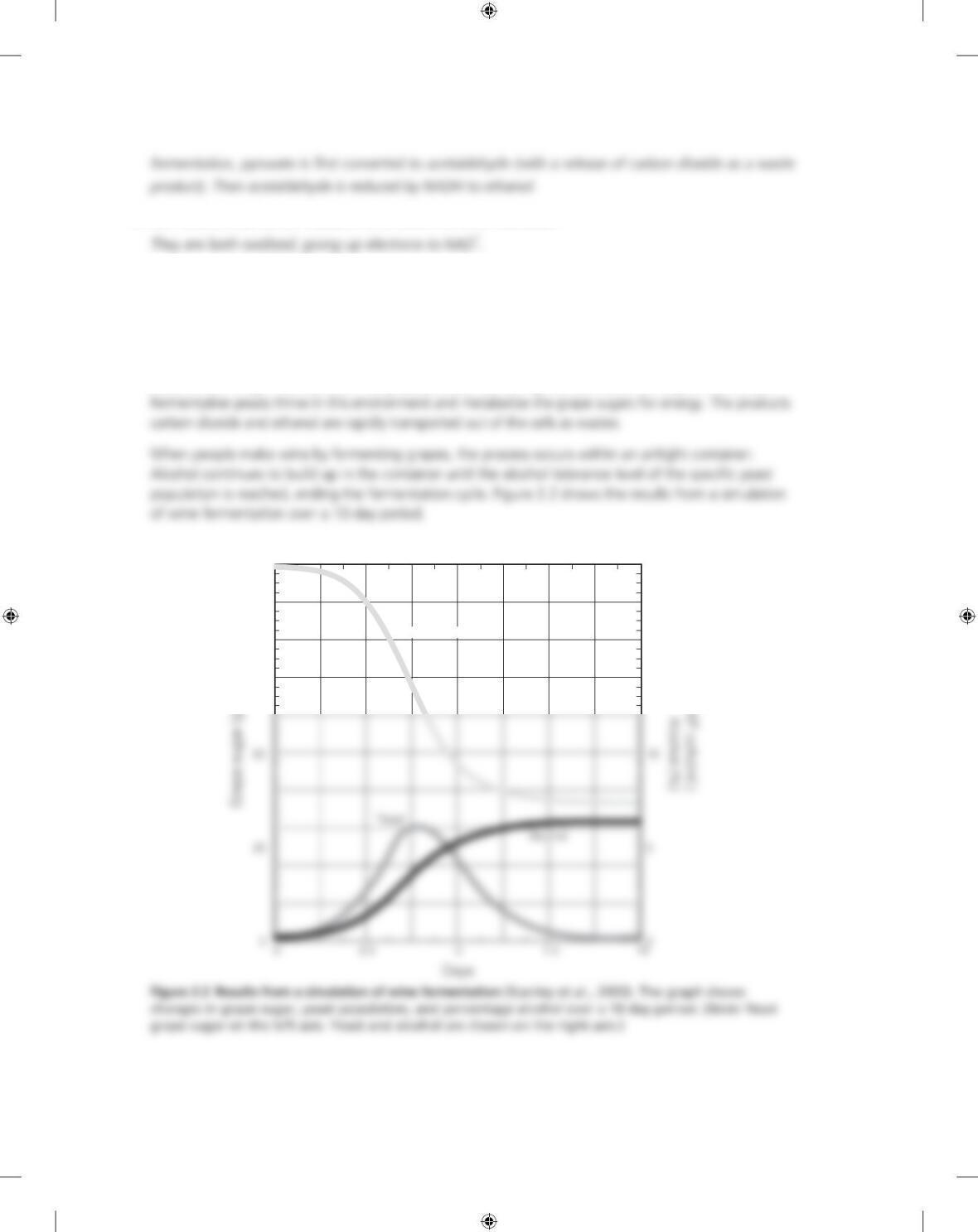
1.ExamineFigure2.2andllintheinformationbelow.
a. The grape sugar level starts at g and ends at g.
b.Theyeastpopulationreachesitshighestlevelofapproximately onDay .
c. The alcohol level starts at %andendsatapproximately %.
d.Lookatthegraphsshowingthecorrelationbetweenyeastpopulationandpercentagealcohol.At
whatpercentagealcoholdoesthisyeastpopulationbegintodecline? %
2.Whyisn’ttheremaininggrapesugarconvertedtoethanolandcarbondioxide?
3. What product of alcohol fermentation is not shown in the preceeding graph?
4.If youremovedthealcoholas itwasproduced,wouldyou predictan increaseora decreasein
the amount of grape sugars at 10 days? An increase or decrease in the population of yeast at
10days?Explain.
The amount of grape sugar would decrease because high alcohol levels would not kill the yeast.
5.Abottleofwinemayspoilifitisallowedtositforsometimeafterbeingopenedorifitscorkdoes
notformatightseal.Explainwhatcausesthewinetospoilundertheseconditions.(Hint: Available
grapesugardeclines.)
Contamination from airborne microbes results in new metabolic activity. The grape sugar is broken
B. Fermentation with Wild and Cultivated yeasts. In an experiment to identify differences in fermen–
tation carried out by wild and cultivated yeasts, a batch of grapes was divided in two. One batch of
grapes was treated with sulfur dioxide to kill wild yeasts before the juice was extracted. The other batch
was left untreated, allowing wild yeasts to survive.
Chapter 2: Bean Brew b 25
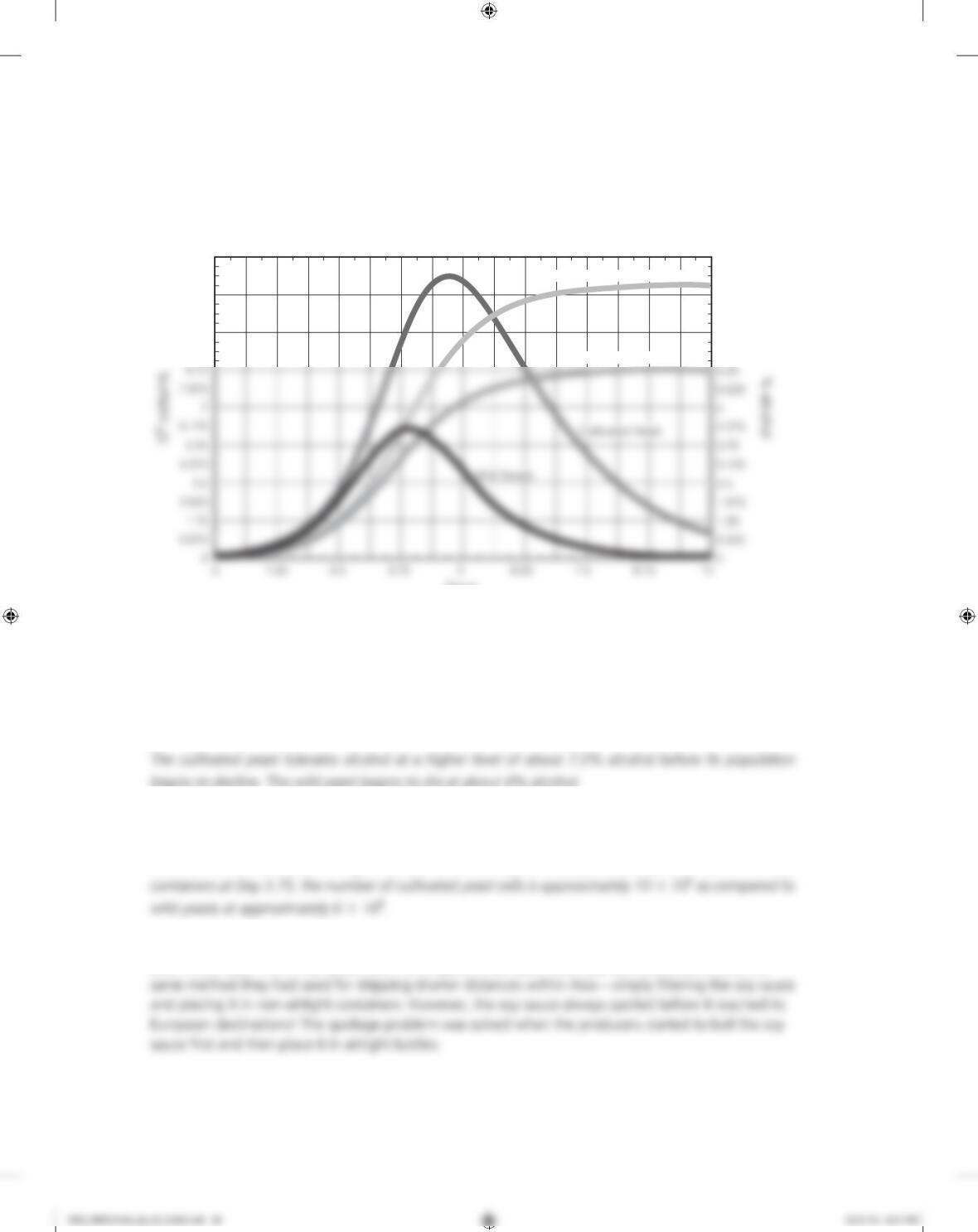
estimate the number of yeast cells and the level of alcohol in each container. Results are shown in
Figure 2.3.
26 a BIoloGICal InquIry: A Workbook of Investigative Cases
14
13.125
12.25
11.375
10.5
9.625
10
9.375
8.75
8.125
7.5
6.875
Days
Cultivated Yeasts’ Alcohol
Wild Yeasts’ Alcohol
Figure 2.3simulated fermentation by wild and cultivated yeasts(Stanleyetal.,2003).(Note:Readpopulation
sizeontheleftaxis.Alcoholproductionisshownontherightaxis.)
1.Assumingalcohollevelaffectsthegrowthofyeast,whichyeasthasahighertoleranceforalcohol?
Atapproximatelywhatpercentagealcoholdothetwoyeastpopulationsinthedifferentcontainers
begin to decline?
2. Why do you think the alcohol levels increase more rapidly in one of the containers? Use data from
Day3.75tosupportyourhypothesis.
More alcohol is produced the greater the number of yeast cells present. If you compare the two
C. Bottling soy sauce. Now apply some of the concepts you learned about grape fermentation to the
BeanBrewcase.WhensoysaucewasrstshippedtoEurope,Asiansoysauceproducerstriedthe
1.Explainwhyplacingsoysauceinairtightbottleswasmoresuccessfulforlong-distanceshipping
thansimplyplacingthesauceinbarrels.
Boiling the soy kills the majority of remaining organisms, putting a stop to metabolism. Making the
bottles airtight prevents any additional microbes from entering and breaking down molecules in soy
2.Whenthesoysaucewasnotboiledbeforeitwasbottled,thebottlessometimesburstduringthe
voyage.Whatdoyouthinkcausedthis?
If a large population of anaerobic organisms were still alive and fermenting, carbon dioxide would build
3.Bottled soy sauce does not taste the same as fresh soy sauce. What do you think causes this
change?
Boiling the soy sauce for bottling may destroy some of the molecules that enhance the flavor of soy
4.Topreserveavorinmoderntimes,brewedsoysaucesarenotboiledbutarepasteurized(heated
toatemperatureofabout60°C[140°F])beforebeingbottled.Pasteurizedsoysaucetastesbetter
thanboiledsoysauce.Whatdoespasteurizationdo?Whyshouldopenedbottlesofsoysaucebe
stored in the refrigerator?
Pasteurizationraisesthetemperaturetoonly60°C,whichissufcienttokilloffmanymicrobes,but
III. Alcohol Dehydrogenase
Ethanol,whichistoxictoyeastcells,isalsotoxictohumancells.Wecanconsumealcoholduetoalco-
hol dehydrogenase, an enzyme produced by humans and many other animals that catalyzes the oxida–
tion of alcohols to aldehydes. In this reaction, nicotinamide adenine dinucleotide (NAD1) is used as an
oxidizing agent.
Chapter 2: Bean Brew b 27
Notonlydoesalcoholdehydrogenaseallow humans todetoxify(withinlimits!)theethanolthatwe
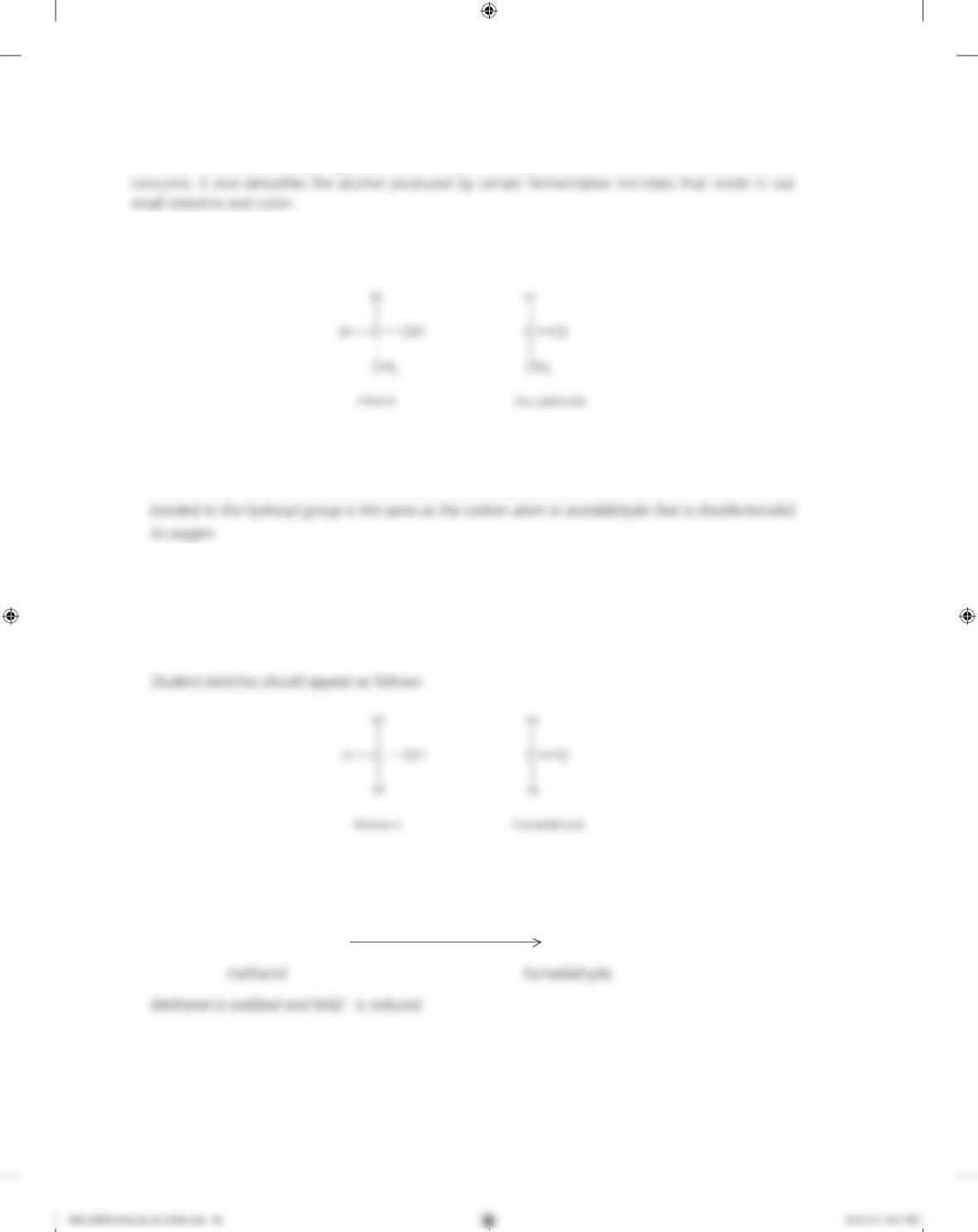
1.Drawmoleculesofethanolandacetaldehyde.
Student sketches should appear as follows:
2.Explainwhyethanolisconsideredanelectrondonorinthisredoxreaction.
Ethanol loses electrons when it is converted to acetaldehyde. The carbon atom in ethanol that is
3.Consumption of methanol can be fatal because alcohol dehydrogenase converts methanol to
formaldehyde, a highly toxic substance that can cause the death of cells in the human body.
Formaldehydeisthesubstanceoncecommonlyusedtopreserveanimalandplanttissues;how–
ever, due to its cancer-causing properties, its use is restricted. Draw molecules of methanol and
formaldehyde.
4.Whatisoxidizedandreducedinthisreaction?Explain.
alcohol dehydrogenase
CH3OH 1 NAD1 CH2O 1 NADH 1 H1
28 a BIoloGICal InquIry: A Workbook of Investigative Cases
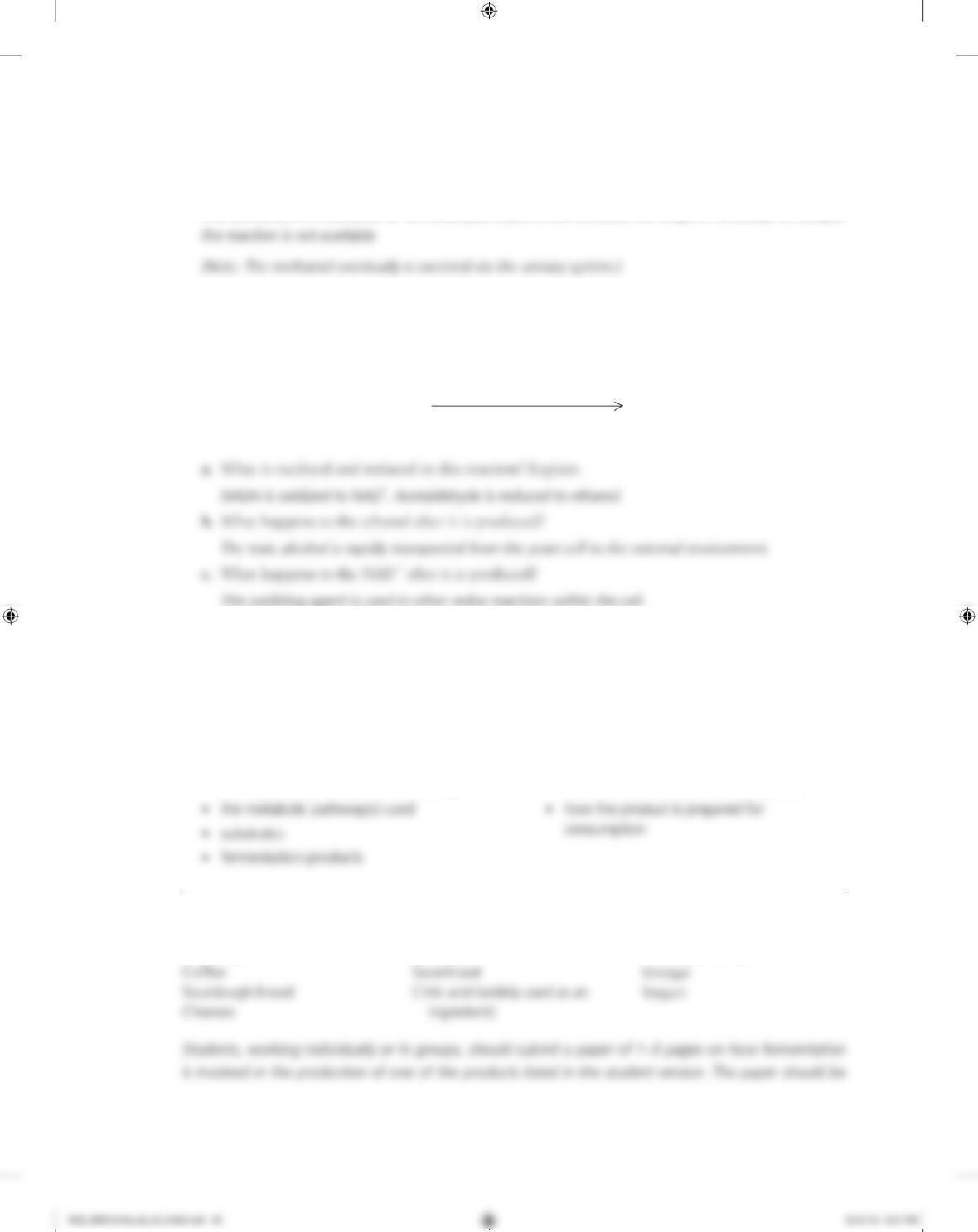
5.Treatmentformethanolingestioninvolvesgivingthepatientanalcoholdehydrogenaseinhibitor.
Explainwhythisishelpful.
The conversion of methanol to formaldehyde is prevented because the enzyme necessary to catalyze
6.Duringfermentationinyeast,alcoholdehydrogenasecatalyzesareactionthatbreaksdownacetal–
dehydeintoethanolandregeneratesNAD1.Notethatthisisthereverseofthereactioncatalyzedby
theenzymeinhumansandotheranimals.
alcohol dehydrogenase
CH3CHO 1 NADH 1 H1 CH3CH2OH 1 NAD1
acetaldehyde ethanol
additional Investigation
IV. More Human Uses of Fermentation
Thingsarefermentingeverywhere!Chooseaproductfromthelistbelow.Useyourtextandother
resources, including primary sources, to find out how fermentation is used to make this product. Write a
paper of 1–3 pages, based on reliable sources, indicating:
Chapter 2: Bean Brew b 29
Sausage
Chocolate
Tempeh
Kimchee
Dental caries (product is the
decayed tooth)
products
• the organism(s) doing the fermenting
• how the fermentation is accomplished
based on reliable sources. Consider asking students for at least one primary literature article. The paper
should address the following items:
• the organism doing the fermenting
• themetabolicpathway(s)used
V. Open-Ended Investigations
Usetheworkingwinemodel(availableathttp://bioquest.org/icbl/casebook/wine)toconduct
References
Noda,F.,K.Hayashi,andT.Mizunuma.Antagonismbetweenosmophiliclacticacidbacteriaandyeasts
inbrinefermentationofsoysauce.Applied and Environmental Microbiology,40(3):4452–457,1980.
30 a BIoloGICal InquIry: A Workbook of Investigative Cases