CHAPTER 18 GENOMES AND THEIR EVOLUTION
Scientific Skills Exercise
Teaching objective: A version of this Scientific Skills Exercise can be assigned in
MasteringBiology.
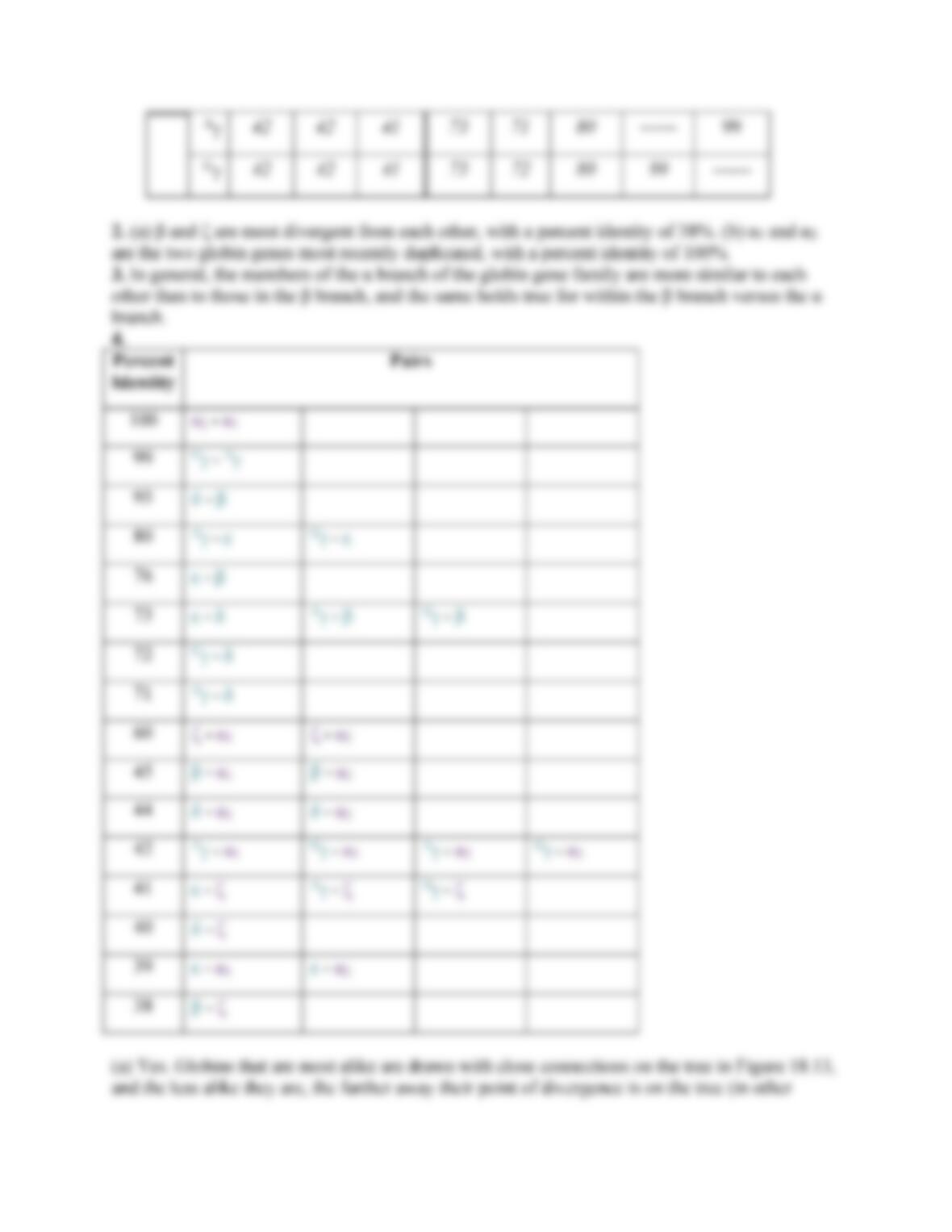
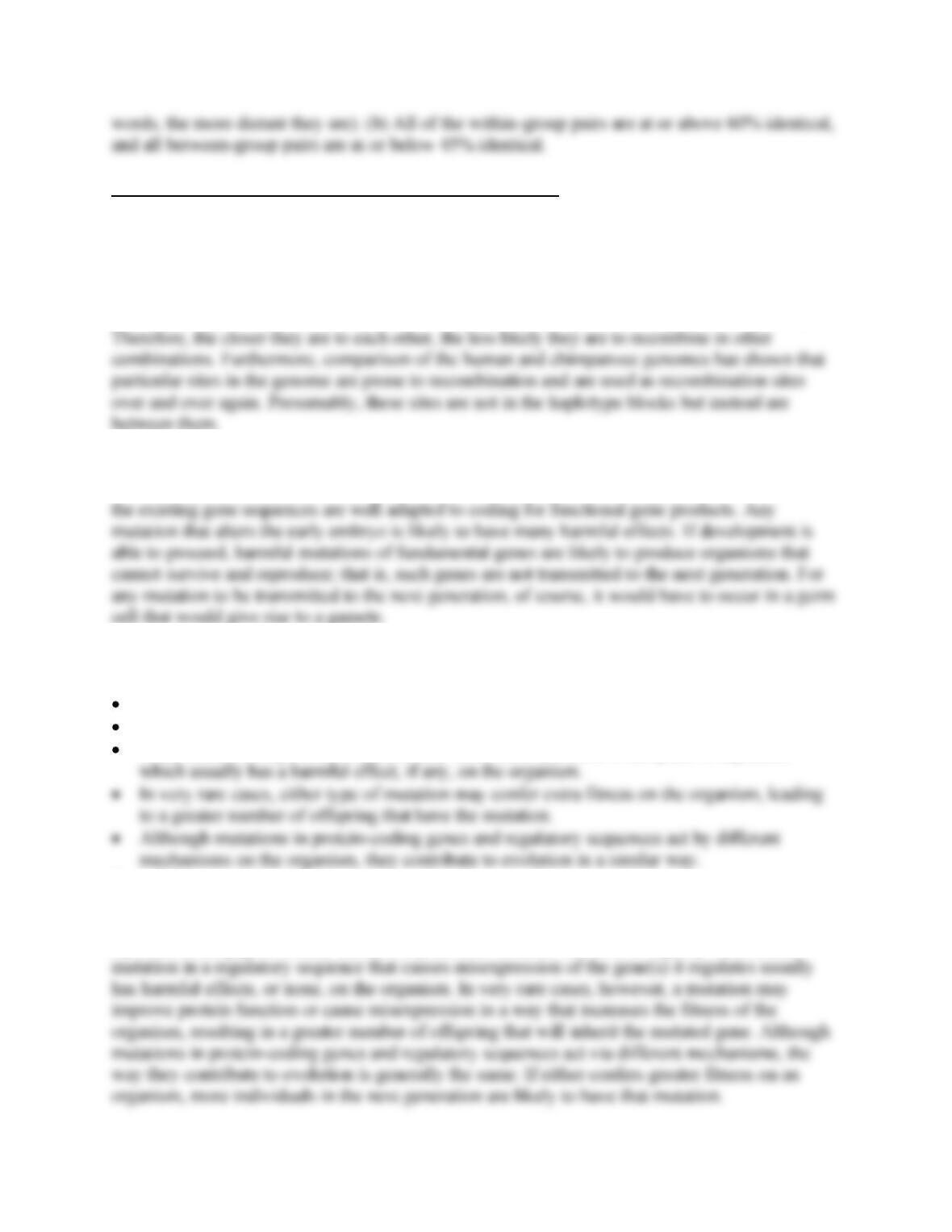
Students will examine amino acid identity percentages in a table and see how these data are used
to propose evolutionary relationships. In this example, they will also see how the evolutionary
relationships among globins are consistent with the model presented in Figure 18.13.
Teaching tips: It will be useful to remind the students that the values in the table were calculated
based on pair-wise sequence alignments, not a consensus sequence, and that the globins in the
table are all contemporary (currently existing) proteins. The ancestral globins shown in Figure
the denominator to calculate the percent identity.
You may want to introduce the notion that not every mutation in the duplicated globin genes will
result in altered amino acids, and not all amino acid changes will result in altered function. It is
only the mutations that do cause altered function (or expression patterns) that will be acted upon
by natural selection.
Answers:
1. (a) The table cells with dashed lines indicate self-pairs (for example, – ). Because the globins
in these pairs are identical, the dashed lines signify 100% identity. (b) The cells were left blank
Suggested Answers for End-of-Chapter Essay Questions
See the general information on grading short-answer essays and the suggested rubric at the
beginning of this document.
5. Scientific Inquiry
SNPs act as genetic markers, and just like STRs, they exhibit genetic linkage (see Chapter 12).
6. Focus on Evolution
Genes whose functions are fundamental, and thus essential, tend to be highly conserved because
7. Focus on Information
Sample key points:
Mutations can affect protein-coding genes or regulatory sequences.
A mutation in a protein-coding gene usually has a harmful effect, if any, on protein function.
A mutation in a regulatory sequence may cause misexpression of the genes it regulates,
Sample top-scoring answer:
Mutations occur randomly along the chromosomal DNA and can affect any type of DNA
sequence. If the mutation occurs in a germ cell, it can be passed along to offspring. A mutation in
a protein-coding gene usually causes the protein to function less well or equally well, and a
8. Synthesize Your Knowledge
A change in gene regulation by the Hox
inhibited and could form. The insect already had a functional pair of wings on the second