CHAPTER 13 THE MOLECULAR BASIS OF INHERITANCE
Scientific Skills Exercise
Teaching objective: Students will do predictions of base composition in DNA from different
Teaching tips: A version of this Scientific Skills Exercise can be assigned in MasteringBiology.
Because we now know the structure of DNA, students can be puzzled by why the number of A
The calculations in this exercise are simple algebraic equations based on a few basic rules: A + T
+ C + G = 100%; A = T and C = G.
Answers:
1.
rule that the DNA of different species varies in its base composition. Ch
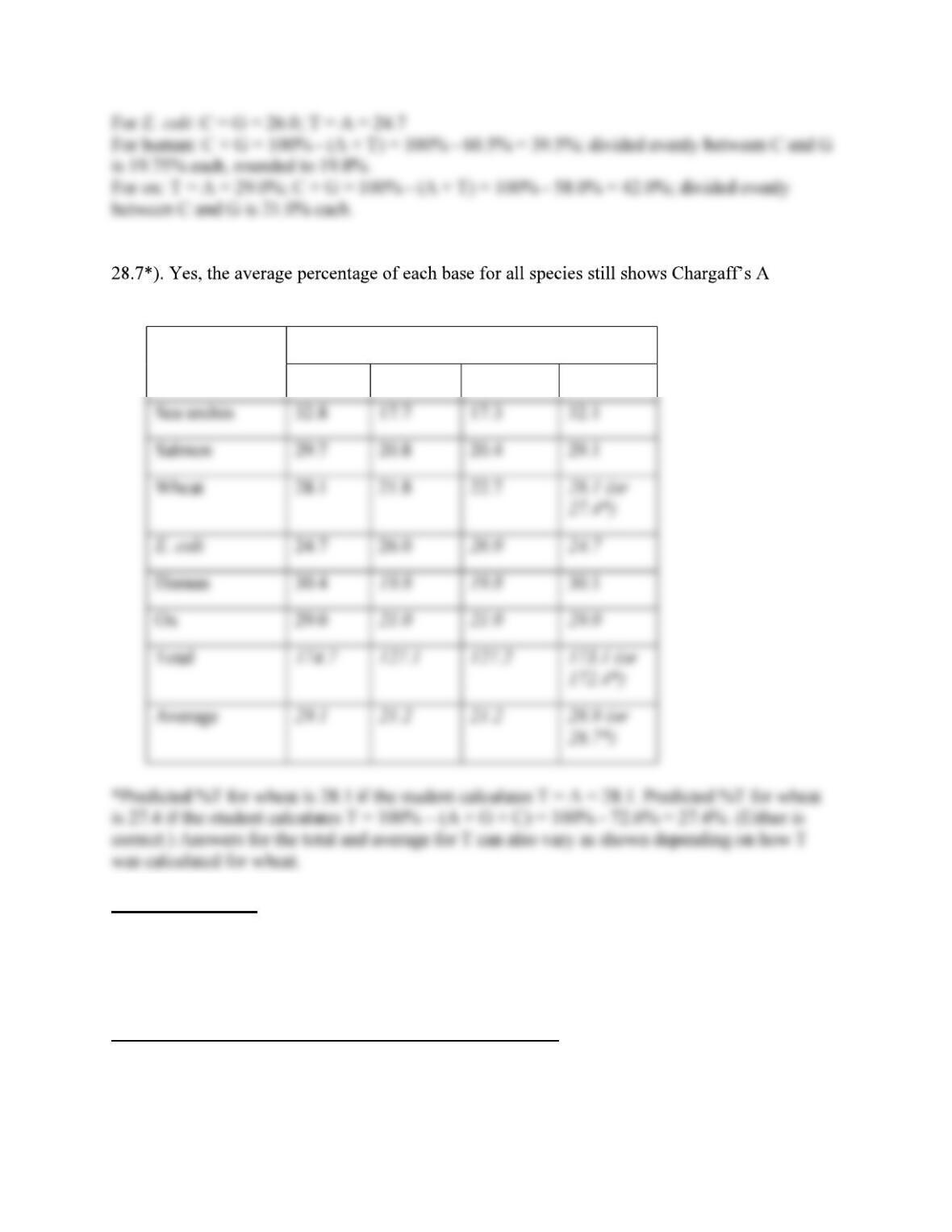
3. Average for A = 29.1, average for G = 21.2, average for C = 21.2, and average for T = 28.9 (or
-T and
C-G equivalence relationship.
Source of DNA
Base Percentage
Adenine
Guanine Cytosine Thymine
Interpret the Data
Figure 13.29 The height of the peak reflects the number added, consecutively, of a particular
base. The first 25 nucleotides in the sequence are TCAGCGTAAGGTGATGTATAGGGGC.
Suggested Answers for End-of-Chapter Essay Questions
See the general information on grading short-answer essays and the suggested rubric at the
beginning of this document.
11. Scientific Inquiry
12. Focus on Evolution
This could occur in several ways. The bacteria could decrease their synthesis of protective
pigments (or break down those already produced). This would be analogous to a human
13. Focus on Organization
Sample key points:
The heritable information in the DNA double helix is in the form of a sequence of nucleotide
bases along one strand, matched by complementary bases along the other strand.
This structure allows the molecule to be copied accurately and efficiently.
There are many possible sequences along the length of a DNA molecule.

Sample top-scoring answer:
The structure of the DNA molecule is well correlated with its function in carrying heritable
information. DNA is a double helix, carrying information in the form of a sequence of
nucleotides along one polynucleotide strand, matched by nucleotides with complementary bases
14. Synthesize Your Knowledge
The uniqueness of a stretch of DNA is based on its sequence of nucleotide bases, which are on
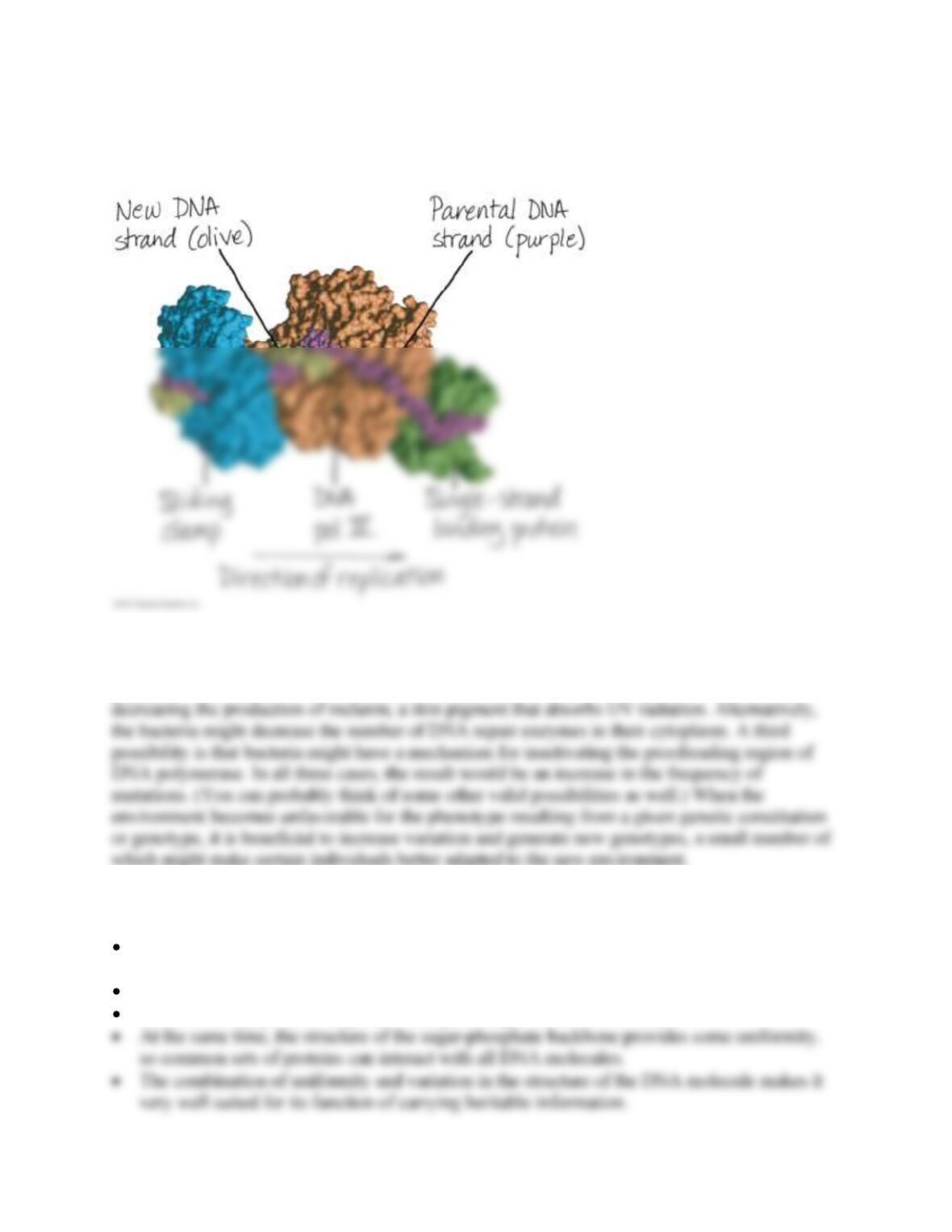
the interior of the double helix. The protein appears to have regions that are closely associated
with the space between the two strands of the DNA double helix, the region between the two