CHAPTER 12 THE CHROMOSOMAL BASIS OF INHERITANCE
Scientific Skills Exercise
Teaching objective: 2 value for a given data set and determine
whether or not to reject a hypothesis about the data.
Teaching tips: A version of this Scientific Skills Exercise can be assigned in MasteringBiology.
Students often stumble on the step of calculating expected numbers of offspring for each
population of offspring.
recombinant (non-parental) phenotypes: One way is for genes on two different chromosomes to
move independently of each other and the other is the result of crossing over between two linked
generation parents, while a recombinant phenotype is a phenotype that is different from both.
Another way of 2 2 may be used to measure the probability that
this data set could have been obtained by random sampling from a population for which the
hypothesis is correct. If the probability is less than 5%, it is very unlikely that the observed data
could have resulted randomly if the hypothesis were true, so the hypothesis must be rejected.
Some important considerations, mentioned briefly in the exercise, are sample size and the
strength of the linkage (how close the two genes are, if they are linked). With small sample sizes,
only very strong linkages (genes that are very close) will be detectable, while with larger sample
sizes we are capable of detecting even weak linkages. For this reason, we must be cautious with
2 probabilities. We rarely have sufficient evidence to
prove our hypothesis, but rather we simply fail to disprove it. That is, our failure to detect any
Answers:
1.
Offspring from
testcross of AaBb
(F1) x aabb
Purple stem/
short petals
(A-B-)
Green stem/
short petals
(aaB-)
Purple stem/
long petals (A-
bb)
Green stem/
long petals
(aabb)
2.
Testcross offspring Expected
(e)
Observed
(o)
Deviation
(o – e)
(o – e)2
(o – e)2/e
Suggested Answers for End-of-Chapter Essay Questions
See the general information on grading short-answer essays and the suggested rubric at the
beginning of this document.
10. Scientific Inquiry
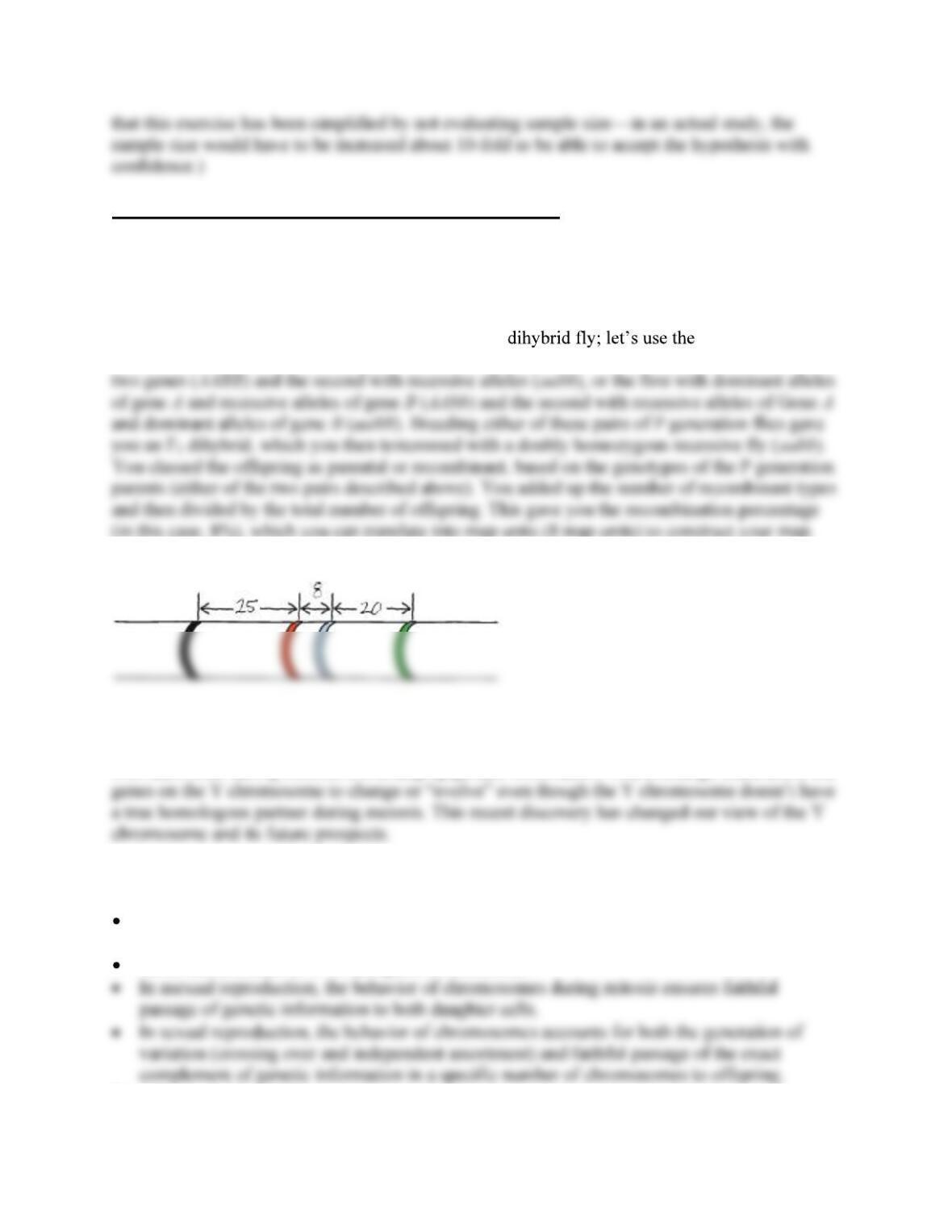
(a) For each pair of genes, you had to generate an F1 A and B genes as
an example. You obtained homozygous parental flies, either the first with dominant alleles of the
(b)
11. Focus on Evolution
It has been suggested that the regions of internal homology within the Y chromosome may pair
with each other during meiosis I, exchanging genetic information. This exchange could allow the
12. Focus on Information
Sample key points:
A chromosome consists of one DNA molecule, carrying the heritable information, along with
associated proteins.
Genes are stretches of DNA along the chromosome.
Sample top-scoring answer:
Chromosomes contain the DNA that carries the heritable information. One chromosome is made
up of one DNA molecule and associated proteins. Genes, in different forms called alleles, are
present as stretches of DNA at specific locations along the chromosomal DNA molecule. The
13. Synthesize Your Knowledge
A male butterfly zygote would be XX. During the first cell division, if nondisjunction occurred
for one of the X chromosomes, the two daughter cells would have been XXX and XO. The XXX