
b 163
As with all the cases in this book, please read the preface, if you have not already
done so. In the preface you will find suggestions about using Investigative Case–
Based Learning (ICBL) in different instructional situations such as starting a new
lecture topic, assessing what students already know, setting a context for lab activi–
ties, and so on. The preface also describes ways to use cases in a variety of classroom
settings and suggests multiple ways to assess learning with cases.
• Cyclopamine,cellsignalingandcancer
• Evolutionofthehedgehoggenefamily
• Stemcellsandcellsignaling
• Antibodiesasresearchtools
own and others’ prior knowledge.
Five investigations accompany Shh: Silencing the Hedgehog Pathway. Four are
“core” investigations relating directly to the facts of the case, and one “addi-
tional” open-ended investigation extends beyond the facts of the case. Table
IG10.1 describes what students will gain from each investigation.
Chapter 10:
Shh: Silencing the
Hedgehog Pathway
InstruCtor’s GuIde
M10_REEC4164_04_IE_CH10.indd 163 24/01/14 7:22 PM
164 a BIoloGICal InquIry: A Workbook of Investigative Cases
table IG10.1 shh: silencing the Hedgehog Pathway overview.
Investigation learning Goals Inquiry skills used
Core Investigations
II. Phylogenetics of the
Hedgehog Gene
Family
Students review two text figures, a phylo-
gram and an ultrametric tree based on
hedgehog gene, and answer questions
about phylogenetic relatedness among
animal groups. They use conserved gene
sequences to determine hedgehog
protein relatedness.
• reading trees as hypotheses
• using sequence data to infer
relationships
• recognizing relationships
among animal taxa
Students develop a proposal for research
on the hedgehog pathway after exploring
a curated database of research. Proposal
review panels may be an optional activity.
V. Open-Ended
Investigations
• navigating a complex
database
• developing an experimental
design
• writing a proposal
• reviewing a proposal
additional Investigation
M10_REEC4164_04_IE_CH10.indd 164 24/01/14 7:22 PM
CHaPter 10: Shh: Silencing the Hedgehog Pathway b 165
Case narrative
“I’m so relieved,” Ann said as she plopped down
in the coffee shop booth where her friend Delores
was reading e-mail on her laptop.
“Oh Ann!? What did the doctor say?” Delores
asked.
“Well no one else in the family has had skin
cancer.” Grimacing, Ann added,”It’s more likely
I’m paying for my tan.”
After Ann left, Delores searched for “basal
cell cancer” on the Web. She wondered how her
friend ended up with skin cancer. She found
kind of cancer, was linked to problems with
the hedgehog signaling pathway. Exposure
to UV radiation was one way to impact the
pathway.
“More questions than answers,” Delores
sighed. She looked up “hedgehog signaling path–
researchers divided mice into two groups and
then exposed them to UV radiation. One group
was given a drug called cyclopamine, a known
antagonist to the hedgehog pathway, in their
drinking water, and the other group got plain
water. The mice that got the cyclopamine had
M10_REEC4164_04_IE_CH10.indd 165 24/01/14 7:22 PM
suggested answers for Case analysis
1. Recognize potential issues and major topics in the case. What is this case about? Underline
terms or phrases that seem to be important to understanding this case. Then list 3–4 biology-related
topics or issues in the case.
2. What specific questions do you have about these topics? By yourself, or better yet, in a group,
make a list of what you already know that is related to the case in the the “What Do I Know?”
column. List questions you would like to learn more about in “What Do I Need to Know?” column.
166 a BIoloGICal InquIry: A Workbook of Investigative Cases
Students are likely to mention some or all of
these, many of which come from the case:
• Thehedgehogsignalingpathwayisinvolvedin
BCC.
• Cyclopamineistheantagonisttothe
hedgehogsignalingpathway.
• Antagonismmeans“goingagainst.”
• Whatisthehedgehogsignalingpathway?
• Whereisit?
• Wheredoescyclopaminecomefrom?
• Howdidthescientistsknowtouseit?
• Doesitworkonothercancersaswell?
• Howdoesitwork?
• Canhumansbetreatedwithcyclopamine?
What do I Know? What do I need to Know?
M10_REEC4164_04_IE_CH10.indd 166 24/01/14 7:22 PM
3. Put a check mark by 1–3 questions or issues in the “What Do I Need to Know?” list that you think
4. What kinds of references or resources would help you answer or explore these questions? Identify
two different resources and explain what information each resource is likely to give that will help
you answer the question(s). Choose specific resources.
StudentsmightlookuptheAtharetal.paper,usewebsitesoncanceratNIHorotherplacesincluding
suggested answers for Core Investigations
I. Critical Reading: Cell Signaling Pathways
You should be familiar with the structure and function of proteins that have active sites, such as en–
zymes or antibodies. To complete this investigation you should read Chapter 11: Cell Communication
(specifically, Concepts 11.1 and 11.4) and Chapter 18: Regulation of Gene Expression (specifically,
Concepts 18.4 and 18.5).
1. What is cancer? (Hint: Use of multiple sources for this definition, such as Cancerquest [http://www.
cancerquest.org] in addition to the text, is recommended.)
Cancerisadiseaseincellsinwhichcontrolofcelldivisionbecomesunregulated.Amassofdivid–
2. What are some of the causes of cancer?
Cancerhasmanycauses,includingmutationscausedbyenvironment(e.g.,nicotine,UVrays),aswell
CHaPter 10: Shh: Silencing the Hedgehog Pathway b 167
• Mostpeoplewhohaveitdonotdiefromit.
• Howcloseamatcharemouseandhuman
M10_REEC4164_04_IE_CH10.indd 167 24/01/14 7:22 PM
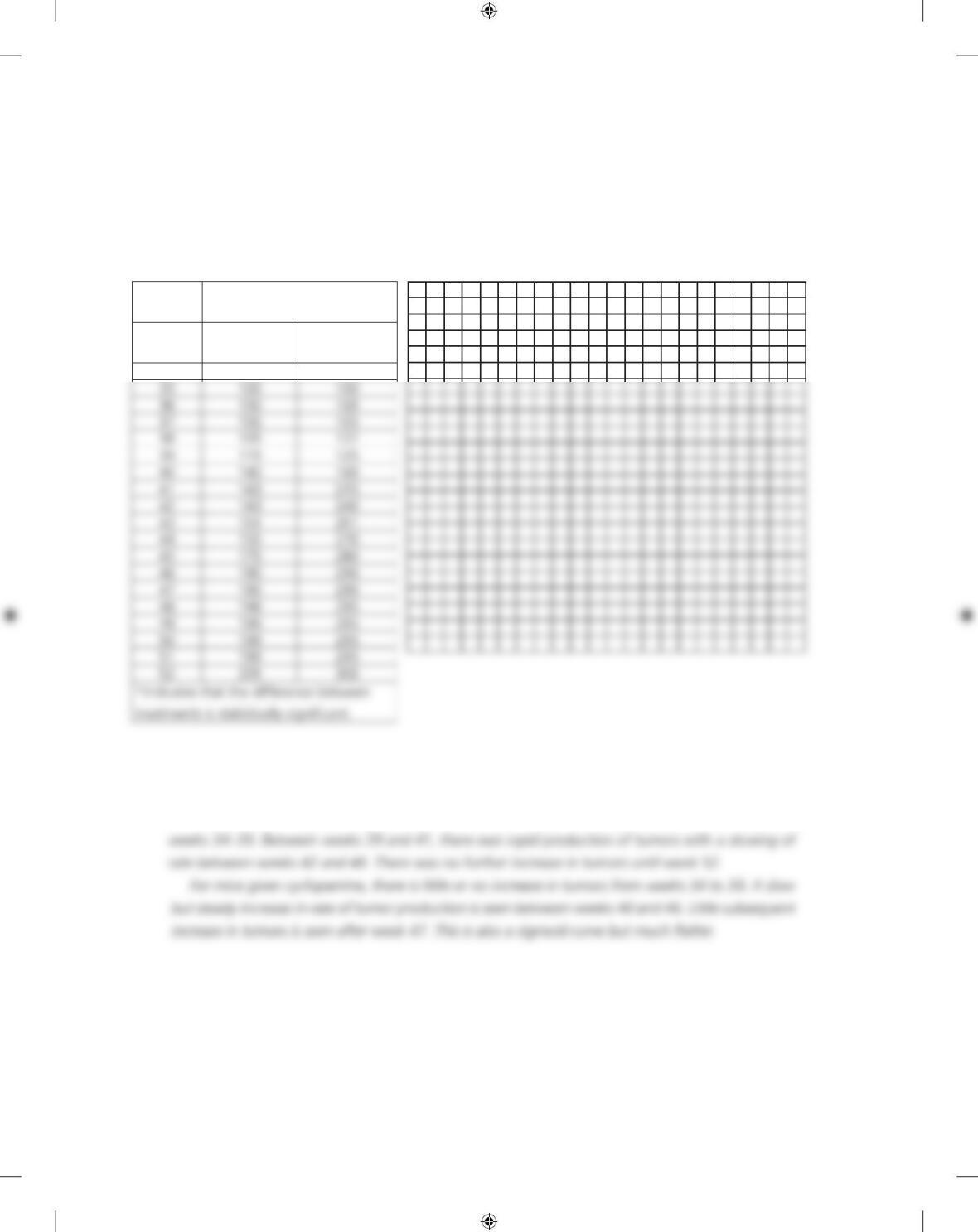
3. Prepare a graph of these data showing the effect of time on tumor production in the two treatments.
Put both treatments on the same graph, on two separate lines.
168 a BIoloGICal InquIry: A Workbook of Investigative Cases
a. On the basis of the shape of the curves, explain the patterns of tumor production in control and
experimental mice in weeks 34–52.
Forcontrolmice,asigmoid-shapedcurveisshown,inwhichcancerproductionisslowbetween
table 10.1 effect of cyclopamine on tumors in mice irradiated with
uVB (data approximated from athar et al., 2004)
% increase in the number of
tumors per mouse
Weeks on
the test
*Cyclopamine
treatment
Water control
treatment
34 100 100
M10_REEC4164_04_IE_CH10.indd 168 24/01/14 7:22 PM
CHaPter 10: Shh: Silencing the Hedgehog Pathway b 169
b. What is the overall percentage increase in tumors for control versus experimental mice?
Overall,a300%increaseintumorproductionforwater-treatedcontrolmice.
c. Which of these two data formats would be more effective in presenting the results of the experi-
ment to the public? Which would be more effective for other scientists?”
4. The researchers found that UV irradiated mice given cyclopamine had 0.4 tumors per mouse, while
those that did not get the drug had 1.3 tumors per mouse, and after a statistical test found p < 0.01.
How effective was cyclopamine in treating BCC in the mice?
Themicethatreceivedwater,thecontrols,visiblyhavemanymoretumorsthanthosetreatedwith
The hedgehog signaling pathway plays a crucial role in the development of many animal embryos. In ad-
dition, the hedgehog pathway controls regeneration of short-lived adult tissues, such as those in skin and
blood. When the hedgehog pathway is active, transcription of proteins occurs in target cells followed by
rapid division of those cells. The hedgehog pathway is also active in BCC and several other cancers.
M10_REEC4164_04_IE_CH10.indd 169 24/01/14 7:22 PM
170 a BIoloGICal InquIry: A Workbook of Investigative Cases
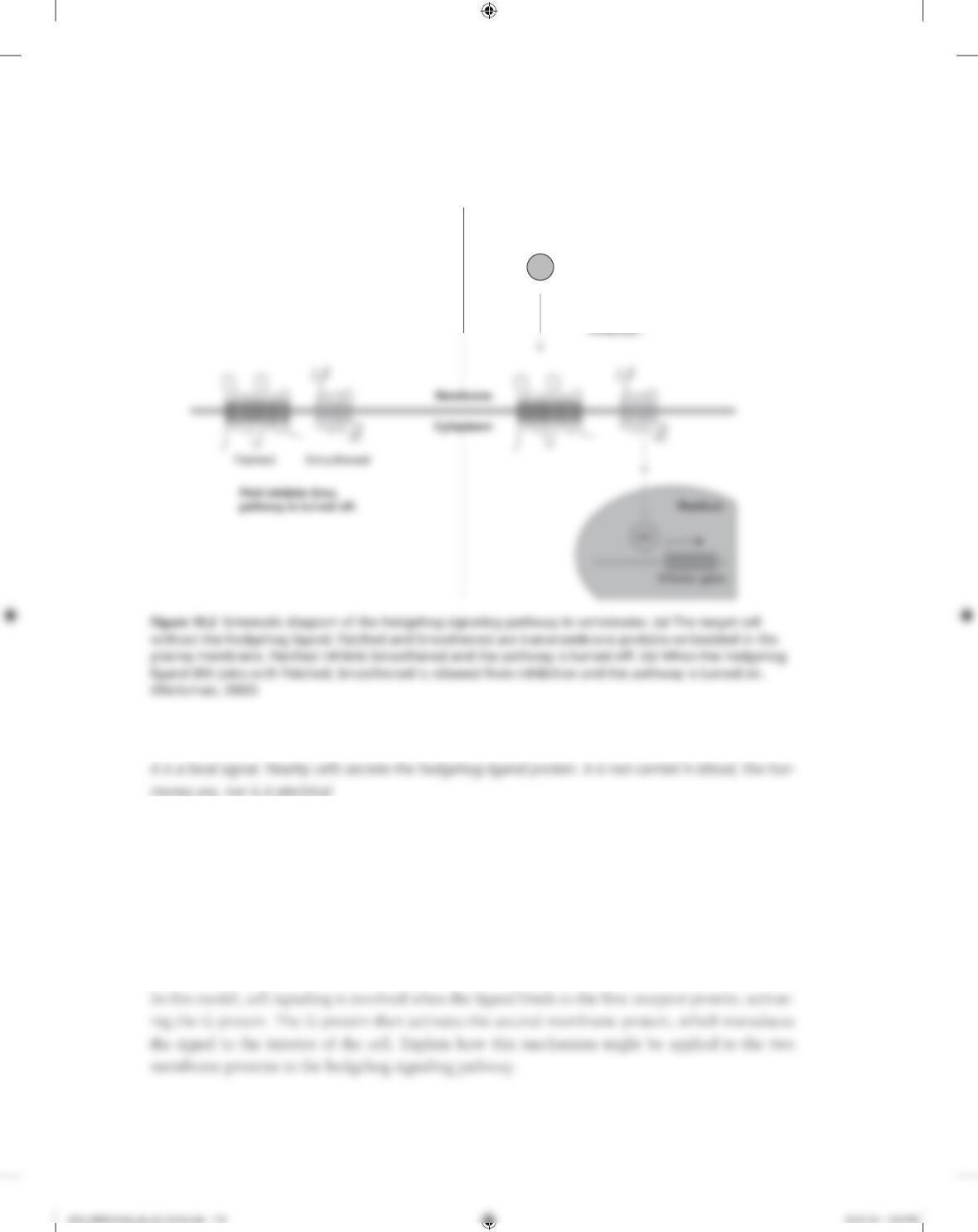
When Shh binds at Ptch,
Smo is released from
Hedgehog ligand
(a) (b)
Shh
5. Is the hedgehog signaling pathway a local or long-distance type of signaling? Explain.
6. Examine Figure 10.2 and identify which molecules are involved in reception, transduction, and
response in the hedgehog pathway.
PtchandSmoareinvolvedinreceptionofthehedgehogsignal.Glimoleculesareinvolvedintransduc–
tion.Responseiscarriedoutbytheeffectorgene.
7. The mechanism of the activation of Smo by the hedgehog ligand binding to Ptch is not completely
understood. However, the model shown in Figure 11.12 in the text shows a pathway with two
membrane proteins, similar to the arrangement of membrane proteins in the hedgehog pathway.
8. As scientists evaluate new data, they frequently have to revise their models. Because we know that
Ptch is an inhibitor of Smo and G protein is not involved, revise the model in Figure 11.12 to
incorporate this new information.
BecauseSmocanbecomeactivewhenPtchisdisabledbymutation,itsuggeststhatthemechanism
9. Cyclopamine is a known antagonist of Smo. Describe how cyclopamine reduces the number of
BCCs in UV-irradiated mice.
Smoactivatestheinteracellularcomponentsofthehedgehogpathwayresultingintranscriptionand
subsequentcelldivision.Itdoesthiswhenhedgehogispresentorwhenstchisabsentormutated.
10. Explain how a failure to have cell division occurs at a critical time during development could lead
to lambs with one eye. See Section 18.4 on critical events in the development of left-right sym-
metry and body plan.
The hedgehog genes help determine left-right symmetry and the body plan. A failure of the
CHaPter 10: Shh: Silencing the Hedgehog Pathway b 171

II. Phylogenetics of the Hedgehog Gene Family
Nobel Prize researchers Christiane NüssleinVolhard and Eric Wieschaus investigated fruity mutations in
Homologous hedgehog genes were later discovered in vertebrates. After these genes were sequenced
in several different kinds of animals, they were compared and used to determine phylogenetic related-
ness. If you have not yet studied phylogenetic classification, you may want to read Chapter 26 before
completing this investigation. Consider the phylogram in Figure 26.12 in your text as you answer the fol-
lowing questions.
1. What species is used as the outgroup for the hedgehog gene in this phylogram? Provide a reason for
using this species.
Thefruity,Drosophila,hasthehedgehoggeneandmakesagoodoutgroupbecausethisgenusis
2. What does the phylogram tell us about the hedgehog gene in mammals and birds as compared to the
hedgehog gene in mammals and amphibians?
Consider the ultrametric tree in Figure 26.13 in your text as you answer the following questions.
3. Does this ultrametric tree provide information about the rate of change in the hedgehog gene for
these animal groups? If not, what information can be inferred from this tree?
4. List all the pairs of animal groups that share a more recent common ancestor than humans and
birds.
5. How could phylogenetic and ultrametric trees help inform researchers interested in designing ex-
periments to study the hedgehog pathway?
Inadditiontotheirvalueinevolutionarybiology,comparativegenomicstudiesconfirmtherelevance
172 a BIoloGICal InquIry: A Workbook of Investigative Cases
M10_REEC4164_04_IE_CH10.indd 172 24/01/14 7:22 PM

After viewing the hedgehog phylogram in Figure 26.12, two researchers decide to look more closely
at the relationship between hedgehog proteins found in animals. They obtain sequence information from
The following amino acid sequences were produced from a conserved region of a gene in the hedge-
hog family of genes.
Scorpion Hh DGPHAINSLH YEGRAVDITT SDRDRSKYGM LARLAVDAGF DWVYYESRAH IHCSVKSESA
Human Shh DGHHSEESLH YEGRAVDITT SDRDRSKYGM LARLAVEAGF DWVYYESKAH IHCSVKAENS
Octopus Hh QGHHAPTSLH YEGRAVDITT SDRVRSRYGM LARLAVEAGF DWVYYESRSH IHCSVRSDSL
Chicken Shh DGHHSEESLH YEGRAVDITT SDRDRSKYGM LARLAVEAGF DWVYYESKAH IHCSVKAENS
6. Which of these organisms are invertebrates and to what phylum does each belong?
7. Which are vertebrates and to what class does each belong?
Thevertebratesarethechicken,abird(Aves),andthehuman,amammal.
8. Based on the preceding limited amino acid sequences, which animal has the hedgehog protein
most like the one in the human?
9. Which organism has the most differences in the amino acid sequence compared to the human
hedgehog protein sequence?
10. Would you have predicted the answers to questions 8 and 9? Why or why not?
Wethinkmostlearnerswouldbeabletomakethisprediction.Ifthegeneishomologous,onewould
III. Critical Reading: Stem Cells and Gene Expression
Chapters 18 and 20 explore the basic question of how cells with the same DNA can become different cell
types. Cell biologists cite differential gene expression in cells as the explanation. They are working with
stem cells to better understand the regulation of gene expression in both developing and adult organisms.
CHaPter 10: Shh: Silencing the Hedgehog Pathway b 173
M10_REEC4164_04_IE_CH10.indd 173 24/01/14 7:22 PM
1. Specify the location of a cell in your body that:
a. contains genetic information on eye color and the production of insulin.
Open—cellsanywhereinthebody
Over the last century, cell determination in the developing embryo has been closely observed. New meth-
ods and tools enable modern scientists to probe this process at the molecular level.
2. What is the molecular definition of determination?
3. What molecules provide the earliest evidence that a cell is committed to a particular cell fate?
4. What are the major differences between stem cells found in embryonic tissue and those found in
adult tissues?
Embryonicorfetalstemcellsaretotipotent,i.e.,arebelievedtobeabletogiverisetoallkindsofcells.
Adultstemcellsarepluripotent,thatis,arerestrictedtothekindsofcellstheycanbecome.
174 a BIoloGICal InquIry: A Workbook of Investigative Cases
M10_REEC4164_04_IE_CH10.indd 174 24/01/14 7:22 PM
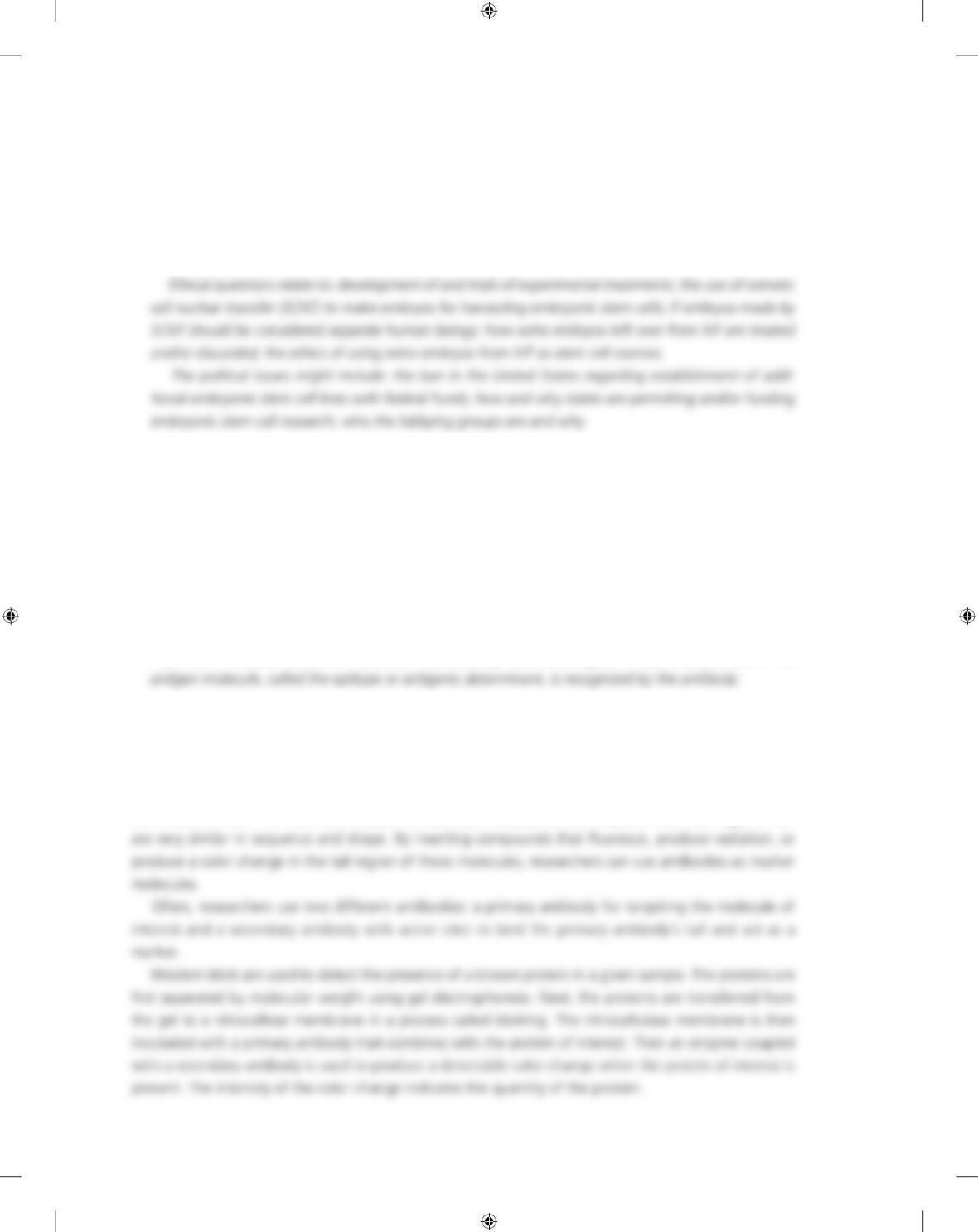
Current research with adult stem cells has provided some unexpected results (Figure 10.3).
5. To what kinds of cells can adult bone marrow cells give rise?
Bone,cartilage,fat,muscle,nervoustissue,blood,andtheliningsofbloodvessels.
6. Describe why human adult stem cells from bone marrow are used to treat patients who have
undergone radiation treatments.
7. Provide an example of how treatment with cultured embryonic stem cells could be used to supply
cells for the repair of damaged or diseased organs in human patients.
CHaPter 10: Shh: Silencing the Hedgehog Pathway b 175
Mouse adult stem cells are
injected into the muscle of
the damaged left ventricular
wall of the mouse heart.
Adult stem cells
Stem cells help
regenerate
damaged
heart muscle.
176 a BIoloGICal InquIry: A Workbook of Investigative Cases
8. Use of adult stem cells is well accepted; however, these cells have limited use as donor cells. Human
embryonic stem cells have greater potential uses in a wider variety of tissues; however, the use of
embryonic stem cells raises ethical and political issues. Identify two concerns an individual might
have with the use of embryonic stem cells.
Therearemanyissuesstudentscanraisehere:
IV. Investigating the Hedgehog Pathway: Antibodies as Research Tools
Scientists ingeniously design research tools based on invivo processes of biological systems. For example,
PCR is a technique utilizing the enzyme DNA polymerase to initiate the synthesis of a minuscule DNA
sample. Likewise, Western blots and immunohistochemistry are techniques utilizing the highly specific
binding of antibodies with target molecules to act as molecular probes in cells and tissues.
1. Explain how an antibody is able to recognize a specific antigen. (Include an explanation of an
epitope in your answer.)
Thereisamolecularinteractionbetweentheantibodyandtheantigen.Averysmallportionofthe
antibody techniques
Antibodies can be used to find, bind, and tag a specific molecule of interest. Antibodies are Y-shaped
molecules, with the tips of the Y containing unique amino acid sequences that bind the antigen. These
variable portions of antibody molecules convey the high specificity for a target molecule. The large
tail or base of the Y is much less variable. In fact, all antibodies within a species have tail regions that
M10_REEC4164_04_IE_CH10.indd 176 24/01/14 7:22 PM

2. Briey describe what you can learn about a target protein by using each of these two techniques.
Westernblotsallowyoutodetectwhetheraspecificproteinispresentinasample.
Immunohistochemistryallowsyoutoseewhereintheorganismorcelltheproteinispresent.
In 1996, it was discovered that a mutation in the Patched gene in the hedgehog pathway was
3. Refer to the hedgehog pathway diagram (Figure 10.2) and explain what happens when the Patched
protein is nonfunctional.
Normally,PatchedinhibitsSmoothened.WithoutafunctionalPatchedprotein,theSmoothenedprotein
4. How could this lead to cancer?
Thebasalcellsareuncontrolled.Abnormaltranscriptionandcelldivisionresult.
As soon as the hedgehog pathway was implicated, researchers began looking at inhibitors that might
5. If you were asked to test this hypothesis, which technique do you think would be more useful—
Western blots or immunohistochemistry? Explain your choice.
TheimmunohistochemistrytechniqueisagoodwaytodetectShhinsideandoutsideofcells,notjust
confirmitspresence.
The following experiment was designed to test the effect of cyclopamine on Shh secretion:
Chick embryos in embryonic Day 3 (cells known to secrete Shh) are divided into cyclopamine-
CHaPter 10: Shh: Silencing the Hedgehog Pathway b 177
M10_REEC4164_04_IE_CH10.indd 177 24/01/14 7:22 PM
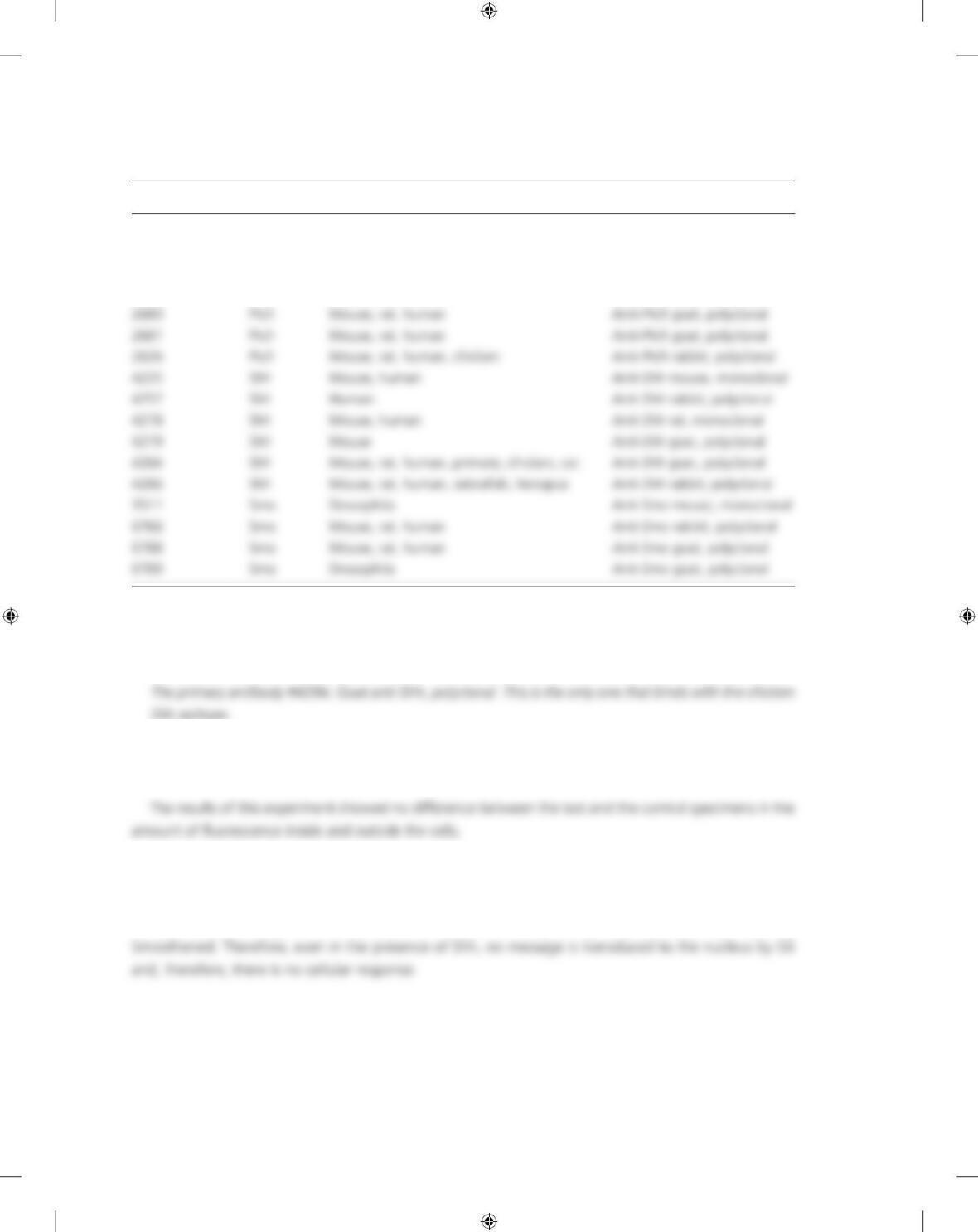
table 10.2 antibodies for Hedgehog Proteins.
order number Protein tissue specificity antibody type and source
1223 Hh Drosophila Anti-Hh goat, polyclonal
1224 Hh Drosophila Anti-Hh rabbit, polyclonal
2011 Ptc Drosophila Anti-Ptc goat, polyclonal
2624 Ptch Mouse, rat, human, chicken Anti-Ptch rabbit, polyclonal
Based on a page from a research supply company catalog.
6. Consider the antibodies for hedgehog proteins listed in Table 10.2. Which one of these primary
antibodies would you choose for the experiment described earlier? Why?
7. The secondary antibody includes a uorescent marker in its tail region. Why?
ToshowwheretheShhproteinislocated.
8. What can you conclude from these results?
Inthisexperiment,cyclopaminedoesnotappeartoinhibitShhsecretion.
New evidence suggests that cyclopamine’s effect on the pathway may be caused by inhibiting
178 a BIoloGICal InquIry: A Workbook of Investigative Cases
M10_REEC4164_04_IE_CH10.indd 178 24/01/14 7:22 PM

9. Consider the use of cyclopamine as a chemotherapeutic agent in cases of spontaneous BCC.
Researchers discovered that this cancer results from a mutation of Patched. If cyclopamine was
approved for human use, would you recommend it for these cases of BCC? Why or why not?
suggested answers for additional Investigations
V. Open-Ended Investigations
To learn more about the hedgehog pathway, you could explore the Hedgehog Pathway Signaling Data-
base (Ramirez-Weber, 2006), which contains relevant information, images, and references to research
articles. You may wish to form a group to develop a proposal for a new investigation. For example:
• Exploreaknownhedgehogpathwayantagonistotherthancyclopamine.
How does this antagonist disrupt the pathway?
References
Anonymous. 2006. Stem Cell Basics: What are the potential uses of human stem cells and the obstacles
that must be overcome before these potential uses will be realized? In Stem Cell Information [World
2002. http://www.genesdev.org/cgi/content/full/16/21/2743 (Last accessed 8 April, 2013).
Johnson, R. L., A. L. Rothman, J. Xie, L. V. Goodrich, J. W. Bare, J. M. Bonifas, A. G. Quinn, R. M. Myers,
1996.
CHaPter 10: Shh: Silencing the Hedgehog Pathway b 179
M10_REEC4164_04_IE_CH10.indd 179 24/01/14 7:22 PM

Matlack, David. June 2007. Private communication regarding the use of immunohistochemistry and anti-
bodies, June 2007.
Matlack, D., P. Pape-Lindstrom, and S. Webb. 2006. Hedgehog-emony: BioQUEST Complex Data Sets
Workshop Project. http://bioquest.org/summer2006/workshop_forms/project_template.php?project_id=251
180 a BIoloGICal InquIry: A Workbook of Investigative Cases