Page 12 8B14M026
• Prahalad and Hart 69 – Firms can “do well and do good” at the same time by creating buying power
and increasing the earning levels of those who are living in poverty.
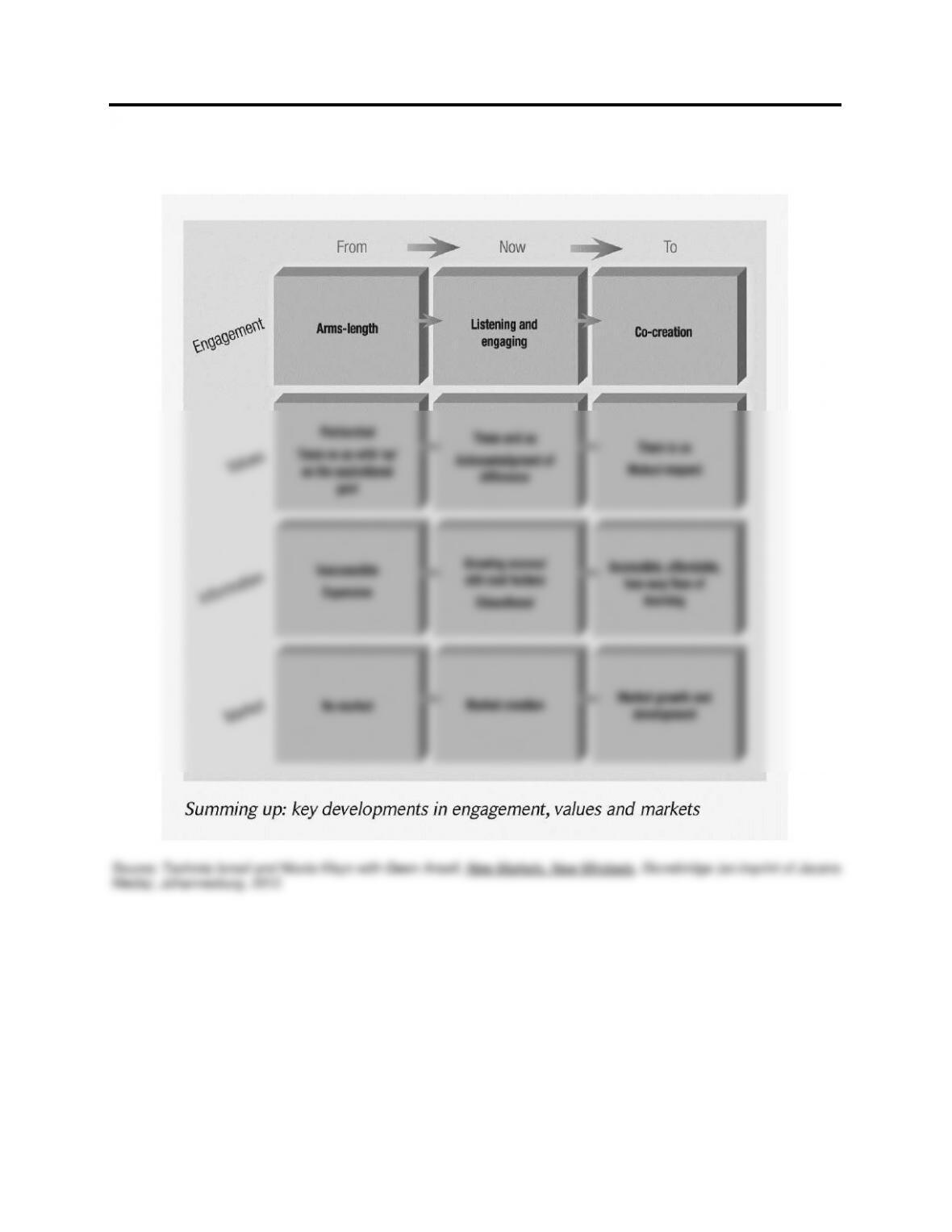
Finally, on the far left of the scale in terms of the role of business in society is the proposition of a social
business, described by proponent Mohammed Yunus as “a cause-driven business” and “a company
RESOURCES
The Brewing Industry:
The world’s four biggest brewers — Belgium-based Anheuser-Busch InBev (AB-InBev), London-based
SABMiller, the Dutch brewer Heineken and Denmark’s Carlsberg — now account for more than half the
global market for beer.
REFERENCES
• Keith Campbell, “Natural Resources Continue to Drive Mozambican Economy and Attract Foreign
Page 13 8B14M026
Page 14 8B14M026
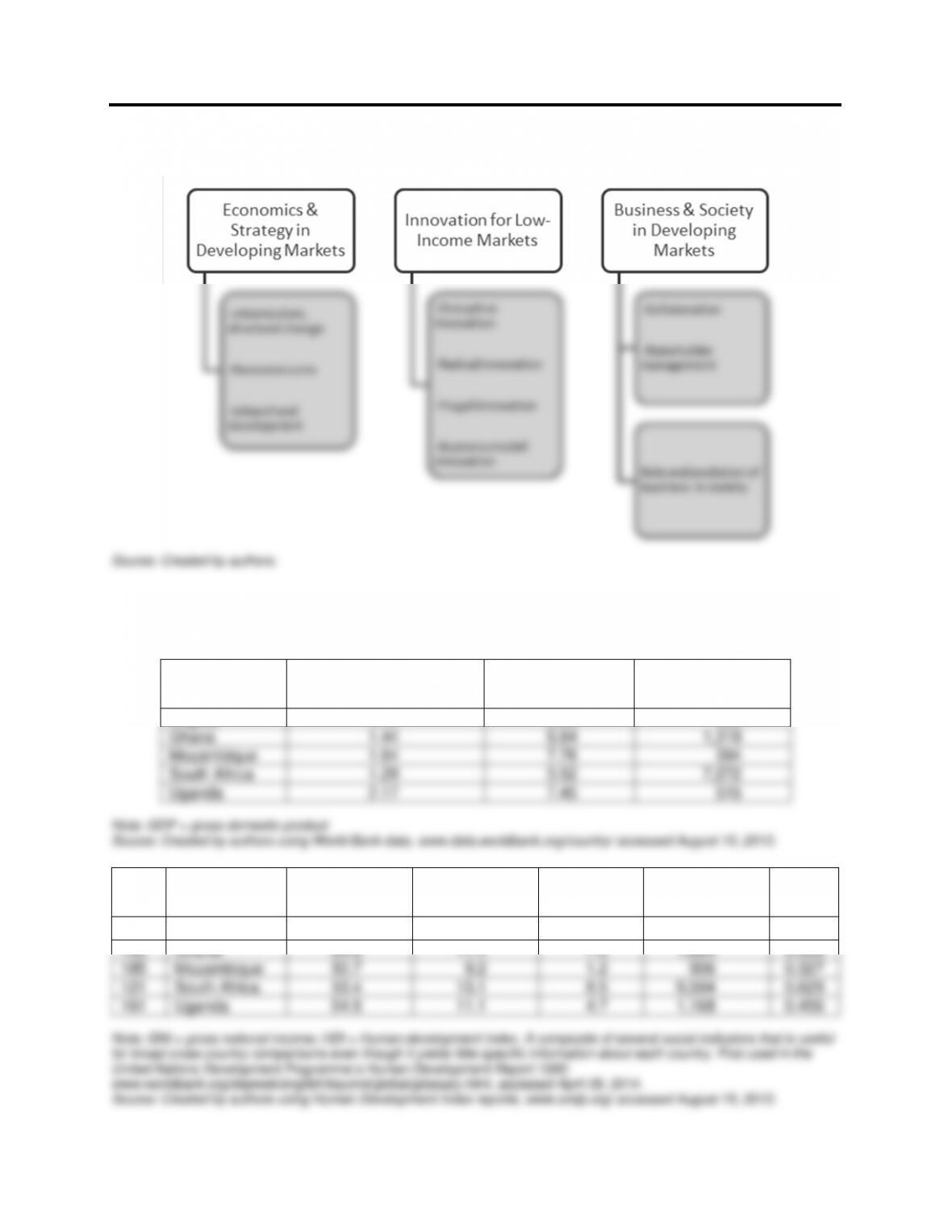
EXHIBIT TN-1: FRAMEWORK OF CASE THEMES
EXHIBIT TN-2: MACROECONOMIC INDICATORS FOR POVERY AND GROWTH IN SELECT
AFRICAN ECONOMIES
Country
Percentage of Population
Leaving Poverty Each Year
(%) (2010 estimated)
Annual Real GDP
Growth (%) (2000–
2010)
Per Capita GDP (U.S.
dollars) (2010)
Angola
1.76
8.38
320
Ghana
1.44
5.84
1,319
Mozambique
1.64
7.76
394
South Africa
1.29
3.52
7,272
Uganda
2.17
7.45
515
HDI
Rank
Country
Life Expectancy
at Birth (2012)
Expected Years
of Schooling
(2012)
Mean Years
of Schooling
(2012)
GNI Per Capita
in 2005 PPP$
(2012)
HDI
Value
(2012)
148
Angola
51.5
10.2
4.7
4,812
0.508
135
Ghana
64.6
11.4
7.0
1,684
0.558
185
Mozambique
50.7
9.2
1.2
906
0.327
121
South Africa
53.4
13.1
8.5
9,594
0.629
161
Uganda
54.5
11.1
4.7
1,168
0.456
Page 15 8B14M026
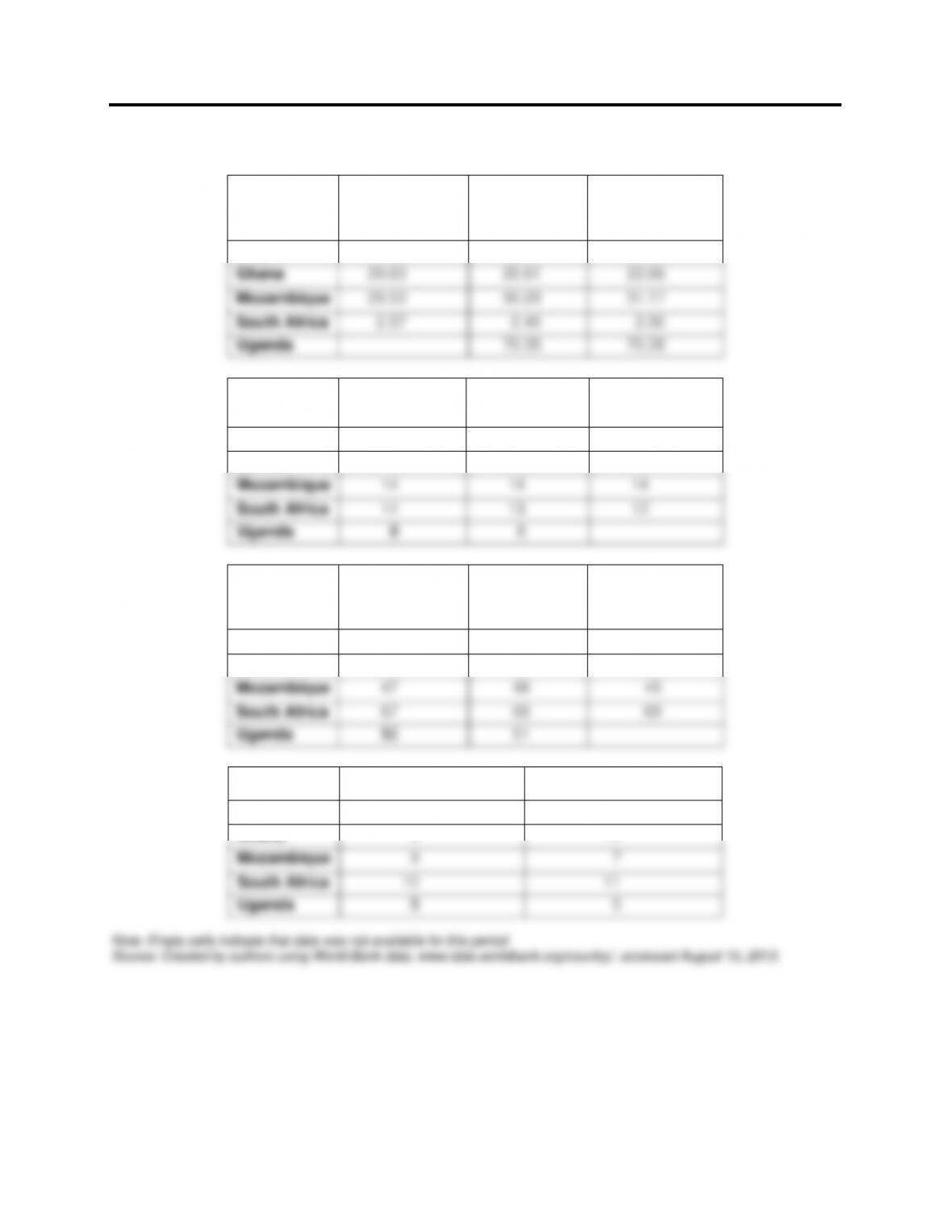
EXHIBIT TN-2 (CONTINUED)
Country
Agriculture,
Value Added (%
of GDP) 2010
Agriculture,
Value added
(% of GDP)
2011
Agriculture, value
Added (% of
GDP) 2012
Angola
9.84
9.29
10.0
Ghana
29.63
25.61
22.66
Mozambique
29.53
30.29
31.17
South Africa
2.57
2.46
2.56
Uganda
70.38
70.38
Country
Manufacturing,
Value Added (%
of GDP) 2010
Manufacturing ,
Value Added (%
of GDP) 2011
Manufacturing,
Value Added (%
of GDP) 2012
Angola
6
6
6
Ghana
7
7
7
Mozambique
14
14
14
South Africa
14
13
12
Uganda
8
8
Country
Services, Value
Added (% of
GDP) 2010
Services,
Value Added
(% of GDP)
2011
Services, Value
Added (% of
GDP) 2012
Angola
30
28
30
Ghana
51
48
50
Mozambique
47
46
45
South Africa
67
68
69
Uganda
50
51
Country
Total Natural Resources
Rents (% of GDP) 2010
Total Natural Resources
Rents (% of GDP) 2011
Angola
50
47
Ghana
9
14
Mozambique
9
7
South Africa
10
11
Uganda
5
5
Note: Empty cells indicate that data was not available for this period
Source: Created by authors using World Bank data, www.data.worldbank.org/country/, accessed August 15, 2013.
Page 16 8B14M026
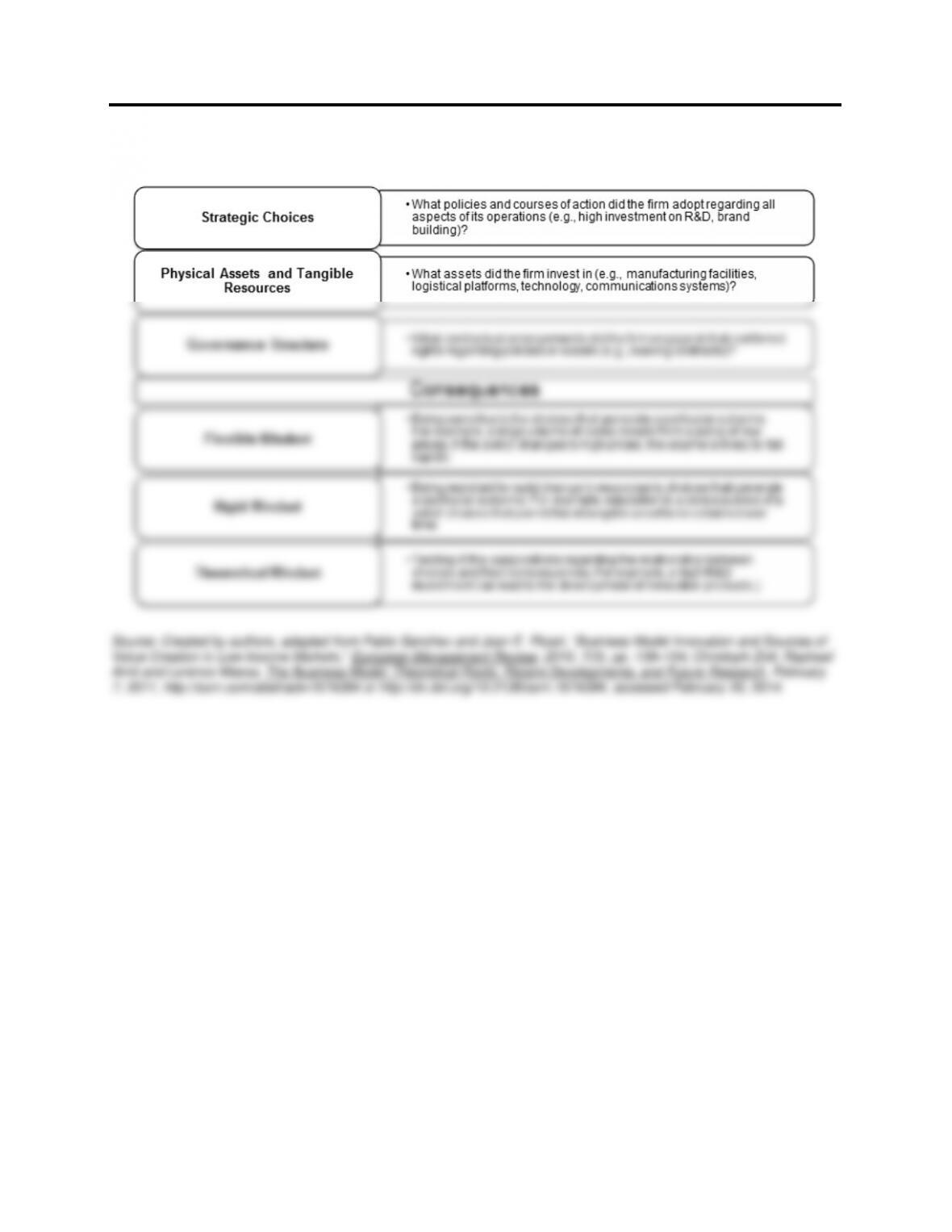
EXHIBIT TN-3: BUSINESS MODEL FRAMEWORK
Page 17 8B14M026
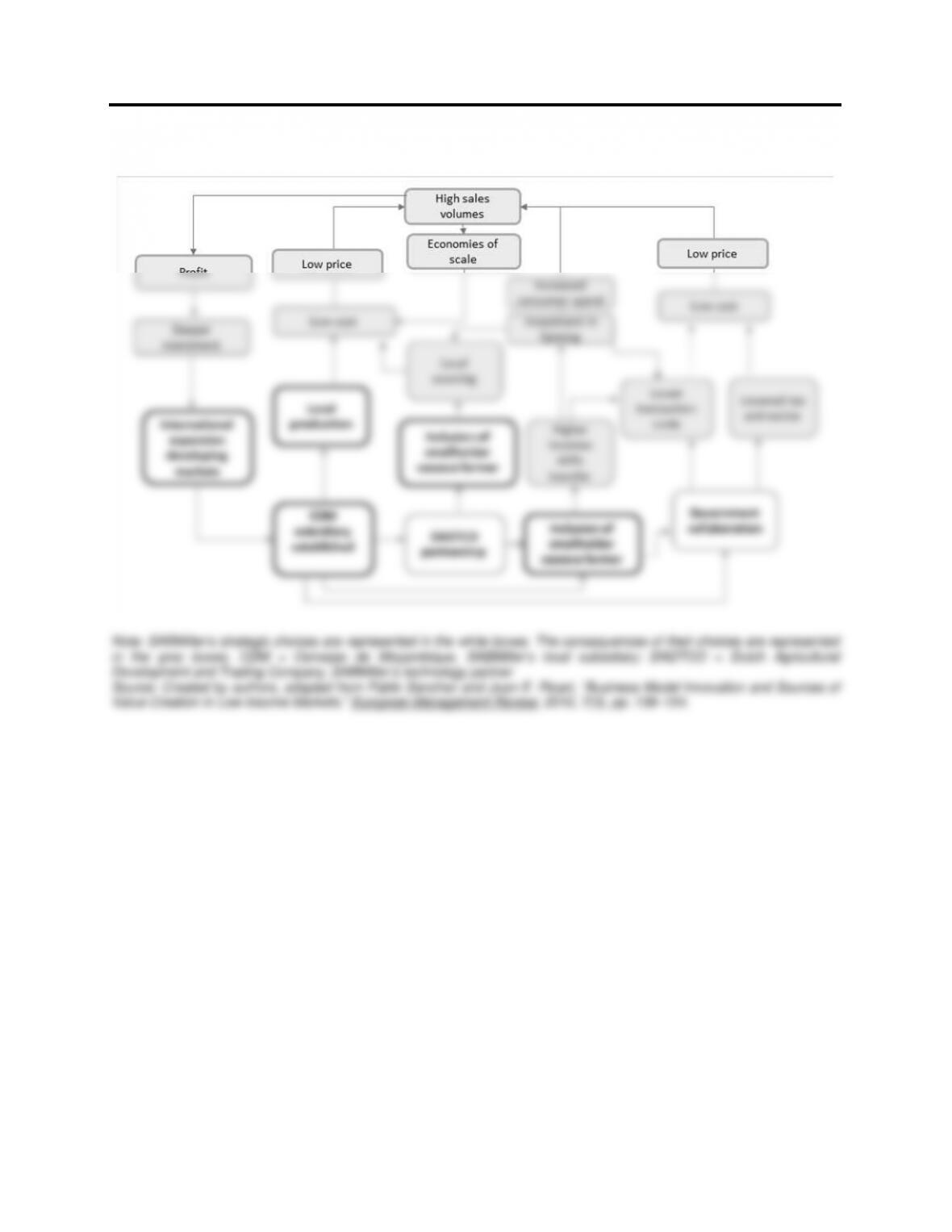
EXHIBIT TN-4: SABMILLER’S STRATEGIC CHOICES FOR IMPALA BEER IN MOZAMBIQUE
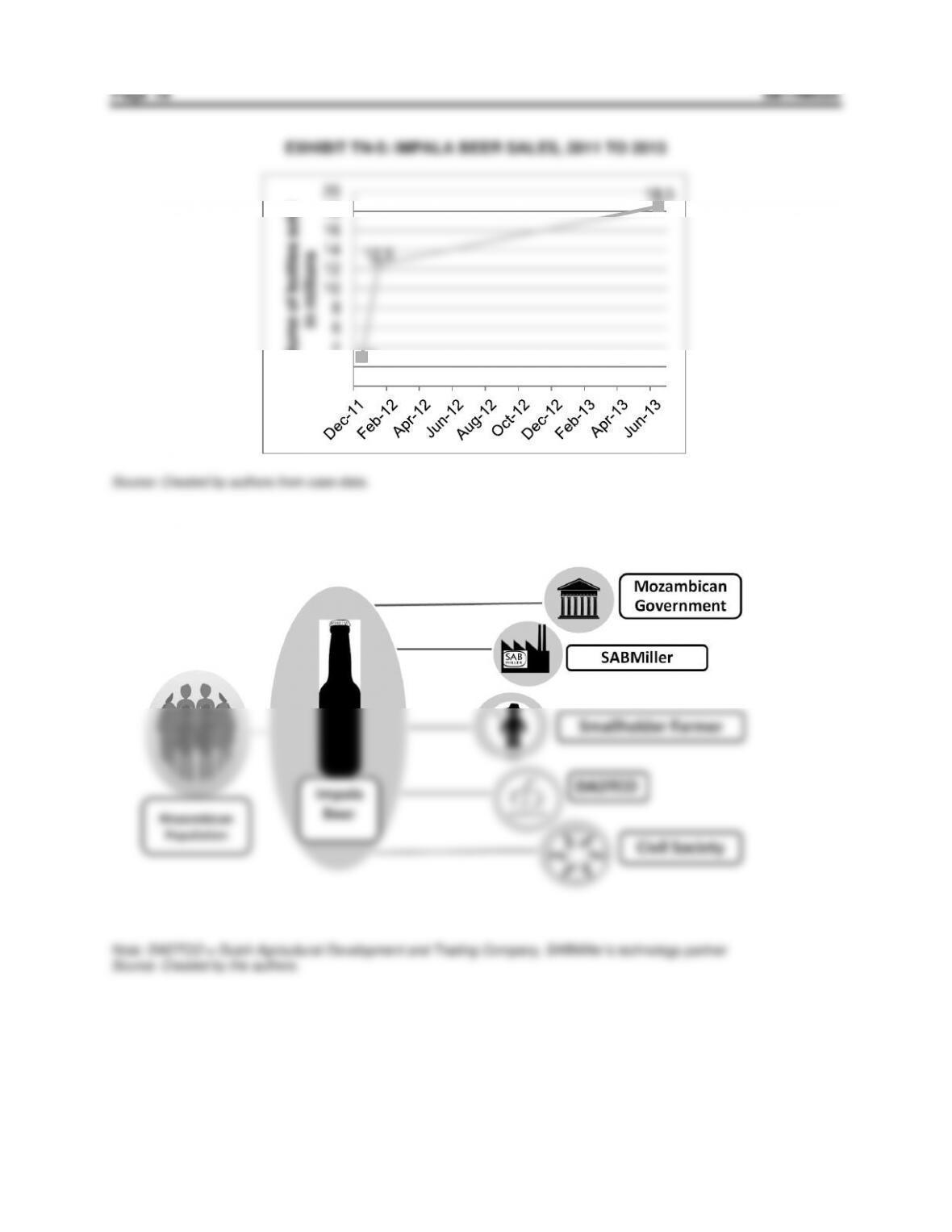
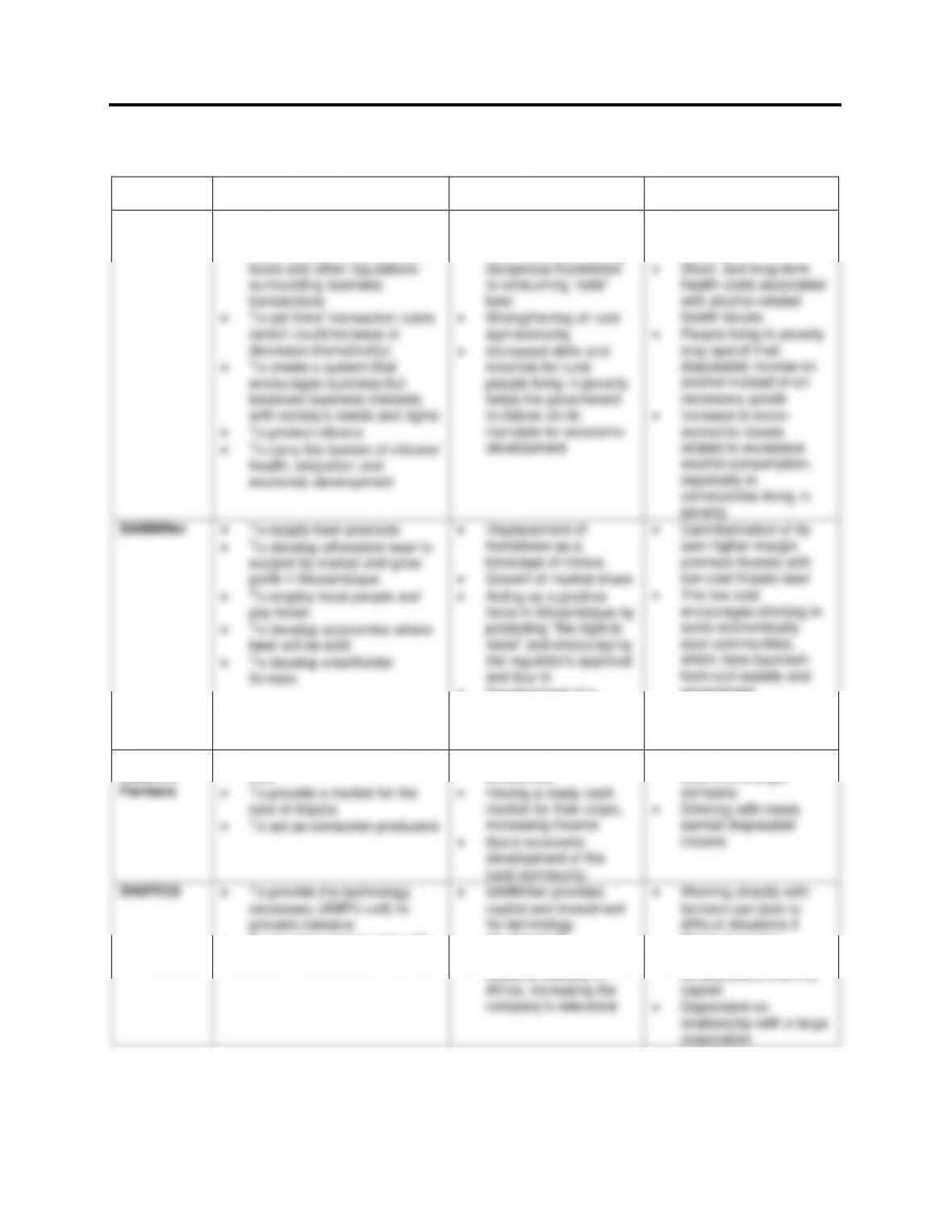
EXHIBIT TN-6: STAKEHOLDERS OF IMPALA BEER IN MOZAMBIQUE
Page 19 8B14M026
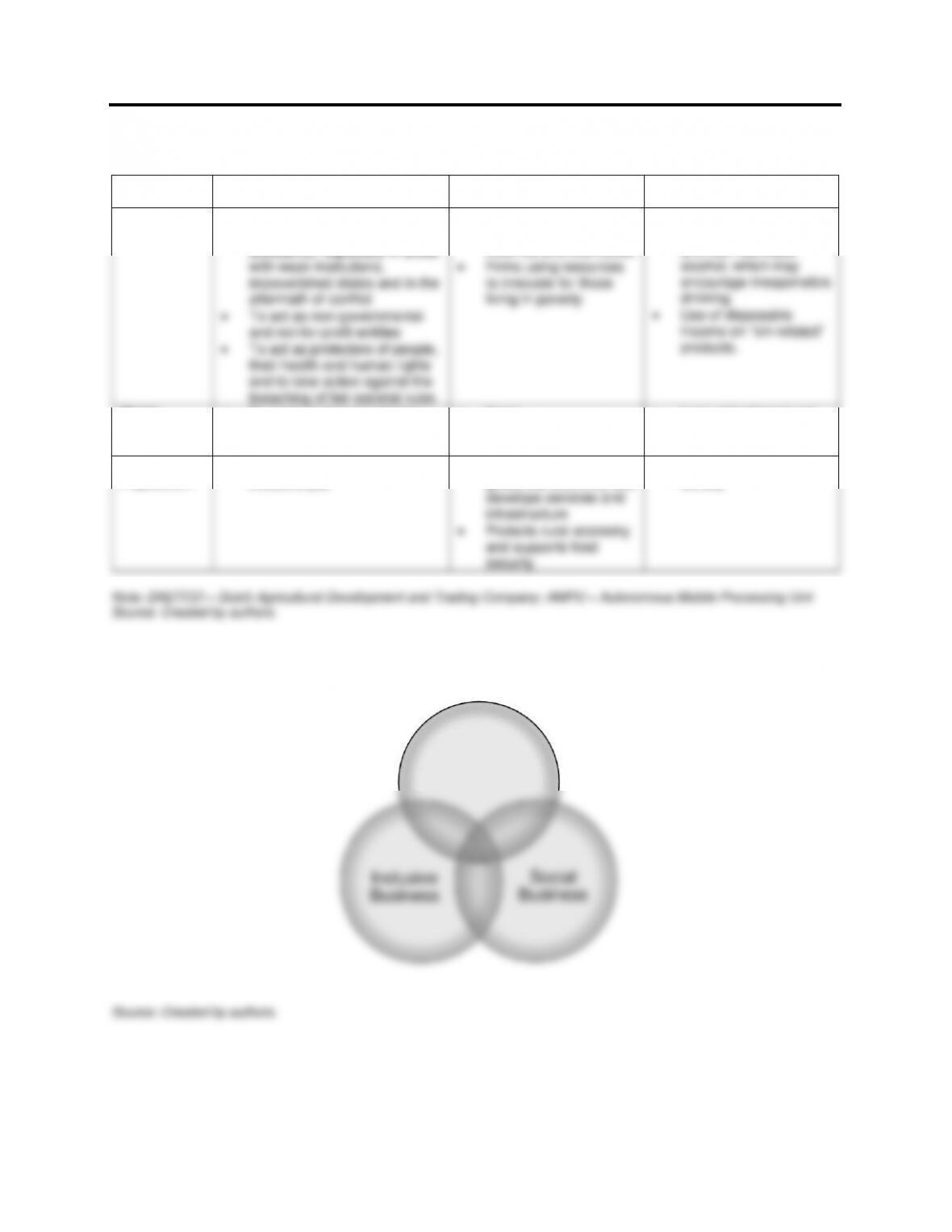
EXHIBIT TN-7: KEY POINTS FOR CLASS DISCUSSION ON STAKEHOLDER ANALYSIS
Stakeholder
Roles
The Upsides of Success
The Downsides of
Success
Mozambican
Government
• To permit the ability to conduct
business in Mozambique
• To control excises, customs,
taxes and other regulations
surrounding business
transactions
• To set firms’ transaction costs
(which could increase or
decrease dramatically)
• To create a system that
encourages business but
balances business interests
with society’s needs and rights
• To protect citizens
• To carry the burden of citizens’
health, education and
economic development
• Increase in tax revenue
• People living in poverty
move from consuming
dangerous homebrew
to consuming “safe”
beer
• Strengthening of rural
agri-economy
• Increased skills and
incomes for rural
people living in poverty
helps the government
to deliver on its
mandate for economic
development
• Cheap alcohol may
encourage irresponsible
drinking
• Short- and long-term
health costs associated
with alcohol-related
health issues
• People living in poverty
may spend their
disposable income on
alcohol instead of on
necessary goods
• Increase in socio-
economic issues
related to excessive
alcohol consumption,
especially in
communities living in
poverty
SABMiller
• To supply beer products
• To develop affordable beer to
expand its market and grow
profit in Mozambique
• To employ local people and
pay taxes
• To develop economies where
beer will be sold
• To develop smallholder
farmers
• Displacement of
homebrew as a
beverage of choice
• Growth of market share
• Acting as a positive
force in Mozambique by
protecting “the right to
trade” and encouraging
the regulator’s approval
and buy-in
• Development of a
transplantable business
model for other
developing economies
• Cannibalization of its
own higher-margin
premium brands with
low-cost Impala beer
• The low cost
encourages drinking in
socio-economically
poor communities,
which risks backlash
from civil society and
government
• Loss of “the right to
trade”
Smallholder
Cassava
Farmers
• To supply the input for Impala
beer
• To provide a market for the
sale of Impala
• To act as consumer-producers
• Development of farming
efficiencies
• Having a ready cash
market for their crops,
increasing income
• Socio-economic
development of the
rural community
• Dependency on the
whims of a single
company
• Drinking with newly
earned disposable
income
DADTCO
• To provide the technology
necessary (AMPU unit) to
process cassava
• To develop relationships with
farmers
• SABMiller provides
capital and investment
for technology
development
• Development of the
cassava industry in
• Working directly with
farmers can lead to
difficult situations if
things go wrong
• Technology becomes
so successful that it is
Page 20 8B14M026
EXHIBIT TN-7 (CONTINUED)
Stakeholder
Roles
The Upsides of Success
The Downsides of
Success
Civil Society
• To debate global development
• To offer global development
assistance, especially in areas
with weak institutions,
impoverished states and in the
aftermath of conflict
• To act as non-governmental
and not-for-profit entities
• To act as protectors of people,
their health and human rights
and to take action against the
breaching of fair societal rules
• Transfer of skills and
development of rural
incomes and livelihoods
• Firms using resources
to innovate for those
living in poverty
• Concern over the
consumption of cheap
and well-marketed
alcohol, which may
encourage irresponsible
drinking
• Use of disposable
income on “sin-related”
products.
Home
Brewers
• To produce homemade brew
for those who cannot afford
more expensive bottled beer
• None
• Loss of livelihood and
income
Mozambican
Population
• To live and work in
Mozambique
• Increase in tax revenue
grows the economy and
develops services and
infrastructure
• Protects rural economy
and supports food
security
• As above for civil
society
EXHIBIT TN-8: FIRM POSITIONING IN LOW-INCOME MARKETS
For Profit
Page 21 8B14M026
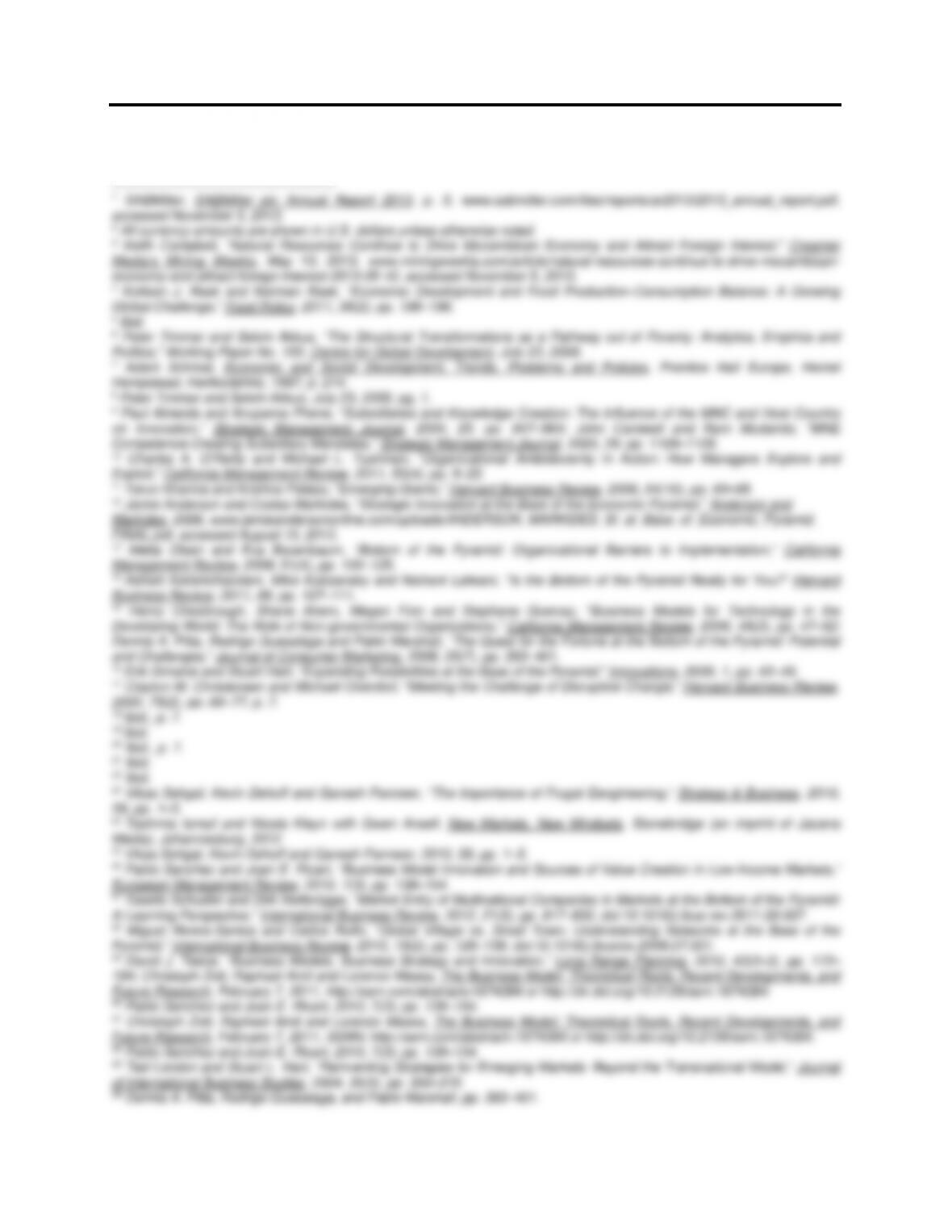
EXHIBIT TN-9: THE EVOLVING ROLE OF BUSINESS
IN LOW-INCOME MARKETS
Page 22 8B14M026
ENDNOTES
Page 23 8B14M026