Chapter 9
ANSWERS TO QUESTIONS
1. Why might a bank be willing to borrow funds from other banks at a higher rate than the rate
at which it can borrow from the Fed?
Because if the bank borrows too frequently from the Fed, the Fed may restrict its ability to
2. Rank the following bank assets from most to least liquid:
a. Commercial loans
b. Securities
3. Suppose your bank has the following balance sheet:
Assets
Liabilities
Reserves $ 50 million
Checkable deposits $200 million
Securities $ 50 million
Loans $150 million
Bank capital $ 50 million
If the required reserve ratio on deposits is 10%, what actions should the bank manager take if
there is an unexpected deposit outflow of $50 million?
The $50 million deposit outflow means that the bank will have a reserve shortfall of $15
4. Suppose your bank has the following balance sheet:
Assets
Liabilities
Rate-sensitive
$100 million
Rate-sensitive
$75 million
Fixed-rate
$100 million
Fixed-rate
$125 million
What would happen to bank profits if the interest rates in the economy go down? What actions
could you take to reduce the bank’s interest-rate risk?
The bank’s profits would go down because it has more interest-rate sensitive assets than
5. If no decent lending opportunity arises in the economy, and the central bank pays an interest
rate on reserves that is similar to other low-risk investments, do you think banks will be
willing to hold large amounts of excess reserves?
Banks should be willing to hold large amounts of excess reserves. This is exactly what
happened during the onset of the global financial crisis started in 2007. Banks were willing to
6. If the bank you own has no excess reserves and a sound customer comes in asking for a loan,
should you automatically turn the customer down, explaining that you don’t have any excess
reserves to lend out? Why or why not? What options are available that will enable you to
provide the funds your customer needs?
No. When you turn a customer down, you may lose that customer’s business forever, which
is extremely costly. Instead, you might go out and borrow from other banks, corporations, or
7. If a bank finds that its ROE is too low because it has too much bank capital, what can it do to
raise its ROE?
To lower capital and raise ROE, holding its assets constant, it can pay out more dividends or
8. If a bank is falling short of meeting its capital requirements by $1 million, what three things
can it do to rectify the situation?
It can raise $1 million of capital by issuing new stock. It can cut its dividend payments by $1
9. Why do equity holders care more about ROE than about ROA?
Because ROE, the return on equity, tells stock holders how much they are earning on their
10. If a bank doubles the amount of its capital and ROA stays constant, what will happen to
ROE?
ROE will fall in half.
11. What are the benefits and costs for a bank when it decides to increase the amount of its bank
capital?
The benefit is that the bank now has a larger cushion of bank capital and so is less likely to
12. Why is being nosy a desirable trait for a banker?
In order for a banker to reduce adverse selection she must screen out good from bad credit
restrictive loan covenants. Hence, it pays for the banker to be nosy.
13. A bank almost always insists that the firms it lends to keep compensating balances at the
bank. Why?
Compensating balances can act as collateral. They also help establish long-term customer
relationships, which make it easier for the bank to collect information about prospective
14. If the president of a bank told you that the bank was so well run that it has never had to call
in loans, sell securities, or borrow as a result of a deposit outflow, would you be willing to
buy stock in that bank? Why or why not?
No, because the bank president is not managing the bank well. The fact that the bank has never
15. “Because diversification is a desirable strategy for avoiding risk, it never makes sense for a
bank to specialize in making specific types of loans.” Is this statement true, false, or
uncertain? Explain your answer.
False. Although diversification is a desirable strategy for a bank, it may still make sense for a
bank to specialize in certain types of lending. For example, a bank may have developed
16. If you are a banker and expect interest rates to rise in the future, would you prefer to make
short-term loans or long-term loans?
You should want to make short-term loans. Then, when these loans mature, you will be able
17. “Bank managers should always seek the highest return possible on their assets.” Is this
statement true, false, or uncertain? Explain your answer.
False. If an asset has a lot of risk, a bank manager might not want to hold it even if it has a
18. After July 2010, bank customers using a debit card had to specifically opt-in to the bank’s
overdraft protection plan. Explain the effect of this regulation on a bank’s noninterest
income.
Before this regulation, customers were automatically enrolled in bank’s overdraft protection
plans. This meant that debit card transactions would be approved, even if funds were
ANSWERS TO APPLIED PROBLEMS
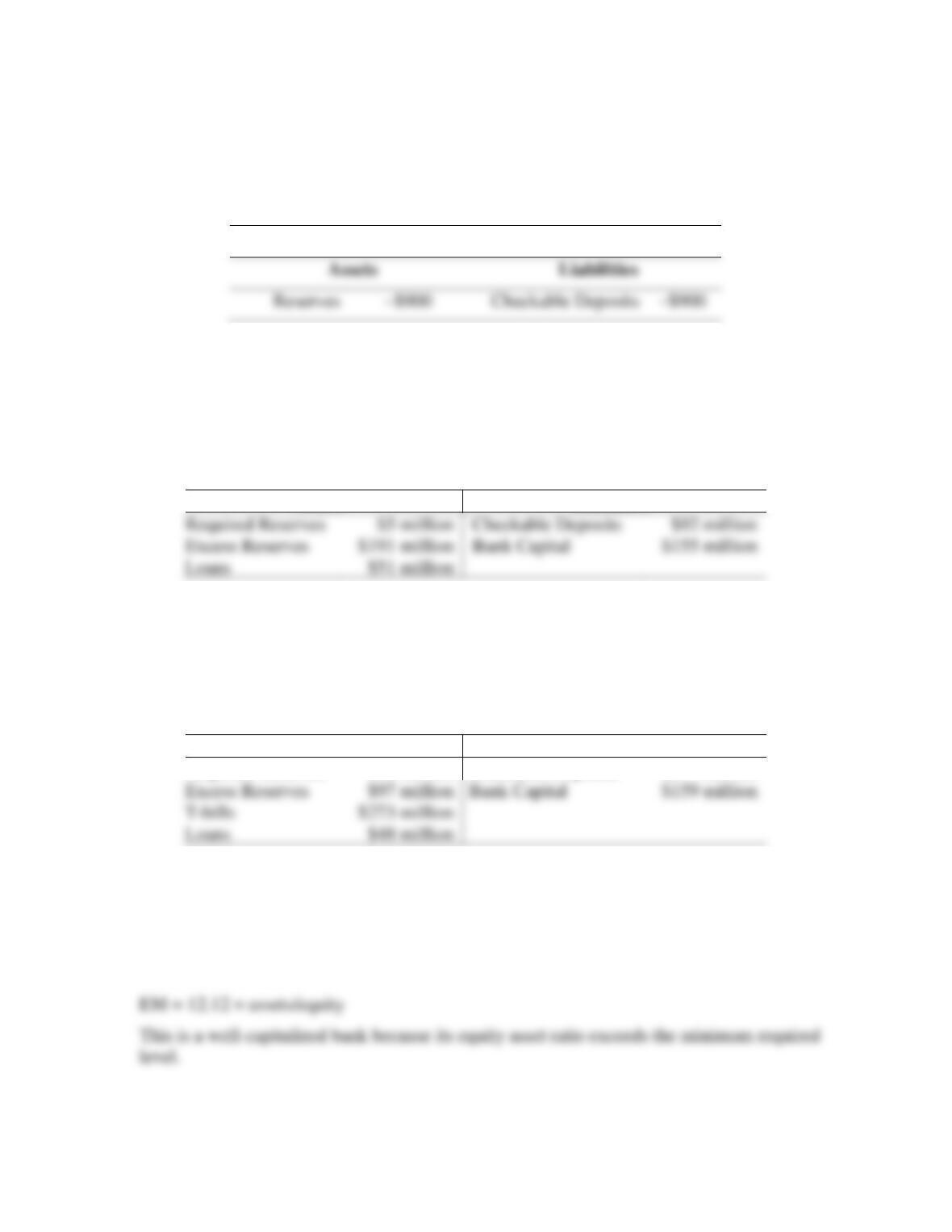
19. Using the T-accounts of the First National Bank and the Second National Bank given in this
chapter, describe what happens when Jane Brown writes a check for $90 on her account at
the First National Bank to pay her friend Joe Green, who in turn deposits the check in his
account at the Second National Bank.
The T-accounts for the two banks are as follows:
First National Bank
Assets
Liabilities
Reserves –$90
Checkable Deposits –$90
Assets
Liabilities
20. What happens to reserves at the First National Bank if one person withdraws $1,100 of cash
and another person deposits $200 of cash? Use T-accounts to explain your answer.
Reserves drop by $200. The T-account for the First National Bank is as follows:
First National Bank
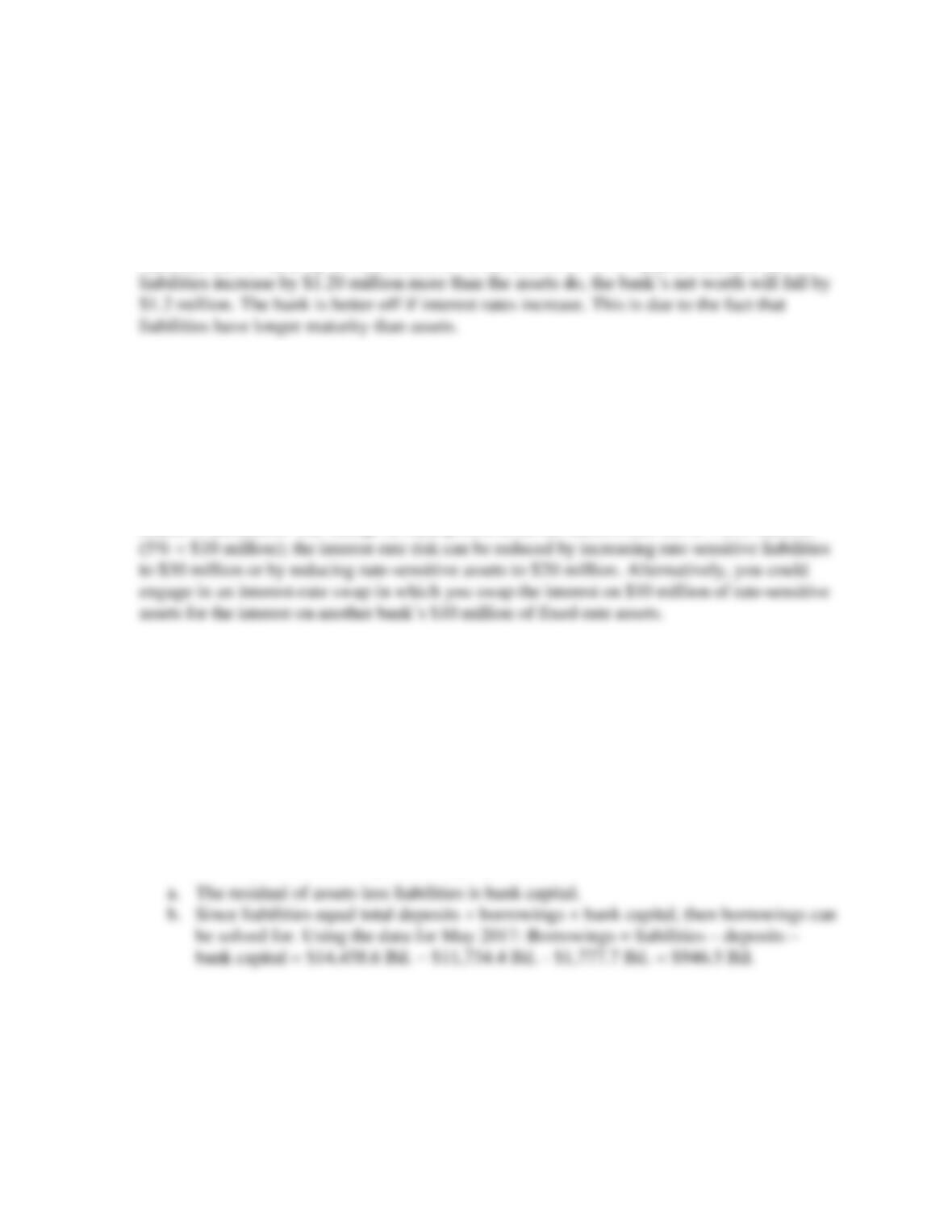
21. NewBank started its first day of operations with $155 million in capital. A total of $92
million in checkable deposits is received. The bank makes a $28 million commercial loan and
lends another $23 million in mortgage loans. If required reserves are 5.4%, what does the
bank balance sheet look like?
The NewBank balance sheet is as follows:
Assets
Liabilities
Required Reserves
Excess Reserves
$155 million
Loans
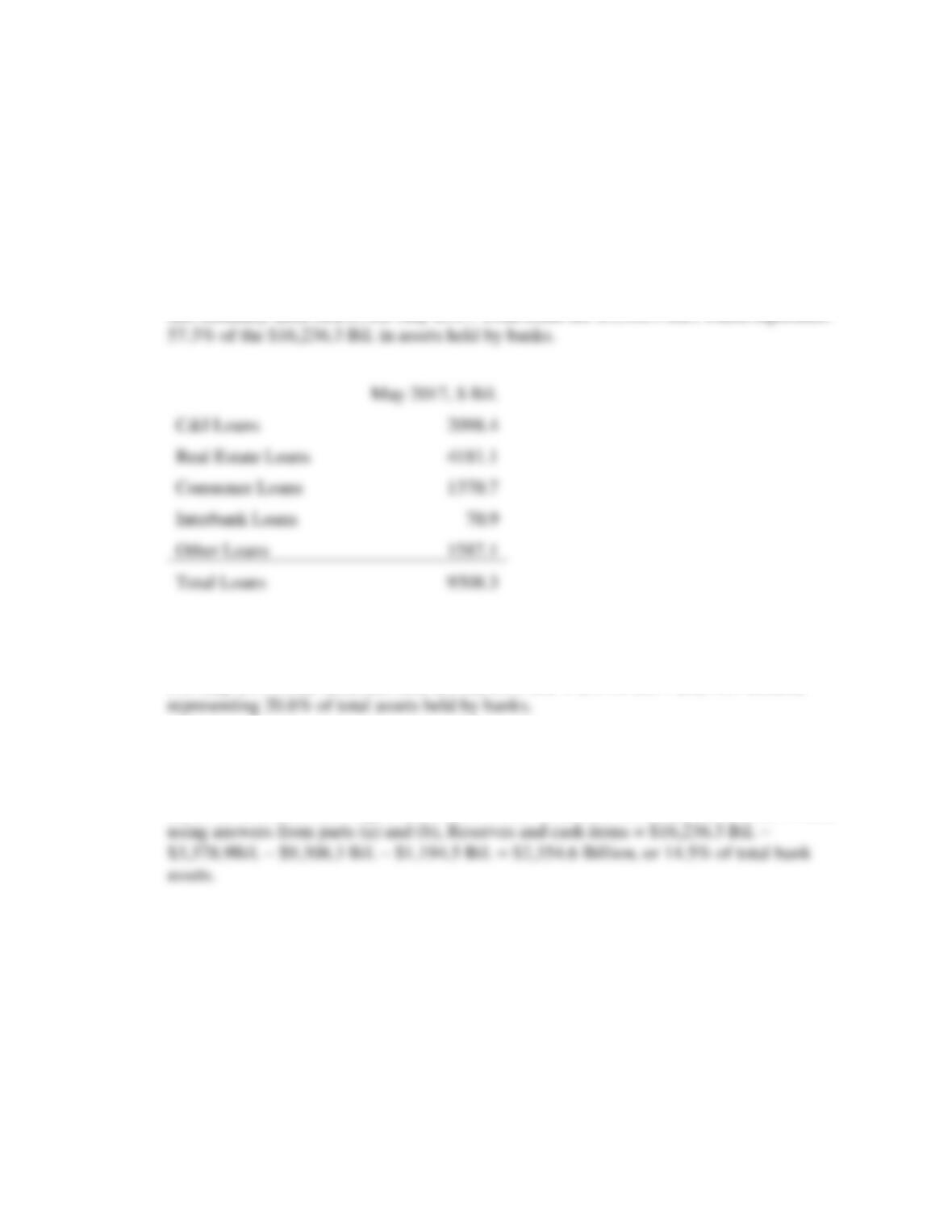
22. Suppose NewBank decides to invest $273 million in 30-day T-bills. The T-bills are currently
trading at $4,981 (including commissions) for a $4,940 face value instrument. How many T-
bills do they purchase? What does the balance sheet look like?
The bank can purchase $273 M/$4,981, which is about 54,808 T-bills. The NewBank balance
sheet is as follows:
Assets
Liabilities
Required Reserves
$18 million
Checkable Deposits
$277 million
Excess Reserves
$97 million
Bank Capital
$159 million
T-bills
Loans
$48 million
23. Axle Bank reported an ROE of 16% and an ROA of 1.32%. What is the equity multiplier?
How well capitalized is this bank?
ROE = ROA EM
0.16 = 0.0132 EM
24. Suppose you are manager of a bank whose $200 million of assets have an average duration
of five years and whose $160 million liabilities have an average duration of seven years.
Conduct a duration analysis for the bank and show what will happen to the net worth of the
bank if interest rates fall by 1%. What will happen if the rates rise by 1%? When would the
bank be better off?
The assets increase in value by $10 million (= 200 million × 1% × 5 years) while the
liabilities fall in value by $11.20 million (= $160 million × 1% × 7 years). Because the
25. Suppose you are the manager of a bank that has $15 million of fixed-rate assets, $30 million
of rate-sensitive assets, $25 million of fixed-rate liabilities, and $20 million of rate-sensitive
liabilities. Conduct a gap analysis for the bank, and show what will happen to bank profits if
interest rates rise by 5 percentage points. What actions could you take to reduce the bank’s
interest-rate risk?
The gap is $10 million ($30 million of rate-sensitive assets minus $20 million of rate-
sensitive liabilities). The change in bank profits from the interest rate rise is +$0.5 million
ANSWERS TO DATA ANALYSIS PROBLEMS
1. Go to the St. Louis Federal Reserve FRED database and find data for all commercial banks
on total liabilities (TLBACBM027SBOG), total deposits (DPSACBM027SBOG), and residual
of assets less liabilities (RALACBM027SBOG).
a. What is the balance sheet interpretation of the residual of assets less liabilities?
b. For the most recent month of data available, use the three indicators listed above to
calculate the total amount of borrowings by banks.
2. Go to the St. Louis Federal Reserve FRED database and find data for all commercial banks
on total assets (TLAACBM027SBOG), U.S. government and agency securities held
(USGSEC), other securities held (OTHSEC), commercial and industrial loans (BUSLOANS),
real estate loans (REALLN), consumer loans (CONSUMER), interbank loans
(IBLACBM027S-BOG), other loans (OLLACBM027SBOG), and other assets
(OATACBM027SBOG). Use the most recent month of data available across all indicators.
a. What is the total amount of loans held by banks? What is this number as a percentage of
total bank assets?
b. What is the total amount of securities held by banks? What is this number as a
percentage of total bank assets?
For May 2017, total securities held are $2,464.3 Bil. + $914.6 Bil = $3,378.9 Billion,
c. What is the total amount of reserves and cash items? What is this number as a percentage
of total bank assets?
Reserves and cash items equal total assets minus securities, loans, and other assets. Thus,