Chapter 8
Fundamentals of Capital Budgeting
8-1. Pisa Pizza, a seller of frozen pizza, is considering introducing a healthier version of its pizza that
will be low in cholesterol and contain no trans fats. The firm expects that sales of the new pizza
will be $19 million per year. While many of these sales will be to new customers, Pisa Pizza
estimates that 30% will come from customers who switch to the new, healthier pizza instead of
buying the original version.
a. Assume customers will spend the same amount on either version. What level of incremental
sales is associated with introducing the new pizza?
b. Suppose that 52% of the customers who will switch from Pisa Pizza’s original pizza to its
healthier pizza will switch to another brand if Pisa Pizza does not introduce a healthier
pizza. What level of incremental sales is associated with introducing the new pizza in this
case?
8-2. Kokomochi is considering the launch of an advertising campaign for its latest dessert product,
the Mini Mochi Munch. Kokomochi plans to spend $3.76 million on TV, radio, and print
advertising this year for the campaign. The ads are expected to boost sales of the Mini Mochi
Munch by $9.14 million this year and by $7.14 million next year. In addition, the company
expects that new consumers who try the Mini Mochi Munch will be more likely to try
Kokomochi’s other products. As a result, sales of other products are expected to rise by $3.35
million each year.
Kokomochi’s gross profit margin for the Mini Mochi Munch is 36%, and its gross profit margin
averages 24% for all other products. The company’s marginal corporate tax rate is 38% both
this year and next year. What are the incremental earnings associated with the advertising
campaign?
Chapter 8/Fundamentals of Capital Budgeting 113
1
2
3
4
5
6
7
8
9
10
11
12
13
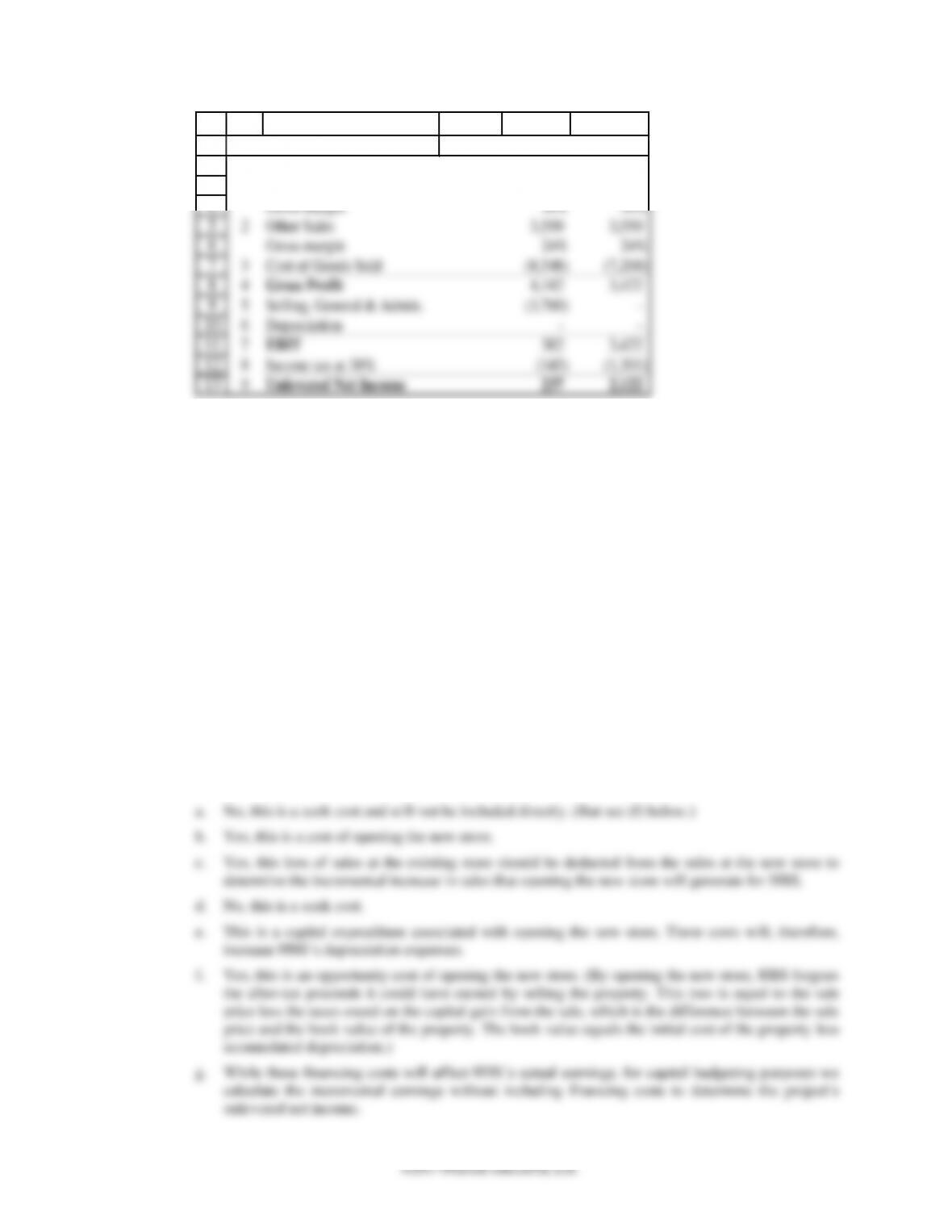
A B C D E
Year 1 2
Incremental Earnings Forecast ($000s)
1 Sales of Mini Mochi Munch 9,140 7,140
Gross margin 36% 36%
2 Other Sales 3,550 3,550
Gross margin 24% 24%
3 Cost of Goods Sold (8,548) (7,268)
4Gross Profit 4,142 3,422
5 Selling, General & Admin. (3,760) –
6 Depreciation – –
7EBIT 382 3,422
8 Income tax at 38% (145) (1,301)
9Unlevered Net Income 237 2,122
8-3. Home Builder Supply, a retailer in the home improvement industry, currently operates seven
retail outlets in Georgia and South Carolina. Management is contemplating building an eighth
retail store across town from its most successful retail outlet. The company already owns the
land for this store, which currently has an abandoned warehouse located on it. Last month, the
marketing department spent $12,000 on market research to determine the extent of customer
demand for the new store. Now Home Builder Supply must decide whether to build and open the
new store.
Which of the following should be included as part of the incremental earnings for the proposed
new retail store?
a. The cost of the land where the store will be located.
b. The cost of demolishing the abandoned warehouse and clearing the lot.
c. The loss of sales in the existing retail outlet, if customers who previously drove across town
to shop at the existing outlet become customers of the new store instead.
d. The $12,000 in market research spent to evaluate customer demand.
e. Construction costs for the new store.
f. The value of the land if sold.
g. Interest expense on the debt borrowed to pay the construction costs.
Year
0
1
2
3
4
5
Incremental Earnings Forecast ($000s)
1
Sales
–
13,000
23,371
31,304
37,208
–
2
Cost of Goods Sold
(6,000)
(9,575)
(11,384)
(12,010)
Cost of Lost Sales
(400)
(808)
(1,216)
(1,624)
–
3
Gross Profit
–
6,600
12,989
18,704
23,574
–
4
Selling, General & Admin.
–
(2,800)
(2,800)
(2,800)
(2,800)
–
5
Research & Development
(15,000)
–
–
–
–
–
6
Depreciation
–
(2,500)
(2,500)
(2,500)
–
–
7
EBIT
(15,000)
1,300
7,689
13,404
20,774
–
8
Income tax at 40%
6,000
520
3,075
5,362
8,310
–
9
Unlevered Net Income
(9,000)
780
4,613
8,043
12,464
–
8-6. Cellular Access, Inc. is a cellular telephone service provider that reported net income of $241
million for the most recent fiscal year. The firm had depreciation expenses of $128 million,
capital expenditures of $159 million, and no interest expenses. Working capital increased by $10
million. Calculate the free cash flow for Cellular Access for the most recent fiscal year.
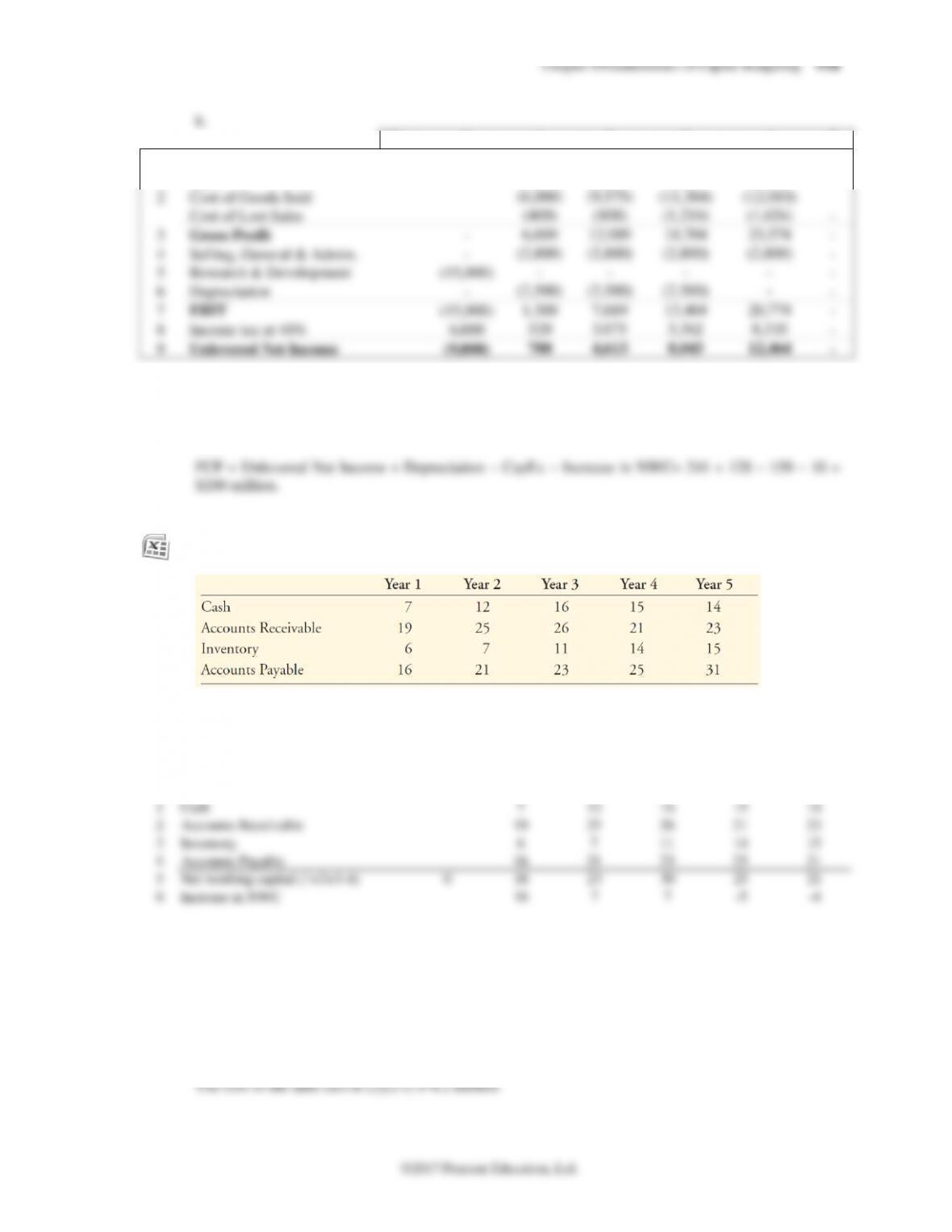
8-7. Castle View Games would like to invest in a division to develop software for video games. To
evaluate this decision, the firm first attempts to project the working capital needs for this
operation. Its chief financial officer has developed the following estimates (in millions of dollars):
Assuming that Castle View currently does not have any working capital invested in this division,
calculate the cash flows associated with changes in working capital for the first five years of this
investment.
Year0 Year1 Year2 Year3 Year4 Year5
1
Cash 7 12 16 15 14
2
Accounts Receivable 19 25 26 21 23
3
Inventory 6 7 11 14 15
4
Accounts Payable 16 21 23 25 31
5
Net working capital (1+2+3-4) 016 23 30 25 21
6
Increase in NWC 16 7 7 -5 -4
8-8. Mersey Chemicals manufactures polypropylene that it ships to its customers via tank car.
Currently, it plans to add two additional tank cars to its fleet four years from now. However, a
proposed plant expansion will require Mersey’s transport division to add these two additional
tank cars in two years’ time rather than in four years. The current cost of a tank car is $2.1
million, and this cost is expected to remain constant. Also, while tank cars will last indefinitely,
they will be depreciated straight-line over a five-year life for tax purposes. Suppose Mersey’s tax
rate is 36%. When evaluating the proposed expansion, what incremental free cash flows should
be included to account for the need to accelerate the purchase of the tank cars?
116 Berk/DeMarzo, Corporate Finance, Fourth Edition, Global Edition
©2017 Pearson Education, Ltd.
Depreciation = (4.2 million) / (5 years) = $0.84m/year
Depreciation tax shield = ($0.84)(36%) = $0.3024m/year
Initial tank car cost
2.1
Tax rate
36%
Year
2
3
4
5
6
7
8
9
10
With expansion
CapEx
-4.2
Depreciation tax shield
0.3024
0.3024
0.3024
0.3024
0.3024
FCF
–4.2
0.3024
0.3024
0.3024
0.3024
0.3024
0
0
0
Without expansion
CapEx
–4.2
Depreciation tax shield
0.3024
0.3024
0.3024
0.3024
0.3024
FCF
0
0
–4.2
0.3024
0.3024
0.3024
0.3024
0.3024
0
Incremental FCF
–4.2
0.3024
4.5024
0
0
0
–0.3024
–0.3024
0
8-9. Elmdale Enterprises is deciding whether to expand its production facilities. Although long-term
cash flows are difficult to estimate, management has projected the following cash flows for the
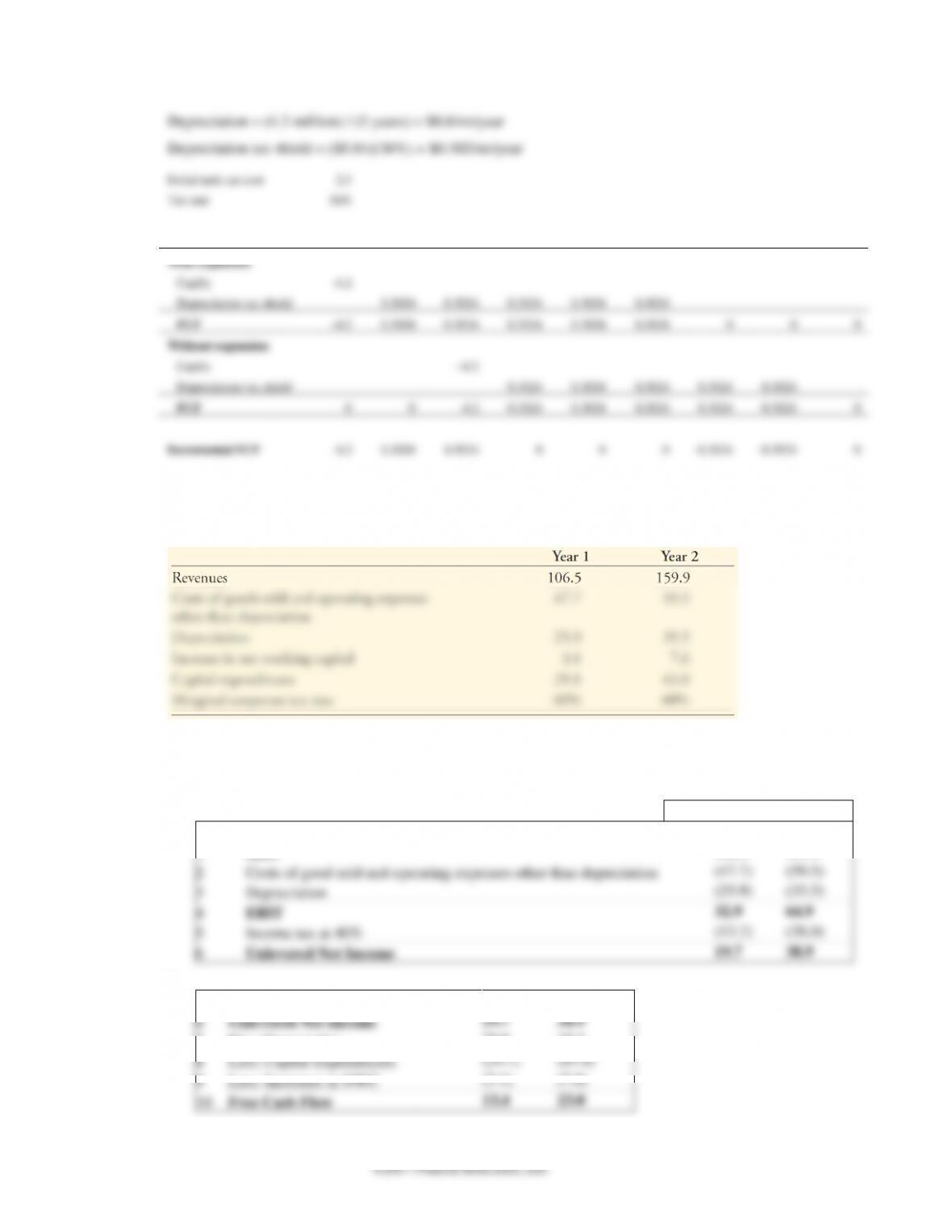
first two years (in millions of dollars):
a. What are the incremental earnings for this project for years 1 and 2?
b. What are the free cash flows for this project for the first two years?
a.
Year
1
2
Incremental Earnings Forecast ($000s)
1
Sales
106.5
159.9
2
Costs of good sold and operating expenses other than depreciation
(47.7)
(59.5)
3
Depreciation
(25.9)
(35.5)
4
EBIT
32.9
64.9
5
Income tax at 40%
(13.2)
(26.0)
6
Unlevered Net Income
19.7
38.9
b.
Free Cash Flow ($000s)
1
2
6
Unlevered Net Income
19.7
38.9
7
Plus: Depreciation
25.9
35.5
8
Less: Capital Expenditures
(29.1)
(43.8)
9
Less: Increases in NWC
(3.1)
(7.6)
10
Free Cash Flow
13.4
23.0
118 Berk/DeMarzo, Corporate Finance, Fourth Edition, Global Edition
©2017 Pearson Education, Ltd.
Free Cash Flows are:
0
1
2
…
9
10
= Net income
3.90
3.90
3.90
3.90
+ Depreciation
2.80
2.80
2.80
2.80
– Capex
(16.00)
– Inc. in NWC
(14.00)
14.00
FCF
(30.00)
6.70
6.70
…
6.70
20.70
b.
9 10
6.70 1 20.70
30 1 $12.36 million
0.12 (1.12) (1.12)
NPV
= − + − − =
8-11. Using the assumptions in part (a) of Problem 5 (assuming there is no cannibalization),
a. Calculate HomeNet’s net working capital requirements (that is, reproduce Table 8.4 under
the assumptions in Problem 5(a)).
b. Calculate HomeNet’s FCF (that is, reproduce Table 8.3 under the same assumptions as in
(a)).
a.
Year
0
1
2
3
4
5
Net Working Capital Forecast ($000s)
1
Cash requirements
–
–
–
–
–
–
2
Inventory
–
–
–
–
–
–
3
Receivables (15% of Sales)
–
1,950
3,510
4,739
5,686
–
4
Payables (15% of COGS)
–
(900)
(1,440)
(1,728)
(1,843)
–
5
Net Working Capital
–
1,050
2,070
3,011
3,843
–
b.
Year
0
1
2
3
4
5
Incremental Earnings Forecast ($000s)
1
Sales
–
13,000
23,400
31,590
37,908
–
2
Cost of Goods Sold
(6,000)
(9,600)
(11,520
)
(12,288
)
–
3
Gross Profit
–
7,000
13,800
20,070
25,620
–
4
Selling, General &
Admin.
–
(2,800)
(2,800)
(2,800)
(2,800)
–
5
Research & Development
(15,000)
–
–
–
–
–
6
Depreciation
–
(2,500)
(2,500)
(2,500)
–
–
7
EBIT
(15,000)
1,700
8,500
14,770
22,820
–
8
Incometaxat40%
6,000
(680)
(3,400)
(5,908)
(9,128)
–
9
Unlevered Net Income
(9,000)
1,020
5,100
8,862
13,692
–
Free Cash Flow ($000s)
10
Plus: Depreciation
–
2,500
2,500
2,500
–
–
11
Less: Capital
Expenditures
(7,500)
–
–
–
–
–
12
Less: Increases in NWC
–
(1,050)
(1,020)
(941)
(833)
3,843
13
Free Cash Flow
(16,500)
2,470
6,580
10,421
12,860
3,843
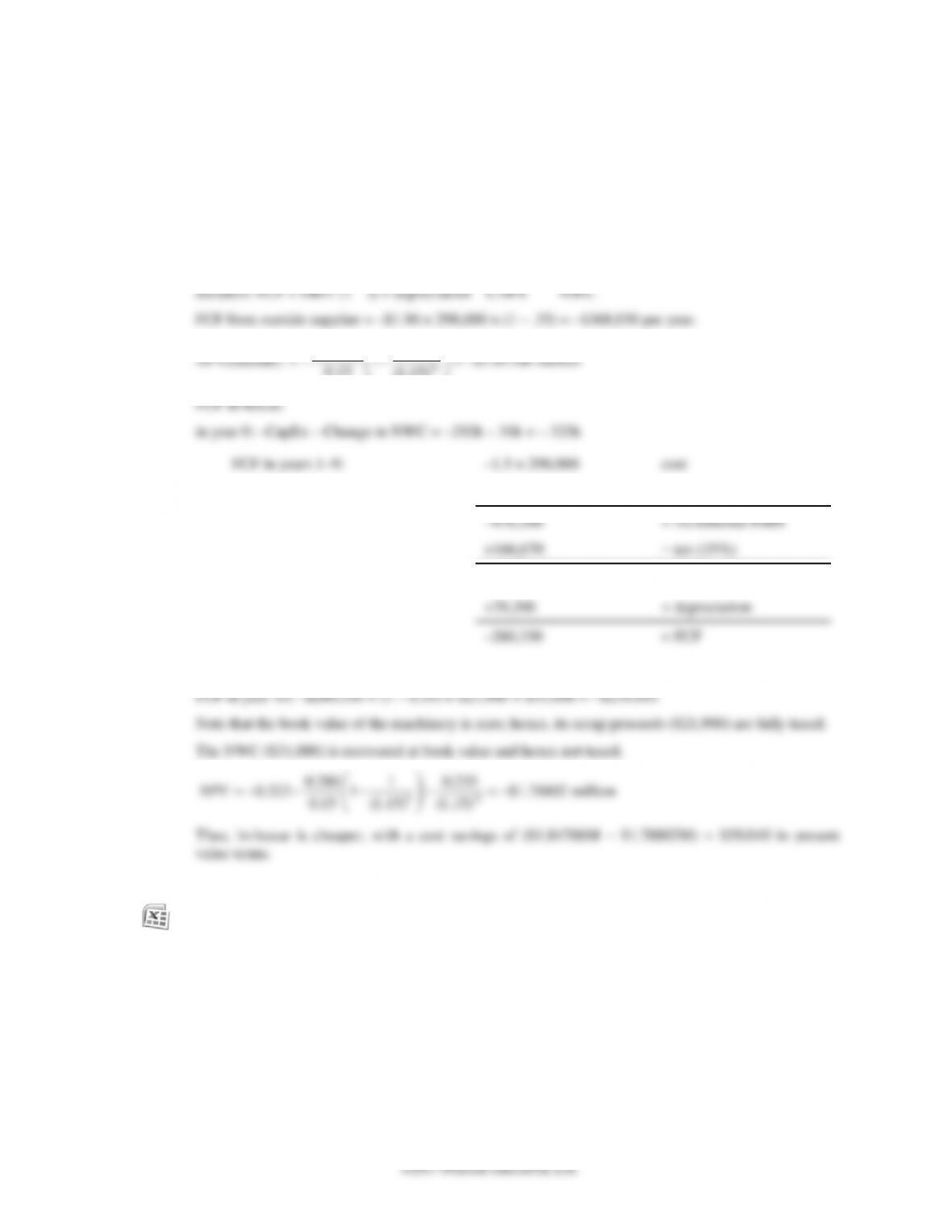
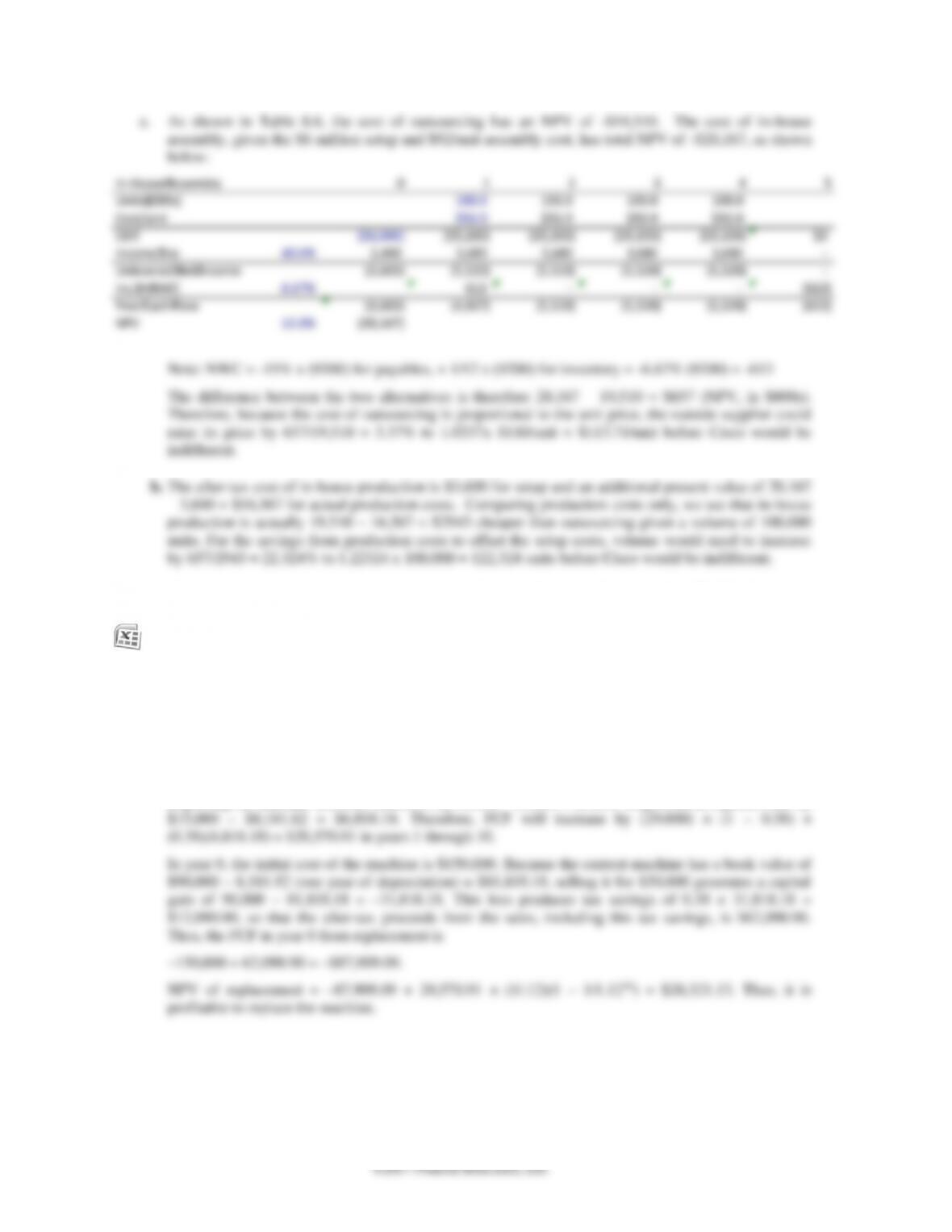
8-12. A bicycle manufacturer currently produces 298,000 units a year and expects output levels to
remain steady in the future. It buys chains from an outside supplier at a price of $1.90 a chain.
The plant manager believes that it would be cheaper to make these chains rather than buy them.
Direct in-house production costs are estimated to be only $1.50 per chain. The necessary
machinery would cost $292,000 and would be obsolete after 10 years. This investment could be
Chapter 8/Fundamentals of Capital Budgeting 119
depreciated to zero for tax purposes using a 10-year straight-line depreciation schedule. The
plant manager estimates that the operation would require $31,000 of inventory and other
working capital upfront (year 0), but argues that this sum can be ignored since it is recoverable
at the end of the 10 years. Expected proceeds from scrapping the machinery after 10 years are
$21,900.
If the company pays tax at a rate of 35% and the opportunity cost of capital is 15%, what is the
net present value of the decision to produce the chains in-house instead of purchasing them from
the supplier?
120 Berk/DeMarzo, Corporate Finance, Fourth Edition, Global Edition
©2017 Pearson Education, Ltd.
a. As shown in Table 8.6, the cost of outsourcing has an NPV of -$19,510. The cost of in-house
assembly, given the $6 million setup and $92/unit assembly cost, has total NPV of -$20,167, as shown
below:
In-HouseAssembly 0 1 2 3 4 5
Units(000s) 100.0 100.0 100.0 100.0
Cost/unit $92.0 $92.0 $92.0 $92.0
EBIT ($6,000) ($9,200) ($9,200) ($9,200) ($9,200) $0
IncomeTax 40.0% 2,400 3,680 3,680 3,680 3,680 –
UnleveredNetIncome (3,600) (5,520) (5,520) (5,520) (5,520) –
Inc.inNWC 6.67% 613 – – – (613)
FreeCashFlow (3,600) (4,907) (5,520) (5,520) (5,520) (613)
NPV 12.0% (20,167)
Note: NWC = -15% x (9200) for payables, + 1/12 x (9200) for inventory = -6.67% (9200) = –613
The difference between the two alternatives is therefore 20,167 – 19,510 = $657 (NPV, in $000s).
Therefore, because the cost of outsourcing is proportional to the unit price, the outside supplier could
raise its price by 657/19,510 = 3.37% to 1.0337x $110/unit = $113.71/unit before Cisco would be
indifferent.
b. The after-tax cost of in-house production is $3,600 for setup and an additional present value of 20,167
– 3,600 = $16,567 for actual production costs. Comparing production costs only, we see that in-house
production is actually 19,510 – 16,567 = $2943 cheaper than outsourcing given a volume of 100,000
units. For the savings from production costs to offset the setup costs, volume would need to increase
by 657/2943 = 22.324% to 1.22324 x 100,000 = 122,324 units before Cisco would be indifferent.
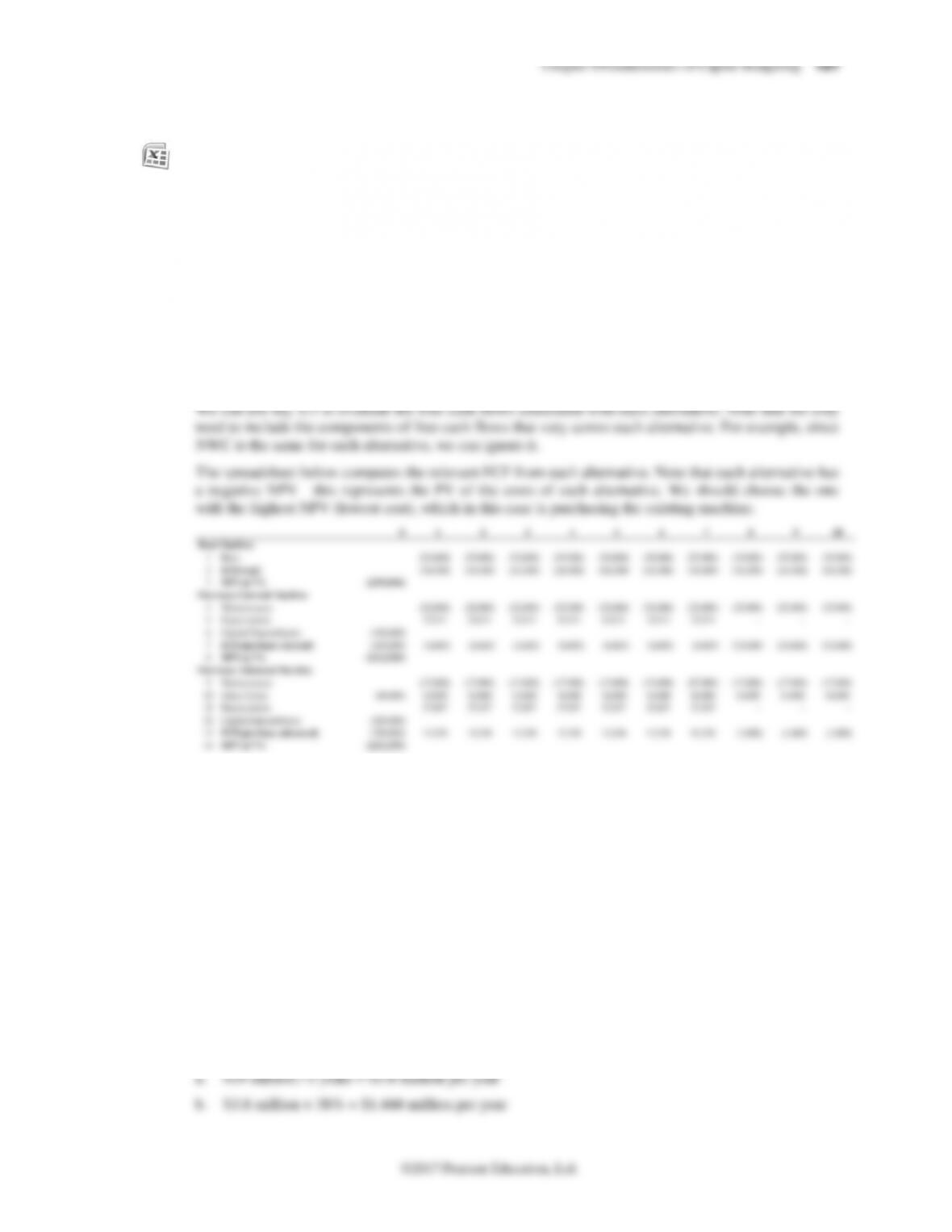
8-14. One year ago, your company purchased a machine used in manufacturing for $90,000. You have
learned that a new machine is available that offers many advantages; you can purchase it for
$150,000 today. It will be depreciated on a straight-line basis over 10 years, after which it has no
salvage value. You expect that the new machine will contribute EBITDA (earnings before
interest, taxes, depreciation, and amortization) of $50,000 per year for the next 10 years. The
current machine is expected to produce EBITDA of $21,000 per year. The current machine is
being depreciated on a straight-line basis over a useful life of 11 years, after which it will have no
salvage value, so depreciation expense for the current machine is $8,182 per year. All other
expenses of the two machines are identical. The market value today of the current machine is
$50,000. Your company’s tax rate is 38%, and the opportunity cost of capital for this type of
equipment is 12%. Is it profitable to replace the year–old machine?
Replacing the machine increases EBITDA by 50,000 – 21,000 = 29,000. Depreciation expenses rise by
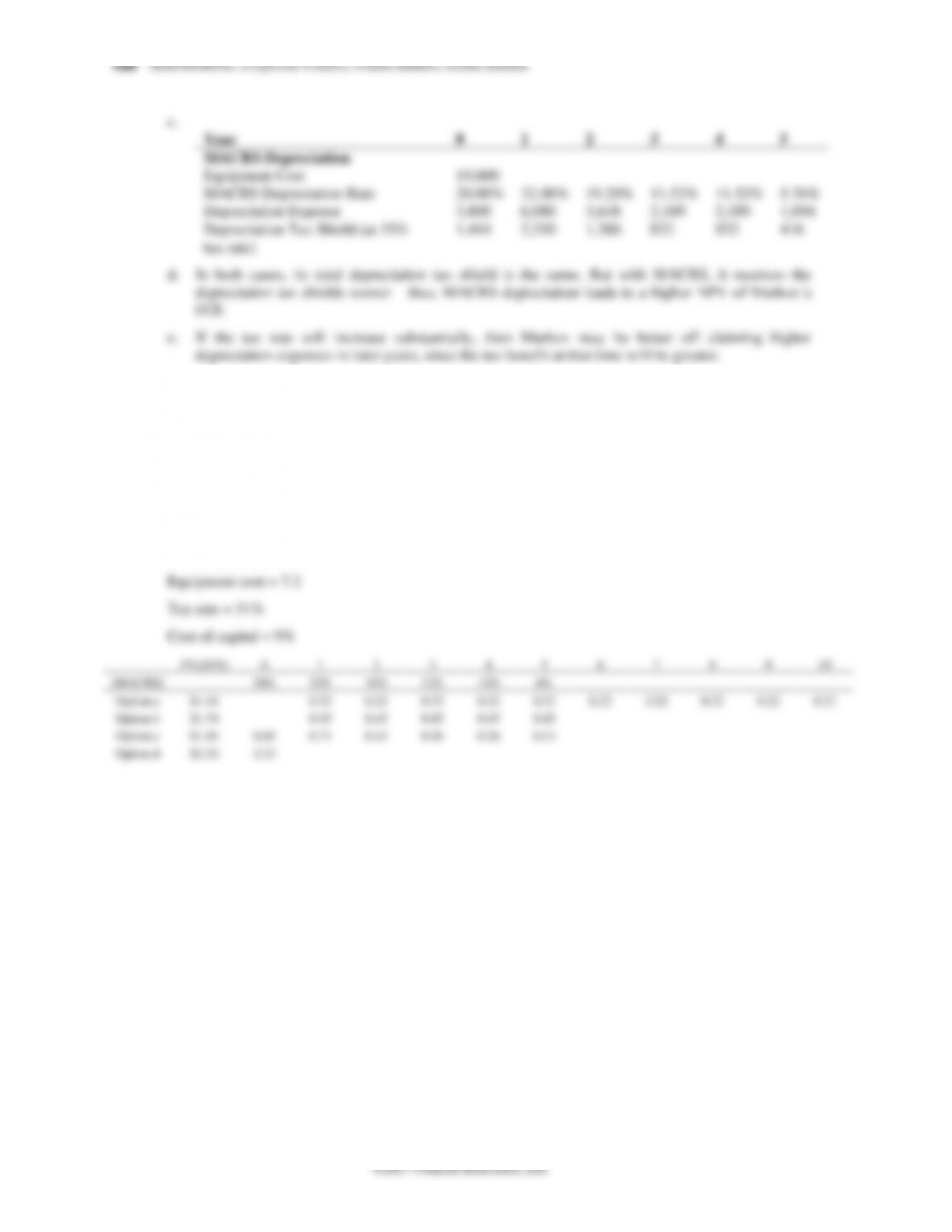
8-17. Your firm is considering a project that would require purchasing $7.2 million worth of new
equipment. Determine the present value of the depreciation tax shield associated with this
equipment if the firm’s tax rate is 31%, the appropriate cost of capital is 9%, and the equipment
can be depreciated
a. Straight-line over a 10-year period, with the first deduction starting in one year.
b. Straight-line over a five-year period, with the first deduction starting in one year.
c. Using MACRS depreciation with a five-year recovery period and starting immediately.
d. Fully as an immediate deduction.
Chapter 8/Fundamentals of Capital Budgeting 123
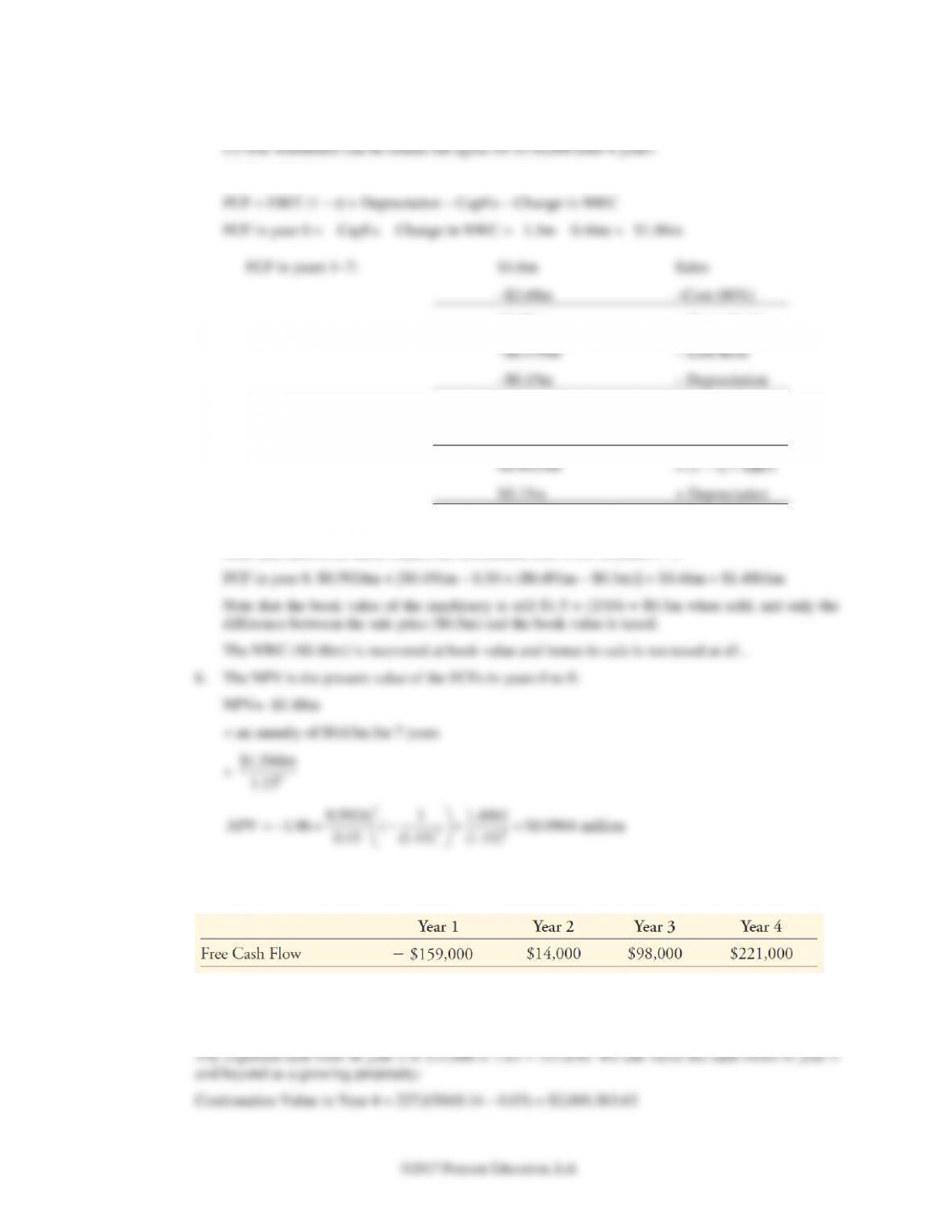
a. Assumptions:
(2) The NWC is fully recovered at book value after 8 years.
FCF in years 1–7:
$4.6m
Sales
–$3.68m
–Cost (80%)
$0.92m
= Gross Profit
–$0.138m
– Lost Rent
–$0.15m
– Depreciation
$0.632m
= EBIT
–$0.1896m
– Tax (30%)
$0.4424m
= (1 – t) EBIT
$0.15m
+ Depreciation
$0.5924m
= FCF
Note that there is no more CapEx nor investment into NWC in years 1–7.
78
0.15 (1.15) (1.15)
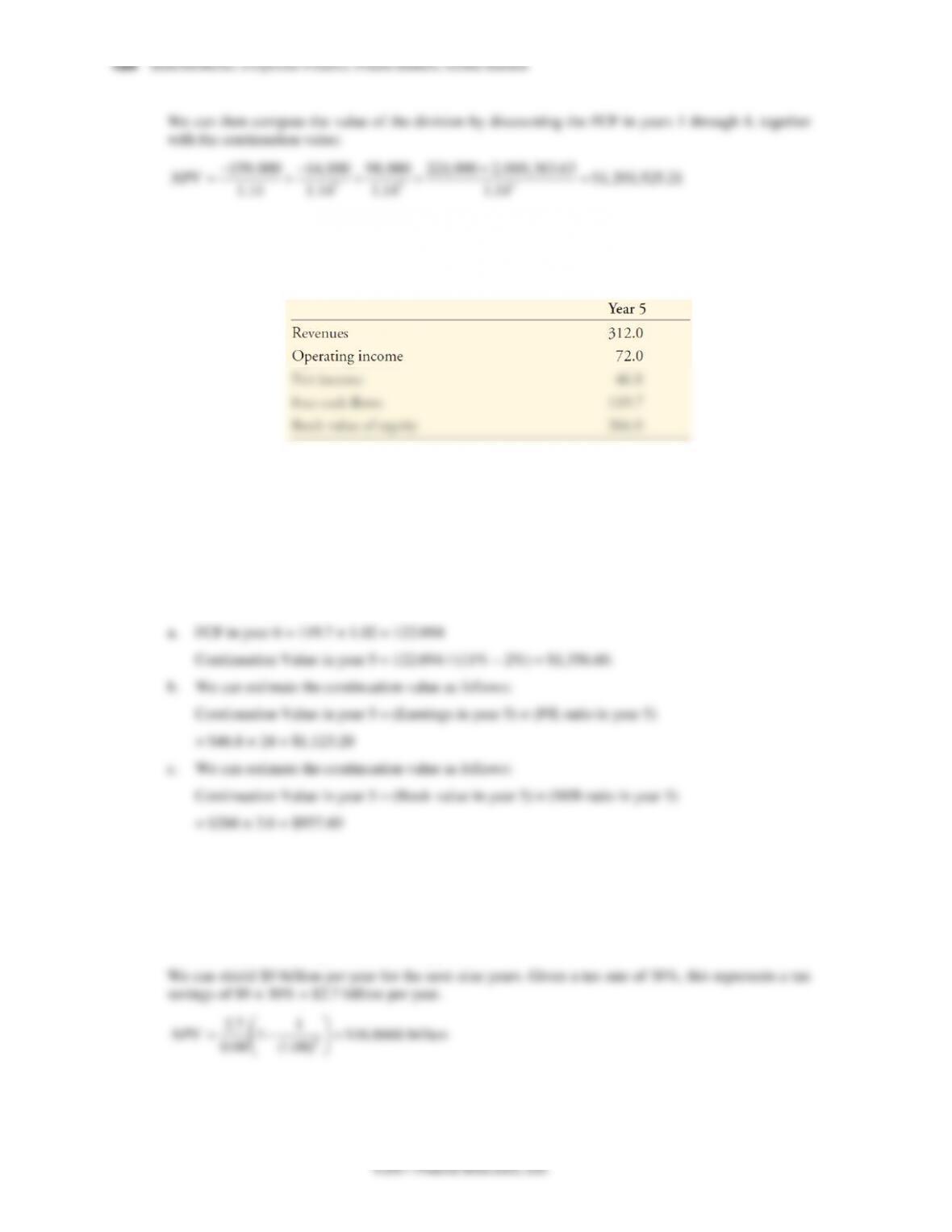
8-19. Bay Properties is considering starting a commercial real estate division. It has prepared the
following four-year forecast of free cash flows for this division:
Assume cash flows after year 4 will grow at 3% per year, forever. If the cost of capital for this
division is 14%, what is the continuation value in year 4 for cash flows after year 4? What is the
value today of this division?
©2017 Pearson Education, Ltd.
2 3 4
1.14 1.14 1.14 1.14
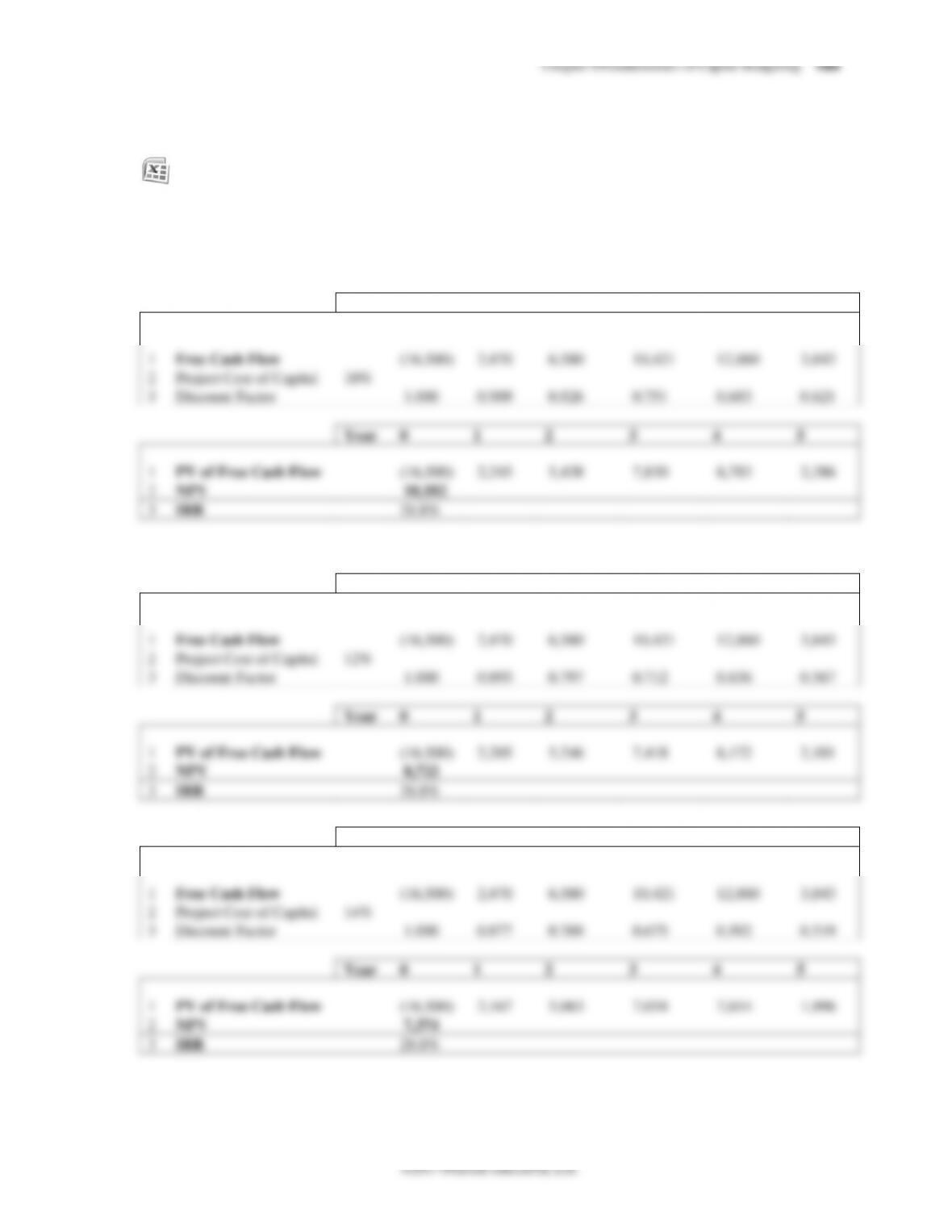
8-20. Your firm would like to evaluate a proposed new operating division. You have forecasted cash
flows for this division for the next five years, and have estimated that the cost of capital is 11%.
You would like to estimate a continuation value. You have made the following forecasts for the
last year of your five-year forecasting horizon (in millions of dollars):
a. You forecast that future free cash flows after year 5 will grow at 2% per year, forever.
Estimate the continuation value in year 5, using the perpetuity with growth formula.
b. You have identified several firms in the same industry as your operating division. The
average P/E ratio for these firms is 24. Estimate the continuation value assuming the P/E
ratio for your division in year 5 will be the same as the average P/E ratio for the comparable
firms today.
c. The average market/book ratio for the comparable firms is 3.6. Estimate the continuation
value using the market/book ratio.
8-21. In September 2008, the IRS changed tax laws to allow banks to utilize the tax loss carryforwards
of banks they acquire to shield their future income from taxes (prior law restricted the ability of
acquirers to use these credits). Suppose Fargo Bank acquires Covia Bank and with it acquires
$81 billion in tax loss carryforwards. If Fargo Bank is expected to generate taxable income of $9
billion per year in the future, and its tax rate is 30%, what is the present value of these acquired
tax loss carryforwards given a cost of capital of 8%?
9
0.08 (1.08)
126 Berk/DeMarzo, Corporate Finance, Fourth Edition, Global Edition
8-23. For the assumptions in part (a) of Problem 5, assuming a cost of capital of 12%, calculate the
following:
a. The break-even annual sales price decline.
b. The break-even annual unit sales increase.
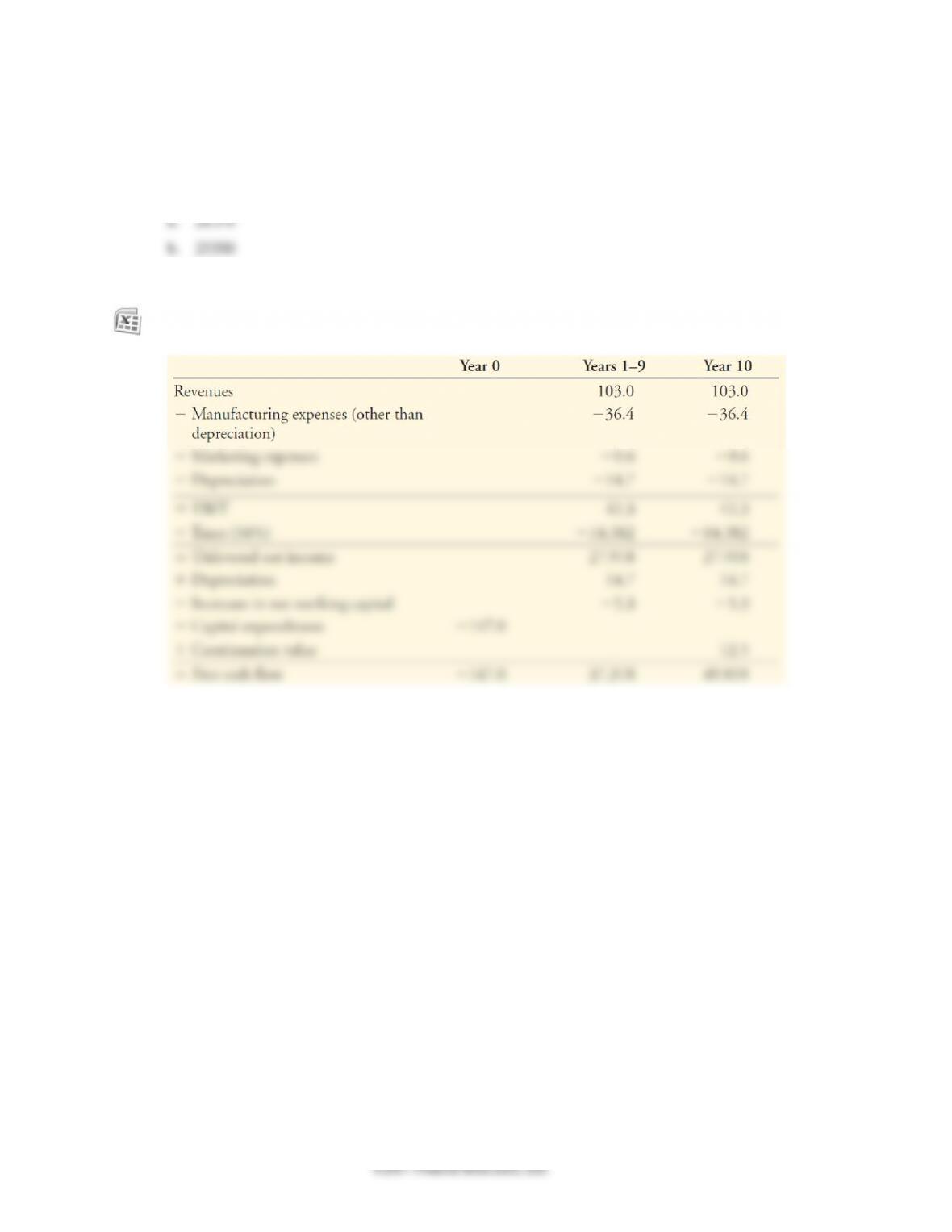
8-24. Bauer Industries is an automobile manufacturer. Management is currently evaluating a proposal
to build a plant that will manufacture lightweight trucks. Bauer plans to use a cost of capital of
12.2% to evaluate this project. Based on extensive research, it has prepared the following
incremental free cash flow projections (in millions of dollars):
a. For this base-case scenario, what is the NPV of the plant to manufacture lightweight trucks?
b. Based on input from the marketing department, Bauer is uncertain about its revenue
forecast. In particular, management would like to examine the sensitivity of the NPV to the
revenue assumptions. What is the NPV of this project if revenues are 8% higher than
forecast? What is the NPV if revenues are 8% lower than forecast?
c. Rather than assuming that cash flows for this project are constant, management would like
to explore the sensitivity of its analysis to possible growth in revenues and operating
expenses. Specifically, management would like to assume that revenues, manufacturing
expenses, and marketing expenses are as given in the table for year 1 and grow by 3% per
year every year starting in year 2. Management also plans to assume that the initial capital
expenditures (and therefore depreciation), additions to working capital, and continuation
value remain as initially specified in the table. What is the NPV of this project under these
alternative assumptions? How does the NPV change if the revenues and operating expenses
grow by 6% per year rather than by 3%?
d. To examine the sensitivity of this project to the discount rate, management would like to
compute the NPV for different discount rates. Create a graph, with the discount rate on the
x-axis and the NPV on the y–axis, for discount rates ranging from 5% to 30%. For what
ranges of discount rates does the project have a positive NPV?
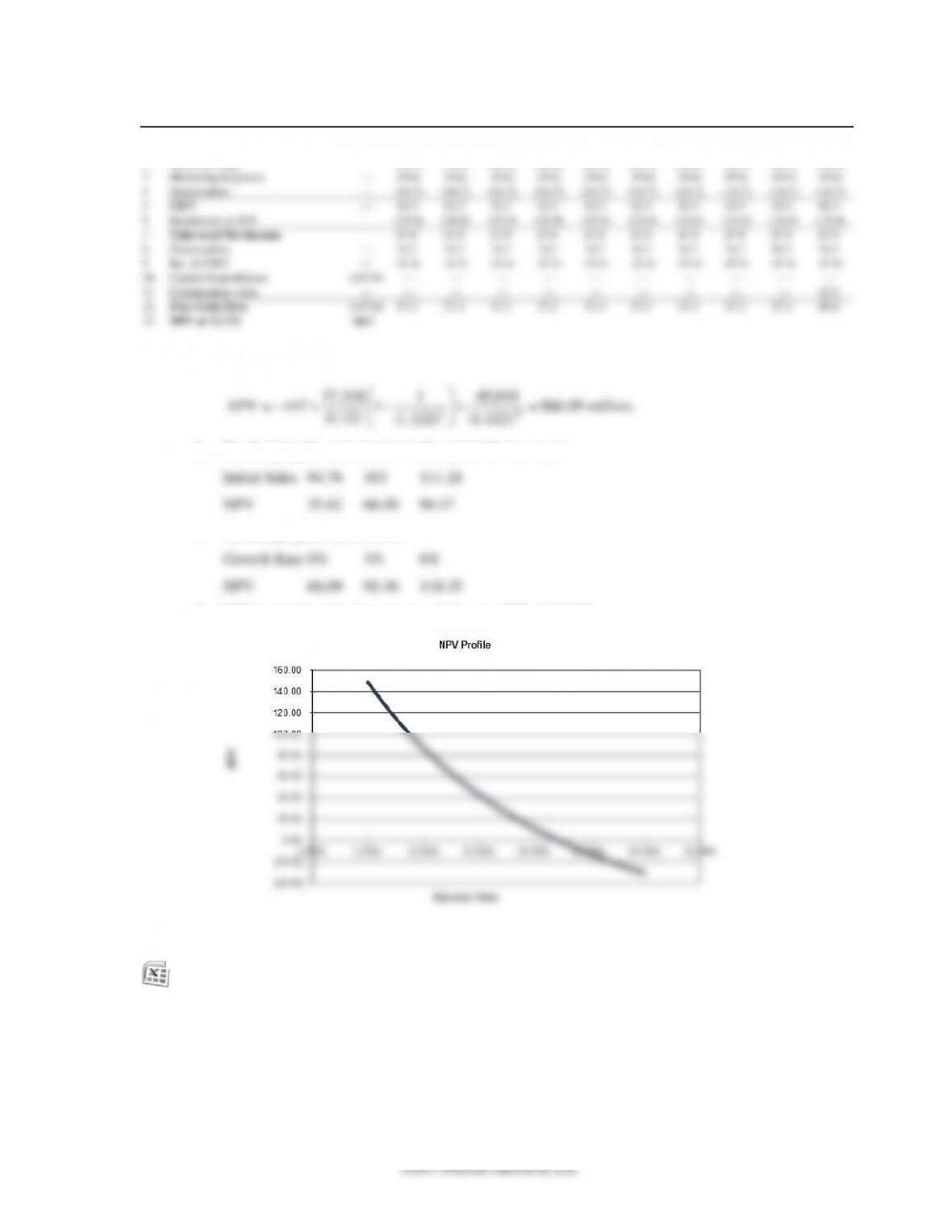
Chapter 8/Fundamentals of Capital Budgeting 127
Year 0 1 2 3 4 5 6 7 8 9 10
Free Cash Flow Forecast ($ millions)
1 Sales —103.0 103.0 103.0 103.0 103.0 103.0 103.0 103.0 103.0 103.0
2 Manufacturing —(36.4) (36.4) (36.4) (36.4) (36.4) (36.4) (36.4) (36.4) (36.4) (36.4)
3 Marketing Expenses —(9.6) (9.6) (9.6) (9.6) (9.6) (9.6) (9.6) (9.6) (9.6) (9.6)
4 Depreciation —(14.7) (14.7) (14.7) (14.7) (14.7) (14.7) (14.7) (14.7) (14.7) (14.7)
5 EBIT —42.3 42.3 42.3 42.3 42.3 42.3 42.3 42.3 42.3 42.3
6 Income tax at 34% —(14.4) (14.4) (14.4) (14.4) (14.4) (14.4) (14.4) (14.4) (14.4) (14.4)
7Unlevered Net Income —27.9 27.9 27.9 27.9 27.9 27.9 27.9 27.9 27.9 27.9
8 Depreciation —14.7 14.7 14.7 14.7 14.7 14.7 14.7 14.7 14.7 14.7
9 Inc. in NWC —(5.3) (5.3) (5.3) (5.3) (5.3) (5.3) (5.3) (5.3) (5.3) (5.3)
10 Capital Expenditures (147.0) ——————————
11 Continuation value — — — — — — — — — — 12.5
12 Free Cash Flow (147.0) 37.3 37.3 37.3 37.3 37.3 37.3 37.3 37.3 37.3 49.8
13 NPV at 12.2% 66.1 ——————————
a. The NPV of the estimate free cash flow is
9 10
37.318 1 49.818
0.122 (1.122) (1.122)
b. By changing the year 1 sales in the spreadsheet, we get
c. By changing the spreadsheet:
d. NPV is positive for discount rates below the IRR of 22.23%.
8-25. Billingham Packaging is considering expanding its production capacity by purchasing a new
machine, the XC-750. The cost of the XC-750 is $2.79 million. Unfortunately, installing this
machine will take several months and will partially disrupt production. The firm has just
completed a $46,000 feasibility study to analyze the decision to buy the XC-750, resulting in the
following estimates:
■ Marketing: Once the XC-750 is operating next year, the extra capacity is expected to
generate $10 million per year in additional sales, which will continue for the 10-year life of
the machine.
128 Berk/DeMarzo, Corporate Finance, Fourth Edition, Global Edition
■ Operations: The disruption caused by the installation will decrease sales by $5.04 million this
year. Once the machine is operating next year, the cost of goods for the products produced
by the XC-750 is expected to be 68% of their sale price. The increased production will
require additional inventory on hand of $1.05 million to be added in year 0 and depleted in
year 10.
■ Human Resources: The expansion will require additional sales and administrative personnel
at a cost of $2.05 million per year.
■ Accounting: The XC-750 will be depreciated via the straight-line method over the 10-year
life of the machine. The firm expects receivables from the new sales to be 14% of revenues
and payables to be 9% of the cost of goods sold. Billingham’s marginal corporate tax rate is
35%.
a. Determine the incremental earnings from the purchase of the XC-750.
b. Determine the free cash flow from the purchase of the XC-750.
c. If the appropriate cost of capital for the expansion is 9.7%, compute the NPV of the
purchase.
d. While the expected new sales will be $10 million per year from the expansion, estimates
range from $8.05 million to $11.95 million. What is the NPV in the worst case? In the best
case?
e. What is the break-even level of new sales from the expansion? What is the break-even level
for the cost of goods sold?
f. Billingham could instead purchase the XC-900, which offers even greater capacity. The cost
of the XC-900 is $4.03 million. The extra capacity would not be useful in the first two years
of operation, but would allow for additional sales in years 3–10. What level of additional
sales (above the $10 million expected for the XC-750) per year in those years would justify
purchasing the larger machine?