Chapter 7
Investment Decision Rules
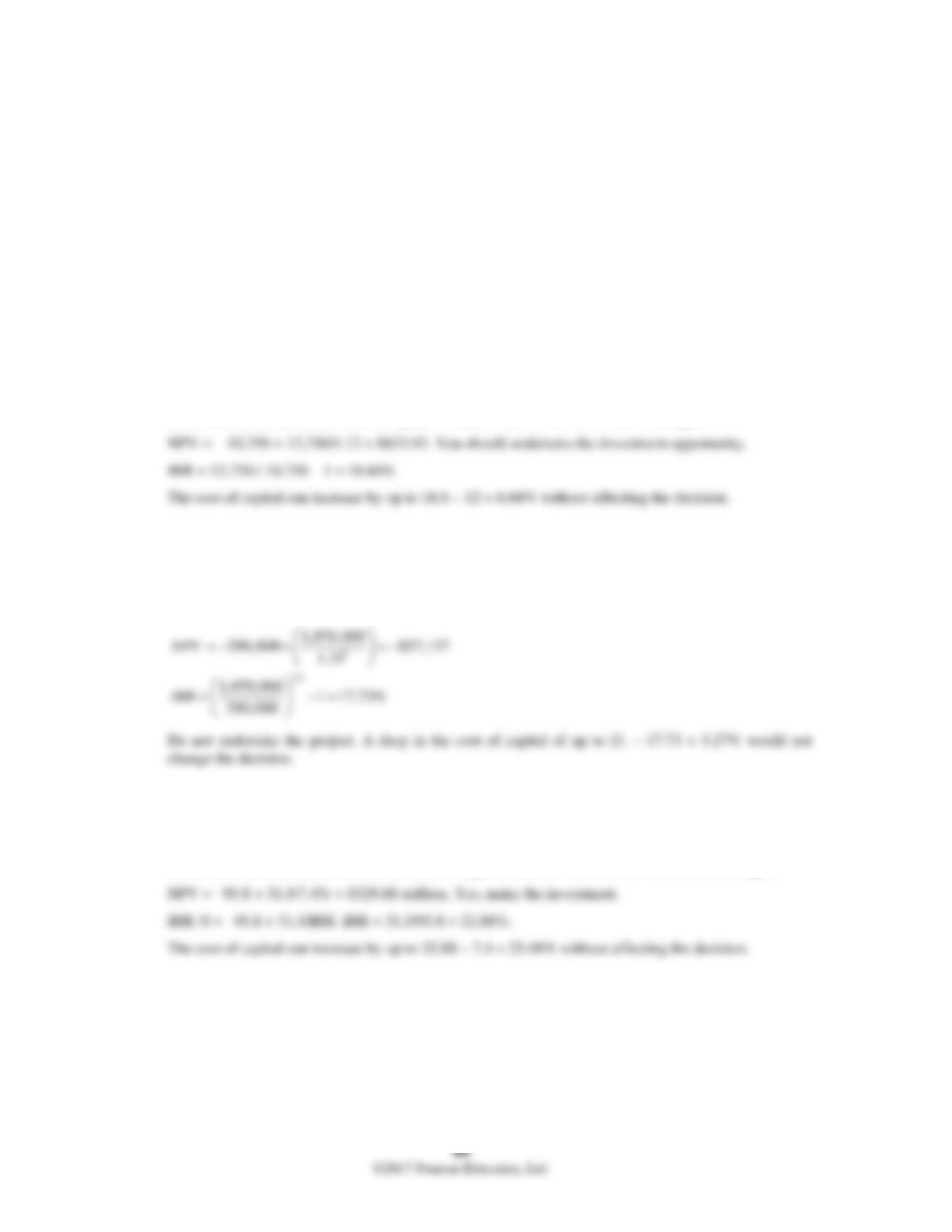
7-1. Your brother wants to borrow $10,750 from you. He has offered to pay you back $12,750 in a
year. If the cost of capital of this investment opportunity is 12%, what is its NPV? Should you
undertake the investment opportunity? Calculate the IRR and use it to determine the maximum
deviation allowable in the cost of capital estimate to leave the decision unchanged.
7-2. You are considering investing in a start–up company. The founder asked you for $290,000 today
and you expect to get $1,070,000 in eight years. Given the riskiness of the investment
opportunity, your cost of capital is 21%. What is the NPV of the investment opportunity? Should
you undertake the investment opportunity? Calculate the IRR and use it to determine the
maximum deviation allowable in the cost of capital estimate to leave the decision unchanged.
8
1/8
1,070,000
290,000 $57,137
1.21
1,070,000 1 17.73%
290,000
NPV
IRR
= − + = −
= − =
Do not undertake the project. A drop in the cost of capital of up to 21 – 17.73 = 3.27% would not
change the decision.
7-3. You are considering opening a new plant. The plant will cost $95.8 million upfront. After that, it
is expected to produce profits of $31.5 million at the end of every year. The cash flows are
expected to last forever. Calculate the NPV of this investment opportunity if your cost of capital
is 7.4%. Should you make the investment? Calculate the IRR and use it to determine the
maximum deviation allowable in the cost of capital estimate to leave the decision unchanged.
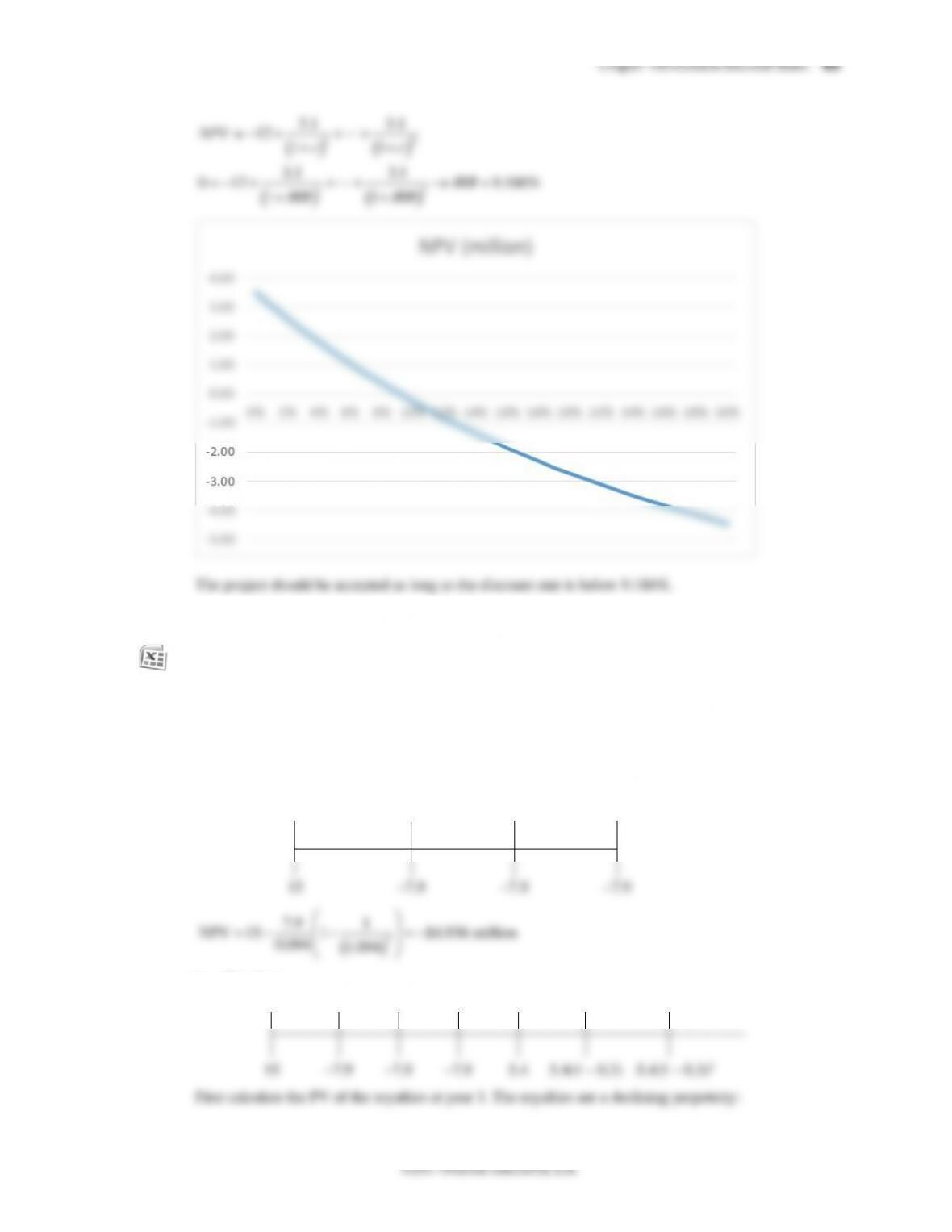
7-4. Your firm is considering the launch of a new product, the XJ5. The upfront development cost is
$12 million, and you expect to earn a cash flow of $3.1 million per year for the next five years.
Plot the NPV profile for this project for discount rates ranging from 0% to 30%. For what range
of discount rates is the project attractive?
©2017 Pearson Education, Ltd.
7-5. Bill Clinton reportedly was paid $15 million to write his book My Life. Suppose the book took
three years to write. In the time he spent writing, Clinton could have been paid to make speeches.
Given his popularity, assume that he could earn $7.9 million per year (paid at the end of the
year) speaking instead of writing. Assume his cost of capital is 9.4% per year.
a. What is the NPV of agreeing to write the book (ignoring any royalty payments)?
b. Assume that, once the book is finished, it is expected to generate royalties of $5.4 million in
the first year (paid at the end of the year) and these royalties are expected to decrease at a
rate of 30% per year in perpetuity. What is the NPV of the book with the royalty payments?
a. Timeline:
0
1
2
3
15
–7.9
–7.9
–7.9
( )
3
7.9 1
NPV 15 1 $4.856 million
0.094 1.094
= − − = −
b. Timeline:
0
1
2
3
4
5
6
15
–7.9
–7.9
–7.9
5.4
5.4(1 – 0.3)
5.4(1 – 0.3)2
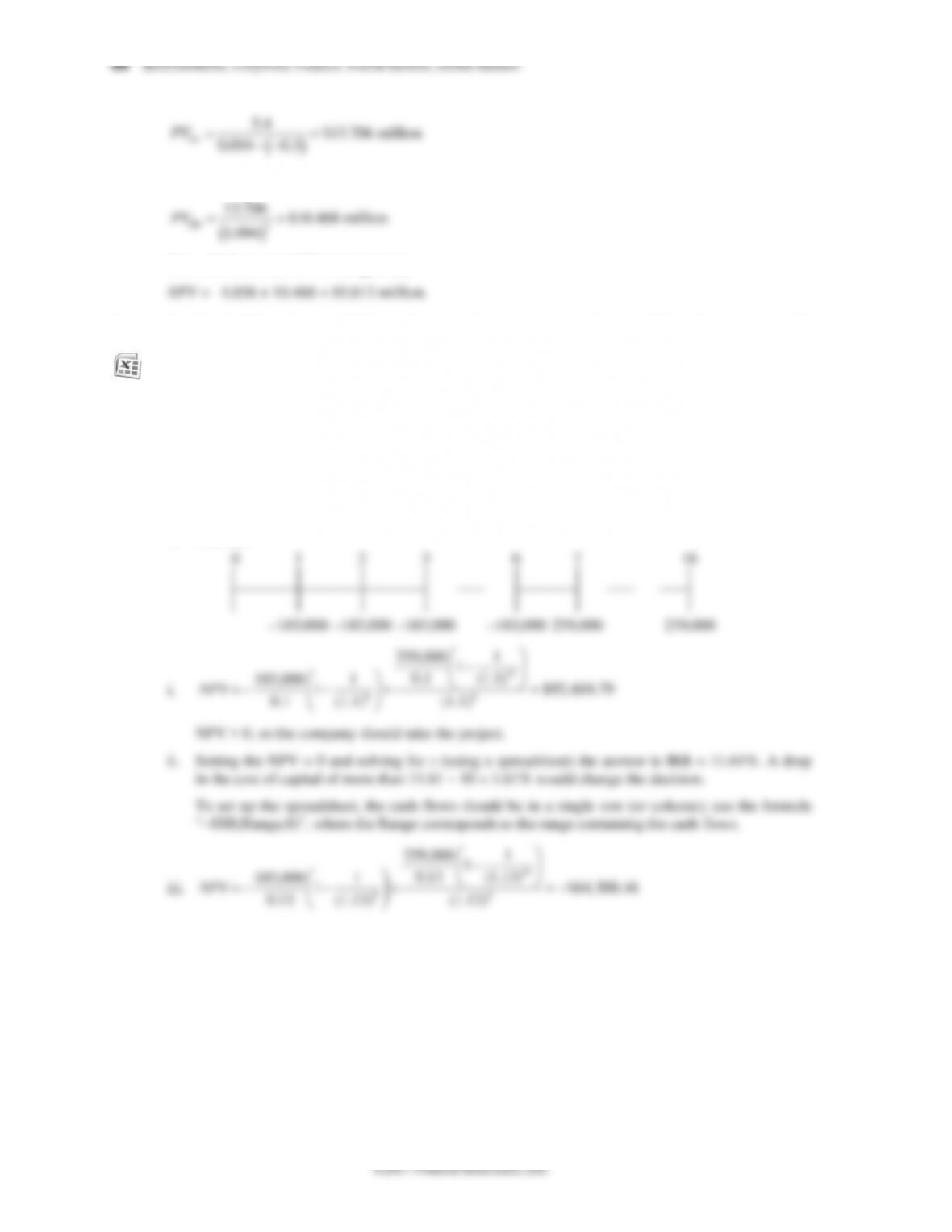
First calculate the PV of the royalties at year 3. The royalties are a declining perpetuity:
©2017 Pearson Education, Ltd.
( )
0.094 0.3
−−
So the value today is
( )
03
13.706 $10.468 million
1.094
R
PV ==
Now add this to the NPV from part (a):
7-6. FastTrack Bikes, Inc. is thinking of developing a new composite road bike. Development will
take six years and the cost is $185,000 per year. Once in production, the bike is expected to make
$259,000 per year for 10 years. Assume the cost of capital is 10%.
a. Calculate the NPV of this investment opportunity, assuming all cash flows occur at the end
of each year. Should the company make the investment?
b. By how much must the cost of capital estimate deviate to change the decision? (Hint: Use
Excel to calculate the IRR.)
c. What is the NPV of the investment if the cost of capital is 13%?
a. Timeline:
0
1
2
3
6
7
16
–185,000
–185,000
–185,000
–185,000
259,000
259,000
i.
10
66
259,000 1
1
0.1 (1.1)
185,000 1
= 1 + $92,604.79
0.1 (1.1) (1.1)
NPV
−
− − =
NPV > 0, so the company should take the project.
ii. Setting the NPV = 0 and solving for r (using a spreadsheet) the answer is IRR = 11.61%. A drop
in the cost of capital of more than 11.61 – 10 = 1.61% would change the decision.
To set up the spreadsheet, the cash flows should be in a single row (or column); use the formula
“=IRR(Range,0)”, where the Range corresponds to the range containing the cash flows.
iii.
10
66
259,000 1
1
0.13 (1.13)
185,000 1
= 1 + $64,508.46
0.13 (1.13) (1.13)
NPV
−
− − = −
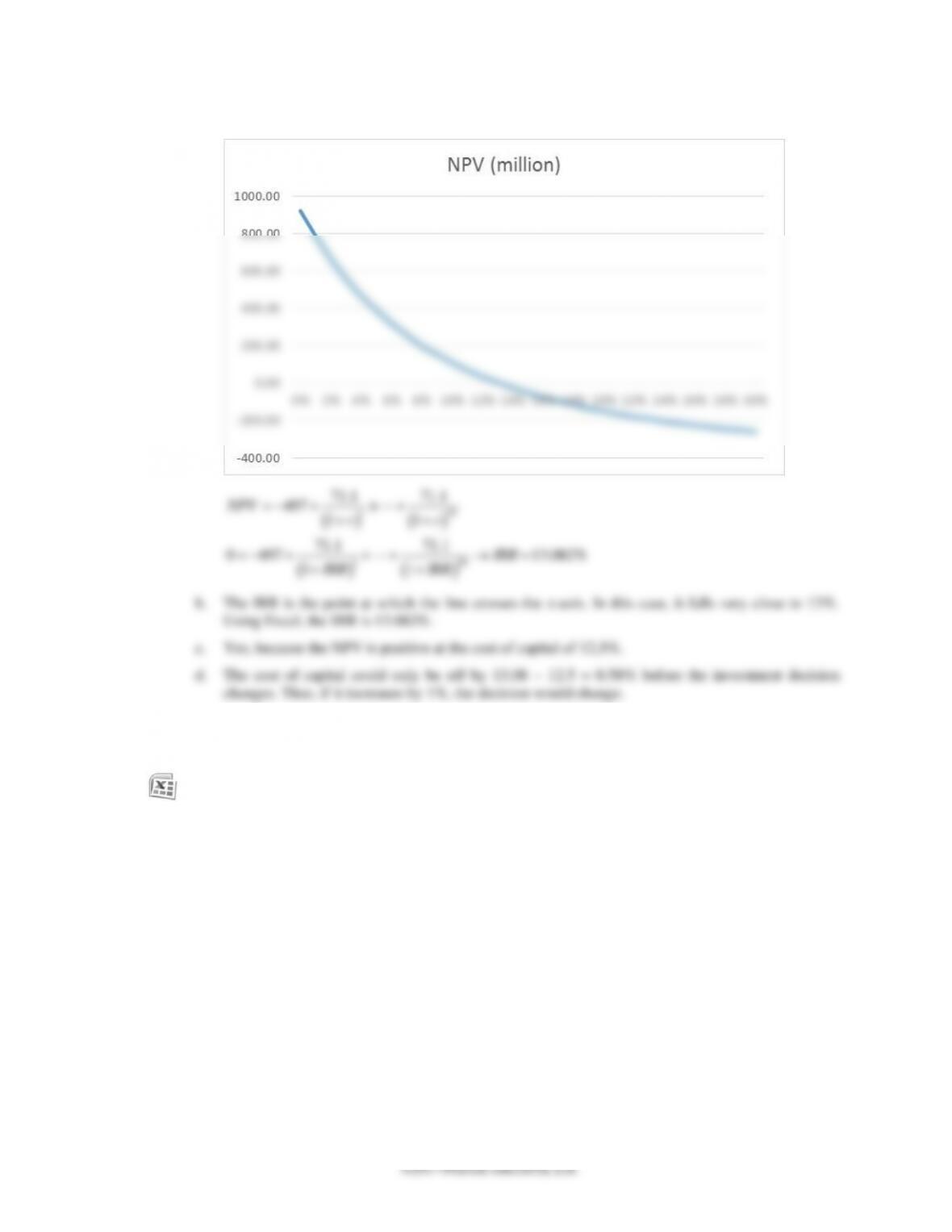
7-7. OpenSeas, Inc. is evaluating the purchase of a new cruise ship. The ship would cost $497 million,
and would operate for 20 years. OpenSeas expects annual cash flows from operating the ship to
be $71.1 million (at the end of each year) and its cost of capital is 12.5%.
a. Prepare an NPV profile of the purchase.
b. Estimate the IRR (to the nearest 1%) from the graph.
c. Is the purchase attractive based on these estimates?
d. How far off could OpenSeas’ cost of capital be (to the nearest 1%) before your purchase
decision would change?
Chapter 7/Investment Decision Rules 95
a.
( ) ( )
( ) ( )
1 20
1 20
71.1 71.1
497 11
71.1 71.1
0 497 13.082%
11
NPV rr
IRR
IRR IRR
= − + + +
++
= − + + + → =
++
b. The IRR is the point at which the line crosses the x-axis. In this case, it falls very close to 13%.
Using Excel, the IRR is 13.082%.
c. Yes, because the NPV is positive at the cost of capital of 12.5%.
d. The cost of capital could only be off by 13.08 – 12.5 = 0.58% before the investment decision
changes. Thus, if it increases by 1%, the decision would change.
7-8. You are CEO of Rivet Networks, maker of ultra-high performance network cards for gaming
computers, and you are considering whether to launch a new product. The product, the Killer
X3000, will cost $900,000 to develop up front (year 0), and you expect revenues the first year of
$800,000, growing to $1.5 million the second year, and then declining by 40% per year for the
next 3 years before the product is fully obsolete. In years 1 through 5, you will have fixed costs
associated with the product of $100,000 per year, and variable costs equal to 50% of revenues.
a. What are the cash flows for the project in years 0 through 5?
b. Plot the NPV profile for this investment from 0% to 40% in 10% increments.
c. What is the project’s NPV if the project’s cost of capital is 10%?
d. Use the NPV profile to estimate the cost of capital at which the project would become
unprofitable; that is, estimate the project’s IRR.
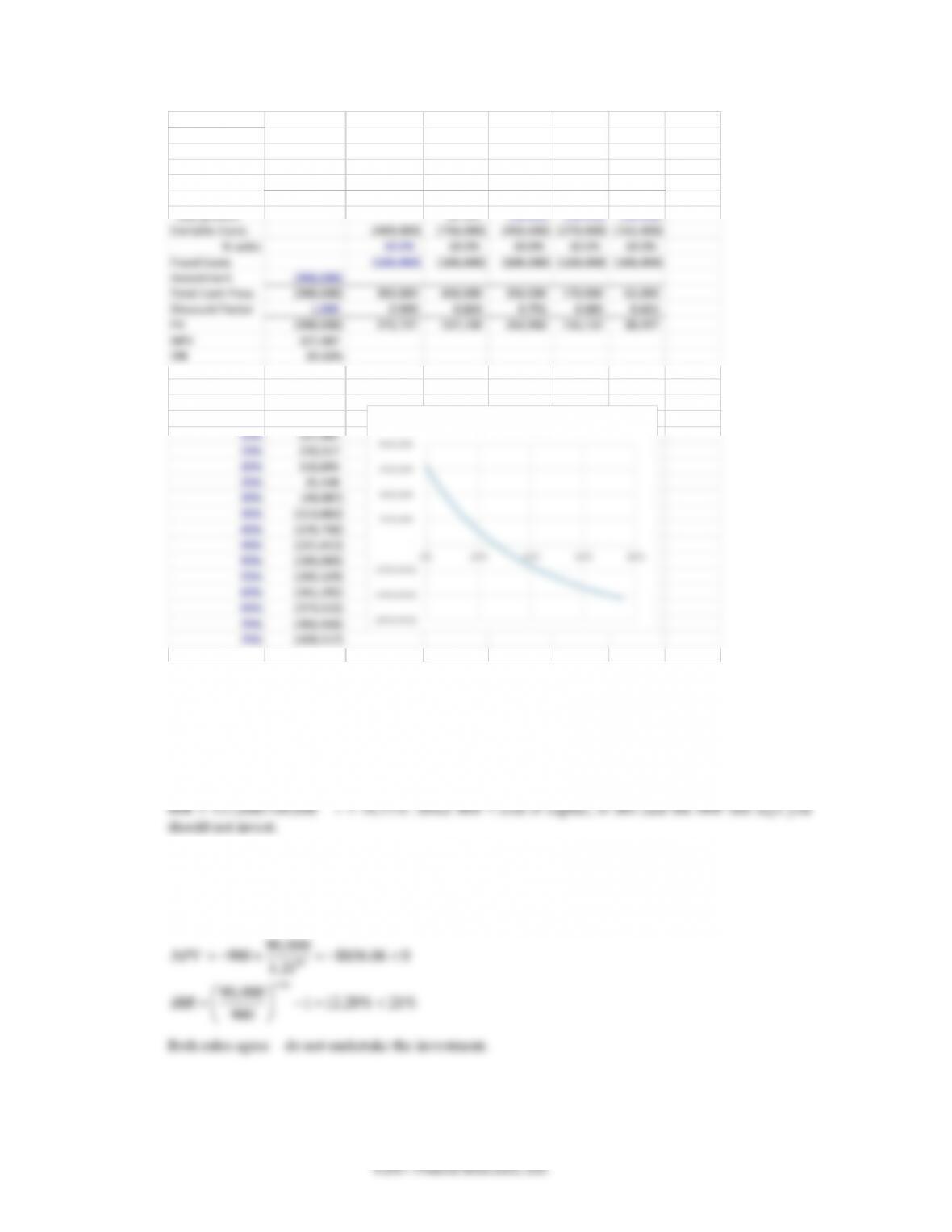
96 Berk/DeMarzo, Corporate Finance, Fourth Edition, Global Edition
Rivet Networks
Cost of Capital 10.0%
01 2 3 4 5
Revenues 800,000 1,500,000 900,000 540,000 324,000
yoy growth 87.5% (40.0%) (40.0%) (40.0%)
Variable Costs (400,000) (750,000) (450,000) (270,000) (162,000)
% sales 50.0% 50.0% 50.0% 50.0% 50.0%
Fixed Costs (100,000) (100,000) (100,000) (100,000) (100,000)
Investment (900,000)
Total Cash Flow (900,000) 300,000 650,000 350,000 170,000 62,000
Discount Factor 1.000 0.909 0.826 0.751 0.683 0.621
PV (900,000) 272,727 537,190 262,960 116,112 38,497
NPV 327,487
IRR 26.62%
Discount rate 327,487
0% 632,000
5% 466,065
10% 327,487
15% 210,517
20% 110,835
25% 25,148
30% (49,087)
35% (113,862)
40% (170,750)
45% (221,012)
50% (265,663)
55% (305,529)
60% (341,292)
65% (373,511)
70% (402,656)
75% (429,117)
(600,000)
(400,000)
(200,000)
–
200,000
400,000
600,000
800,000
0% 20% 40% 60% 80%
NPV Profile
7-9. You are considering an investment in a clothes distributor. The company needs $109,000 today
and expects to repay you $127,000 in a year from now. What is the IRR of this investment
opportunity? Given the riskiness of the investment opportunity, your cost of capital is 19%.
What does the IRR rule say about whether you should invest?
40
1/40
90,000
900 $856.06 0
1.21
90,000 1 12.20% 21%
NPV
= − + = −
98 Berk/DeMarzo, Corporate Finance, Fourth Edition, Global Edition
Since the IRR is much greater than the discount rate, the IRR rule says write the book. Since this is a
negative NPV project, from 7-5(a), the IRR gives the wrong answer.
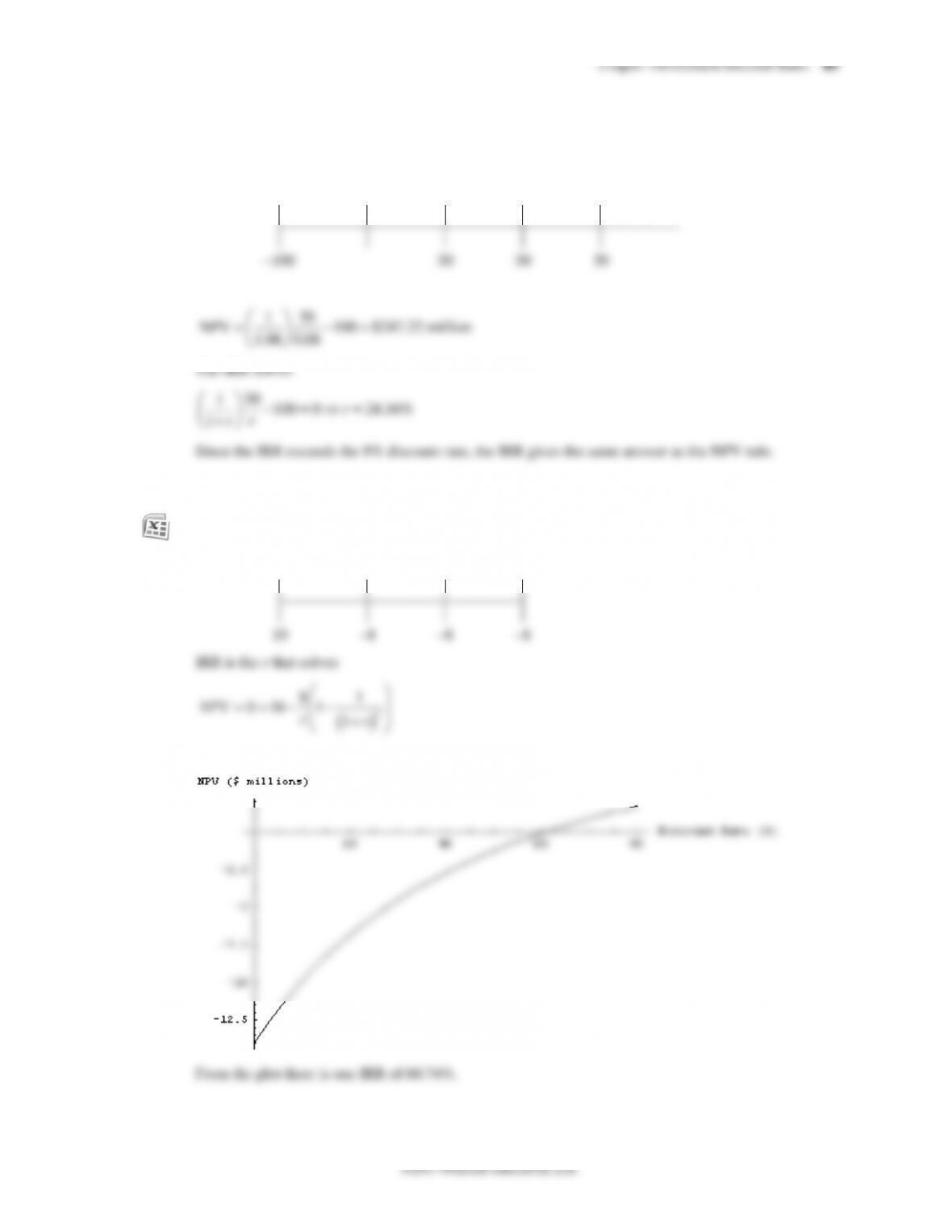
Timeline:
0
1
2
3
4
5
6
10
–8
–8
–8
5
5(1 – 0.3)
5(1.03)2
( ) ( )
33
11
rr
+
++
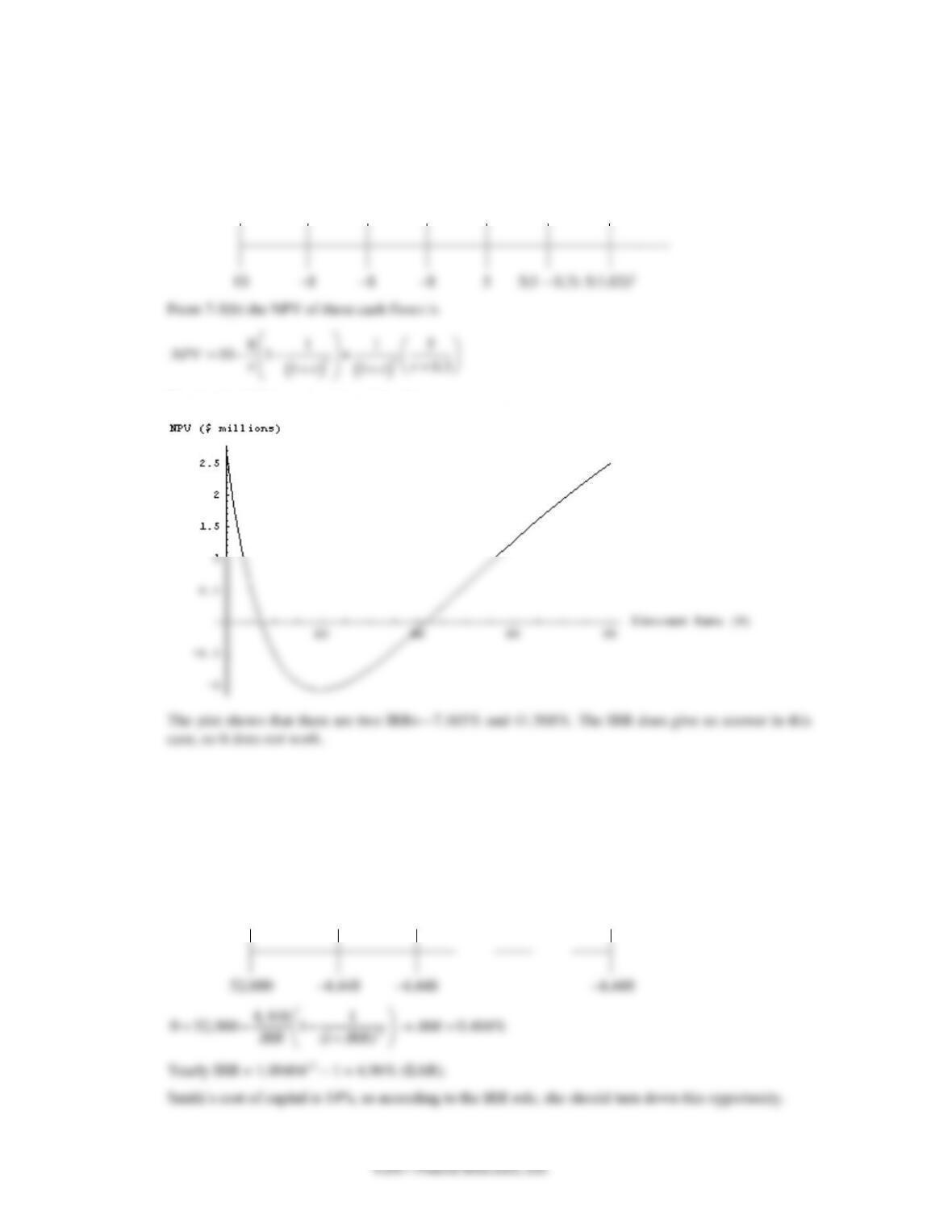
Plotting the NPV as a function of the discount rate gives
7-13. Professor Wendy Smith has been offered the following deal: A law firm would like to retain her
for an upfront payment of $52,000. In return, for the next year the firm would have access to 8
hours of her time every month. Smith’s rate is $556 per hour and her opportunity cost of capital
is 14% (EAR). What does the IRR rule advise regarding this opportunity? What about the NPV
rule?
The timeline of this investment opportunity is:
0
1
2
12
52,000
–4,448
–4,448
–4,448
12
4,448 1
0 52,000 1 0.404%
(1 ) IRR
IRR IRR
= − − → =
+
Yearly IRR = 1.0040412 – 1 = 4.96% (EAR).
Smith’s cost of capital is 14%, so according to the IRR rule, she should turn down this opportunity.
Chapter 7/Investment Decision Rules 99
©2017 Pearson Education, Ltd.
Let’s see what the NPV rule says. If you invest at an EAR of 14%, then after one month you will have
1.141/12 – 1 = 1.098%, so the monthly cost of capital is 1.098%. Computing the NPV using this
discount rate gives
12
4,448 1
52,000 1 $2,245.65,
0.01098 (1.01098)
NPV
= − − =
which is positive, so the correct decision is to accept the deal. Smith can also be relatively confident in
this decision.
The reason that the IRR rule gives the opposite recommendation is that, in this case, positive cash
flows occur first and negative cash flows later. When this happens, the naïve IRR rule should not be
used, and instead the opposite recommendation should be followed (which is consistent with the NPV
rule).
7-14. Innovation Company is thinking about marketing a new software product. Upfront costs to
market and develop the product are $5,100,000. The product is expected to generate profits of
$1,000,000 per year for 10 years. The company will have to provide product support expected to
cost $97,000 per year in perpetuity. Assume all profits and expenses occur at the end of the year.
a. What is the NPV of this investment if the cost of capital is 5.54%? Should the firm
undertake the project? Repeat the analysis for discount rates of 2.72% and 10.46%.
b. How many IRRs does this investment opportunity have?
c. Can the IRR rule be used to evaluate this investment? Explain.
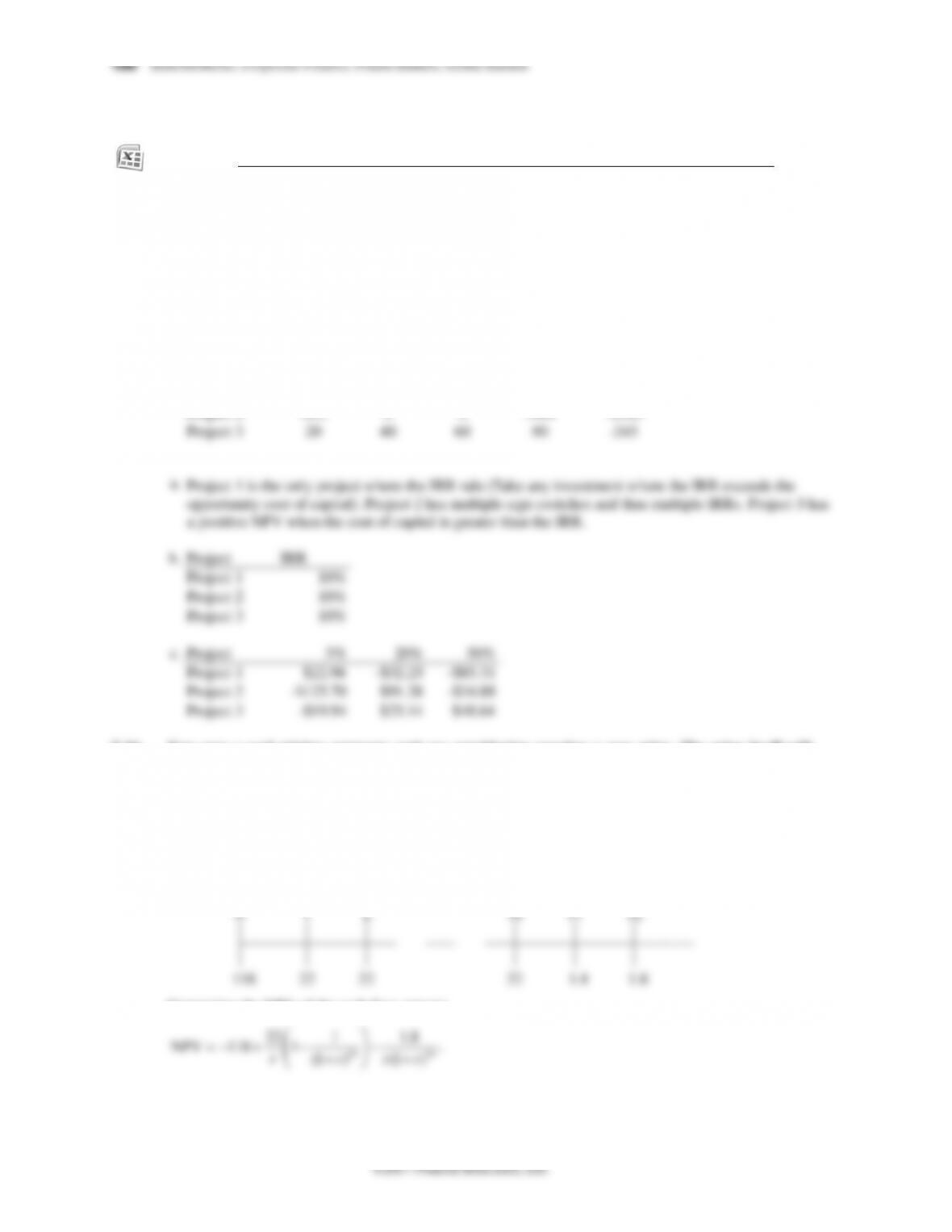
a. Timeline:
0
1
2
10
11
12
–5.1
1 – 0.097
1 – 0.097
1 – 0.097
-0.097
-0.097
Chapter 7/Investment Decision Rules 101
©2017 Pearson Education, Ltd.
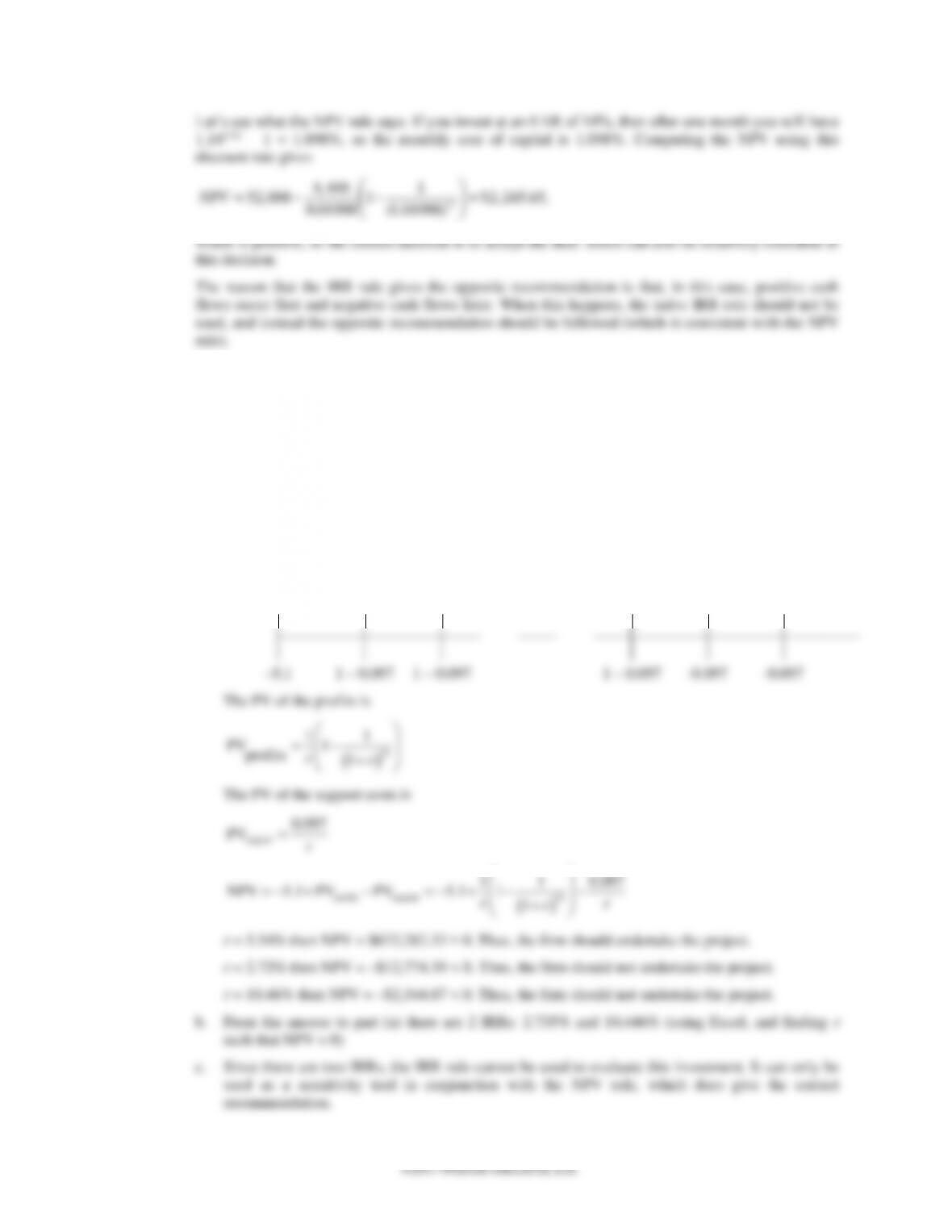
You can verify that r = 1.846% or 12.349% gives an NPV of zero. There are two IRRs, so you cannot
apply the IRR rule. Let’s see what the NPV rule says. Using the cost of capital of 7.8% gives
10 10
22 1 1.8
118 1 $20.074 million
(1.078) 0.078(1.078)
NPV r
= − + − − =
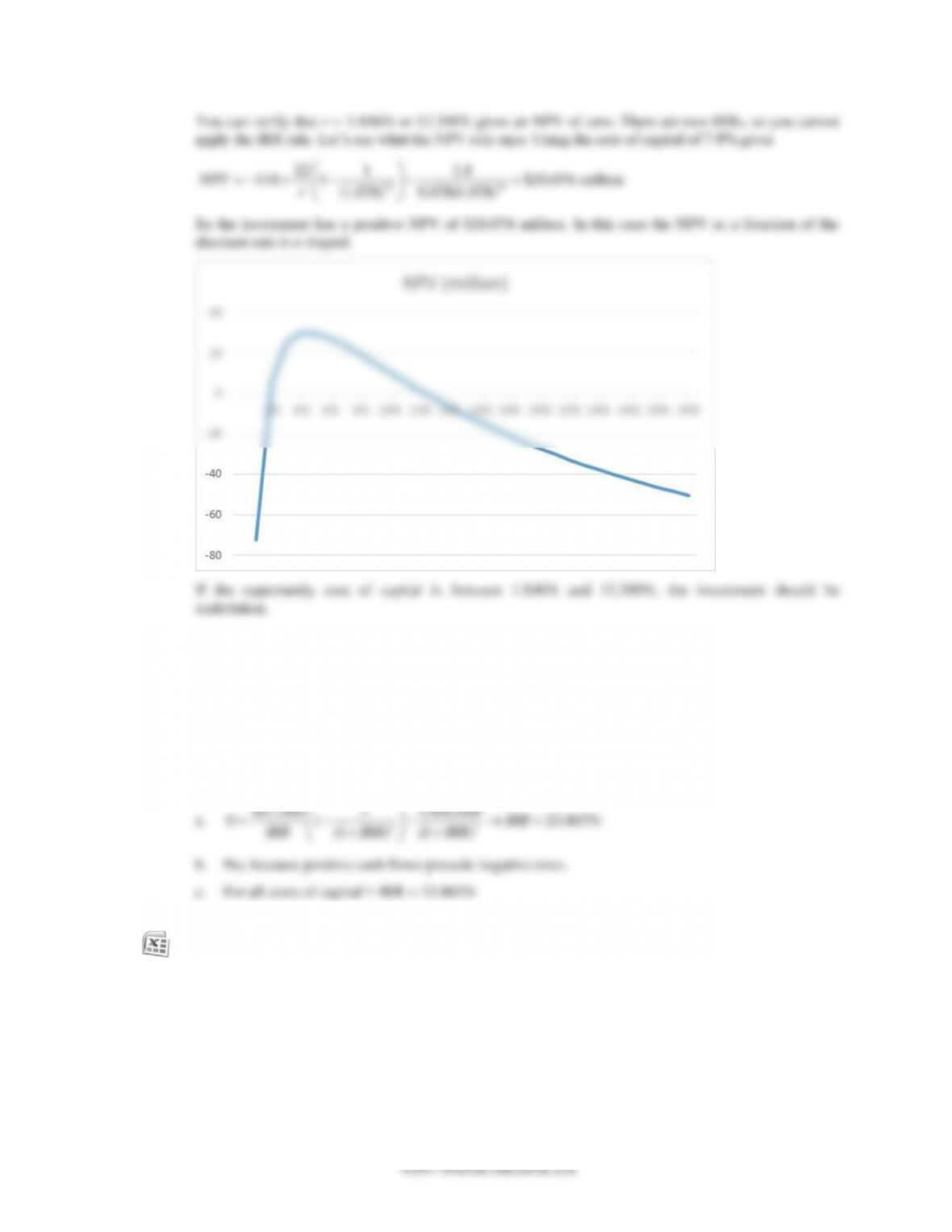
So the investment has a positive NPV of $20.074 million. In this case the NPV as a function of the
discount rate is n shaped.
7-17. Your firm spends $407,000 per year in regular maintenance of its equipment. Due to the
economic downturn, the firm considers forgoing these maintenance expenses for the next three
years. If it does so, it expects it will need to spend $1.9 million in year 4 replacing failed
equipment.
a. What is the IRR of the decision to forgo maintenance of the equipment?
b. Does the IRR rule work for this decision?
c. For what costs of capital is forgoing maintenance a good decision?
407,000 1 1,900,000
7-18. You are considering investing in a new gold mine in South Africa. Gold in South Africa is buried
very deep, so the mine will require an initial investment of $290 million. Once this investment is
made, the mine is expected to produce revenues of $29 million per year for the next 20 years. It
will cost $15 million per year to operate the mine. After 20 years, the gold will be depleted. The
mine must then be stabilized on an ongoing basis, which will cost $4.9 million per year in
perpetuity. Calculate the IRR of this investment. (Hint: Plot the NPV as a function of the
discount rate.)
102 Berk/DeMarzo, Corporate Finance, Fourth Edition, Global Edition
Timeline:
0
1
2
3
20
21
22
–290
14
14
14
14
–4.9
–4.9
( )
20
14 1
1
profits 1
PV rr
=−
+
In year 20, the PV of the stabilizations costs are
stabilization,20
4.9
PV r
=
So the PV today is
( )
stabilization 20
4.9
1
PV rr
=+
( ) ( )
20 20
14 1 4.9
290 1 11
NPV rr r r
= − + − −
++
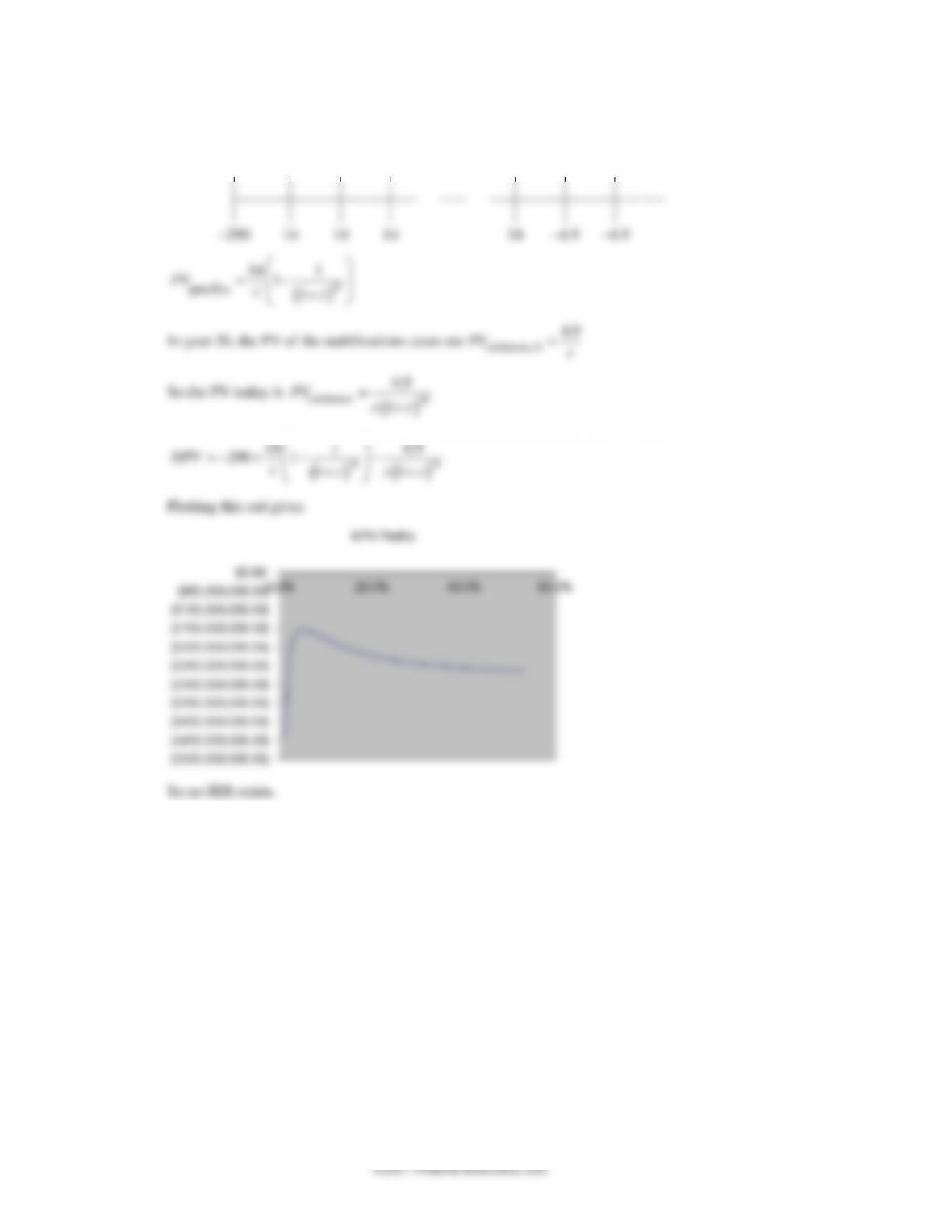
Plotting this out gives
So no IRR exists.
7-19. Your firm has been hired to develop new software for the university’s class registration system.
Under the contract, you will receive $507,000 as an upfront payment. You expect the
development costs to be $439,000 per year for the next three years. Once the new system is in
place, you will receive a final payment of $850,000 from the university four years from now.
a. What are the IRRs of this opportunity?
b. If your cost of capital is 10%, is the opportunity attractive?
Suppose you are able to renegotiate the terms of the contract so that your final payment in year 4
will be $1.2 million.
c. What is the IRR of the opportunity now?
d. Is it attractive at these terms?
©2017 Pearson Education, Ltd.
7-20. You are considering constructing a new plant in a remote wilderness area to process the ore
from a planned mining operation. You anticipate that the plant will take a year to build and cost
$99 million upfront. Once built, it will generate cash flows of $12 million at the end of every year
over the life of the plant. The plant will be useless 20 years after its completion once the mine
runs out of ore. At that point you expect to pay $141 million to shut the plant down and restore
the area to its pristine state. Using a cost of capital of 12%,
a. What is the NPV of the project?
b. Is using the IRR rule reliable for this project? Explain.
c. What are the IRR’s of this project?
Timeline:
0
1
2
3
21
Cash Flow
–99
12
12
12 + –141
a.
20
21
12 1
1
0.12 (1.12) 141
99 $32.02
1.12 (1.12)
NPV
−
= − + − =
million
.
b. No, the IRR rule is not reliable because the project has a negative cash flow that comes after the
positive ones.
c. Because the total cash flows are equal to zero (–99 + 12 20 – 141 = 0), one IRR must be 0%.
Because the cash flows change sign more than once, we can have a second IRR. This IRR solves
20
21
12 1
1(1 ) 141
0 99 1(1 )
IRR IRR
IRR IRR
−
+
= − + −
++
.
Using trial and error, Excel, or plotting the NPV profile, we can find a second IRR of 2.2387%.
Because there are two IRRs, the rule does not apply.
7-21. You are a real estate agent thinking of placing a sign advertising your services at a local bus stop.
The sign will cost $10,000 and will be posted for one year. You expect that it will generate
additional revenue of $1500 a month. What is the payback period?
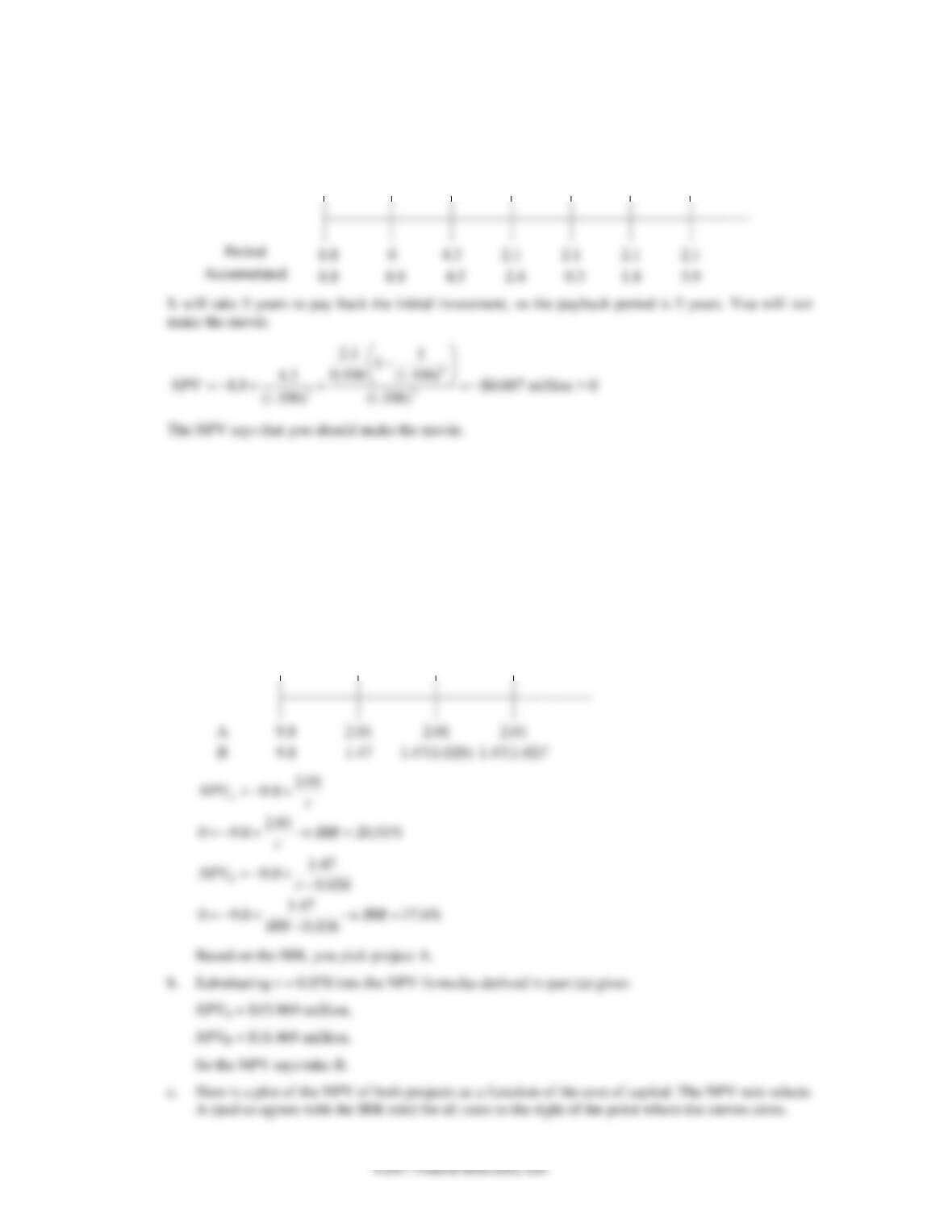
7-22. You are considering making a movie. The movie is expected to cost $8.8 million upfront and take
a year to make. After that, it is expected to make $4.3 million in the first year it is released and
$2.1 million for the following four years. What is the payback period of this investment? If you
104 Berk/DeMarzo, Corporate Finance, Fourth Edition, Global Edition
require a payback period of two years, will you make the movie? What is the NPV of the movie if
the cost of capital is 10.6%?
Timeline:
0
1
2
3
4
5
6
Period
–8.8
0
4.3
2.1
2.1
2.1
2.1
Accumulated
–8.8
–8.8
–4.5
–2.4
–0.3
1.8
3.9
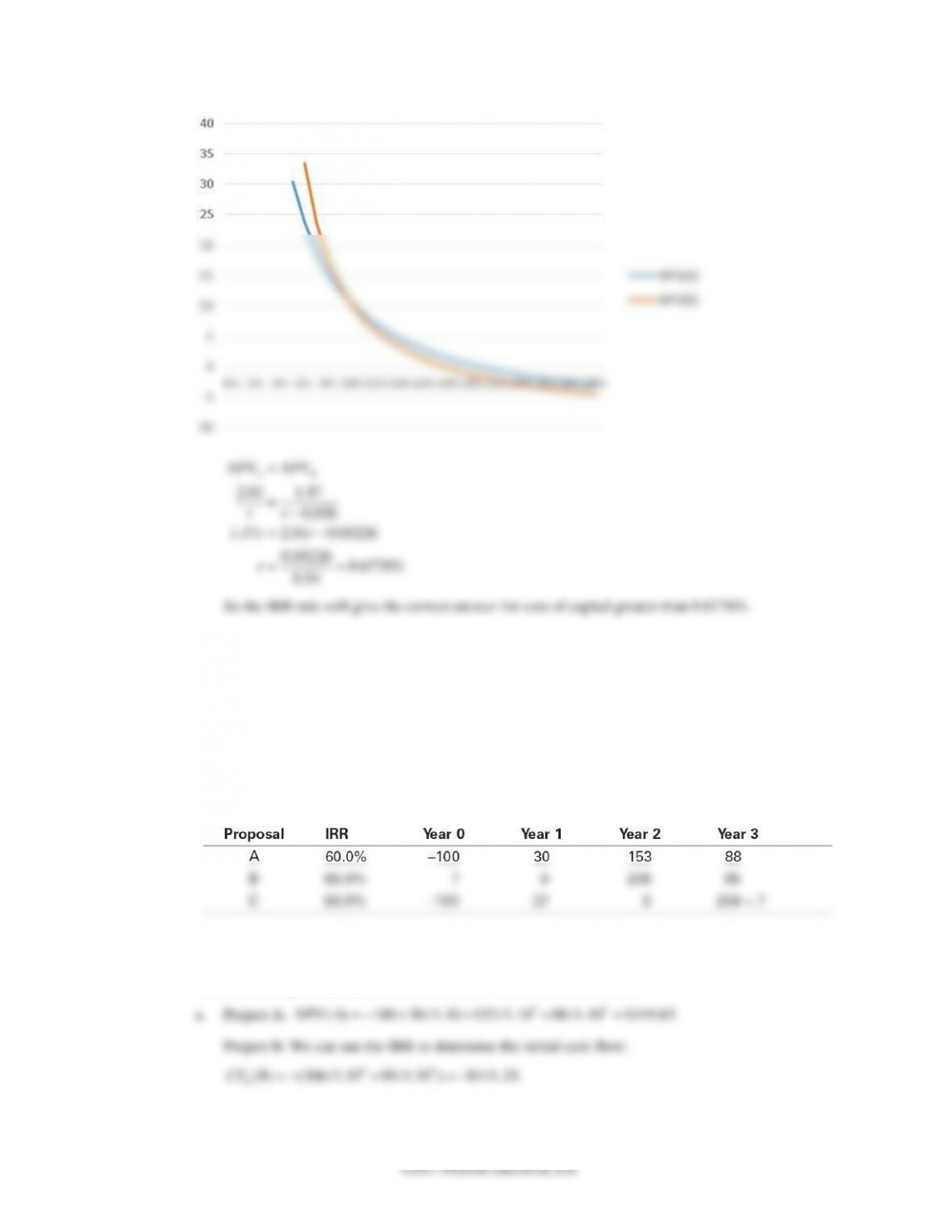
7-23. You are deciding between two mutually exclusive investment opportunities. Both require the
same initial investment of $9.8 million. Investment A will generate $2.01 million per year
(starting at the end of the first year) in perpetuity. Investment B will generate $1.47 million at
the end of the first year and its revenues will grow at 2.6% per year for every year after that.
a. Which investment has the higher IRR?
b. Which investment has the higher NPV when the cost of capital is 7.8%?
c. In this case, for what values of the cost of capital does picking the higher IRR give the
correct answer as to which investment is the best opportunity?
a. Timeline:
0
1
2
3
A
–9.8
2.01
2.01
2.01
B
–9.8
1.47
1.47(1.026)
1.47(1.02)2
2.01
9.8
2.01
0 9.8 20.51%
A
NPV r
IRR
r
= − +
= − + → =
Chapter 7/Investment Decision Rules 105
©2017 Pearson Education, Ltd.
2.01 1.47
0.026
1.47 2.01 0.05226
0.05226 9.6778%
0.54
AB
NPV NPV
rr
rr
r
=
=−
=−
==
So the IRR rule will give the correct answer for cost of capital greater than 9.6778%.
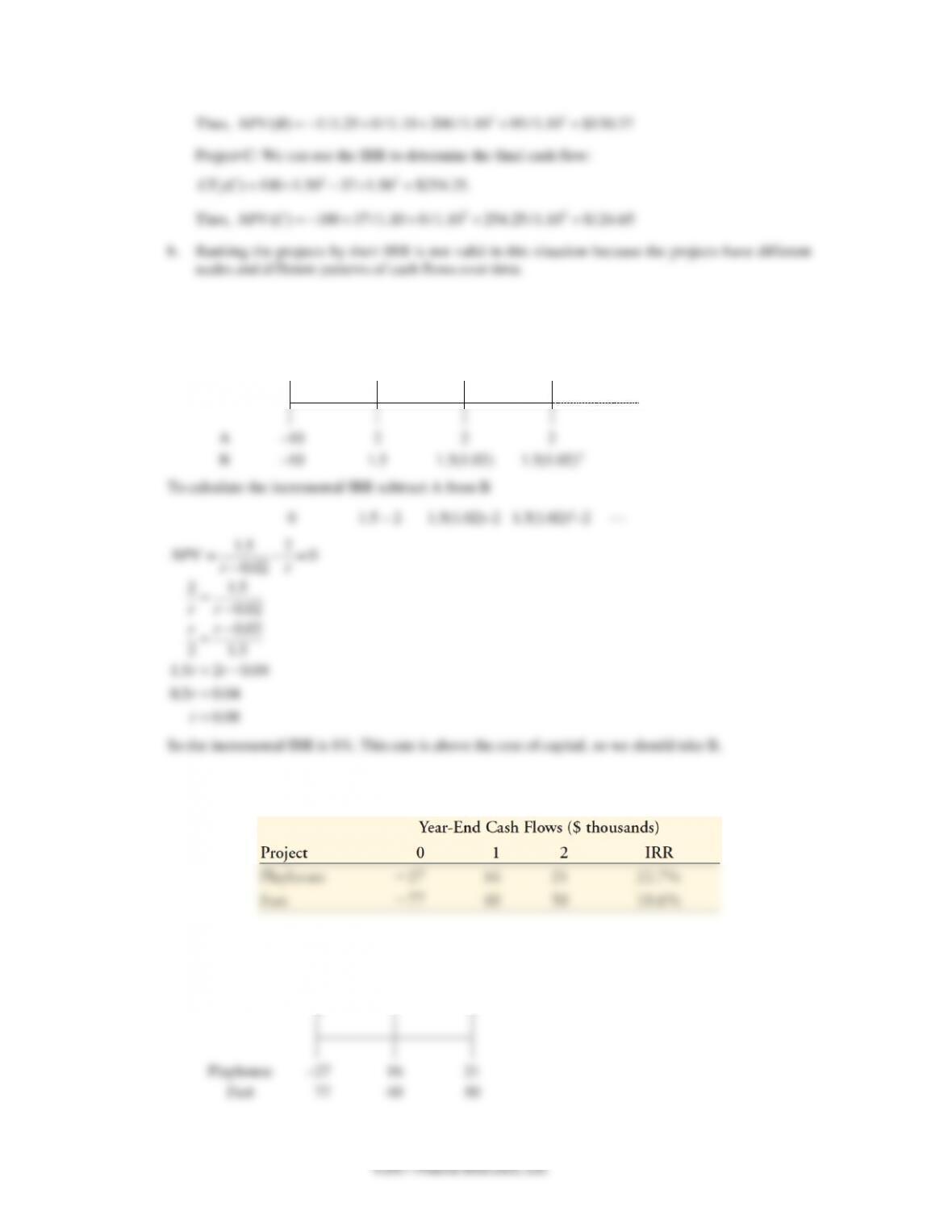
7-24. You have just started your summer internship, and your boss asks you to review a recent
analysis that was done to compare three alternative proposals to enhance the firm’s
manufacturing facility. You find that the prior analysis ranked the proposals according to their
IRR, and recommended the highest IRR option, Proposal A. You are concerned and decide to
redo the analysis using NPV to determine whether this recommendation was appropriate. But
while you are confident the IRRs were computed correctly, it seems that some of the underlying
data regarding the cash flows that were estimated for each proposal was not included in the
report. For Proposal B, you cannot find information regarding the total initial investment that
was required in year 0. And for Proposal C, you cannot find the data regarding additional
salvage value that will be recovered in year 3. Here is the information you have:
Suppose the appropriate cost of capital for each alternative is 10%. Using this information,
determine the NPV of each project. Which project should the firm choose?
Why is ranking the projects by their IRR not valid in this situation?
23
106 Berk/DeMarzo, Corporate Finance, Fourth Edition, Global Edition
©2017 Pearson Education, Ltd.
Thus,
23
( ) 111.25 0 /1.10 206 /1.10 95 /1.10 $130.37NPV B = − + + + =
Project C: We can use the IRR to determine the final cash flow:
32
3( ) 100 1.50 37 1.50 $254.25.CF C = − =
Thus,
23
( ) 100 37 /1.10 0 /1.10 254.25 /1.10 $124.65NPV C = − + + + =
b. Ranking the projects by their IRR is not valid in this situation because the projects have different
scales and different patterns of cash flows over time.
7-25. Use the incremental IRR rule to correctly choose between the investments in Problem 21 when
the cost of capital is 7%. At what cost of capital would your decision change?
Timeline:
0
1
2
3
A
–10
2
2
2
B
–10
1.5
1.5(1.02)
1.5(1.02)2
0
1.5 – 2
1.5(1.02)–2
1.5(1.02)2–2
1.5 2 0
0.02
NPV rr
= − =
−
2 1.5
0.02
0.02
2 1.5
1.5 2 0.04
0.5 0.04
0.08
rr
rr
rr
r
r
=−
−
=
=−
=
=
So the incremental IRR is 8%. This rate is above the cost of capital, so we should take B.
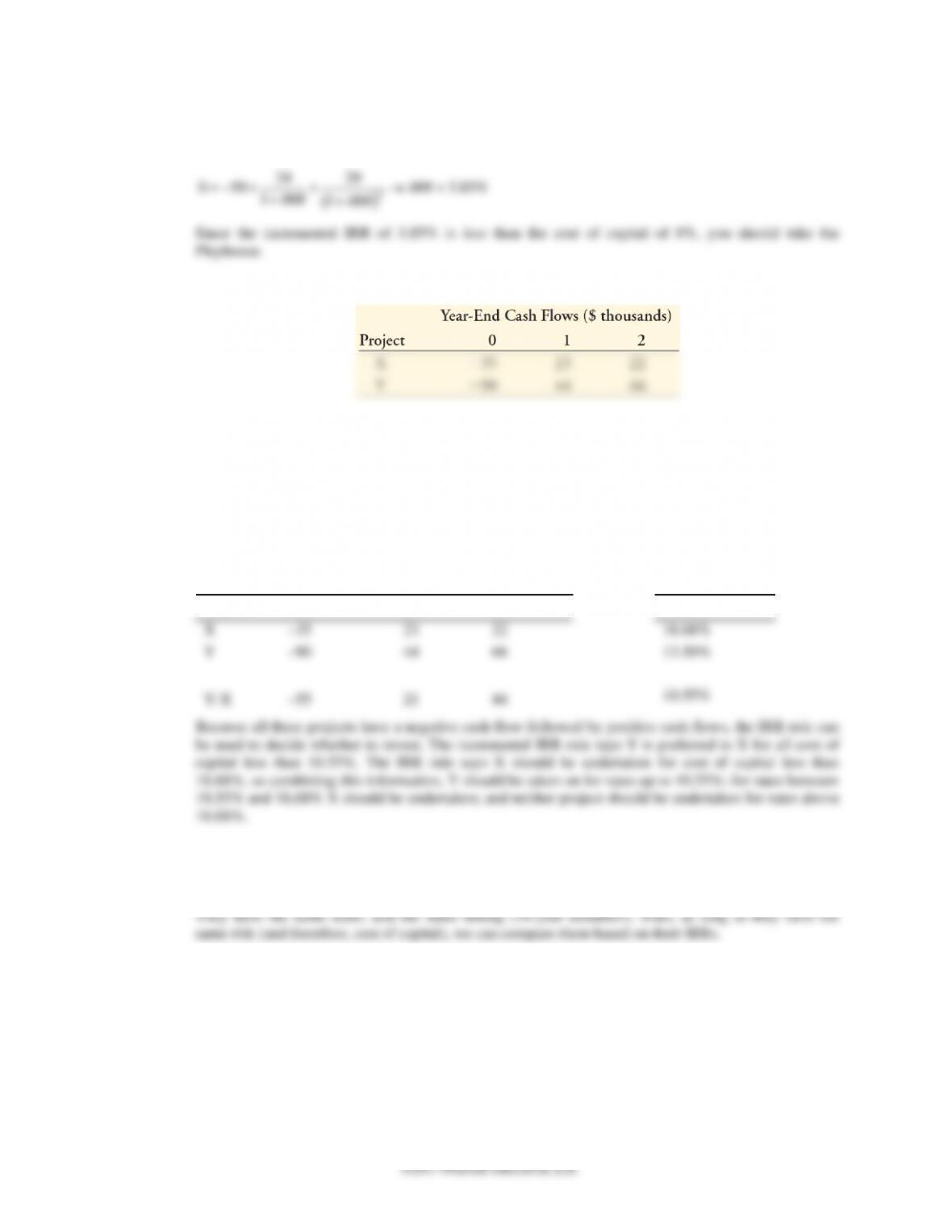
7-26. You work for an outdoor play structure manufacturing company and are trying to decide
between two projects:
You can undertake only one project. If your cost of capital is 8%, use the incremental IRR rule
to make the correct decision.
Timeline:
0
1
2
Playhouse
–27
16
21
Fort
–77
40
50
Chapter 7/Investment Decision Rules 107
Subtract the Playhouse cash flows from the Fort
–50
24
29
( )
2
24 29
0 50 3.85%
11IRR
IRR IRR
= − + + → =
++
Since the incremental IRR of 3.85% is less than the cost of capital of 8%, you should take the
Playhouse.
7-27. You are evaluating the following two projects:
Use the incremental IRR to determine the range of discount rates for which each project is
optimal to undertake. Note that you should also include the range in which it does not make
sense to take either project.
To compute the incremental IRR, we first need to compute the difference between the cash flows.
Compute Y – X to make sure the incremental net investment is negative and the other cash flows are
positive:
Year-End Cash Flows ($ thousands)
Project
0
1
2
IRR
X
–35
23
22
18.68%
Y
–90
44
66
13.50%
Y-X
–55
21
44
10.55%
Because all three projects have a negative cash flow followed by positive cash flows, the IRR rule can
be used to decide whether to invest. The incremental IRR rule says Y is preferred to X for all cost of
capital less than 10.55%. The IRR rule says X should be undertaken for cost of capital less than
18.68%, so combining this information, Y should be taken on for rates up to 10.55%; for rates between
10.55% and 18.68% X should be undertaken; and neither project should be undertaken for rates above
18.68%.
7-28. Consider two investment projects, both of which require an upfront investment of $12 million
and pay a constant positive amount each year for the next 10 years. Under what conditions can
you rank these projects by comparing their IRRs?
7-29. You are considering a safe investment opportunity that requires a $780 investment today, and
will pay $570 two years from now and another $580 five years from now.
a. What is the IRR of this investment?
b. If you are choosing between this investment and putting your money in a safe bank account
that pays an EAR of 5% per year for any horizon, can you make the decision by simply
comparing this EAR with the IRR of the investment? Explain.
108 Berk/DeMarzo, Corporate Finance, Fourth Edition, Global Edition
©2017 Pearson Education, Ltd.
a.
( ) ( )
25
570 580
0 780 12.15%
11 IRR
IRR IRR
= − + + → =
++
b. Yes—because they have the same timing, scale, and risk (safe), you can choose the investment
with the higher IRR (i.e. the investment opportunity).
7-30. Facebook is considering two proposals to overhaul its network infrastructure. They have
received two bids. The first bid, from Huawei, will require a $17 million upfront investment and
will generate $20 million in savings for Facebook each year for the next three years. The second
bid, from Cisco, requires a $97 million upfront investment and will generate $60 million in
savings each year for the next three years.
a. What is the IRR for Facebook associated with each bid?
b. If the cost of capital for this investment is 16%, what is the NPV for Facebook of each bid?
Suppose Cisco modifies its bid by offering a lease contract instead. Under the terms of the
lease, Facebook will pay $30 million upfront, and $35 million per year for the next three
years. Facebook’s savings will be the same as with Cisco’s original bid.
c. Including its savings, what are Facebook’s net cash flows under the lease contract? What is
the IRR of the Cisco bid now?
d. Is this new bid a better deal for Facebook than Cisco’s original bid? Explain.
20 1
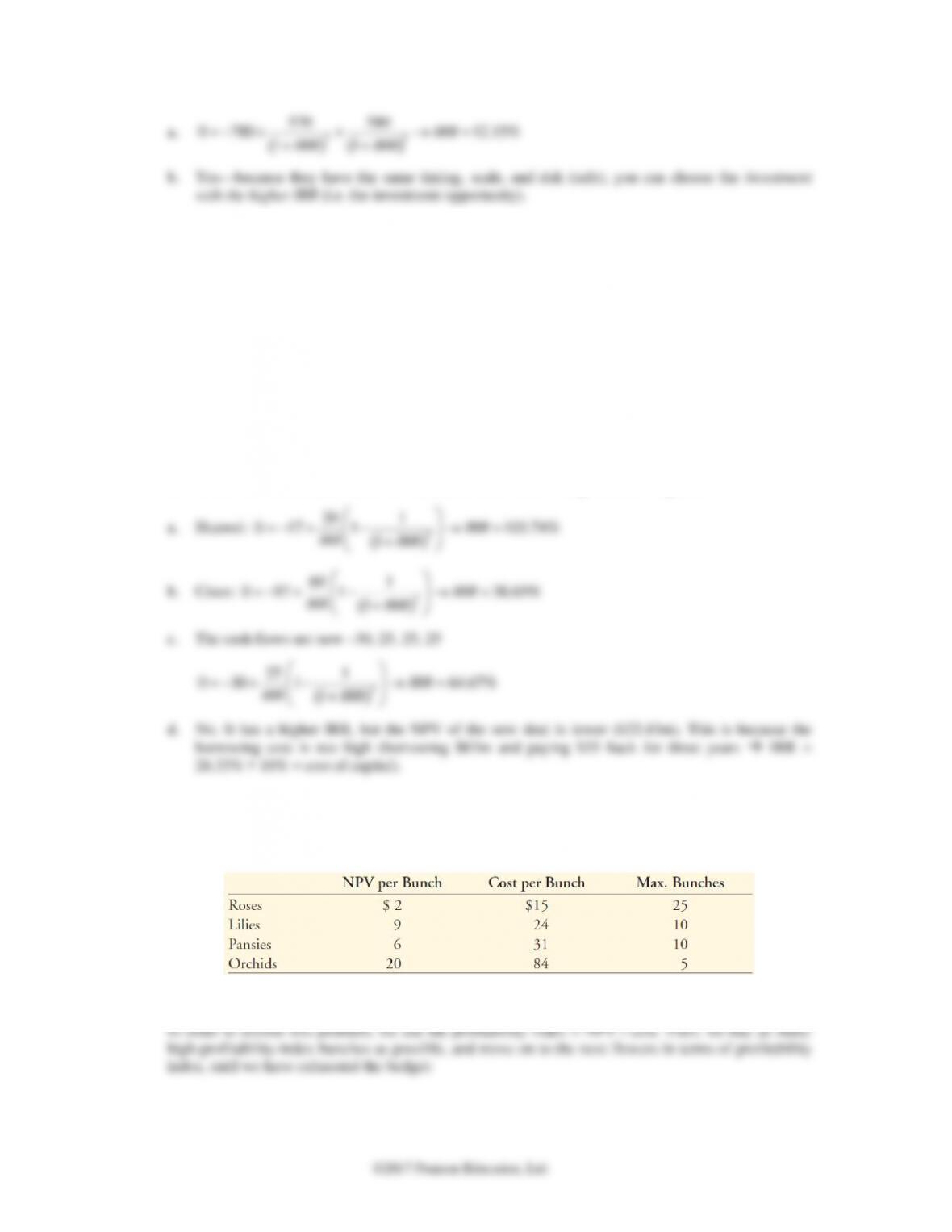
7-31. Natasha’s Flowers, a local florist, purchases fresh flowers each day at the local flower market.
The buyer has a budget of $970 per day to spend. Different flowers have different profit margins,
and also a maximum amount the shop can sell. Based on past experience the shop has estimated
the following NPV of purchasing each type:
What combination of flowers should the shop purchase each day?
©2017 Pearson Education, Ltd.
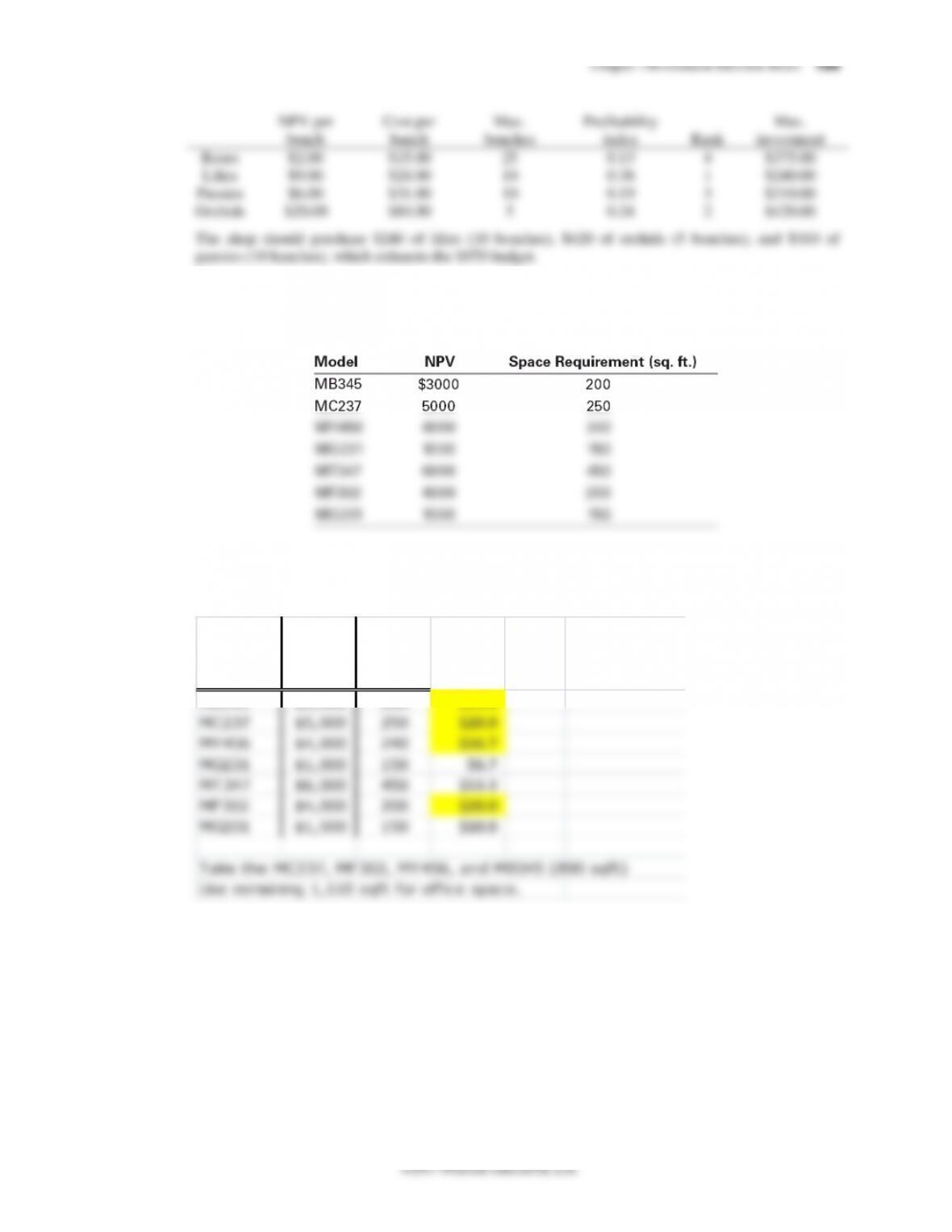
7-32. You own a car dealership and are trying to decide how to configure the showroom floor. The
floor has 2000 square feet of usable space. You have hired an analyst and asked her to estimate
the NPV of putting a particular model on the floor and how much space each model requires:
In addition, the showroom also requires office space. The analyst has estimated that office space
generates an NPV of $14 per square foot. What models should be displayed on the floor and how
many square feet should be devoted to office space?
Model NPV
Space
Requirem
ent (sq.
ft.)
NPV/sqft
MB345 $3,000 200 $15.0
MC237 $5,000 250 $20.0
MY456 $4,000 240 $16.7
MG231 $1,000 150 $6.7
MT347 $6,000 450 $13.3
MF302 $4,000 200 $20.0
MG201 $1,500 150 $10.0
Take the MC237, MF302, MY456, and MB345 (890 sqft)
Use remaining 1,110 sqft for office space.
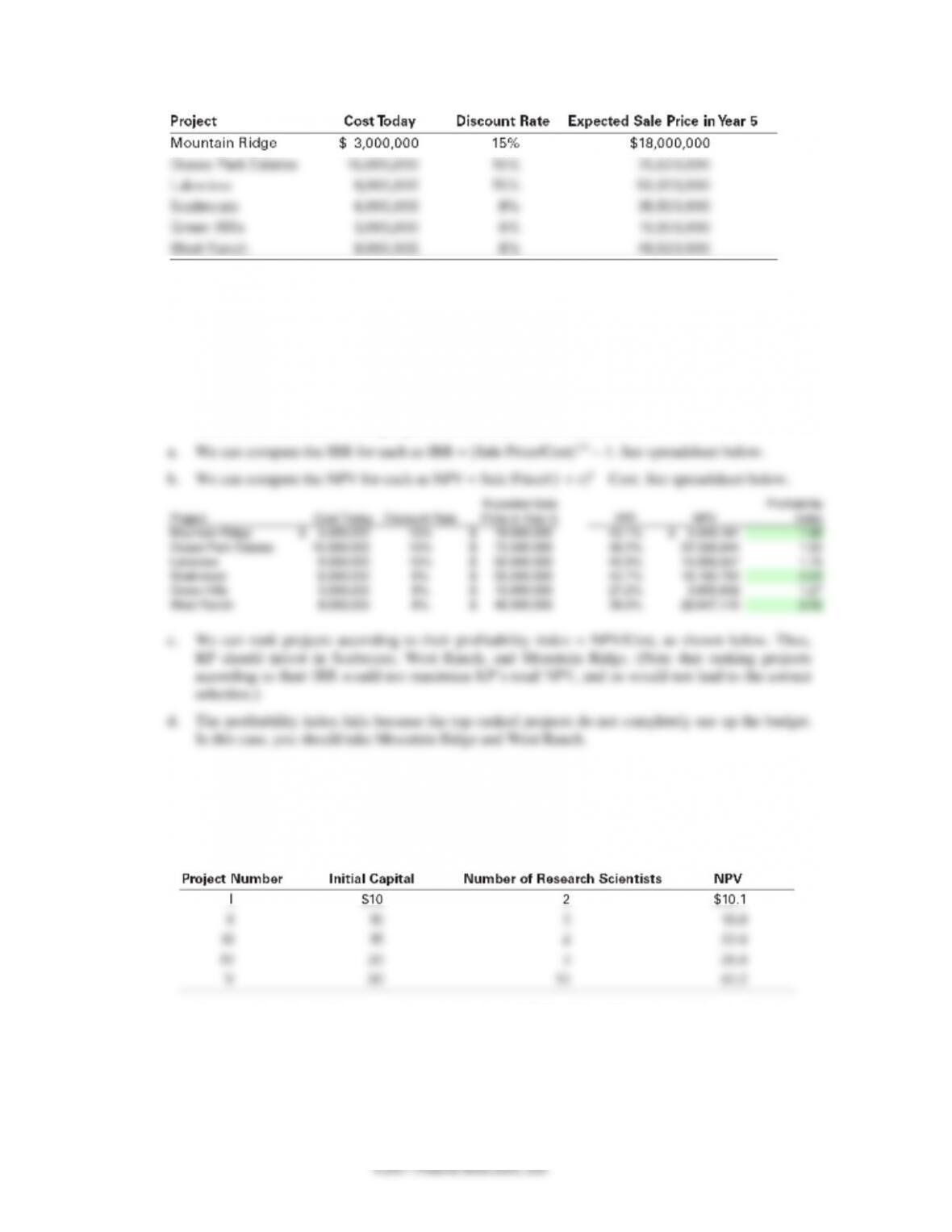
7-33. Kaimalino Properties (KP) is evaluating six real estate investments. Management plans to buy
the properties today and sell them five years from today. The following table summarizes the
initial cost and the expected sale price for each property, as well as the appropriate discount rate
based on the risk of each venture.
110 Berk/DeMarzo, Corporate Finance, Fourth Edition, Global Edition
KP has a total capital budget of $18,000,000 to invest in properties.
a. What is the IRR of each investment?
b. What is the NPV of each investment?
c. Given its budget of $18,000,000, which properties should KP choose?
d. Explain why the profitability index method could not be used if KP’s budget were
$12,000,000 instead. Which properties should KP choose in this case?
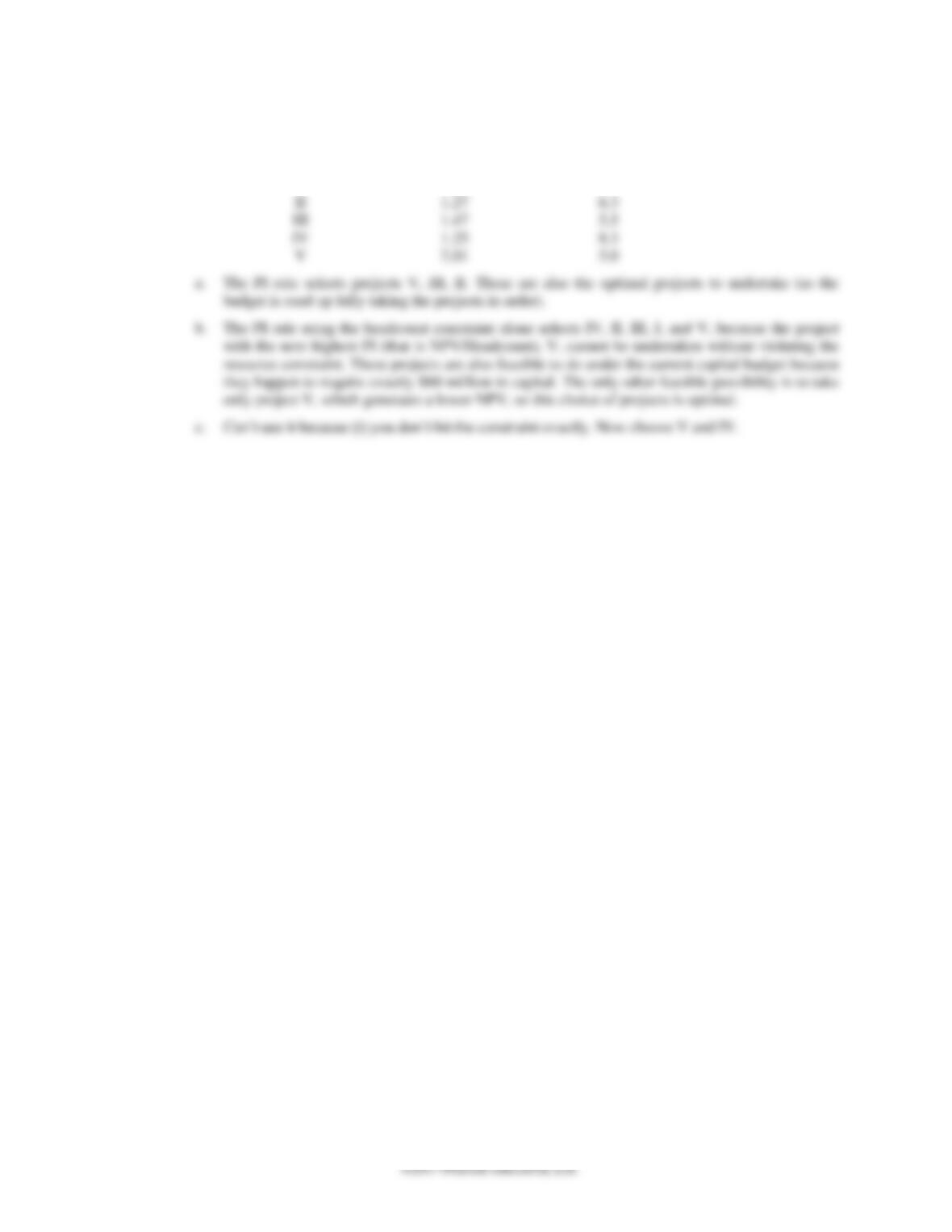
7-34. Orchid Biotech Company is evaluating several development projects for experimental drugs.
Although the cash flows are difficult to forecast, the company has come up with the following
estimates of the initial capital requirements and NPVs for the projects. Given a wide variety of
staffing needs, the company has also estimated the number of research scientists required for
each development project (all cost values are given in millions of dollars).
a. Suppose that Orchid has a total capital budget of $60 million. How should it prioritize these
projects?
b. Suppose in addition that Orchid currently has only 12 research scientists and does not
anticipate being able to hire any more in the near future. How should Orchid prioritize these
projects?
Chapter 7/Investment Decision Rules 111
c. If instead, Orchid had 15 research scientists available, explain why the profitability index
ranking cannot be used to prioritize projects. Which projects should it choose now?
Project
PI
NPV/Headcount
I
1.01
5.1
II
1.27
6.3
III
1.47
5.5
IV
1.25
8.3
V
2.01
5.0