
Chapter 7
ANSWERS TO QUESTIONS
1. What basic principle of finance can be applied to the valuation of any investment asset?
The value of any investment is found by computing the value today of all cash flows the
2. What are the two main sources of cash flows for a stockholder? How reliably can these cash
flows be estimated? Compare the problem of estimating stock cash flows to the problem of
estimating bond cash flows. Which security would you predict to be more volatile?
There are two cash flows from stock: periodic dividends and a future sales price. Dividends
are frequently changed when a firm’s earnings either rise or fall, which can make them
difficult to estimate. The future sales price is also difficult to estimate, because it depends on
the dividends that will be paid at some date even further in the future. Bond cash flows also
3. Some economists think that central banks should try to prick bubbles in the stock market
before they get out of hand and cause later damage when they burst. How can monetary
policy be used to prick a market bubble? Explain using the Gordon growth model.
A stock market bubble can occur if market participants either believe that dividends will have
rapid growth or if they substantially lower the required return on their equity investments,
thus lowering the denominator in the Gordon model and thereby causing stock prices to
4. If monetary policy becomes more transparent about the future course of interest rates, how
will stock prices be affected, if at all?
With more certainty over the course future interest rates will follow, uncertainty and risk
would likely be reduced, which will lower the required return on investment ke and lead to a
5. Suppose that you are asked to forecast future stock prices of ABC Corporation, so you
proceed to collect all available information. The day you announce your forecast,
competitors of ABC Corporation announce a brand new plan to merge and reshape the
structure of the industry. Would your forecast still be considered optimal?
Your forecast is still considered to be optimal, since it was made with all available
information at the time. The fact that new information that would most probably impact the
6. “Anytime it is snowing when Joe Commuter gets up in the morning, he misjudges how long it
will take him to drive to work. When it is not snowing, his expectations of the driving time are
perfectly accurate. Considering that it snows only once every ten years where Joe lives, Joe’s
expectations are almost always perfectly accurate.” Are Joe’s expectations rational? Why or
why not?
Although Joe’s expectations are typically quite accurate, they could still be improved by his
7. If Suppose that you decide to play a game. You buy stock by throwing a dice a few times,
using that method to select which stock to buy. After ten months you calculate the return on
your investment and the return earned by someone who followed “expert” advice during the
same period. If both returns are similar, would this constitute evidence in favor of or against
the efficient market hypothesis?
If both returns are similar, this would constitute evidence in favor of the efficient market
hypothesis, that states that so called “expert” advice is not a better predictor of movements in
8. “If stock prices did not follow a random walk, there would be unexploited profit
opportunities in the market.” Is this statement true, false, or uncertain? Explain your answer.
True, as an approximation. If large changes in a stock price could be predicted, then the
optimal forecast of the stock return would not equal the equilibrium return for that stock. In
this case, there would be unexploited profit opportunities in the market and expectations
9. Suppose that increases in the money supply lead to a rise in stock prices. Does this mean that
when you see that the money supply has sharply increased in the past week, you should go
out and buy stocks? Why or why not?
No, you shouldn’t buy stocks, because the rise in the money supply is publicly available
10. You are considering purchasing a 10-year bond and follow the theory of rational
expectations. If you have just read the annual report of the central bank in your country that
states interest rates are higher than expected, will you buy the bond today or in the next
month?
If you follow the theory of rational expectations, then you can expect that interest rates will
11. If you read in the Wall Street Journal that the “smart money” on Wall Street expects stock
prices to fall, should you follow that lead and sell all your stocks?
No, because this is publicly available information and is already reflected in stock prices. The
12. If your broker has been right in her five previous buy and sell recommendations, should you
continue listening to her advice?
Probably not. Although your broker has done well in the past, efficient markets theory
suggests that she has probably been lucky. Unless you believe that your broker has better
13. Can a person with rational expectations expect the price of a share of Google to rise by 10%
in the next month?
No, if the person has no better information than the rest of the market. An expected price rise
of 10% over the next month implies over a 100% annual return on Google stock, which
14. Suppose that in every last week of November stock prices go up by an average of 3%. Would
this constitute evidence in favor of or against the efficient market hypothesis?
If there is a phenomenon that takes place regularly and it is not incorporated into people’s
expectations, then these expectations are not optimal (since they are not including all
available information). We can conclude that people are not taking into account that stock
15. “An efficient market is one in which no one ever profits from having better information than
the rest of the market participants.” Is this statement true, false, or uncertain? Explain your
answer.
False. The people with better information are exactly those who make the market more
16. If higher money growth is associated with higher future inflation, and if announced money
growth turns out to be extremely high but is still less than the market expected, what do you
think will happen to long-term bond prices?
Because inflation is less than expected, expectations of future short-term interest rates would
17. “Foreign exchange rates, like stock prices, should follow a random walk.” Is this statement
true, false, or uncertain? Explain your answer.
True, in principle. Foreign exchange rates are a random walk over a short interval such as a
week, because changes in the exchange rate are unpredictable; if a change were predictable,
18. Assume that the efficient market hypothesis holds. Marcos has been recently hired by a
brokerage firm and claims that he now has access to the best market information. However,
he is the “new guy,” and no one at the firm tells him much about the business. Would you
expect Marcos’s clients to be better or worse off than the rest of the firm’s clients?
If the efficient market hypothesis holds, then Marcos’ clients would technically not be at any
disadvantage with respect to other clients of the same firm. However, information flows
19. Suppose that you are a trader at the stock market. T-Mobile’s stocks currently trade at $45
and the expected return is 9%. You have information that leads you to believe that by the end
of year the company’s returns will be around 40%. Are your expectations optimal? How will
your behavior influence the stock price?
For your expectations to be optimal, they must include all available information up to date.
This means that you need to consider unexploited profit opportunities, that is, the profit
20. In the late 1990s, as information technology advanced rapidly and the Internet was widely
developed, U.S. stock markets soared, peaking in early 2001. Later that year, these markets
began to unwind and then crashed, with many commentators identifying the previous few
years as a “stock market bubble.” How might it be possible for this episode to be a bubble
but still adhere to the efficient market hypothesis?
It may be considered a bubble in that stock market prices rose well above true fundamental
values. However, given the relatively new and rapid technology advances during the time,
there was a great deal of uncertainty over what the true fundamental values of many
21. What are the implications of behavioral finance?
Behavioral finance suggests that most people are averse to loss, so quite often when markets
are down and brokers face losses, they tend to make even worse decisions to avoid these
ANSWERS TO APPLIED PROBLEMS
22. Compute the price of a share of stock that pays a $5 per year dividend and that you expect to
be able to sell in one year for $40, assuming you require a 5% return.
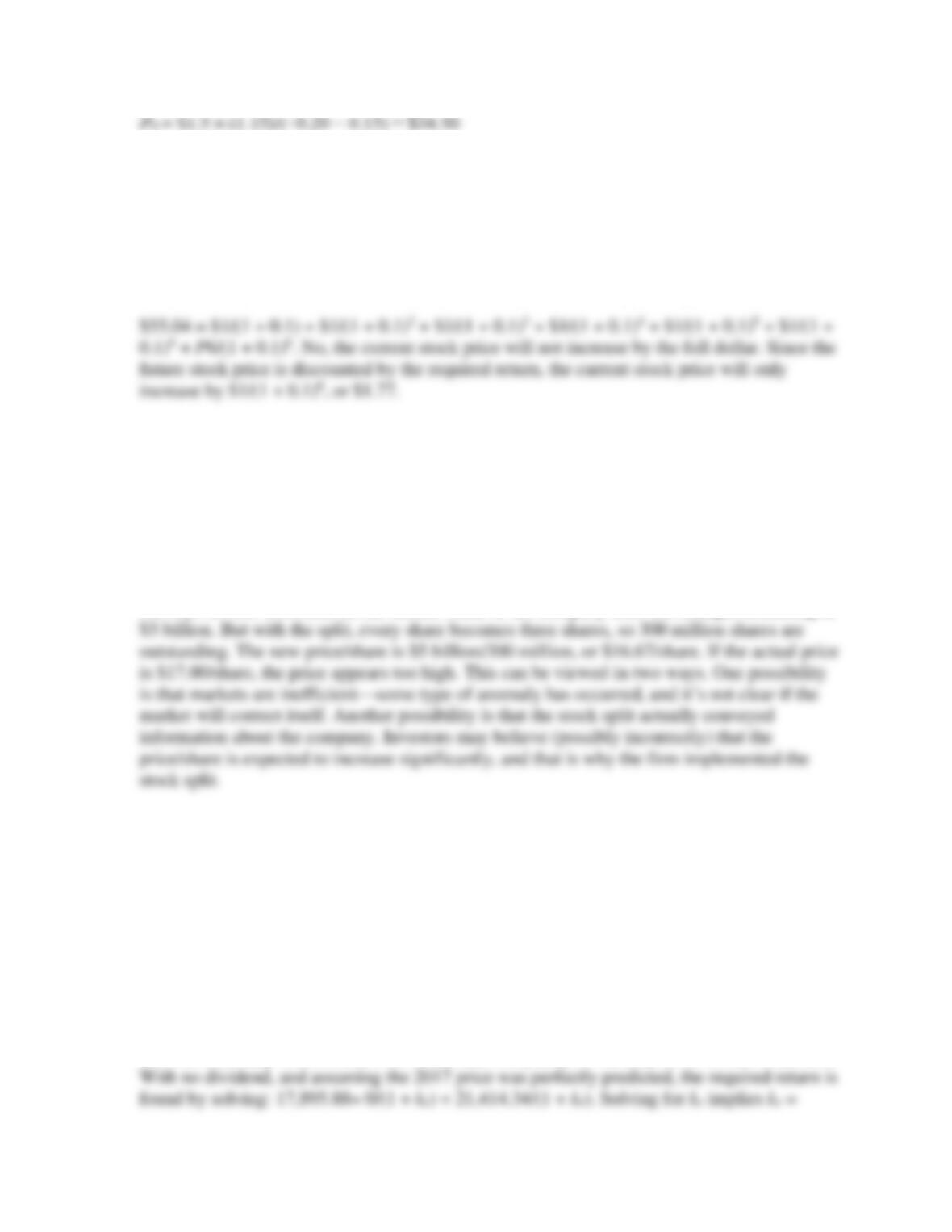
24. The current price of a stock is $55.04. If dividends are expected to be $1 per share for the
next six years, and the required return is 8%, what should the price of the stock be in six
years when you plan to sell it? If the dividend and required return remain the same, and the
stock price is expected to increase by $1 six years from now, does the current stock price also
increase by $1? Why or why not?
The price six years from now should be $80. This can be found by solving for P6 below:
25. A company has just announced a 3-for-1 stock split, effective immediately. Prior to the split,
the company had a market value of $5 billion with 100 million shares outstanding. Assuming
the split conveys no new information about the company, what are the value of the company,
the number of shares outstanding, and the price per share after the split? If the actual market
price immediately following the split is $17.00 per share, what does this tell us about market
efficiency?
Prior to the split, each share was worth $5 billion/100 million, or $50/share. If the split
conveys no new information, the market value of the company does not change, remaining at
ANSWERS TO DATA ANALYSIS PROBLEMS
1. Go to the St. Louis Federal Reserve FRED database and find data on the Dow Jones
Industrial Average (DJIA). Assume the DJIA is a stock that pays no dividends. Apply the one-
period valuation model, using the data from one year prior up to the most current date
available, to determine the required return on equity investment. In other words, assume the
most recent stock price of DJIA is known one year prior. What rate of return would be
required in order to “buy” a share of DJIA? Suppose that a $100 dividend is paid out
instead. How does this change the required rate of return?
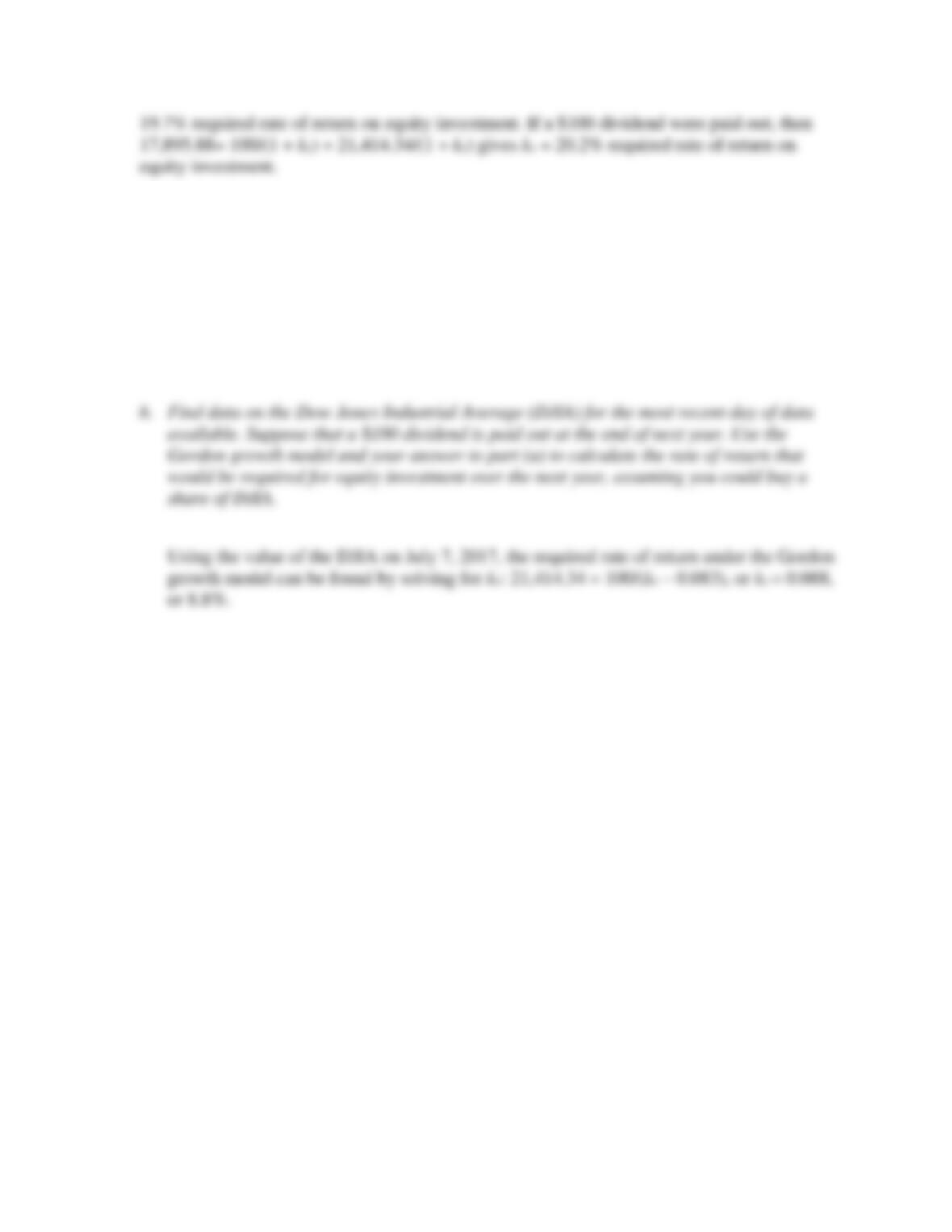
The DJIA on July 7, 2017, was 21,414.34, and one year prior on July 7, 2016, was 17,895.88.
2. Go to the St. Louis Federal Reserve FRED database and find data on net corporate dividend
payments (B056RC1A027NBEA). Adjust the units setting to “Percent Change from Year
Ago,” and download the data into a spreadsheet.
a. Calculate the average annual growth rate of dividends from 1960 to the most recent year
of data available.
From 1960 to 2016, the average growth rate of dividend payments was 8.3%.