Chapter 5
Interest Rates
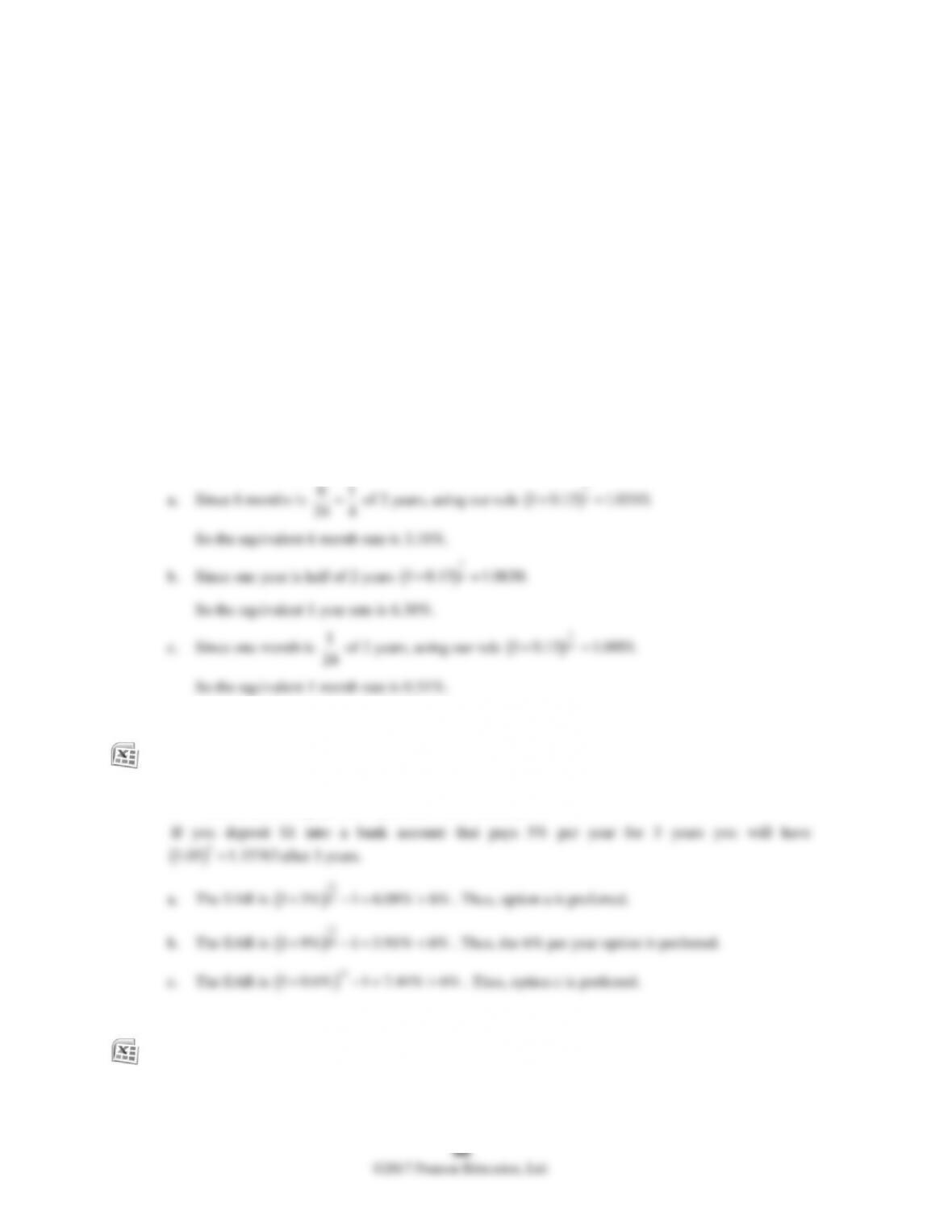
5-1. Your bank is offering you an account that will pay 13% interest in total for a two-year deposit.
Determine the equivalent discount rate for a period length of:
a. Six months.
b. One year.
c. One month.
61
1
5-2. Which do you prefer: a bank account that pays 6% per year (EAR) for three years or:
a. An account that pays 3% every six months for three years?
b. An account that pays 9% every 18 months for three years?
c. An account that pays 0.6% per month for three years?
5-3. Many academic institutions offer a sabbatical policy. Every seven years a professor is given a
year free of teaching and other administrative responsibilities at full pay. For a professor
earning $100,000 per year who works for a total of 42 years, what is the present value of the
amount she will earn while on sabbatical if the interest rate is 6% (EAR)?
Chapter 5/Interest Rates 57
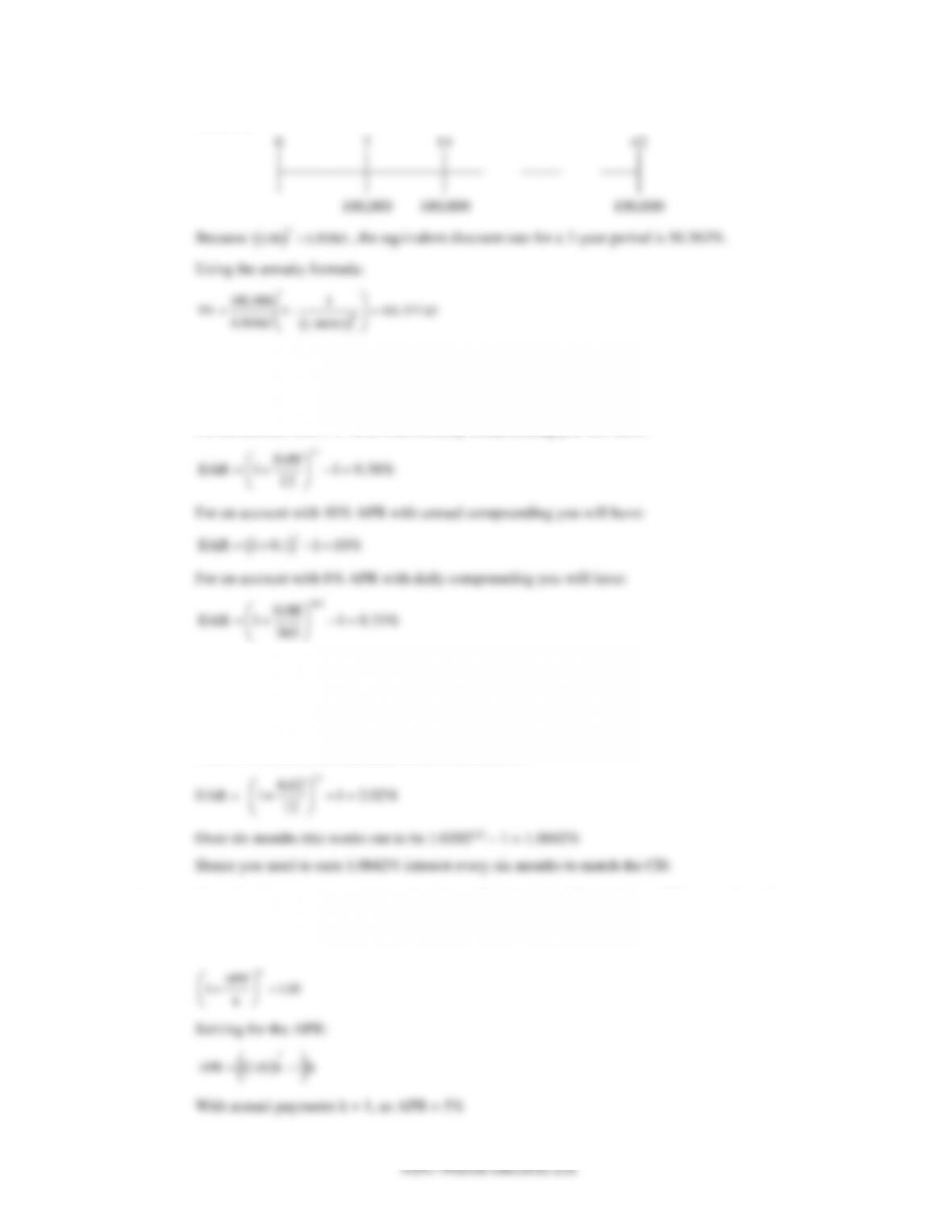
Timeline:
0
7
14
42
100,000
100,000
100,000
Because
( )
7
1.06 1.50363=
, the equivalent discount rate for a 7-year period is 50.363%.
Using the annuity formula:
( )
6
100,000 1
PV 1 181,377.62
0.50363 1.50363
= − =
5-4. You have found three investment choices for a one-year deposit: 9% APR compounded monthly,
10% APR compounded annually, and 8% APR compounded daily. Compute the EAR for each
investment choice. (Assume that there are 365 days in the year.)
For an account with 9% APR with monthly compounding you will have:
12
0.09
EAR 1 1 9.38%
12
= + − =
For an account with 10% APR with annual compounding you will have:
( )
1
EAR 1 0.1 1 10%= + − =
For an account with 8% APR with daily compounding you will have:
365
0.08
EAR 1 1 8.33%
365
= + − =
5-5. You are considering moving your money to new bank offering a one-year CD that pays an APR
of 2% with monthly compounding. Your current bank’s manager offers to match the rate you
have been offered. The account at your current bank would pay interest every six months. How
much interest will you need to earn every six months to match the CD?
With 2% APR, we can calculate the EAR as follows:
12
0.02
5-6. Your bank account pays interest with an EAR of 5%. What is the APR quote for this account
based on semiannual compounding? What is the APR with monthly compounding?
Using the formula for converting from an EAR to an APR quote:
k
APR
1 1.05
k
+=
Solving for the APR:
( )
( )
1
k
APR 1.05 1 k=−
With annual payments k = 1, so APR = 5%
58 Berk/DeMarzo, Corporate Finance, Fourth Edition, Global Edition
©2017 Pearson Education, Ltd.
With semiannual payments k = 2, so APR = 4.939%
With monthly payments k = 12, so APR = 4.889%
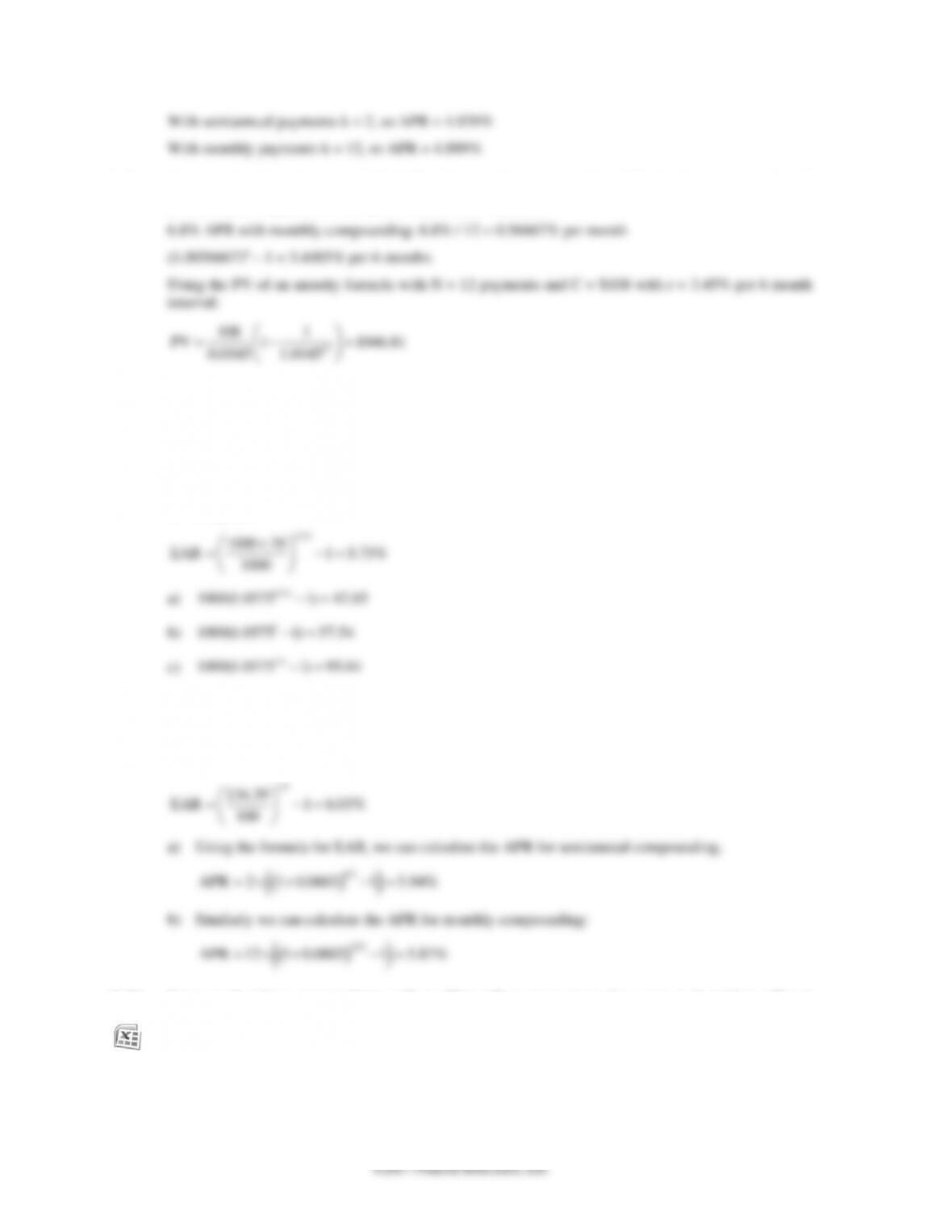
5-7. Suppose the interest rate is 6.8% APR with monthly compounding. What is the present value of
an annuity that pays $108 every six months for six years?
12
0.0345 1.0345
5-8. You can earn $38 in interest on a $1000 deposit for eight months. If the EAR is the same
regardless of the length of the investment, determine how much interest you will earn on a $1000
deposit for:
a. 9 months.
b. 1 year.
c. 1.6 years.
12/8
1000 38
EAR 1 5.75%
1000
+
= − =
a)
9/12
1000(1.0575 1) 42.85−=
b)
1
1000(1.0575 1) 57.54−=
c)
1.6
1000(1.0575 1) 93.64−=
5-9. Suppose you invest $101 in a bank account, and five years later it has grown to $136.4.
a. What APR did you receive, if the interest was compounded semiannually?
b. What APR did you receive if the interest was compounded monthly?
1/5
134.39
EAR 1 6.03%
100
= − =
a) Using the formula for EAR, we can calculate the APR for semiannual compounding.
( )
( )
12
APR 2 1 0.0603 1 5.94%= + − =
b) Similarly we can calculate the APR for monthly compounding:
( )
( )
112
APR 12 1 0.0603 1 5.87%= + − =
5-10. Your son has been accepted into college. This college guarantees that your son’s tuition will not
increase for the four years he attends college. The first $8500 tuition payment is due in six
months. After that, the same payment is due every six months until you have made a total of
eight payments. The college offers a bank account that allows you to withdraw money every six
months and has a fixed APR of 8% (semiannual) guaranteed to remain the same over the next
four years. How much money must you deposit today if you intend to make no further deposits
Chapter 5/Interest Rates 59
and would like to make all the tuition payments from this account, leaving the account empty
when the last payment is made?
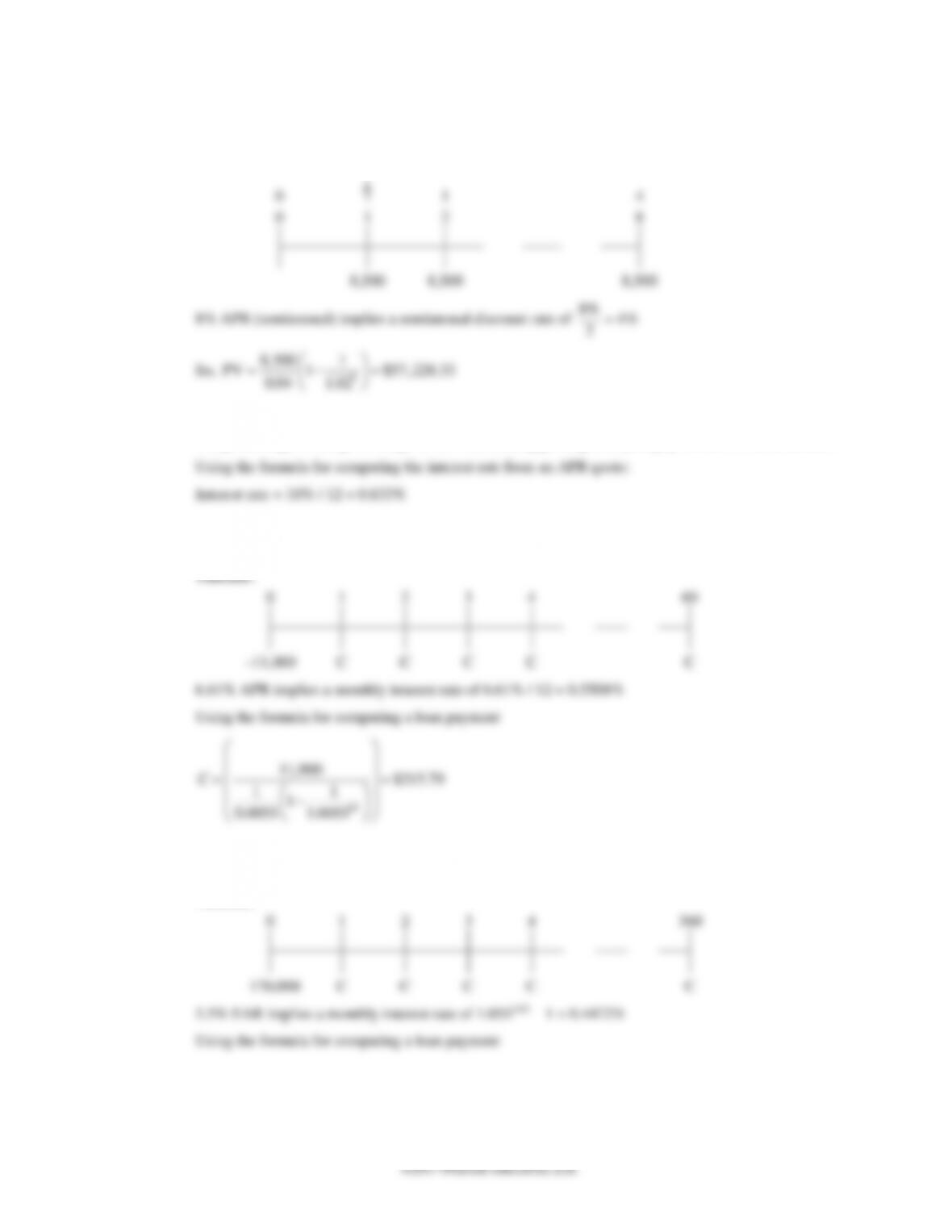
Timeline:
0
1
2
1
4
0
1
2
8
8,500
8,500
8,500
8% APR (semiannual) implies a semiannual discount rate of
8% 4%
2=
So,
8
8,500 1
PV 1 $57,228.33
0.04 1.02
= − =
5-11. You make monthly payments on your mortgage. It has a quoted APR of 10% (monthly
compounding). What percentage of the outstanding principal do you pay in interest each month?
5-12. Capital One is advertising a 60-month, 6.61% APR motorcycle loan. If you need to borrow
$11,000 to purchase your dream Harley Davidson, what will your monthly payment be?
0
1
2
3
4
C
C
C
C
C
60
11
1
0.0055 1.0055
−
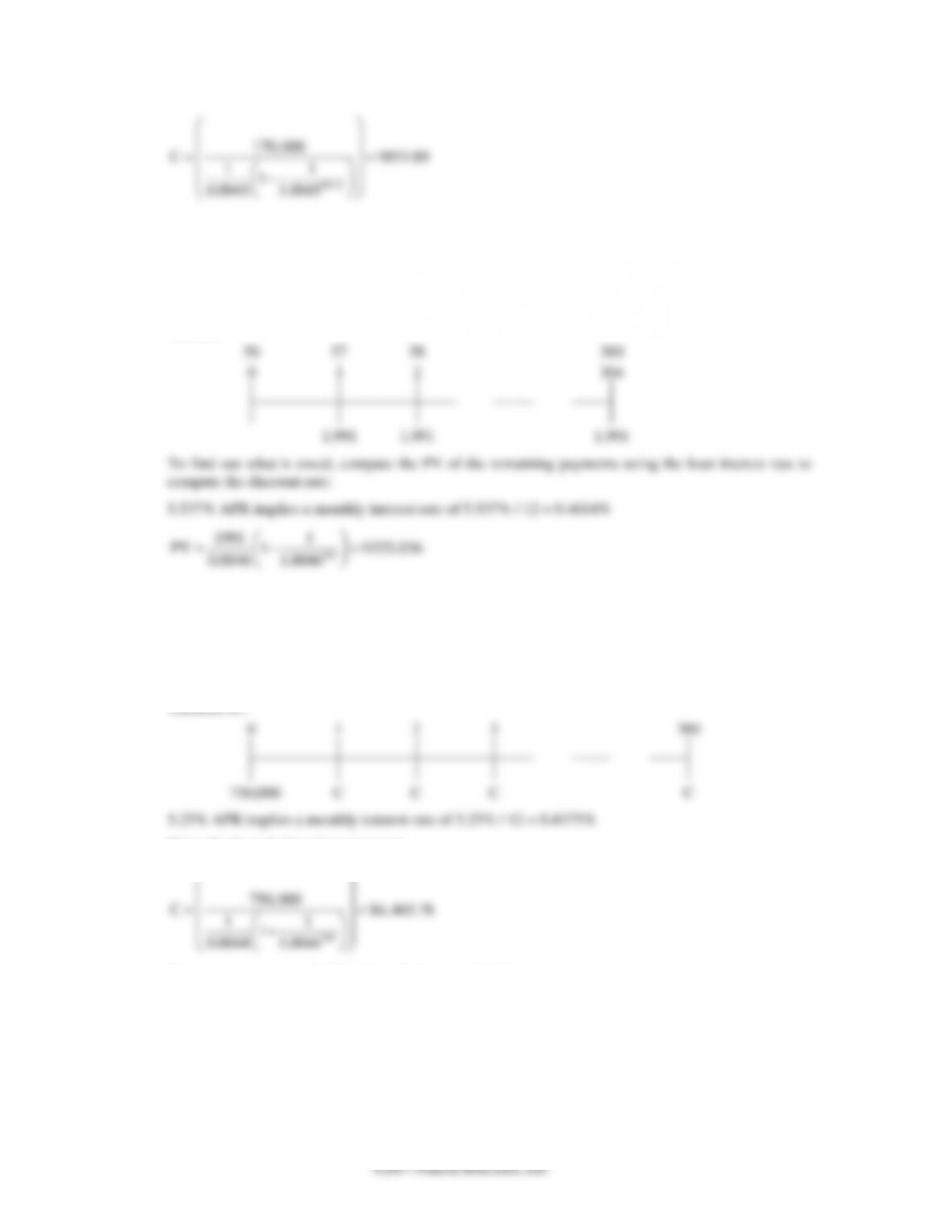
5-13. Oppenheimer Bank is offering a 30-year mortgage with an EAR of 5.5%. If you plan to borrow
$170,000, what will your monthly payment be?
Timeline:
0
1
2
3
4
360
–170,000
C
C
C
C
C
5.5% EAR implies a monthly interest rate of 1.0551/12 – 1 = 0.4472%
Using the formula for computing a loan payment
60 Berk/DeMarzo, Corporate Finance, Fourth Edition, Global Edition
©2017 Pearson Education, Ltd.
30 12
170,000
C $951.00
11
1
0.0045 1.0045
==
−
5-14. You have decided to refinance your mortgage. You plan to borrow whatever is outstanding on
your current mortgage. The current monthly payment is $1991 and you have made every
payment on time. The original term of the mortgage was 30 years, and the mortgage is exactly
four years and eight months old. You have just made your monthly payment. The mortgage
interest rate is 5.537% (APR). How much do you owe on the mortgage today?
Timeline:
56
57
58
360
0
1
2
304
1,991
1,991
1,991
To find out what is owed, compute the PV of the remaining payments using the loan interest rate to
compute the discount rate:
5.537% APR implies a monthly interest rate of 5.537% / 12 = 0.4614%
304
1991 1
PV 1 $325,036
0.0046 1.0046
= − =
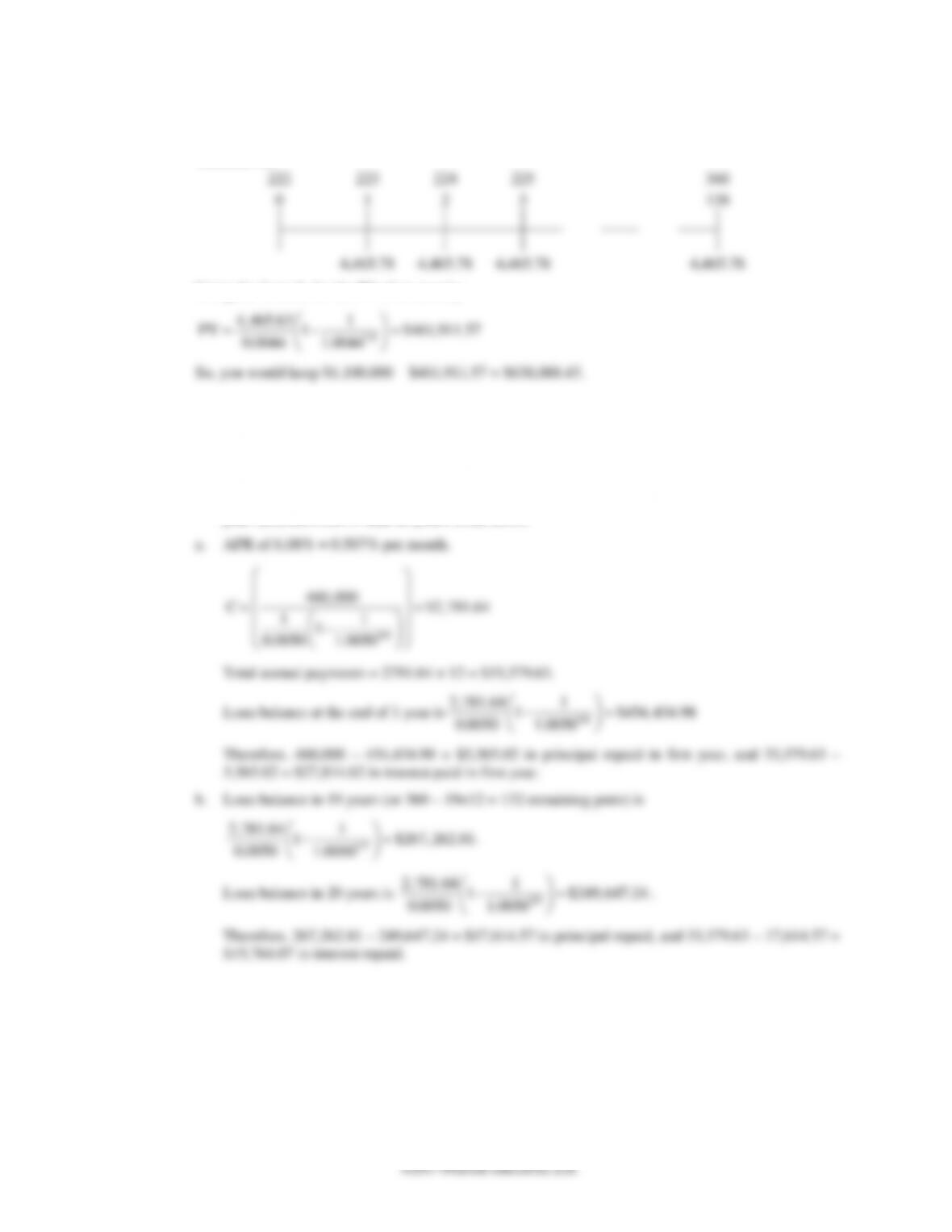
5-15. You have just sold your house for $1,100,000 in cash. Your mortgage was originally a 30-year
mortgage with monthly payments and an initial balance of $750,000. The mortgage is currently
exactly 18.5 years old, and you have just made a payment. If the interest rate on the mortgage is
5.25% (APR), how much cash will you have from the sale once you pay off the mortgage?
First we need to compute the original loan payment
0
1
2
3
360
Using the formula for a loan payment
360
750,000
C $4,465.78
11
1
0.0044 1.0044
==
−
Now we can compute the PV of continuing to make these payments
Chapter 5/Interest Rates 61
The timeline is
Timeline #2:
222
223
224
225
360
0
1
2
3
138
4,465.78
4,465.78
4,465.78
4,465.78
Using the formula for the PV of an annuity
138
4,465.63 1
PV 1 $461,911.57
0.0044 1.0044
= − =
So, you would keep $1,100,000 – $461,911.57 = $638,088.43.
5-16. You have just purchased a home and taken out a $460,000 mortgage. The mortgage has a 30–
year term with monthly payments and an APR of 6.08%.
a. How much will you pay in interest, and how much will you pay in principal, during the first
year?
b. How much will you pay in interest, and how much will you pay in principal, during the 20th
year (i.e., between 19 and 20 years from now)?
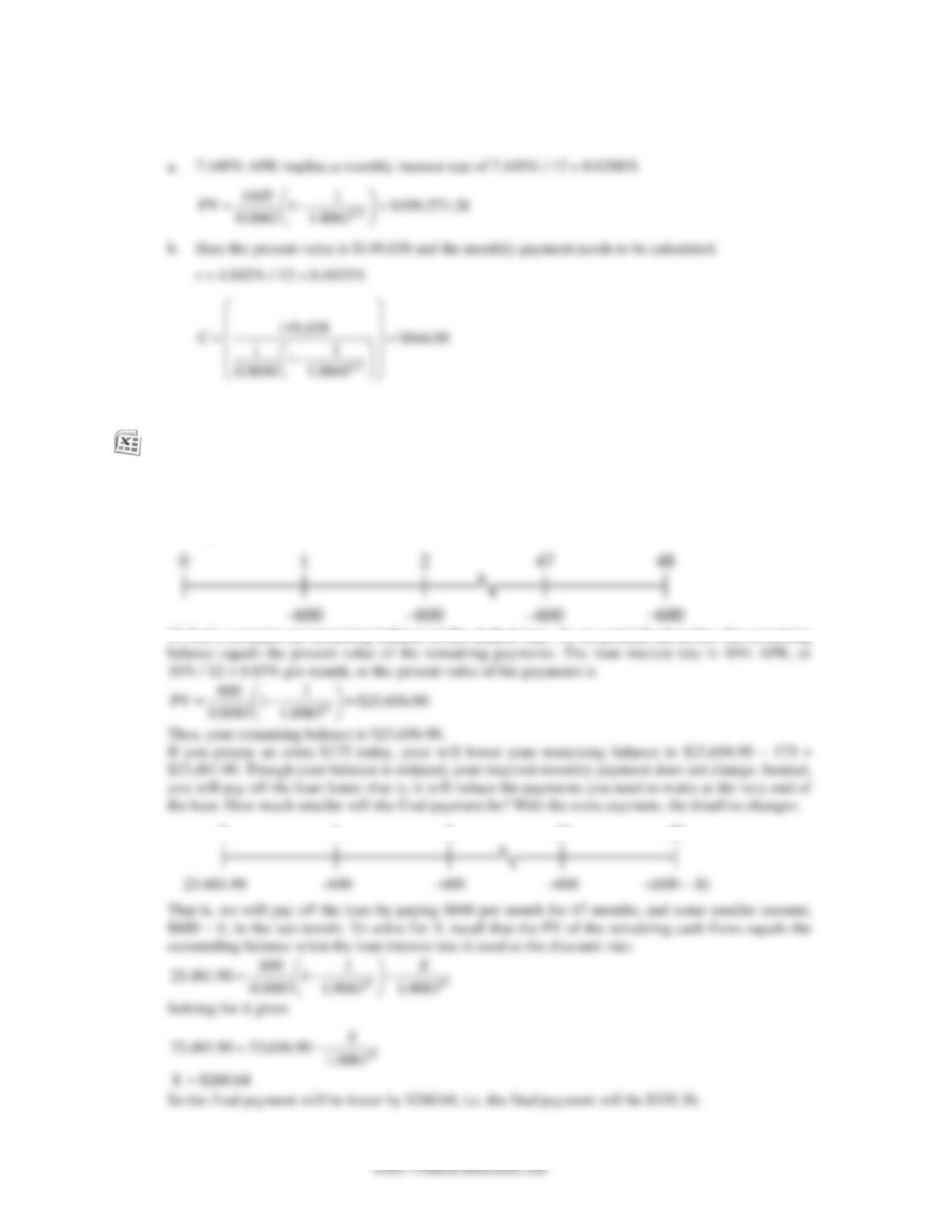
5-17. Your mortgage has 26 years left, and has an APR of 7.449% with monthly payments of $1449.
a. What is the outstanding balance?
b. Suppose you cannot make the mortgage payment and you are in danger of losing your house
to foreclosure. The bank has offered to renegotiate your loan. The bank expects to get
$149,638 for the house if it forecloses. They will lower your payment as long as they will
receive at least this amount (in present value terms). If current 26-year mortgage interest
62 Berk/DeMarzo, Corporate Finance, Fourth Edition, Global Edition
rates have dropped to 4.842% (APR), what is the lowest monthly payment you could make
for the remaining life of your loan that would be attractive to the bank?
312
11
1
0.0040 1.0040
−
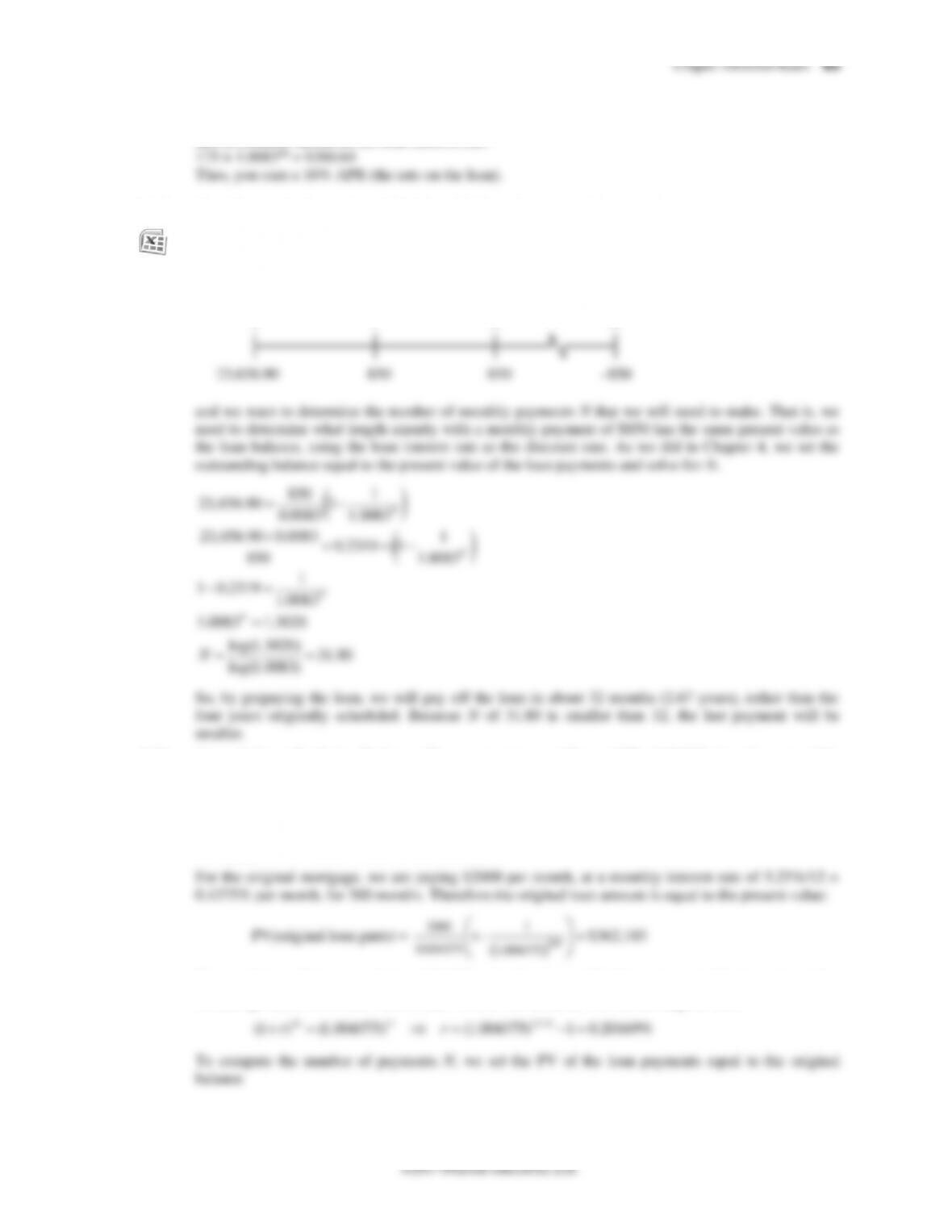
5-18. You have an outstanding student loan with required payments of $600 per month for the next
four years. The interest rate on the loan is 10% APR (monthly). You are considering making an
extra payment of $175 today (that is, you will pay an extra $175 that you are not required to
pay). If you are required to continue to make payments of $600 per month until the loan is paid
off, what is the amount of your final payment? What effective rate of return (expressed as an
APR with monthly compounding) have you earned on the $175?
We begin with the timeline of our required payments
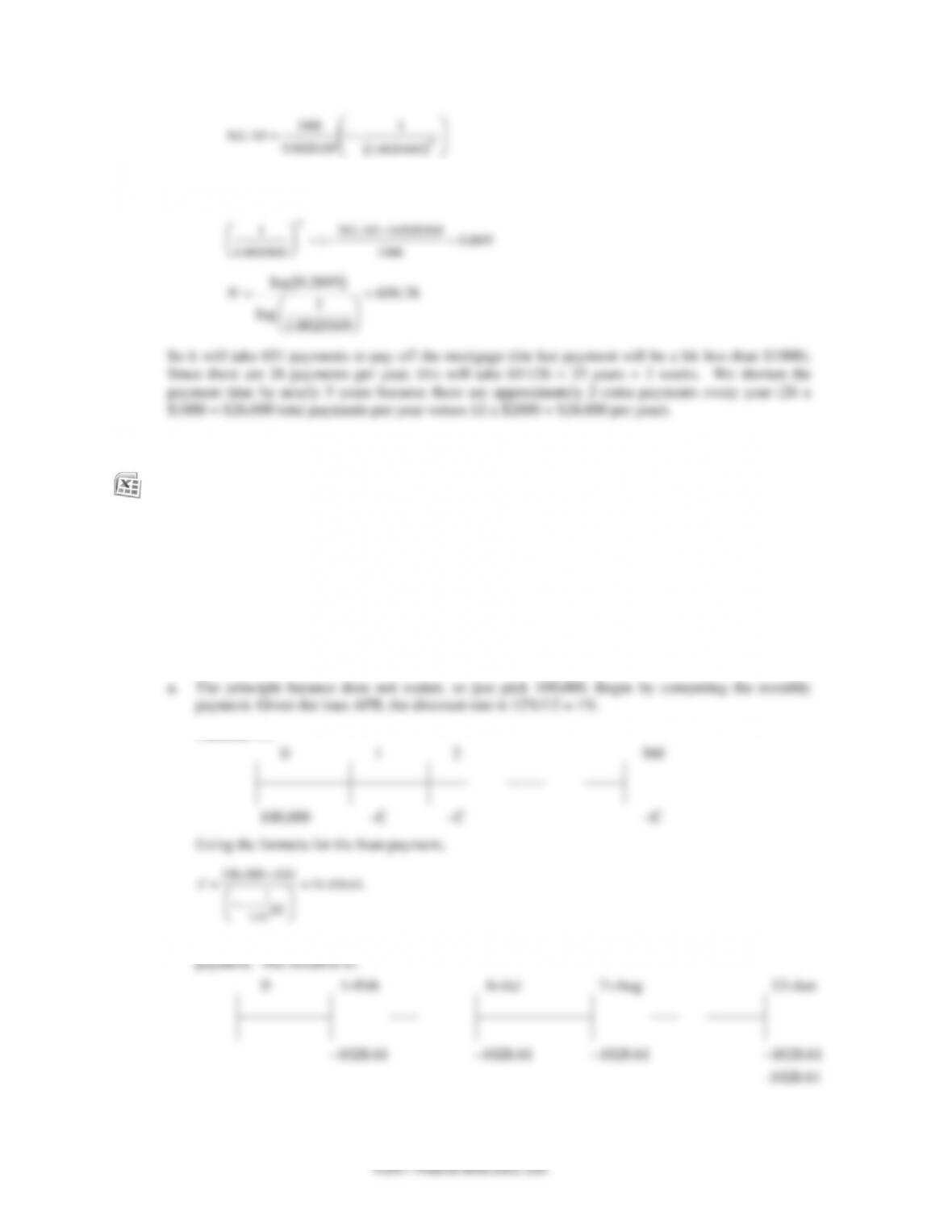
(1) Let’s compute our remaining balance on the student loan. As we pointed out earlier, the remaining
47
–600
0
2
–600
1
–600
48
–600
64 Berk/DeMarzo, Corporate Finance, Fourth Edition, Global Edition
( )
1000 1
362,185 1
0.0020169 1.0020169 N
=−
and solve for N using an annuity calculator, Excel NPER function Excel Goal Seek function, trial and
error, or directly as follows:
1 362,185 0.0020169
N
5-21. Your friend tells you he has a very simple trick for shortening the time it takes to repay your
mortgage by one-third: Use your holiday bonus to make an extra payment on January 1 of each
year (that is, pay your monthly payment due on that day twice). Assume that the mortgage has
an original term of 30 years and an APR of 12%.
a. If you take out your mortgage on January 1 (so that your first payment is due on February 1),
and you make your first extra payment at the end of the first year, in what year will you finish
repaying your mortgage?
b. If you take out your mortgage on July 1 (so the first payment is on August 1), and you make the
extra payment each January, in how many months will you pay off your mortgage?
c. How will the amount of time it takes to pay off the loan given this strategy vary with the interest
rate on the loan?
Timeline #1:
0
1
2
360
100,000
–C
–C
–C
Using the formula for the loan payment,
360
100,000 0.01
C $1,028.61.
1
11.01
==
−
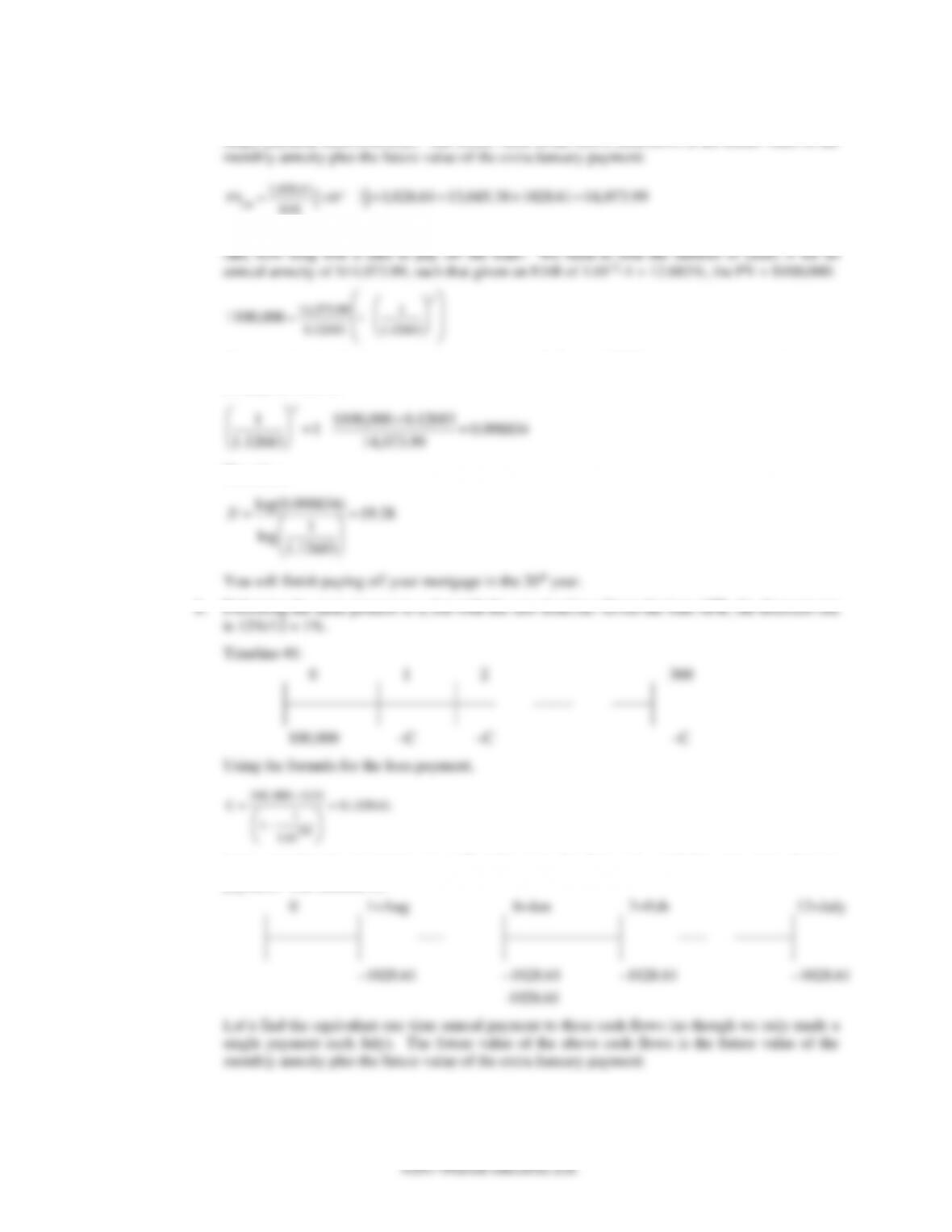
Let’s consider the payments you will make over the first year, including the extra January
Chapter 5/Interest Rates 65
Let’s find the equivalent one time annual payment to these cash flows (as though we only made a
single payment each February). The future value of the above cash flows is the future value of the
1yr =1,028.61
0.01 1.0112 –1
So, the new payment plan is equivalent to paying $14,073.99 at the end of every year. At that
0.12683 1–1
1.12683
è
ø
è
ç
ø
÷
We can solve for N using an annuity calculator, with Excel (NPER function), by trial and error, or
directly as follows:
1
1.12683
æ
è
ø
N
14,073.99 =0.098834
Therefore,
1
2
100,000
360
1
11.01
−
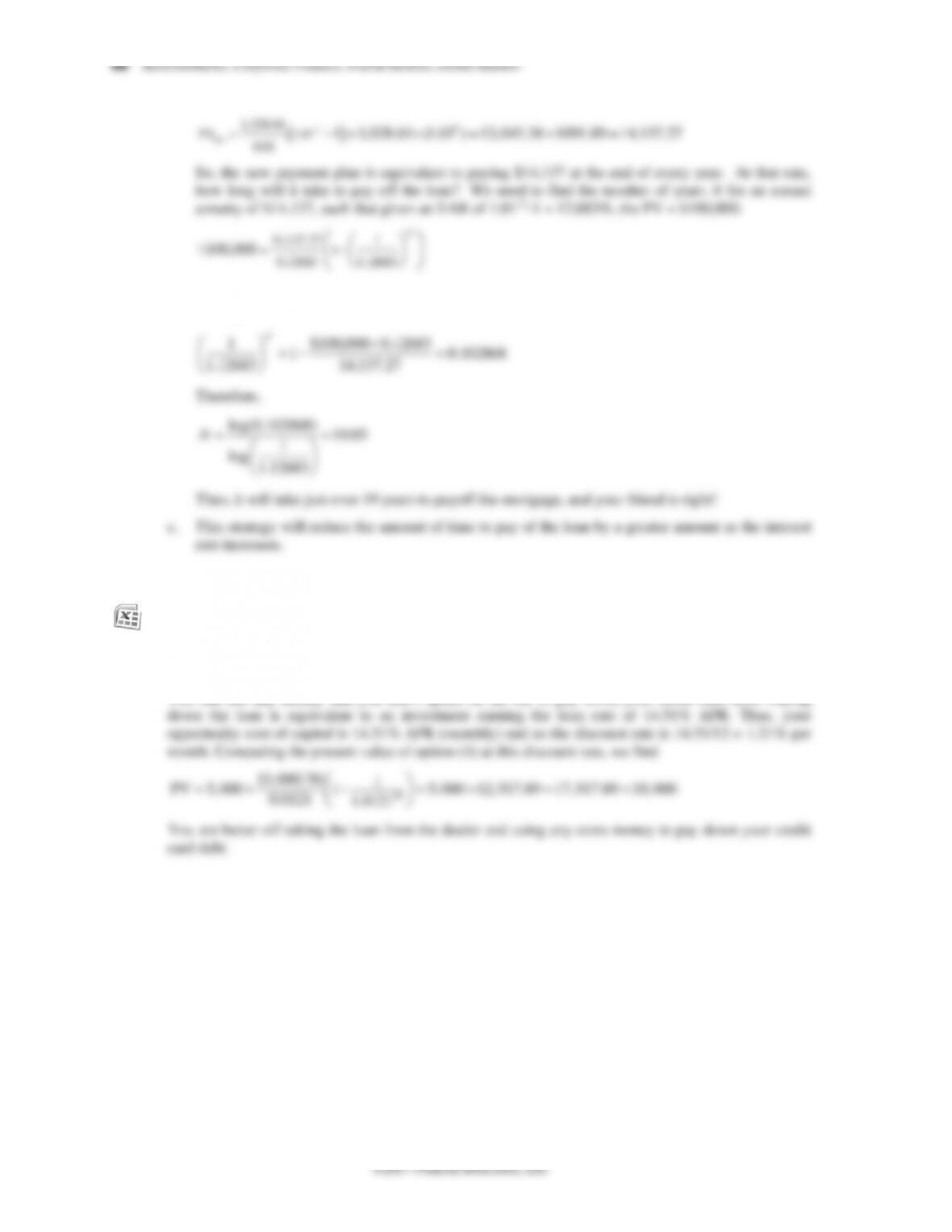
Let’s consider the payments you will make over the first year, including the extra January
payment. The timeline is:
0
1=Aug
6=Jan
7=Feb
12=July
–1028.61
–1028.61
–1028.61
–1028.61
-1028.61
Let’s find the equivalent one time annual payment to these cash flows (as though we only made a
single payment each July). The future value of the above cash flows is the future value of the
monthly annuity plus the future value of the extra January payment:
©2017 Pearson Education, Ltd.
0.12683 1.12683
We can solve for N using an annuity calculator, with Excel (NPER function), by trial and error, or
directly as follows:
1 $100,000 0.12683
N
5-22. You need a new car and the dealer has offered you a price of $20,000, with the following
payment options: (a) pay cash and receive a $2000 rebate, or (b) pay a $5000 down payment and
finance the rest with a 0% APR loan over 30 months. But having just quit your job and started
an MBA program, you are in debt and you expect to be in debt for at least the next 21⁄2 years.
You plan to use credit cards to pay your expenses; luckily you have one with a low (fixed) rate of
14.51% APR. Which payment option is best for you?
You can use any money that you don’t spend on the car to pay down your credit card debt. Paying
5-23. The mortgage on your house is five years old. It required monthly payments of $1390, had an
original term of 30 years, and had an interest rate of 10% (APR). In the intervening five years,
interest rates have fallen and so you have decided to refinance—that is, you will roll over the
outstanding balance into a new mortgage. The new mortgage has a 30-year term, requires
monthly payments, and has an interest rate of 5.625% (APR).
a. What monthly repayments will be required with the new loan?
b. If you still want to pay off the mortgage in 25 years, what monthly payment should you
make after you refinance?
c. Suppose you are willing to continue making monthly payments of $1390. How long will it
take you to pay off the mortgage after refinancing?
Chapter 5/Interest Rates 67
d. Suppose you are willing to continue making monthly payments of $1390, and want to pay off
the mortgage in 25 years. How much additional cash can you borrow today as part of the
refinancing?
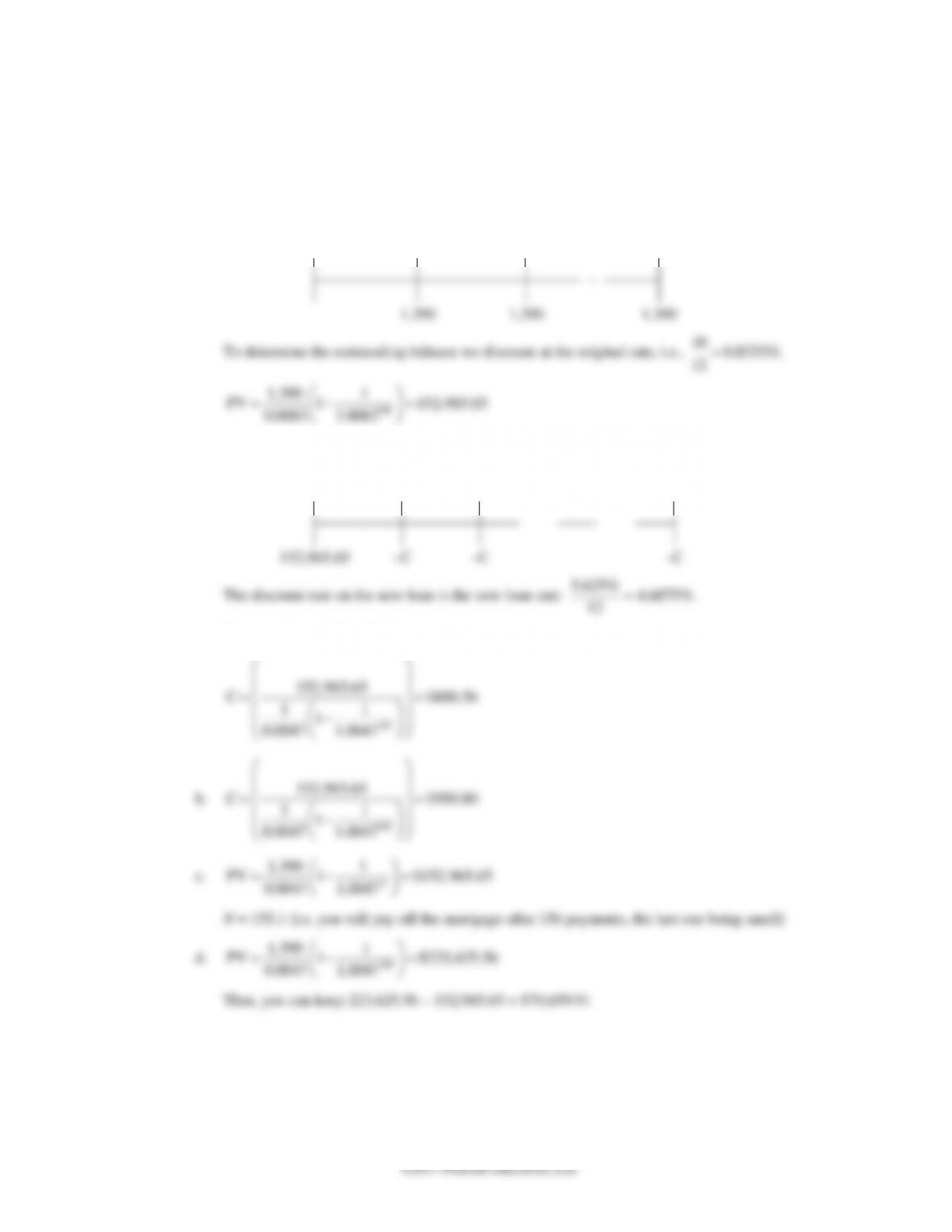
a. First, we calculate the outstanding balance of the mortgage. There are 25 × 12 = 300 months
remaining on the loan, so the timeline is as follows.
Timeline #1:
0
1
2
300
1,390
1,390
1,390
To determine the outstanding balance we discount at the original rate, i.e.,
10 0.8333%.
12 =
300
1,390 1
PV 1 152,965.65
0.0083 1.0083
= − =
Next we calculate the loan payment on the new mortgage.
Timeline #2:
0
1
2
360
152,965.65
–C
–C
–C
The discount rate on the new loan is the new loan rate:
5.625% 4.6875%.
12 =
Using the formula for the loan payment:
152,965.65
152,965.65
5-24. You have credit card debt of $30,000 that has an APR (monthly compounding) of 16%. Each
month you pay the minimum monthly payment only. You are required to pay only the
outstanding interest. You have received an offer in the mail for an otherwise identical credit card
with an APR of 10%. After considering all your alternatives, you decide to switch cards, roll
over the outstanding balance on the old card into the new card, and borrow additional money as
68 Berk/DeMarzo, Corporate Finance, Fourth Edition, Global Edition
well. How much can you borrow today on the new card without changing the minimum monthly
payment you will be required to pay?
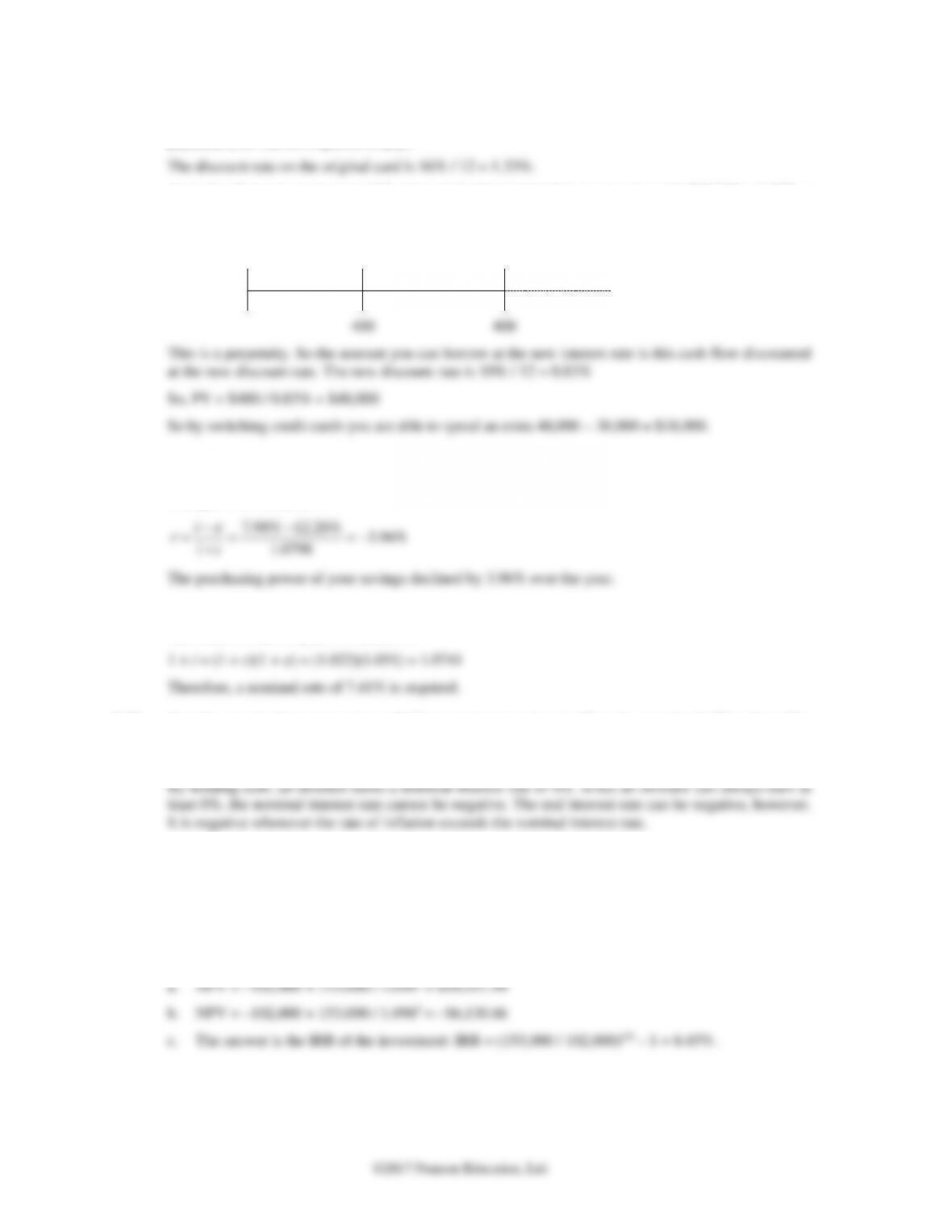
Assuming that your current monthly payment is the interest that accrues, it equals $30,000 × 1.33% =
$400
Timeline:
0
1
2
400
400
5-25. In 1975, interest rates were 7.98% and the rate of inflation was 12.26% in the United States.
What was the real interest rate in 1975? How would the purchasing power of your savings have
changed over the year?
7.98% 12.26% 3.96%
1 1.0798
i
ri
−−
= = = −
+
The purchasing power of your savings declined by 3.96% over the year.
5-26. If the rate of inflation is 5.1%, what nominal interest rate is necessary for you to earn a 2.2%
real interest rate on your investment?
5-27. Can the nominal interest rate available to an investor be significantly negative? (Hint: Consider
the interest rate earned from saving cash “under the mattress.”) Can the real interest rate be
negative? Explain.
5-28. Consider a project that requires an initial investment of $102,000 and will produce a single cash
flow of $153,000 in five years.
a. What is the NPV of this project if the five-year interest rate is 4.9% (EAR)?
b. What is the NPV of this project if the five-year interest rate is 9.8% (EAR)?
c. What is the highest five-year interest rate such that this project is still profitable?
70 Berk/DeMarzo, Corporate Finance, Fourth Edition, Global Edition
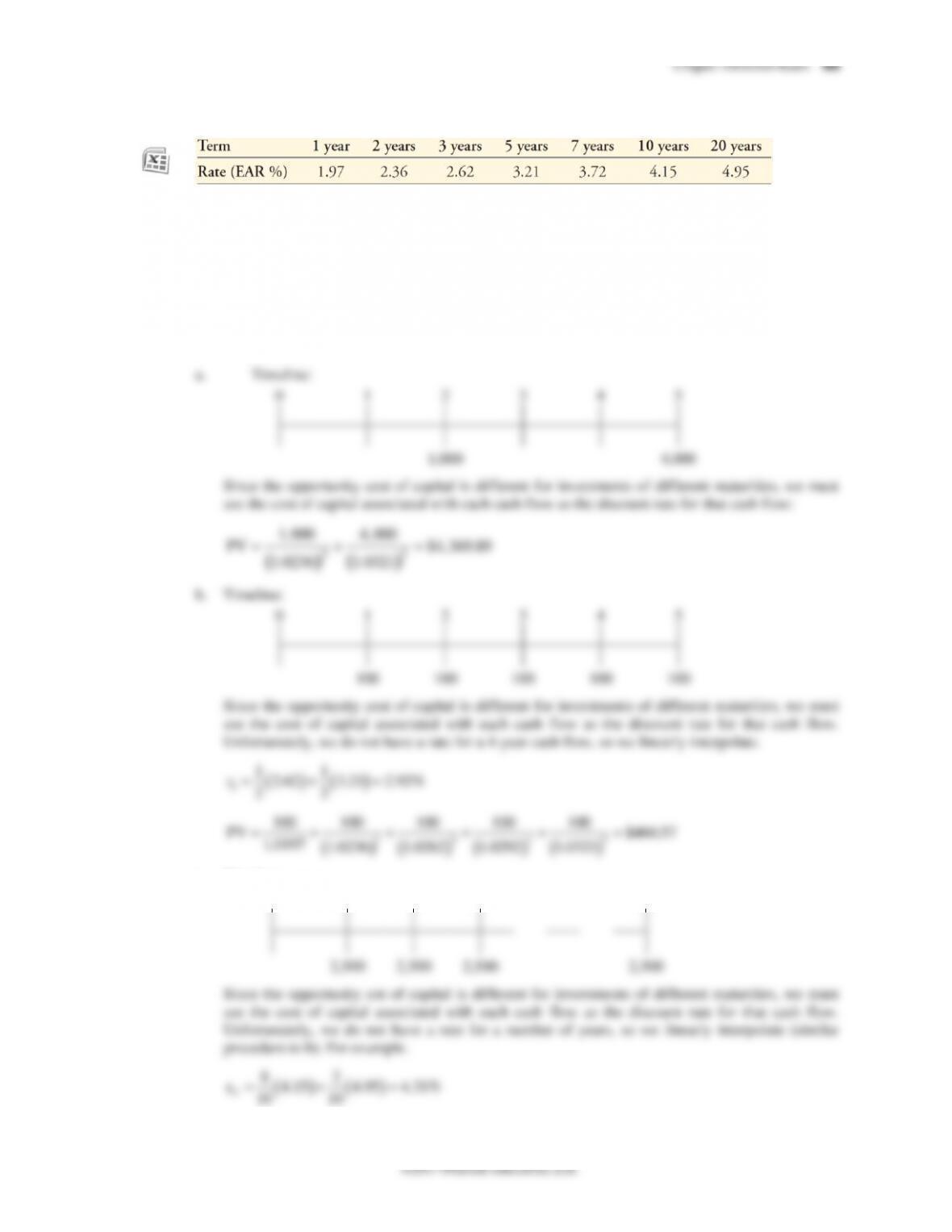
r1 = 1.97%
r5 = 3.21%
r6 = 3.47%
r17 = 4.71%
r18 = 4.79%
r19 = 4.87%
( )
1
1i
i
i
=
+
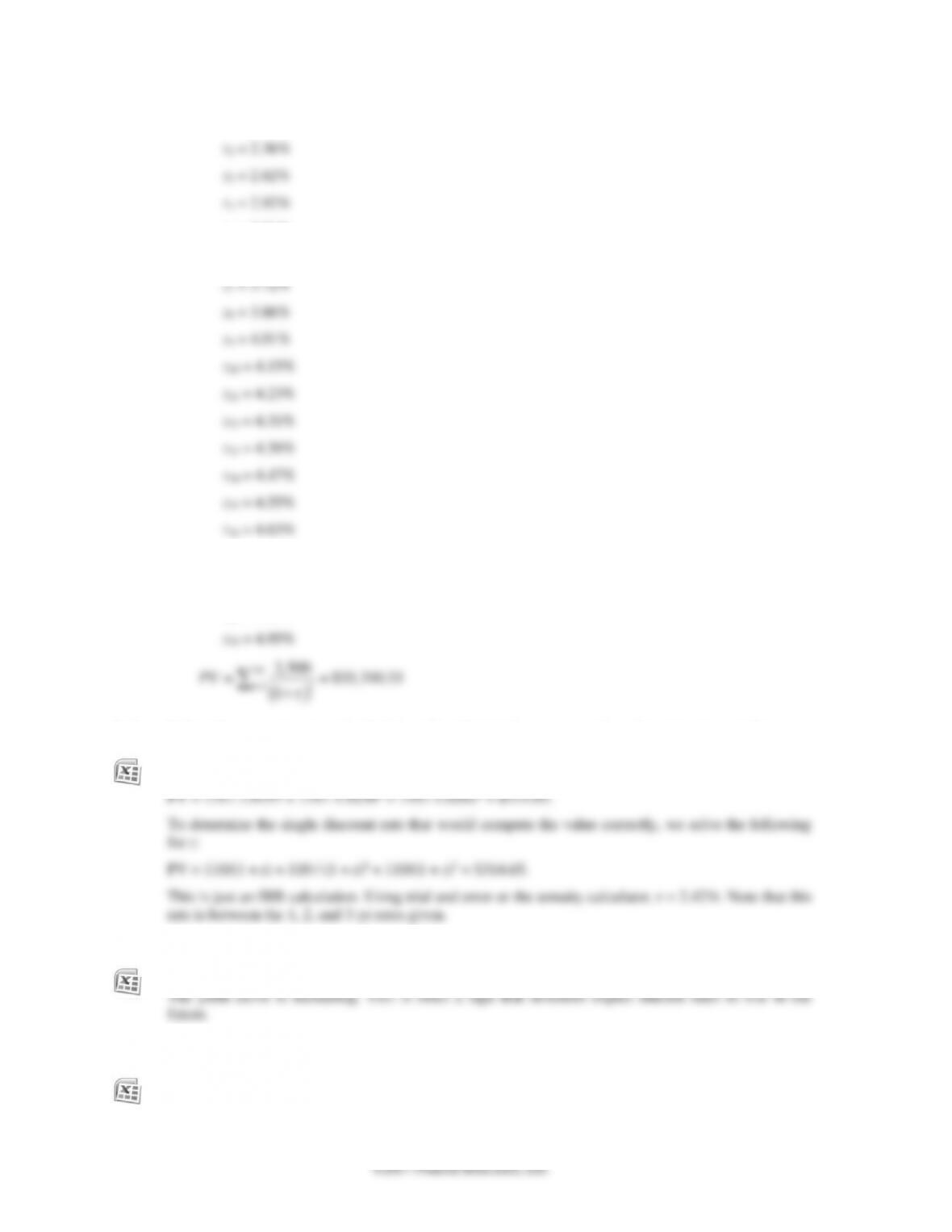
5-30. Using the term structure in Problem 29, what is the present value of an investment that pays
$110 at the end of each of years 1, 2, and 3? If you wanted to value this investment correctly
using the annuity formula, which discount rate should you use?
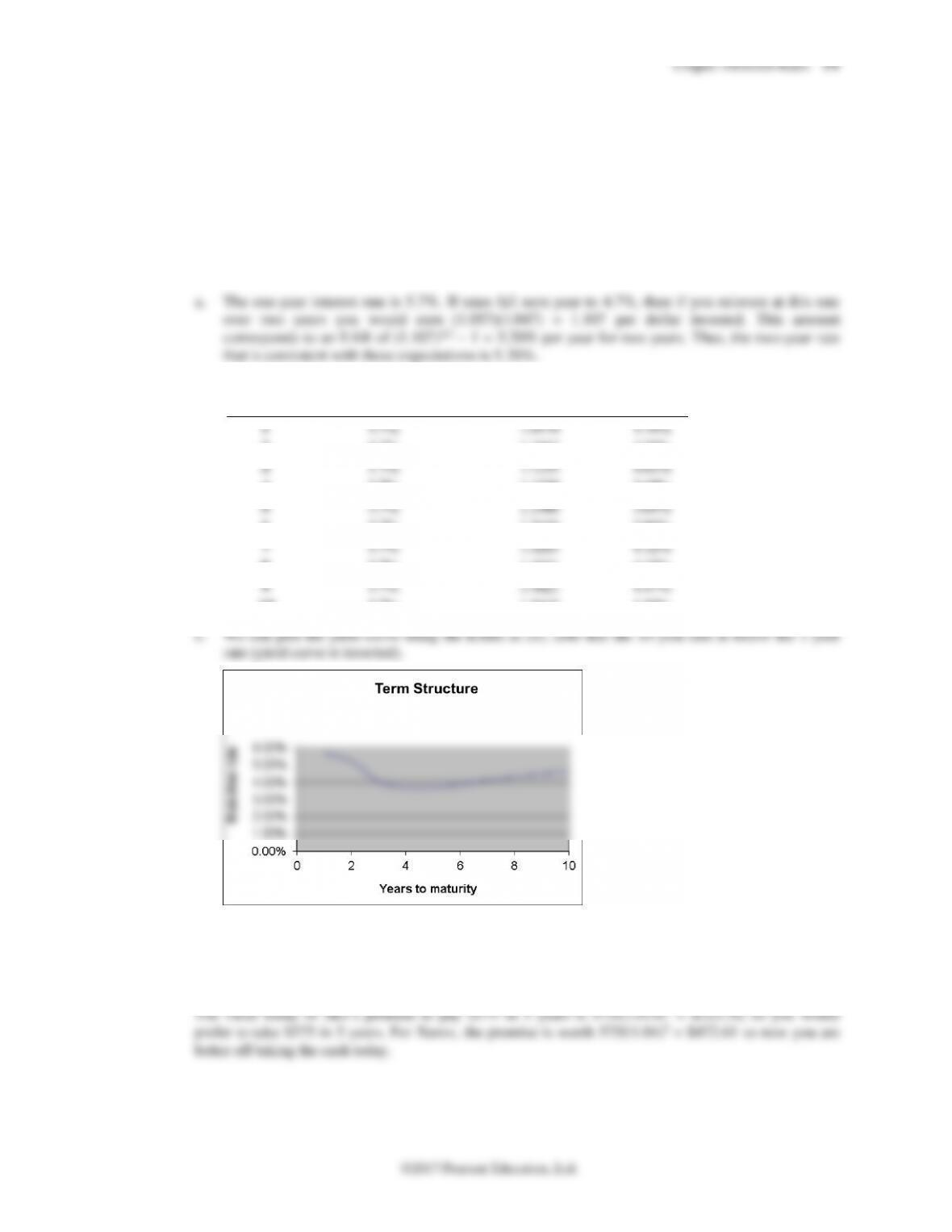
5-31. What is the shape of the yield curve given the term structure in Problem 29? What expectations
are investors likely to have about future interest rates?
5-32. Suppose the current one-year interest rate is 5.7%. One year from now, you believe the economy
will start to slow and the one-year interest rate will fall to 4.7%. In two years, you expect the
economy to be in the midst of a recession, causing the Federal Reserve to cut interest rates
drastically and the one-year interest rate to fall to 1.7%. The one-year interest rate will then rise
74 Berk/DeMarzo, Corporate Finance, Fourth Edition, Global Edition
Because the value of the assets equals the value of the liabilities at this discount rate, this is also the
value of the assets.