30
Chapter 4
The Time Value of Money
4-1. You have just taken out a five-year loan from a bank to buy an engagement ring. The ring costs
$6000. You plan to put down $2000 and borrow $4000. You will need to make annual payments
of $1250 at the end of each year. Show the timeline of the loan from your perspective. How would
the timeline differ if you created it from the bank’s perspective?
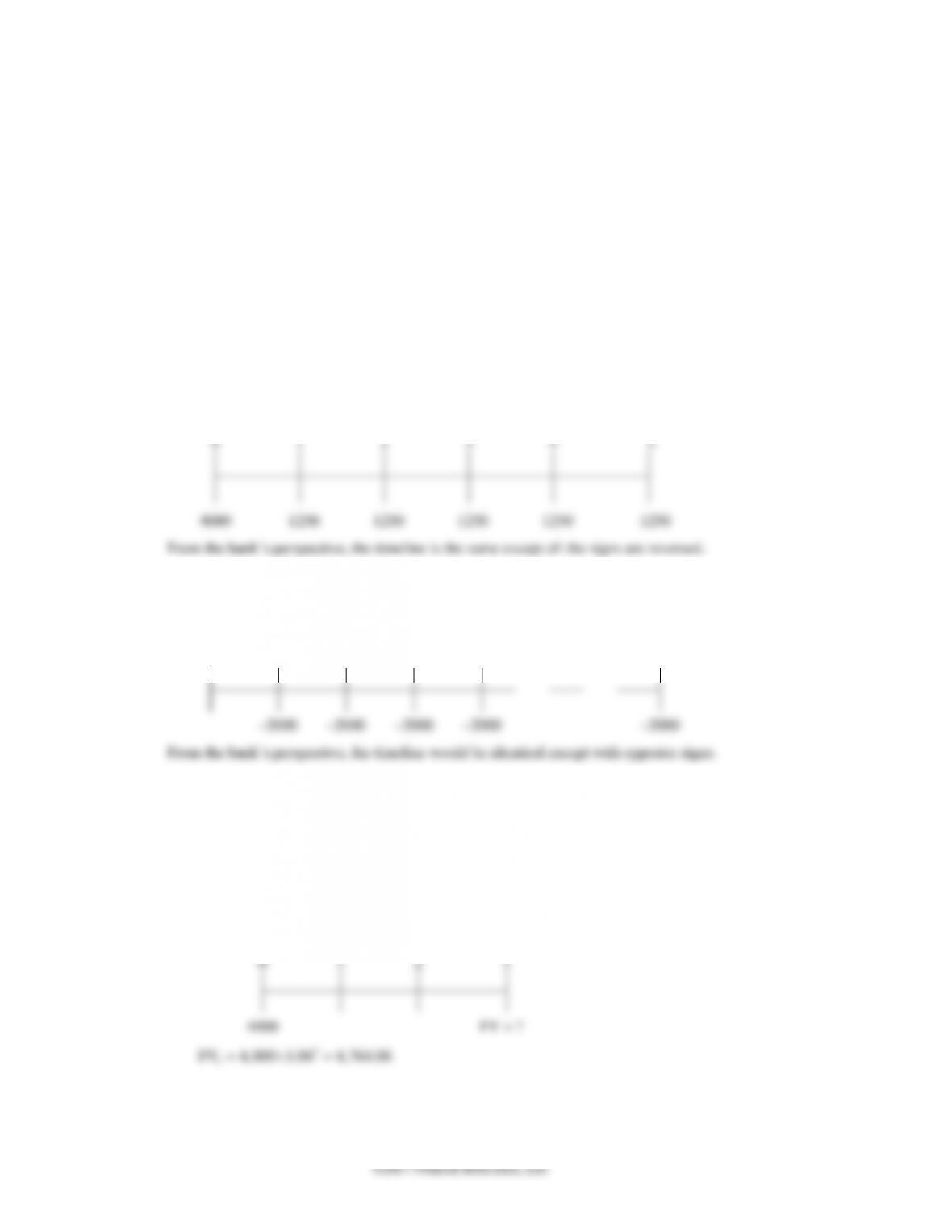
0
1
2
3
4
5
4000
–1250
–1250
–1250
–1250
–1250
From the bank’s perspective, the timeline is the same except all the signs are reversed.
4-2. You currently have a four-year-old mortgage outstanding on your house. You make monthly
payments of $2000. You have just made a payment. The mortgage has 26 years to go (i.e., it had
an original term of 30 years). Show the timeline from your perspective. How would the timeline
differ if you created it from the bank’s perspective?
0
1
2
3
4
312
–2000
–2000
–2000
–2000
–2000
From the bank’s perspective, the timeline would be identical except with opposite signs.
4-3. Calculate the future value of $4000 in:
a. Three years at an interest rate of 6% per year.
b. Six years at an interest rate of 6% per year.
c. Three years at an interest rate of 12% per year.
d. Why is the amount of interest earned in part (a) less than half the amount of interest earned
in part (b)?
a. Timeline:
0
1
2
3
4000
FV = ?
3
3
FV 4,000 1.06 4,764.06= =
Chapter 4/The Time Value of Money 31
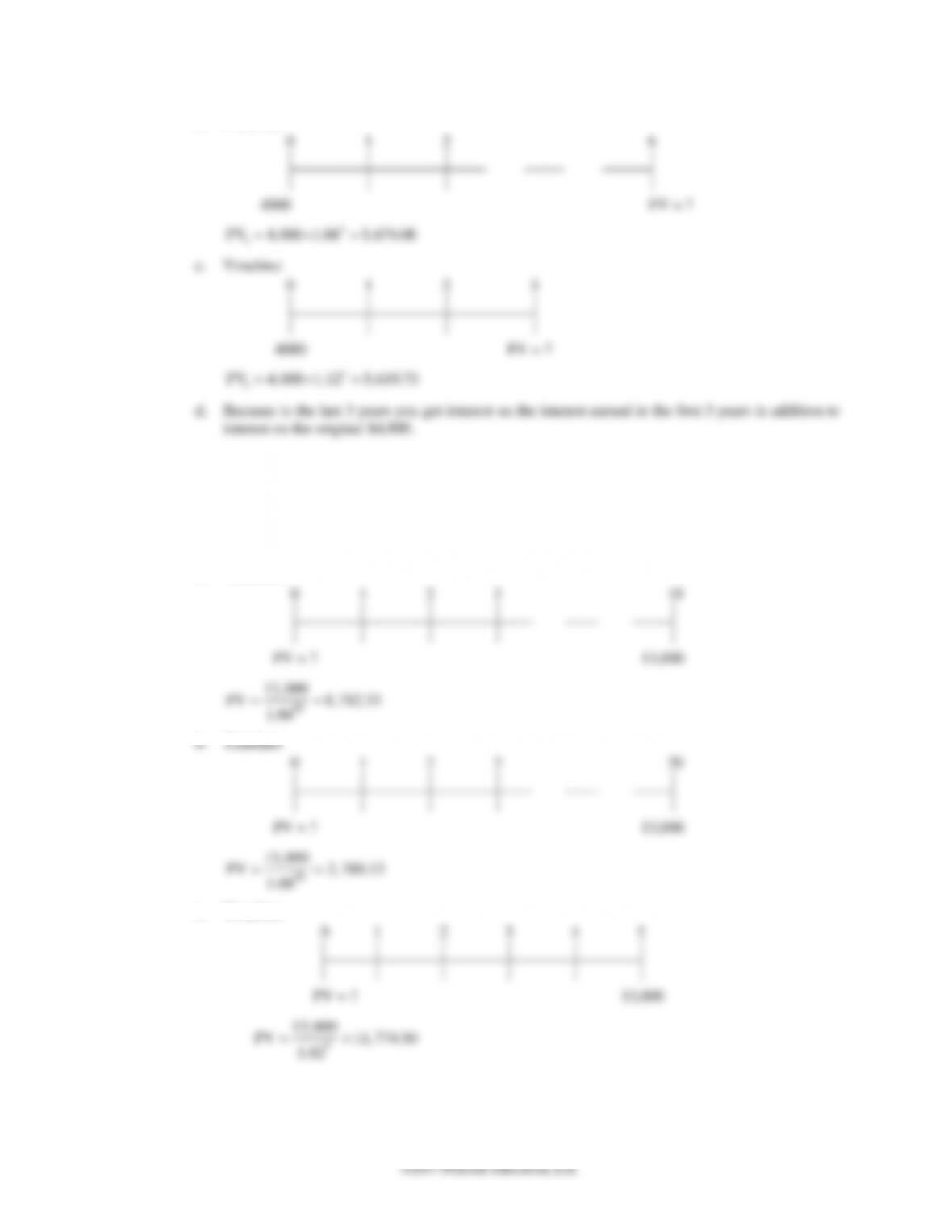
b. Timeline:
0
1
2
6
4000
FV = ?
6
6
FV 4,000 1.06 5,674.08= =
c. Timeline:
0
1
2
3
4000
FV = ?
3
3
FV 4,000 1.12 5,619.71= =
d. Because in the last 3 years you get interest on the interest earned in the first 3 years in addition to
interest on the original $4,000.
4-4. What is the present value of $13,000 received:
a. Ten years from today when the interest rate is 4% per year?
b. Twenty years from today when the interest rate is 8% per year?
c. Five years from today when the interest rate is 2% per year?
a. Timeline:
0
1
2
3
10
PV = ?
13,000
10
13, 000
PV 8, 782.33
1.04
==
b. Timeline:
0
1
2
3
20
PV = ?
13,000
20
13, 000
PV 2, 789.13
1.08
==
c. Timeline:
0
1
2
3
4
5
PV = ?
13,000
5
13, 000
PV 11, 774.50
1.02
==
32 Berk/DeMarzo, Corporate Finance, Fourth Edition, Global Edition
4-5. Your brother has offered to give you either $60,000 today or $100,000 in 12 years. If the interest
rate is 6% per year, which option is preferable?
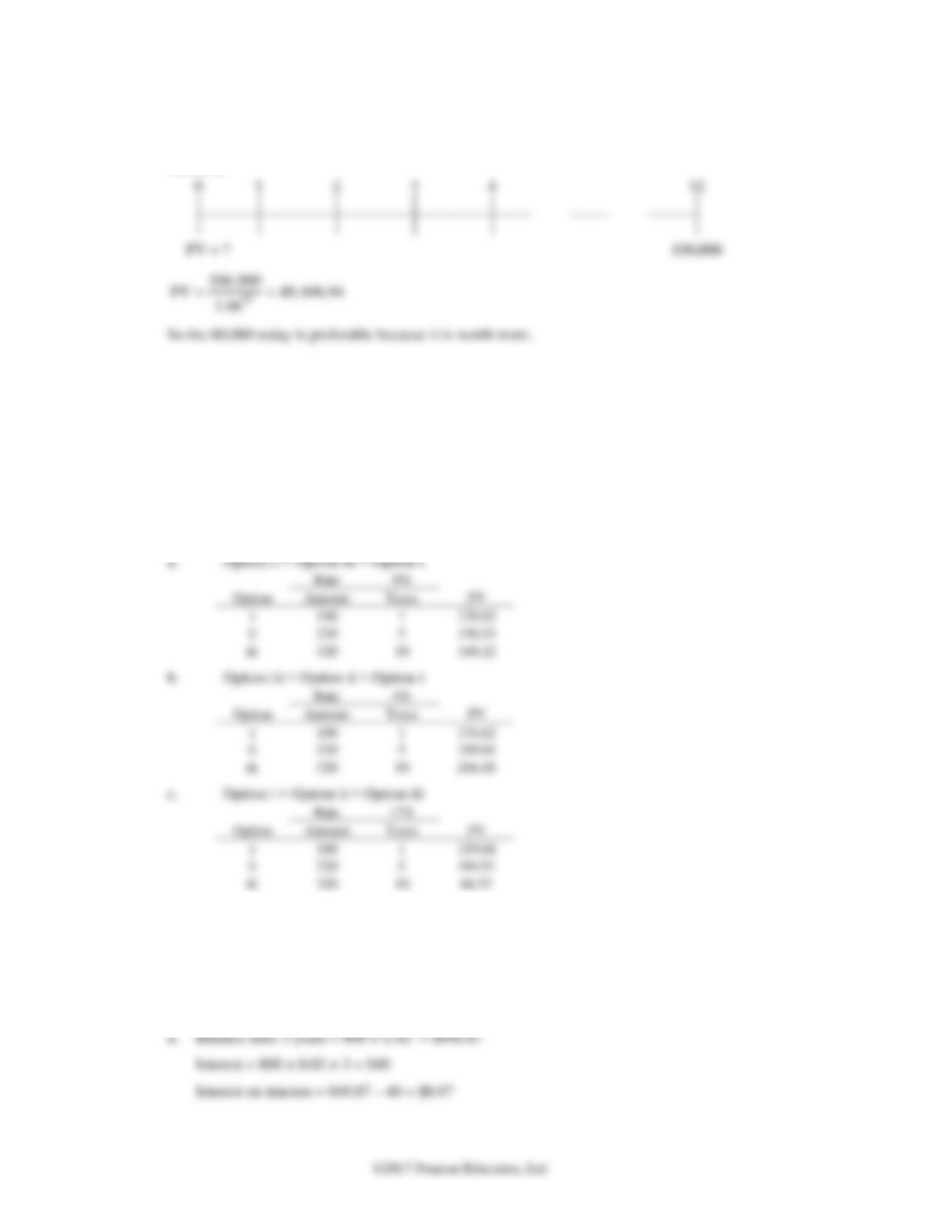
Timeline:
0
1
2
3
4
12
PV = ?
100,000
12
100, 000
PV 49, 696.94
1.06
==
So the 60,000 today is preferable because it is worth more.
4-6. Consider the following alternatives:
i. $140 received in one year
ii. $230 received in five years
iii. $320 received in ten years
a. Rank the alternatives from most valuable to least valuable if the interest rate is 8% per year.
b. What is your ranking if the interest rate is only 4% per year?
c. What is your ranking if the interest rate is 17% per year?
©2017 Pearson Education, Ltd.
4-12. You have just received a windfall from an investment you made in a friend’s business. He will be
paying you $32,049 at the end of this year, $64,098 at the end of the following year, and $96,147
at the end of the year after that (three years from today). The interest rate is 12.9% per year.
a. What is the present value of your windfall?
b. What is the future value of your windfall in three years (on the date of the last payment)?
b. FV = 145,486.08 × 1.1293 = $209,364.61
4-13. You have a loan outstanding. It requires making three annual payments at the end of the next
three years of $4000 each. Your bank has offered to restructure the loan so that instead of
making five payments as originally agreed, you will make only one final payment at the end of
the loan in five years. If the interest rate on the loan is 5.63%, what final payment will the bank
require you to make so that it is indifferent between the two forms of payment?
4-14. You have been offered a unique investment opportunity. If you invest $20,000 today, you will
receive $1000 one year from now, $3000 two years from now, and $20,000 ten years from now.
a. What is the NPV of the opportunity if the interest rate is 12% per year? Should you take the
opportunity?
b. What is the NPV of the opportunity if the interest rate is 2% per year? Should you take it
now?
4-15. Marian Plunket owns her own business and is considering an investment. If she undertakes the
investment, it will pay $40,000 at the end of each of the next three years. The opportunity
36 Berk/DeMarzo, Corporate Finance, Fourth Edition, Global Edition
requires an initial investment of $10,000 plus an additional investment at the end of the second
year of $50,000. What is the NPV of this opportunity if the interest rate is 9% per year? Should
Marian take it?
Timeline:
0
1
2
3
–10,000
40,000
–10,000
40,000
NPV = –10,000 + 40,000 / 1.091 – 10,000 / 1.092 + 40,000 / 1.093 = $49,167.79
Yes, make the investment.
4-16. Your buddy in mechanical engineering has invented a money machine. The main drawback of
the machine is that it is slow. It takes one year to manufacture $900. However, once built, the
machine will last forever and will require no maintenance. The machine can be built
immediately, but it will cost $9000 to build. Your buddy wants to know if he should invest the
money to construct it. If the interest rate is 9.5% per year, what should your buddy do?
Timeline:
0
1
2
3
–9,000
900
900
900
To decide whether to build the machine you need to calculate the NPV. The cash flows the machine
generates are a perpetuity, so by the PV of a perpetuity formula:
PV = 900 / 0.095 = $9,476.68
Thus, NPV = –9,000 + 9,476.68 = $476.68 > 0. He should build it.
4-17. How would your answer to Problem 16 change if the machine takes one year to build?
Timeline:
0
1
2
3
–9,000
900
900
To decide whether to build the machine, you need to calculate the NPV: The cash flows the machine
generates are a perpetuity with first payment at date 2. Computing the PV at date 1 gives:
PV1 = 900 / 0.095 = $9,476.68
The value today is
PV0 = 9,476.68 / 1.095 = $8,651.77
Thus, NPV = –9,000 + 8,651.77 = –$348.23 < 0.
He should not build the machine.
4-18. The British government has a consol bond outstanding paying £200 per year forever. Assume the
current interest rate is 12% per year.
a. What is the value of the bond immediately after a payment is made?
b. What is the value of the bond immediately before a payment is made?
Chapter 4/The Time Value of Money 37
©2017 Pearson Education, Ltd.
0
1
2
3
200
200
200
a. The value of the bond is equal to the present value of the cash flows. By the perpetuity formula:
PV = 200 / 0.12 = £1,666.67
b. The value of the bond is equal to the present value of the cash flows. The cash flows are the
perpetuity plus the payment that will be received immediately.
PV 200/0.012 + 200 = £1,866.67
4-19. What is the present value of $4000 paid at the end of each of the next 73 years if the interest rate
is 3% per year?
Timeline:
0
1
2
3
73
4,000
4,000
4,000
4,000
The cash flows are a 73-year annuity, so by the annuity formula:
73
4, 000 1
PV 1 $117,922.67
0.03 1.03
= − =
4-20. You are head of the Schwartz Family Endowment for the Arts. You have decided to fund an arts
school in the San Francisco Bay area in perpetuity. Every five years, you will give the school
$700,000. The first payment will occur four years from today. If the interest rate is 9.5% per
year, what is the present value of your gift?
Timeline:
0
4
8
12
0
1
2
3
700,000
700,000
700,000
First we need the four-year interest rate. If the annual interest rate is 9.5% per year and you invest
$0.7 million for four years you will have, by the 2nd rule of time travel, 0.7 × 1.0954 = $1.01m. So the
four-year interest rate is 43.77%. The cash flows are a perpetuity, so:
700, 000
PV $1, 599, 411.60
0.4377
==
4-21. When you purchased your house, you took out a 30-year annual-payment mortgage with an
interest rate of 9% per year. The annual payment on the mortgage is $9422. You have just made
a payment and have now decided to pay the mortgage off by repaying the outstanding balance.
What is the payoff amount if:
a. You have lived in the house for 13 years (so there are 17 years left on the mortgage)?
b. You have lived in the house for 25 years (so there are 5 years left on the mortgage)?
c. You have lived in the house for 13 years (so there are 17 years left on the mortgage) and you
decide to pay off the mortgage immediately before the thirteenth payment is due?
38 Berk/DeMarzo, Corporate Finance, Fourth Edition, Global Edition
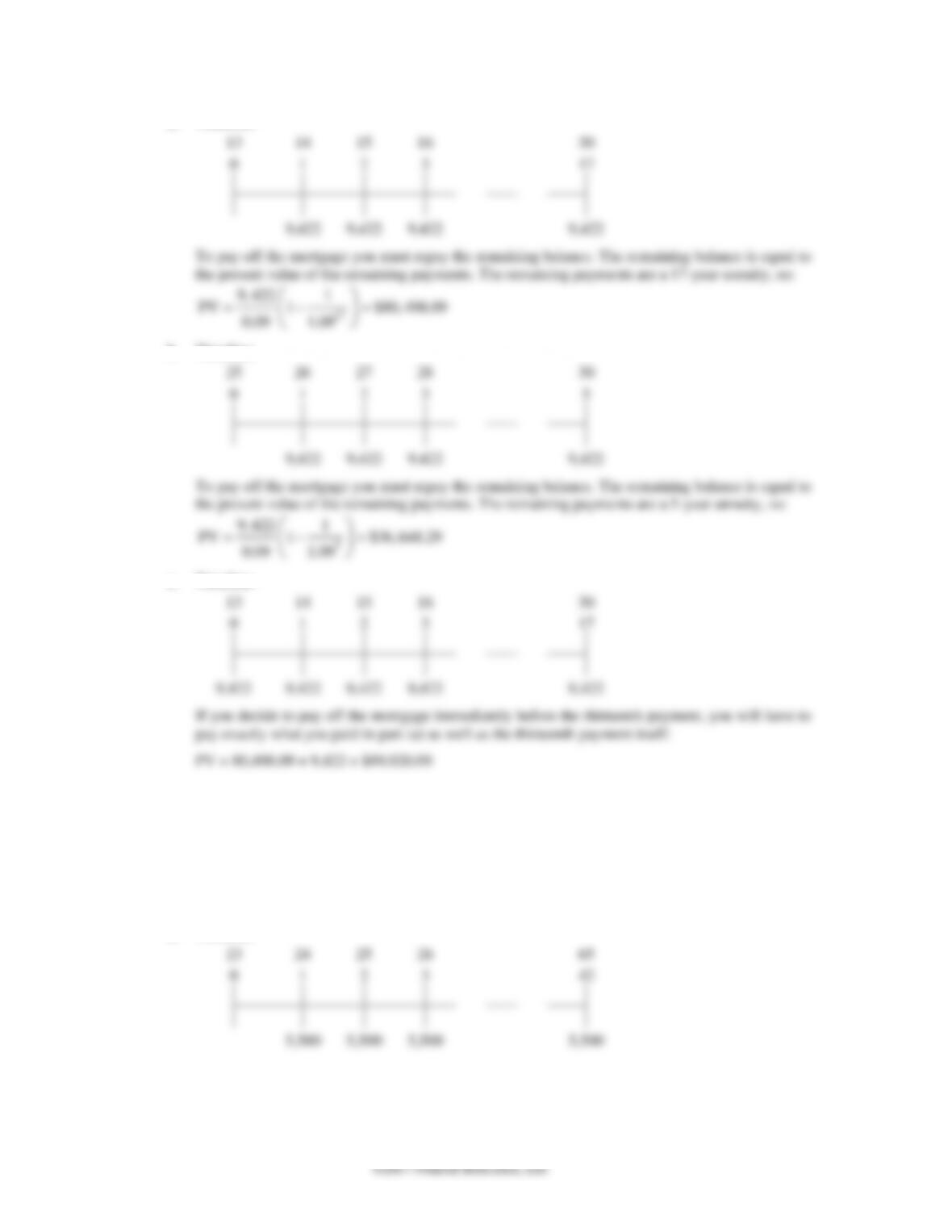
a. Timeline:
13
14
15
16
30
0
1
2
3
17
9,422
9,422
9,422
9,422
To pay off the mortgage you must repay the remaining balance. The remaining balance is equal to
the present value of the remaining payments. The remaining payments are a 17-year annuity, so:
17
9, 422 1
PV 1 $80, 498.09
0.09 1.09
= − =
b. Timeline:
25
26
27
28
30
0
1
2
3
5
9,422
9,422
9,422
9,422
To pay off the mortgage you must repay the remaining balance. The remaining balance is equal to
the present value of the remaining payments. The remaining payments are a 5-year annuity, so:
5
9, 422 1
PV 1 $36, 648.29
0.09 1.09
= − =
c. Timeline:
13
14
15
16
30
0
1
2
3
17
9,422
9,422
9,422
9,422
9,422
If you decide to pay off the mortgage immediately before the thirteenth payment, you will have to
pay exactly what you paid in part (a) as well as the thirteenth payment itself:
PV = 80,498.09 + 9,422 = $89,920.09
4-22. You are 23 years old and decide to start saving for your retirement. You plan to save $5500 at
the end of each year (so the first deposit will be one year from now), and will make the last
deposit when you retire at age 65. Suppose you earn 10% per year on your retirement savings.
a. How much will you have saved for retirement?
b. How much will you have saved if you wait until age 39 to start saving (again, with your first
deposit at the end of the year)?
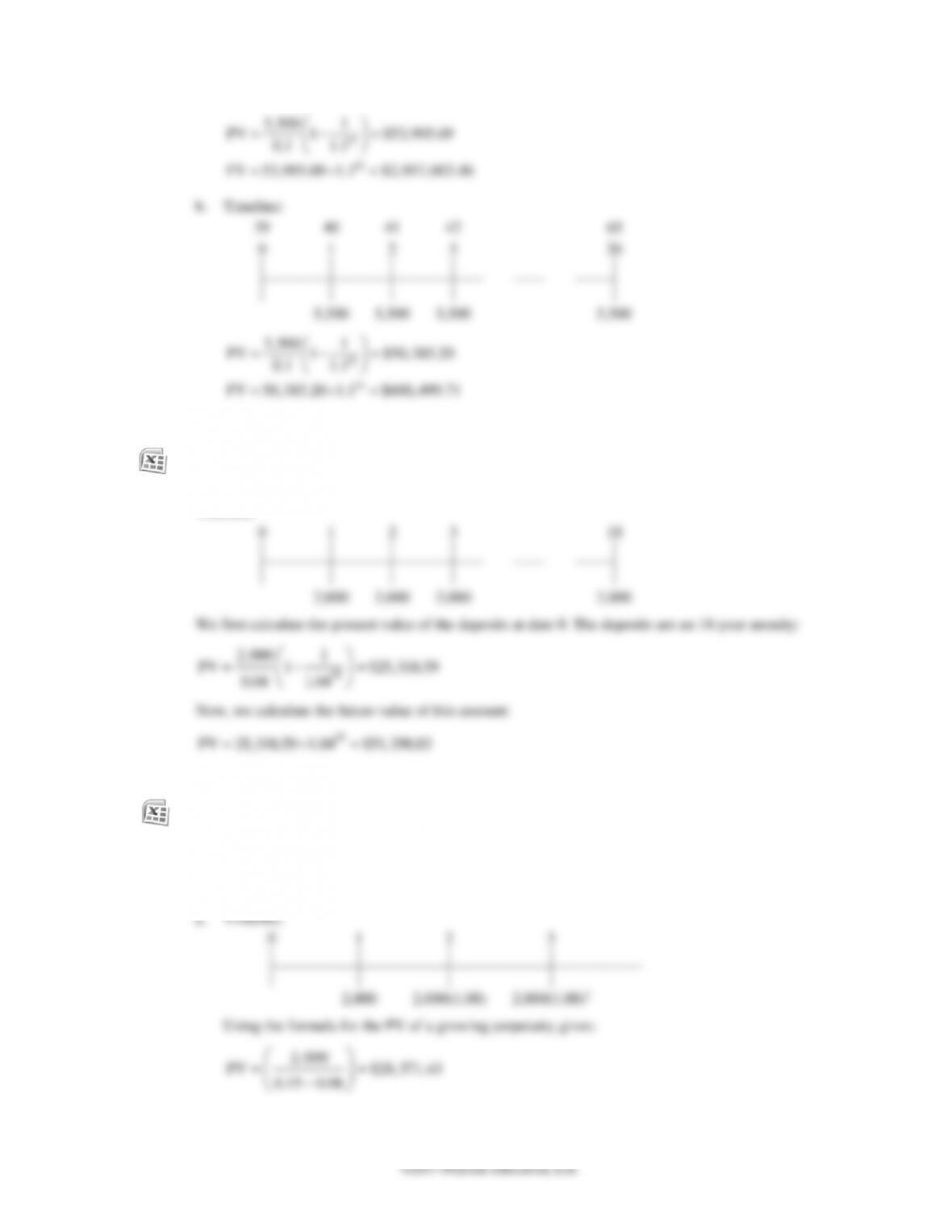
a. Timeline:
23
24
25
26
65
0
1
2
3
42
5,500
5,500
5,500
5,500
Chapter 4/The Time Value of Money 39
©2017 Pearson Education, Ltd.
42
42
5,500 1
PV 1 $53,995.69
0.1 1.1
FV 53,995.69 1.1 $2,957,003.46
= − =
= =
b. Timeline:
39
40
41
42
65
0
1
2
3
26
5,500
5,500
5,500
5,500
26
26
5,500 1
PV 1 $50,385.20
0.1 1.1
FV 50,385.20 1.1 $600, 499.71
= − =
= =
4-23. Your grandmother has been putting $2000 into a savings account on every birthday since your
first (that is, when you turned one). The account pays an interest rate of 4%. How much money
will be in the account on your eighteenth birthday immediately after your grandmother makes
the deposit on that birthday?
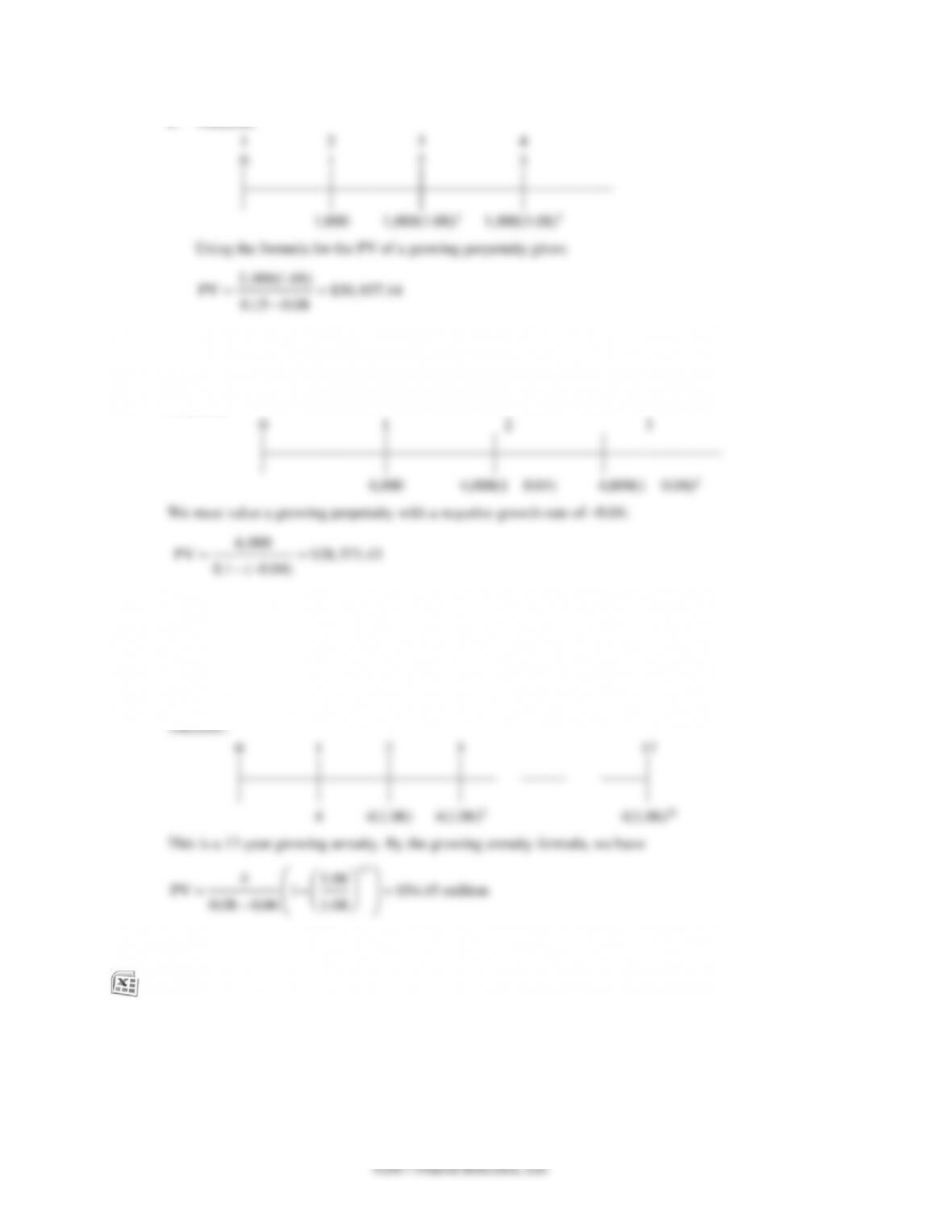
Timeline:
0
1
2
3
18
2,000
2,000
2,000
2,000
We first calculate the present value of the deposits at date 0. The deposits are an 18-year annuity:
18
2, 000 1
PV 1 $25, 318.59
0.04 1.04
= − =
Now, we calculate the future value of this amount:
18
FV 25, 318.59 1.04 $51, 290.83= =
4-24. A rich relative has bequeathed you a growing perpetuity. The first payment will occur in one
year and will be $2000. Each year after that, on the anniversary of the last payment you will
receive a payment that is 8% larger than the last payment. This pattern of payments will go on
forever. If the interest rate is 15% per year,
a. What is today’s value of the bequest?
b. What is the value of the bequest immediately after the first payment is made?
0.15 0.08
−
2,000
40 Berk/DeMarzo, Corporate Finance, Fourth Edition, Global Edition
b. Timeline:
1
2
3
4
0
1
2
3
1,000
1,000(1.08)2
1,000(1.08)3
Using the formula for the PV of a growing perpetuity gives:
2, 000(1.08)
PV $30,857.14
0.15 0.08
==
−
4-25. You are thinking of building a new machine that will save you $4000 in the first year. The
machine will then begin to wear out so that the savings decline at a rate of 4% per year forever.
What is the present value of the savings if the interest rate is 10% per year?
Timeline:
0
1
2
3
4,000
4,000(1 – 0.04)
4,000(1 – 0.04)2
We must value a growing perpetuity with a negative growth rate of –0.04:
4, 000
PV $28, 571.43
0.1 ( 0.04)
==
−−
4-26. You work for a pharmaceutical company that has developed a new drug. The patent on the drug
will last 17 years. You expect that the drug’s profits will be $4 million in its first year and that
this amount will grow at a rate of 6% per year for the next 17 years. Once the patent expires,
other pharmaceutical companies will be able to produce the same drug and competition will
likely drive profits to zero. What is the present value of the new drug if the interest rate is 8%
per year?
0
0.08 0.06 1.08
−
4-27. Your oldest daughter is about to start kindergarten at a private school. Tuition is $30,000 per
year, payable at the beginning of the school year. You expect to keep your daughter in private
school through high school. You expect tuition to increase at a rate of 3% per year over the 13
years of her schooling. What is the present value of the tuition payments if the interest rate is 3%
per year? How much would you need to have in the bank now to fund all 13 years of tuition?
Chapter 4/The Time Value of Money 41
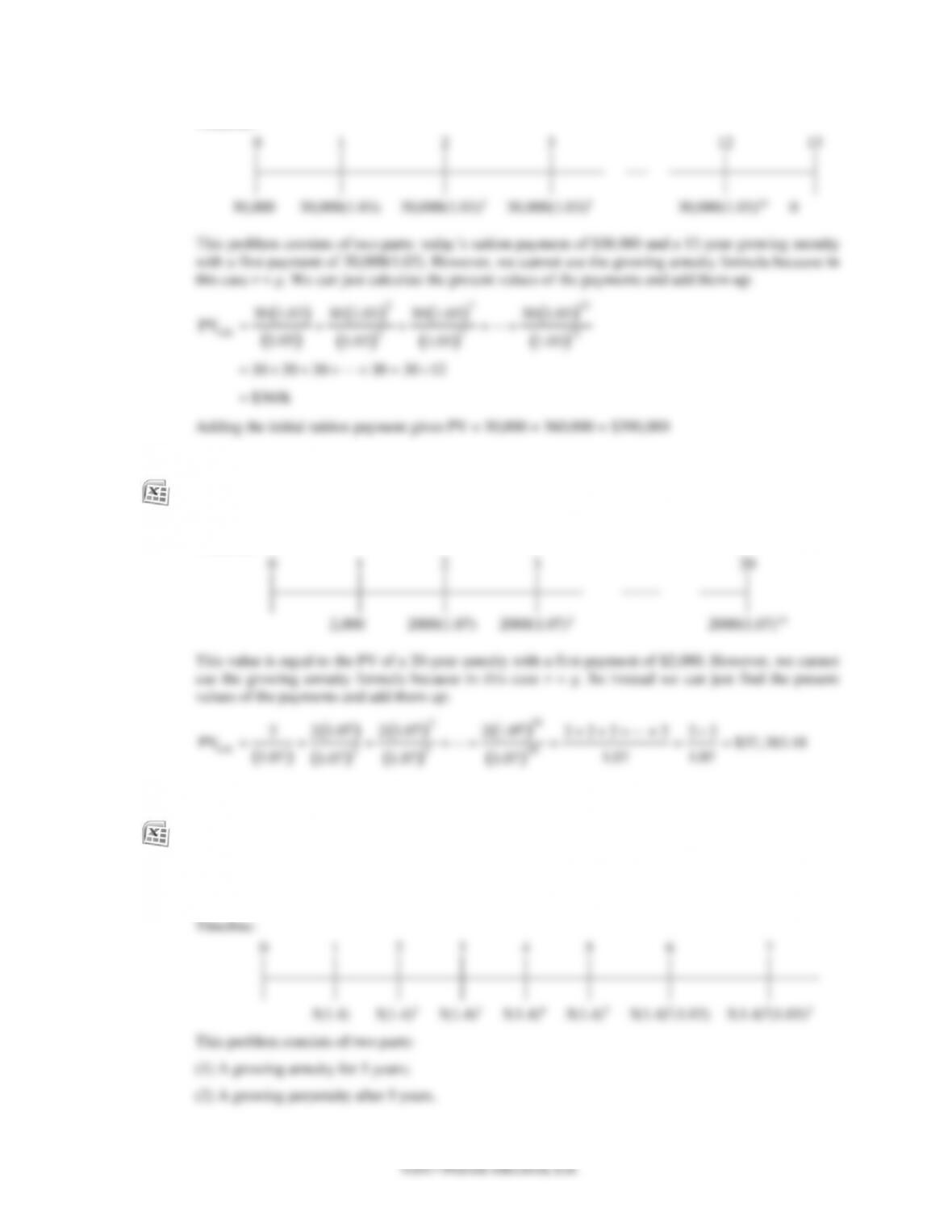
Timeline:
0
1
2
3
12
13
30,000
30,000(1.03)
30,000(1.03)2
30,000(1.03)3
30,000(1.03)12
0
This problem consists of two parts: today’s tuition payment of $30,000 and a 12-year growing annuity
with a first payment of 30,000(1.03). However, we cannot use the growing annuity formula because in
this case r = g. We can just calculate the present values of the payments and add them up:
( )
( )
( )
( )
( )
( )
( )
( )
2 3 12
GA 2 3 12
30 1.03 30 1.03 30 1.03 30 1.03
PV 1.03 1.03 1.03 1.03
30 30 30 30 30 12
$360k
= + + + +
= + + + + =
=
Adding the initial tuition payment gives PV = 30,000 + 360,000 = $390,000
4-28. A rich aunt has promised you $2000 one year from today. In addition, each year after that, she
has promised you a payment (on the anniversary of the last payment) that is 7% larger than the
last payment. She will continue to show this generosity for 20 years, giving a total of 20
payments. If the interest rate is 7%, what is her promise worth today?
Timeline:
0
1
2
3
20
2,000
2000(1.07)
2000(1.07)2
2000(1.07)19
This value is equal to the PV of a 20-year annuity with a first payment of $2,000. However, we cannot
use the growing annuity formula because in this case r = g. So instead we can just find the present
values of the payments and add them up:
( )
( )
( )
( )
( )
( )
( )
2 19
GA 2 3 20
2 1.07 2 1.07 2 1.07
2 2 2 2 2 2 2
PV $37,383.18
1.07 1.07 1.07
1.07 1.07 1.07
+ + + +
= + + + + = = =
4-29. You are running a hot Internet company. Analysts predict that its earnings will grow at 40% per
year for the next five years. After that, as competition increases, earnings growth is expected to
slow to 3% per year and continue at that level forever. Your company has just announced
earnings of $5 million. What is the present value of all future earnings if the interest rate is 7%?
(Assume all cash flows occur at the end of the year.)
5(1.4)
5(1.4)2
5(1.4)3
5(1.4)4
5(1.4)5
5(1.4)5(1.03)
5(1.4)5(1.03)2
42 Berk/DeMarzo, Corporate Finance, Fourth Edition, Global Edition
First we find the PV of (1):
5
GA
5(1.4) 1.4
PV 1 $60.128 million.
0.07 0.4 1.07
= − =
−
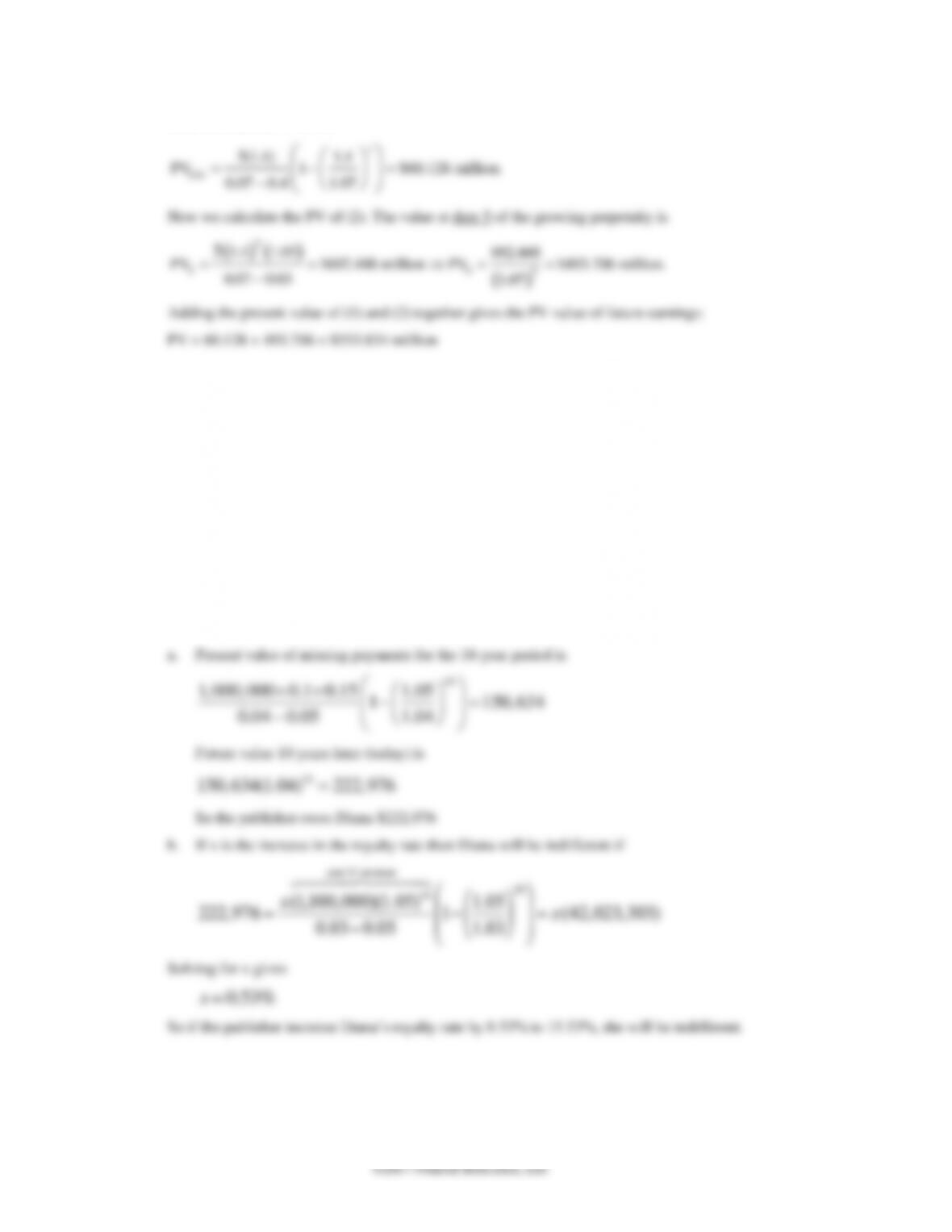
Now we calculate the PV of (2). The value at date 5 of the growing perpetuity is
( ) ( )
( )
5
50
5
1.4 1.03 692.448
PV $692.448 million PV $493.706 million.
0.07 0.03 1.07
5
= = = =
−
Adding the present value of (1) and (2) together gives the PV value of future earnings:
PV = 60.128 + 493.706 = $553.834 million
4-30. Ten years ago Diana Torres wrote what has become the leading Tort textbook. She has been
receiving royalties based on revenues reported by the publisher. These revenues started at $1
million in the first year, and grew steadily by 5% per year. Her royalty rate is 15% of revenue.
Recently, she hired an auditor who discovered that the publisher had been under reporting
revenues. The book had actually earned 10% more in revenues than had been reported on her
royalty statements.
a. Assuming the publisher pays an interest rate of 4% on missed payments, how much money
does the publisher owe Diana?
b. The publisher is short of cash, so instead of paying Diana what is owed, the publisher is
offering to increase her royalty rate on future book sales. Assume the book will generate
revenues for an additional 20 years and that the current revenue growth will continue. If
Diana would otherwise put the money into a bank account paying interest of 3%, what
royalty rate would make her indifferent between accepting an increase in the future royalty
rate and receiving the cash owed today.