Chapter 31
International Corporate Finance
31–1. You are a U.S. investor who is trying to calculate the present value of a €14 million cash inflow
that will occur one year in the future. The spot exchange rate is S = $1.137/€ and the forward
rate is F1 = $1.159/€. You estimate that the appropriate dollar discount rate for this cash flow is
7% and the appropriate euro discount rate is 5%.
a. What is the present value of the €14 million cash inflow computed by first discounting the
euro and then converting it into dollars?
b. What is the present value of the €14 million cash inflow computed by first converting the
cash flow into dollars and then discounting?
c. What can you conclude about whether these markets are internationally integrated, based
on your answers to parts (a) and (b)?
31–2. Mia Caruso Enterprises, a U.S. manufacturer of children’s toys, has made a sale in Bulgaria and
is expecting a BGN17 million cash inflow in one year. The current spot rate is S = $0.5717/BGN
and the one-year forward rate is F1 = $0.5388/BGN.
a. What is the present value of Mia Caruso’s BGN17 million inflow computed by first
discounting the cash flow at the appropriate Bulgarian Lev discount rate of 6%, and then
converting the result into dollars?
b. What is the present value of the BGN17 million cash inflow computed by first converting the
cash flow into dollars and then discounting it at the appropriate dollar discount rate of
11%?
c. What can you conclude about whether these markets are internationally integrated, based
on your answers to parts (a) and (b)?
Chapter 31/International Corporate Finance 377
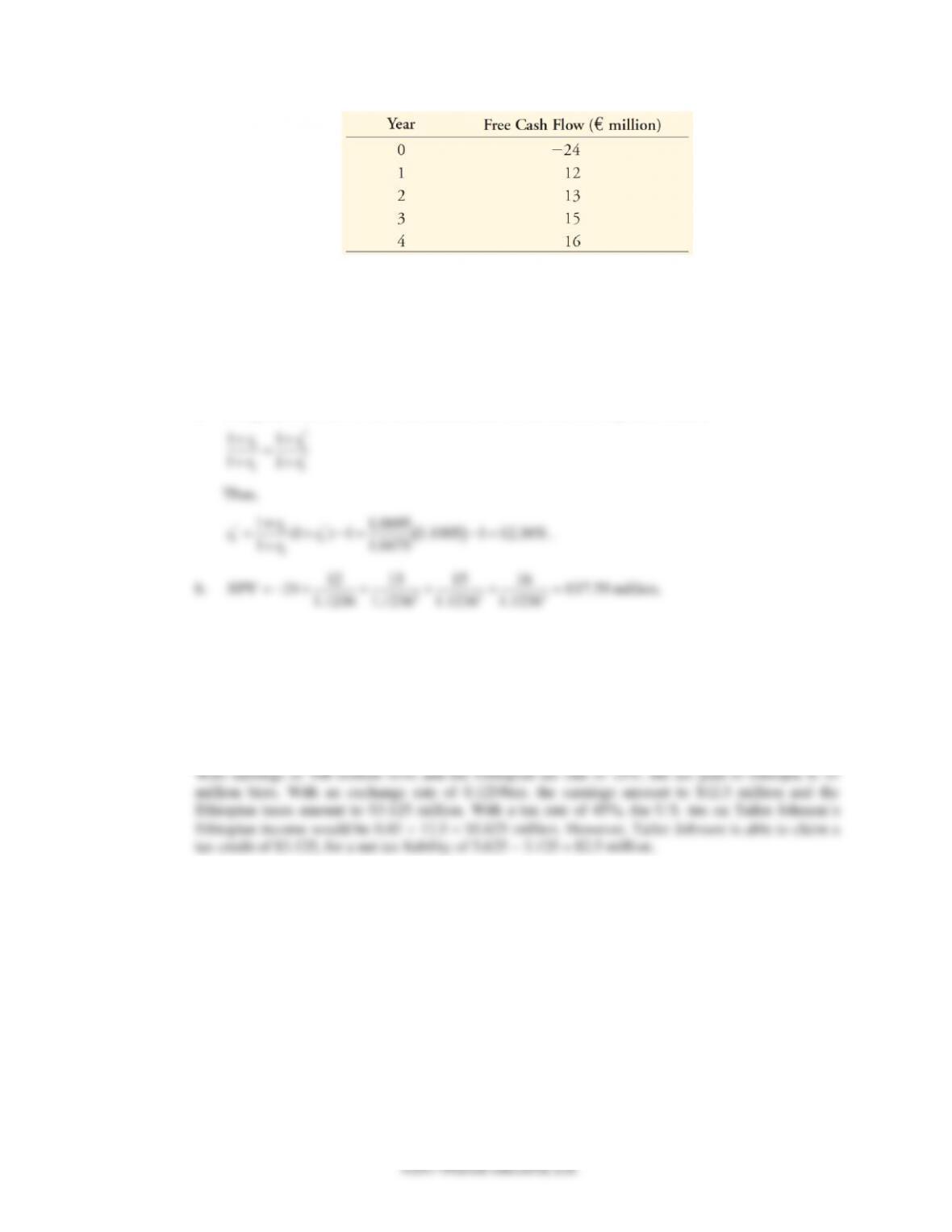
The new project has similar dollar risk to Manzetti’s other projects. The company knows that its
overall dollar WACC is 10.05%, so it feels comfortable using this WACC for the project. The
risk-free interest rate on dollars is 4.75% and the risk-free interest rate on euros is 6.95%.
a. Manzetti Foods is willing to assume that capital markets in the United States and the euro
area are internationally integrated. What is the company’s euro WACC?
b. What is the present value of the project in euros?
a. Using the formula for the Internationalization of the Cost of Capital, we have:
*
$$
11
++
rr
2 3 4
1.1236 1.1236 1.1236 1.1236
31–9. Tailor Johnson, a U.S. maker of fine menswear, has a subsidiary in Ethiopia. This year, the
subsidiary reported and repatriated earnings before interest and taxes (EBIT) of 100 million
Ethiopian birrs. The current exchange rate is 8 birr/$ or S1 = $0.125/birr. The Ethiopian tax rate
on this activity is 25%. U.S. tax law requires Tailor Johnson to pay taxes on the Ethiopian
earnings at the same rate as profits earned in the United States, which is currently 45%.
However, the United States gives a full tax credit for foreign taxes paid up to the amount of the
U.S. tax liability. What is Tailor Johnson’s U.S. tax liability on its Ethiopian subsidiary?
31-10. Tailor Johnson, the menswear company with a subsidiary in Ethiopia described in Problem 9, is
considering the tax benefits resulting from deferring repatriation of the earnings from the
subsidiary. Under U.S. tax law, the U.S. tax liability is not incurred until the profits are brought
back home. Tailor Johnson reasonably expects to defer repatriation for 10 years, at which point
the birr earnings will be converted into dollars at the prevailing spot rate, S10, and the tax credit
for Ethiopian taxes paid will still be converted at the exchange rate S1 = $0.125/birr. Tailor
Johnson’s after-tax cost of debt is 5%.
a. Suppose the exchange rate in 10 years is identical to this year’s exchange rate, so S10 =
$0.125/birr. What is the present value of deferring the U.S. tax liability on Tailor Johnson’s
Ethiopian earnings for 10 years?
b. How will the exchange rate in 10 years affect the actual amount of the U.S. tax liability?
Write an equation for the U.S. tax liability as a function of the exchange rate S10.
378 Berk/DeMarzo, Corporate Finance, Fourth Edition, Global Edition
©2017 Pearson Education, Ltd.
a. From question 31-9, the tax liability is $2.5 million. Deferred for 10 years, using the after-tax cost
of debt at 5%, the present value is
10
2.5/1.05 $1.53=
million. Hence, the value of deferral is 2.5 –
1.53 = $0.97 million.
b. The earnings will need to be converted at the future exchange rate,
10
S
, although the tax credit
will still be calculated at
1$0.125/S birr=
. Hence, the U.S. tax liability will be
10
(0.45)( )(100) 3.125S−
.
31-11. Peripatetic Enterprises, a U.S. import-export trading firm, is considering its international tax
situation. U.S. tax law requires U.S. corporations to pay taxes on their foreign earnings at the
same rate as profits earned in the United States; this rate is currently 45%. However, a full tax
credit is given for the foreign taxes paid up to the amount of the U.S. tax liability. Peripatetic has
major operations in Poland, where the tax rate is 20%, and in Sweden, where the tax rate is
60%. The profits, which are fully and immediately repatriated, and foreign taxes paid for the
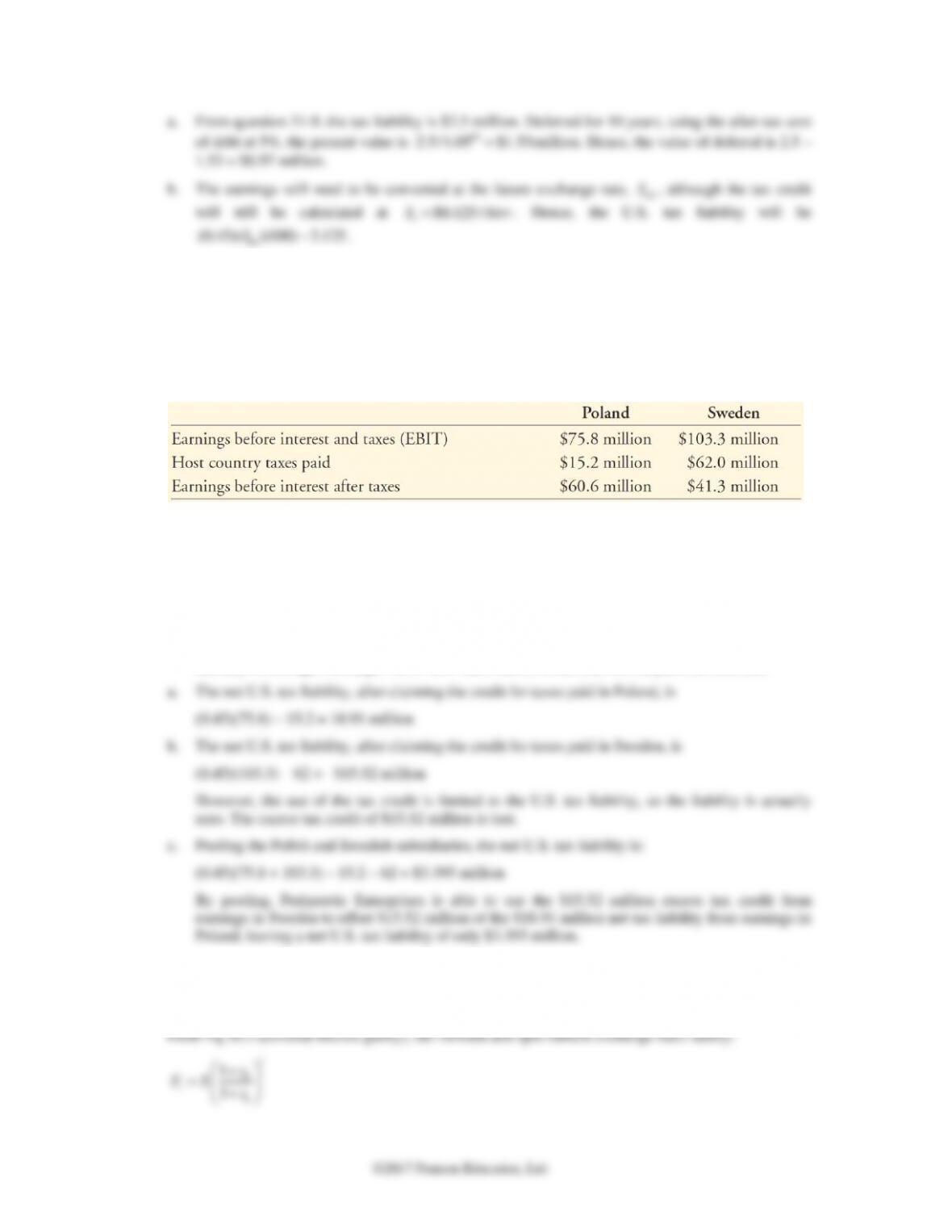
current year are shown here:
a. What is the U.S. tax liability on the earnings from the Polish subsidiary assuming the
Swedish subsidiary did not exist?
b. What is the U.S. tax liability on the earnings from the Swedish subsidiary assuming the
Polish subsidiary did not exist?
c. Under U.S. tax law, Peripatetic is able to pool the earnings from its operations in Poland and
Sweden when computing its U.S. tax liability on foreign earnings. Total EBIT is thus $179.1
million and the total host country taxes paid is $77.2 million. What is the total U.S. tax
liability on foreign earnings? Show how this relates to the answers in parts (a) and (b).
31-12. Suppose the interest on Russian government bonds is 7.9%, and the current exchange rate is 28.6
rubles per dollar. If the forward exchange rate is 29.1 rubles per dollar, and the current U.S.
risk-free interest rate is 4.8%, what is the implied credit spread for Russian government bonds?
$
1
+
i
Chapter 31/International Corporate Finance 379
where
R
r
and
$
r
are risk-free interest rates in rubles and dollars respectively. With this equation we
can use the spot and forward exchange rates, and the risk-free $ interest rate, to solve for the risk–free
ruble interest rate:
$
29.1
(1 ) 1 (1.048) 1 6.632%
28.6
= + − = − =
R
F
rr
S
Therefore, the implied risk-free ruble interest rate is 6.632%, implying that Russian government bonds
have an implied credit spread of 7.9% – 6.632% = 1.1268% to compensate investors for the possibility
of the Russian government defaulting.
31-13. Assume that in the original Ityesi example in Table 31.1, all sales actually occur in the United
States and are projected to be $60 million per year for four years. Keeping other costs the same,
calculate the NPV of the investment opportunity.
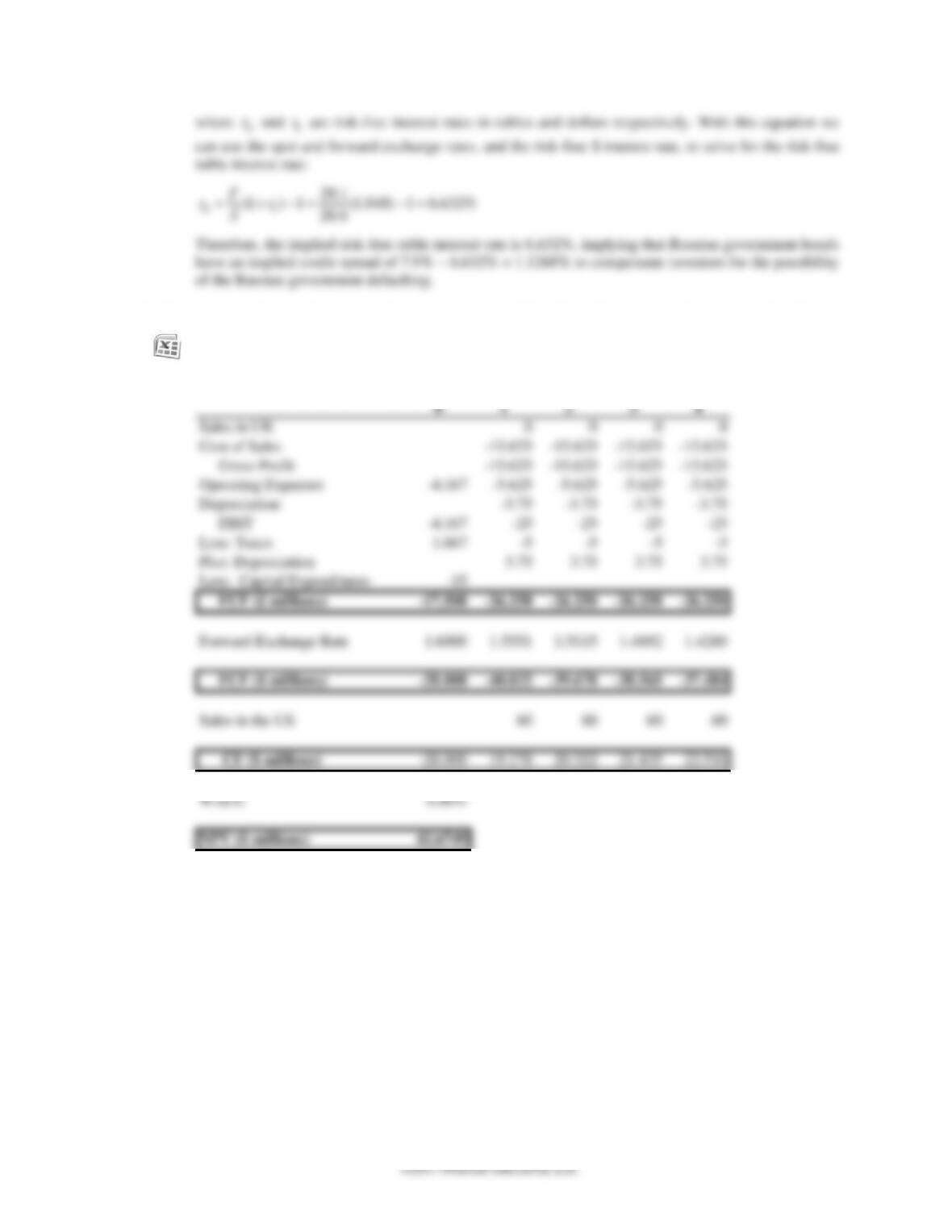
The solution to this problem is in the following Excel spreadsheet:
0 1 2 3 4
Sales in UK 0 0 0 0
Cost of Sales -15.625 -15.625 -15.625 -15.625
Gross Profit -15.625 -15.625 -15.625 -15.625
Operating Expenses -4.167 -5.625 -5.625 -5.625 -5.625
Depreciation -3.75 -3.75 -3.75 -3.75
EBIT -4.167 -25 -25 -25 -25
Less: Taxes 1.667 -5 -5 -5 -5
Plus: Depreciation 3.75 3.75 3.75 3.75
Less: Capital Expenditures -15
FCF (£ millions) -17.500 -26.250 -26.250 -26.250 -26.250
Forward Exchange Rate 1.6000 1.5551 1.5115 1.4692 1.4280
FCF ($ millions) -28.000 -40.822 -39.678 -38.565 -37.484
Sales in the US 60 60 60 60
CF ($ millions) -28.000 19.178 20.322 21.435 22.516