Chapter 30
Risk Management
30–1. The William Companies (WMB) owns and operates natural gas pipelines that deliver 12% of the
natural gas consumed in the United States. WMB is concerned that a major hurricane could
disrupt its Gulfstream pipeline, which runs 691 miles through the Gulf of Mexico. In the event of
a disruption, the firm anticipates a loss of profits of $65 million. Suppose the likelihood of a
disruption is 3% per year, and the beta associated with such a loss is −0.25. If the risk-free
interest rate is 5% and the expected return of the market is 10%, what is the actuarially fair
insurance premium?
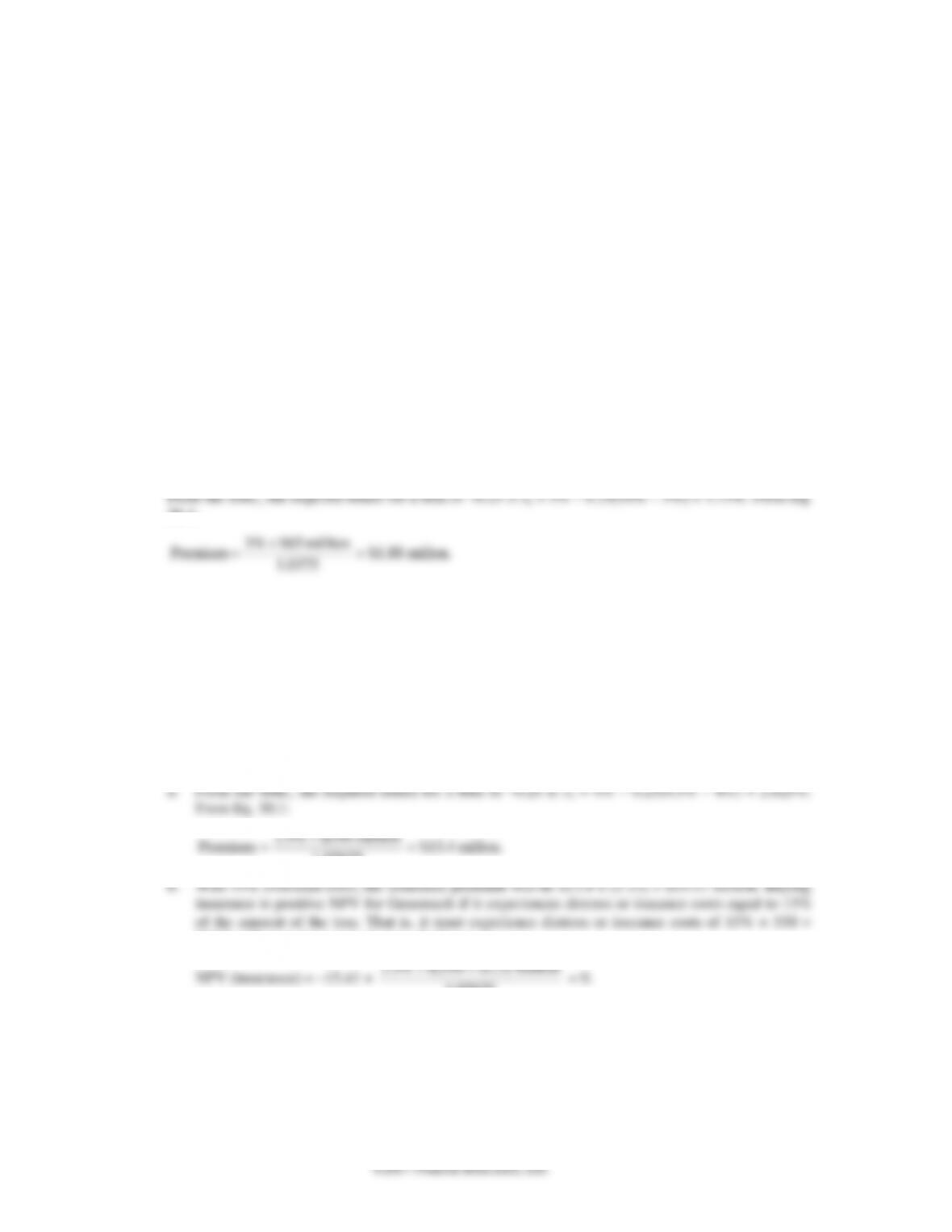
30.1:
3% $65 million
Premium $1.88 millon.
1.0375
==
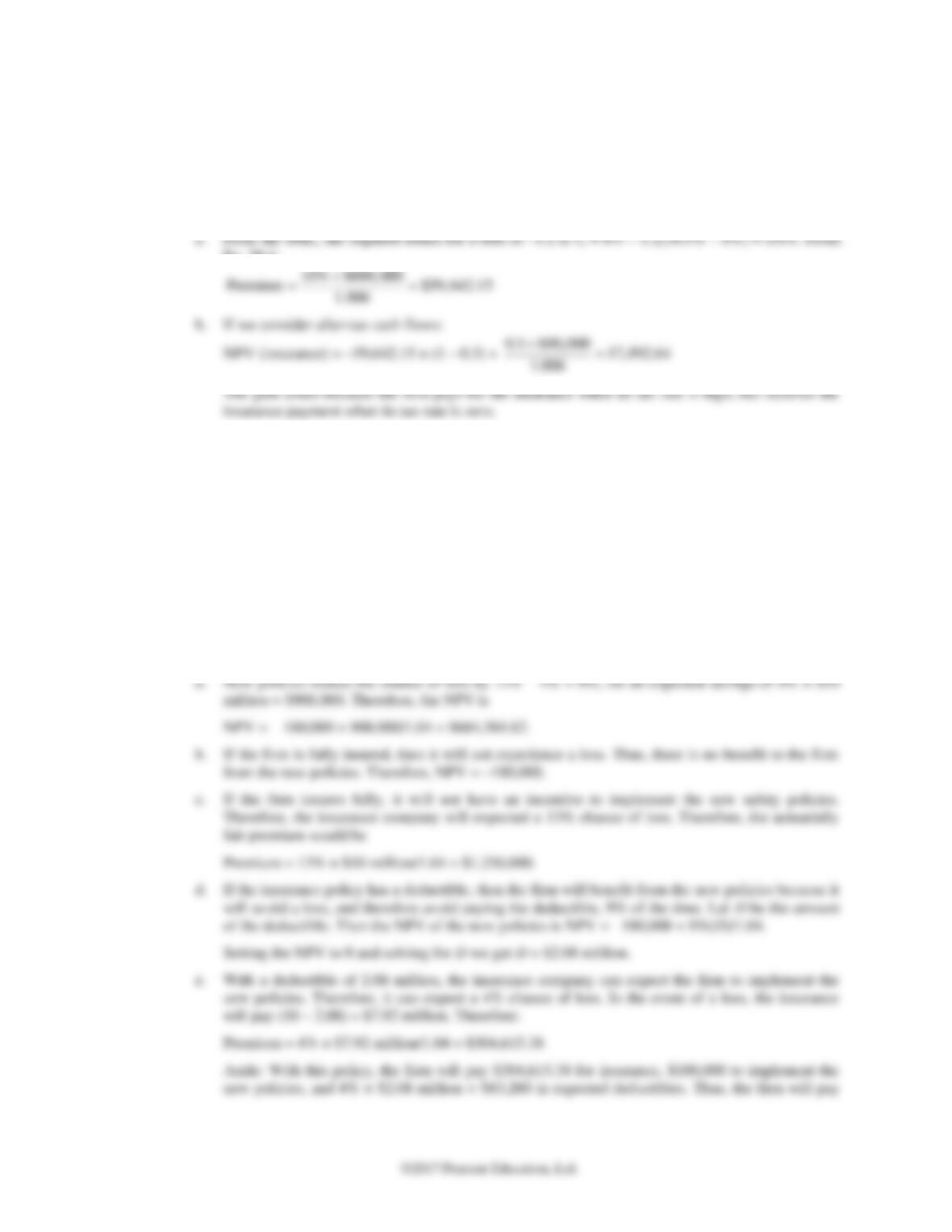
30–2. Genentech’s main facility is located in South San Francisco. Suppose that Genentech would
experience a direct loss of $550 million in the event of a major earthquake that disrupted its
operations. The chance of such an earthquake is 2.5% per year, with a beta of −0.25.
a. If the risk-free interest rate is 4% and the expected return of the market is 9.5%, what is the
actuarially fair insurance premium required to cover Genentech’s loss?
b. Suppose the insurance company raises the premium by an additional 15% over the amount
calculated in part (a) to cover its administrative and overhead costs. What amount of
financial distress or issuance costs would Genentech have to suffer if it were not insured to
justify purchasing the insurance?
Chapter 30/Risk Management 363
An insurance firm has agreed to write a trade insurance policy that will pay $600,000 in the
event of an import moratorium. The chance of a moratorium is estimated to be 10%, with a beta
of −1.2. Suppose the risk-free interest rate is 6% and the expected return of the market is 10.5%.
a. What is the actuarially fair premium for this insurance?
b. What is the NPV of purchasing this insurance for your firm? What is the source of this gain?
Eq. 30.1:
10% $600,000
Premium $59,642.15
1.006
==
b. If we consider after-tax cash flows:
NPV (insurance) = –59,642.15 × (1 – 0.3) +
0.1 600,000 17,892.64
1.006
=
The gain arises because the firm pays for the insurance when its tax rate is high, but receives the
insurance payment when its tax rate is zero.
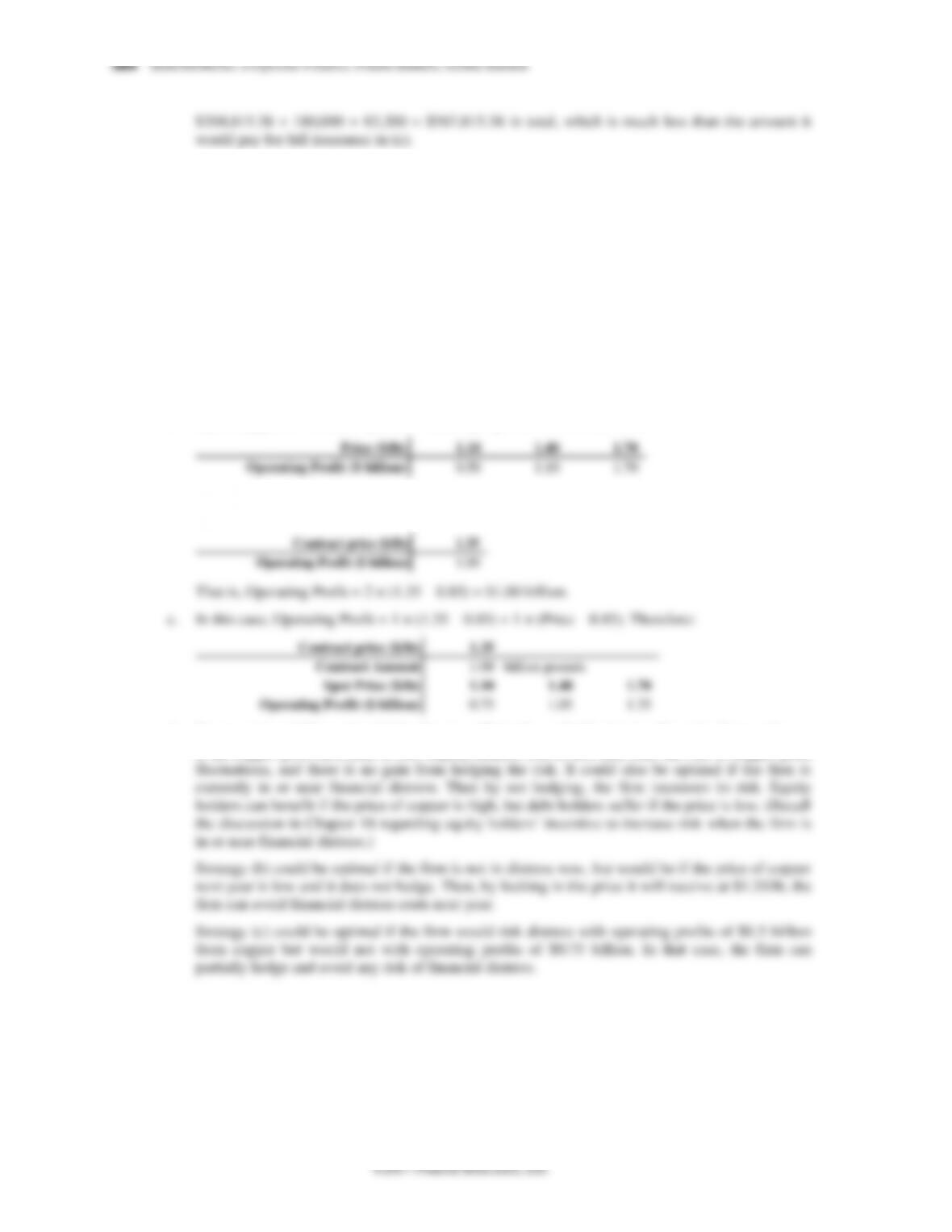
30–4. Your firm faces a 13% chance of a potential loss of $10 million next year. If your firm
implements new policies, it can reduce the chance of this loss to 4%, but these new policies have
an upfront cost of $180,000. Suppose the beta of the loss is 0, and the risk-free interest rate is
4%.
a. If the firm is uninsured, what is the NPV of implementing the new policies?
b. If the firm is fully insured, what is the NPV of implementing the new policies?
c. Given your answer to part (b), what is the actuarially fair cost of full insurance?
d. What is the minimum-size deductible that would leave your firm with an incentive to
implement the new policies?
e. What is the actuarially fair price of an insurance policy with the deductible in part (d)?
©2017 Pearson Education, Ltd.
30–5. BHP Billiton is the world’s largest mining firm. BHP expects to produce 2 billion pounds of
copper next year, with a production cost of $0.85 per pound.
a. What will be BHP’s operating profit from copper next year if the price of copper is $1.10,
$1.40, or $1.70 per pound, and the firm plans to sell all of its copper next year at the going
price?
b. What will be BHP’s operating profit from copper next year if the firm enters into a contract
to supply copper to end users at an average price of $1.35 per pound?
c. What will be BHP’s operating profit from copper next year if copper prices are described as
in part (a), and the firm enters into supply contracts as in part (b) for only 50% of its total
output?
d. Describe situations for which each of the strategies in parts (a), (b), and (c) might be optimal.
a. Operating profit = 2 billion pounds × (Price per pound – $0.85/lb). Thus:
Price ($/lb) 1.10 1.40 1.70
Operating Profit ($ billion) 0.50 1.10 1.70
b. In this case, they will sell for the contract price of $1.35/lb, no matter what the spot price of copper
is next year:
Contract price ($/lb) 1.35
Operating Profit ($ billion) 1.00
That is, Operating Profit = 2 × (1.35 – 0.85) = $1.00 billion.
c. In this case, Operating Profit = 1 × (1.35 – 0.85) + 1 × (Price – 0.85). Therefore:
Contract price ($/lb) 1.35
Contract Amount 1.00 billion pounds
Spot Price ($/lb) 1.10 1.40 1.70
Operating Profit ($ billion) 0.75 1.05 1.35
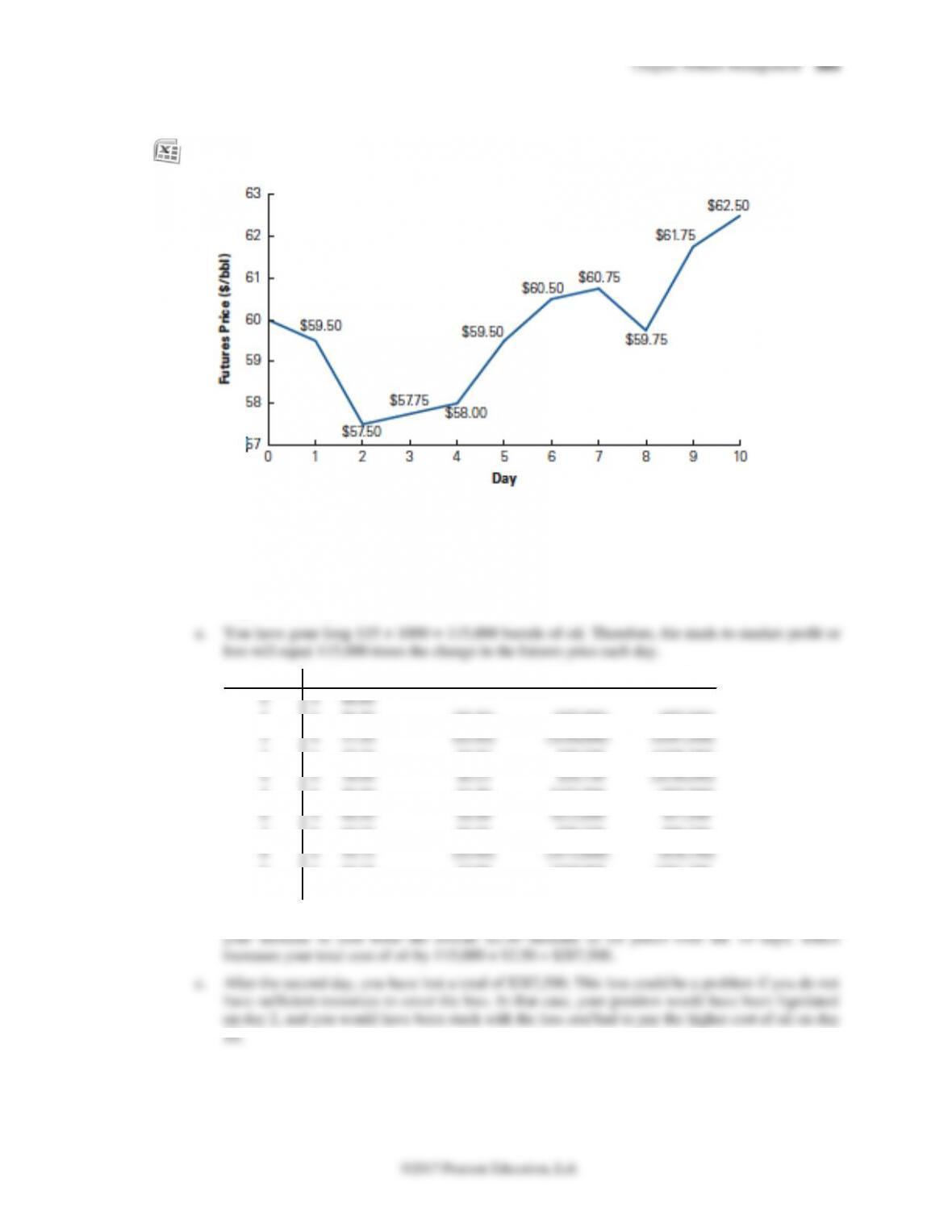
d. Strategy (a) could be optimal if the firm is sufficiently profitable that it will not be distressed even
if the copper price next year is low. Equity holders will in this case bear the risk of copper price
©2017 Pearson Education, Ltd.
30–9. You are a broker for frozen seafood products for Choyce Products. You just signed a deal with a
Belgian distributor. Under the terms of the contract, in one year you will deliver 3600 kilograms
of frozen king crab for 102,000 euros. Your cost for obtaining the king crab is $106,000. All cash
flows occur in exactly one year.
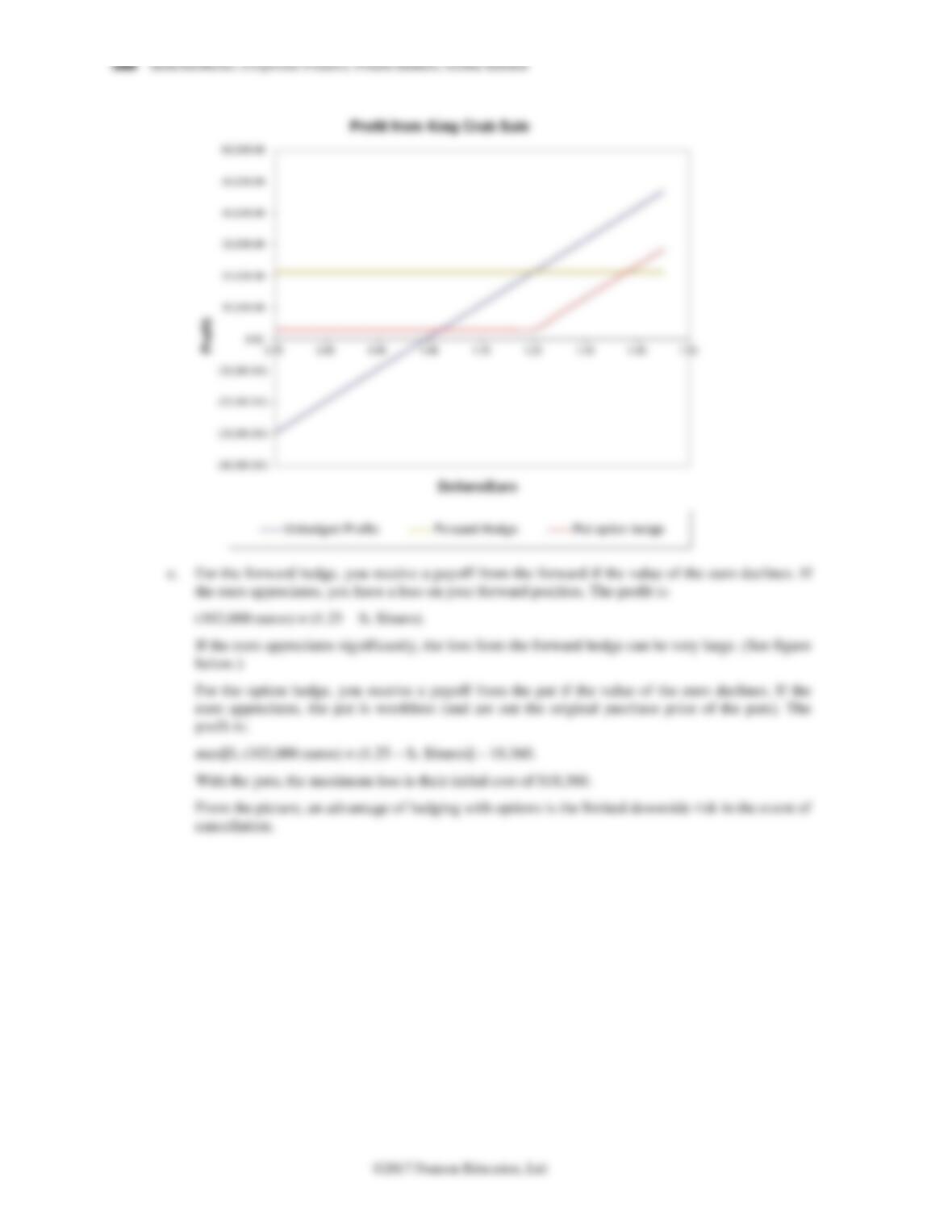
a. Plot your profits in one year from the contract as a function of the exchange rate in one year,
for exchange rates from $0.75/€ to $1.45/€. Label this line “Unhedged Profits.”
b. Suppose the one-year forward exchange rate is $1.25/€ and that you enter into a forward
contract to sell the euros you will receive at this rate. In the figure from part (a), plot your
combined profits from the crab contract and the forward contract as a function of the
exchange rate in one year. Label this line “Forward Hedge.”
c. Suppose that instead of using a forward contract, you consider using options. A one-year call
option to buy euros at a strike price of $1.25/€ is trading for $0.18/€. Similarly a one year put
option to sell euros at a strike price of $1.25/€ is trading for $0.18/€. To hedge the risk of
your profits, should you buy or sell the call or the put?
d. In the figure from parts (a) and (b), plot your “all in” profits using the option hedge
(combined profits of crab contract, option contract, and option price) as a function of the
exchange rate in one year. Label this line “Option Hedge.” (Note : You can ignore the effect
of interest on the option price.)
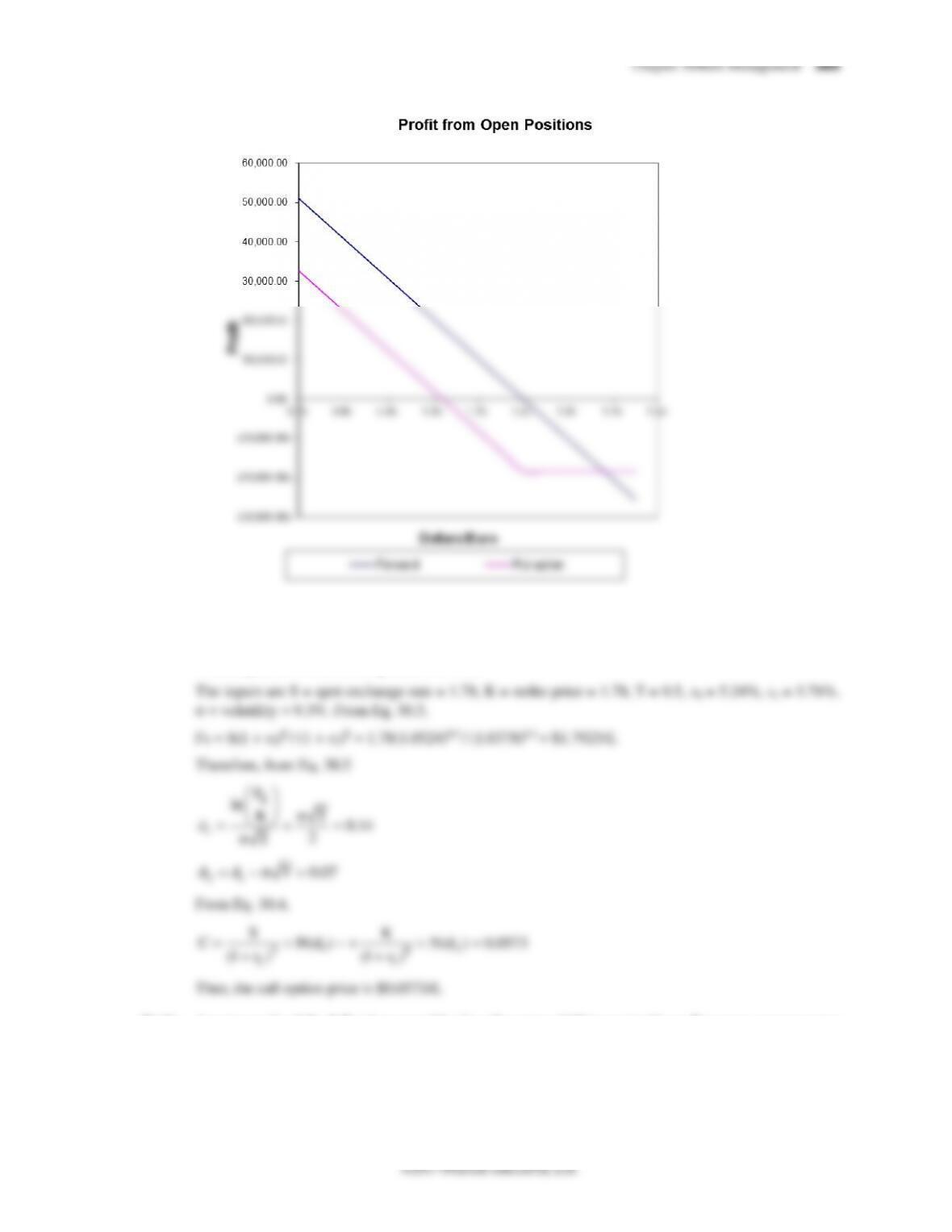
e. Suppose that by the end of the year, a trade war erupts, leading to a European embargo on
U.S. food products. As a result, your deal is cancelled, and you don’t receive the euros or
incur the costs of procuring the crab. However, you still have the profits (or losses)
associated with your forward or options contract. In a new figure, plot the profits associated
with the forward hedge and the options hedge (labeling each line). When there is a risk of
cancellation, which type of hedge has the least downside risk? Explain briefly.
©2017 Pearson Education, Ltd.
©2017 Pearson Education, Ltd.
30-10. Suppose the current exchange rate is $1.78/£, the interest rate in the United States is 5.24%, the
interest rate in the United Kingdom is 3.78%, and the volatility of the $/£ exchange rate is 9.3%.
Use the Black-Scholes formula to determine the price of a six-month European call option on the
British pound with a strike price of $1.78/£.
30-11. Assume each of the following securities has the same yield–to-maturity: a five-year, zero-coupon
bond; a nine-year, zero-coupon bond; a five-year annuity; and a nine-year annuity. Rank these
securities from lowest to highest duration.
370 Berk/DeMarzo, Corporate Finance, Fourth Edition, Global Edition
©2017 Pearson Education, Ltd.
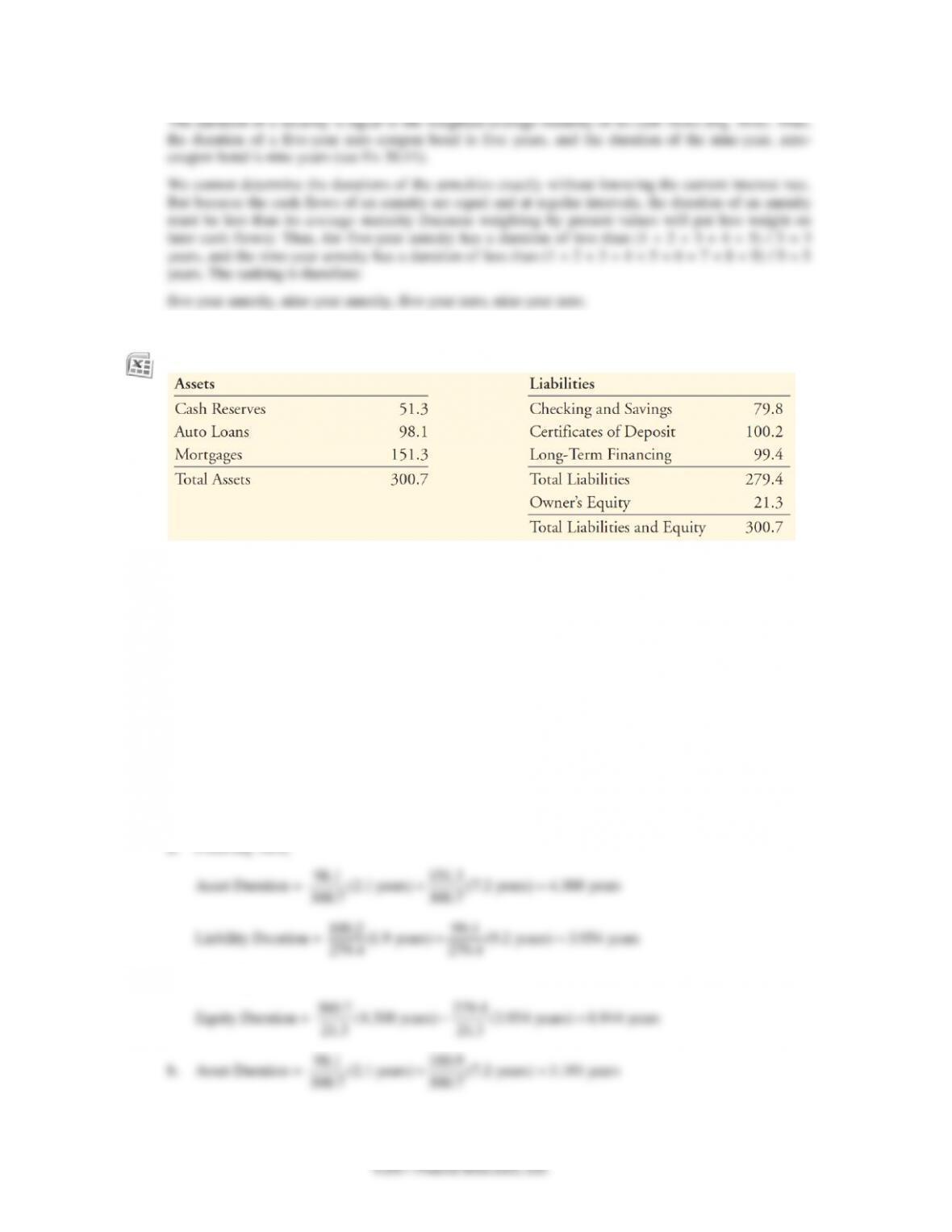
The duration of a security is equal to the weighted-average maturity of its cash flows (Eq. 30.6). Thus,
the duration of a five-year zero coupon bond is five years, and the duration of the nine-year, zero-
coupon bond is nine years (see Ex 30.11).
We cannot determine the durations of the annuities exactly without knowing the current interest rate.
But because the cash flows of an annuity are equal and at regular intervals, the duration of an annuity
must be less than its average maturity (because weighting by present values will put less weight on
later cash flows). Thus, the five-year annuity has a duration of less than (1 + 2 + 3 + 4 + 5) / 5 = 3
years, and the nine-year annuity has a duration of less than (1 + 2 + 3 + 4 + 5 + 6 + 7 + 8 + 9) / 9 = 5
years. The ranking is therefore:
five-year annuity, nine-year annuity, five-year zero, nine-year zero.
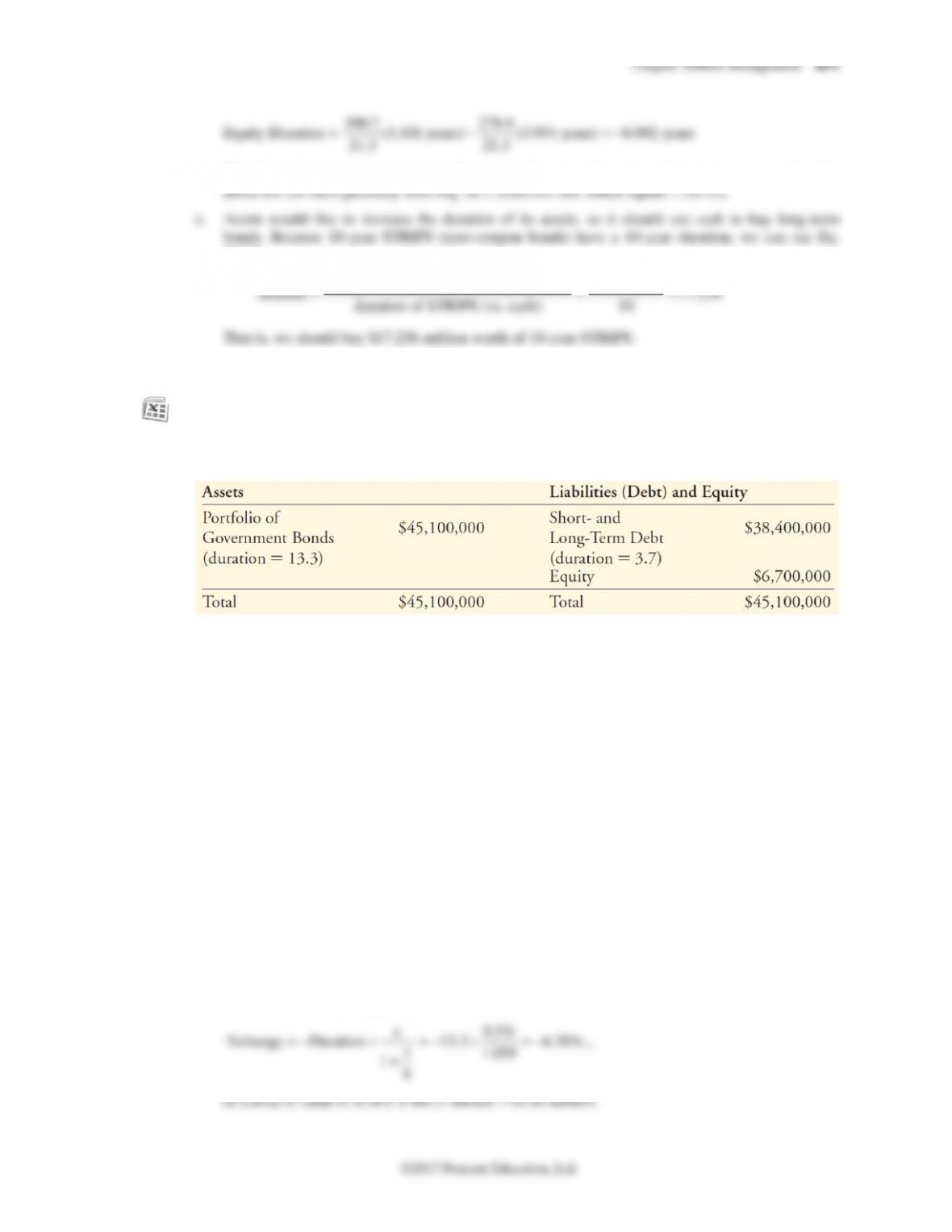
30-12. You have been hired as a risk manager for Acorn Savings and Loan. Currently, Acorn’s balance
sheet is as follows (in millions of dollars):
When you analyze the duration of loans, you find that the duration of the auto loans is 2.1 years,
while the mortgages have a duration of 7.2 years. Both the cash reserves and the checking and
savings accounts have a zero duration. The CDs have a duration of 1.9 years and the long-term
financing has a 9.2-year duration.
a. What is the duration of Acorn’s equity?
b. Suppose Acorn experiences a rash of mortgage prepayments, reducing the size of the
mortgage portfolio from $151.3 million to $100.9 million, and increasing cash reserves to
$101.7 million. What is the duration of Acorn’s equity now? If interest rates are currently
4% and were to fall to 3%, estimate the approximate change in the value of Acorn’s equity.
(Assume interest rates are APRs based on monthly compounding.)
c. Suppose that after the prepayments in part (b), but before a change in interest rates, Acorn
considers managing its risk by selling mortgages and/or buying 10-year Treasury STRIPS
(zero coupon bonds). How many should the firm buy or sell to eliminate its current interest
rate risk?
a. From Eq. 30.8,
98.1 151.3
279.4 279.4
From Eq. 30.9,
300.7 279.4
300.7 300.7
©2017 Pearson Education, Ltd.
21.3 21.3
Therefore, if interest rates drop by 1%, we would expect the value of Acorn’s equity to drop by
30.10:
change in equity duration equity value 8.092 21.3
Amount 17.236
duration of STRIPS (vs. cash) 10
= = =
That is, we should buy $17.236 million worth of 10-year STRIPS.
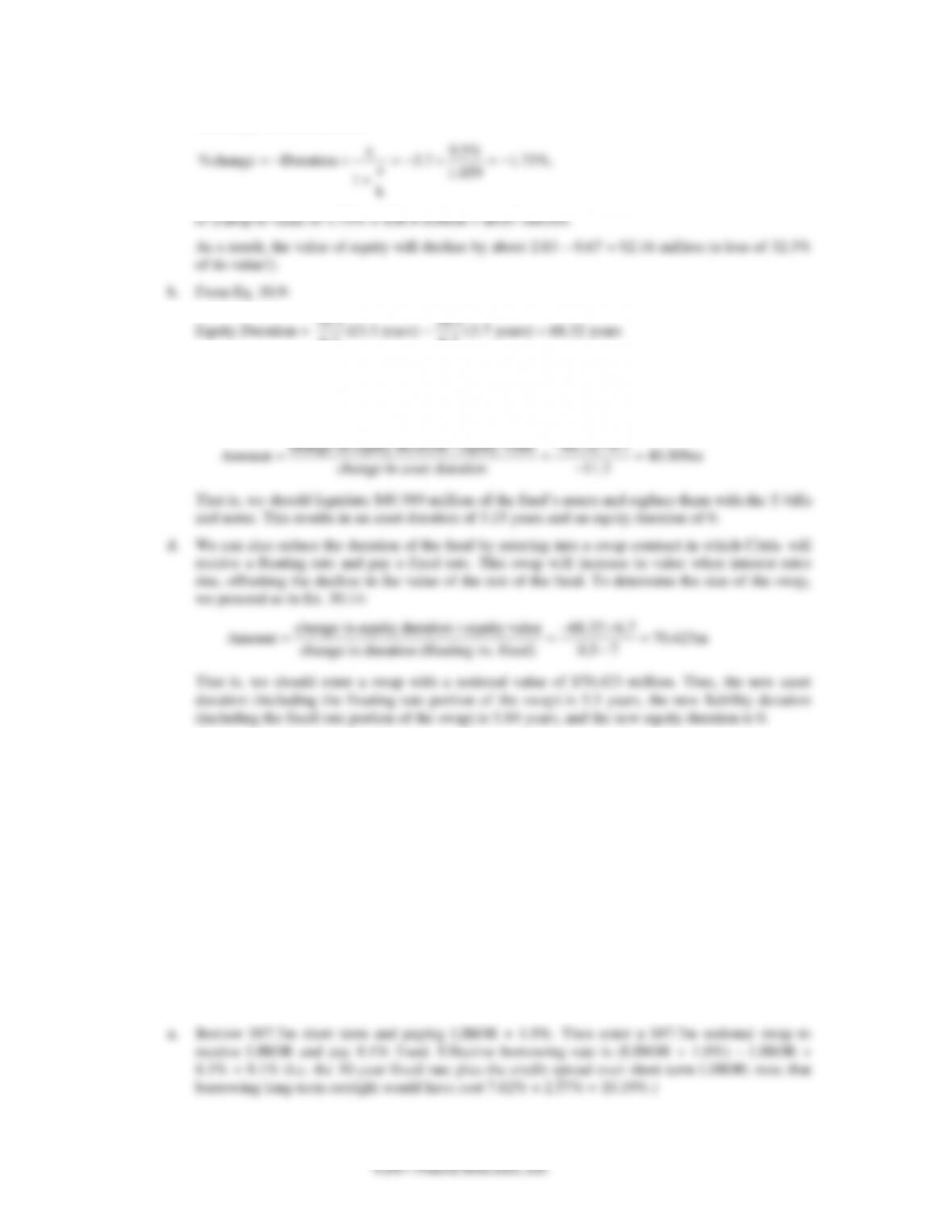
30-13. The Citrix Fund has invested in a portfolio of government bonds that has a current market value
of $45.1 million. The duration of this portfolio of bonds is 13.3 years. The fund has borrowed to
purchase these bonds, and the current value of its liabilities (i.e., the current value of the bonds it
has issued) is $38.4 million. The duration of these liabilities is 3.7 years. The equity in the Citrix
Fund (or its net worth) is obviously $6.7 million. The market-value balance sheet below
summarizes this information:
Assume that the current yield curve is flat at 5.9%. You have been hired by the board of
directors to evaluate the risk of this fund.
a. Consider the effect of a surprise increase in interest rates, such that the yields rise by 50
basis points (i.e., the yield curve is now flat at 6.4%). What would happen to the value of the
assets in the Citrix Fund? What would happen to the value of the liabilities? What can you
conclude about the change in the value of the equity under these conditions?
b. What is the initial duration of the Citrix Fund (i.e., the duration of the equity)?
c. As a result of your analysis, the board of directors fires the current manager of the fund.
You are hired and given the objective of minimizing the fund’s exposure to interest rate
fluctuations. You are instructed to do so by liquidating a portion of the fund’s assets and
reinvesting the proceeds in short-term Treasury bills and notes with an average duration of
two years. How many dollars do you need to liquidate and reinvest to minimize the fund’s
interest rate sensitivity?
d. Rather than immunizing the fund using the strategy in part (c), you consider using a swap
contract. If the duration of a 10-year, fixed-coupon bond is seven years, what is the
notational amount of the swap you should enter into? Should you receive or pay the fixed–
rate portion of the swap?
a. The duration of the assets is 13.3 years. To estimate the effect of a parallel interest-rate increase of
0.5%, we use the duration formula:
0.5%
%change Duration 13.3 6.28%,
r1.059
1k
= − = − = −
+
,
or a drop in value of 6.28% × $45.1 million = $2.83 million.
372 Berk/DeMarzo, Corporate Finance, Fourth Edition, Global Edition
Similarly, for the liabilities:
0.5%
%change Duration 3.7 1.75%,
r1.059
1k
= − = − = −
+
or a drop in value of 1.75% × $38.4 million = $0.67 million.
As a result, the value of equity will decline by about 2.83 – 0.67 = $2.16 million (a loss of 32.3%
of its value!).
b. From Eq. 30.9:
Equity Duration =
45.1 38.4
(13.3 years) (3.7 years) 68.32 years
6.7 6.7
−=
This explains the extreme sensitivity of the equity value to changes in interest rates.
c. Liquidating a portion of the assets and investing in T-bills and notes will reduce the duration of
these assets by 13.3 – 2 = 11.3 years. From Eq. 30.10:
change in equity duration equity value 68.32 6.7
Amount 40.509m
change in asset duration 11.3
−
= = =
−
That is, we should liquidate $40.509 million of the fund’s assets and replace them with the T–bills
and notes. This results in an asset duration of 3.15 years and an equity duration of 0.
d. We can also reduce the duration of the fund by entering into a swap contract in which Citrix will
receive a floating rate and pay a fixed rate. This swap will increase in value when interest rates
rise, offsetting the decline in the value of the rest of the fund. To determine the size of the swap,
we proceed as in Ex. 30.14:
change in equity duration equity value 68.32 6.7
Amount 70.423m
change in duration (floating vs. fixed) 0.5 7
−
= = =
−
That is, we should enter a swap with a notional value of $70.423 million. Thus, the new asset
duration (including the floating rate portion of the swap) is 5.5 years, the new liability duration
(including the fixed rate portion of the swap) is 5.84 years, and the new equity duration is 0.
30-14. Your firm needs to raise $97.7 million in funds. You can borrow short term at a spread of 1%
over LIBOR. Alternatively, you can issue 10-year, fixed-rate bonds at a spread of 2.57% over 10–
year Treasuries, which currently yield 7.62%. Current 10–year interest rate swaps are quoted at
LIBOR versus the 8.1% fixed rate.
Management believes that the firm is currently “underrated” and that its credit rating is likely
to improve in the next year or two. Nevertheless, the managers are not comfortable with the
interest rate risk associated with using short-term debt.
a. Suggest a strategy for borrowing the $97.7 million. What is your effective borrowing rate?
b. Suppose the firm’s credit rating does improve three years later. It can now borrow at a
spread of 0.50% over Treasuries, which now yield 8.99% for a seven-year maturity. Also,
seven-year interest rate swaps are quoted at LIBOR versus 9.54%. How would you lock in
your new credit quality for the next seven years? What is your effective borrowing rate
now?
Chapter 30/Risk Management 373
©2017 Pearson Education, Ltd.
b. Refinance $97.7m short-term loan with long-term loan at 8.99% + 0.50% = 9.49%. Unwind swap
by entering new swap to pay LIBOR and receive 9.54%. Effective borrowing cost now:
9.49% + (–LIBOR + 8.1%) + (LIBOR – 9.54%) = 8.05%.
Note: This rate is approximately equal to the original long-term rate less the 2.07% decline in the
firm’s credit spread (the additional 0.07% reduction comes from the differential change in the
Treasury rates—which decreased by 1.37%—and the swap rates—which decreased by 1.44%).
The firm gets the benefit of its improved credit quality without being exposed to the increase in
interest rates that occurred.