Chapter 27
Short-Term Financial Planning
27–1. Which of the following companies are likely to have high short-term financing needs? Why?
a. A clothing retailer
b. A professional sports team
c. An electric utility
d. A company that operates toll roads
e. A restaurant chain
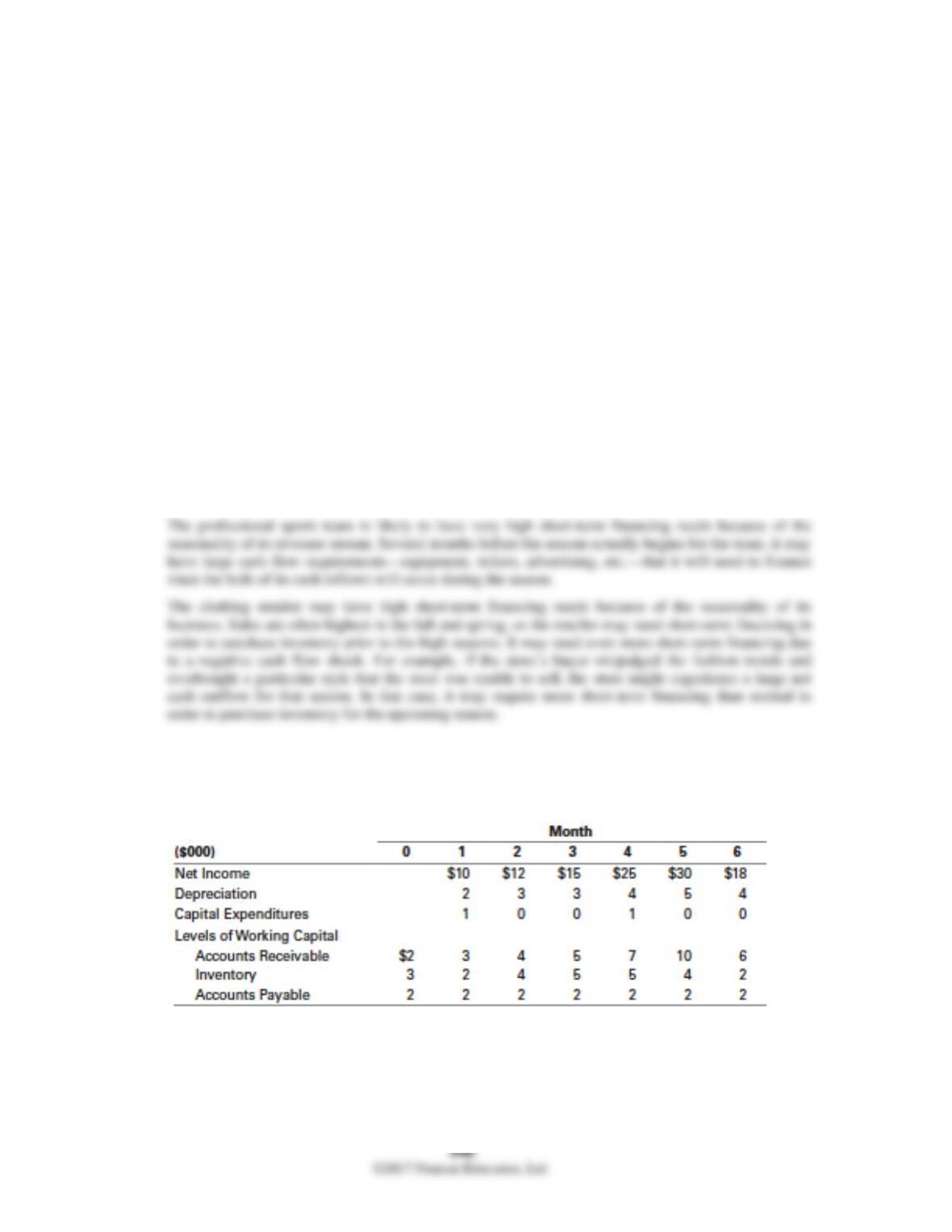
27–2. Sailboats Etc. is a retail company specializing in sailboats and other sailing-related equipment.
The following table contains financial forecasts as well as current (month 0) working capital
levels. During which months are the firm’s seasonal working capital needs the greatest? When
does it have surplus cash?
©2017 Pearson Education, Ltd.
Changes in working capital
Month
1
2
3
4
5
6
Accounts receivable
$1
$1
$1
$2
$3
–$4
Inventory
–$1
$2
$1
0
–$1
–$2
Accounts payable
0
0
0
0
0
0
Change in net working capital
$0
$3
$2
$2
$2
–$6
From the table it can be seen that Sailboat’s working capital needs are highest in Month 2 because its
investments in accounts receivable and in inventory increased the most in that month.
Sailboats, Etc. has a surplus cash position in every month as shown below:
Month
($000)
1
2
3
4
5
6
Net income
$10
$12
$15
$25
$30
$18
plus depreciation
2
3
3
4
5
4
minus changes in net working capital
0
3
2
2
2
–6
Cash flow from operations
$12
$12
$16
$27
$33
$28
minus capital expenditures
1
0
0
1
0
0
Change in cash
$11
$12
$16
$26
$33
$28
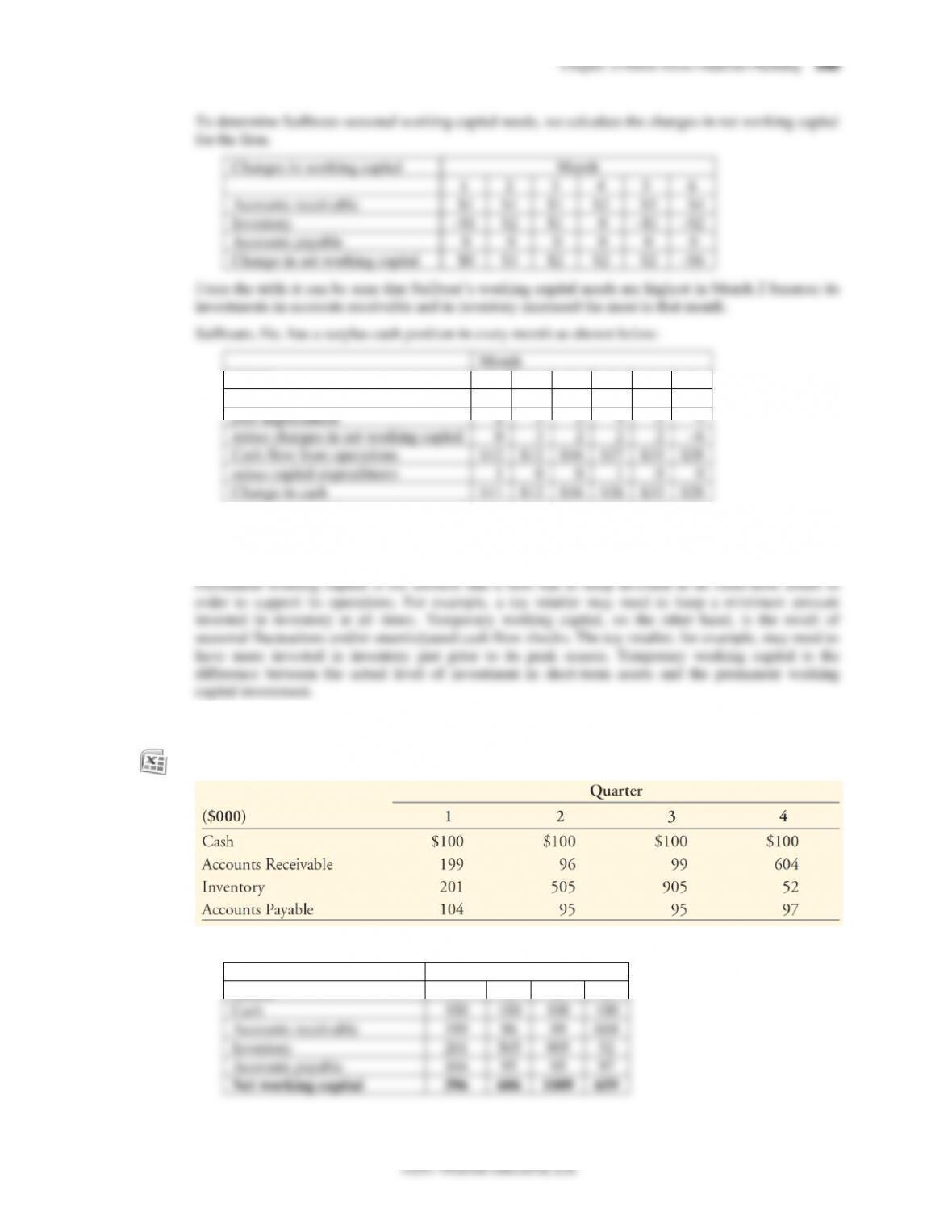
27–3. What is the difference between permanent working capital and temporary working capital?
27–4. Quarterly working capital levels for your firm for the next year are included in the following
table. What are the permanent working capital needs of your company? What are the temporary
needs?
The net working capital for each quarter is calculated below:
Quarter
($000)
1
2
3
4
Cash
100
100
100
100
Accounts receivable
199
96
99
604
Inventory
201
505
905
52
Accounts payable
104
95
95
97
Net working capital
396
606
1009
659
©2017 Pearson Education, Ltd.
27–5. Why might a company choose to finance permanent working capital with short-term debt?
27–6. Hand-to-Mouth (H2M) is currently cash-constrained, and must make a decision about whether
to delay paying one of its suppliers, or take out a loan. They owe the supplier $10,000 with terms
of 2/10 Net 40, so the supplier will give them a 2% discount if they pay today (when the discount
period expires). Alternatively, they can pay the full $10,000 in one month when the invoice is
due. H2M is considering three options:
Alternative A: Forgo the discount on its trade credit agreement, wait and pay the full $10,000 in
one month.
Alternative B: Borrow the money needed to pay its supplier today from Bank A, which has
offered a one-month loan at an APR of 12%. The bank will require a (no–interest)
compensating balance of 5% of the face value of the loan and will charge a $100
loan origination fee. Because H2M has no cash, it will need to borrow the funds to
cover these additional amounts as well.
Alternative C: Borrow the money needed to pay its supplier today from Bank B, which has
offered a one-month loan at an APR of 15%. The loan has a 1% loan origination
fee, which again H2M will need to borrow to cover.
Which alternative is the cheapest source of financing for Hand–to-Mouth?
27–7. Consider two loans with a 1-year maturity and identical face values: a 7.6% loan with a 0.97%
loan origination fee and a 7.6% loan with a 4.7% (no-interest) compensating balance
requirement. Which loan would have the higher effective annual rate? Why?
Chapter 27/Short-Term Financial Planning 351
©2017 Pearson Education, Ltd.
The loan with the 0.97% loan origination fee would cost the most since the loan origination fee is just
another form of interest, so on a $1,000 loan, the borrower is paying $9.7 in interest (in addition to the
7.6% interest) and will have the use of only $990.3 for the period, making the effective annual cost of
the loan equal to
(76 9.3) 8.61%.
990.3
+=
The compensating balance requirement of 4.7% on a $1,000 loan reduces the usable proceeds of the
firm by 4.7% to $953, but the interest rate is still 7.6%, so the effective annual cost of that arrangement
is
76 7.975%.
953 =
27–8. What is the difference between evergreen credit and a revolving line of credit?
27–9. Which of the following one-year $1000 bank loans offers the lowest effective annual rate?
a. A loan with an APR of 5.9%, compounded monthly
b. A loan with an APR of 5.9%, compounded annually, that also has a compensating balance
requirement of 9.7% (on which no interest is paid)
c. A loan with an APR of 5.9%, compounded annually, that has a 1.2% loan origination fee
27-10. The Needy Corporation borrowed $14,000 from Bank Ease. According to the terms of the loan,
Needy must pay the bank $488 in interest every three months for the three-year life of the loan,
with the principal to be repaid at the maturity of the loan. What effective annual rate is Needy
paying?
27-11. The Treadwater Bank wants to raise $1.1 million using three-month commercial paper. The net
proceeds to the bank will be $1,084,600. What is the effective annual rate of this financing for
Treadwater?
©2017 Pearson Education, Ltd.
27-12. Magna Corporation has an issue of commercial paper with a face value of $1,000,000 and a
maturity of six months. Magna received net proceeds of $973,710 when it sold the paper. What is
the effective annual rate of the paper to Magna?
27-13. What is the difference between direct paper and dealer paper?
27-14. The Signet Corporation has issued four-month commercial paper with a $6.3 million face value.
The firm netted $6,113,898 on the sale. What effective annual rate is Signet paying for these
funds?
27-15. What is the difference between pledging accounts receivable to secure a loan and factoring
accounts receivable?
27-16. The Ohio Valley Steel Corporation has borrowed $5.1 million for one month at a stated annual
rate of 8.7%, using inventory stored in a field warehouse as collateral. The warehouser charges a
$5100 fee, payable at the end of the month. What is the effective annual rate of this loan?
27-17. Discuss the three different arrangements under which a firm may use inventory to secure a loan.
The three different methods under which inventory is used as collateral for a loan are floating liens,
trust receipts, and warehouse arrangements.
Chapter 27/Short-Term Financial Planning 353
With a floating lien (also called a “general lien” or a “blanket lien”), all of the borrower’s inventory
27-18. The Rasputin Brewery is considering using a public warehouse loan as part of its short-term
financing. The firm will require a loan of $540,000. Interest on the loan will be 9.6% (APR,
annual compounding) to be paid at the end of the year. The warehouse charges 1% of the face
value of the loan, payable at the beginning of the year. What is the effective annual rate of this
warehousing arrangement?