333
Chapter 25
Leasing
25–1. Suppose an H1200 supercomputer has a cost of $300,000 and will have a residual market value
of $75,000 in four years. The risk-free interest rate is 6.1% APR with monthly compounding.
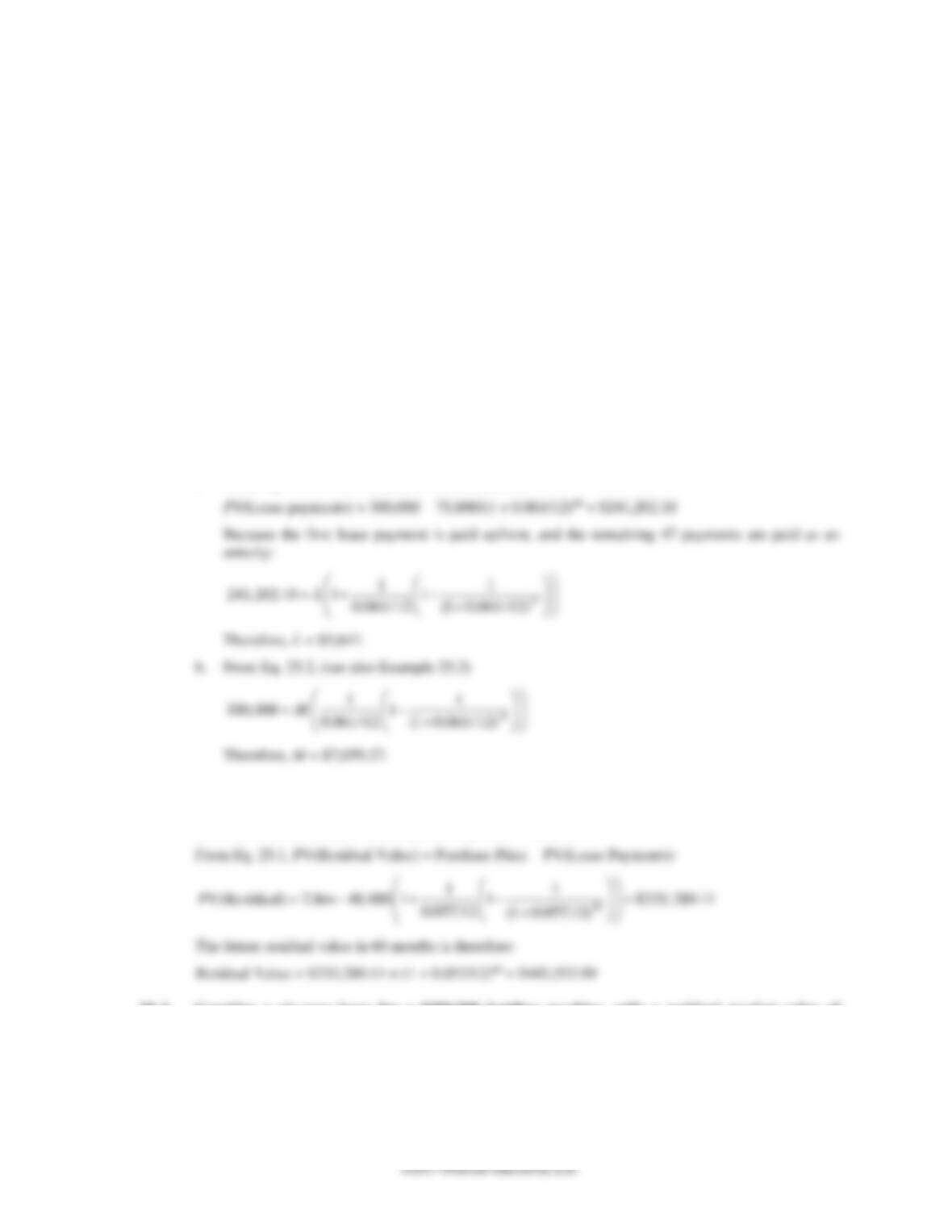
a. What is the risk-free monthly lease rate for a four-year lease in a perfect market?
b. What would be the monthly payment for a four-year $300,000 risk-free loan to purchase the
H1200?
a. From Eq. 25.1, for a four-year (48 month) lease,
25–2. Suppose the risk-free interest rate is 5.7% APR with monthly compounding. If a $2.8 million
MRI machine can be leased for five years for $48,000 per month, what residual value must the
lessor recover to break even in a perfect market with no risk?
25–3. Consider a six-year lease for a $350,000 bottling machine, with a residual market value of
$122,500 at the end of the six years. If the risk-free interest rate is 5.9% APR with monthly
compounding, compute the monthly lease payment in a perfect market for the following leases:
a. A fair market value lease
b. A $1.00 out lease
334 Berk/DeMarzo, Corporate Finance, Fourth Edition, Global Edition
c. A fixed price lease with an $50,000 final price
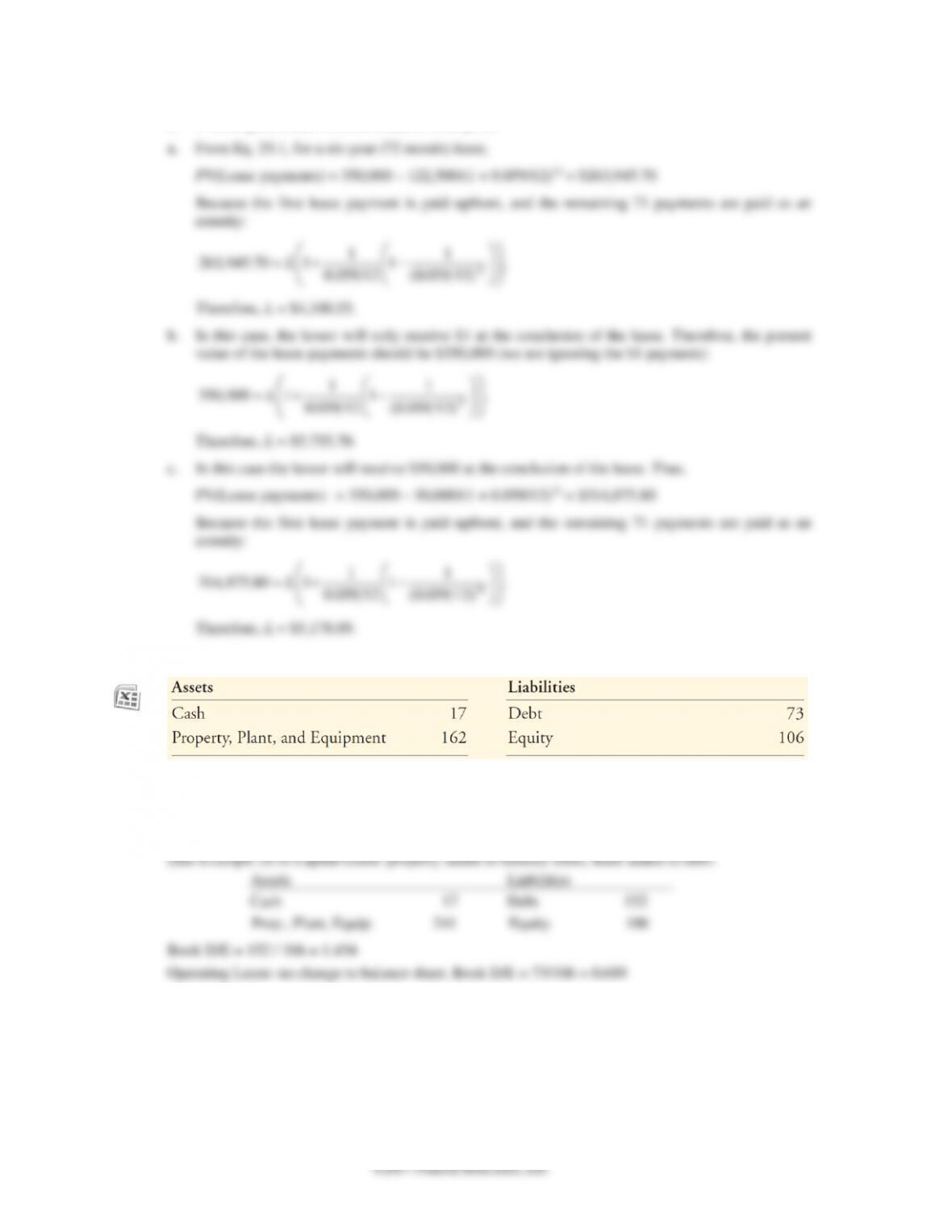
25–4. Acme Distribution currently has the following items on its balance sheet:
Under current FASB accounting standards (that is, prior to 2019), how will Acme’s balance
sheet change if it enters into an $79 million capital lease for new warehouses? What will its book
debt-equity ratio be? How will Acme’s balance sheet and debt-equity ratio change if the lease is
an operating lease?
25–5. Your firm is considering leasing a $50,000 copier. The copier has an estimated economic life of
eight years. Suppose the appropriate discount rate is 9.3% APR with monthly compounding.
Classify each lease below as a capital lease or operating lease, and explain why:
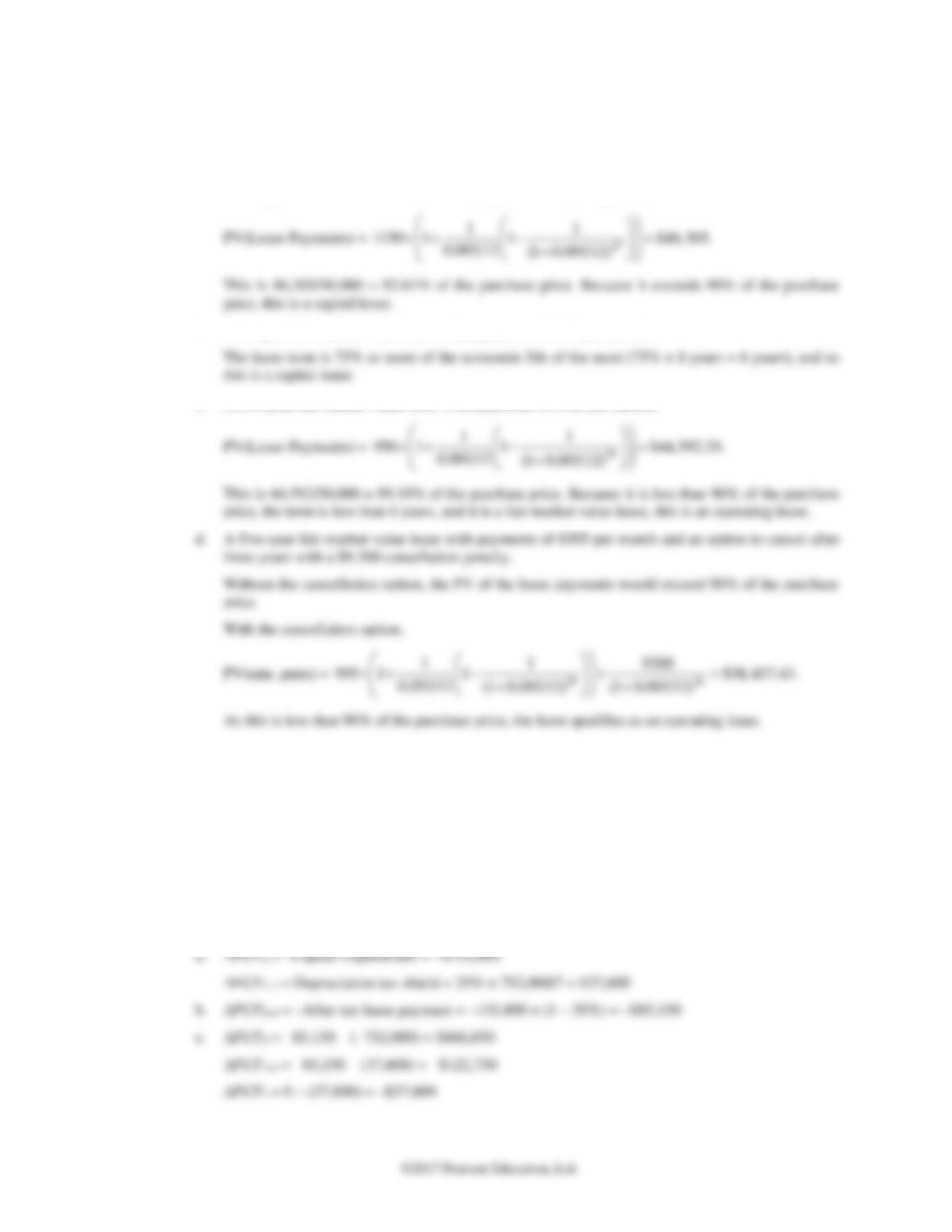
a. A four-year fair market value lease with payments of $1150 per month
b. A six-year fair market value lease with payments of $790 per month
Chapter 25/Leasing 335
c. A five-year fair market value lease with payments of $925 per month
d. A five-year fair market value lease with payments of $995 per month and an option to cancel
after three years with a $9300 cancellation penalty
a. A four-year fair market value lease with payments of $1,150 per month.
11
b. A six-year fair market value lease with payments of $790 per month.
c. A five-year fair market value lease with payments of $925 per month.
11
25–6. Craxton Engineering will either purchase or lease a new $752,000 fabricator. If purchased, the
fabricator will be depreciated on a straight-line basis over seven years. Craxton can lease the
fabricator for $131,000 per year for seven years. Craxton’s tax rate is 35%. (Assume the
fabricator has no residual value at the end of the seven years.)
a. What are the free cash flow consequences of buying the fabricator if the lease is a true tax
lease?
b. What are the free cash flow consequences of leasing the fabricator if the lease is a true tax
lease?
c. What are the incremental free cash flows of leasing versus buying?
Chapter 25/Leasing 337
©2017 Pearson Education, Ltd.
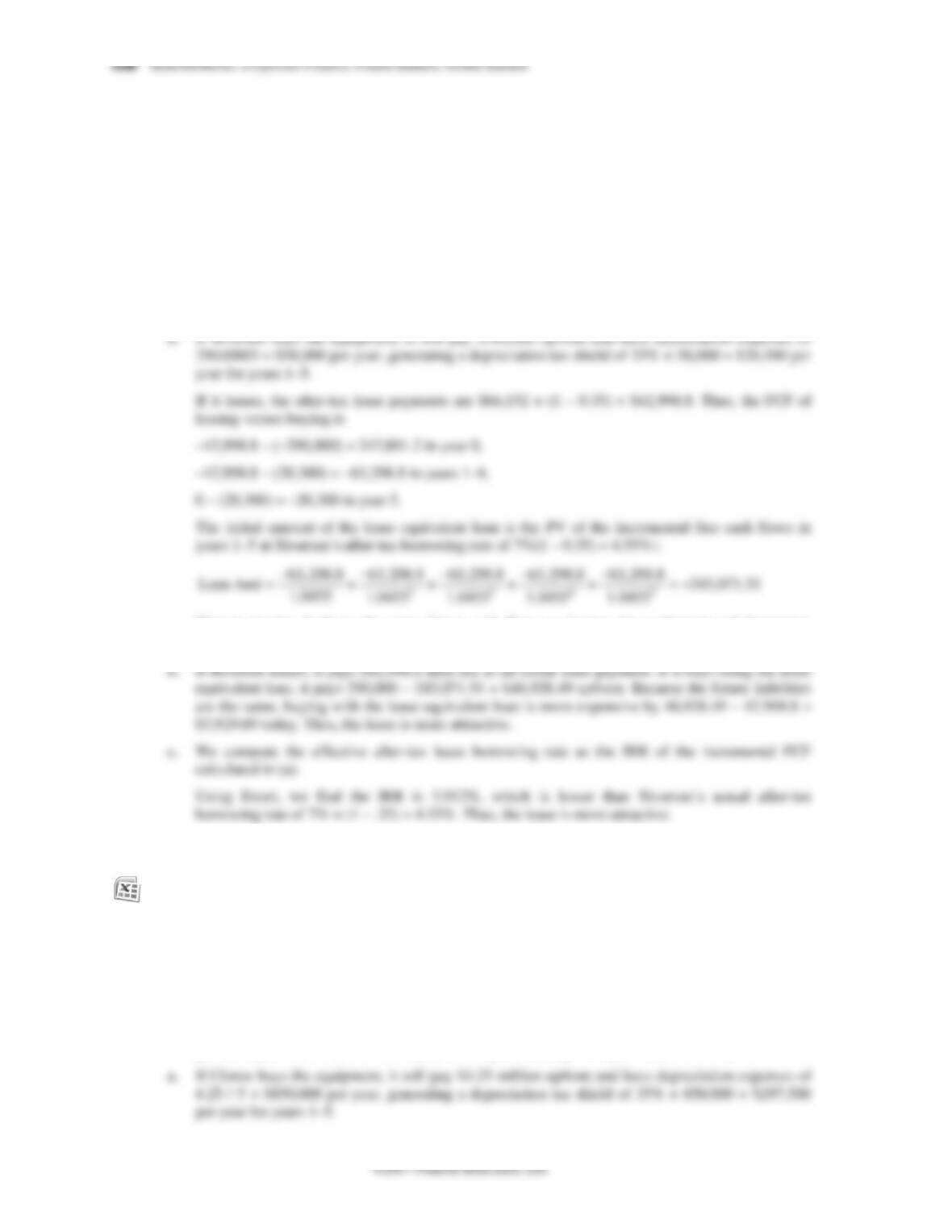
If it leases, the after-tax lease payments are $972,000 × (1 – 0.35) = $631,800. Thus, the FCF of
leasing versus buying is
–631,800 – (–4,250,000) = 3,618,200 in year 0,
–631,800 – (297,500) = –929,300 in years 1–4,
0 v) = –297,500 in year 5.
We can determine the gain from leasing by discounting the incremental cash flows at Clorox’s
after-tax borrowing rate of 6.6% (1 – 0.35) = 4.29%:
2345
929,300 929,300 929,300 929,300 297,500
NPV(Lease–Buy) 3,618,200 1.0429 1.0429 1.0429 1.0429 1.0429
$26,723.83
−−−−−
= +++++
=
Under these assumptions, the lease is more attractive than financing a purchase of the computer.
b. The depreciation tax shield if Clorox buys is now 35% × ($4.25 million × 20%) = $297,500 in
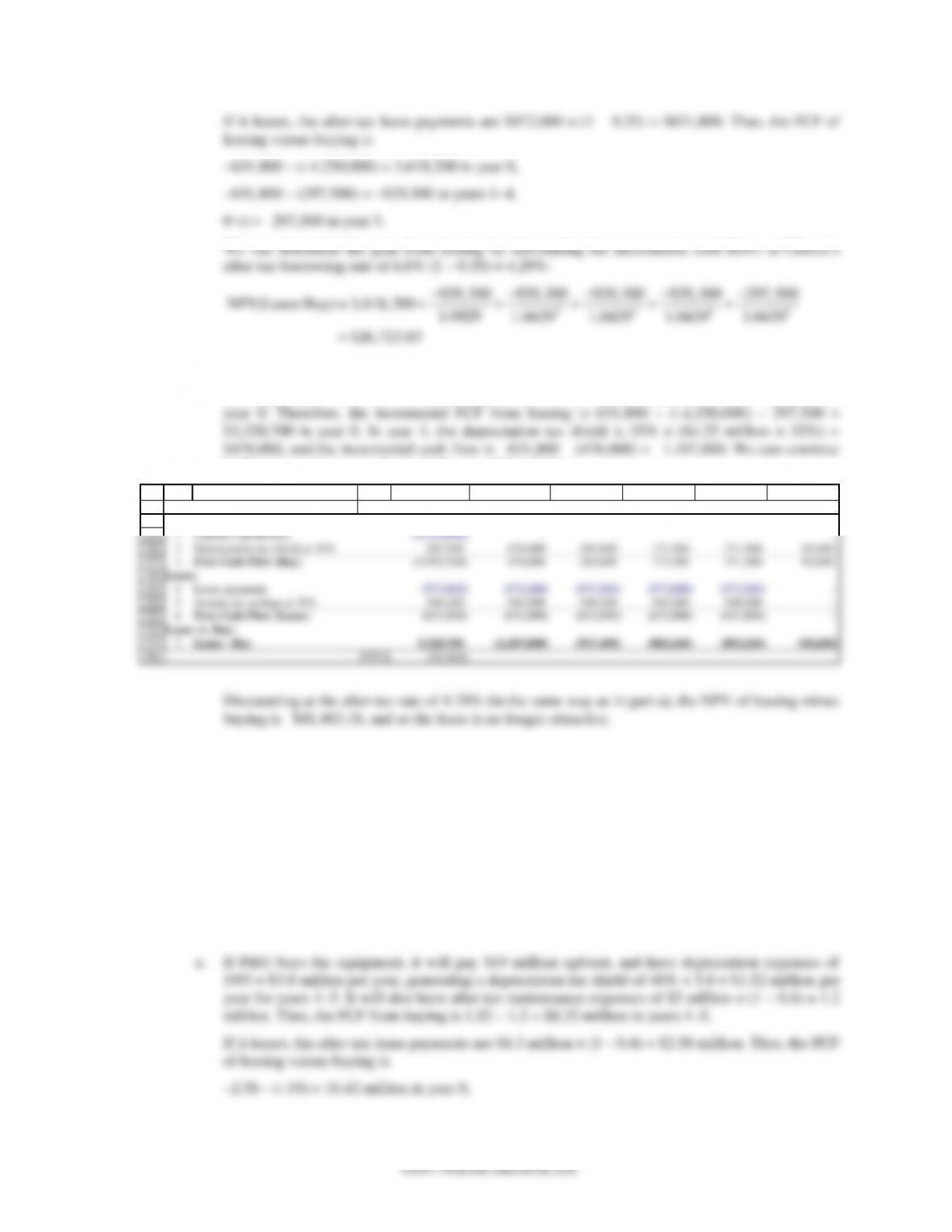
in this way each year as shown in the spreadsheet below:
41
42
43
46
47
48
49
50
51
52
53
56
A B C D E F G H I
Year 0 1 2 3 4 5
Buy:
1 Capital Expenditures (4,250,000) – – – – –
2 Depreciation tax shield at 35% 297,500 476,000 285,600 171,360 171,360 85,680
3Free Cash Flow (Buy) (3,952,500) 476,000 285,600 171,360 171,360 85,680
Lease:
4 Lease payments (972,000) (972,000) (972,000) (972,000) (972,000) –
5 Income tax savings at 35% 340,200 340,200 340,200 340,200 340,200 –
6Free Cash Flow (Lease) (631,800) (631,800) (631,800) (631,800) (631,800) –
Lease vs. Buy:
7Lease – Buy 3,320,700 (1,107,800) (917,400) (803,160) (803,160) (85,680)
NPV Lease
(41,463)
Discounting at the after-tax rate of 4.29% (in the same way as in part a), the NPV of leasing minus
buying is –$41,463.18, and so the lease is no longer attractive.
25–9. Suppose Procter and Gamble (P&G) is considering purchasing $19 million in new
manufacturing equipment. If it purchases the equipment, it will depreciate it on a straight-line
basis over the five years, after which the equipment will be worthless. It will also be responsible
for maintenance expenses of $2 million per year. Alternatively, it can lease the equipment for
$4.3 million per year for the five years, in which case the lessor will provide necessary
maintenance. Assume P&G’s tax rate is 40% and its borrowing cost is 7.5%.
a. What is the NPV associated with leasing the equipment versus financing it with the lease
equivalent loan?
b. What is the break-even lease rate—that is, what lease amount could P&G pay each year and
be indifferent between leasing and financing a purchase?
338 Berk/DeMarzo, Corporate Finance, Fourth Edition, Global Edition
©2017 Pearson Education, Ltd.
–2.58 – (0.32) = –2.9 million in years 1–4,
0 – (0.32) = –0.32 million in year 5.
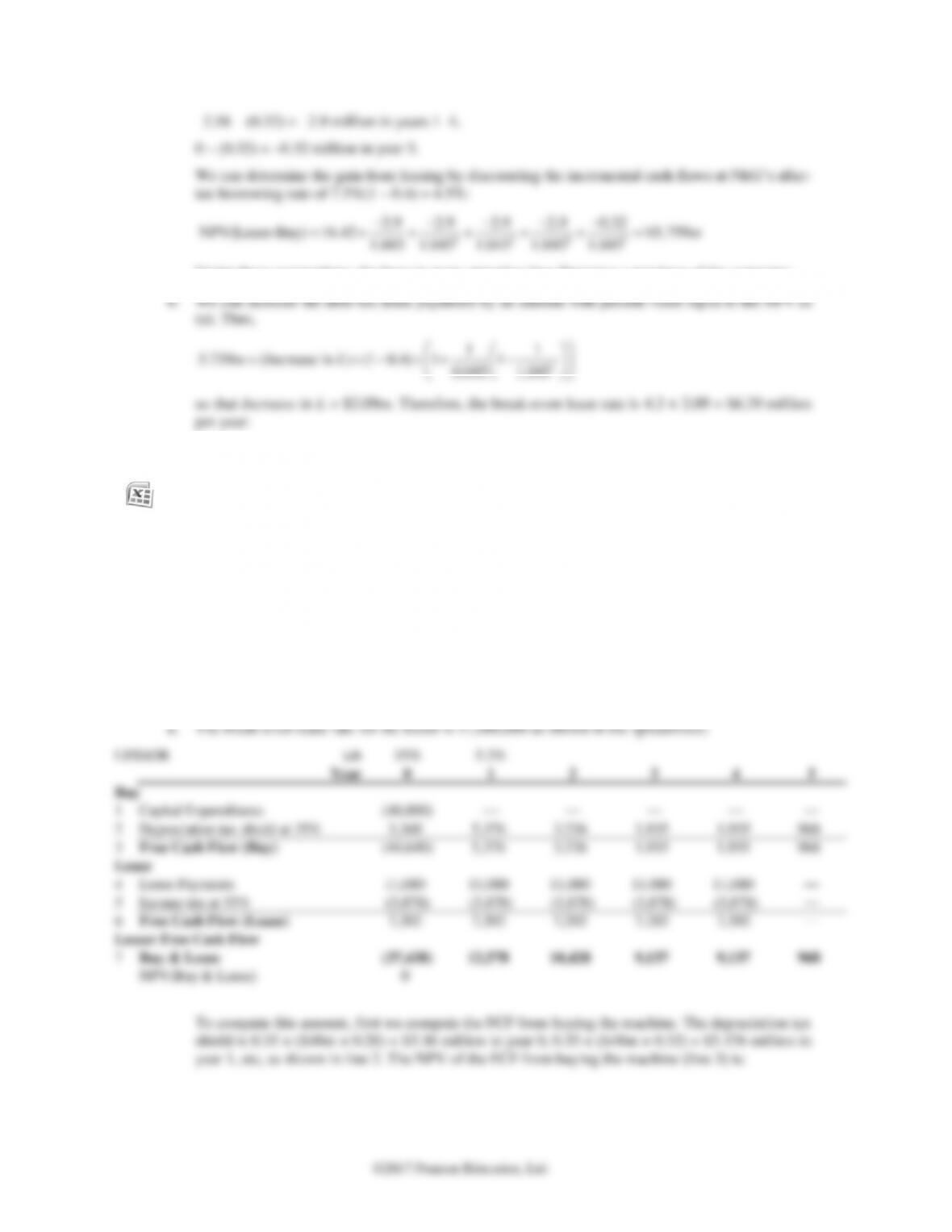
We can determine the gain from leasing by discounting the incremental cash flows at P&G’s after–
tax borrowing rate of 7.5%(1 – 0.4) = 4.5%:
2 3 4 5
2.9 2.9 2.9 2.9 0.32
NPV(Lease–Buy) 16.42 $5,759
1.045 1.045 1.045 1.045 1.045 m
− − − − −
= + + + + + =
Under these assumptions, the lease is more attractive than financing a purchase of the computer.
25-10. Suppose Microsoft is considering the purchase of computer servers and network infrastructure
to expand its very successful business offering cloud-based computing. In total, it will purchase
$48 million in new equipment. This equipment will qualify for accelerated depreciation: 20% can
be expensed immediately, followed by 32%, 19.2%, 11.52%, 11.52%, and 5.76% over the next
five years. However, because of the firm’s substantial loss carryforwards, Microsoft estimates its
marginal tax rate to be 10% over the next five years, so it will get very little tax benefit from the
depreciation expenses. Thus, Microsoft considers leasing the equipment instead. Suppose
Microsoft and the lessor face the same 8% borrowing rate, but the lessor has a 35% tax rate. For
the purpose of this question, assume the equipment is worthless after five years, the lease term is
five years, and the lease qualifies as a true tax lease.
a. What is the lease rate for which the lessor will break even?
b. What is the gain to Microsoft with this lease rate?
c. What is the source of the gain in this transaction?
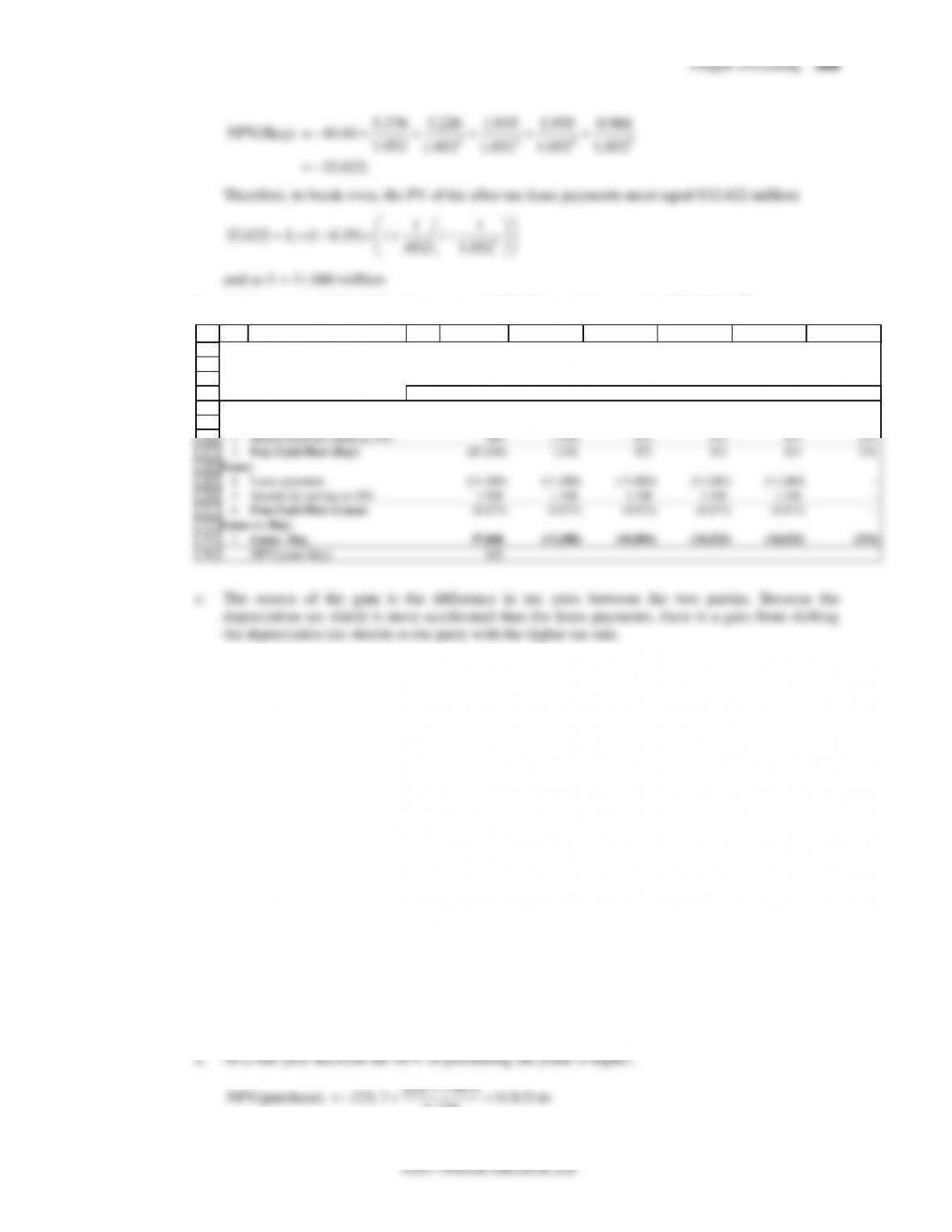
b. At a lease rate of $11.080 and a tax rate of 10%, Microsoft has a gain of $0.145 million.
38
39
40
41
42
43
46
47
48
49
50
51
52
53
56
A B C D E F G H I
rD 8%
LESSEE tca 10% 7.200%
Year 0 1 2 3 4 5
Buy:
1 Capital Expenditures (48,000) – – – – –
2 Depreciation tax shield at 10% 960 1,536 922 553 553 276
3Free Cash Flow (Buy) (47,040) 1,536 922 553 553 276
Lease:
4 Lease payments (11,080) (11,080) (11,080) (11,080) (11,080) –
5 Income tax savings at 10% 1,108 1,108 1,108 1,108 1,108 –
6Free Cash Flow (Lease) (9,972) (9,972) (9,972) (9,972) (9,972) –
Lease vs. Buy:
7Lease – Buy 37,068 (11,508) (10,894) (10,525) (10,525) (276)
NPV(Lease-Buy) 145
c. The source of the gain is the difference in tax rates between the two parties. Because the
depreciation tax shield is more accelerated than the lease payments, there is a gain from shifting
the depreciation tax shields to the party with the higher tax rate.
25–11. Western Airlines is considering a new route that will require adding an additional Boeing 777 to
its fleet. Western can purchase the airplane for $221.7 million or lease it for $25 million per year.
If it purchases the airplane, its seating can be optimized, and the new route is expected to
generate profits of $49.5 million per year. If leased, the route will only generate profits of $35
million per year. Suppose the appropriate cost of capital is 12.9% and that, if purchased, the
plane can be sold at any time for an expected resale price of $221.7 million. Ignore taxes.
a. As a one-year decision, does purchasing or leasing the plane have higher NPV?
b. Suppose the funds to purchase or lease the plane will come from equity holders (for ex–
ample, by reducing the amount of Western’s current dividend). Western also has one-year
debt outstanding, and there is a 9.1% (risk-neutral) probability that over the next year
Western will declare bankruptcy and its equity holders will be wiped out. Otherwise, the
debt will be rolled over at the end of the year. Is purchasing or leasing the plane more
attractive to equity holders?
c. At what (risk-neutral) probability of default would equity holders’ preference for leasing
versus purchasing the plane change?
340 Berk/DeMarzo, Corporate Finance, Fourth Edition, Global Edition
34.8
NPV(lease) 25 $5.82m
1.129
= − + =
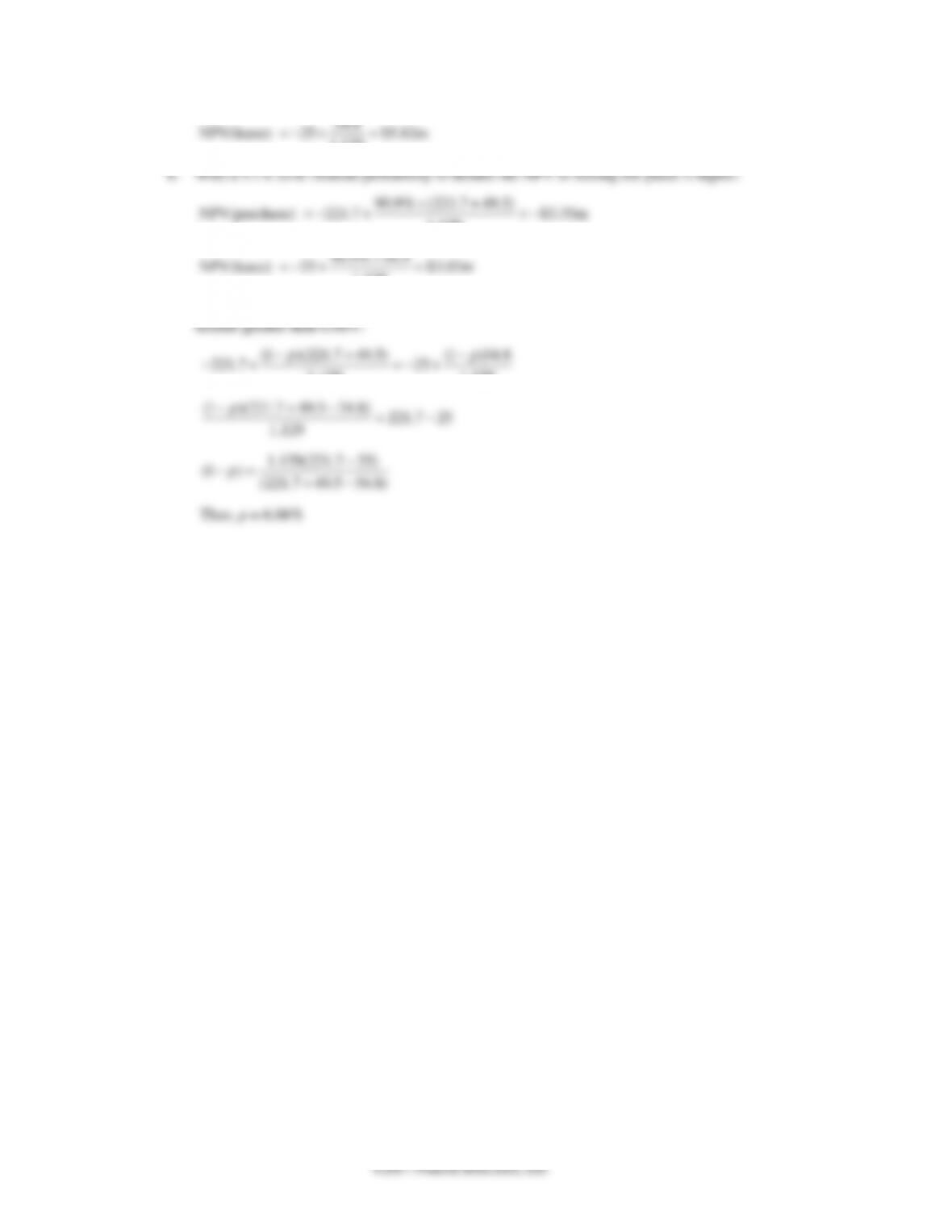
b. With a 9.1% (risk-neutral) probability of default the NPV of leasing the plane is higher:
90.9% (221.7 49.5)
NPV(purchase) 221.7 $3.35m
1.129
+
= − + = −
90.9% 34.8
NPV(lease) 25 $3.02m
1.129
= − + =
c. Equity holders’ would prefer to lease the plane over purchasing the plane at any probability of