321
Chapter 23
Raising Equity Capital
23–1. What are some of the alternative sources from which private companies can raise equity capital?
23–2. What are the advantages and the disadvantages to a private company of raising money from a
corporate investor?
23–3. Starware Software was founded last year to develop software for gaming applications. The
founder initially invested $1,000,000 and received 12 million shares of stock. Starware now needs
to raise a second round of capital, and it has identified an interested venture capitalist. This
venture capitalist will invest $1 million and wants to own 38% of the company after the
investment is completed.
a. How many shares must the venture capitalist receive to end up with 38% of the company?
What is the implied price per share of this funding round?
b. What will the value of the whole firm be after this investment (the post-money valuation)?
23–4. Suppose venture capital firm GSB partners raised $50 million of committed capital. Each year
over the 12-year life of the fund, 1.5% of this committed capital will be used to pay GSB’s
management fee. As is typical in the venture capital industry, GSB will only invest $41 million
(committed capital less lifetime management fees). At the end of 12 years, the investments made
322 Berk/DeMarzo, Corporate Finance, Fourth Edition, Global Edition
by the fund are worth $550 million. GSB also charges 30% carried interest on the profits of the
fund (net of management fees).
a. Assuming the $41 million of invested capital is invested immediately and all proceeds were
received at the end of 12 years, what is the IRR of the investments GSB partners made?
That is, compute IRR ignoring all management fees.
b. Of course, as an investor or limited partner, you are more interested in your own IRR—that
is, the IRR including all fees paid. Assuming that investors gave GSB partners the full $50
million up front, what is the IRR for GSB’s limited partners (that is, the IRR net of all fees
paid).
50
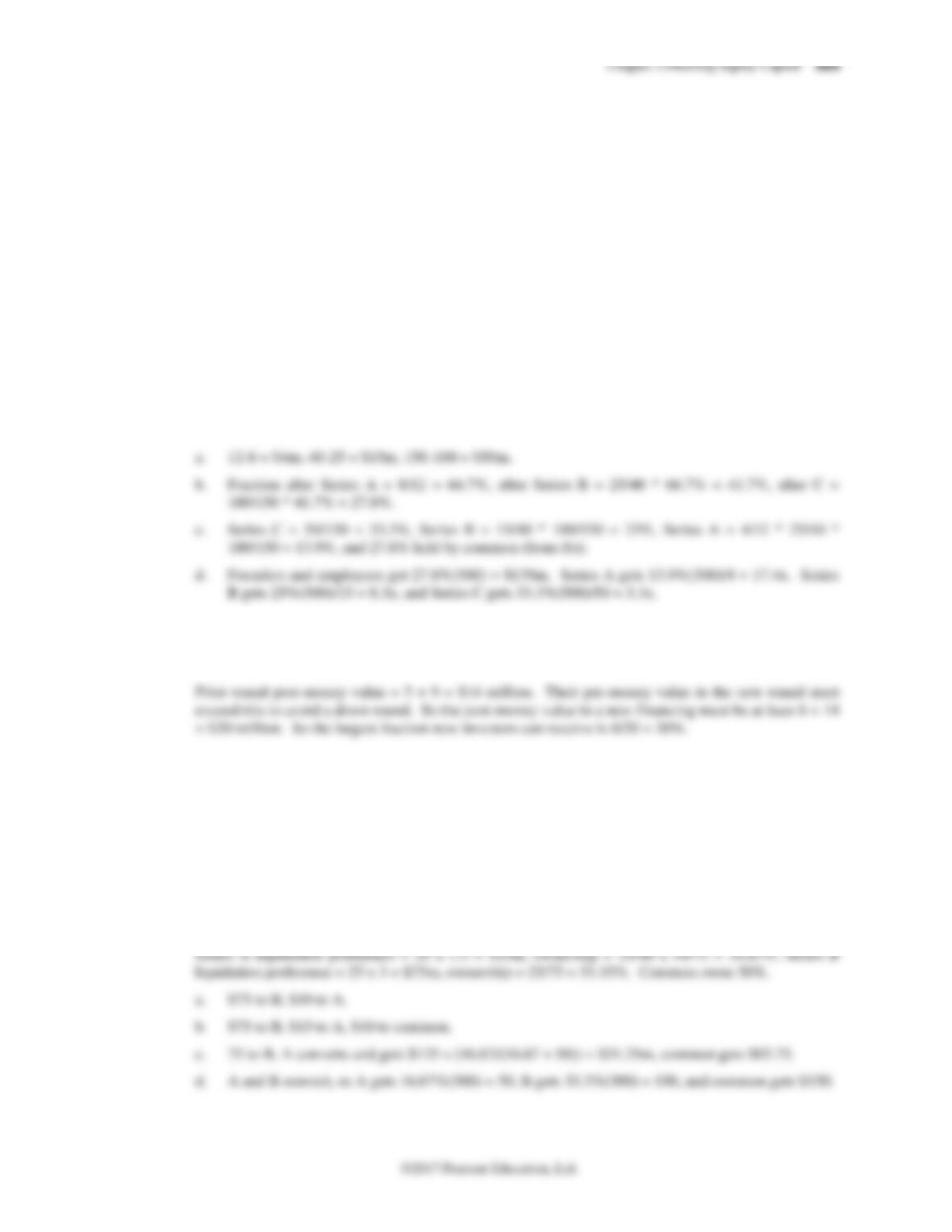
23–5. Three years ago, you founded your own company. You invested $110,000 of your money and
received 5.5 million shares of Series A preferred stock. Since then, your company has been
through three additional rounds of financing.
a. What is the pre-money valuation for the Series D funding round?
b. What is the post-money valuation for the Series D funding round?
c. Assuming that you own only the Series A preferred stock (and that each share of all series of
preferred stock is convertible into one share of common stock), what percentage of the firm
do you own after the last funding round?
326 Berk/DeMarzo, Corporate Finance, Fourth Edition, Global Edition
©2017 Pearson Education, Ltd.
Who loses from the price increase? The original shareholders who offered their stock in the IPO lose,
because they sold the stock for $16.00 per share when the market was willing to pay $22.00 per share
(however, it is fair to say that ex-post they lose but ex-ante they do not, because they either expected
$16 to be a fair price or they viewed the underpricing as a cost they were willing to pay in exchange
for liquidity).
23–15. Chen Brothers, Inc., sold 4 million shares in its IPO, at a price of $18.50 per share. Management
negotiated a fee (the underwriting spread) of 7% on this transaction. What was the dollar cost of
this fee?
23–16. Your firm has 12 million shares outstanding, and you are about to issue 4 million new shares in
an IPO. The IPO price has been set at $16 per share, and the underwriting spread is 8%. The
IPO is a big success with investors, and the share price rises to $55 on the first day of trading.
a. How much did your firm raise from the IPO?
b. What is the market value of the firm after the IPO?
c. Assume that the post-IPO value of the firm is the fair market value. Suppose your firm could
have issued shares directly to investors at their fair market value, in a perfect market with
no underwriting spread and no underpricing. What would the share price have been in this
case, if you raise the same amount as in part (a)?
d. Comparing part (b) and part (c), what is the total cost to the firm’s original investors due to
market imperfections from the IPO?
23–17. You have an arrangement with your broker to request 1050 shares of all available IPOs. Suppose
that 10% of the time, the IPO is “very successful” and appreciates by 102% on the first day,
84% of the time it is “successful” and appreciates by 13%, and 6% of the time it “fails” and falls
by 13%.
a. By what amount does the average IPO appreciate the first day; that is, what is the average
IPO underpricing?
b. Suppose you expect to receive 50 shares when the IPO is very successful, 240 shares when it
is successful, and 1050 shares when it fails. Assume the average IPO price is $14. What is
your expected one-day return on your IPO investments?
©2017 Pearson Education, Ltd.