308 Berk/DeMarzo, Corporate Finance, Fourth Edition, Global Edition
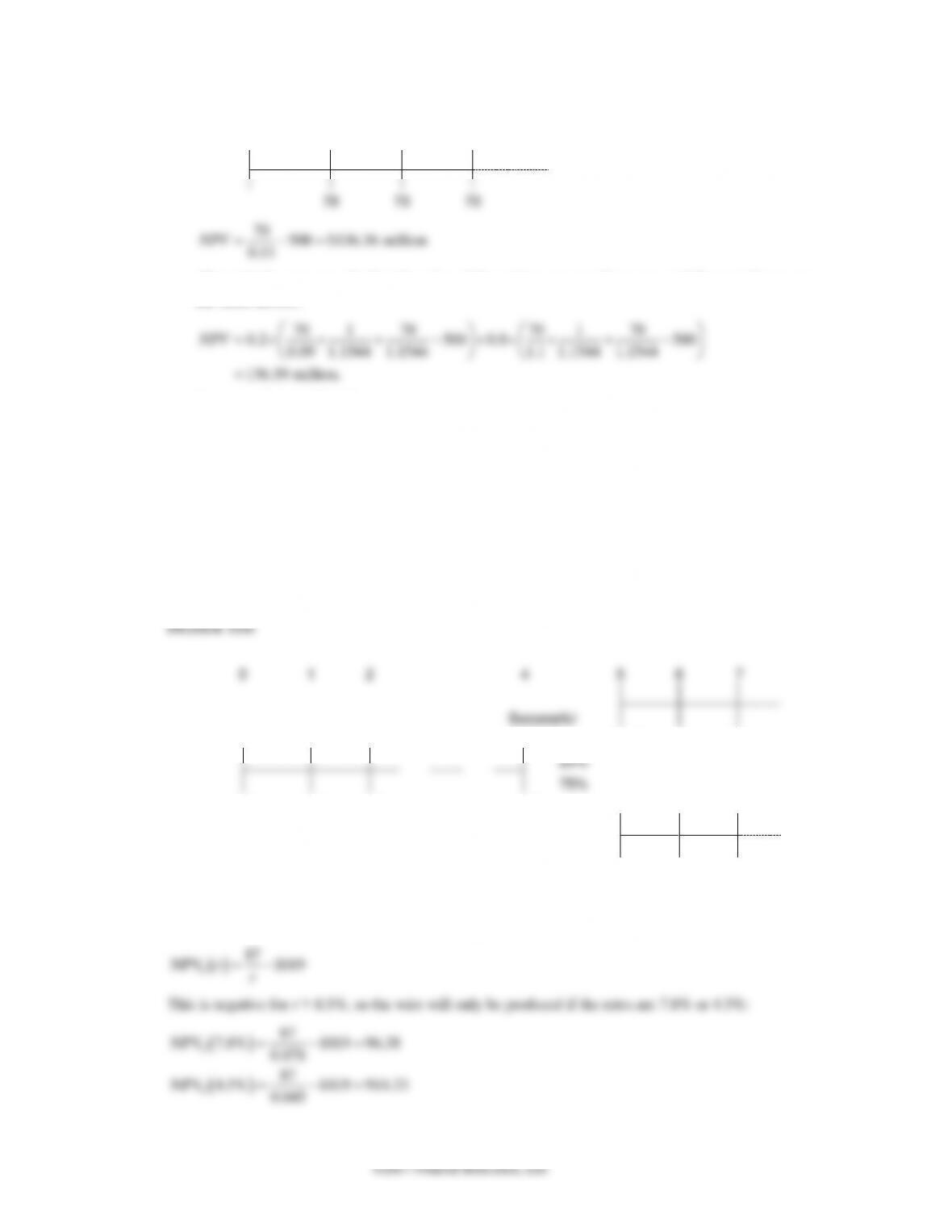
Timeline:
0
1
2
3
70
70
70
70 500 $136.36 million
0.11
NPV = − =
Alternatively, you can calculate the value of the project one year from now and discount that to get
the same answer:
70 1 70 70 1 70
0.2 500 0.8 500
0.09 1.1544 1.1544 1.1 1.1544 1.1544
136.39 million.
NPV
= + − + + −
=
So you are better off waiting.
22–13. Your R&D division has just synthesized a material that will superconduct electricity at room
temperature; you have given the go ahead to try to produce this material commercially. It will
take five years to find out whether the material is commercially viable, and you estimate that the
probability of success is 25%. Development will cost $9.6 million per year, paid at the beginning
of each year. If development is successful and you decide to produce the material, the factory will
be built immediately. It will cost $1019 million to put in place and will generate profits of $87
million at the end of every year in perpetuity. Assume that the current five-year risk-free interest
rate is 9.7% per year, and the yield on a perpetual risk-free bond will be 11.6%, 10.4%, 7.8%, or
4.5% in five years. Assume that the risk-neutral probability of each possible rate is the same.
What is the value today of this project?
Chapter 22/Real Options 309
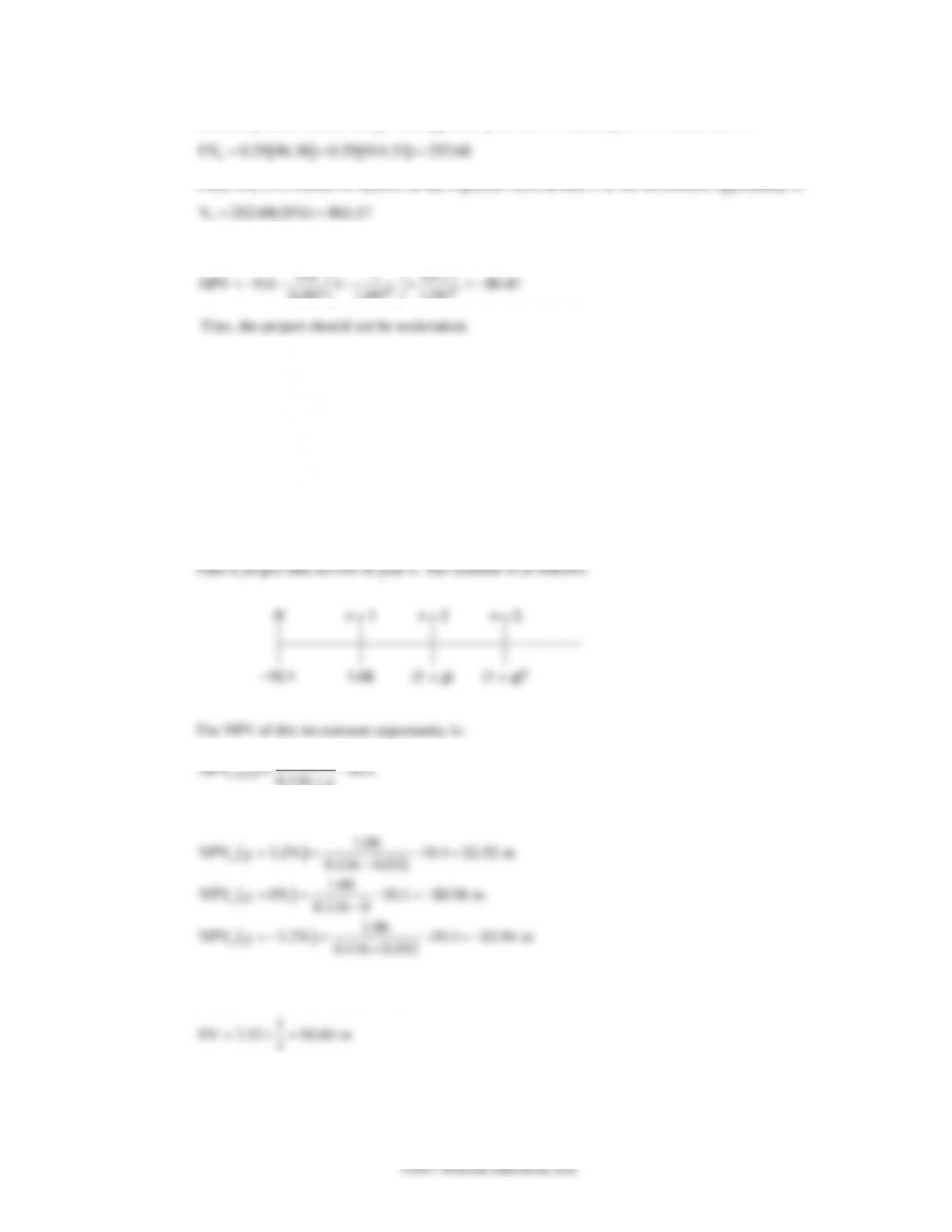
So the expected value of the growth opportunity at time 5 if development is successful is:
( ) ( )
5
EV 0.25 96.38 0.25 914.33 252.68= + =
There is a 25% chance of success so the expected value at time 5 of the investment opportunity is:
5
V 252.68(25%) $63.17
==
The NPV of the development opportunity at time 0 is therefore
9.6 1 63.17
22–14. You are an analyst working for Goldman Sachs, and you are trying to value the growth potential
of a large, established company, Big Industries. Big Industries has a thriving R&D division that
has consistently turned out successful products. You estimate that, on average, the R&D division
generates approximately two new product proposals every three years, so that there is a 61%
chance that a project will be proposed every year. Typically, the investment opportunities the
R&D division produces require an initial investment of $10.1 million and yield profits of $1.06
million per year that grow at one of three possible growth rates in perpetuity: 3.2%, 0%, and
–3.2%. All three growth rates are equally likely for any given project. These opportunities are
always “take it or leave it” opportunities: If they are not undertaken immediately, they
disappear forever. Assume that the cost of capital will always remain at 11.6% per year. What is
the present value of all future growth opportunities Big Industries will produce?
310 Berk/DeMarzo, Corporate Finance, Fourth Edition, Global Edition
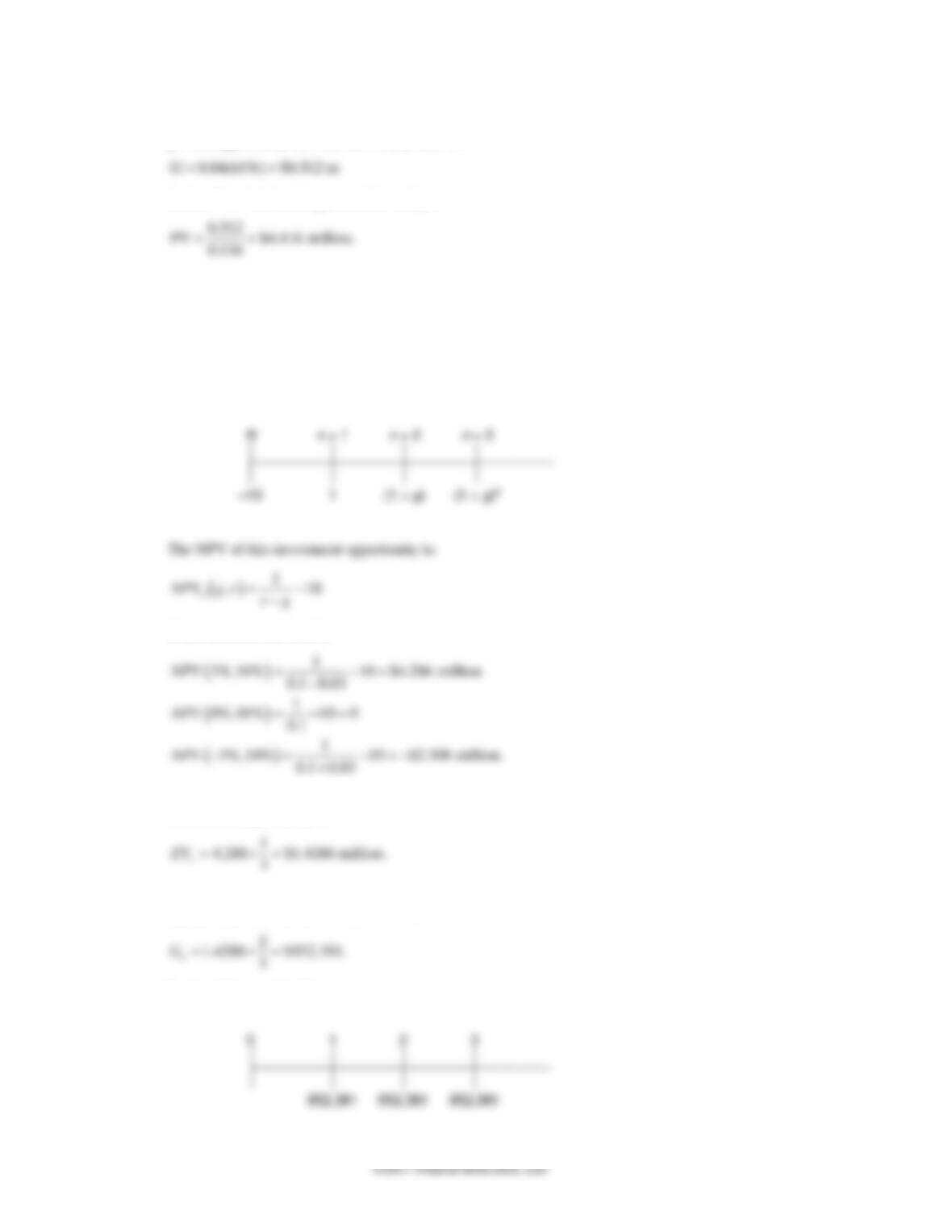
The probability that a project will arrive in any given year is 61%, and so the expected value of the
growth opportunity that will arrive in year n is:
G 0.84(61%) $0.512 m==
So the PV of all these opportunities today is:
0.512
PV $4.416 million.
0.116
==
22–15. Repeat Problem 14, but this time assume that all the probabilities are risk-neutral probabilities,
which means the cost of capital is always the risk-free rate and risk-free rates are as follows: The
current interest rate for a risk-free perpetuity is 8%; in one year, there is a 64.375% chance that
all risk-free interest rates will be 10% and stay there forever, and a 35.625% chance that they
will be 6% and stay there forever. The current one-year risk-free rate is 7%.
Take a project that arrives in year n. The timeline is as follows.
1
n
−
If the risk free rate is 10%:
( )
( )
( )
1
3%,10% 10 $4.286 million
0.1 0.03
1
0%,10% 10 0
0.1
1
3%,10% 10 $2.308 million.
0.1 0.03
NPV
NPV
NPV
= − =
−
= − =
− = − = −
+
Therefore, only the projects with positive rates will be taken on. Thus, the expected value of any given
investment opportunity is:
1
4.286 $1.4286 million.
3
n
EV = =
The probability that a project will arrive in any given year is 2/3, so the expected value of the growth
opportunity that will arrive in year n is:
2
1.4286 $952,381.
3
n
G= =
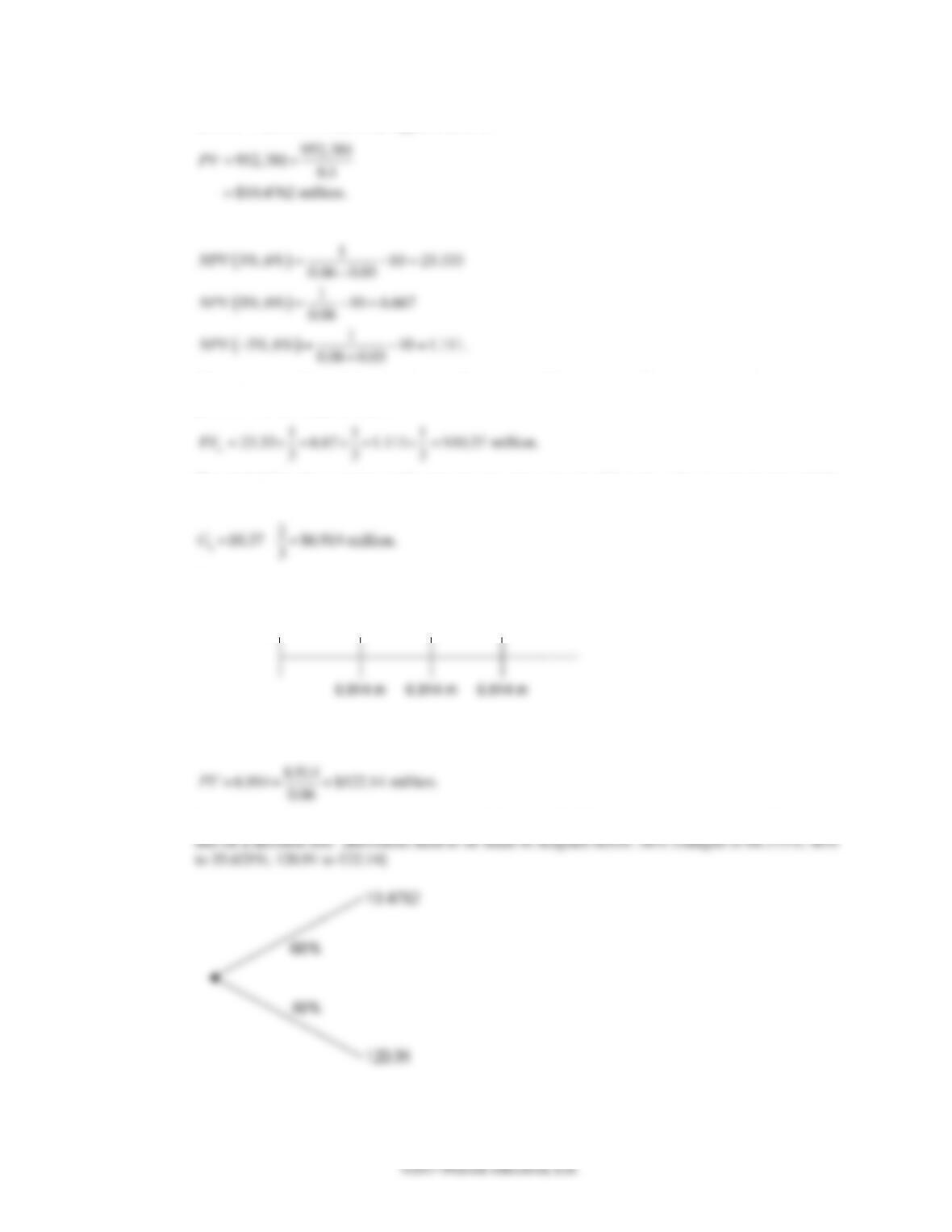
Putting this on a timeline:
0
1
2
3
952,381
952,381
952,381
Chapter 22/Real Options 311
So the PV at time 1 of all these opportunities is:
952,381
952,381 0.1
$10.4762 million.
PV =+
=
Now, if the risk free rate is 6%:
( )
( )
( )
1
3%,6% 10 23.333
0.06 0.03
1
0%,6% 10 6.667
0.06
1
3%,6% 10 1.111.
0.06 0.03
NPV
NPV
NPV
= − =
−
= − =
− = − =
+
Therefore, regardless of the growth rate, all projects will be taken on. Thus, the expected value of any
given investment opportunity is:
1 1 1
23.33 6.67 1.111 $10.37 million.
3 3 3
n
EV = + + =
The probability that a project will arrive in any given year is 2/3, and so the expected value of the
growth opportunity that will arrive in year n is
Gn=10.37´2
3=$6.914 million.
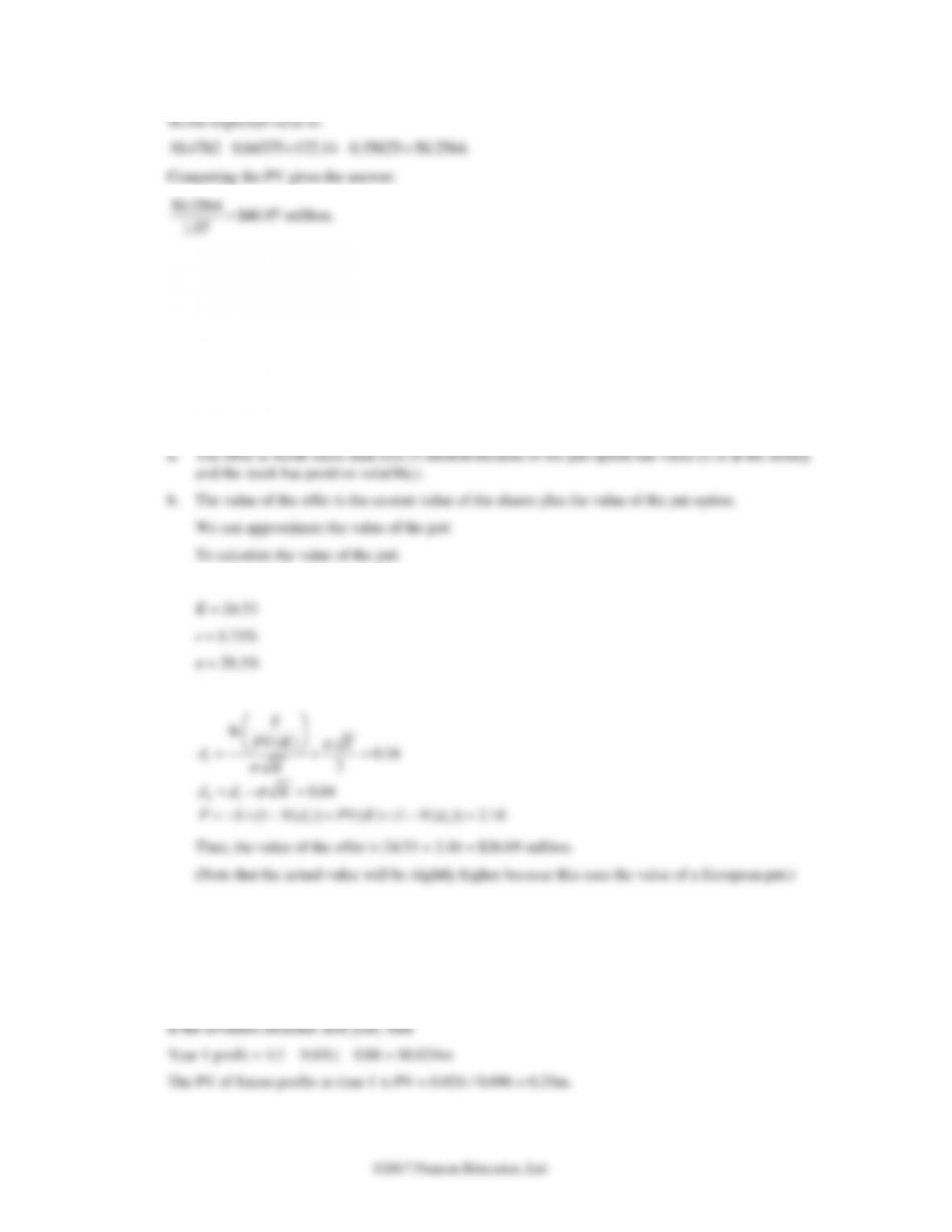
Putting this on a timeline:
0
1
2
3
6.914 m
6.914 m
6.914 m
So the PV at time 1 of all these opportunities is:
PV =6.914 +6.914
0.06 =$122.14 million.
There is a 64.375% chance of rates going to 10% and a 35.625% chance of rates going to 6%. Putting
312 Berk/DeMarzo, Corporate Finance, Fourth Edition, Global Edition
©2017 Pearson Education, Ltd.
So the expected value is:
10.4762´0.64375+122.14´0.35625=50.2564.
Computing the PV gives the answer:
50.2564
1.07 =$46.97 million.
22–16. You own a small networking startup. You have just received an offer to buy your firm from a
large, publicly traded firm, JCH Systems. Under the terms of the offer, you will receive 1 million
shares of JCH. JCH stock currently trades for $24.53 per share. You can sell the shares of JCH
that you will receive in the market at any time. But as part of the offer, JCH also agrees that at
the end of the next year, it will buy the shares back from you for $24.53 per share if you desire.
Suppose the current one-year risk-free rate is 5.75%, the volatility of JCH stock is 29.3%, and
JCH does not pay dividends.
a. Is this offer worth more than $24.53 million? Explain.
b. What is the value of the offer?
S = 24.53
T = 1
1
21
12
ln () 0.34
2
0.04
(1 ( )) ( ) (1 ( )) 2.16
= + =
= − =
= − − + − =
S
PV K T
dK
d d K
P S N d PV K N d
Thus, the value of the offer is 24.53 + 2.16 = $26.69 million.
(Note that the actual value will be slightly higher because this uses the value of a European put.)
22-17. You own a wholesale plumbing supply store. The store currently generates revenues of $1
million per year. Next year, revenues will either decrease by 9.6% or increase by 4.8%, with
equal probability, and then stay at that level as long as you operate the store. You own the store
outright. Other costs run $880,000 per year. There are no costs to shutting down; in that case
you can always sell the store for $510,000. What is the business worth today if the cost of capital
is fixed at 9.6%?
Chapter 22/Real Options 313
©2017 Pearson Education, Ltd.
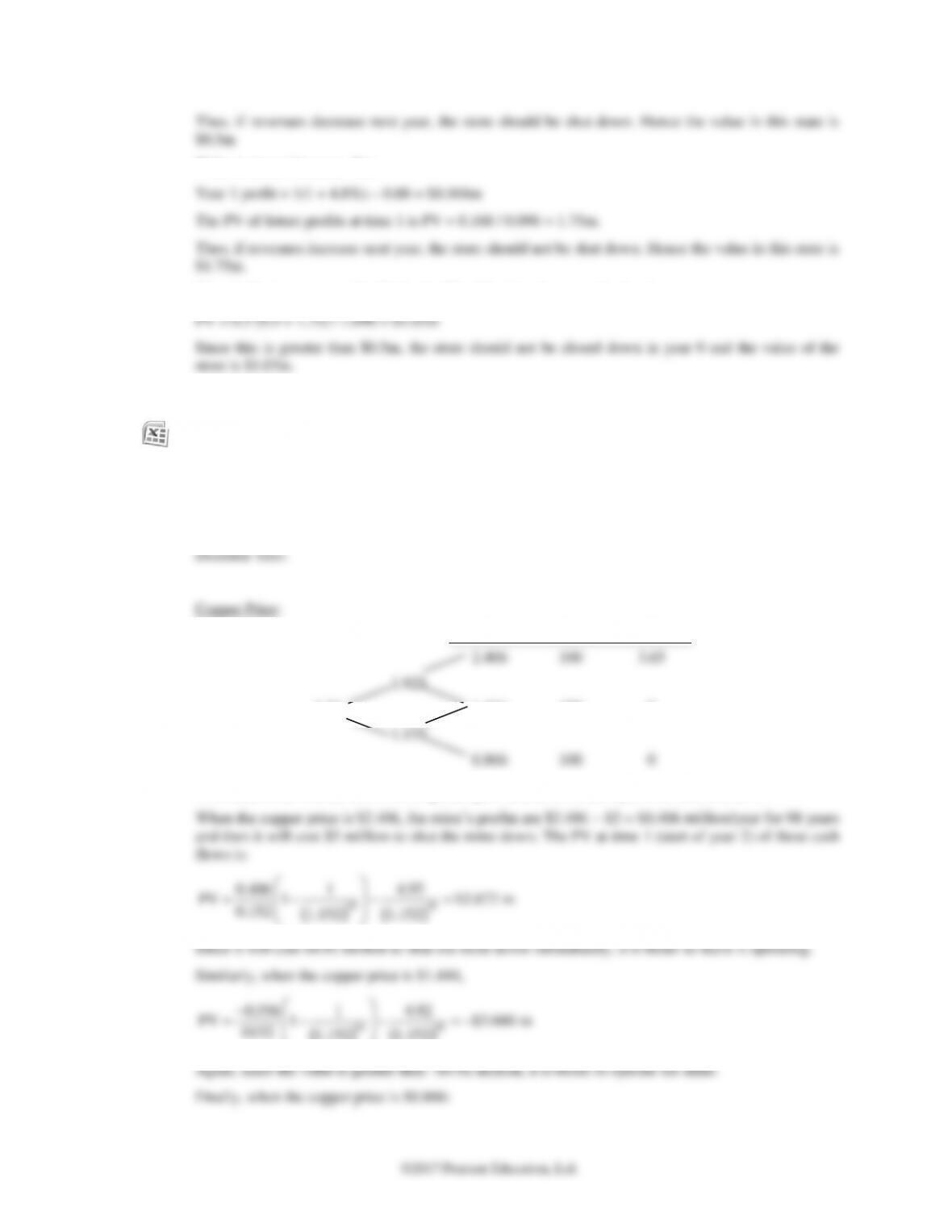
Thus, if revenues decrease next year, the store should be shut down. Hence the value in this state is
$0.5m
If the revenues increase, then
Since both states are equally likely, the PV of the time 1 expected value is:
22–18. You own a copper mine. The price of copper is currently $1.54 per pound. The mine produces 1
million pounds of copper per year and costs $2 million per year to operate. It has enough copper
to operate for 100 years. Shutting the mine down would entail bringing the land up to EPA
standards and is expected to cost $4.92 million. Reopening the mine once it is shut down would
be an impossibility given current environmental standards. The price of copper has an equal
(and independent) probability of going up or down by 25% each year for the next two years and
then will stay at that level forever. Calculate the NPV of continuing to operate the mine if the
cost of capital is fixed at 15.2%. Is it optimal to abandon the mine or keep it operating?
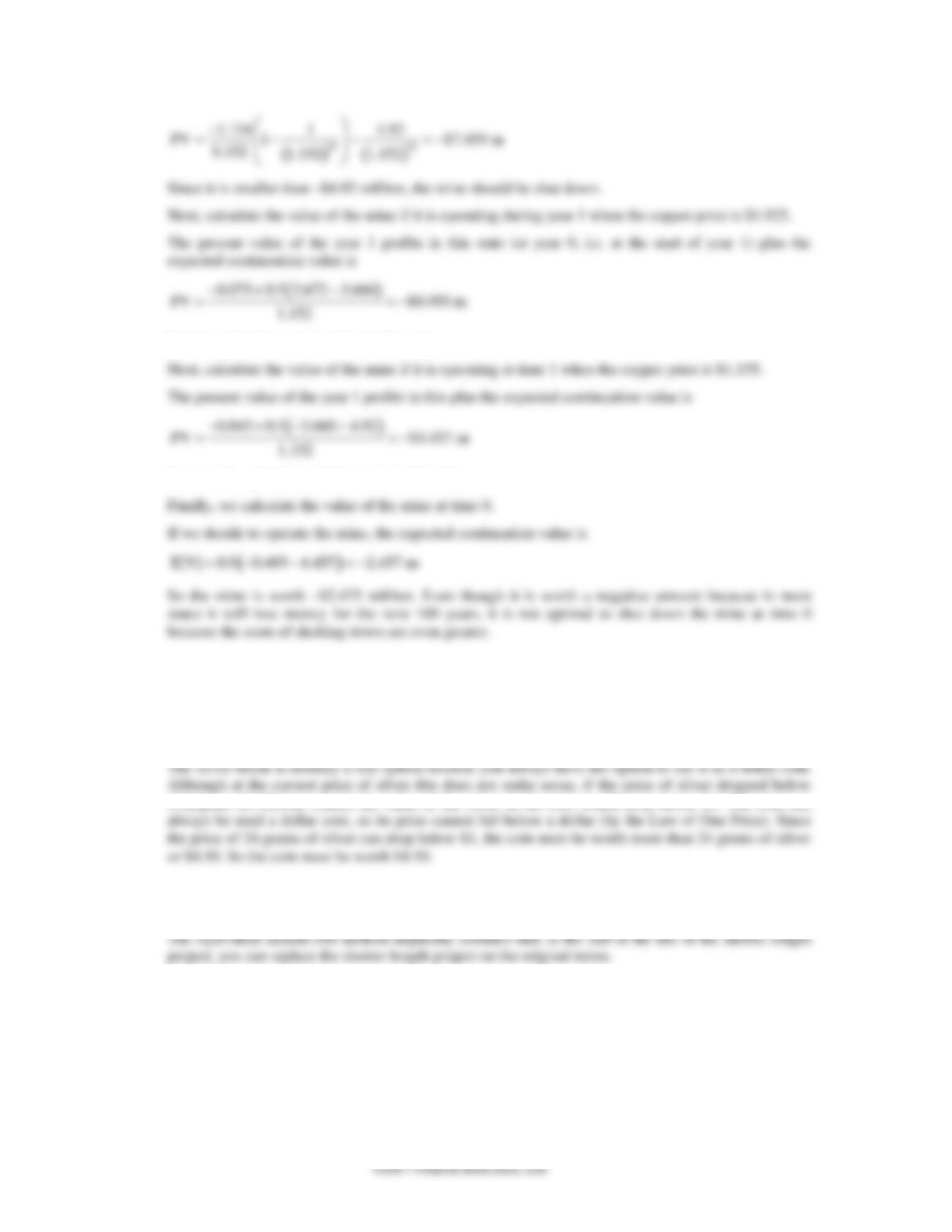
S
B
C
2.406
100
3.65
1.925
1.54
1.444
100
0
1.155
0.866
100
0
First, determine whether the mine is operating or shut down in each possible state at time 2.
0.556 1 4.92
−
314 Berk/DeMarzo, Corporate Finance, Fourth Edition, Global Edition
©2017 Pearson Education, Ltd.
( ) ( )
98 98
1.134 1 4.92
PV 1 $7.459 m
0.152 1.152 1.152
−
= − − = −
Since it is smaller than –$4.92 million, the mine should be shut down.
Next, calculate the value of the mine if it is operating during year 1 when the copper price is $1.925.
The present value of the year 1 profits in this state (at year 0, i.e. at the start of year 1) plus the
expected continuation value is
( )
0.075 0.5 2.672 3.660
PV $0.493 m
1.152
− + −
= = −
So it is optimal to run the mine in this state.
1.152
So it is also optimal to run the mine in this state.
22–19. An original silver dollar from the late eighteenth century consists of approximately 24 grams of
silver. At a price of $0.19 per gram ($6 per troy ounce), the silver content of the coin is currently
worth about $4.50. Assume that these coins are in plentiful supply and are not collector’s items,
so they have no numismatic value. If the current price of silver is $0.19 per gram, will the price
of the coin be greater than, less than, or equal to $4.50? Justify your answer.
4.1¢/gram ($1.28/troy ounce) the value of the silver in the coin would drop below $1. The coin can
22–20. What implicit assumption is made when managers use the equivalent annual benefit method to
decide between two projects with different lives that use the same resource?
22–21. You own a cab company and are evaluating two options to replace your fleet. Either you can
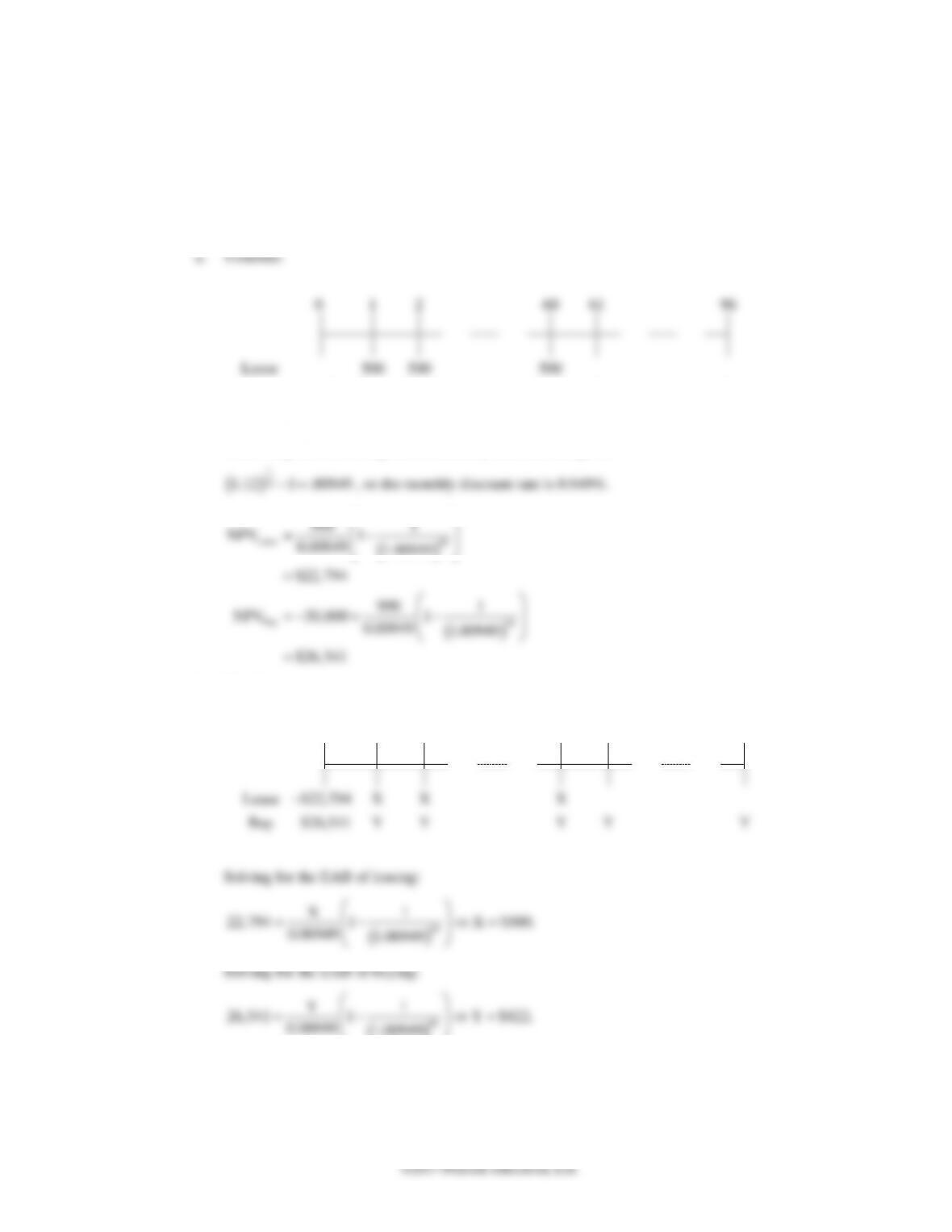
take out a five-year lease on the replacement cabs for $500 per month per cab, or you can
purchase the cabs outright for $30,000, in which case the cabs will last eight years. You must
return the cabs to the leasing company at the end of the lease. The leasing company is
responsible for all maintenance costs, but if you purchase the cabs, you will buy a maintenance
contract that will cost $100 per month for the life of each cab. Each cab will generate revenues of
$1000 per month. Assume the cost of capital is fixed at 12%.
Chapter 22/Real Options 315
a. Calculate the NPV per cab of both possibilities: purchasing the cabs or leasing them.
b. Calculate the equivalent monthly annual benefit of both opportunities.
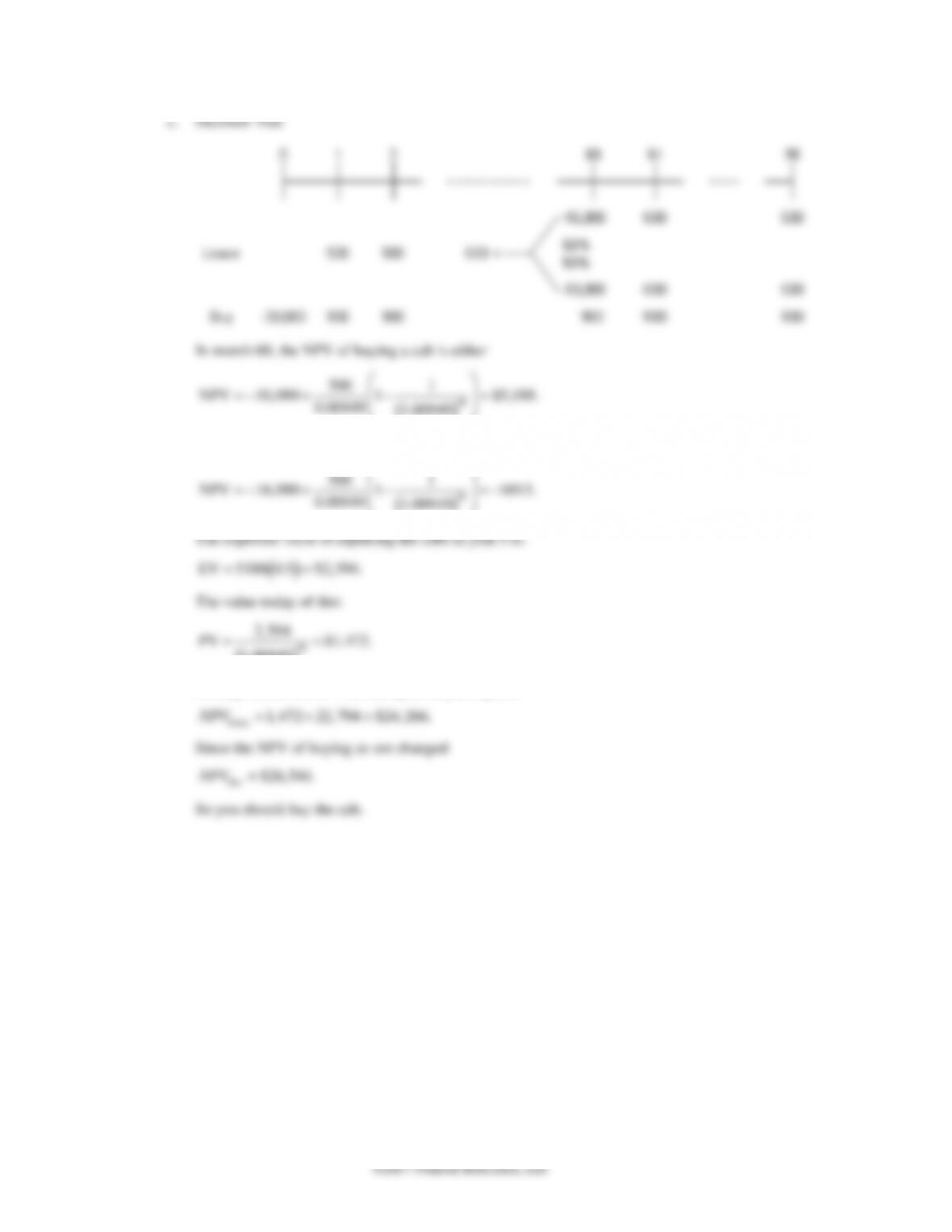
c. If you are leasing a cab, you have the opportunity to buy the used cab after five years.
Assume that in five years a five-year-old cab will cost either $10,000 or $16,000 with equal
likelihood, will have maintenance costs of $500 per month, and will last three more years.
Which option should you take?
316 Berk/DeMarzo, Corporate Finance, Fourth Edition, Global Edition
©2017 Pearson Education, Ltd.
c. Decision Tree
In month 60, the NPV of buying a cab is either
( )
36
500 1
0.00949 1.00949
Or
500 1
( )
60
2,594
PV $1,472.
1.00949
==
Adding this to the NPV of leasing from part a gives:
1,472 22,794 $24, 266.
Lease
NPV = + =
Since the NPV of buying as not changed
$26,541.
Buy
NPV =
So you should buy the cab.
22–22. You own a cab company and are evaluating two options to replace your fleet. Either you can
take out a five-year lease on the replacement cabs for $491 per month per cab, or you can
purchase the cabs outright for $31,000, in which case the cabs will last eight years. You must
return the cabs to the leasing company at the end of the lease. The leasing company is
responsible for all maintenance costs, but if you purchase the cabs, you will buy a maintenance
contract that.will cost $101 per month for the life of each cab. Each cab will generate revenues of
$1076 per month. Assume the cost of capital is fixed at 11.1%.
a. Calculate the NPV per cab of both possibilities: purchasing the cabs or leasing them.
b. Calculate the equivalent monthly benefit of both opportunities.
c. If you are leasing a cab, you have the opportunity to buy the used cab after five years.
Assume that in five years a five-year-old cab will cost either $10,300 or $15,800 with equal
likelihood, will have maintenance costs of $505 per month, and will last three more years.
Which option should you take?
Chapter 22/Real Options 317
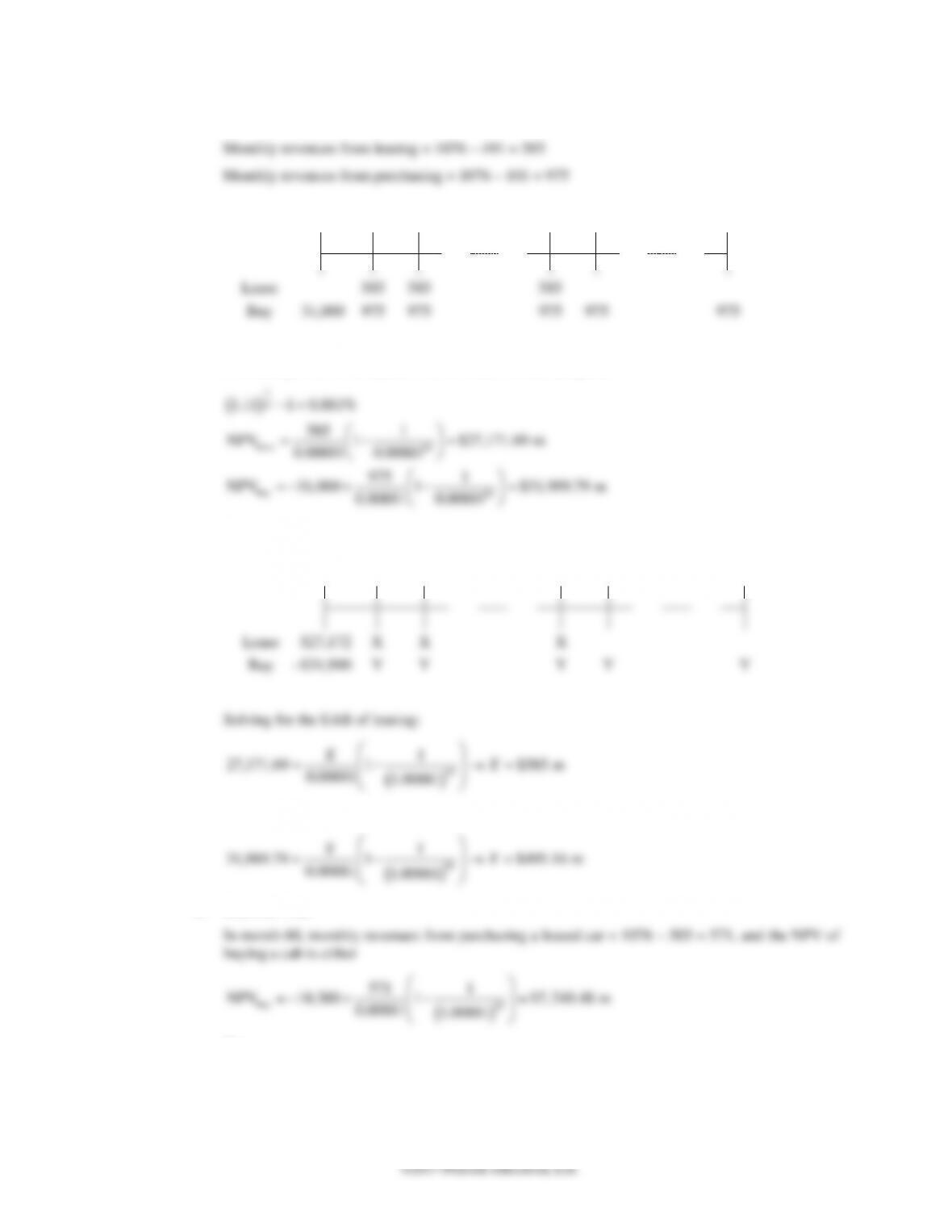
a. Timeline:
0
1
2
60
61
96
Lease
585
585
585
Buy
–31,000
975
975
975
975
975
Converting the cost of capital to a monthly discount rate gives:
( )
1
12
lease 60
buy 96
1.11 1 0.881%
585 1
NPV 1 $27,171.69 m
0.00881 0.00881
975 1
NPV 31,000 1 $31,989.79 m
0.00881 0.00881
−=
= − =
= − + − =
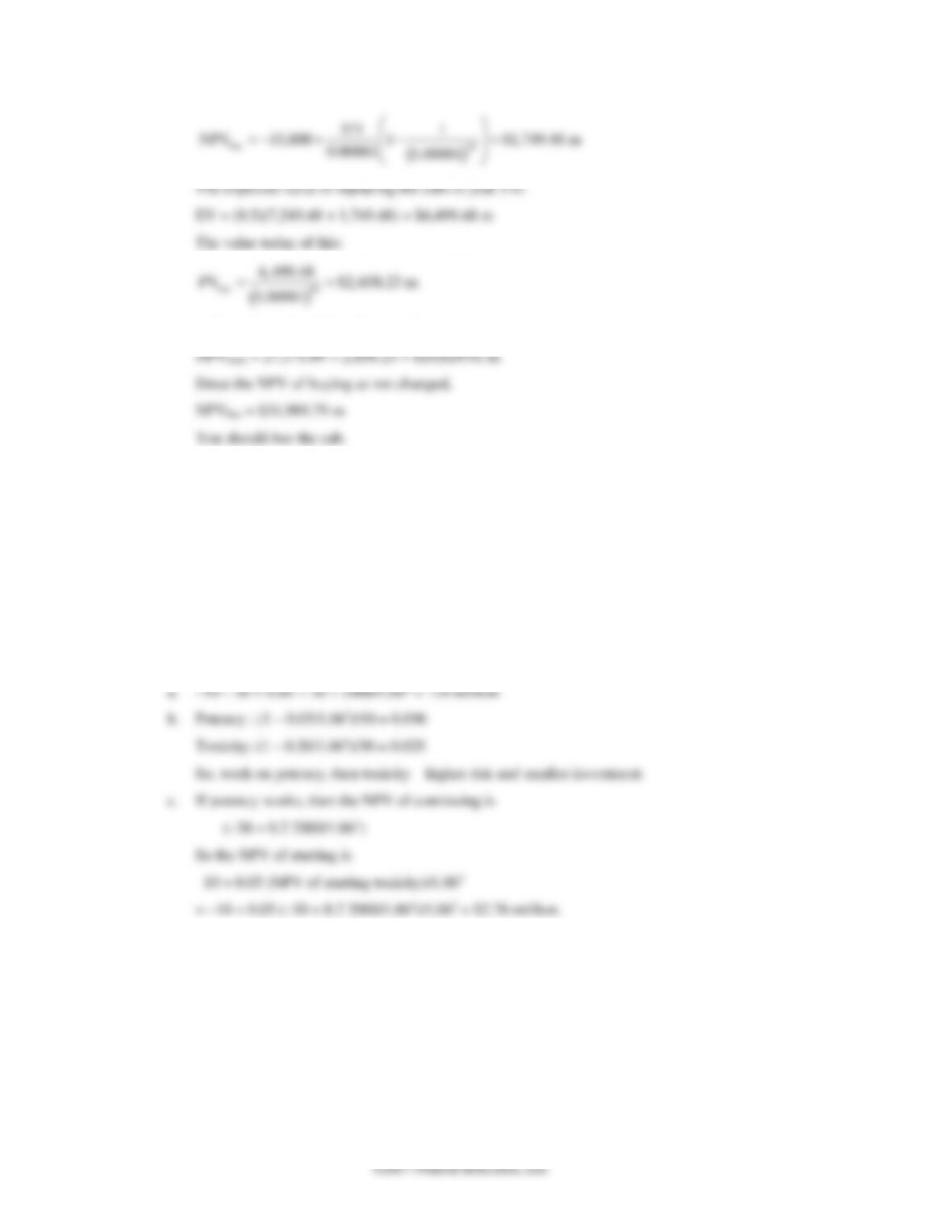
b. Timeline:
0
1
2
60
61
96
Lease
–$27,172
X
X
X
Buy
–$31,990
Y
Y
Y
Y
Y
Solving for the EAB of leasing:
( )
60
1
27,171.69 1 $585 m
0.00881 1.00881
= − → =
XX
Solving for the EAB of buying:
( )
96
1
31,989.79 1 $495.16 m
0.00881 1.00881
= − → =
XX
c. Decision Tree
( )
0.00881 1.00881
Or
318 Berk/DeMarzo, Corporate Finance, Fourth Edition, Global Edition
©2017 Pearson Education, Ltd.
( )
buy 36
571 1
NPV 15,800 1 $1,749.48 m
0.00881 1.00881
= − + − =
The expected value of replacing the cabs in year 5 is:
EV = (0.5)(7,249.48 + 1,749.48) = $4,499.48 m
The value today of this:
( )
buy 60
4, 499.48
PV $2,658.23 m
1.00881
==
Adding this to the NPV of leasing from part a gives:
22–23. Genenco is developing a new drug that will slow the aging process. In order to succeed, two
breakthroughs are needed, one to increase the potency of the drug, and the second to eliminate
toxic side effects. Research to improve the drug’s potency is expected to require an upfront
investment of $10 million and take 2 years; the drug has a 5% chance of success. Reducing the
drug’s toxicity will require a $30 million up-front investment, take 4 years, and has a 20%
chance of success. If both efforts are successful, Genenco can sell the patent for the drug to a
major drug company for $2 billion. All risk is idiosyncratic, and the risk-free rate is 6%.
a. What is the NPV of launching both research efforts simultaneously?
b. What is the optimal order to stage the investments?
c. What is the NPV with the optimal staging?
22–24. Your engineers are developing a new product to launch next year that will require both software
and hardware innovations. The software team requests a budget of $6 million and forecasts an
80% chance of success. The hardware team requests a $11 million budget and forecasts a 53%
chance of success. Both teams will need 6 months to work on the product, and the risk-free
interest rate is 3% APR with semiannual compounding.
a. Which team should work on the project first?
b. Suppose that before anyone has worked on the project, the hardware team comes back and
revises their proposal, changing the estimated chance of success to 78% based on new
information. Will this affect your decision in (a)?
©2017 Pearson Education, Ltd.
22–25. Your firm is thinking of expanding. If you invest today, the expansion will generate $11 million
in FCF at the end of the year and will have a continuation value of either $145 million (if the
economy improves) or $50 million (if the economy does not improve). If you wait until next year
to invest, you will lose the opportunity to make $11 million in FCF, but you will know the
continuation value of the investment in the following year (that is, in a year from now, you will
know what the investment continuation value will be in the following year). Suppose the riskfree
rate is 4%, and the risk-neutral probability that the economy improves is 37%. Assume the cost
of expanding is the same this year or next year.
a. If the cost of expanding is $83 million, should you do so today, or wait until next year to
decide?
b. At what cost of expanding would there be no difference between expanding now and
waiting? To what profitability index does this correspond?
22–26. Assume that the project in Example 22.5 pays an annual cash flow of $100,000 (instead of
$90,000).
a. What is the NPV of investing today?
b. What is the NPV of waiting and investing tomorrow?
c. Verify that the hurdle rate rule of thumb gives the correct time to invest in this case.