283
Chapter 21
Option Valuation
21–1. The current price of Estelle Corporation stock is $25. In each of the next two years, this stock
price will either go up by 24% or go down by 24%. The stock pays no dividends. The one-year
risk-free interest rate is 8% and will remain constant. Using the Binomial Model, calculate the
price of a one-year call option on Estelle stock with a strike price of $25.
21–2. Using the information in Problem 1, use the Binomial Model to calculate the price of a one year
put option on Estelle stock with a strike price of $25.
21–3. The current price of Natasha Corporation stock is $5.65. In each of the next two years, this stock
price can either go up by $2.50 or go down by $2. The stock pays no dividends. The one–year
risk-free interest rate is 3.2% and will remain constant. Using the Binomial Model, calculate the
price of a two-year call option on Natasha stock with a strike price of $7.
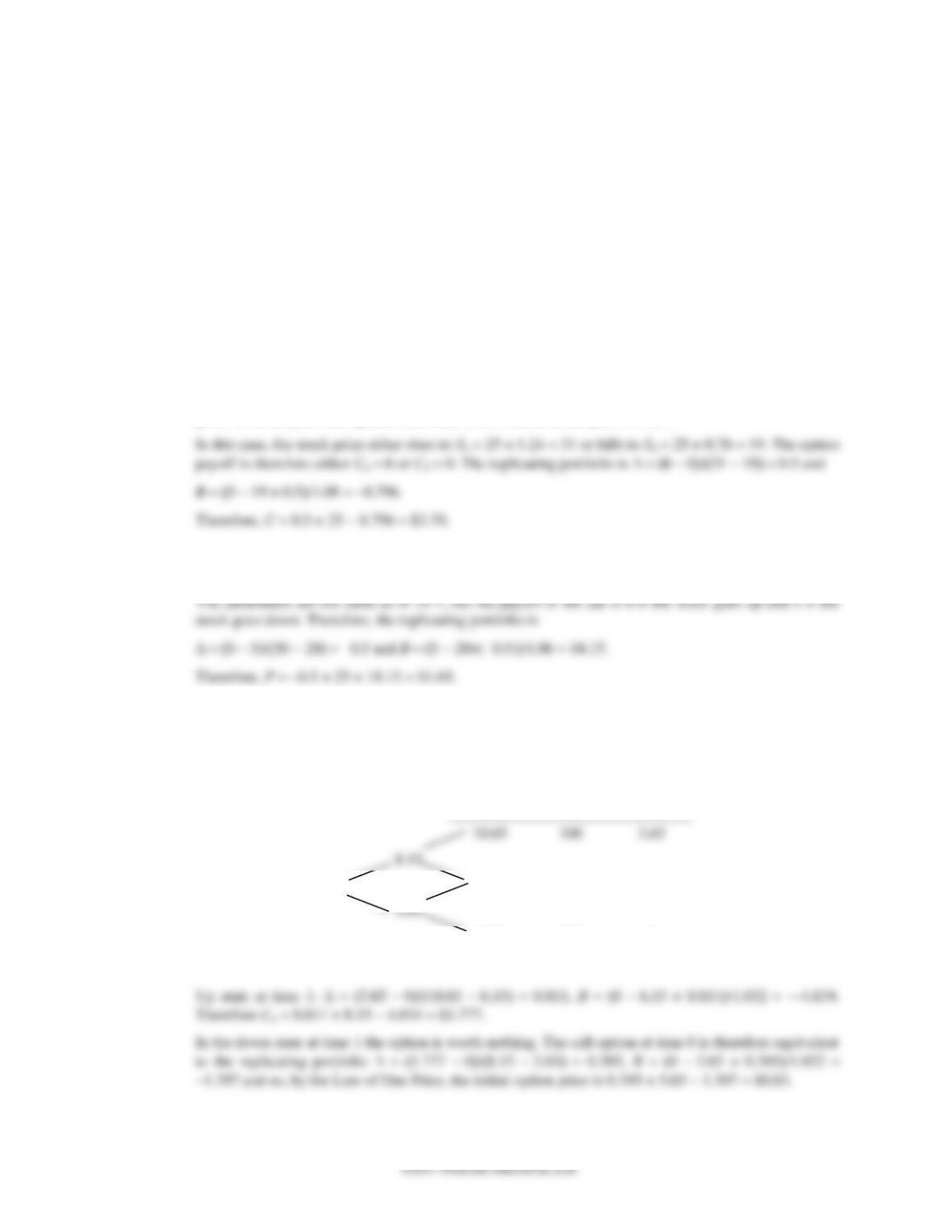
S
B
C
10.65
100
3.65
8.15
5.65
6.15
100
0
3.65
1.65
100
0
Chapter 21/Option Valuation 285
b. What is the value today of a one-year European put option on Eagletron stock with a strike
price of $20?
c. Suppose the put options in parts (a) and (b) could either be exercised immediately, or in one
year. What would their values be in this case?
21–8. What is the highest possible value for the delta of a call option? What is the lowest possible
value? (Hint: See Figure 21.1.)
21–9. Hema Corp. is an all equity firm with a current market value of $1340 million (i.e., $1.34 billion),
and will be worth $1206 million or $1876 million in one year. The risk-free interest rate is 5%.
Suppose Hema Corp. issues zero–coupon, one-year debt with a face value of $1407 million and
uses the proceeds to pay a special dividend to shareholders. Assuming perfect capital markets,
use the binomial model to answer the following:
a. What are the payoffs of the firm’s debt in one year?
b. What is the value today of the debt today?
c. What is the yield on the debt?
d. Using Modigliani-Miller, what is the value of Hema’s equity before the dividend is paid?
What is the value of equity just after the dividend is paid?
e. Show that the ex-dividend value of Hema’s equity is consistent with the binomial model.
What is the Δ of the equity, when viewed as a call option on the firm’s assets?
21-10. Consider the setting of Problem 9. Suppose that in the event Hema Corp. defaults, $90 million of
its value will be lost to bankruptcy costs. Assume there are no other market imperfections.
286 Berk/DeMarzo, Corporate Finance, Fourth Edition, Global Edition
a. What is the present value of these bankruptcy costs, and what is their delta with respect to
the firm’s assets?
b. In this case, what is the value and yield of Hema’s debt?
c. In this case, what is the value of Hema’s equity before the dividend is paid? What is the
value of equity just after the dividend is paid?
(debt value) to determine ex-div value = $100 (Note this ex-div value is the same as in Problem 9
because equity holders have the same final payoffs.)
21-11. Roslin Robotics stock has a volatility of 35% and a current stock price of $60 per share. Roslin
pays no dividends. The risk-free interest is 5%. Determine the Black–Scholes value of a one-year,
at-the-money call option on Roslin stock.
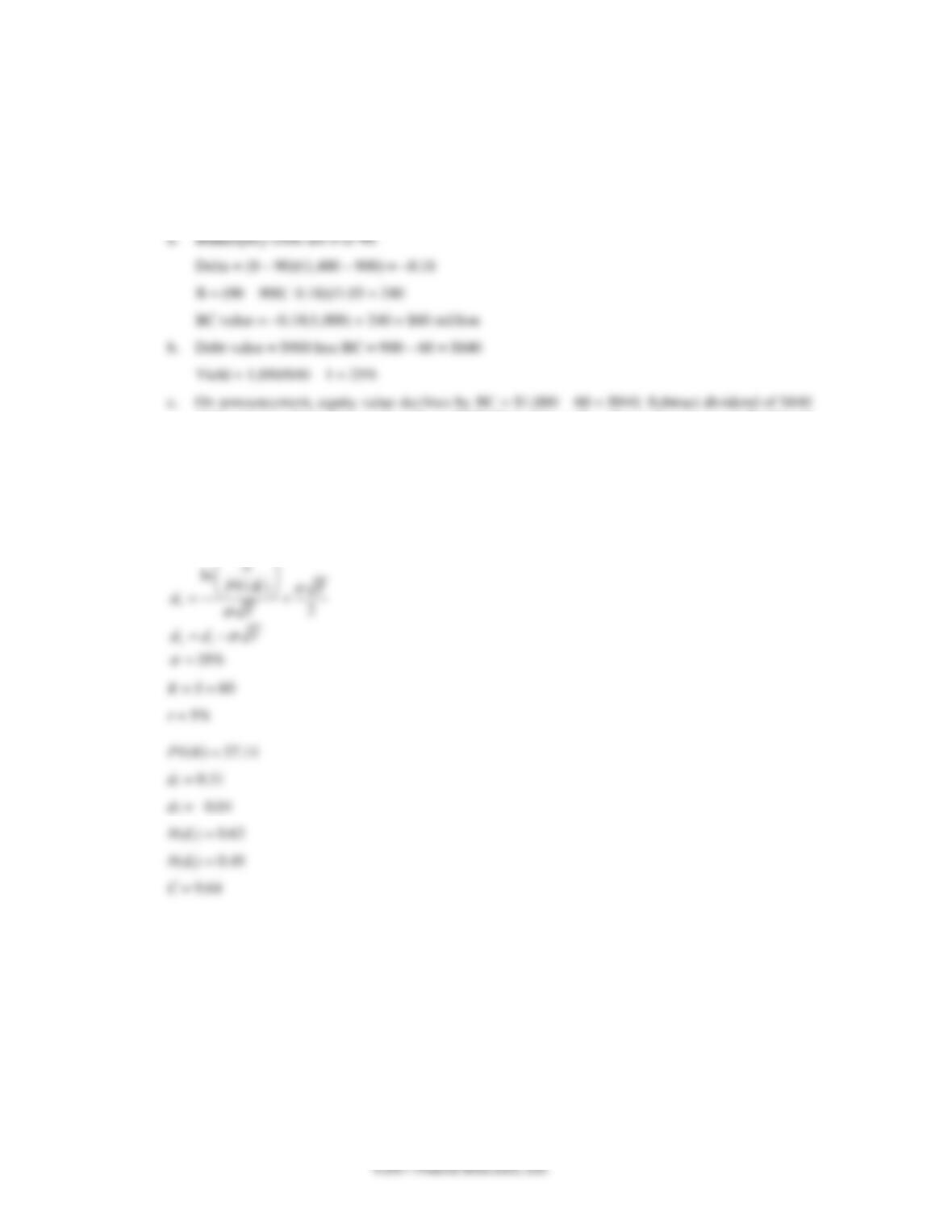
12
1
21
( ) ( ) ( )
ln ()
2
35%
= −
=+
=−
=
C S N d PV K N d
S
PV K T
dT
d d T
K = S = 60
r = 5%
PV(K) = 57.14
d1 = 0.31
d2 = –0.04
N(d1) = 0.62
N(d2) = 0.49
C = 9.64
21-12. Rebecca is interested in purchasing a European call on a hot new stock, Up, Inc. The call has a
strike price of $99 and expires in 92 days. The current price of Up stock is $119.16, and the stock
has a standard deviation of 42% per year. The risk-free interest rate is 6.25% per year.
a. Using the Black-Scholes formula, compute the price of the call.
b. Use put-call parity to compute the price of the put with the same strike and expiration date.
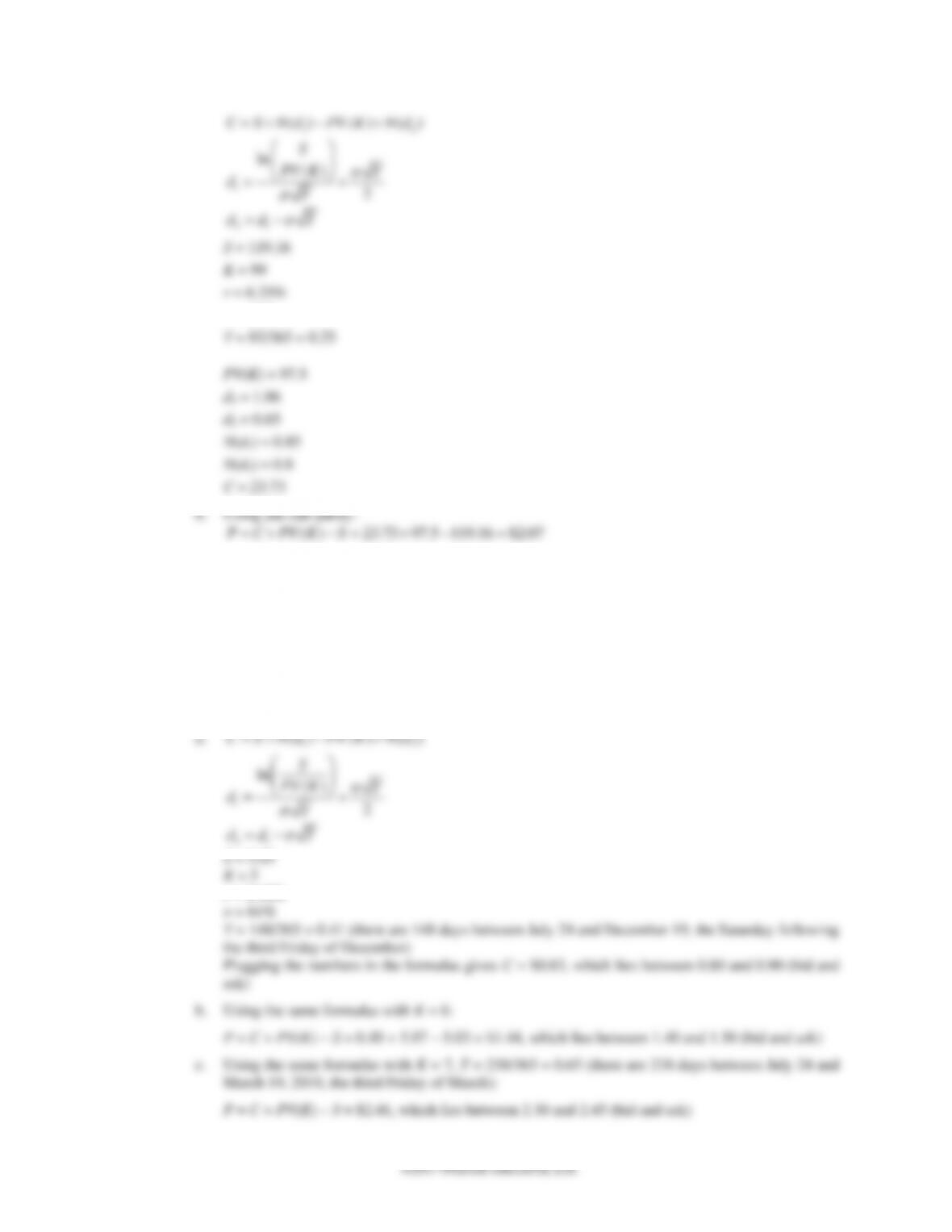
a. Using the Black-Sholes formula:
Chapter 21/Option Valuation 287
©2017 Pearson Education, Ltd.
12
1
21
( ) ( ) ( )
ln ()
2
= −
=+
=−
C S N d PV K N d
S
PV K T
dT
d d T
S = 119.16
K = 99
r = 6.25%
σ = 42%
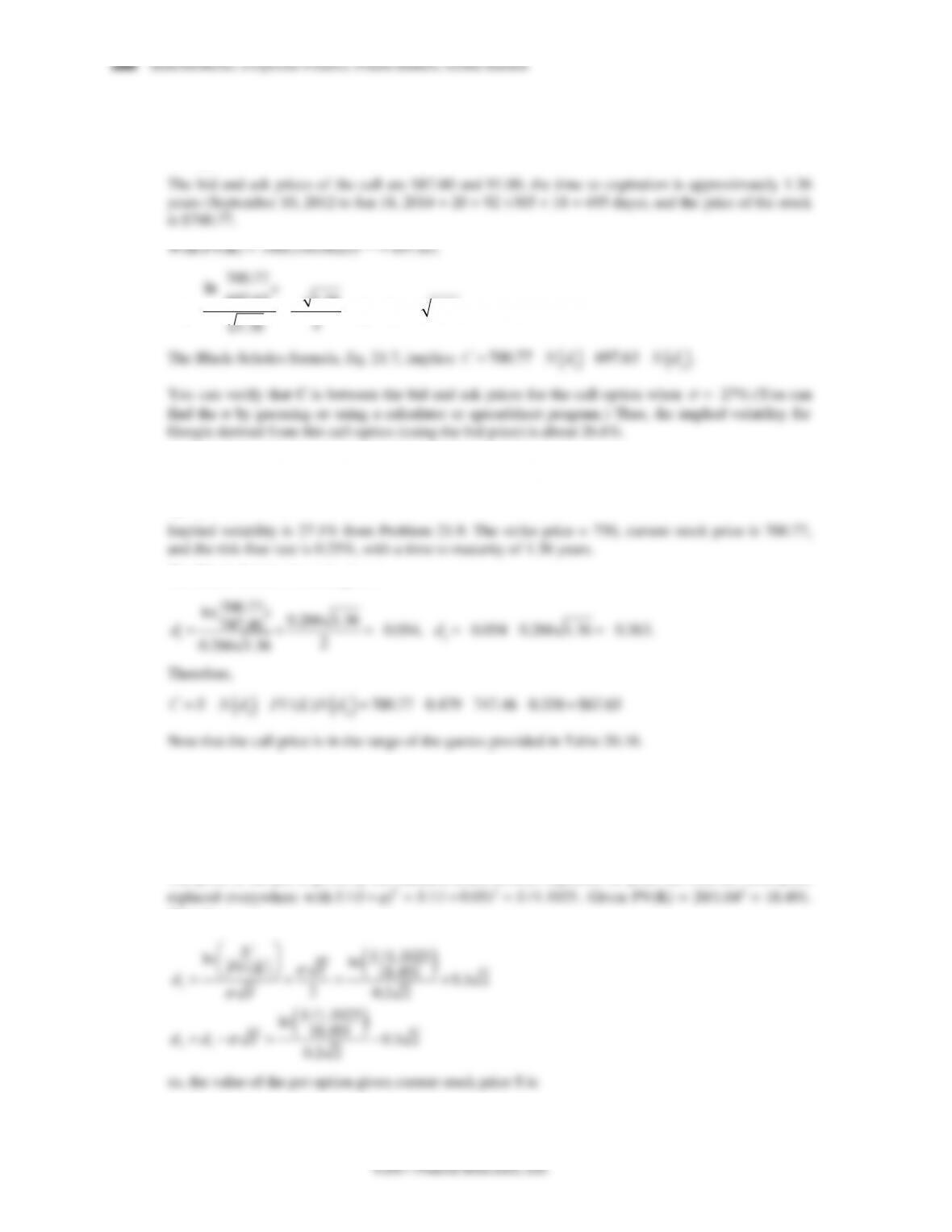
21-13. Using the data in Table 21.1, compare the price on July 24, 2009, of the following options on
JetBlue stock to the price predicted by the Black–Scholes formula. Assume that the standard
deviation of JetBlue stock is 64% per year and that the short-term risk-free rate of interest is
1.1% per year.
a. December 2009 call option with a $5 strike price
b. December 2009 put option with a $6 strike price
c. March 2010 put option with a $7 strike price
r = 1.10%
Chapter 21/Option Valuation 289
( )
21
( ) ( ) (1 ( )) (1 ( ))
/1.1025 /1.1025
ln( ) ln( )
18.491 18.491
18.491 1 0.1 2 /1.1025 1 0.1 2 .
0.2 2 0.2 2
x
P S PV K N d S N d
SS
N S N
= − − −
= − − − − +
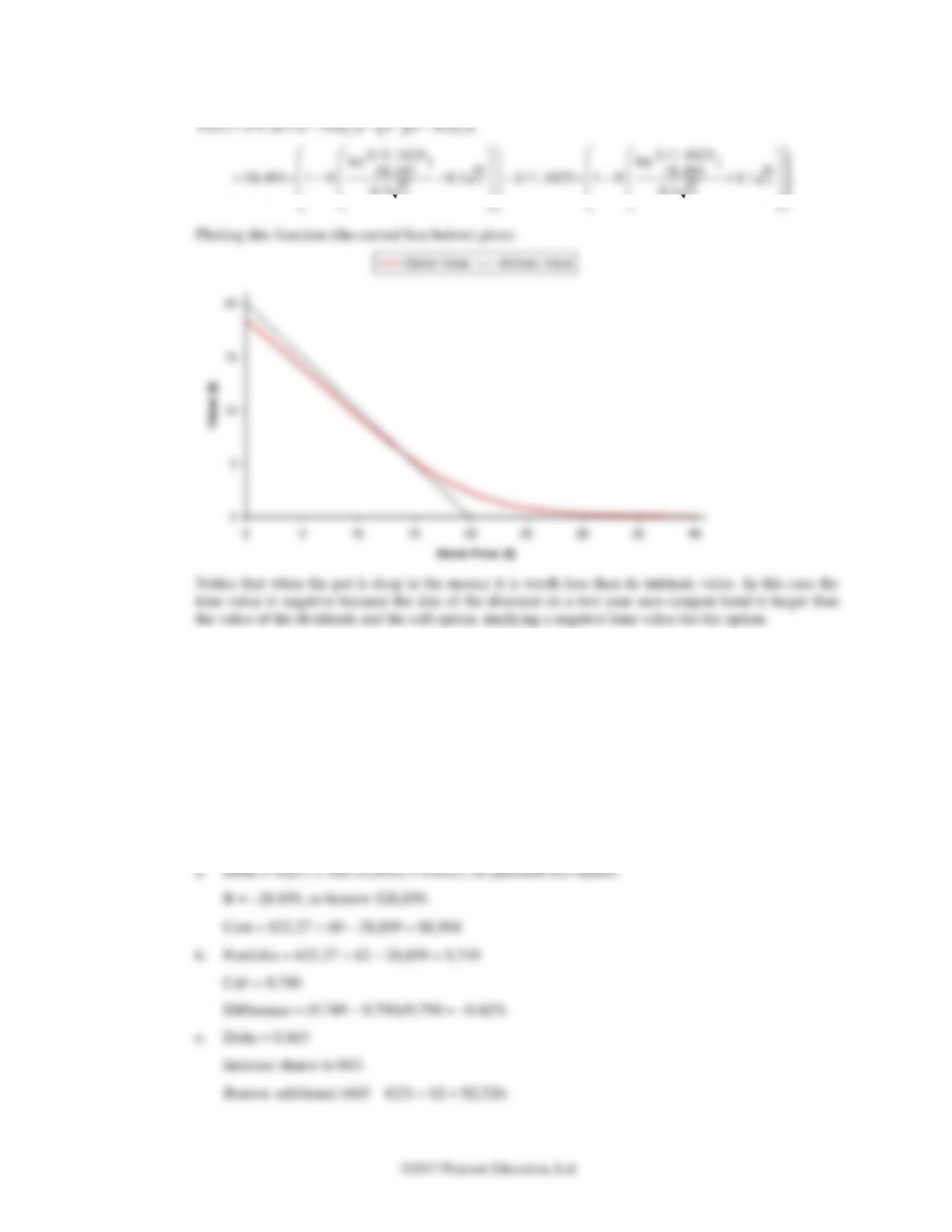
Plotting this function (the curved line below) gives:
0
5
10
15
20
0 5 10 15 20 25 30 35 40
Stock Price ($)
Value ($)
Option Value Intrinsic Value
Notice that when the put is deep in the money it is worth less than its intrinsic value. In this case the
time value is negative because the size of the discount on a two year zero-coupon bond is larger than
the value of the dividends and the call option, implying a negative time value for the option.
21-17. Consider the at-the-money call option on Roslin Robotics evaluated in Problem 11. Suppose the
call option is not available for trade in the market. You would like to replicate a long position in
1000 call options.
a. What portfolio should you hold today?
b. Suppose you purchase the portfolio in part a. If Roslin stock goes up in value to $62 per
share today, what is the value of this portfolio now? If the call option were available for
trade, what would be the difference in value between the call option and the portfolio
(expressed as percent of the value of the call)?
c. After the stock price change in part b, how should you adjust your portfolio to continue to
replicate the options?
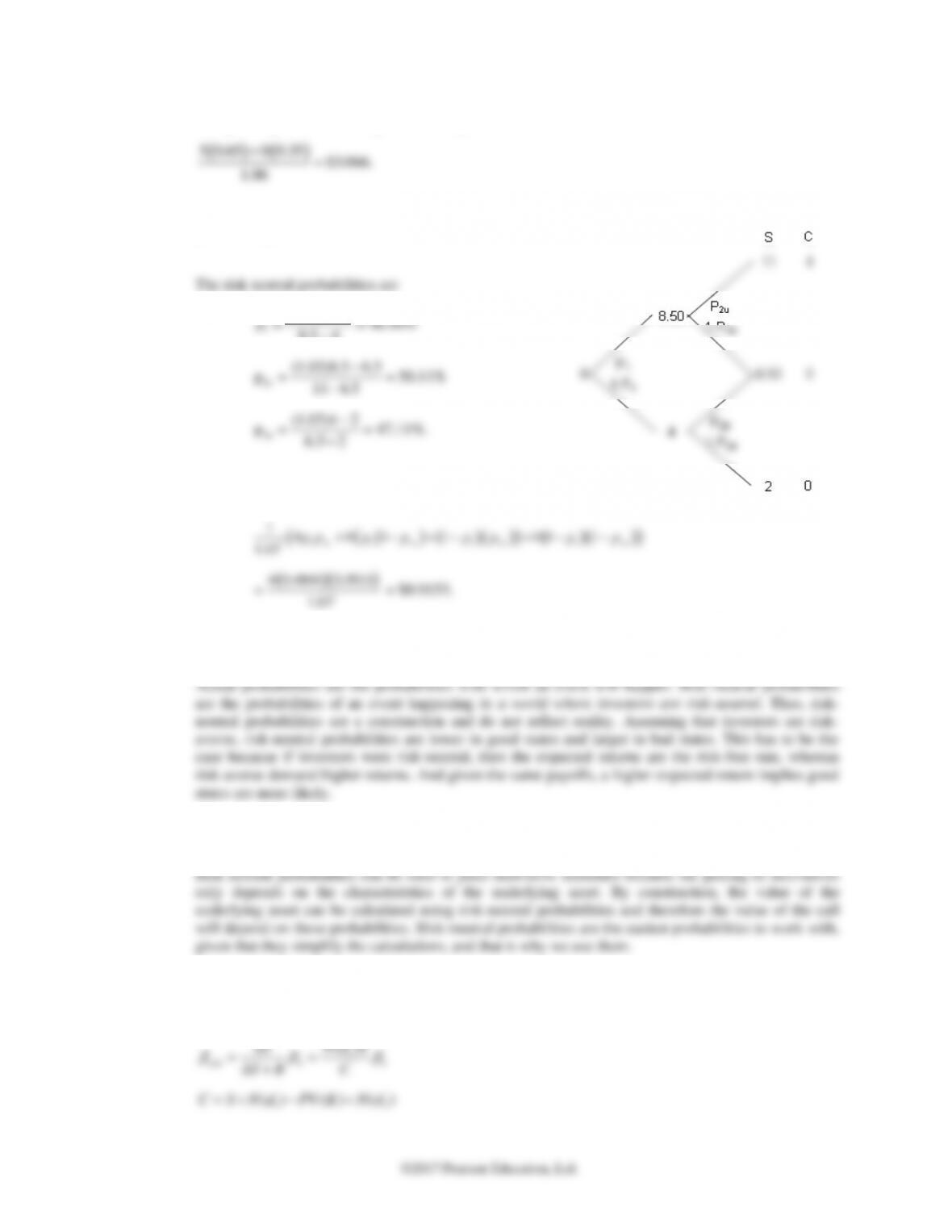
Chapter 21/Option Valuation 291
Using these probabilities the price of the option is
( ) ( )
5 0.65 0 0.35 $3.066.
1.06
+=
21-22. Using the information in Problem 3, calculate the risk-neutral probabilities. Then use them to
price the option.
292 Berk/DeMarzo, Corporate Finance, Fourth Edition, Global Edition
©2017 Pearson Education, Ltd.
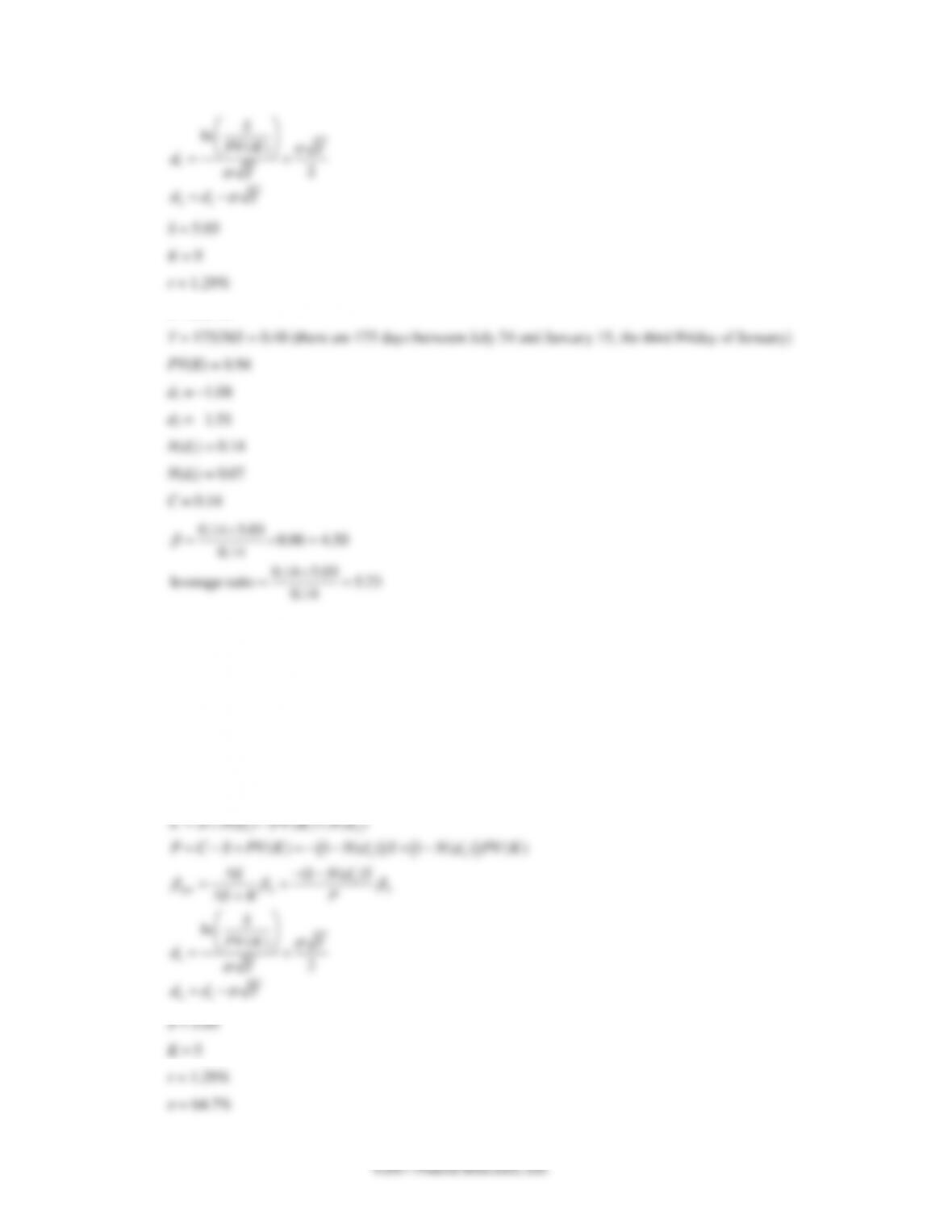
1
21
ln ()
2
=+
=−
S
PV K T
dT
d d T
S = 5.03
K = 9
r = 1.29%
σ = 64.7%
leverage ratio 5.23
0.14
==
21-26. Consider the March 2010 $5 put option on JetBlue listed in Table 21.1. Assume that the volatility
of JetBlue is 64.7% per year and its beta is 0.86. The short-term risk-free rate of interest is
1.29% per year.
a. What is the put option’s leverage ratio?
b. What is the beta of the put option?
c. If the expected risk premium of the market is 6%, what is the expected return of the put
option based on the CAPM?
d. Given its expected return, why would an investor buy a put option?
( ) ( )
12
12
( ) ( ) ( )
( ) 1 ( ) 1 ( ) ( )
= −
= − + = − − + −
C S N d PV K N d
P C S PV K N d S N d PV K
1
(1 ( )
put S S
N d S
S
S B P
−−
==
+
1
21
ln ()
2
=+
=−
S
PV K T
dT
d d T
S = 5.03
K = 5
r = 1.29%
σ = 64.7%
Chapter 21/Option Valuation 293
©2017 Pearson Education, Ltd.
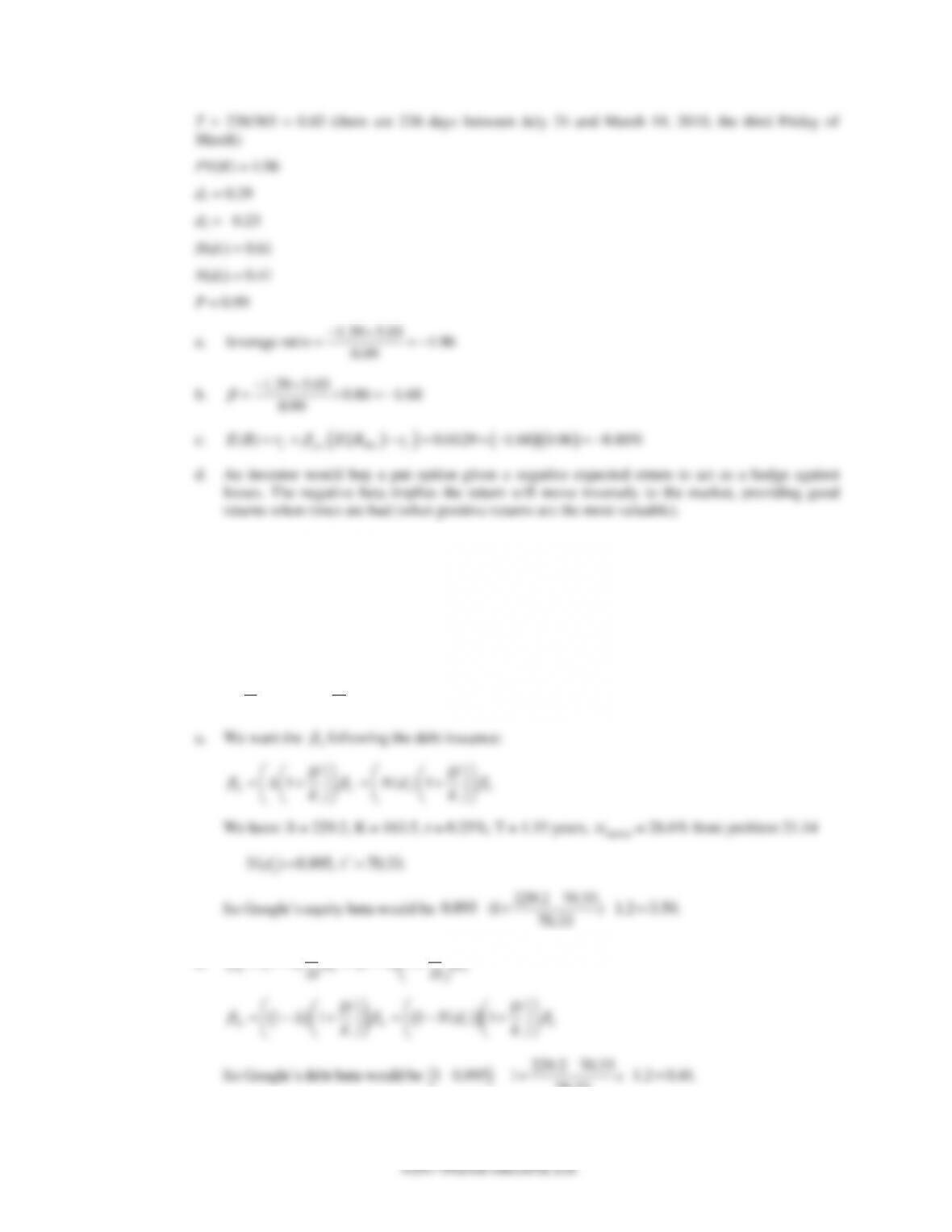
T = 238/365 = 0.65 (there are 238 days between July 24 and March 19, 2010, the third Friday of
March)
PV(K) = 4.96
d1 = 0.29
d2 = –0.23
N(d1) = 0.61
N(d2) = 0.41
P = 0.99
a.
1.39 5.03
leverage ratio 1.96
0.99
−
= = −
b.
1.39 5.03 0.86 1.68
0.99
−
= = −
c.
( )
( )
( )( )
( ) 0.0129 1.68 0.06 8.80%
= + − = + − = −
f put Mkt f
E R r E R r
d. An investor would buy a put option given a negative expected return to act as a hedge against
losses. The negative beta implies the return will move inversely to the market, providing good
returns when times are bad (when positive returns are the most valuable).
21-27. Return to Example 20.10, in which Google was contemplating issuing zero-coupon debt due in 18
months with a face value of $96 billion, and using the proceeds to pay a special dividend. Google
currently has a market value of $135.1 billion and the risk-free rate is 1%. Using the market
data in Figure 20.10, answer the following:
a. If Google’s current equity beta is 1.45, estimate Google’s equity beta after the debt is issued.
b. Estimate the beta of the new debt.
1
E U U
AD
EE
= = +
70.33 )´1.2 =3.50.
b.
(1 ) (1 ) 1
D U U
AE
DD
= − = − +
( ) ( )
1
1 1 1 ( ) 1
D U U
DD
Nd
EE
= − + = − +
So Google’s debt beta would be
1–0.895
( )
´1+229.2–70.33
70.33
æ
è
çö
ø
÷´1.2 =0.41.
294 Berk/DeMarzo, Corporate Finance, Fourth Edition, Global Edition
21-28. You would like to estimate the unlevered beta of Schwartz Industries (SI). SI’s value of
outstanding equity is $365.45 million, and you have estimated its beta to be 1.2. SI has four-year
zero-coupon debt outstanding with a face value of $200 million that currently trades for $134.54
million. SI pays no dividends and reinvests all of its earnings. The four-year risk-free interest
rate is 5.13%. Use the Black-Scholes formula to estimate the unlevered beta of the firm.
Using the volatility:
134.54
1 0.94 1 365.45
+ +
UD
E
21-29. The J. Miles Corp. has 26 million shares outstanding with a share price of $18 per share. Miles
also has outstanding zero-coupon debt with a 5-year maturity, a face value of $890 million, and a
yield to maturity of 10%. The risk-free interest rate is 5%.
a. What is the implied volatility of Miles’ assets?
b. What is the minimum profitability index required for equity holders to gain by funding a
new investment that does not change the volatility of the Miles’ assets?
c. Suppose Miles is considering investing cash on hand in a new investment that will increase
the volatility of its assets by 10%. What is the minimum NPV such that this investment will
increase the value of Miles’ shares?
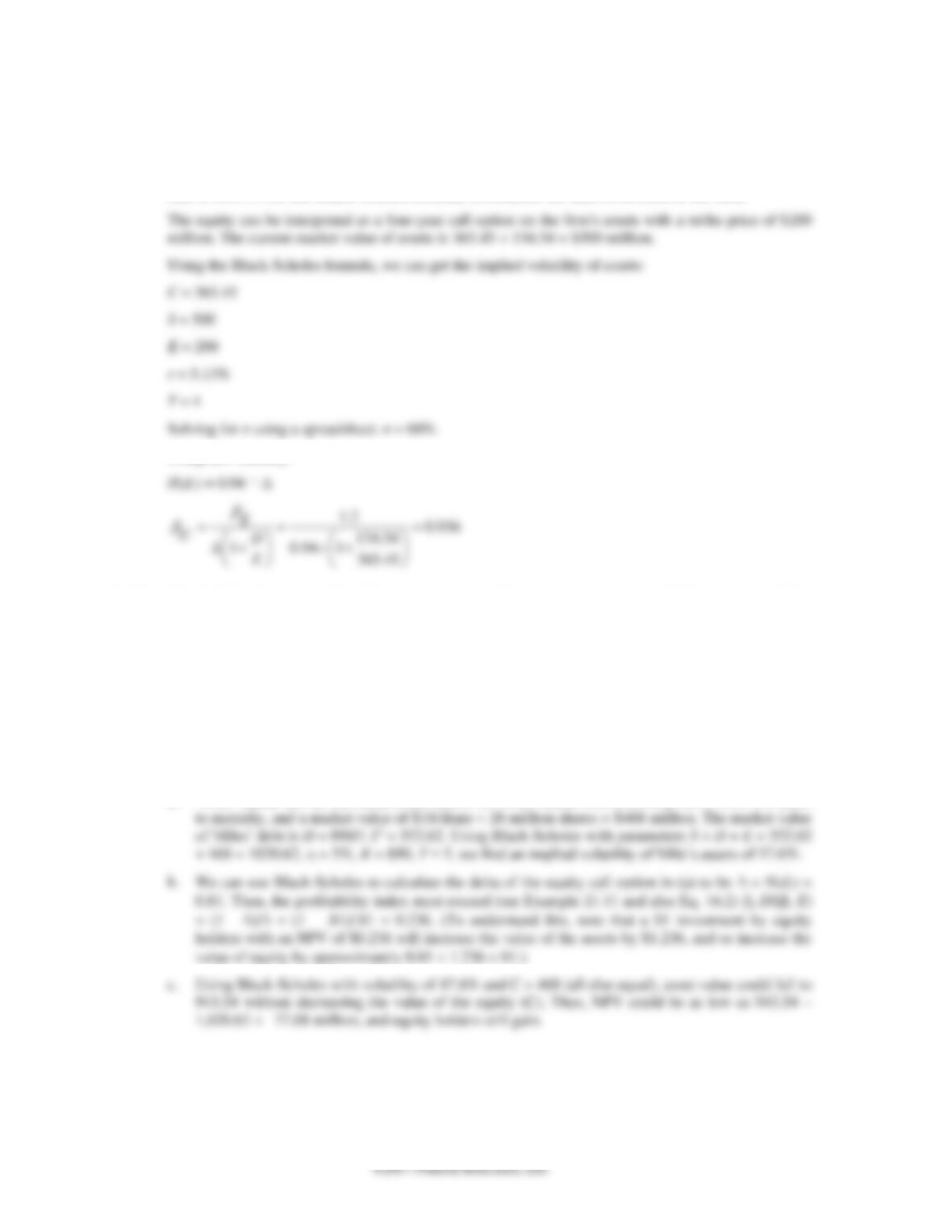
a. Miles’ equity can be viewed as a call option on Miles’ assets with a strike price of 890, five years