271
Chapter 20
Financial Options
20–1. Explain the meanings of the following financial terms:
a. Option
b. Expiration date
c. Strike price
d. Call
e. Put
20–2. What is the difference between a European option and an American option? Are European
options available exclusively in Europe and American options available exclusively in the United
States?
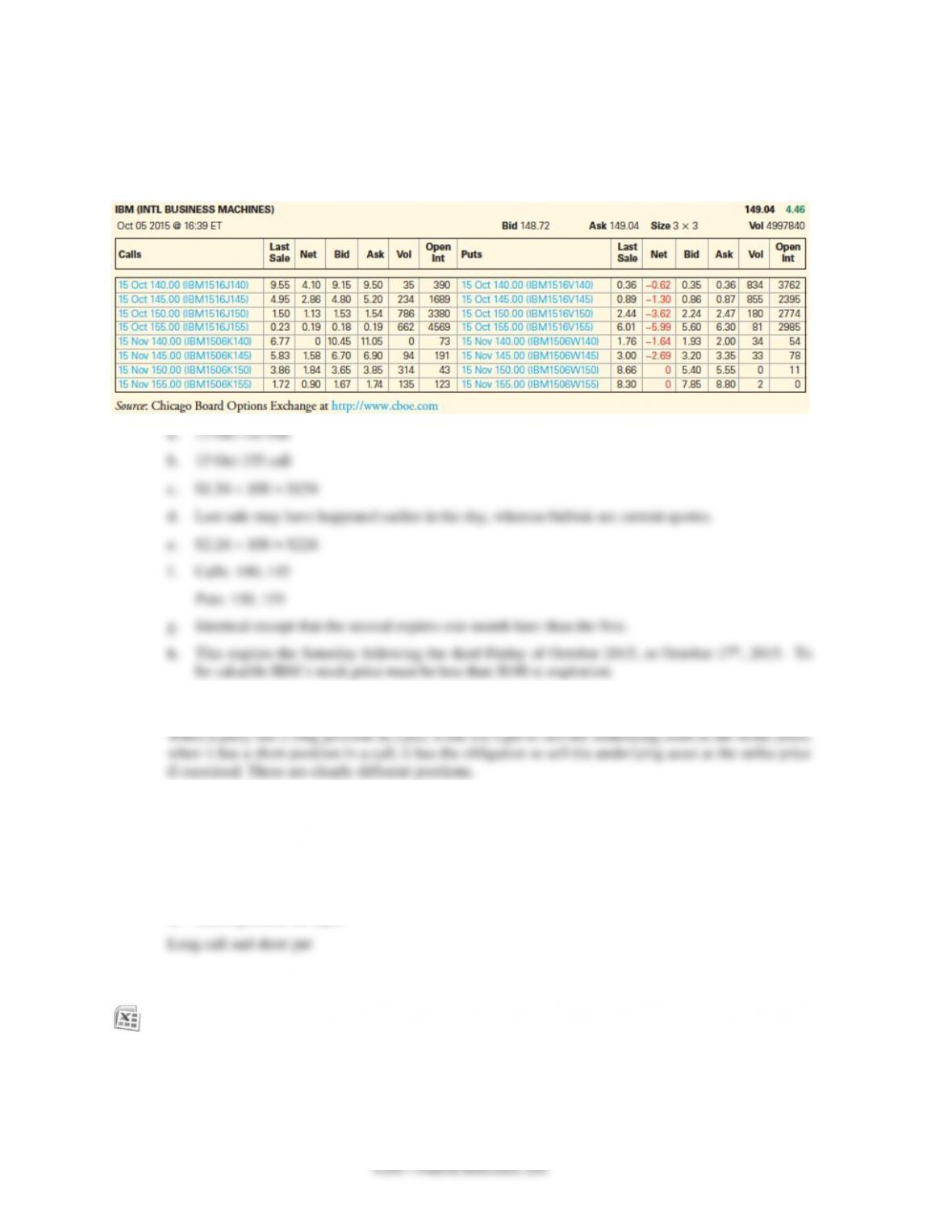
20–3. Below is an option quote on IBM from the CBOE Web site showing options expiring in October
and November 2015.
a. Which option contract had the most trades today?
b. Which option contract is being held the most overall?
c. Suppose you purchase one option with symbol IBM1516J150. How much will you need to
pay your broker for the option (ignoring commissions)?
d. Explain why the last sale price is not always between the bid and ask prices.
e. Suppose you sell one option with symbol IBM1516V150. How much will you receive for the
option (ignoring commissions)?
f. The calls with which strike prices are currently in-the-money? Which puts are in-the-
money?
272 Berk/DeMarzo, Corporate Finance, Fourth Edition, Global Edition
g. What is the difference between the option with symbol IBM1516J140 and the option with
symbol IBM1506K140?
h. On what date does the option with symbol IBM1516V140 expire? In what range must IBM’s
stock price be at expiration for this option to be valuable?
20–4. Explain the difference between a long position in a put and a short position in a call.
20–5. Which of the following positions benefit if the stock price increases?
a. Long position in a call
b. Short position in a call
c. Long position in a put
d. Short position in a put
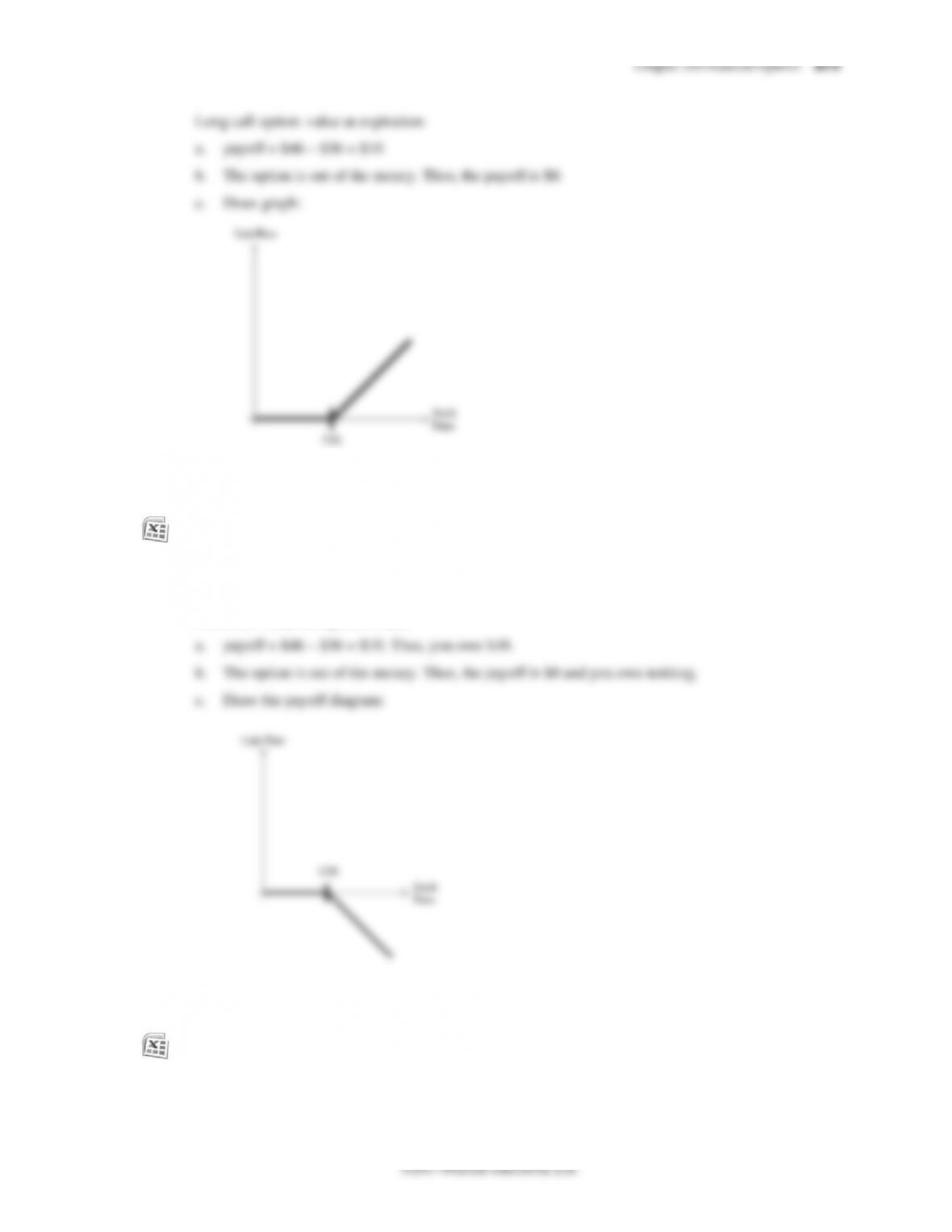
20–6. You own a call option on Intuit stock with a strike price of $36. The option will expire in exactly
three months’ time.
a. If the stock is trading at $46 in three months, what will be the payoff of the call?
b. If the stock is trading at $32 in three months, what will be the payoff of the call?
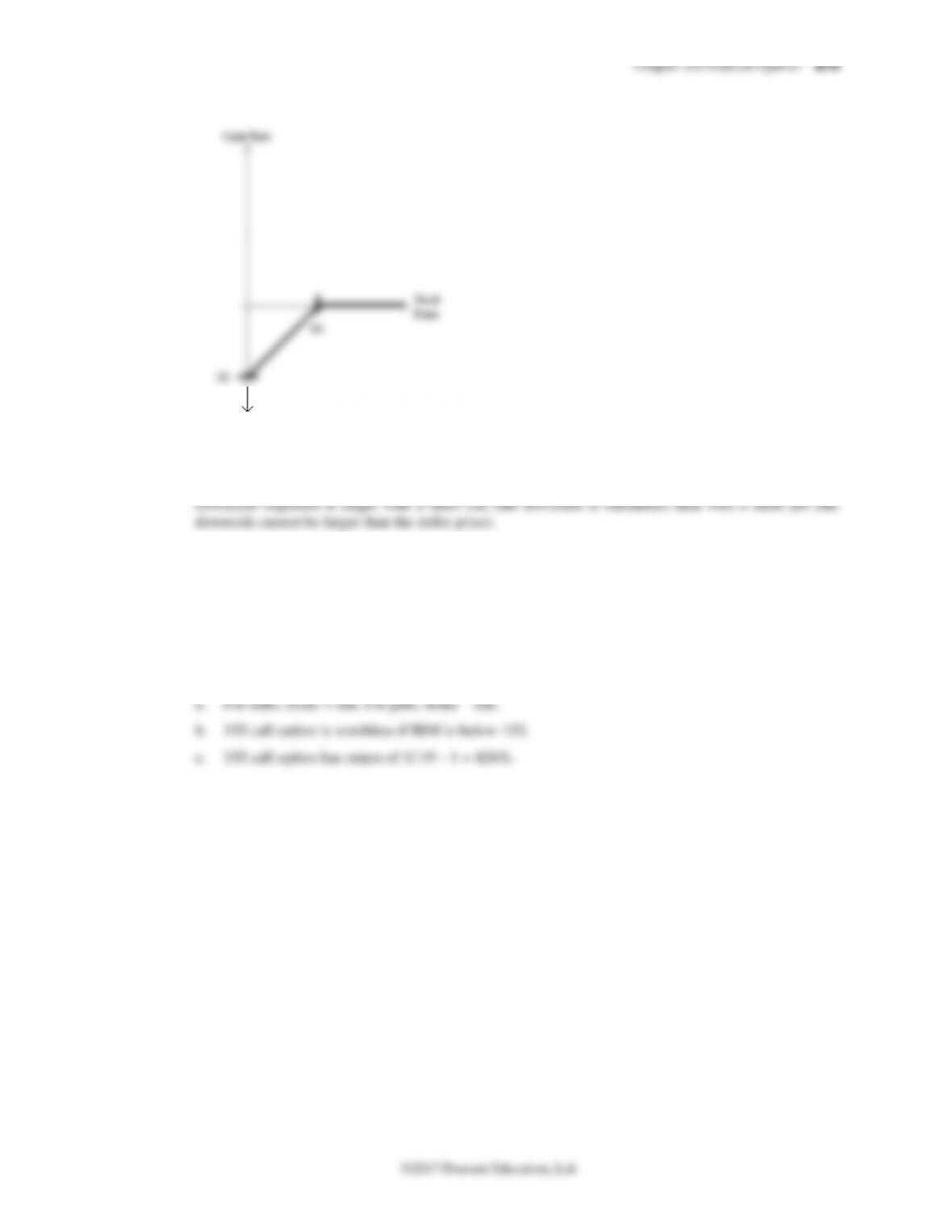
c. Draw a payoff diagram showing the value of the call at expiration as a function of the stock
price at expiration.
©2017 Pearson Education, Ltd.
20–7. Assume that you have shorted the call option in Problem 6.
a. If the stock is trading at $46 in three months, what will you owe?
b. If the stock is trading at $32 in three months, what will you owe?
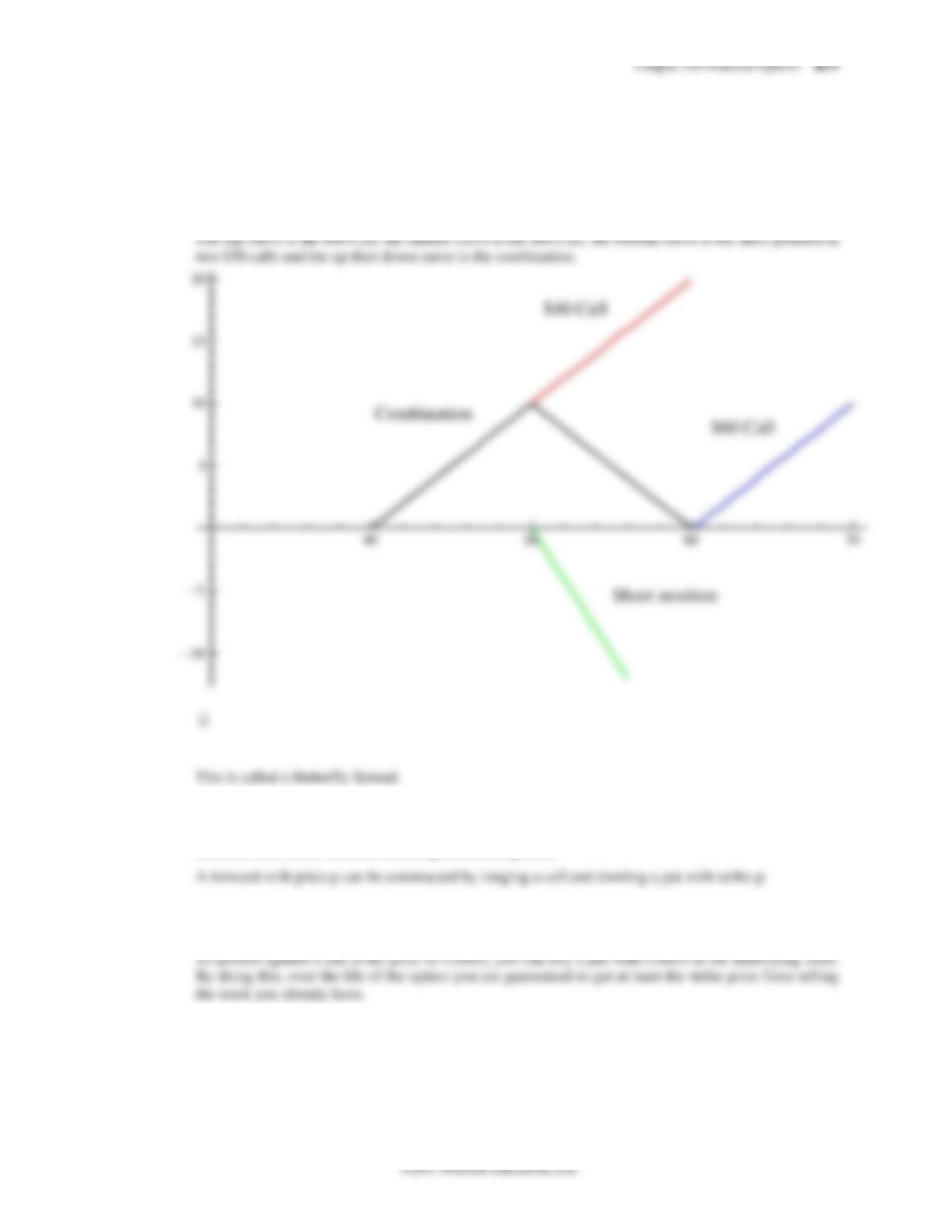
c. Draw a payoff diagram showing the amount you owe at expiration as a function of the stock
price at expiration.
Short call: value at expiration date:
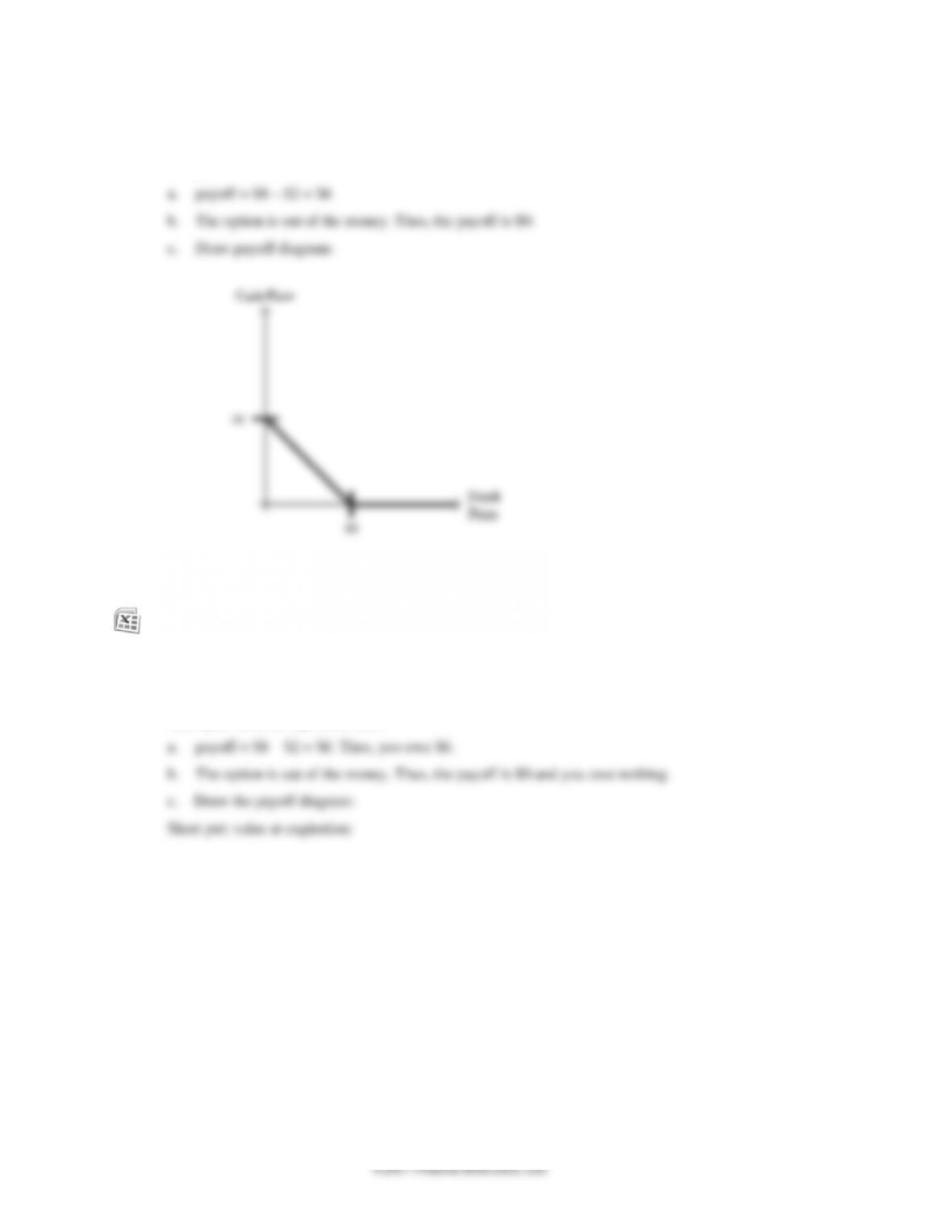
20–8. You own a put option on Ford stock with a strike price of $8. The option will expire in exactly six
months’ time.
a. If the stock is trading at $2 in six months, what will be the payoff of the put?
b. If the stock is trading at $21 in six months, what will be the payoff of the put?
$36
274 Berk/DeMarzo, Corporate Finance, Fourth Edition, Global Edition
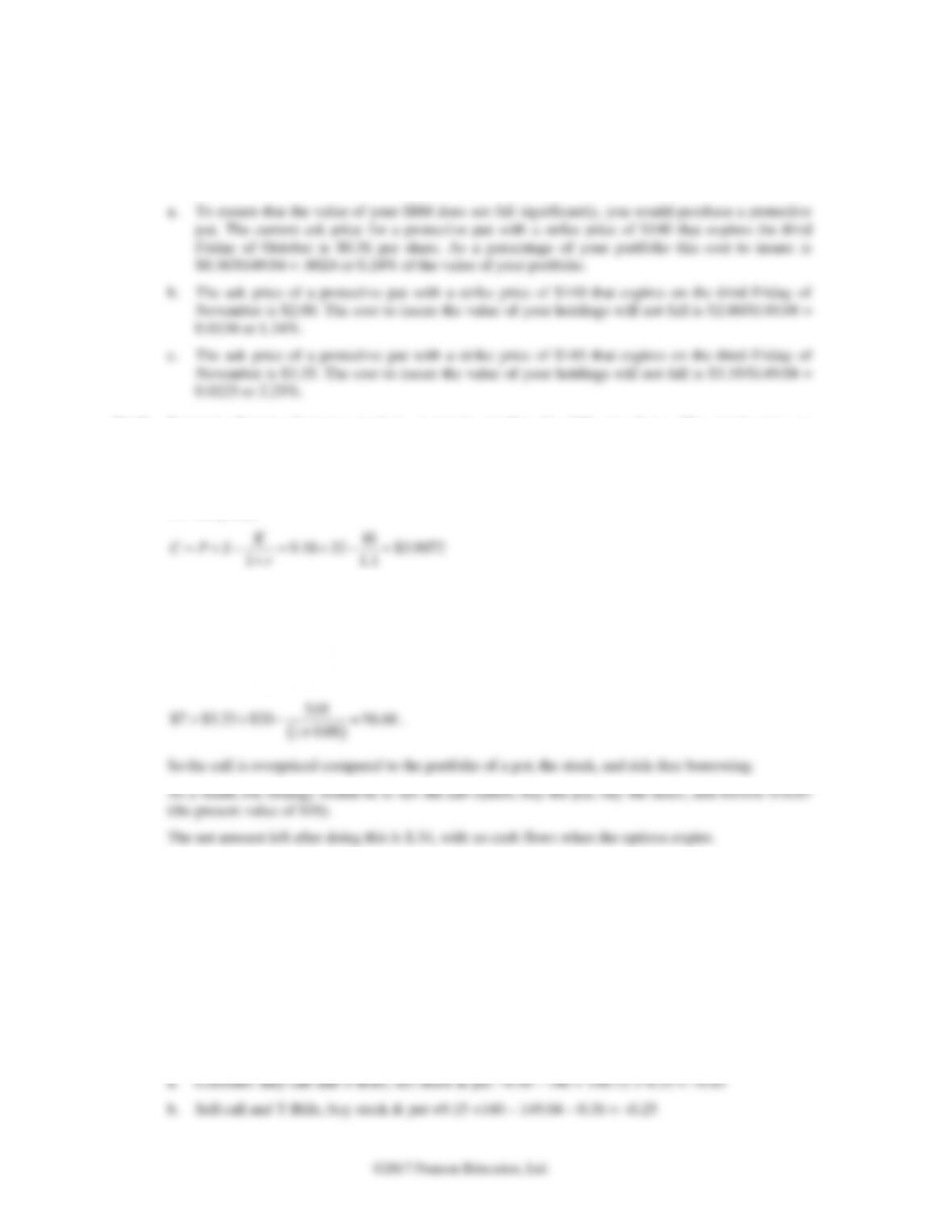
c. Draw a payoff diagram showing the value of the put at expiration as a function of the stock
price at expiration.
Long put value at expiration:
20–9. Assume that you have shorted the put option in Problem 8.
a. If the stock is trading at $2 in three months, what will you owe?
b. If the stock is trading at $21 in three months, what will you owe?
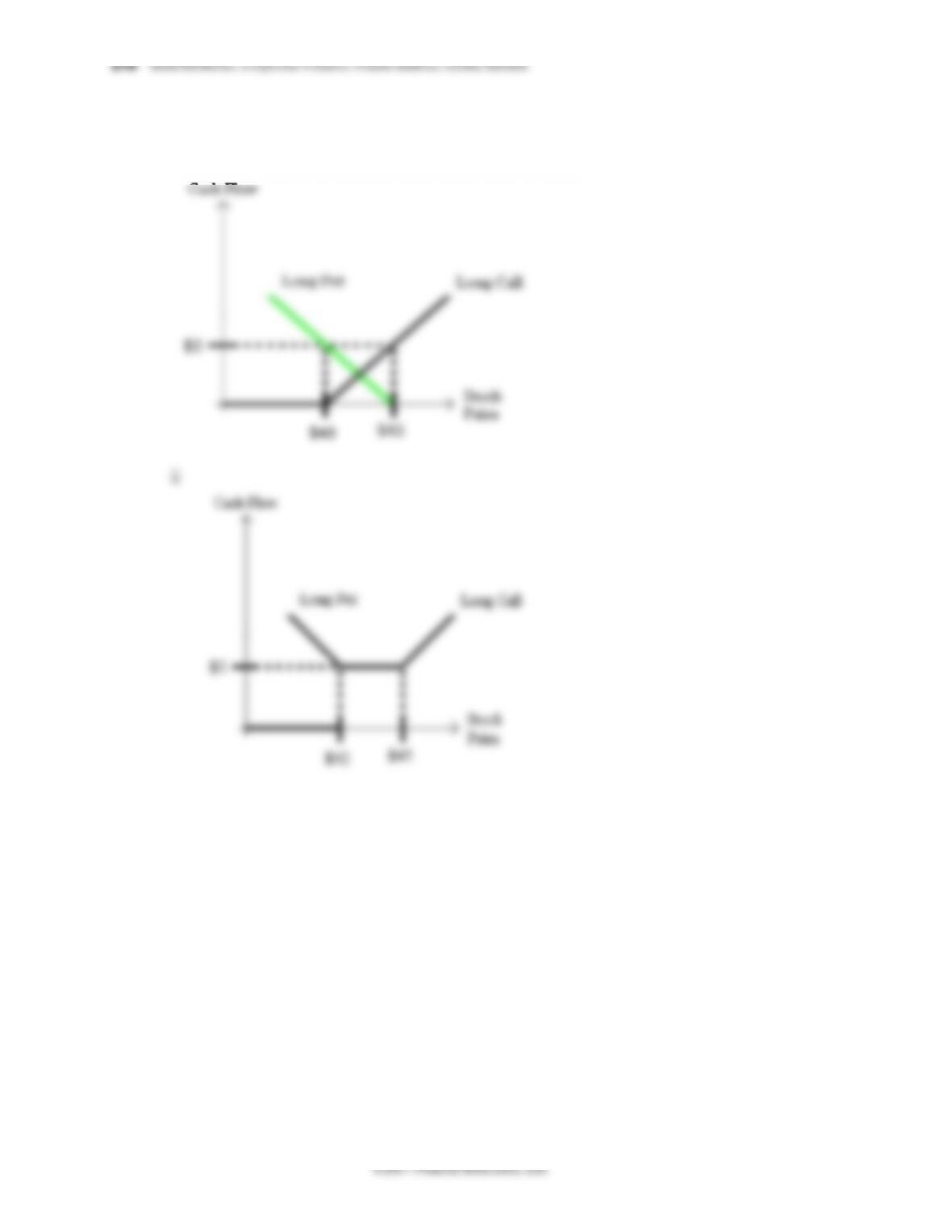
c. Draw a payoff diagram showing the amount you owe at expiration as a function of the stock
price at expiration.
Short put: value at expiration date:
$8
$8
278 Berk/DeMarzo, Corporate Finance, Fourth Edition, Global Edition
b. What will it cost to insure that the value of your holdings will not fall below $140 per share
between now and the third Friday in November?
c. What will it cost to insure that the value of your holdings will not fall below $145 per share
between now and the third Friday in November?
20-17. Dynamic Energy Systems stock is currently trading for $32 per share. The stock pays no
dividends. A one-year European put option on Dynamic with a strike price of $41 is currently
trading for $9.18. If the risk-free interest rate is 10% per year, what is the price of a one-year
European call option on Dynamic with a strike price of $41?
Put-call parity:
41
9.18 32 $3.9072
1 1.1
= + − = + − =
+
K
C P S r
20-18. You happen to be checking the newspaper and notice an arbitrage opportunity. The current
stock price of Intrawest is $20 per share and the one-year risk-free interest rate is 8%. A one
year put on Intrawest with a strike price of $18 sells for $3.33, while the identical call sells for $7.
Explain what you must do to exploit this arbitrage opportunity.
The arbitrage opportunity exists because:
( )
$18
$7 $3.33 $20 $6.66
1 0.08
+ − =
+
.
So the call is overpriced compared to the portfolio of a put, the stock, and risk-free borrowing.
As a result, the strategy would be to sell the call option, buy the put, buy the stock, and borrow $16.67
(the present value of $18).
The net amount left after doing this is $.34, with no cash flows when the options expire.
20-19. Consider the October 2015 IBM call and put options in Problem 3. Ignoring the negligible
interest you might earn on T-Bills over the remaining few days’ life of the options, show that
there is no arbitrage opportunity using put-call parity for the options with a $140 strike price.
Specifically:
a. What is your profit/loss if you buy a call and T-Bills, and sell IBM stock and a put option?
b. What is your profit/loss if you buy IBM stock and a put option, and sell a call and T-Bills?
c. Explain why your answers to (a) and (b) are not both zero.
d. Do the same calculation for the October options with a strike price of $150. What do you
find? How can you explain this?
Chapter 20/Financial Options 279
c. Both are negative due to transactions costs: call spread (0.35) + put spread (0.01) + stock spread
(0.32) = 0.68 in total loss in (a) & (b)
d. In this case, there appears to be a small profit if we buy the stock and the put, and sell the call and
20-20. In mid-February 2016, European-style options on the S&P 100 index (OEX) expiring in
December 2017 were priced as follows:
Dec 2017 OEX Index Options
Strike Price
Call Price
Put Price
840
88.00
860
76.30
102.21
880
111.56
Given an interest rate of 0.40% for a December 2017 maturity (22 months in the future), use put-
call parity (with dividends) to determine:
a. The price of a December 2017 OEX put option with a strike price of 840.
b. The price of a December 2017 OEX call option with a strike price of 880.
a. From put-call parity:
From the 860 calls and puts:
22/12
860
1.004
Therefore, for the 840 put:
22/12
840
1.004
b. And for the 880 call:
880
282 Berk/DeMarzo, Corporate Finance, Fourth Edition, Global Edition
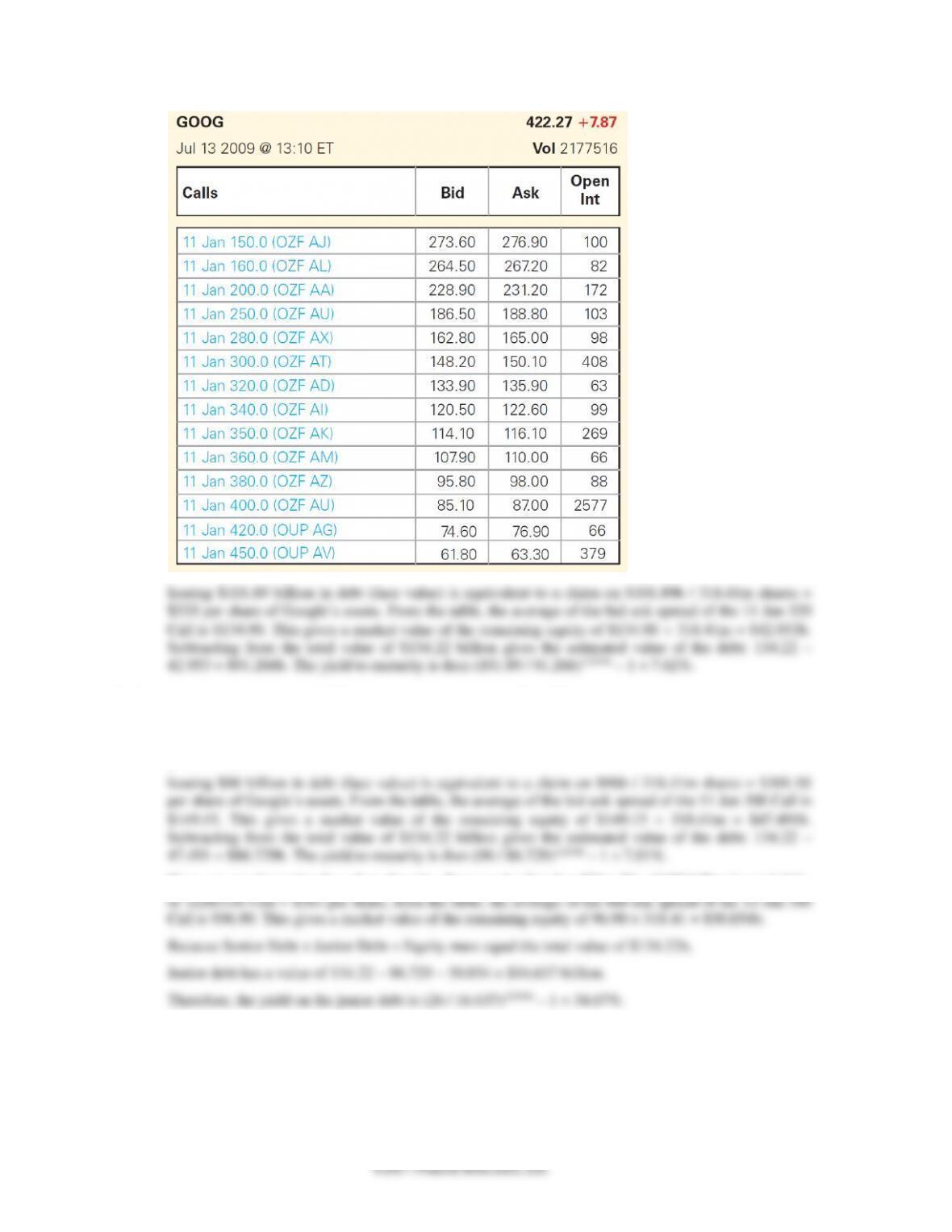
20–32. Suppose that in July 2009, Google were to issue $96 billion in zero-coupon senior debt, and
another $26 billion in zero-coupon junior debt, both due in January 2011. Use the option data in
the preceding table to determine the rate Google would pay on the junior debt issue. (Assume
perfect capital markets.)
Next, we can determine the value of equity. Because the firm has $96 + 26 = $122 billion in total debt,