Chapter 16
16–1. Gladstone Corporation is about to launch a new product. Depending on the success of the new
product, Gladstone may have one of four values next year: $147 million, $136 million, $91
million, or $82 million. These outcomes are all equally likely, and this risk is diversifiable.
Gladstone will not make any payouts to investors during the year. Suppose the risk-free interest
rate is 5% and assume perfect capital markets.
a. What is the initial value of Gladstone’s equity without leverage?
Now suppose Gladstone has zero-coupon debt with a $100 million face value due next year.
b. What is the initial value of Gladstone’s debt?
c. What is the yield-to-maturity of the debt? What is its expected return?
d. What is the initial value of Gladstone’s equity? What is Gladstone’s total value with
leverage?
147 136 91 82
+ + +
1.05
16–2. Baruk Industries has no cash and a debt obligation of $36 million that is now due. The market
value of Baruk’s assets is $81 million, and the firm has no other liabilities. Assume perfect capital
markets.
a. Suppose Baruk has 10 million shares outstanding. What is Baruk’s current share price?
b. How many new shares must Baruk issue to raise the capital needed to pay its debt
obligation?
c. After repaying the debt, what will Baruk’s share price be?
81 36 $4.5/ share
10
−=
216 Berk/DeMarzo, Corporate Finance, Fourth Edition, Global Edition
©2017 Pearson Education, Ltd.
b.
36 8 million shares
4.5 =
c.
81 $4.5 / share
18 =
16–3. When a firm defaults on its debt, debt holders often receive less than 50% of the amount they are
owed. Is the difference between the amount debt holders are owed and the amount they receive a
cost of bankruptcy?
16–4. Which type of firm is more likely to experience a loss of customers in the event of financial
distress:
a. Campbell Soup Company or Intuit, Inc. (a maker of accounting software)?
b. Allstate Corporation (an insurance company) or Adidas AG (maker of athletic footwear,
apparel, and sports equipment)?
16–5. Which type of asset is more likely to be liquidated for close to its full market value in the event of
financial distress:
a. An office building or a brand name?
b. Product inventory or raw materials?
c. Patent rights or engineering “know–how”?
16–6. Suppose Tefco Corp. has a value of $179 million if it continues to operate, but has outstanding
debt of $181 million that is now due. If the firm declares bankruptcy, bankruptcy costs will equal
$11 million, and the remaining $168 million will go to creditors. Instead of declaring bankruptcy,
management proposes to exchange the firm’s debt for a fraction of its equity in a workout. What
is the minimum fraction of the firm’s equity that management would need to offer to creditors
for the workout to be successful?
16–7. You have received two job offers. Firm A offers to pay you $79,000 per year for two years. Firm
B offers to pay you $83,000 for two years. Both jobs are equivalent. Suppose that firm A’s
contract is certain, but that firm B has a 50% chance of going bankrupt at the end of the year. In
that event, it will cancel your contract and pay you the lowest amount possible for you not to
quit. If you did quit, you expect you could find a new job paying $79,000 per year, but you would
be unemployed for three months while you search for it.
a. Say you took the job at firm B. What is the least Firm B can pay you next year in order to
match what you would earn if you quit?
Chapter 16/Financial Distress, Managerial Incentives, and Information 217
b. Given your answer to part (a), and assuming your cost of capital is 5%, which offer pays you
a higher present value of your expected wage?
c. Based on this example, discuss one reason why firms with a higher risk of bankruptcy may
need to offer higher wages to attract employees.
16–8. As in Problem 1, Gladstone Corporation is about to launch a new product. Depending on the
success of the new product, Gladstone may have one of four values next year: $147 million, $136
million, $91 million, or $82 million. These outcomes are all equally likely, and this risk is
diversifiable. Suppose the risk-free interest rate is 5% and that, in the event of default, 26% of
the value of Gladstone’s assets will be lost to bankruptcy costs. (Ignore all other market
imperfections, such as taxes.)
a. What is the initial value of Gladstone’s equity without leverage?
Now suppose Gladstone has zero-coupon debt with a $100 million face value due next year.
b. What is the initial value of Gladstone’s debt?
c. What is the yield-to-maturity of the debt? What is its expected return?
d. What is the initial value of Gladstone’s equity? What is Gladstone’s total value with
leverage?
Suppose Gladstone has 10 million shares outstanding and no debt at the start of the year.
e. If Gladstone does not issue debt, what is its share price?
f. If Gladstone issues debt of $100 million due next year and uses the proceeds to repurchase
shares, what will its share price be? Why does your answer differ from that in part (e)?
147 136 91 82
+ + +
10 =
10 7.9
1
8
−
16–9. Kohwe Corporation plans to issue equity to raise $40 million to finance a new investment. After
making the investment, Kohwe expects to earn free cash flows of $9 million each year. Kohwe
currently has five million shares outstanding and has no other assets or opportunities. Suppose
the appropriate discount rate for Kohwe’s future free cash flows is 9%, and the only capital
market imperfections are corporate taxes and financial distress costs.
a. What is the NPV of Kohwe’s investment?
b. Given these plans, what is Kohwe’s value per share today?
Suppose Kohwe borrows the $40 million instead. The firm will pay interest only on this loan each
year, and it will maintain an outstanding balance of $40 million on the loan. Suppose that
Kohwe’s corporate tax rate is 30%, and expected free cash flows are still $9 million each year.
c. What is Kohwe’s share price today if the investment is financed with debt?
Now suppose that with leverage, Kohwe’s expected free cash flows will decline to $8 million per
year due to reduced sales and other financial distress costs. Assume that the appropriate
discount rate for Kohwe’s future free cash flows is still 9%.
d. What is Kohwe’s share price today given the financial distress costs of leverage?
940 $60
222 Berk/DeMarzo, Corporate Finance, Fourth Edition, Global Edition
©2017 Pearson Education, Ltd.
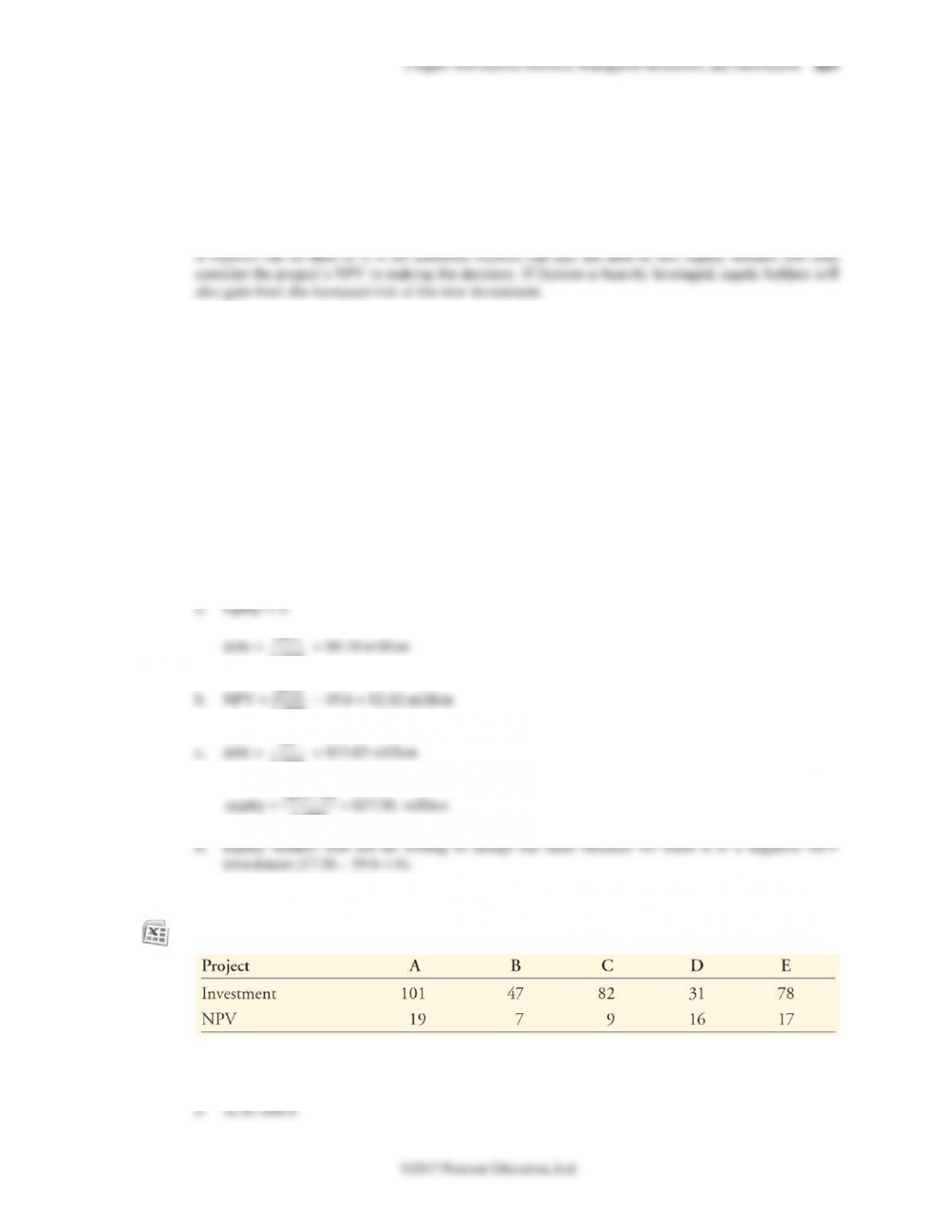
b. Don’t take B&C = loss of 7 + 9 = 16 million
D/E Ratio
1.50
Equity
1.90
Debt
0.23
Cutoff
0.18157895
Using Equation 16.2
Project
A
B
C
D
E
NPV/I
0.19
0.15
0.11
0.52
0.22
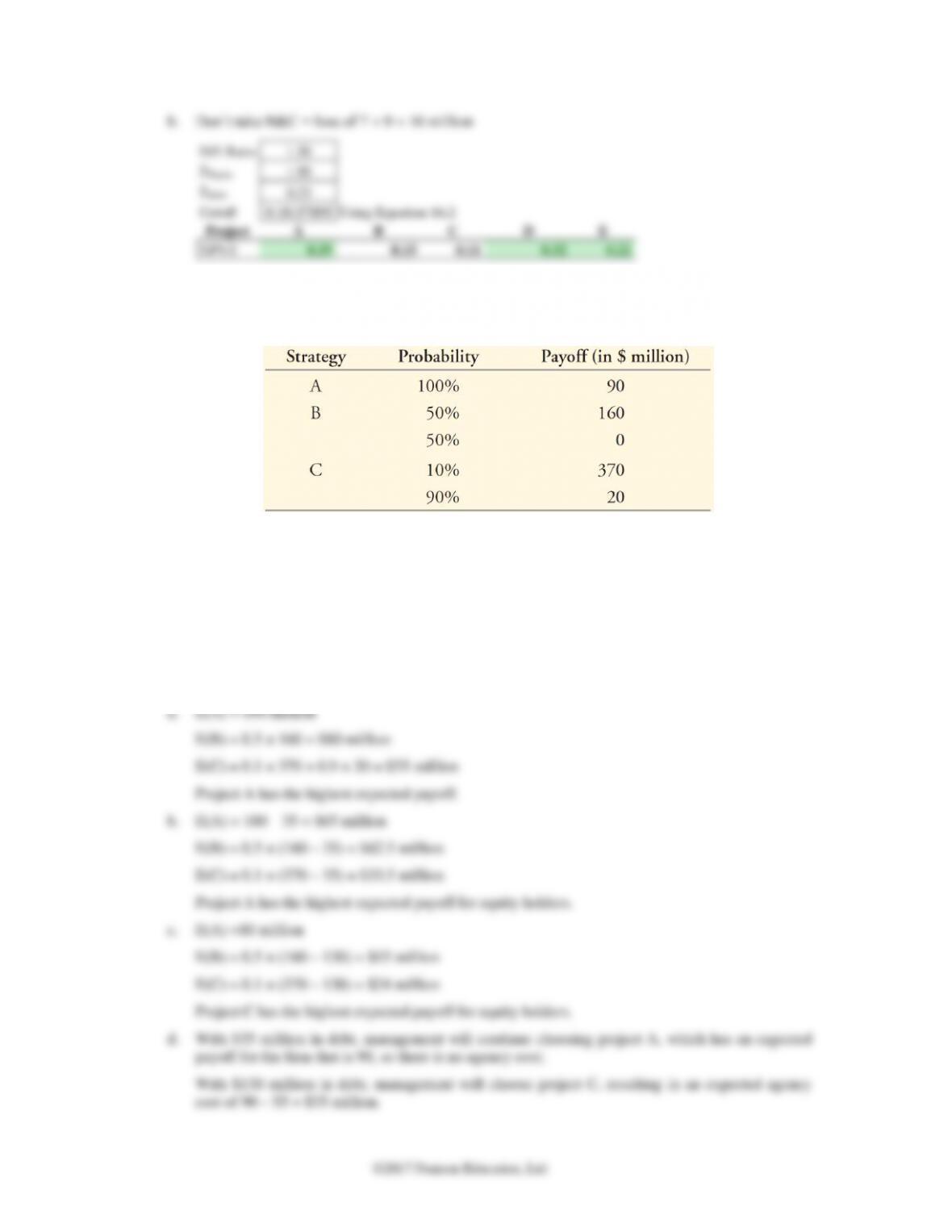
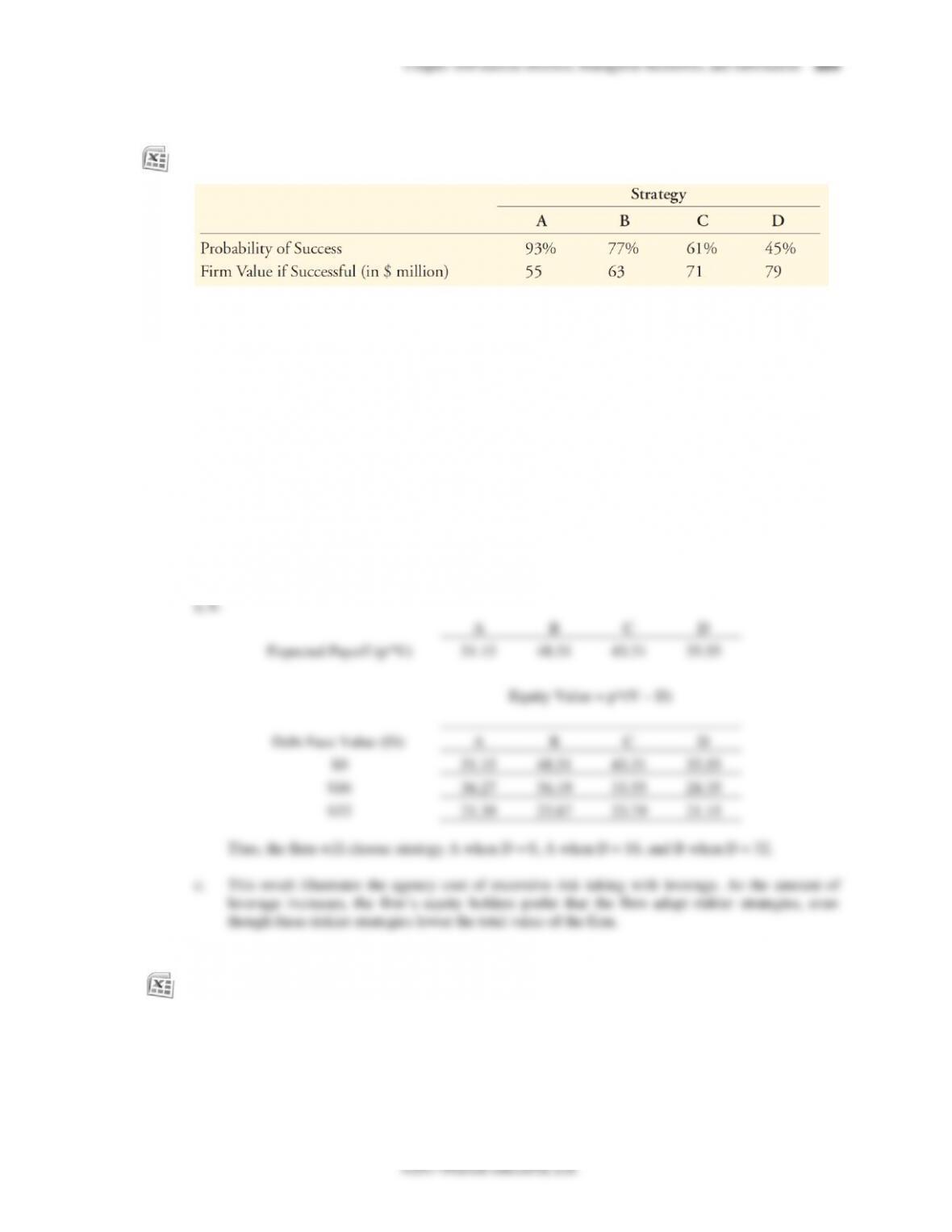
16-20. Zymase is a biotechnology startup firm. Researchers at Zymase must choose one of three
different research strategies. The payoffs (after-tax) and their likelihood for each strategy are
shown below. The risk of each project is diversifiable.
a. Which project has the highest expected payoff?
b. Suppose Zymase has debt of $35 million due at the time of the project’s payoff. Which
project has the highest expected payoff for equity holders?
c. Suppose Zymase has debt of $130 million due at the time of the project’s payoff. Which
project has the highest expected payoff for equity holders?
d. If management chooses the strategy that maximizes the payoff to equity holders, what is the
expected agency cost to the firm from having $35 million in debt due? What is the expected
agency cost to the firm from having $130 million in debt due?
224 Berk/DeMarzo, Corporate Finance, Fourth Edition, Global Edition
b. Suppose Petron issues equity and buys back its debt, reducing the debt’s face value to $4
million. If it does so, what strategy will it choose after the transaction? Will the total value
of the firm increase?
c. Suppose you are a debt holder, deciding whether to sell your debt back to the firm. If you
expect the firm to reduce its debt to $4 million, what price would you demand to sell your
debt?
d. Based on your answer to (c), how much will Petron need to raise from equity holders in
order to buy back the debt?
e. How much will equity holders gain or lose by recapitalizing to reduce leverage? How much
will debt holders gain or lose? Would you expect Petron’s management to choose to reduce
its leverage?
Chapter 16/Financial Distress, Managerial Incentives, and Information 225
c. Show that if Petron has $32 million in debt outstanding, shareholders can gain by increasing
the face value of debt to $54 million, even though this will reduce the total value of the firm.
d. Show that if Petron has $54 million in debt outstanding, shareholders will lose by buying
back debt to reduce the face value of debt to $32 million, even though that will increase the
total value of the firm.
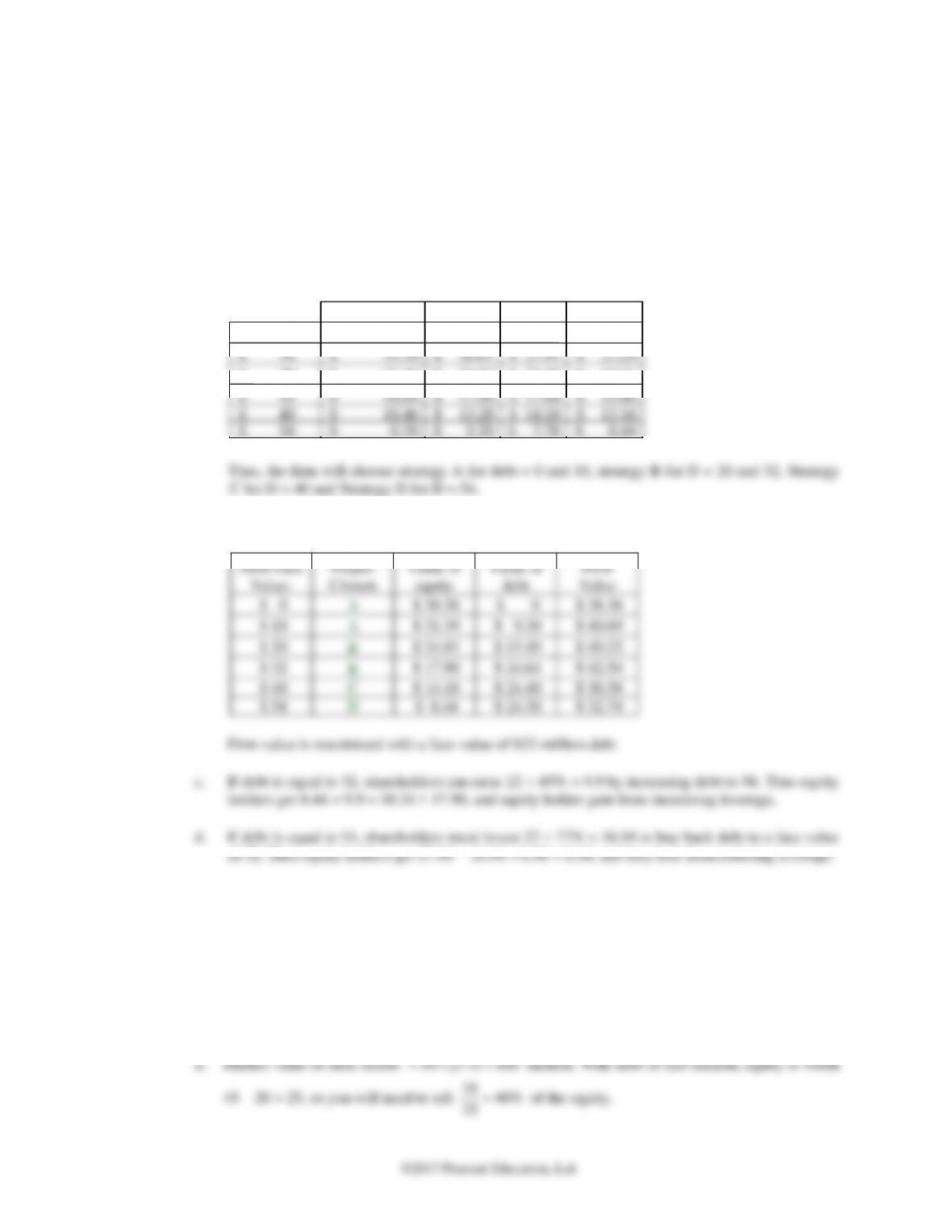
a. The table shows value of equity for different debt levels and strategy choices. Optimal strategies
are highlighted:
Debt amount:
A
B
C
D
0
$
38.36
$
36.38
$
32.48
$
26.66
$
10
$
31.39
$
30.61
$
27.91
$
23.29
$
20
$
24.41
$
24.83
$
23.33
$
19.91
$
32
$
16.04
$
17.90
$
17.84
$
15.86
$
40
$
10.46
$
13.28
$
14.18
$
13.16
$
54
$
0.70
$
5.20
$
7.78
$
8.44
$
b. The total value of the firm in each case is:
Debt Face
Value:
Project
Chosen
Value of
equity
Value of
debt
Firm
Value
$ 0
A
$ 38.36
$ 0
$ 38.36
$ 10
A
$ 31.39
$ 9.30
$ 40.69
$ 20
B
$ 24.83
$ 15.40
$ 40.23
$ 32
B
$ 17.90
$ 24.64
$ 42.54
$ 40
C
$ 14.18
$ 24.40
$ 38.58
$ 54
D
$ 8.44
$ 24.30
$ 32.74
Firm value is maximized with a face value of $32 million debt
c. If debt is equal to 32, shareholders can raise 22 45% = 9.9 by increasing debt to 54. Thus equity
holders get 8.44 + 9.9 = 18.34 > 17.90, and equity holder gain from increasing leverage.
d. If debt is equal to 54, shareholders must invest 22 77% = 16.94 to buy back debt to a face value
of 32. Thus equity holders get 17.90 − 16.94 = 0.96 < 8.44, and they lose from reducing leverage.
16–24. You own your own firm, and you want to raise $30 million to fund an expansion. Currently, you
own 100% of the firm’s equity, and the firm has no debt. To raise the $30 million solely through
equity, you will need to sell two-thirds of the firm. However, you would prefer to maintain at
least a 50% equity stake in the firm to retain control.
a. If you borrow $20 million, what fraction of the equity will you need to sell to raise the
remaining $10 million? (Assume perfect capital markets.)
b. What is the smallest amount you can borrow to raise the $30 million without giving up
control? (Assume perfect capital markets.)
25 =
©2017 Pearson Education, Ltd.
16–25. Empire Industries forecasts net income this coming year as shown below (in thousands of
dollars):
Approximately $250,000 of Empire’s earnings will be needed to make new, positive-NPV
investments. Unfortunately, Empire’s managers are expected to waste 10% of its net income on
needless perks, pet projects, and other expenditures that do not contribute to the firm. All
remaining income will be returned to shareholders through dividends and share repurchases.
a. What are the two benefits of debt financing for Empire?
b. By how much would each $1 of interest expense reduce Empire’s dividend and share
repurchases?
c. What is the increase in the total funds Empire will pay to investors for each $1 of interest
expense?
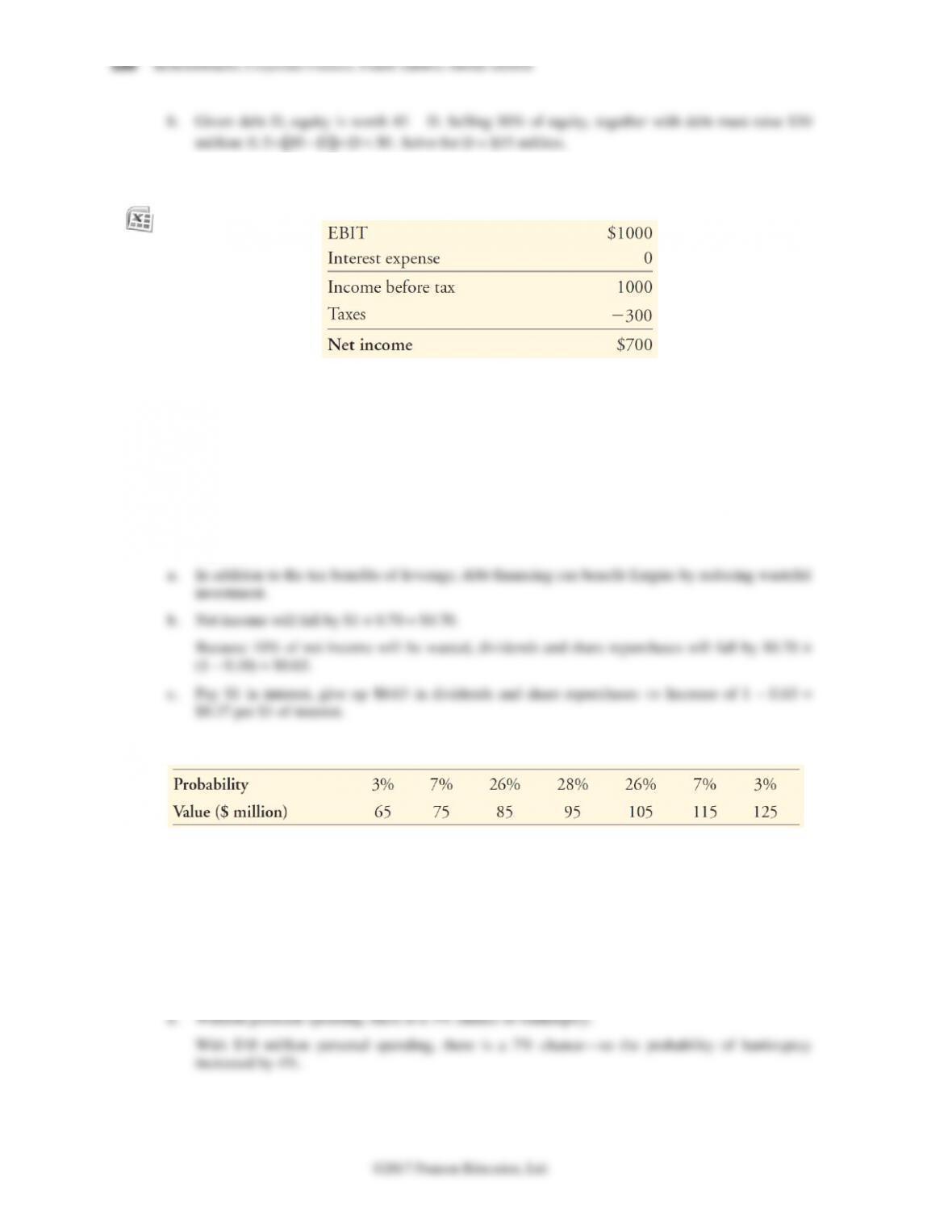
16–26. Ralston Enterprises has assets that will have a market value in one year as follows:
That is, there is a 3% chance the assets will be worth $65 million, a 7% chance the assets will be
worth $75 million, and so on. Suppose the CEO is contemplating a decision that will benefit her
personally but will reduce the value of the firm’s assets by $10 million. The CEO is likely to
proceed with this decision unless it substantially increases the firm’s risk of bankruptcy.
a. If Ralston has debt due of $70 million in one year, the CEO’s decision will increase the
probability of bankruptcy by what percentage?
b. What level of debt provides the CEO with the biggest incentive not to proceed with the
decision?
©2017 Pearson Education, Ltd.
16–27. Although the major benefit of debt financing is easy to observe—the tax shield—many of the
indirect costs of debt financing can be quite subtle and difficult to observe. Describe some of
these costs.
16–28. If it is managed efficiently, Remel, Inc., will have assets with a market value of $49.5 million,
$101.4 million, or $148.8 million next year, with each outcome being equally likely. However,
managers may engage in wasteful empire building, which will reduce the market value by $5.2
million in all cases. Managers may also increase the risk of the firm, changing the probability of
each outcome to 49%, 10%, and 41%, respectively.
a. What is the expected value of Remel’s assets if it is run efficiently?
Suppose managers will engage in empire building unless that behavior increases the likelihood of
bankruptcy. They will choose the risk of the firm to maximize the expected payoff to equity
holders.
b. Suppose Remel has debt due in one year as shown below. For each case, indicate whether
managers will engage in empire building, and whether they will increase risk. What is the
expected value of Remel’s assets in each case?
i. $43.6 million
ii. $47.8 million
iii. $91.1 million
iv. $98.1 million
c. Suppose the tax savings from the debt, after including investor taxes, is equal to 12% of the
expected payoff of the debt. The proceeds of the debt, as well as the value of any tax savings,
will be paid out to shareholders immediately as a dividend when the debt is issued. Which
debt level in part (b) is optimal for Remel?
49.5 101.4 148.8 $99.9
++=
c. Because the tax benefits are paid as a dividend, the manager will empire build or increase risk as
determined in part (b). We can therefore determine the expected value of equity with leverage by
adding the expected tax benefit to the value calculated in part (b).
©2017 Pearson Education, Ltd.
16–29. Which of the following industries have low optimal debt levels according to the trade-off theory?
Which have high optimal levels of debt?
a. Tobacco firms
b. Accounting firms
c. Mature restaurant chains
d. Lumber companies
e. Cell phone manufacturers
16–30 According to the managerial entrenchment theory, managers choose capital structures so as to
preserve their control of the firm. On the one hand, debt is costly for managers because they risk
losing control in the event of default. On the other hand, if they do not take advantage of the tax
shield provided by debt, they risk losing control through a hostile takeover.
Suppose a firm expects to generate free cash flows of $90 million per year, and the discount rate
for these cash flows is 10%. The firm pays a tax rate of 40%. A raider is poised to take over the
firm and finance it with $750 million in permanent debt. The raider will generate the same free
cash flows, and the takeover attempt will be successful if the raider can offer a premium of 20%
over the current value of the firm. According to the managerial entrenchment hypothesis, what
level of permanent debt will the firm choose?
90 $900
Chapter 16/Financial Distress, Managerial Incentives, and Information 229
©2017 Pearson Education, Ltd.
To prevent successful raid, current management must have a levered value of at least
$1.2 $1 .
1.20
billion billion=
Thus, the minimum tax shield is $1 billion – 900 million = $100 million, which requires
100 $250
0.40 =
million in debt.
16-31. Info Systems Technology (IST) manufactures microprocessor chips for use in appliances and
other applications. IST has no debt and 50 million shares outstanding. The correct price for
these shares is either $9 or $7 per share. Investors view both possibilities as equally likely, so the
shares currently trade for $8.
IST must mise $450 million to build a new production facility. Because the firm would suffer a
large loss of both customers and engineering talent in the event of financial distress, managers
believe that if IST borrows the $450 million, the present value of financial distress costs will
exceed any tax benefits by $30 million. At the same time, because investors believe that managers
know the correct share price, IST faces a lemons problem if it attempts to raise the $450 million
by issuing equity.
a. Suppose that if IST issues equity, the share price will remain $8. To maximize the long-term
share price of the firm once its true value is known, would managers choose to issue equity
or borrow the $450 million if
i. They know the correct value of the shares is $7?
ii. They know the correct value of the shares is $9?
b. Given your answer to part (a), what should investors conclude if IST issues equity? What
will happen to the share price?
c. Given your answer to part (a), what should investors conclude if IST issues debt? What will
happen to the share price in that case?
d. How would your answers change if there were no distress costs, but only tax benefits of
leverage?
$30 $0.60
450 56.25
16–32. During the Internet boom of the late 1990s, the stock prices of many Internet firms soared to
extreme heights. As CEO of such a firm, if you believed your stock was significantly overvalued,
would using your stock to acquire non-Internet stocks be a wise idea, even if you had to pay a
small premium over their fair market value to make the acquisition?
230 Berk/DeMarzo, Corporate Finance, Fourth Edition, Global Edition
If the firm must pay 10% more than the target firm was worth, but can do the purchase using shares
that were overvalued by more than 10%, in the long run the firm will gain from the acquisition.
16–33. “We R Toys” (WRT) is considering expanding into new geographic markets. The expansion will
have the same business risk as WRT’s existing assets. The expansion will require an initial
investment of $45 million and is expected to generate perpetual EBIT of $15 million per year.
After the initial investment, future capital expenditures are expected to equal depreciation, and
no further additions to net working capital are anticipated.
WRT’s existing capital structure is composed of $600 million in equity and $250 million in debt
(market values), with 10 million equity shares outstanding. The unlevered cost of capital is 10%,
and WR T’s debt is risk free with an interest rate of 4%. The corporate tax rate is 40%, and
there are no personal taxes.
a. WRT initially proposes to fund the expansion by issuing equity. If investors were not
expecting this expansion, and if they share WRT’s view of the expansion’s profitability, what
will the share price be once the firm announces the expansion plan?
b. Suppose investors think that the EBIT from WRT’s expansion will be only $4 million. What
will the share price be in this case? How many shares will the firm need to issue?
c. Suppose WRT issues equity as in part (b). Shortly after the issue, new information emerges
that convinces investors that management was, in fact, correct regarding the cash flows from
the expansion. What will the share price be now? Why does it differ from that found in part
(a)?
a. NPV of expansion
0.60
15 45 $45
0.1
= − =
million
600 45 $64.5 per share
+