Chapter 15
Debt and Taxes
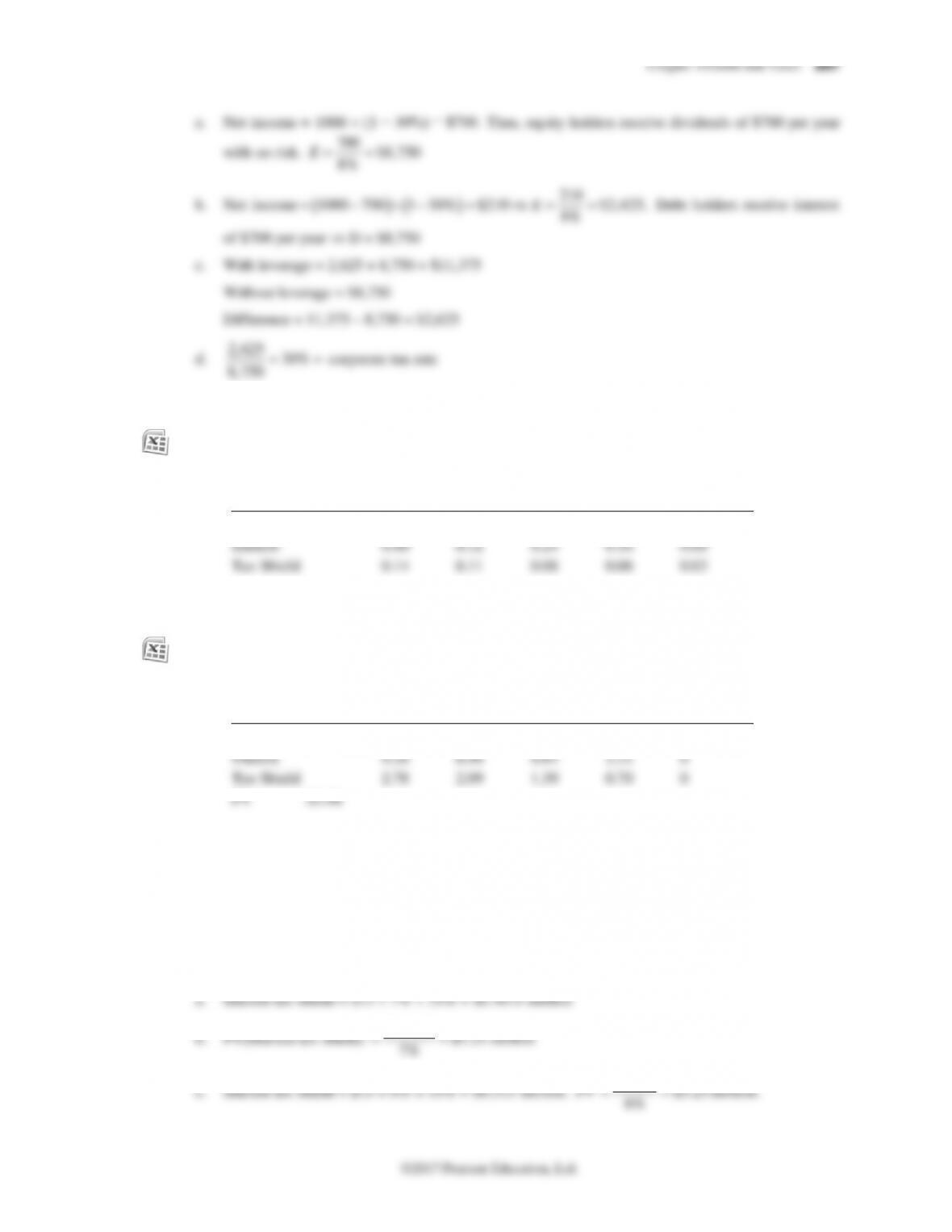
15–1. Pelamed Pharmaceuticals has EBIT of $133 million in 2006. In addition, Pelamed has interest
expenses of $49 million and a corporate tax rate of 35%.
a. What is Pelamed’s 2006 net income?
b. What is the total of Pelamed’s 2006 net income and interest payments?
c. If Pelamed had no interest expenses, what would its 2006 net income be? How does it
compare to your answer in part b?
d. What is the amount of Pelamed’s interest tax shield in 2006?
15–2. Grommit Engineering expects to have net income next year of $24.21 million and free cash flow
of $12.11 million. Grommit’s marginal corporate tax rate is 30%.
a. If Grommit increases leverage so that its interest expense rises by $9.2 million, how will its
net income change?
b. For the same increase in interest expense, how will free cash flow change?
15–3. Suppose the corporate tax rate is 30%. Consider a firm that earns $1000 before interest and
taxes each year with no risk. The firm’s capital expenditures equal its depreciation expenses each
year, and it will have no changes to its net working capital. The risk-free interest rate is 8%.
a. Suppose the firm has no debt and pays out its net income as a dividend each year. What is
the value of the firm’s equity?
b. Suppose instead the firm makes interest payments of $700 per year. What is the value of
equity? What is the value of debt?
c. What is the difference between the total value of the firm with leverage and without
leverage?
d. The difference in part (c) is equal to what percentage of the value of the debt?
©2017 Pearson Education, Ltd.
8,750 ==
15–4. Braxton Enterprises currently has debt outstanding of $5 million and an interest rate of 8%.
Braxton plans to reduce its debt by repaying $1 million in principal at the end of each year for
the next five years. If Braxton’s marginal corporate tax rate is 35%, what is the interest tax
shield from Braxton’s debt in each of the next five years?
Year
0
1
2
3
4
5
Debt
5.00
4.00
3.00
2.00
1.00
Interest
0.40
0.32
0.24
0.16
0.08
Tax Shield
0.14
0.11
0.08
0.06
0.03
15–5. Your firm currently has $116 million in debt outstanding with a 8% interest rate. The terms of
the loan require it to repay $29 million of the balance each year. Suppose that the marginal
corporate tax rate is 30%, and that the interest tax shields have the same risk as the loan. What
is the present value of the interest tax shields from this debt?
Year
0
1
2
3
4
5
Debt
116.00
87.00
58.00
29.00
0
0
Interest
9.28
6.96
4.64
2.32
0
Tax Shield
2.78
2.09
1.39
0.70
0
PV
$5.98
15–6. Arnell Industries has just issued $15 million in debt (at par). The firm will pay interest only on
this debt. Arnell’s marginal tax rate is expected to be 35% for the foreseeable future.
a. Suppose Arnell pays interest of 7% per year on its debt. What is its annual interest tax
shield?
b. What is the present value of the interest tax shield, assuming its risk is the same as the loan?
c. Suppose instead that the interest rate on the debt is 6%. What is the present value of the
interest tax shield in this case?
7%
c. Interest tax shield = $15 × 6% × 35% = $0.315 million.
$0.315 $5.25
6%
==PV
million.
©2017 Pearson Education, Ltd.
2,449 2,449
15-12. Summit Builders has a market debt-equity ratio of 1.30, a corporate tax rate of 38%, and pays
9% interest on its debt. The interest tax shield from its debt lowers Summit’s WACC by what
amount?
1.30 0.565
2.30
==
+
D
ED
.
15-13. NatNah, a builder of acoustic accessories, has no debt and an equity cost of capital of 17%.
Suppose NatNah decides to increase its leverage and maintain a market debt–to-value ratio of
0.4. Suppose its debt cost of capital is 7% and its corporate tax rate is 33%. If NatNah’s pretax
WACC remains constant, what will its (effective after-tax) WACC be with the increase in
leverage?
+D
Dr
ED
15-14. Restex maintains a debt-equity ratio of 0.78, has an equity cost of capital of 12%, and a debt cost
of capital of 7%. Restex’s corporate tax rate is 38%, and its market capitalization is $258
million.
a. If Restex’s free cash flow is expected to be $11 million in one year, what constant expected
future growth rate is consistent with the firm’s current market value?
b. Estimate the value of Restex’s interest tax shield.
1 0.78
−−
b. Pretax
( )( )
100
WACC WACC 10% 7.4% 0.38% 11.63%
172
= + = + =
+DC
Dr
ED
( )
13.76 $142.81 million
pretax WACC 0.1163 0.02
PV Interest Tax Shield 172 142.81 $29.19 million
= = =
−−
= − = − =
U
LU
FCF
Vg
VV
15-16. Milton Industries expects free cash flow of $18 million each year. Milton’s corporate tax rate is
38%, and its unlevered cost of capital is 16%. Milton also has outstanding debt of $75.25 million,
and it expects to maintain this level of debt permanently.
a. What is the value of Milton Industries without leverage?
b. What is the value of Milton Industries with leverage?
18 $112.5 million
U
27 4.085
−
15-19. Rally, Inc., is an all-equity firm with assets worth $25 billion and 10 billion shares outstanding.
Rally plans to borrow $10 billion and use these funds to repurchase shares. The firm’s corporate
tax rate is 35%, and Rally plans to keep its outstanding debt equal to $10 billion permanently.
a. Without the increase in leverage, what would Rally’s share price be?
b. Suppose Rally offers $2.75 per share to repurchase its shares. Would shareholders sell for
this price?
c. Suppose Rally offers $3.00 per share, and shareholders tender their shares at this price.
What will Rally’s share price be after the repurchase?
d. What is the lowest price Rally can offer and have shareholders tender their shares? What
will its stock price be after the share repurchase in that case?
25 $2.50
©2017 Pearson Education, Ltd.
1 0.324
−
15-21. Facebook, Inc. had no debt on its balance sheet in 2014, but paid $2 billion in taxes. Suppose
Facebook were to issue sufficient debt to reduce its taxes by $250 million per year permanently.
Assume Facebook’s marginal corporate tax rate is 35% and its borrowing cost is 5%.
a. If Facebook’s investors do not pay personal taxes (because they hold their Facebook stock in
tax-free retirement accounts), how much value would be created (what is the value of the tax
shield)?
b. How does your answer change if instead you assume that Facebook’s investors pay a 20%
tax rate on income from equity and a 39.6% tax rate on interest income?
15-22. Markum Enterprises is considering permanently adding $127 million of debt to its capital
structure. Markum’s corporate tax rate is 40%.
a. Absent personal taxes, what is the value of the interest tax shield from the new debt?
b. If investors pay a tax rate of 35% on interest income, and a tax rate of 25% on income from
dividends and capital gains, what is the value of the interest tax shield from the new debt?
C
C
15-23. Garnet Corporation is considering issuing risk-free debt or risk-free preferred stock. The tax
rate on interest income is 32%, and the tax rate on dividends or capital gains from preferred
stock is 20%. However, the dividends on preferred stock are not deductible for corporate tax
purposes, and the corporate tax rate is 36%.
a. If the risk-free interest rate for debt is 6%, what is the cost of capital for risk-free preferred
stock?
b. What is the after-tax debt cost of capital for the firm? Which security is cheaper for the
firm?
Chapter 15/Debt and Taxes 213
c. Show that the after-tax debt cost of capital is equal to the preferred stock cost of capital
multiplied by (1 − τ*).
15-24. Suppose the tax rate on interest income is 40%, and the average tax rate on capital gains and
dividend income is 15%. How high must the marginal corporate tax rate be to offer a tax
advantage?
( )( )
11
* 1 0
1
Ce
i
−−
= −
−
if and only if
1
11
i
C
e
−
−
−
or equivalently:
10.60
1 1 29.41%
1 0.85
−
− = − =
−
i
C
e
.
Thus, there is a tax advantage of debt as long as the marginal corporate tax rate is above 29.41%.
15-25. With its current leverage, Impi Corporation will have net income next year of $9.5 million. If
Impi’s corporate tax rate is 30% and it pays 8% interest on its debt, how much additional debt
can Impi issue this year and still receive the benefit of the interest tax shield next year?
9.5 $13.57
0.08 =
15-26. Colt Systems will have EBIT this coming year of $18 million. It will also spend $7 million on total
capital expenditures and increases in net working capital, and have $4 million in depreciation
expenses. Colt is currently an all-equity firm with a corporate tax rate of 30% and a cost of
capital of 11%.
a. If Colt’s free cash flows are expected to grow by 9.5% per year, what is the market value of
its equity today?
b. If the interest rate on its debt is 9%, how much can Colt borrow now and still have
nonnegative net income this coming year?
c. Is there a tax incentive today for Colt to choose a debt–to-value ratio that exceeds 41%?
Explain.
9.6 $640 million
11% 9.5%
==
−
E
214 Berk/DeMarzo, Corporate Finance, Fourth Edition, Global Edition
©2017 Pearson Education, Ltd.
b. Interest expense of $18 million debt of
18 $200
0.09 =
million.
c. No. The most they should borrow is 200 million; there is no interest tax shield from borrowing
more. So the debt-to-value ratio should be
200 31.25%
640 =
.
15-27. PMF, Inc. is equally likely to have EBIT this coming year of $7 million, $13 million, or $19
million. Its corporate tax rate is 35%, and investors pay a 15% tax rate on income from equity
and a 40% tax rate on interest income.
a. What is the effective tax advantage of debt if PMF has interest expenses of $6 million this
coming year?
b. What is the effective tax advantage of debt for interest expenses in excess of $19 million?
(Ignore carryforwards.)
c. What is the effective tax advantage of debt for interest expenses between $7 million and $13
million? (Ignore carryforwards.)
d. What level of interest expense provides PMF with the greatest tax benefit?
( )( ) ( )( )
1 1 1 0.35 1 0.15
− − − −
Ce