177
Chapter 12
Estimating the Cost of Capital
12–1. Suppose Pepsico’s stock has a beta of 0.59. If the risk-free rate is 3% and the expected return of
the market portfolio is 7%, what is Pepsico’s equity cost of capital?
12–2. Suppose the market portfolio has an expected return of 10% and a volatility of 20%, while
Microsoft’s stock has a volatility of 30%.
a. Given its higher volatility, should we expect Microsoft to have an equity cost of capital that is
higher than 10%?
b. What would have to be true for Microsoft’s equity cost of capital to be equal to 10%?
12–3. Aluminum maker Alcoa has a beta of about 1.96, whereas Hormel Foods has a beta of 0.65. If the
expected excess return of the marker portfolio is 3%, which of these firms has a higher equity
cost of capital, and how much higher is it?
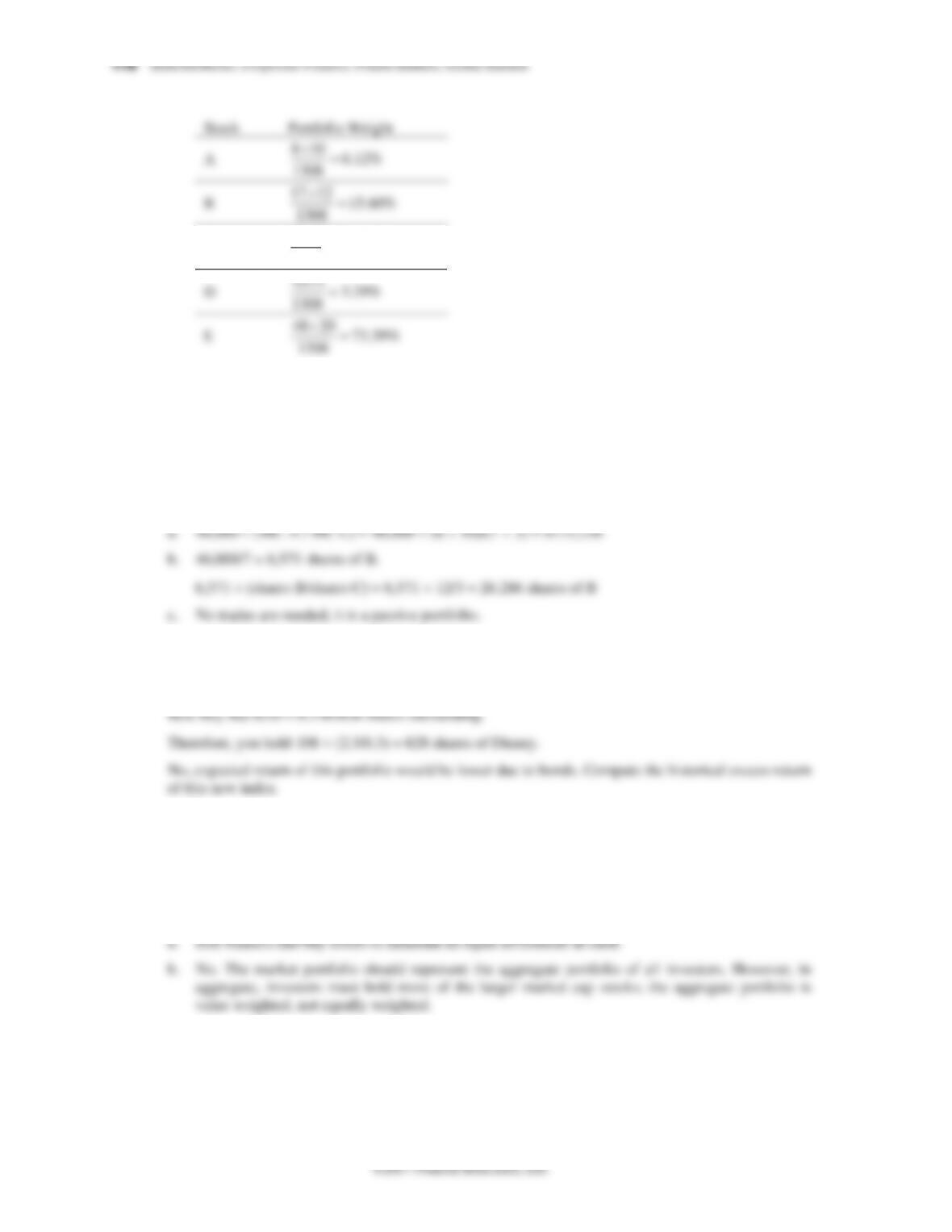
12–4. Suppose all possible investment opportunities in the world are limited to the five stocks listed in
the table below. What does the market portfolio consist of (what are the portfolio weights)?
©2017 Pearson Education, Ltd.
12–9. From the start of 1999 to the start of 2009, the S&P 500 had a negative return. Does this mean
the market risk premium we should have used in the CAPM was negative?
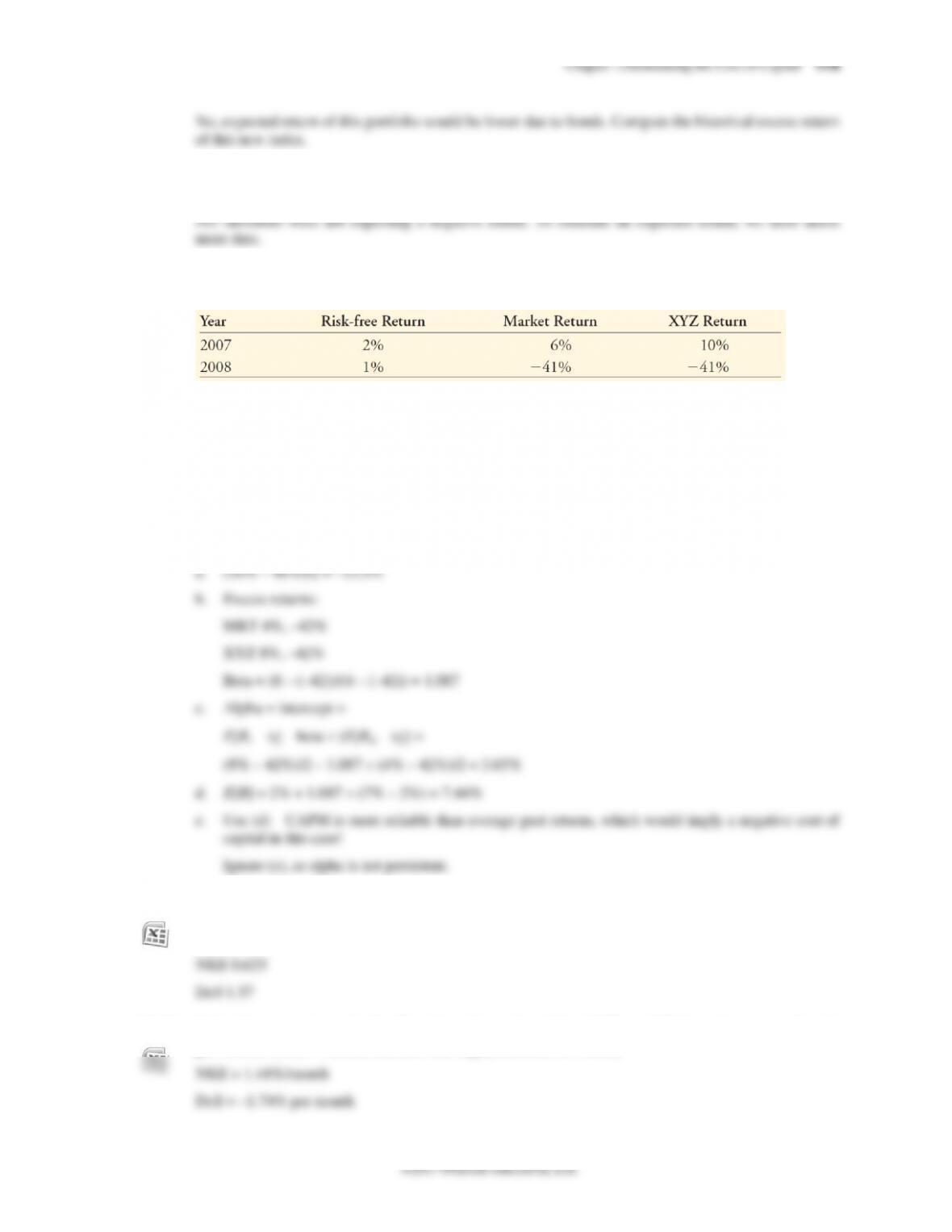
12–10. You need to estimate the equity cost of capital for XYZ Corp. You have the following data
available regarding past returns:
a. What was XYZ’s average historical return?
b. Compute the market’s and XYZ’s excess returns for each year. Estimate XYZ’s beta.
c. Estimate XYZ’s historical alpha.
d. Suppose the current risk-free rate is 2%, and you expect the market’s return to be 7%. Use
the CAPM to estimate an expected return for XYZ Corp.’s stock.
e. Would you base your estimate of XYZ’s equity cost of capital on your answer in part (a) or
in part (d)? How does your answer to part (c) affect your estimate? Explain.
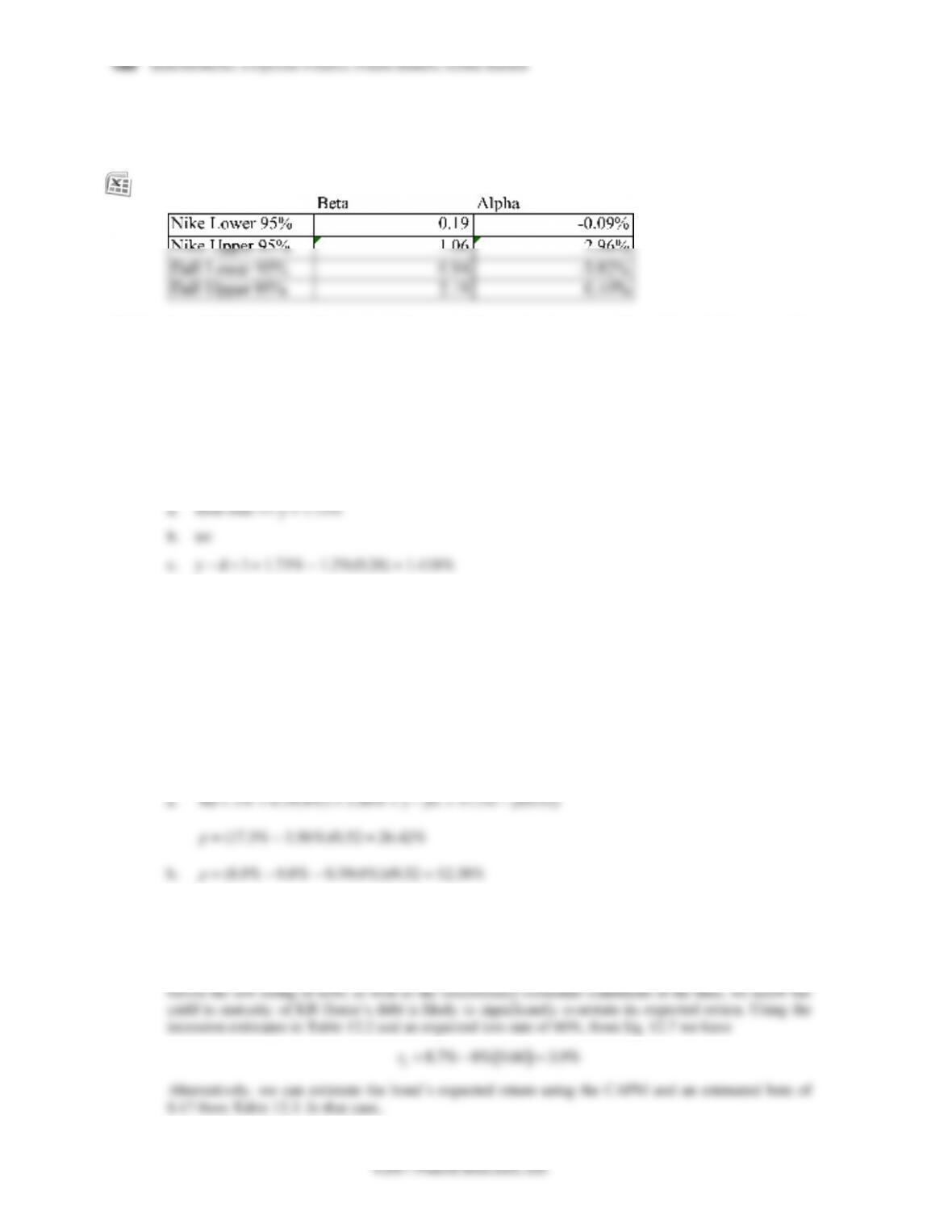
12-11. Go to Chapter Resources on MyFinanceLab and use the data in the spreadsheet provided to
estimate the beta of Nike and Dell stock based on their monthly returns from 2011–2015. (Hint:
You can use the slope() function in Excel.)
12-12. Using the same data as in Problem 11, estimate the alpha of Nike and Dell stock, expressed as %
per month. (Hint: You can use the intercept() function in Excel.)
Chapter 12/Estimating the Cost of Capital 181
©2017 Pearson Education, Ltd.
( )
3.5% 0.17 5.1% 4.37%= + =
d
r
While both estimates are rough approximations, they both confirm that the expected return of KB
Home’s debt is well below its promised yield.
12-17. The Dunley Corp. plans to issue 5-year bonds. It believes the bonds will have a BBB rating.
Suppose AAA bonds with the same maturity have a 4% yield. Assume the market risk premium
is 5% and use the data in Table 12.2 and Table 12.3.
a. Estimate the yield Dunley will have to pay, assuming an expected 50% loss rate in the event
of default during average economic times. What spread over AAA bonds will it have to pay?
b. Estimate the yield Dunley would have to pay if it were a recession, assuming the expected
loss rate is 71% at that time, but the beta of debt and market risk premium are the same as
in average economic times. What is Dunley’s spread over AAA now?
c. In fact, one might expect risk premia and betas to increase in recessions. Redo part (b)
assuming that the market risk premium and the beta of debt both increase by 20%; that is,
they equal 1.2 times their value in recessions.
a. Use CAPM to estimate expected return, using AAA rate as rf rate and average beta from Table
12.3:
12-18. Your firm is planning to invest in an automated packaging plant. Harburtin Industries is an all–
equity firm that specializes in this business. Suppose Harburtin’s equity beta is 0.88, the risk-free
12-19. Consider the setting of Problem 18. You decided to look for other comparables to reduce
estimation error in your cost of capital estimate. You find a second firm, Thurbinar Design,
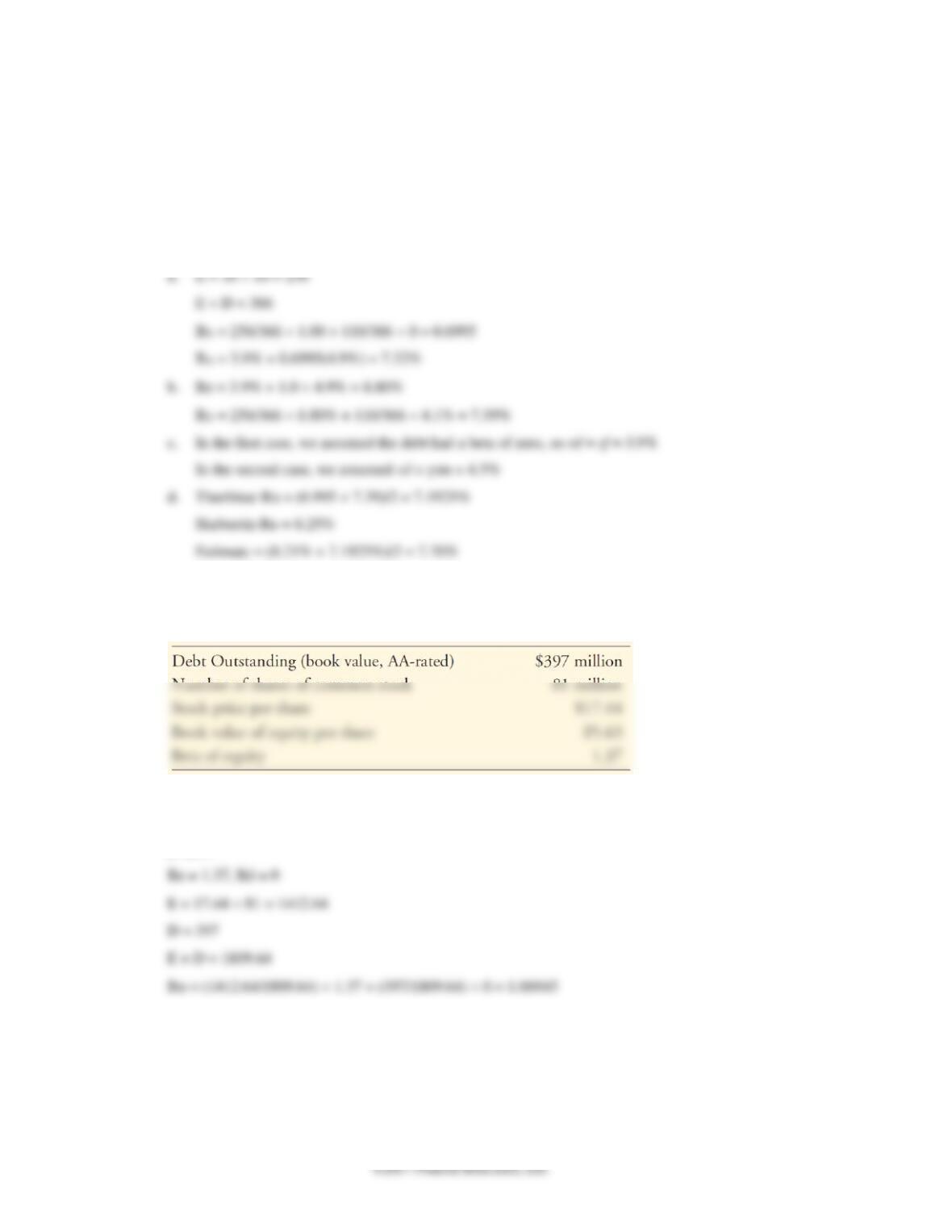
which is also engaged in a similar line of business. Thurbinar has a stock price of $16 per share,
with 16 million shares outstanding. It also has $110 million in outstanding debt, with a yield on
the debt of 4.1%. Thurbinar’s equity beta is 1.00.
a. Assume Thurbinar’s debt has a beta of zero. Estimate Thurbinar’s unlevered beta. Use the
unlevered beta and the CAPM to estimate Thurbinar’s unlevered cost of capital.
182 Berk/DeMarzo, Corporate Finance, Fourth Edition, Global Edition
b. Estimate Thurbinar’s equity cost of capital using the CAPM. Then assume its debt cost of
capital equals its yield, and using these results, estimate Thurbinar’s unlevered cost of
capital.
c. Explain the difference between your estimate in part (a) and part (b).
d. You decide to average your results in part (a) and part (b), and then average this result with
your estimate from Problem 17. What is your estimate for the cost of capital of your firm’s
project?
12-20. IDX Tech is looking to expand its investment in advanced security systems. The project will be
financed with equity. You are trying to assess the value of the investment, and must estimate its
cost of capital. You find the following data for a publicly traded firm in the same line of business:
What is your estimate of the project’s beta? What assumptions do you need to make?
Assume debt is risk-free and market value = book value. Assume comparable assets have same risk as
project.
12-21. In mid-2015, Cisco Systems had a market capitalization of $99 billion. It had A-rated debt of $18
billion as well as cash and short-term investments of $52 billion, and its estimated equity beta at
the time was 1.16.
a. What is Cisco’s enterprise value?
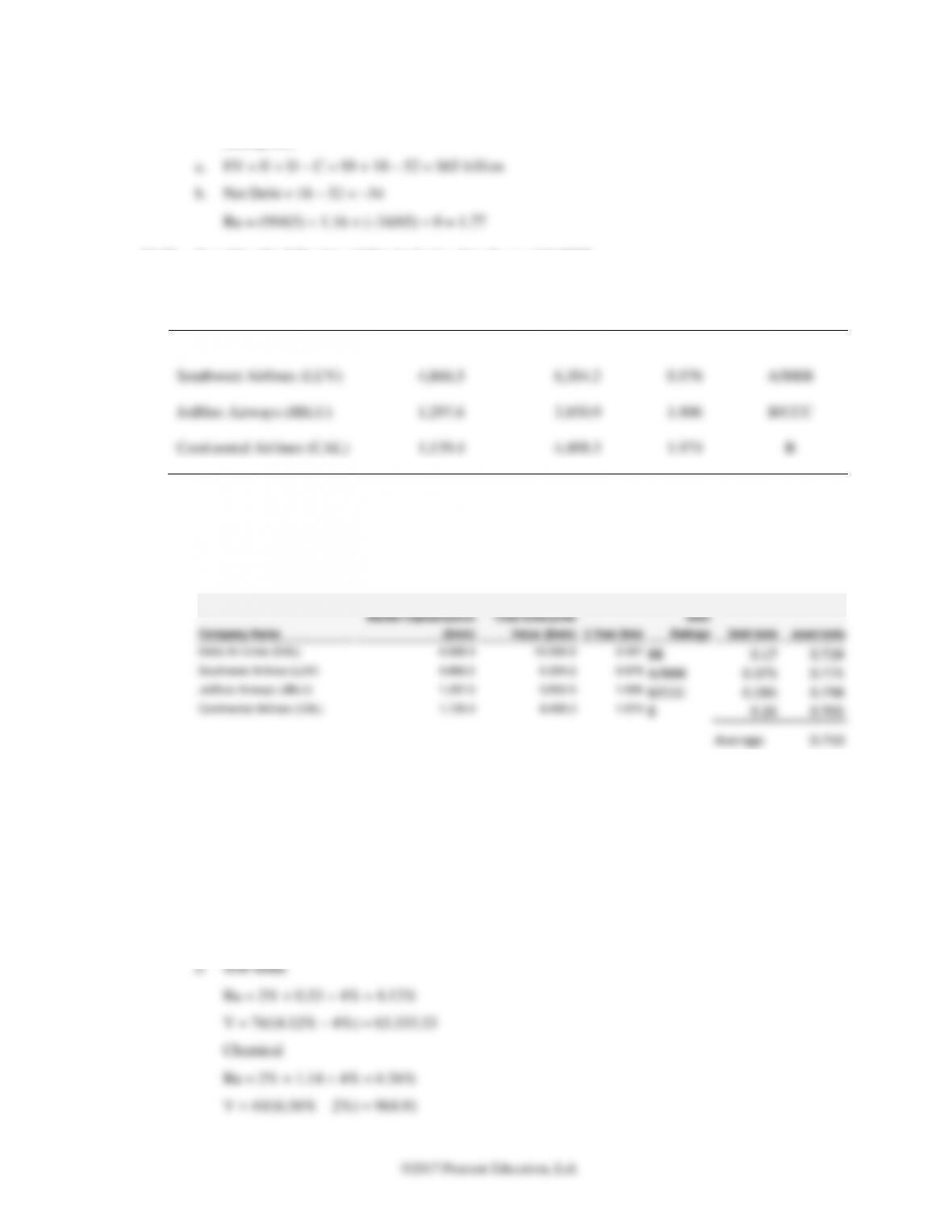
Chapter 12/Estimating the Cost of Capital 183
b. Assuming Cisco’s debt has a beta of zero, estimate the beta of Cisco’s underlying business
enterprise.
12-22. Consider the following airline industry data from mid-2009:
Company Name
Market
Capitalization
($mm)
Total Enterprise
Value ($mm)
Equity Beta
Debt Ratings
Delta Air Lines (DAL)
4,908.4
16,956.8
2.097
BB
Southwest Airlines (LUV)
4,866.5
6,304.2
0.976
A/BBB
JetBlue Airways (JBLU)
1,297.6
3,850.9
1.806
B/CCC
Continental Airlines (CAL)
1,139.4
4,408.3
1.974
B
a. Use the estimates in Table 12.3 to estimate the debt beta for each firm (use an average if
multiple ratings are listed).
b. Estimate the asset beta for each firm.
c. What is the average asset beta for the industry, based on these firms?
Company Name
Market Capitalization
($mm)
Total Enterprise
Value ($mm)
2 Year Beta
Debt
Ratings
Debt beta asset beta
Delta Air Lines (DAL) 4,908.4 16,956.8 2.097 BB 0.17 0.728
Southwest Airlines (LUV) 4,866.5 6,304.2 0.976 A/BBB 0.075 0.771
JetBlue Airways (JBLU) 1,297.6 3,850.9 1.806 B/CCC 0.285 0.798
Continental Airlines (CAL) 1,139.4 4,408.3 1.974 B 0.26 0.703
Average 0.750
12-23. Weston Enterprises is an all-equity firm with two divisions. The soft drink division has an asset
beta of 0.53, expects to generate free cash flow of $76 million this year, and anticipates a 4%
perpetual growth rate. The industrial chemicals division has an asset beta of 1.14, expects to
generate free cash flow of $44 million this year, and anticipates a 2% perpetual growth rate.
Suppose the risk-free rate is 2% and the market risk premium is 4%.
a. Estimate the value of each division.
b. Estimate Weston’s current equity beta and cost of capital. Is this cost of capital useful for
valuing Weston’s projects? How is Weston’s equity beta likely to change over time?
©2017 Pearson Education, Ltd.
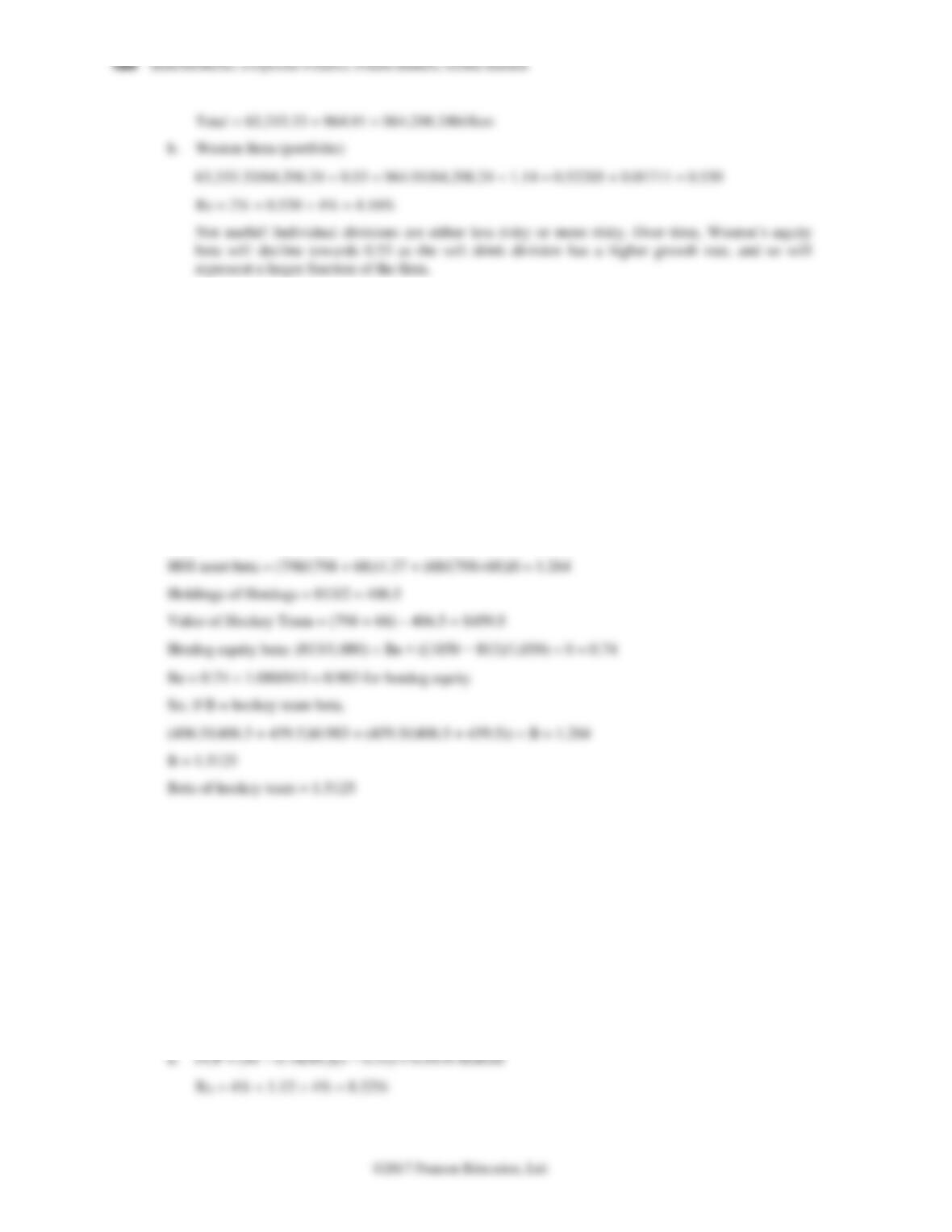
12-24. Harrison Holdings, Inc. (HHI) is publicly traded, with a current share price of $38 per share.
HHI has 21 million shares outstanding, as well as $68 million in debt. The founder of HHI, Harry
Harrison, made his fortune in the fast food business. He sold off part of his fast-food empire and
purchased a professional hockey team. HHI’s only assets are the hockey team, together with
50% of the outstanding shares of Harry’s Hotdogs restaurant chain. Harry’s Hotdogs (HDG) has
a market capitalization of $813 million, and an enterprise value of $1.08 billion. After a little
research, you find that the average asset beta of other fast-food restaurant chains is 0.74. You
also find that the debt of HHI and HDG is highly rated, and so you decide to estimate the beta of
both firms’ debt as zero. Finally, you do a regression analysis on HHI’s historical stock returns
in comparison to the S&P 500, and estimate an equity beta of 1.37. Given this information,
estimate the beta of HHI’s investment in the hockey team.
HHI Equity = 38 21 = $798
HHI debt = $68
12-25. Your company operates a steel plant. On average, revenues from the plant are $41 million per
year. All of the plants costs are variable costs and are consistently 78% of revenues, including
energy costs associated with powering the plant, which represent one quarter of the plant’s costs,
or an average of $8 million per year. Suppose the plant has an asset beta of 1.13, the risk-free
rate is 4%, and the market risk premium is 4%. The tax rate is 33%, and there are no other
costs.
a. Estimate the value of the plant today assuming no growth.
b. Suppose you enter a long-term contract which will supply all of the plant’s energy needs for
a fixed cost of $3 million per year (before tax). What is the value of the plant if you take this
contract?
c. How would taking the contract in (b) change the plant’s cost of capital? Explain.
©2017 Pearson Education, Ltd.
12-26. Unida Systems has 42 million shares outstanding trading for $10 per share. In addition, Unida
has $94 million in outstanding debt. Suppose Unida’s equity cost of capital is 16%, its debt cost
of capital is 8%, and the corporate tax rate is 35%.
a. What is Unida’s unlevered cost of capital?
b. What is Unida’s after-tax debt cost of capital?
c. What is Unida’s weighted average cost of capital?
12-27. You would like to estimate the weighted average cost of capital for a new airline business. Based
on its industry asset beta, you have already estimated an unlevered cost of capital for the firm of
10%. However, the new business will be 22% debt financed, and you anticipate its debt cost of
capital will be 6%. If its corporate tax rate is 33%, what is your estimate of its WACC?