Chapter 11
Optimal Portfolio Choice and the Capital
Asset Pricing Model
11–1. You are considering how to invest part of your retirement savings. You have decided to put
$300,000 into three stocks: 60% of the money in GoldFinger (currently $23/share), 30% of the
money in Moosehead (currently $71/share), and the remainder in Venture Associates (currently
$4/share). If GoldFinger stock goes up to $40/share, Moosehead stock drops to $53/share, and
Venture Associates stock rises to $14 per share,
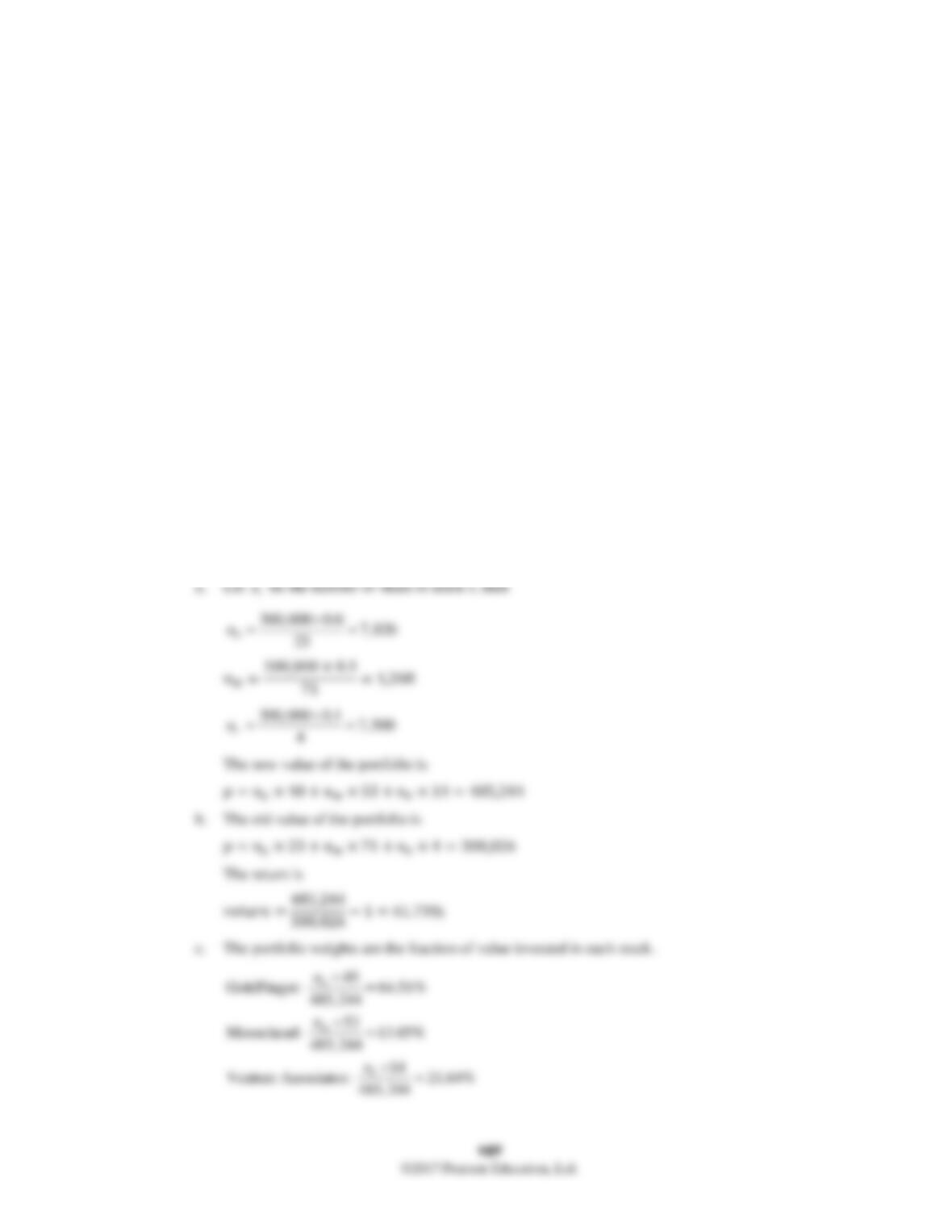
a. What is the new value of the portfolio?
b. What return did the portfolio earn?
c. If you don’t buy or sell any shares after the price change, what are your new portfolio weights?
485, 244
14
Venture Associates: 21.64%
485, 244
=
V
n
160 Berk/DeMarzo, Corporate Finance, Fourth Edition, Global Edition
©2017 Pearson Education, Ltd.
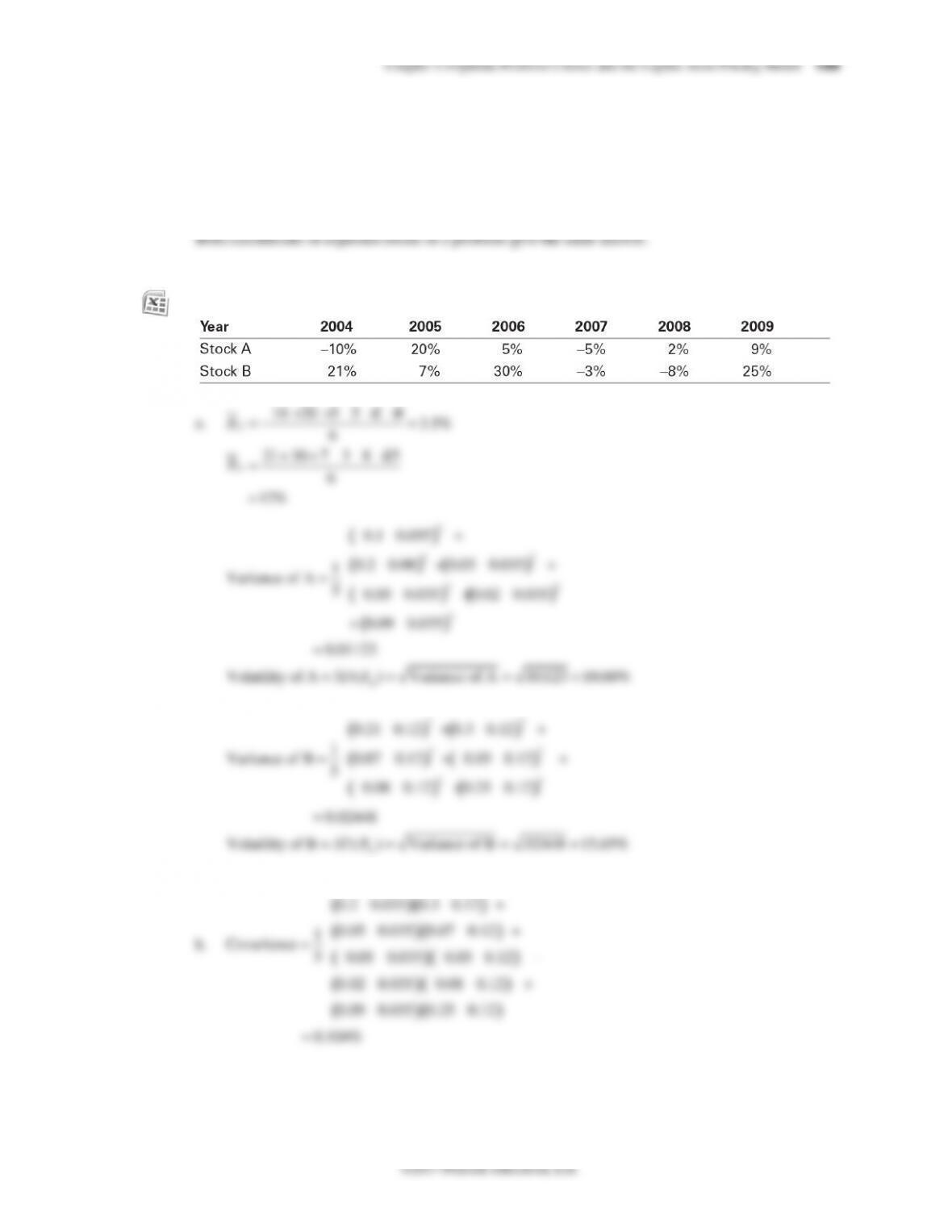
c.
A B
Covariance
Correlation SD(R )SD(R )
6.27%
=
=
11–6. Use the data in Problem 5, consider a portfolio that maintains a 50% weight on stock A and a 50%
weight on stock B.
a. What is the return each year of this portfolio?
b. Based on your results from part a, compute the average return and volatility of the portfolio.
c. Show that (i) the average return of the portfolio is equal to the average of the average returns
of the two stocks, and (ii) the volatility of the portfolio equals the same result as from the
calculation in Eq. 11.9.
d. Explain why the portfolio has a lower volatility than the average volatility of the two stocks.
11–7. Using your estimates from Problem 5, calculate the volatility (standard deviation) of a portfolio
that is 70% invested in stock A and 30% invested in stock B.
( ) ( ) ( )( )( )( )( )
2 2 .5
2 2
Variance 0.7 0.106 0.3 0.1565 2 0.7 0.3 0.0627 0.106 0.1565
Standard Deviation 9.02%
= + + =
= =
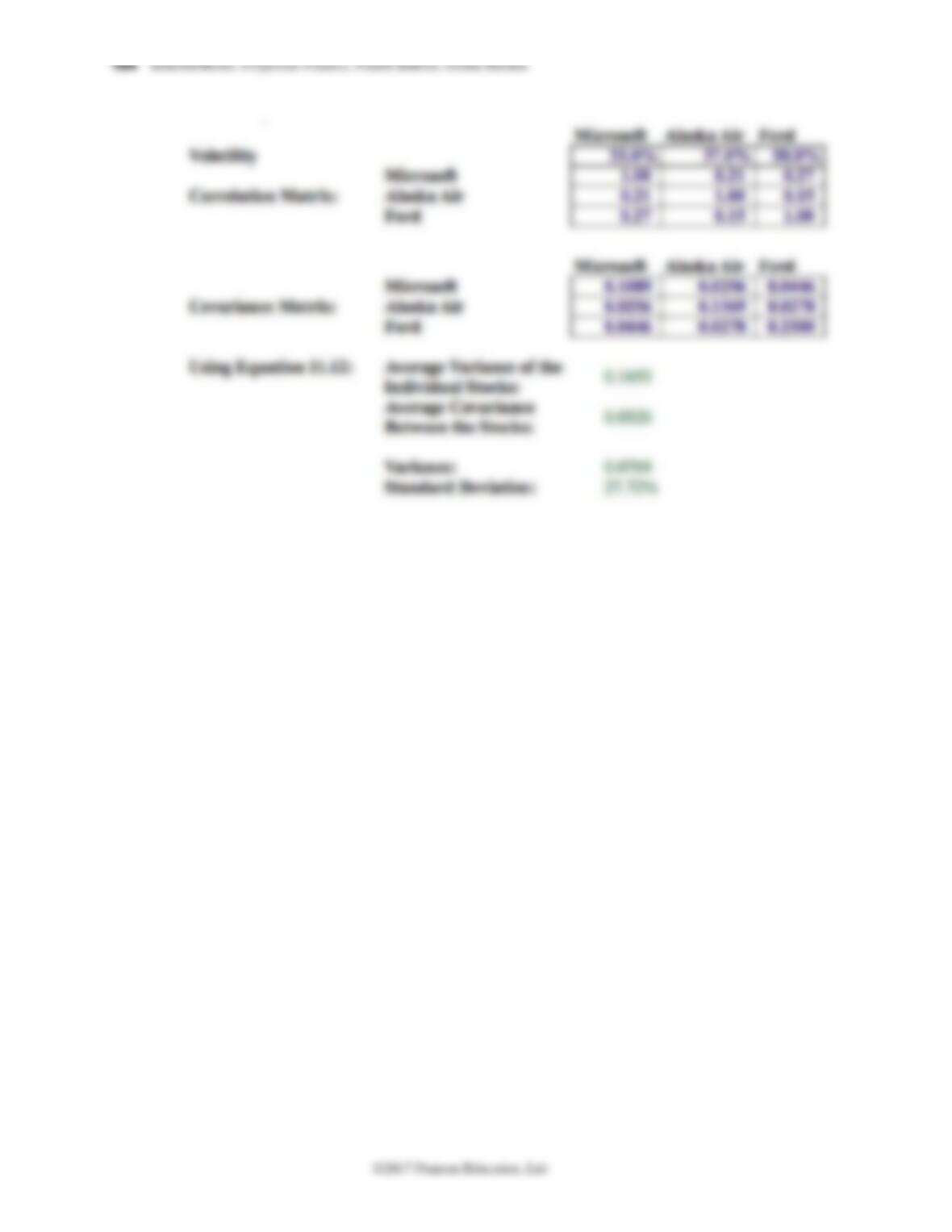
11–8. Using the data from Table 11.3, what is the covariance between the stocks of Alaska Air and
Southwest Airlines?
covariance =con ´SD RD
( )
´SD RAA
( )
=0.39´0.37´0.31=0.04473
11–9. Suppose two stocks have a correlation of 1. If the first stock has an above average return this year,
what is the probability that the second stock will have an above average return?
11-10. Arbor Systems and Gencore stocks both have a volatility of 36%. Compute the volatility of a
portfolio with 50% invested in each stock if the correlation between the stocks is (a) +1.0, (b) 0.50,
(c) 0, (d) –0.50, and (e) –1.0. In which of the cases is the volatility lower than that of the original
stocks?
©2017 Pearson Education, Ltd.
©2017 Pearson Education, Ltd.
166 Berk/DeMarzo, Corporate Finance, Fourth Edition, Global Edition
b. If your portfolio has the volatility in (a), what can you conclude about the correlation between
Delta and Omega?
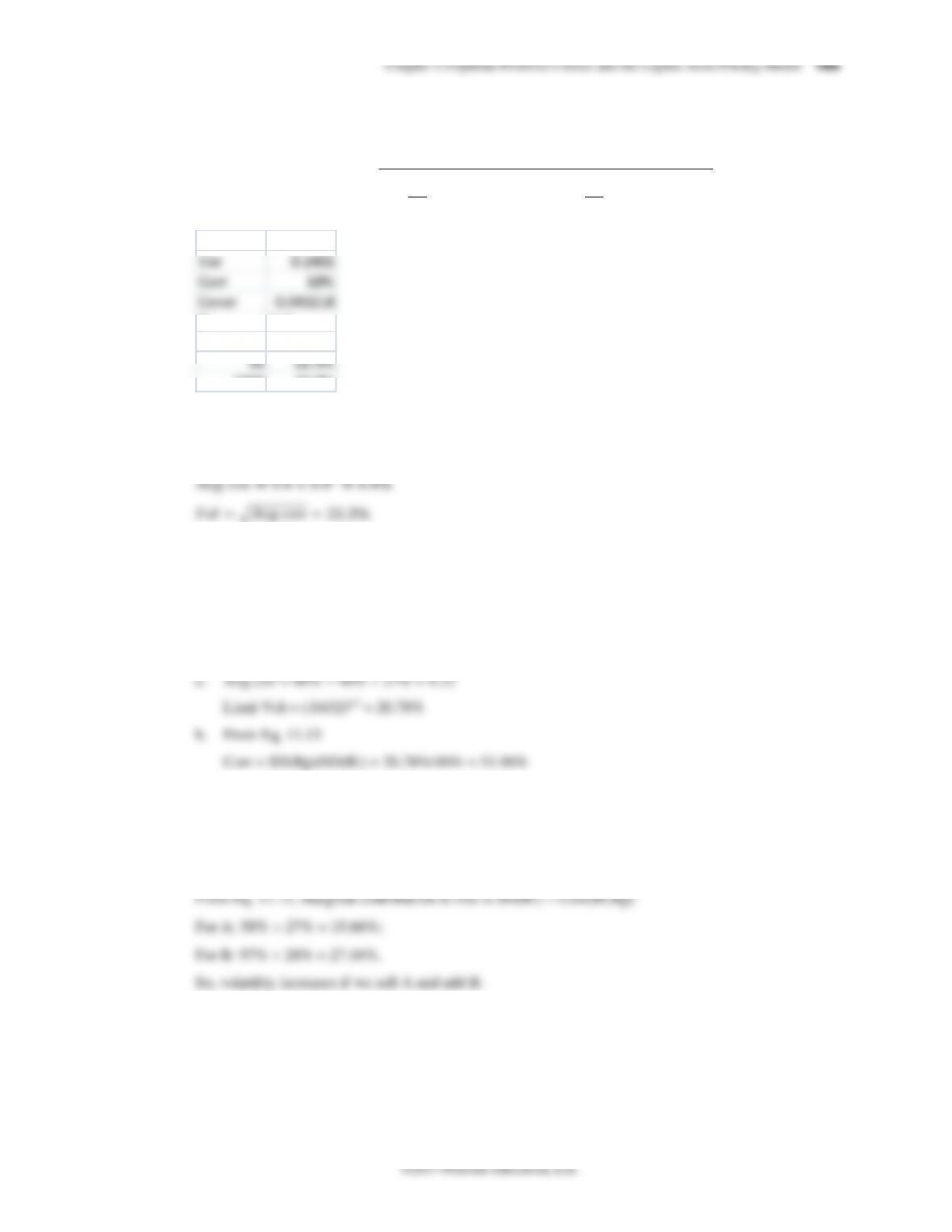
11–21. Suppose Ford Motor stock has an expected return of 15% and a volatility of 38%, and Molson–
Coors Brewing has an expected return of 12% and a volatility of 28%. If the two stocks are
uncorrelated,
a. What is the expected return and volatility of a portfolio consisting of 70% Ford Motor stock
and 30% of Molson-Coors Brewing stock?
b. Given your answer to part (a), is investing all of your money in Molson-Coors stock an efficient
portfolio of these two stocks?
c. Is investing all of your money in Ford Motor an efficient portfolio of these two stocks?
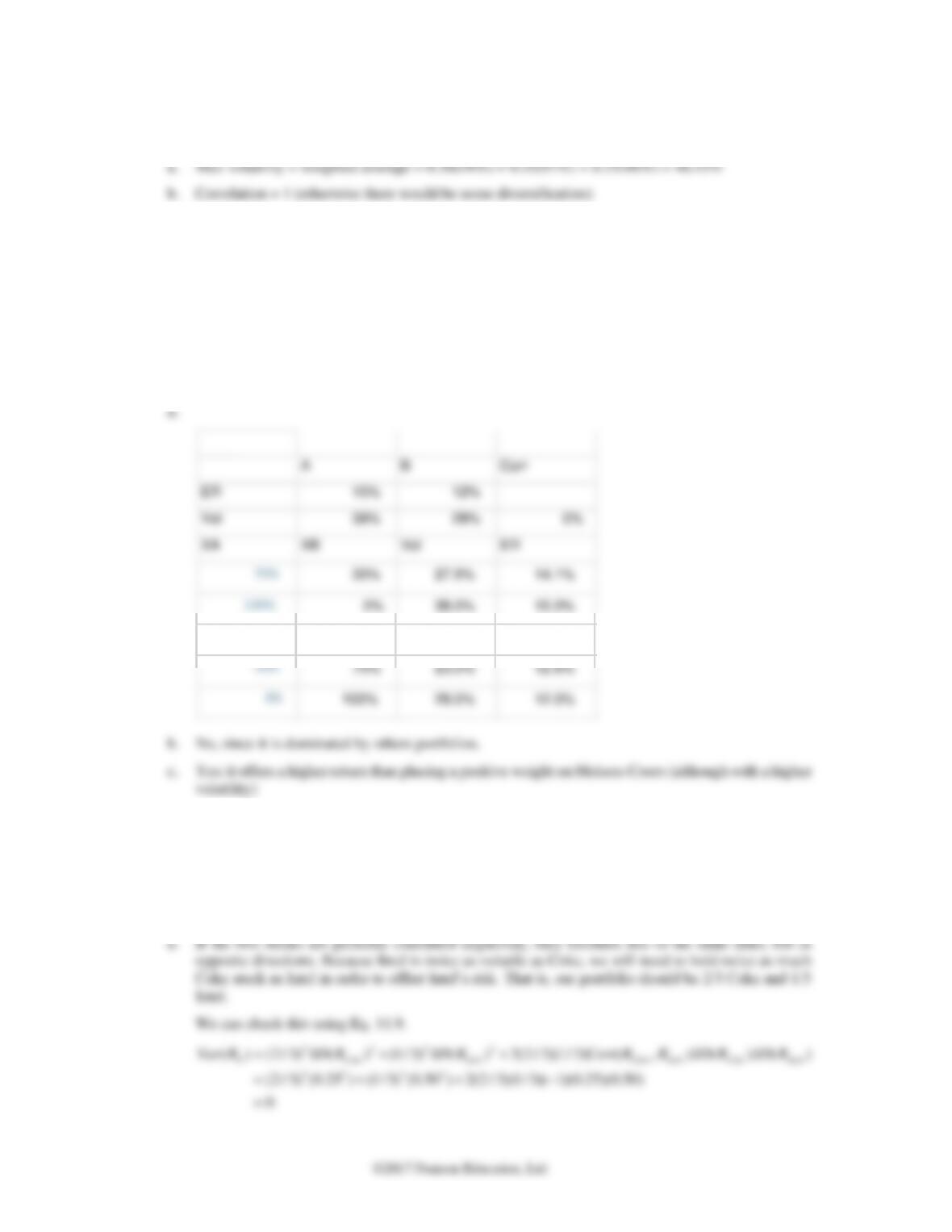
11–22. Suppose Intel’s stock has an expected return of 26% and a volatility of 50%, while Coca–Cola’s
has an expected return of 6% and volatility of 25%. If these two stocks were perfectly negatively
correlated (i.e., their correlation coefficient is −1),
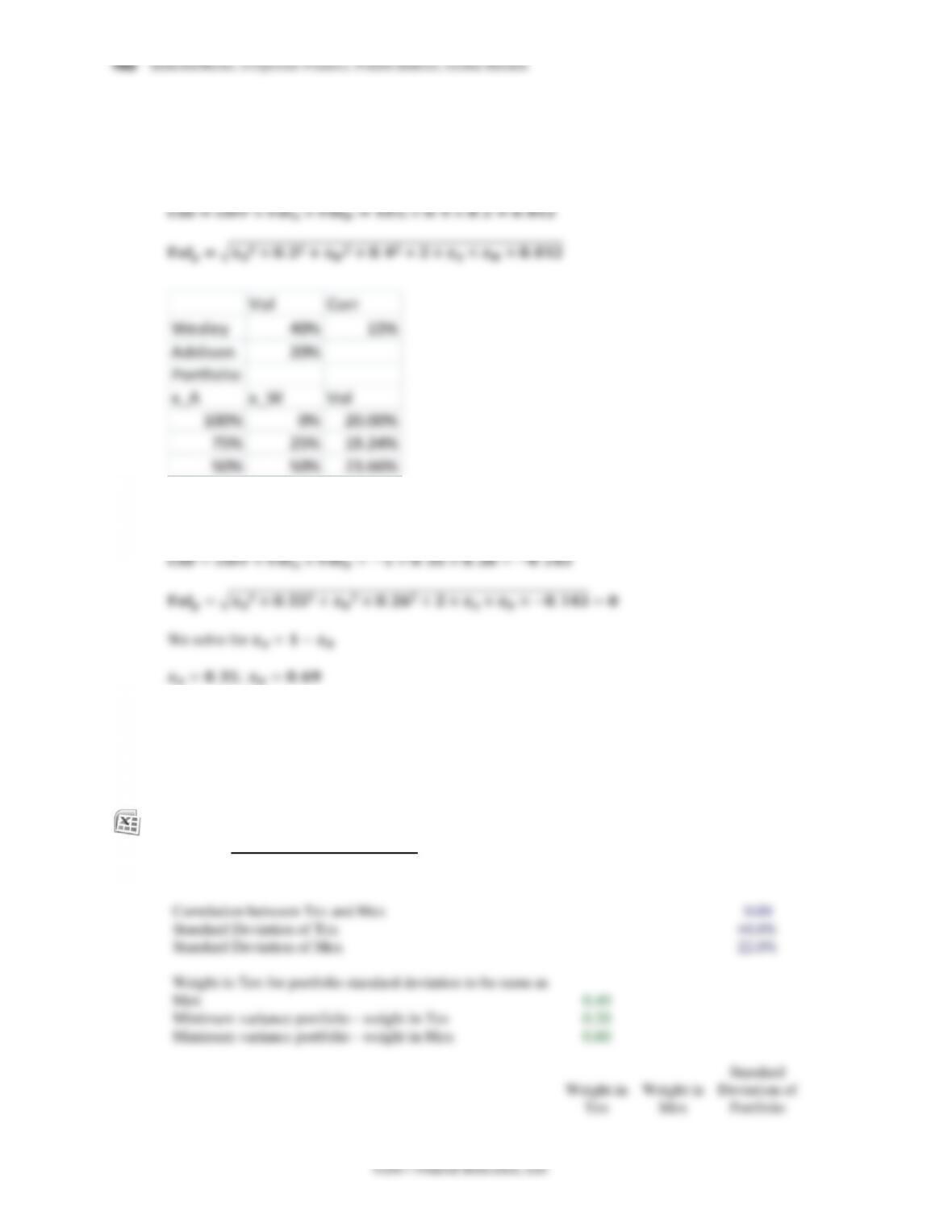
a. Calculate the portfolio weights that remove all risk.
b. If there are no arbitrage opportunities, what is the risk–free rate of interest in this economy?