Instructor Guide for The Essential Cosmic Perspective, Eighth Edition 117
Chapter 9. Asteroids, Comets, and Dwarf Planets:
Their Nature, Orbits, and Impacts
Small bodies in the solar system are important for two reasons: what they tell us
about the formation of the solar system and what they can do to planets if they
and our very presence on the planet.
As always, when you prepare to teach this chapter, be sure you are familiar
with the online quizzes, interactive figures and tutorials, assignable homework,
and other resources available on the MasteringAstronomy website
Teaching Notes (by Section)
Section 9.1 Classifying Small Bodies
This section clarifies the distinctions among comets, asteroids, and dwarf planets,
and introduces their key properties. It also makes the asteroid-meteorite connection.
Section 9.2 Asteroids
This section reminds students of the motivation for studying the small objects and
introduces the minimum number of new terms needed for the chapter. After an
overview of asteroid properties, the section explains how orbital resonances are
responsible for both the existence of asteroids and their occasional collisions with
118 Bennett, Donahue, Schneider, Voit
Teaching about meteorites can be all the more effective if you have
samples for students to view or to hold. Meteorite dealers can be found
easily on the Web or in popular astronomy magazines. Etched iron
Section 9.3 Comets
This section covers the appearance and origin of comets. Because most students
have little
this topic first. Emphasize how small the nucleus is and how large and
insubstantial the tails are. Description of the different effects of the Sun on atoms,
dust, and large grains in the tail makes a useful sequence and helps students
understand meteor showers.
We do not classify comets using an arbitrary period cutoff (long period
versus short period), instead classifying them by their place of origin (Oort
cloud versus Kuiper belt). The two kinds of classification are basically the
same, but the latter is more physically motivated.
Section 9.4 Pluto and the Kuiper Belt
This section focuses on Pluto, Eris, and other large objects of the Kuiper belt.
Note that we have de-
at this point.
Section 9.5 Cosmic Collisions: Small Bodies Versus the Planets
The discussion of cosmic collisions proceeds from the irrefutable (Shoemaker–
Levy 9 impact on Jupiter, meteor showers) to the controversial (death of the
dinosaurs, threats to civilization). This is a great opportunity to show connections
among astronomy, geology, biology, and sociology.
Answers/Discussion Points for Think About It/See It for Yourself
Questions
The Think About It and See It for Yourself questions are not numbered in the
book, so we list them in the order in which they appear, keyed by section number.
Section 9.1
(p. 242, SIFY) The activity encourages students to check out comet
images on the Web, which should be easy to find. A great source for
Section 9.2
(p. 247) Beyond the frost line, the planetesimals that accreted were ice–
Section 9.3
(p. 251, SIFY) The question encourages students to observe a meteor
120 Bennett, Donahue, Schneider, Voit
Section 9.4
Section 9.5
Solutions to End-of-Chapter Problems (Chapter 9)
Visual Skills Check
Review Questions
1. Asteroids are small leftovers from solar system formation made of rock and
metal. They reside mostly in the asteroid belt. Comets are made of ices with
the
Oort cloud. Dwarf planets are the largest comets and asteroids (including
of the debris after it hits the ground.
2. Asteroids can be as large as hundreds of kilometers across, but these are
rare. Smaller sizes are more common including asteroids all the way down
3. Primitive meteorites are intact leftovers of the solar nebula. They contain
rocks and metals mixed together, as well as carbon compounds in some cases.
4. Meteorites and spacecraft data together tell us that large asteroids are
nearly planet-like in their behaviors, whereas smaller ones are battered
5. The asteroid belt lies between the orbits of Mars and Jupiter. It exists
because of orbital resonances with Jupiter. In that region of the solar system,
6. The coma and tails of a comet are produced by ices warming and
sublimating off the surface. As these ices turn to gas, they escape the
7. Meteor showers occur when Earth passes through a stream of pea-size
8. There are two reservoirs of comets in our solar system. The first is the
Kuiper belt, which is similar to the asteroid belt except that it is beyond the
orbit of Neptune and is filled with icy bodies rather than rocky and metallic
9. Pluto is significantly smaller than any of the planets and is made of ice
and rock. This means that it does not fit into either the jovian class or the
terrestrial class of planets. Pluto possesses a thin atmosphere that may
10. One piece of evidence we have that a large impact caused the extinction
122 Bennett, Donahue, Schneider, Voit
The layer that contains the iridium also contains other elements rare on
11. Impacts that would cause mass extinctions occur every 50 to 100 million
years and are therefore considered very rare. Smaller impacts are more
12. The jovian planets have profoundly affected the orbits of small bodies.
Through the action of orbital resonances, Jupiter affects the asteroid belt
Surprising Discoveries?
13. A small asteroid that orbits within the asteroid belt has an active volcano.
14. Scientists discover a meteorite that, based on radiometric dating, is
7.9 billion years old. This would be surprising because the meteorite would
15. An object that resembles a comet in size and composition is discovered
orbiting in the inner solar system. This is reasonable. Many comets from the
16. Studies of a large object in the Kuiper belt reveal that it is made almost
17. Astronomers discover a previously unknown comet that will be brightly
19. Geologists discover a crater from a 5-kilometer object that impacted Earth
20. Archaeologists learn that the fall of ancient Rome was caused in large part
by an asteroid impact in Asia. This would be surprising. An impact large
21. In another solar system, astronomers discover an object the size of Earth
22. Astronomers discover an asteroid with an orbit suggesting that it will
impact Earth in the year 2064. This can be argued both ways: On the one
Quick Quiz
Process of Science
34. This question explores the inherent conflicts between science, government,
the press, and so on. This is a good question for stimulating classroom
124 Bennett, Donahue, Schneider, Voit
Group Work Exercise (no solution provided)
Short Answer/Essay Questions
36. Answers will vary, but here are some possibilities:
The asteroids might have accreted into a single planet between Mars and
37. The factual story goes as follows, though students are encouraged to add
more creative touches: At first, the iron atom floated in space in the
molecular cloud. The cloud collapsed into the solar nebula. As the nebula
38. Asteroids are rocky and closer to the Sun; comets are icy and more distant.
39. Comets have tails because sunlight causes the sublimation of ice as they
approach the Sun. The ejected gas is ionized and carried away in the ion tail
40. Kuiper belt objects are leftovers from the outer edges of the original solar
(relatively) organized motions around the Sun support this conclusion. Oort
41. Students should find that only a small amount of dark material is necessary
Quantitative Problems
42. To estimate the size of a body composed of all of the asteroids, we will find
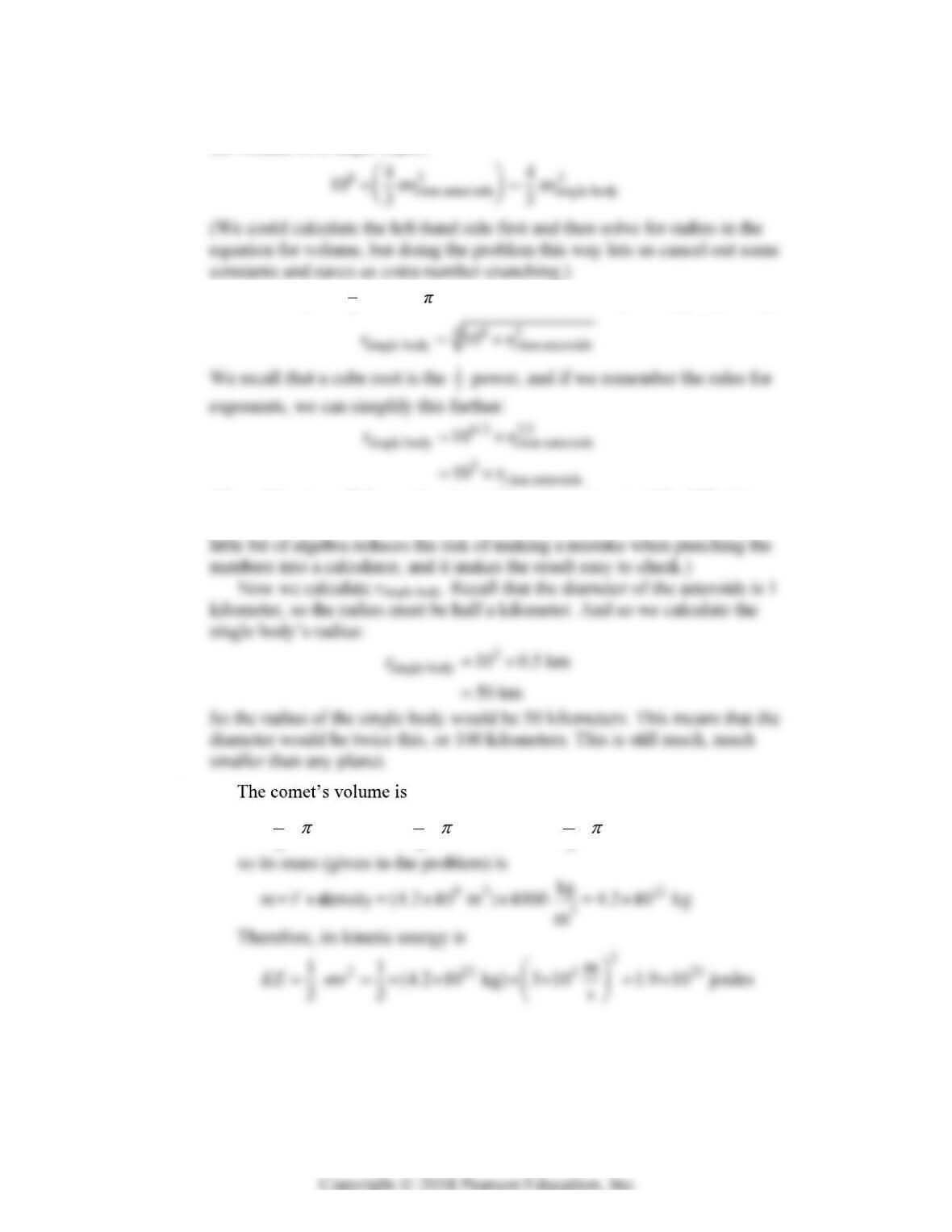
Instructor Guide for The Essential Cosmic Perspective, Eighth Edition 125
So we can equate the total volume of 1 million 1-kilometer asteroids with
the volume of a single object:
Canceling the
4
3
and the on both sides and solving for rsingle body, we get
(If we did not recall these rules, it would not have been terribly difficult to
just crunch the numbers without this simplification. However, doing this
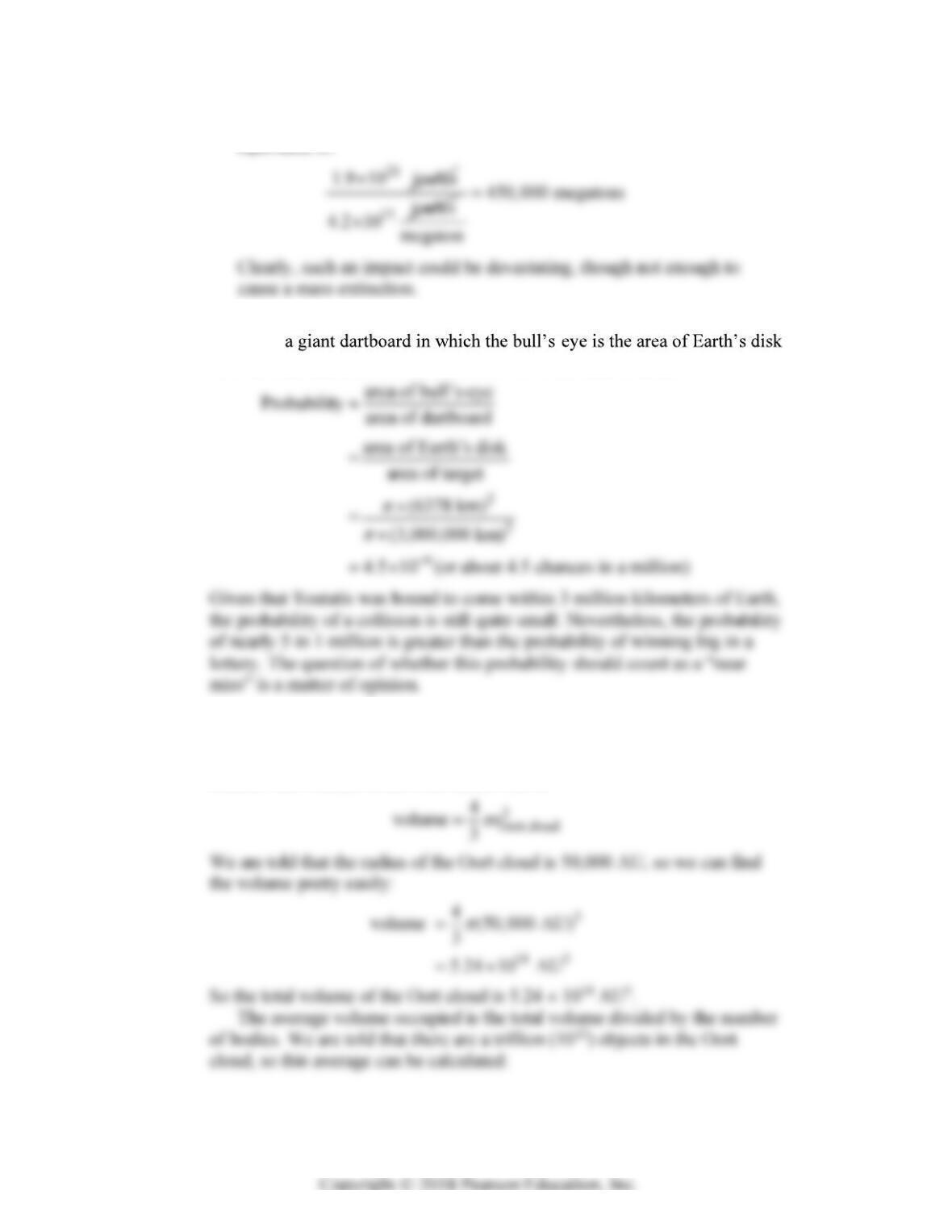
43. a.
V
4
(radius)3
4
(1000 m)3
4
109 m3
4.2
109 m
3
126 Bennett, Donahue, Schneider, Voit
b. Converting this kinetic energy to units of megatons, we find that it is
equivalent to:
44. Following the hint in the problem, we calculate the probability of impact by
assuming –
and the total dartboard area has a radius of 3 million kilometers:
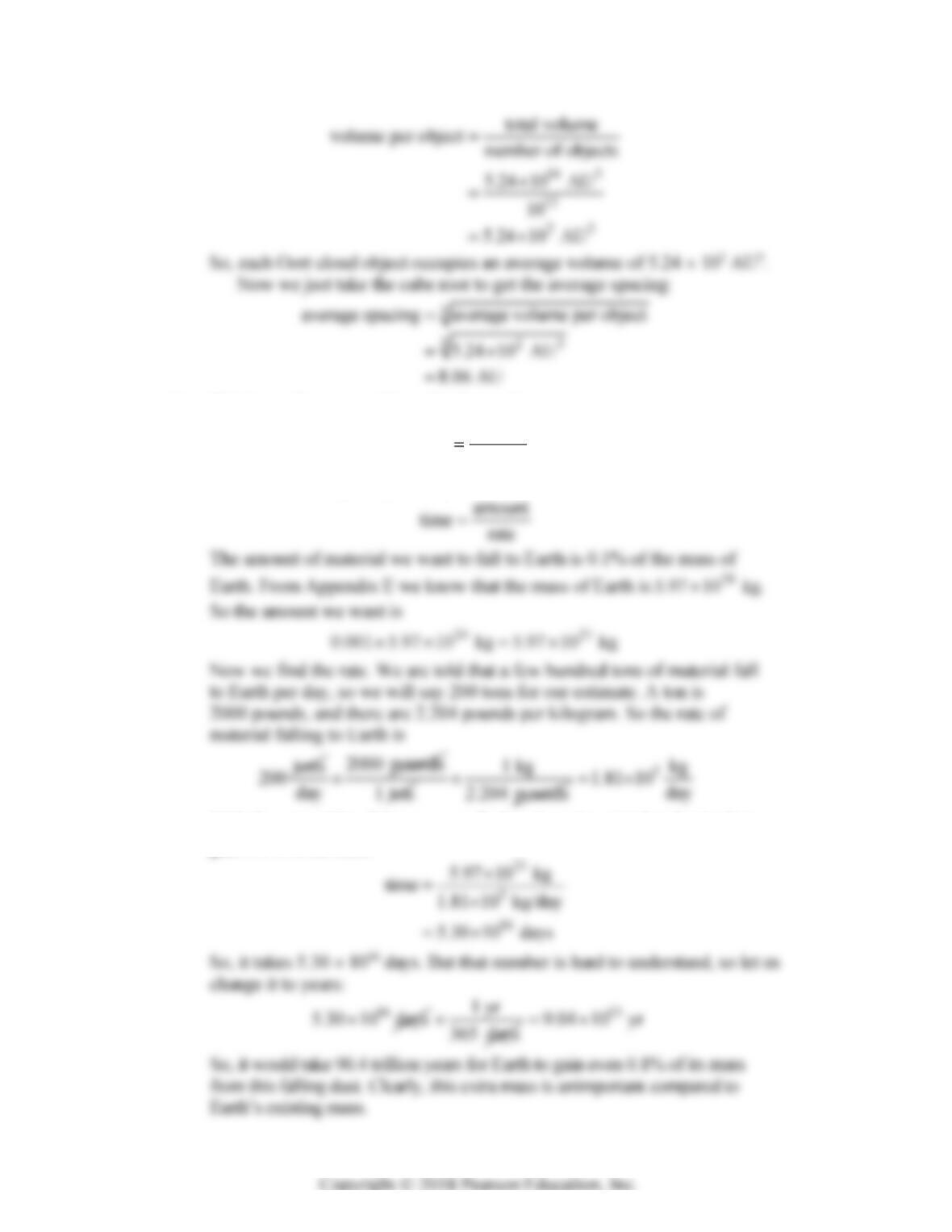
45. To find the average spacing between comets, we will take the cube root of
the average volume that each comet occupies. To get the average volume,
we will find the total volume of the Oort cloud and divide by the number of
comets. The volume of the Oort cloud will be
Instructor Guide for The Essential Cosmic Perspective, Eighth Edition 127
46. This is another rate problem. We know that
amount
rate time
so we can rearrange to get an equation for time:
With these two bits of data, we can find out how long it takes for Earth to
gain 0.1% of its mass: