Instructor Guide for The Essential Cosmic Perspective, Eighth Edition 105
Chapter 8. Jovian Planet Systems
This chapter covers the four jovian planets, their satellites, and their rings.
It is possible to cover this broad subject range in a single chapter because
we emphasize the general properties of these objects, highlighting their
differences in cases where these differences have meaningful interpretations.
Key Changes for the 8th Edition: We have left the basic organization and
content of this chapter unchanged from the prior edition. However, we have made
numerous scientific updates and edits throughout the chapter to improve clarity
for students, for example, presenting the latest results from the Cassini mission.
You should follow news reports about results from Juno during the life cycle of
this edition.
Teaching Notes (by Section)
Section 8.1 A Different Kind of Planet
The section covers the jovian planets themselves, focusing on their interiors,
magnetic fields, and atmospheres.
Even after having studied the general differences between terrestrial and
Section 8.2 A Wealth of Worlds: Satellites of Ice and Rock
This section covers the diverse subject of icy satellites. We do not cover all
satellites, sticking instead to the most important or most curious. In many cases,
the geology of the satellites is not understood, and we do not consider it
Section 8.3 Jovian Planet Rings
This section covers planetary rings. The two key points to emphasize are (1) how
106 Bennett, Donahue, Schneider, Voit
Answers/Discussion Points for Think About It/See It for Yourself
Questions
The Think About It and See It for Yourself questions are not numbered in the
book, so we list them in the order in which they appear, keyed by section number.
Section 8.1
(p. 217) This question asks students to think about the nature of planets
and gravity. If Saturn were a solid object with a density less than that of
water, then it would float. But it is not solid, and the presence of
downward gravity would cause Saturn to spread out over the ocean like a
popped water balloon. At that point, dense materials would sink and gases
Section 8.2
(p. 225
tidal heating. It also makes a good demonstration in class and it works
even better with Silly Putty.
(p. 229) Like all bodies in the solar system, Titan should have been
heavily cratered when the solar system was young. So one question is
ion has certainly
Section 8.3
(p. 233) Ring particles at the inner edge travel faster, just as planets closest
to the Sun travel faster.
Instructor Guide for The Essential Cosmic Perspective, Eighth Edition 107
Solutions to End-of-Chapter Problems (Chapter 8)
Visual Skills Check
Review Questions
1. The jovian planets were all formed from similar planetesimals made of
hydrogen compounds mixed with rock and metals. But Jupiter and Saturn
2.
8.2 indicates. Figure 8.2 also shows that if a planet were to grow more than
3. Jupiter has a gaseous envelope on the outside where the pressure is low.
However, as we travel downward into Jupiter, the pressure increases and the
hydrogen is compressed. Eventually, we get far enough down that the
4. Jupiter has a strong magnetic field because it has a fast rotation and a very
important differences. On
5. The different cloud layers are made of different chemicals and therefore
apparently reflect light differently. This explains why Jupiter has different–
6. Jupiter has bands of alternating winds like Earth, but Jupiter has many more
bands because of its rapid rotation and great size. Jupiter also features powerful
7. We categorize moons by their sizes into three groups: small, medium,
and large. The large moons are over 1500 kilometers in diameter, the
8. The key feature of Io is its extreme volcanic activity, due to tidal heating.
Europa, Ganymede, and Callisto all seem to have subsurface oceans.
them to be quiet and nearly dead.
9. The atmosphere of Titan is the only other one in the solar system that is
mostly
comparable to that of Eart
10. Triton is the large moon of Neptune. It is heavily cratered, but also shows
evidence of geological activity in the recent past. Part of the surface is
covered with wrinkles called cantaloupe terrain, there is evidence of
11. Ice moons can have geological activity at smaller sizes than rocky worlds
because the ice of which they are made melts at much lower temperatures.
12. Planetary rings are made up of countless small icy or rocky/dusty particles
both have narrow, bright, dense rings with very sparse, dusty rings in
13. Because collisions are constantly occurring within the ring systems, ring
particles are continually being ground down to dust. Dust particles cannot
survive long in ring systems because sunlight pressure makes them slowly
Surprising Discoveries?
14.
erupting lava. This is not a possible discovery. The core lies below tens of
15.
instead is due to its surface being covered with an ocean of liquid water.
16. A jovian planet in another star system has a moon as big as Mars. This is
17. A planet orbiting another star is made primarily of hydrogen and helium
18. A previously unknown moon orbits Jupiter outside the orbits of other known
moons. It is the smallest of
19.
and in the same direction that Neptune rotates, but it is made almost entirely
20. An icy, medium-sized moon orbits a jovian planet in a star system that is
only a few hundred million years old. The moon shows evidence of active
21. A jovian planet is discovered in a star system that is much older than our
22. Future observations discover rainfall of liquid water on Titan. Surprising,
23. During a future mission to Uranus, scientists discover it is orbited by
another 20 previously unknown moons. This is not surprising. In fact, in the
Quick Quiz
Process of Science
34. The evidence for a Europan ocean is strong, but all indirect. Strictly
speaking, we have not directly detected liquid water because it would be too
35. es were
based on planets where only radioactivity, accretion, and differentiation
36. This open-
Group Work Exercise (no solution provided)
Short Answer/Essay Questions
38. If the Jupiter-forming nebula had come together with no rotation, the
following would be true:
All the material would have fallen into Jupiter, leaving nothing to make
39. a. The gravitational attraction of Saturn on Mimas is less than that of
40. Without ingredients besides hydrogen and helium, the jovian planets would
41. Observing project. Answers will vary. Consult the latest Sky & Telescope
42. Observing project. Answers will vary. Saturn is an exciting object to
112 Bennett, Donahue, Schneider, Voit
Quantitative Problems
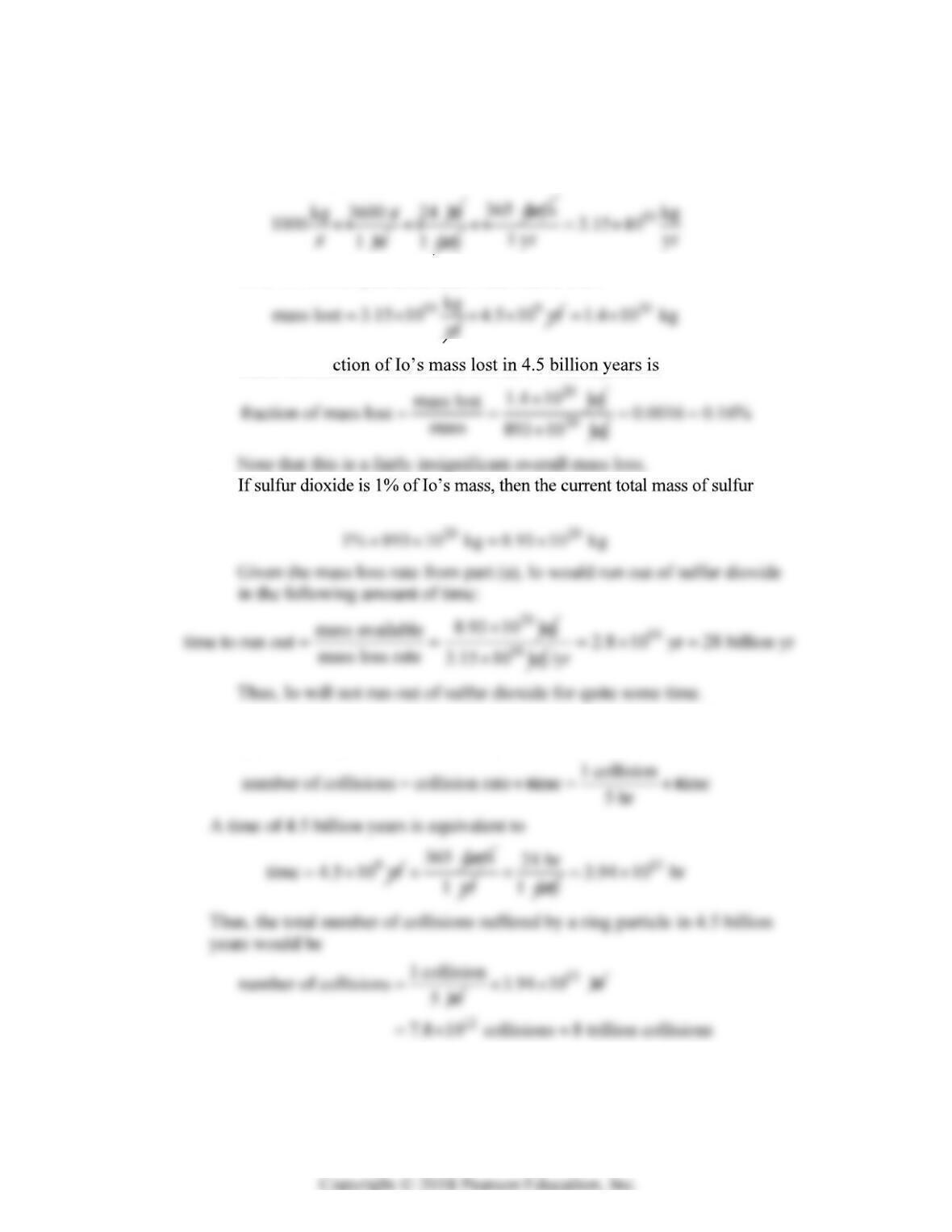
43. a. First, we convert a loss rate of a ton of sulfur dioxide per second into
units of kilograms per year:
Over 4.5 billion years, the total mass loss is then:
Thus, the fra
b.
dioxide is
44. With one collision every 5 hours, the total number of collisions suffered by
a ring particle is given by the following equation:
Instructor Guide for The Essential Cosmic Perspective, Eighth Edition 113
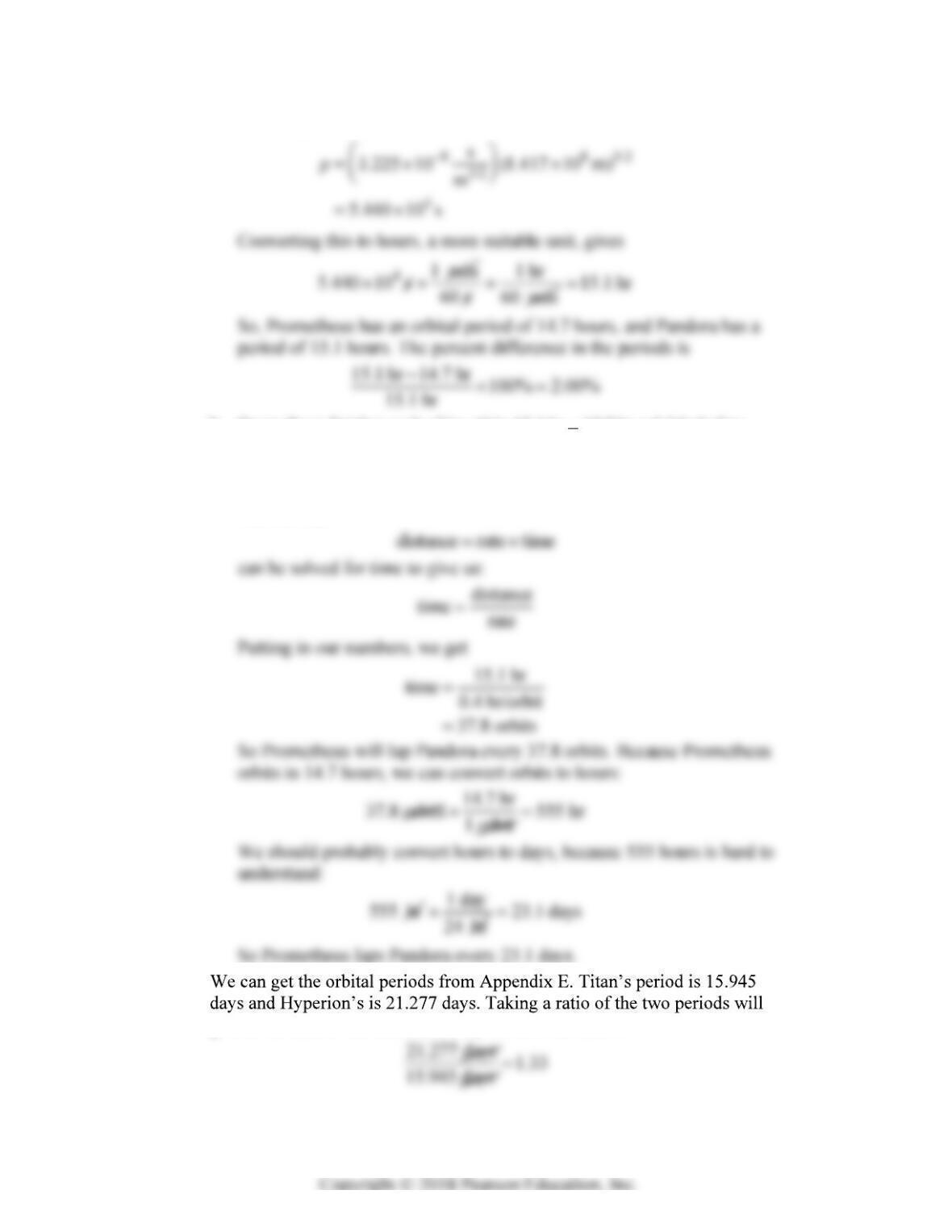
45. a. The two moons lie at 139,350 kilometers and 141,700 kilometers, so the
percent difference in their distances is
We have to convert the semimajor axes for Prometheus and Pandora to
114 Bennett, Donahue, Schneider, Voit
Similarly, for Pandora:
b. Prometheus finishes each of its orbits 15.1 hr 14.7 hr = 0.4 hr before
Pandora does. So we can find out how long it takes Pandora to fall behind
by a full orbit. This is a rate problem: Pandora loses 0.4 hr/orbit, and we
want to know how long it takes to fall behind by a full 15.1 hr.
The old rule
46.
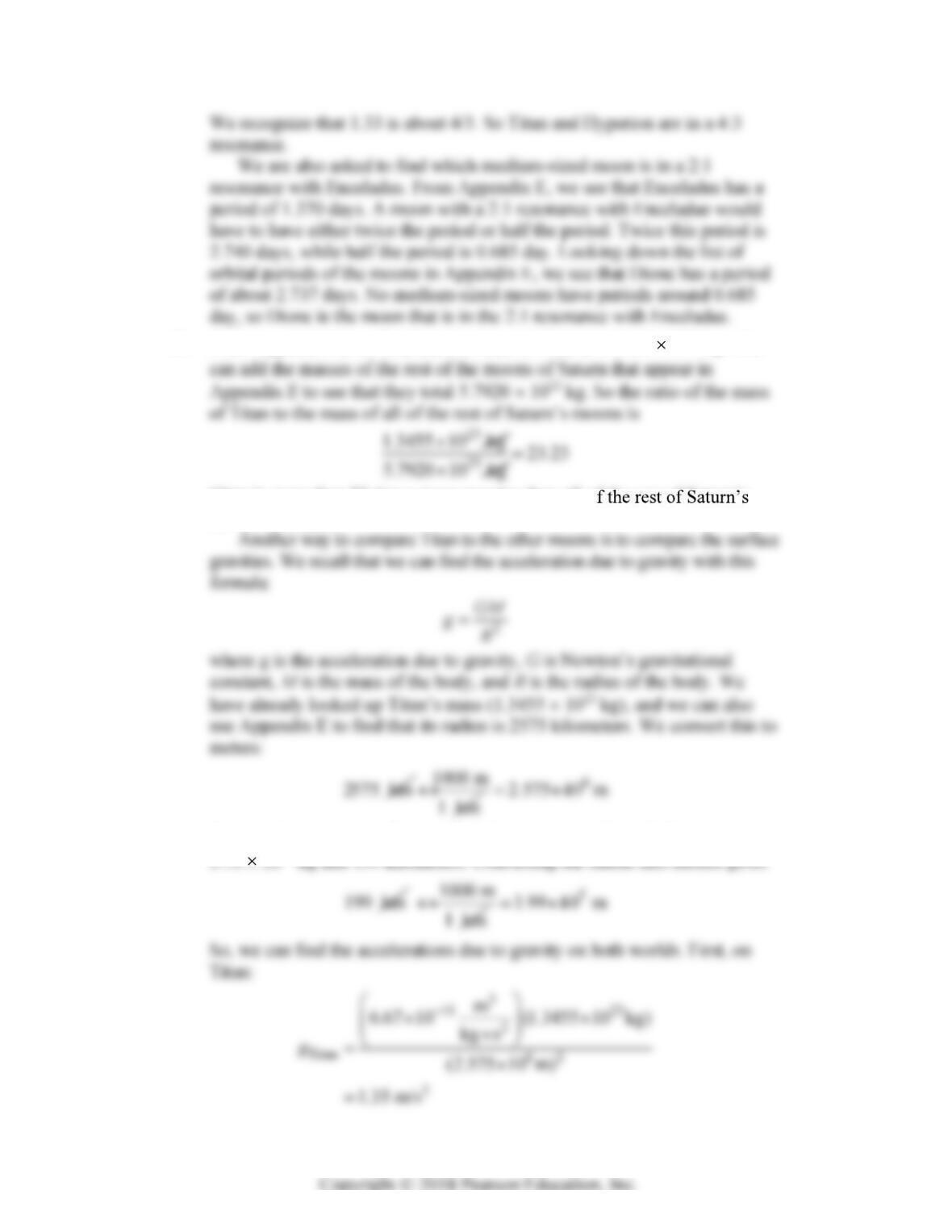
give us an idea of the resonance they are in. The ratio is
Instructor Guide for The Essential Cosmic Perspective, Eighth Edition 115
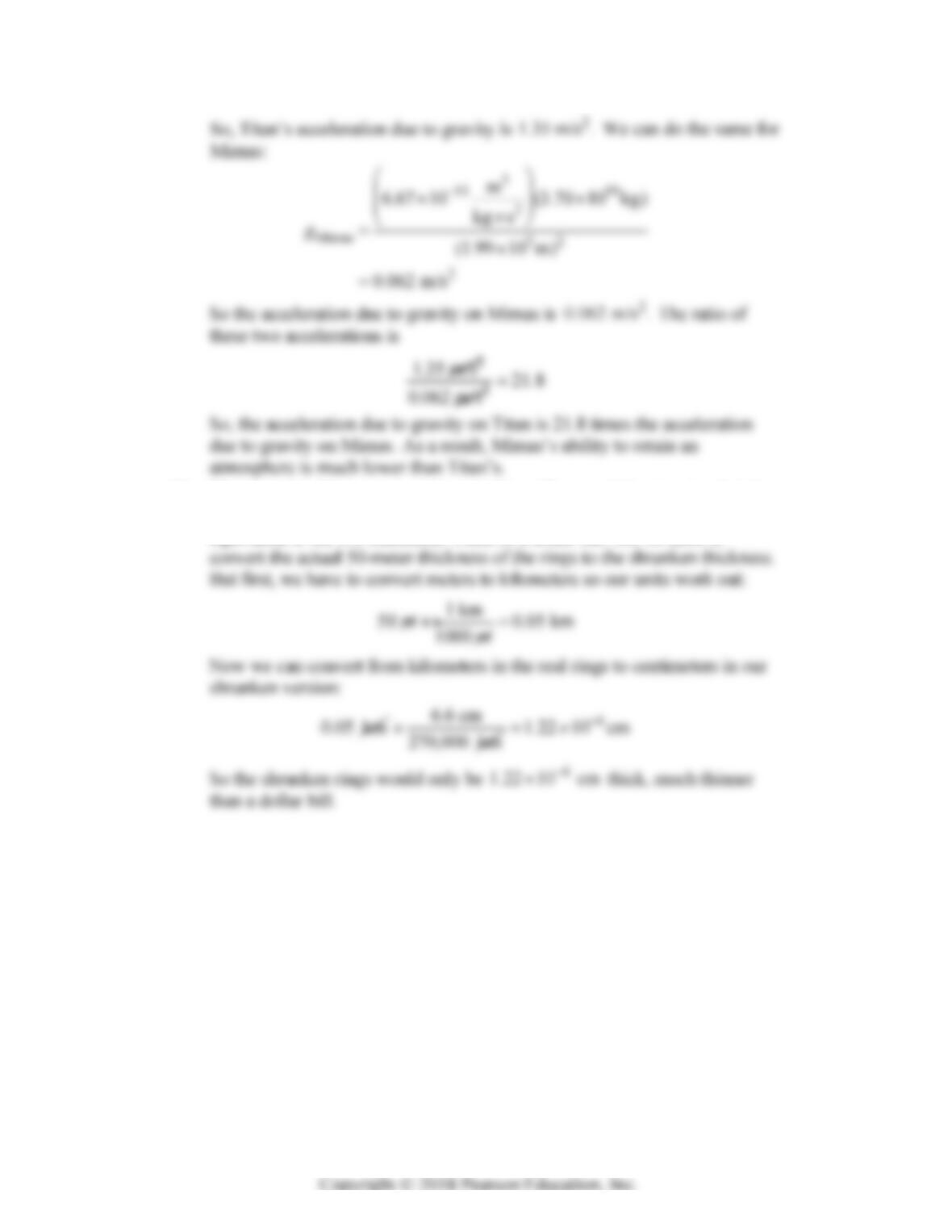
47. From Appendix E, we find that the mass of Titan is 23
1.3455 10 kg.
We
Titan is more than 23 times more massive than all o
moons combined.
We can also use Appendix E to find the mass and radius of Mimas:
116 Bennett, Donahue, Schneider, Voit
48. We recognize this as a conversion problem. We are told to imagine that the
rings, 270,000 kilometers in diameter, are shrunk down to a diameter
equivalent to the 6.6-centimeter width of a dollar bill. So, we need to