92 Bennett, Donahue, Schneider, Voit
Chapter 7. Earth and the Terrestrial Worlds
This chapter covers the terrestrial worlds: Mercury, Venus, Earth, Mars, and the
Moon. Note that, while the focus is on processes, we still use features on Earth
(and occasionally on other worlds) to give concrete examples of each process at
work.
We begin the chapter by using Earth as our prototype for most of the
features and processes that occur on terrestrial planets. We save the unique
aspects of Earth, such as plate tectonics and our oxygen atmosphere, for
the final section of the chapter.
The section organization is planet by planet, but our emphasis remains on
comparative planetology. That is, we discuss the processes that have
occurred on each world with an eye toward giving students an
understanding of why they happen, rather than expecting them to just
memorize the features the processes have created.
example, ask how terrestrial planets would be different if they were larger,
older, younger, and so on.
Note that we do not introduce jargon that will not be useful elsewhere. For
example, we do not use the terms scarp, graben, or regolith instead, we
describe such things using familiar words from everyday English.
terrestrial planets as deeply as they are covered in this chapter? Our
are most directly about Earth. In particular, discussions of the greenhouse
effect and global warming are usually very interesting to students.
Key Changes for the 8th Edition: For those who have used earlier editions of
our textbook, please note the following significant changes in this chapter:
Fully updated section on Mercury based on MESSENGER results.
Fully updated section on Mars based on recent results from Curiosity and
MAVEN.
Instructor Guide for The Essential Cosmic Perspective, Eighth Edition 93
Teaching Notes (by Section)
Section 7.1 Earth as a Planet
This section introduces Earth in a comparative context with other worlds and then
shows examples from Earth to illustrate the major geological and atmospheric
processes that occur on terrestrial worlds.
ce is shaped by four basic geological
processes impact cratering, volcanism, tectonics, and erosion and
provide concrete examples of each.
Section 7.2 The Moon and Mercury: Geologically Dead
This section covers the two smallest of the terrestrial worlds.
Note the emphasis on the fact that their small size explains their lack of
Section 7.3 Mars: A Victim of Planetary Freeze-Drying
This section covers Mars.
Our focus is on the evidence for climate change on Mars and why it
occurred, presumably due to loss of atmosphere. Again, a major emphasis
Section 7.4 Venus: A Hothouse World
This section covers Venus.
Here, our main emphasis is on the runaway greenhouse effect and why it
occurred, along with other geological differences between Venus and
Earth. Because Venus and Earth are nearly the same size, this gives us the
op
case, the answer primarily involves distance from the Sun. The text begins
with an interesting paradox: If Earth and Venus switched locations, would
they also switch identities?
94 Bennett, Donahue, Schneider, Voit
Section 7.5 Earth as a Living Planet
Now that students have seen the basic processes on all the terrestrial worlds, we can
go back and ask what is unique about Earth. We discuss these unique features in
this section, with emphasis on how they make Earth such a pleasant place to live.
For many students, the discussion of human impacts, especially global
warming, will be of the greatest interest. We urge you to cover this topic
even if you do not have time to cover other topics in this section or
Answers/Discussion Points for Think About It/See It for Yourself
Questions
The Think About It and See It for Yourself questions are not numbered in the
book, so we list them in the order in which they appear, keyed by section number.
Section 7.1
(p. 174, SIFY) The pressure from the heavy book will squash a 2-centimeter
ball of Silly Putty at room temperature to about 1 centimeter in 5 seconds.
A warmer ball of Silly Putty will squash to about 0.5 centimeter in the
same amount of time, and a chilled ball to about 1.5 centimeters. Actual
measurements may vary due to the temperatures used and the size of the
ball. Opinions may vary as to whether the differences are large or small
Instructor Guide for The Essential Cosmic Perspective, Eighth Edition 95
Section 7.2
(p. 184) Opinion question that can lead to class discussion. Information
obotic Moon landings might influence the discussion.
Section 7.3
(p. 190) This question asks students to research the latest results from
Curiosity.
Section 7.4
(p. 198
thick CO2 atmosphere and strong greenhouse effect. Because there is no
water on Venus to form oceans, there would be no way to dissolve the
atmospheric CO2 and substantially reduce the greenhouse effect.
Section 7.5
(p. 199) Oxygen would eventually be used up in chemical reactions with
the surface, and animals could not survive. This process might take
Solutions to End-of-Chapter Problems (Chapter 7)
Visual Skills Check
Review Questions
1. -density rock
on top called the mantle. Above that lies the crust made of low-density rock.
The lithosphere of relatively rigid rock. We did not
96 Bennett, Donahue, Schneider, Voit
2. The terrestrial worlds underwent differentiation because, when melted or
nearly melted, dense materials naturally fall as less dense materials rise.
Because all of the heat must be radiated away from the surface of the planets
3.
4. The four geological processes are volcanism, tectonics, impact cratering,
and erosion. Volcanism is the process in which hot material from inside a
5. Because impact cratering occurs on planets at known rates, we can tell the
age of a planetary surface by how many craters it has. If there are more craters,
6. Outgassing
expelled through volcanism. This process is very important to our existence
7. s atmosphere stops harmful X rays and UV radiation from reaching
the surface. The energy of these photons is absorbed in the atmosphere and
heats the layers when the light is absorbed. Ozone is a molecule that is very
good at absorbing UV light; even small amounts in our stratosphere are
8. with its birth 4.55 billion years ago. At that time it
was still hot enough from accretion that it must have had a liquid interior.
Thus, it was capable of volcanism and tectonics. Early in its life, the Moon
experienced many large impacts. These impacts left enormous craters and
also triggered volcanism. The runny lava that seeped into the giant craters
9. Some sample answers follow.
Olympus Mons: A large stratovolcano formed from extensive, long-term
volcanic activity.
Tharsis Bulge: A volcanic feature formed by extensive and long-term
10. Liquid water is not stable on the surface of Mars today because of the cold
temperatures and the low atmospheric pressure. The low temperature means
that water is almost always frozen on Mars today. However, if it did warm
11. Mars may have lost atmospheric gases through solar wind stripping. Early in
magnetic field. However, as the planet cooled and convection stopped, the
magnetic field would have disappeared, leaving the planet vulnerable to the
12.
The small number of craters points to a young surface. There is also a lack of
small craters, because the thick atmosphere destroys impactors before they hit
13. A runaway greenhouse effect occurs when a planet gets so hot that it cannot
keep liquid water stable on the surface. As the planet heats up, more water is
15.
mantle. The plates are positioned above
16. The carbon dioxide cycle is the cycle in which carbon dioxide from the
atmosphere dissolves in rain. This rain is mildly acidic and dissolves some
17. Over the past few decades, it
rising. We also know that the amount of carbon dioxide in our atmosphere is
increasing. Because humans burn fossil fuels for energy, a process that
18. Size: Larger planets are able to stay warm inside longer than smaller planets.
Thus, these worlds experience volcanism and tectonics for much longer than
smaller worlds do. Larger planets are also better able to retain atmospheres,
Surprising Discoveries?
19. New photographs reveal sand dunes on Mercury. This discovery would be a
20. A new orbiter observes a volcanic eruption on Venus. This would not be
21. Radiometric dating of rocks brought back from one lunar crater shows it
formed only 10 million years ago. This would not be surprising. Craters are
22. A new orbital photograph of Mars shows a crater bottom filled with a lake of
23. Clear-cutting in the Amazon rain forest on Earth exposes terrain that is as
24. Drilling into the Martian surface, a robotic spacecraft discovers liquid
water a few meters beneath the slopes of a Martian volcano. This would be
25.
cities just a few thousand years ago but is now buried beneath the Atlantic
26. We find a planet in another solar system that has an Earth-like atmosphere
27. We find a planet in another solar system that has Earth-like plate tectonics;
the planet is the size of the Moon and orbits 1 AU from its star. This would
28. We find evidence that during dinosaur times, when Earth had no polar ice
Quick Quiz
Process of Science
39. Students should briefly relate the ideas behind Figure 7.51
general tendencies are predictable, no specific feature (crater, volcano, or
Instructor Guide for The Essential Cosmic Perspective, Eighth Edition 101
40. This question encourages students to look critically at the popular media,
Group Work Exercise (no solution provided)
Short Answer/Essay Questions
43. If Mars were smaller, it would have undergone less volcanic and tectonic
activity because its interior would have cooled more. With less atmosphere
44. Earth and Venus were both large enough for substantial outgassing of water,
CO2, and N2. But Earth formed far enough from the Sun that the water
45. Sample solution: If Earth had been closer to the Sun, the warmer
temperatures might have forced more water vapor into the atmosphere. This
46. Answers will vary depending on the size and shape of the containers used.
Complete freezing will normall
47. Observations of the Moon should be feasible with virtually any small
48. Essay question. Answers will vary.
Quantitative Problems
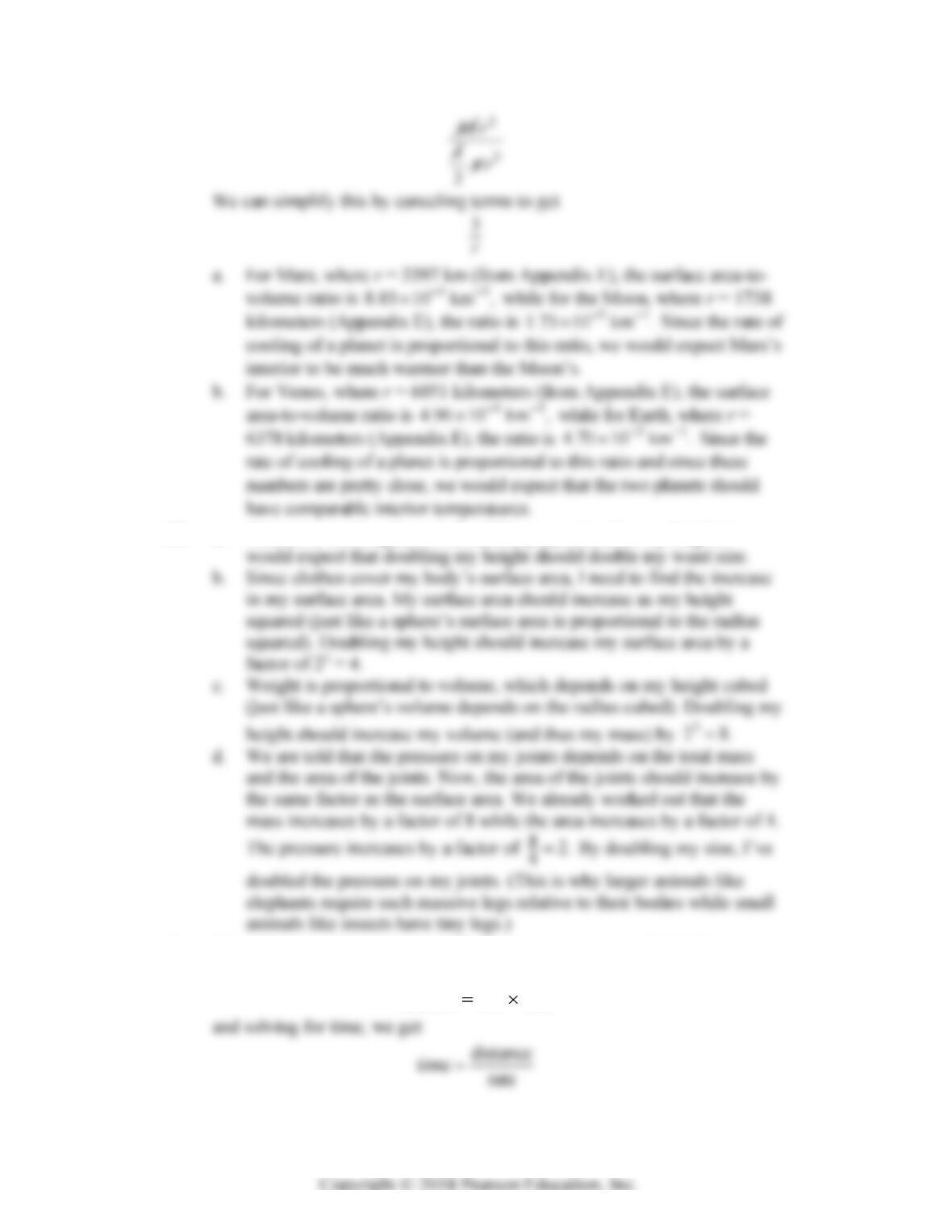
49. First, we will need an expression for the surface area-to-volume ratio. For
spherical objects, this is
102 Bennett, Donahue, Schneider, Voit
50. a. Waist size is a length, so it should be proportional to my height. I
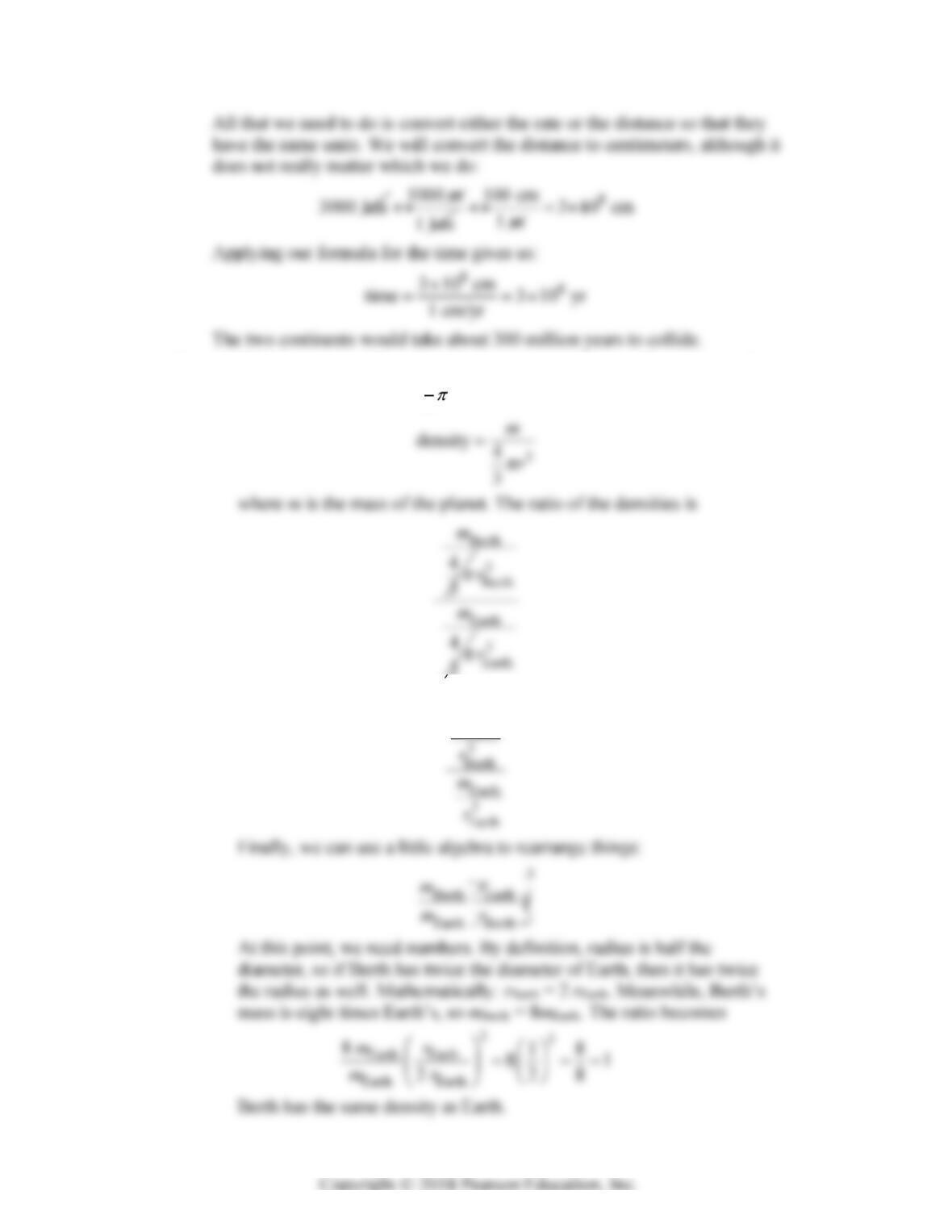
51. This is a rate problem. We are told that the continents are 3000 kilometers
apart and that they move at 1 centimeter per year. Using
distance rate time
Instructor Guide for The Essential Cosmic Perspective, Eighth Edition 103
52. a. This is a ratio problem. Density is mass over volume. The volume of a
planet is proportional to 3
4
3
,
r so the density is
3
Canceling like terms in the numerator and denominator gives
mBerth
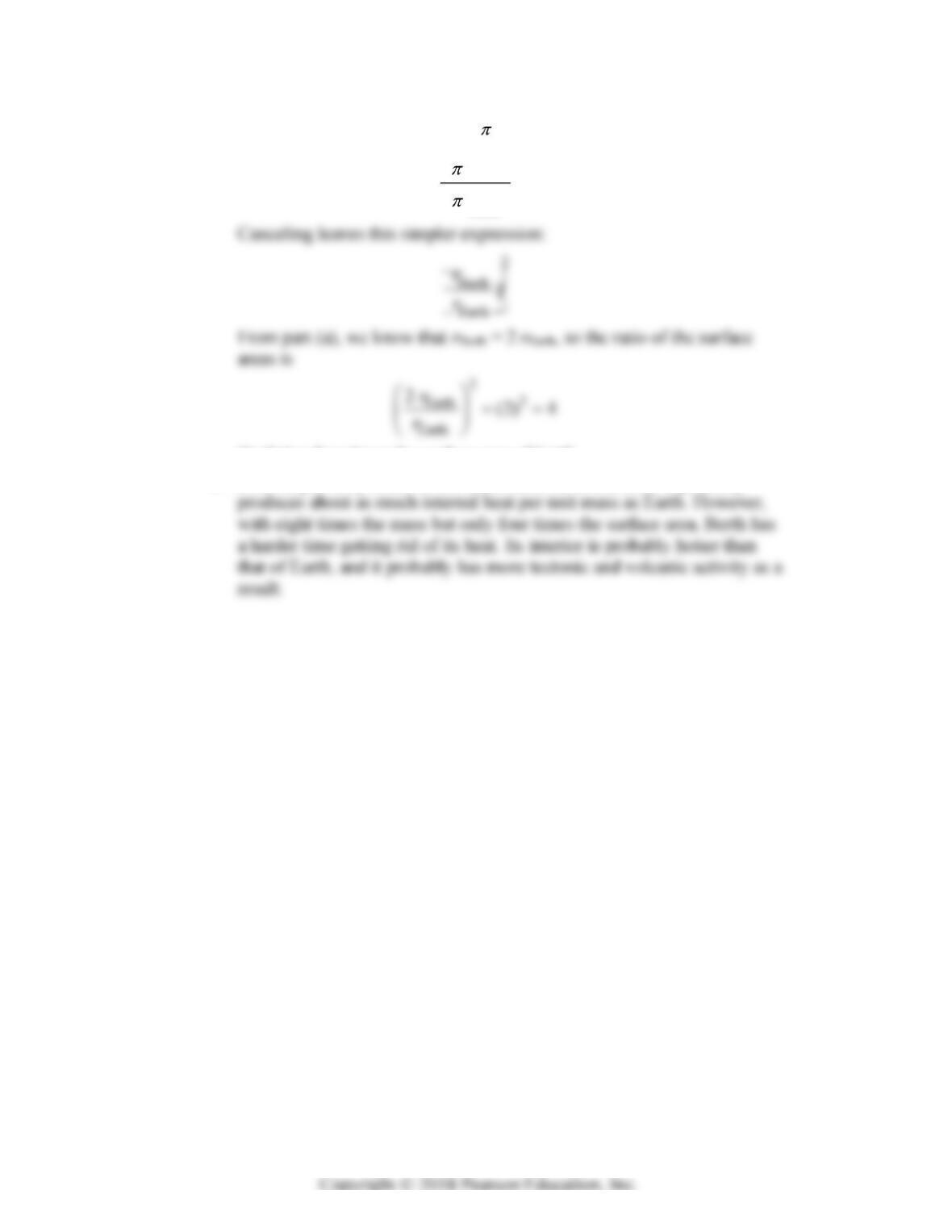
104 Bennett, Donahue, Schneider, Voit
b. Surface area is proportional to 2
4 ,
r so the ratio of surface areas is
4rBerth
2
4r
E
a
r
t
h
2
Berth has four times the surface area of Earth.
c. Berth is probably made of the same material as Earth, so it probably