
Instructor Guide for The Essential Cosmic Perspective, Eighth Edition 79
Part III: Learning from Other Worlds
80 Bennett, Donahue, Schneider, Voit
Chapter 6. Formation of the Solar System
This chapter offers an introduction to our solar system, with an emphasis on
giving students a common background in the essential information about the
planets that will allow a deeper look in coming chapters. We begin by mapping
the broad features of the solar system and then we focus in on individual worlds,
taking a tour of the Sun and the planets. The bulk of the chapter revolves around a
single, unified theory for solar sys
system piece by piece so that the following chapters can look in detail at how
those pieces work and interact with one another.
Key Changes for the 8th Edition: For those who have used earlier editions of
our textbook, please note the following significant changes in this chapter:
Revised discussion of protoplanetary disks with new key images,
including the spectacular chapter-opening image from ALMA.
Teaching Notes (by Section)
Section 6.1 A Brief Tour of the Solar System
–
page spread, followed by a tour of the major worlds in the solar system and then
the summary of key data. The Sun and each planet get a full page, with sizes and
distances referenced to the same scale (the 1-to-10-billion scale of the Voyage
model) introduced in Section 1.2.
Instructor Guide for The Essential Cosmic Perspective, Eighth Edition 81
Section 6.2 The Nebular Theory of Solar System Formation
This section builds upon the first section by summarizing all the features of our
solar system that offer clues to its formation. We focus on four major features that
Section 6.3 Explaining the Major Features of the Solar System
This section begins with a brief overview of how the solar nebula came to exist,
emphasizing galactic recycling. It then goes through the processes that caused the
solar nebula to become a flattened, spinning disk. Thus, in essence, this section
explains the first feature of our solar system listed above. We then discuss how
the planets formed in the disk through the process of accretion, which gives us the
opportunity to explain the remaining three features of the solar system that we
introduced in Section 6.2.
We discuss just enough about galactic recycling so that students can
understand the origin of the solar nebula in a general sense. More detailed
82 Bennett, Donahue, Schneider, Voit
Planetary scientists often refer to materials such as methane, ammonia,
as something that is not actually in the solid state. Therefore, we prefer the
more accurate term hydrogen compounds for these materials. On a related
Section 6.4 The Age of the Solar System
This section addresses the important question of the age of the solar system and
why we think we know the answer.
This question can be answered only with a digression into radioactive
decay. This section offers three ways of learning the concepts: text,
graphs, and equations. While some students may appreciate Cosmic
Answers/Discussion Points for Think About It/See It for Yourself
Questions
The Think About It and See It for Yourself questions are not numbered in the
book, so we list them in the order in which they appear, keyed by section number.
Instructor Guide for The Essential Cosmic Perspective, Eighth Edition 83
Section 6.2
(p. 154) According to our theory, planets could not have formed along
Section 6.3
(p. 156, SIFY the
gravitational influence of nearby stars stirring up the cloud from which
Solutions to End-of-Chapter Problems (Chapter 6)
Visual Skills Check
Review Questions
1. If we looked at the solar system with our naked eye from beyond the orbit of
Neptune, we would see the various planets as points of light. The planets
would not appear as much more than bright stars, although if we watched
them for a while, we could see that they orbit the Sun. From Figure 6.1 we
2. Answers will vary depending on student choices.
3. There are four properties to our solar system that provide us with clues to
how it formed. The first is the fact that the motions in our solar system are
orderly. The planets orbit in the same plane, on nearly circular orbits, and
in the same direction around the Sun, and most of them spin in that same
direction. Most of the major moons of our solar system also follow these
4. Terrestrial planets orbit close to the Sun and are tightly spaced together.
They are made mostly of rock and metal and are smaller and denser than
jovian planets. Terrestrial planets tend to have few, if any, moons, and none
5. The nebular theory states that the solar system formed from a collapsing
cloud of gas and dust billions of years ago. It is widely accepted by
6. The solar nebula was the cloud of gas and dust that formed our solar
system. Much of the material in the cloud everything heavier than
7. The cloud that formed the solar system began by collapsing under its own
gravity. As it did so, to conserve angular momentum it spun faster. When
8. The four major components of the solar nebula were the following:
Gases (hydrogen and helium): These were the least dense part of the
nebula, but the most abundant.
Hydrogen compounds (water, ammonia, and methane): Compounds
made up of the very abundant hydrogen and other relatively abundant
9. The terrestrial planets are thought to have been formed by solid bits of
silicates and metals colliding and sticking together in the solar nebula. The
10. The formation of the jovian planets was similar to that of the terrestrial
planets in the early stages, with the major exception that the jovian planets
were
masses. Because these ices were far more abundant than the silicates and
11. Asteroids and comets are essentially leftovers from planet formation. They
are bits of material that were never swept up into planets, but probably could
have been.
12. The heavy bombardment was a period when many comets or asteroids were
13. We think that the Moon formed when a large impactor struck Earth with a
glancing blow. Such a collision would have blown a lot of material into
orbit around Earth, temporarily forming a disk around our planet. From
14. Radiometric dating is a way to determine the age of something. It uses the
fact that some isotopes of some elements are unstable and that they decay at
a certain rate. Over some length of time, given a collection of atoms of this
Instructor Guide for The Essential Cosmic Perspective, Eighth Edition 87
Surprising Discoveries?
15. A solar system has five terrestrial planets in its inner solar system and three
16. A solar system has four large jovian planets in its inner solar system and
17. A solar system has ten planets that all orbit the star in approximately the
same plane. However, five planets orbit in one direction (e.g.,
counterclockwise), while the other five orbit in the opposite direction (e.g.,
18. A solar system has 12 planets that all orbit the star in the same direction
and in nearly the same plane. The 15 largest moons in this solar system
19. A solar system has six terrestrial planets and four jovian planets. Each of
the six terrestrial planets has at least five moons, while the jovian planets
20. A solar system has four Earth-size terrestrial planets. Each of the four
21. A solar system has many rocky asteroids and many icy comets. However,
most of the comets orbit in the inner solar system, while the asteroids orbit
22. A solar system has several planets similar in composition to the jovian
planets of our solar system but similar in mass to the terrestrial planets of
23. A solar system has several terrestrial planets and several larger planets
made mostly of ice. (Hint: What would happen if the solar wind started
earlier or later than in our solar system?) This would be surprising, since
24. Radiometric dating of the oldest meteorites from another solar system shows
that they are a billion years younger than rocks from the terrestrial planets
Quick Quiz
Process of Science
35. : (1) Science seeks explanations
for observed phenomena that rely solely on natural causes. The nebular
theory certainly satisfies this hallmark, relying on basic physics such as
conservation of energy, angular momentum, collisions, and condensation.
36. Answers will vary, depending on topics chosen by students.
Group Work Exercise (no solution provided)
Short Answer/Essay Questions
Instructor Guide for The Essential Cosmic Perspective, Eighth Edition 89
40. Students should coherently summarize the patterns of motion listed with
bullets on page 151 of the text and make the basic observation that these
41. a. Planets closest to the Sun are the warmest, as they absorb more solar
energy (per unit area). Venus violates the trend, due to its greenhouse
effect.
42. This question asks students to briefly restate and explain ideas taken directly
43. Without the capture of nebular gas, jovian planets would not have
accumulated substantial amounts of material into the planets themselves or
44. Hydrogen was created in the Big Bang. In the solar nebula, hydrogen
appears in gaseous form and also in h 2O
45.
fragments through a star system could eject some of them from the system
90 Bennett, Donahue, Schneider, Voit
Quantitative Problems
46. a. The equal amounts of the parent and daughter isotopes mean that the
age of the rock is one half-life of potassium-40, or 1.25 billion years.
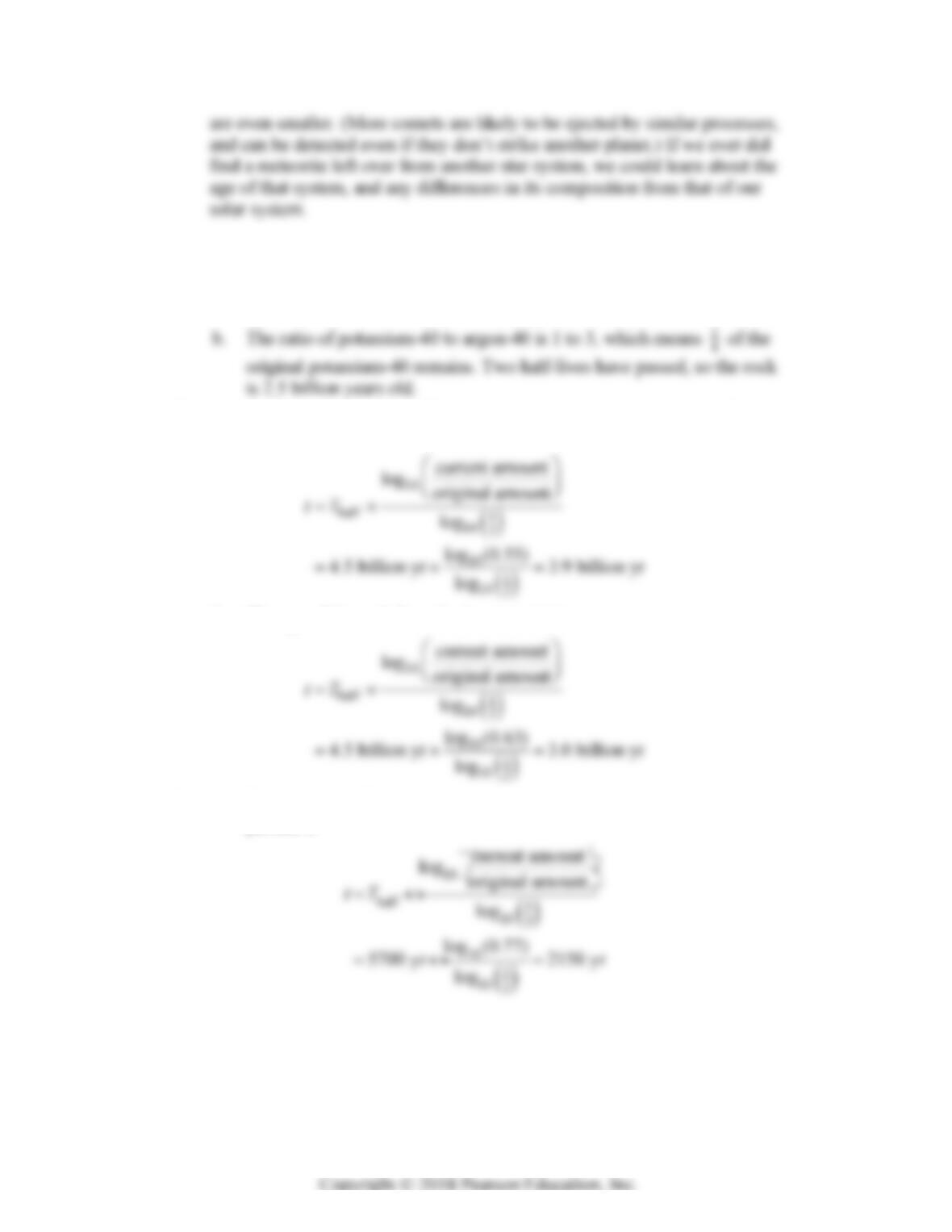
47. a. Following the method of Cosmic Calculations 6.1, we calculate the age
of the rock from the lunar highlands:
b. The age of the rock from the lunar maria is
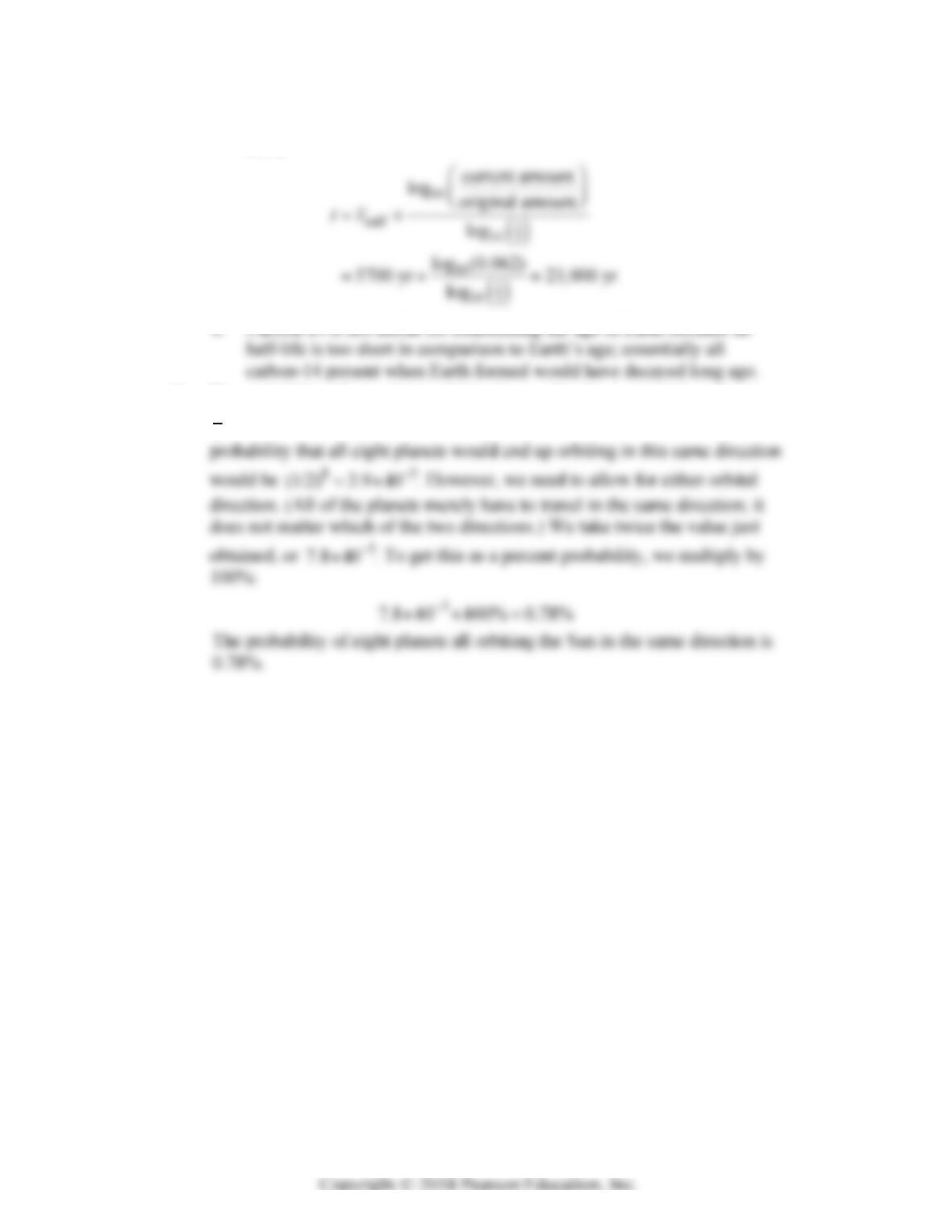
48. a. Based on the radioactive carbon content, the time since the cloth was
painted is
Instructor Guide for The Essential Cosmic Perspective, Eighth Edition 91
b. Based on the radioactive carbon content, the time since the wood was
cut is
49. The probability of one planet orbiting in one direction and not the other is
1
2
.
If the probabilities really did not depend on each other, then the