Instructor Guide for The Essential Cosmic Perspective, Eighth Edition 67
Chapter 5. Light: The Cosmic Messenger
This chapter focuses on the nature of light and matter, and also covers basic
properties of telescopes.
Note that throughout the book we use the term light as a synonym for
electromagnetic radiation in general, as opposed to meaning only visible
when that is what we
mean.
Key Changes for the 8th Edition: For those who have used earlier editions of
our textbook, please note the following significant changes in this chapter:
Teaching Notes (by Section)
Section 5.1 Basic Properties of Light and Matter
This section introduces several important concepts, including wave properties of
wavelength, frequency, and speed; wave-particle duality; the idea that light comes
in the form of photons; the idea of light as an electromagnetic wave; and the basic
terminology of atoms.
Note that throughout the book we use the term light as a synonym for
electromagnetic radiation in general, as opposed to meaning only visible
1. For our purposes, the goal of a definition of light is to put it in the
context of physics, which is why we define light as an electromagnetic
wave that comes in known as photons. This
2. In many ways, the key idea about light in astronomy is that it encodes
information as a result of its interactions with matter, which is why we
3. Another important concept in astronomy is the speed of light, which
we use in defining distances in light-years and in using E = mc2. Since
4. Finally, many other discussions would be greatly complicated if we
did not include all EM radiation under the term light. For example,
shift all require thinking in general terms about emission and
Section 5.2 Learning from Light
This section covers the interpretation of astronomical spectra.
A classroom demonstration of spectroscopy can be very useful if it is
Instructor Guide for The Essential Cosmic Perspective, Eighth Edition 69
We have found that the material in this section, while somewhat complex,
is not difficult for most students to grasp. However, the jargon often used
by astronomers tends to confuse students. Therefore, we have tried to
eliminate such jargon. Note in particular the following:
Section 5.3 Collecting Light with Telescopes
The final section of this chapter describes telescopes, their design, and their uses.
Answers/Discussion Points for Think About It/See It for Yourself
Questions
The Think About It and See It for Yourself questions are not numbered in the
book, so we list them in the order in which they appear, keyed by section number.
Section 5.1
(p. 108) Shorter wavelength means higher frequency and hence higher
energy.
Section 5.2
(p. 114) Yes, for a jump from level 2 to level 4.
(p. 115) In a cold cloud of hydrogen gas, nearly all the electrons will be in
70 Bennett, Donahue, Schneider, Voit
(p. 119) A line shifted from a rest wavelength of 121.6 nanometers to
Section 5.3
(p. 122) The 10-m telescope has a diameter 2000 times greater than the
5- -collecting area is greater by a factor
of 20002 = 4 million.
Solutions to End-of-Chapter Problems (Chapter 5)
Visual Skills Check
Review Questions
1. Wavelength: The distance between two successive peaks in a wave.
2. A photon is a particle of light. Unlike an ordinary wave, light has a smallest
3. From lowest to highest energy, the electromagnetic spectrum is radio,
infrared, visible, ultraviolet, X rays, and gamma rays. This is the same
5. atomic number is the number of protons it has in its nucleus. Its
atomic mass number is the number of protons plus the number of neutrons.
6. Electrical charge is a measure of how strongly something will interact with
electromagnetic fields. We define a proton as having +1 unit of charge and
7. Emission: A light bulb emits light.
8. A continuous spectrum is seen when we observe a hot object emitting light
across a broad range of wavelengths. We see an emission line spectrum
when we look at a cloud of thin gas because we see only the wavelengths of
9. Atoms tend to absorb and emit different wavelengths of light because they
have different energy levels. Similarly, every molecule absorbs or emits
10. We know that a hotter object emits more light at every wavelength. Thus,
11. The Doppler effect
motion toward or away from the observer. When the source is coming
toward us, the light we see has a shorter wavelength (higher frequency),
12. Telescopes have two key properties: light-collecting area and angular
resolution. A telescope can collect a lot more light than can the human eye
because it is larger. This is important because the objects astronomers want
13. The atmosphere has three negative effects on observations. First, it blocks
light of most wavelengths from ever reaching the ground. Second, the
14. Adaptive optics is a technology that can essentially undo the blurring caused
Does It Make Sense?
15. If you could view a spectrum of the light reflecting off a blue sweatshirt,
(looking the same as a spectrum
16. Because of their higher frequency, X rays must travel through space faster
17. Two isotopes of the element rubidium differ in their numbers of protons.
18.
19. If you could see infrared light, you would see a glow from the backs of your
20. If you had X-ray vision, then you could read this entire book without
21. If a distant galaxy has a substantial redshift (as viewed from our galaxy),
then anyone living in that galaxy would see a substantial redshift in a
22. Thanks to adaptive optics, telescopes on the ground can now make
23. Thanks to interferometry, a properly spaced set of 10-meter radio telescopes
24. twinkle. This statement
Quick Quiz
Process of Science
35. Spectra give us confidence that objects throughout the universe are made
from the same collection of chemical elements. Each chemical element
36.
placed along the path of the red light emerging from the first prism. You
could test where to place the second prism by setting up the white screen
74 Bennett, Donahue, Schneider, Voit
Group Work Exercise (no solution provided)
Short Answer/Essay Questions
38. a. The iron has atomic number 26, atomic mass number 26 + 30 = 56, and,
39. a. Fluorine with 9 protons and 10 neutrons has atomic number 9 and
atomic mass number 19. If we added a proton to this nucleus, the result
40. a. Transition B could represent an atom that absorbs a photon with 10.2 eV
transition C.
42. We are considering a spectral line with a rest wavelength of 121.6
nanometers that appears at 120.5 nanometers in Star A, 121.2 nanometers in
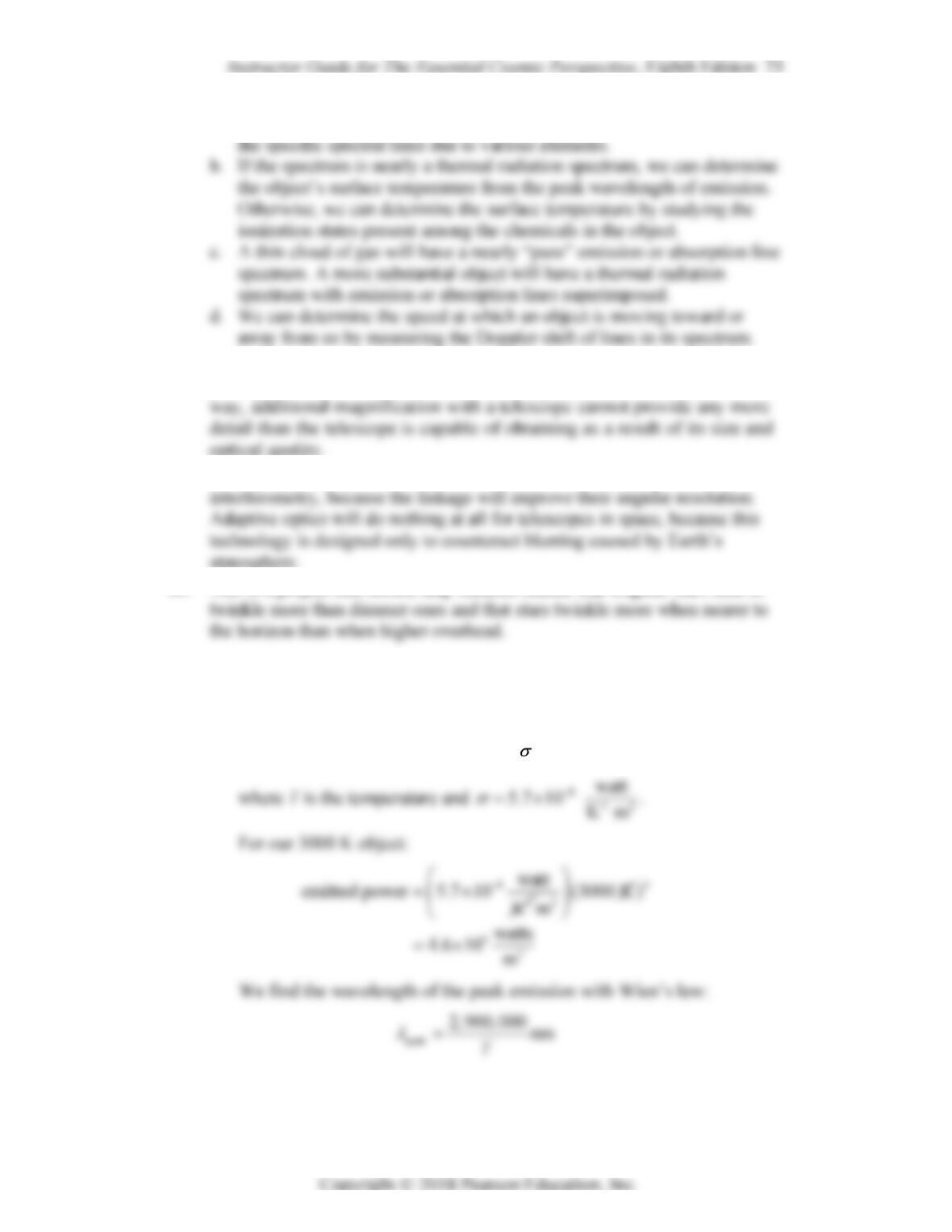
43. a. We can determine the chemical composition of an object by identifying
44. You cannot gain any detail by blowing up a magazine or newspaper
photograph beyond the detail that is already there. In much the same
45. The five telescopes will be much more valuable if linked together for
46. This is a project that should help students realize that brighter stars tend to
Quantitative Problems
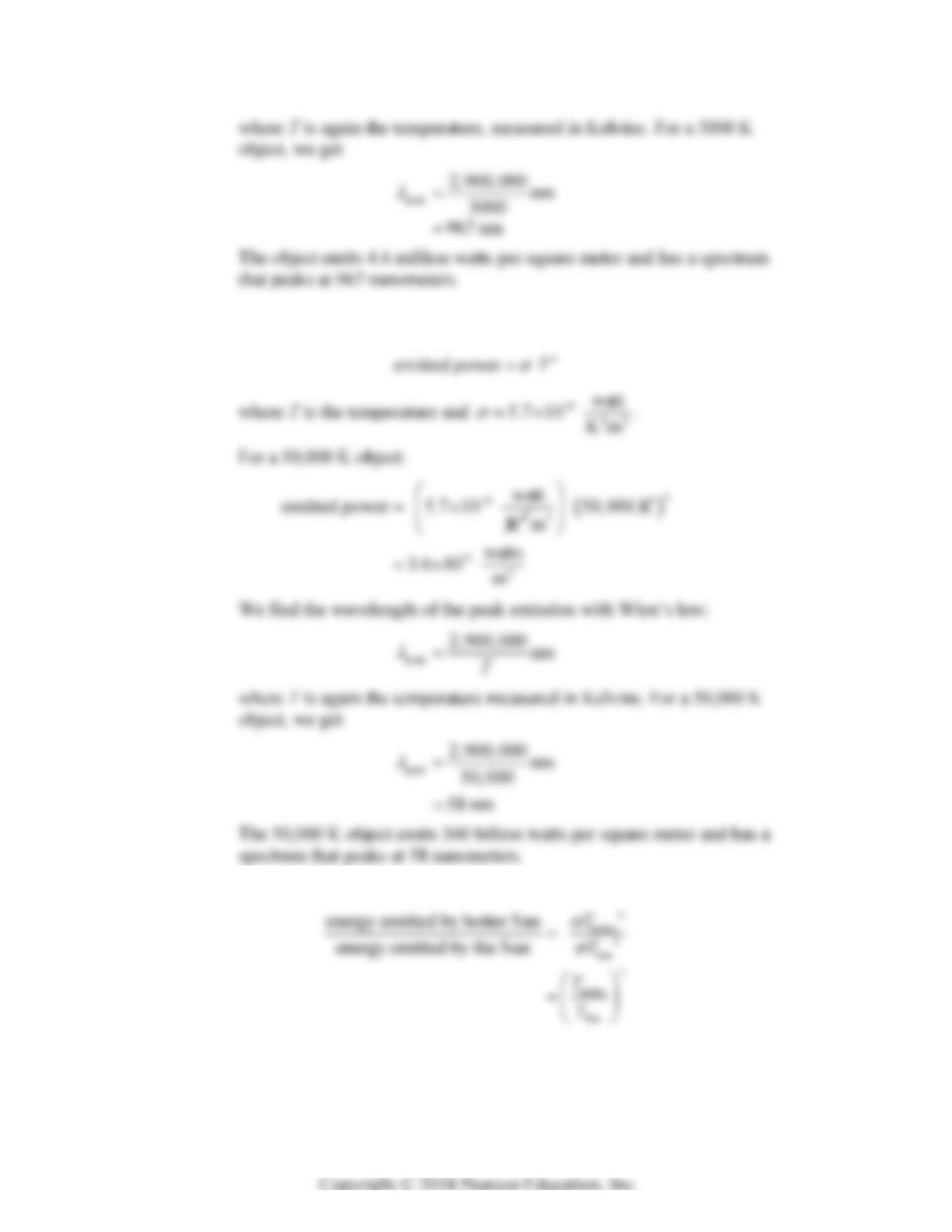
47. a. We can use the Stefan-Boltzmann law to compute the energy emitted by
the object from every square meter:
4
emitted power =
T
76 Bennett, Donahue, Schneider, Voit
b. We can use the Stefan-Boltzmann law to compute the energy emitted by
the object from every square meter:
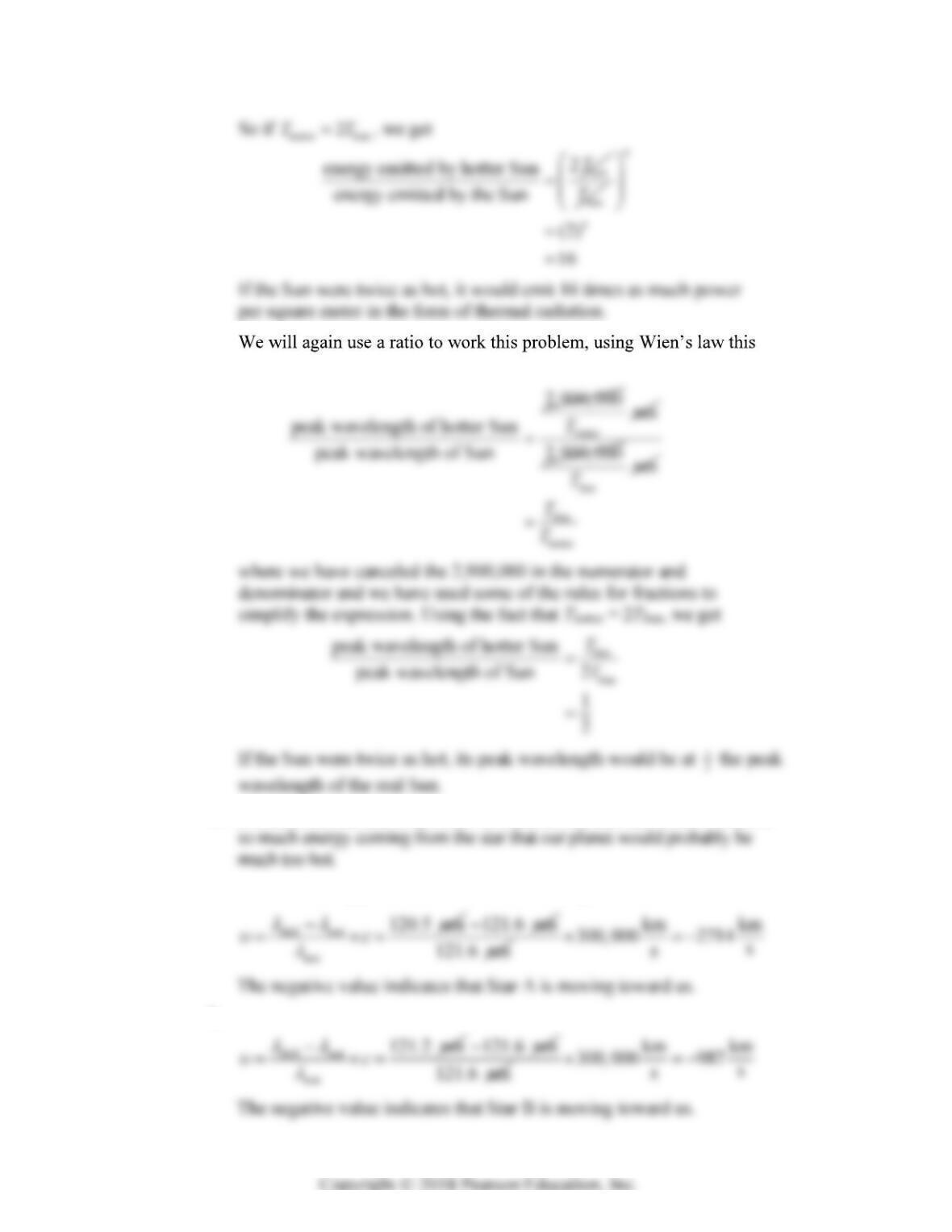
48. a. To solve this, we will set up a ratio using the Stefan-Boltzmann law:
Instructor Guide for The Essential Cosmic Perspective, Eighth Edition 77
b.
time:
c. It is doubtful that life could exist on Earth around this star. There would be
49. a. We use the Doppler shift formula to find the speed of the star:
b.
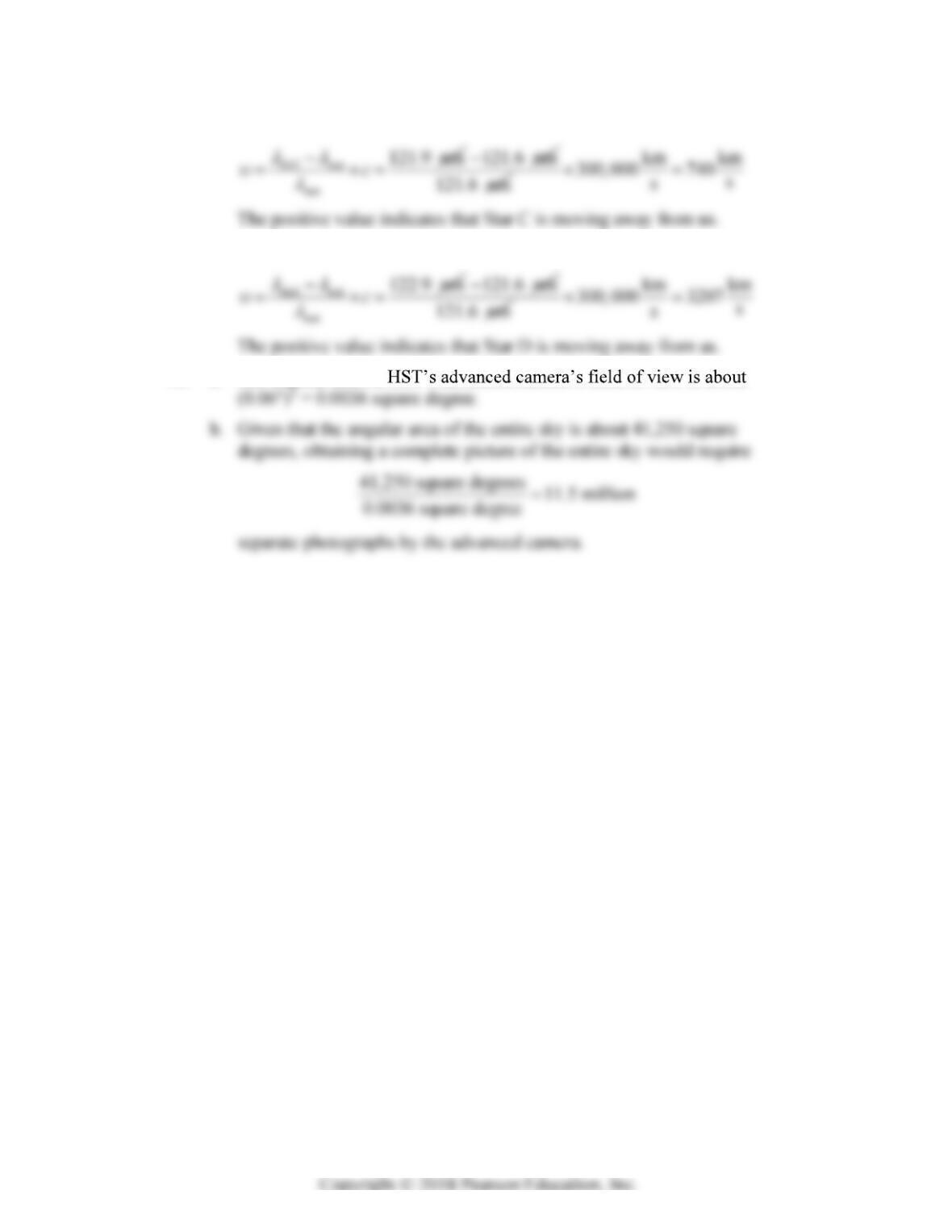
78 Bennett, Donahue, Schneider, Voit
c.
d.
50. a. The angular area of