Instructor Guide for The Essential Cosmic Perspective, Eighth Edition 55
Chapter 4. Making Sense of the Universe:
Understanding Motion, Energy, and Gravity
This chapter focuses on three major ideas and their astronomical applications:
tion of energy and angular
momentum, and (3) the law of gravity.
As always, when you prepare to teach this chapter, be sure you are familiar
Teaching Notes (by Section)
Section 4.1 Describing Motion: Examples from Daily Life
Most nonscience majors are unfamiliar with the basic terminology of motion. For
example, few students enter our astronomy classes with an understanding of why
acceleration is measured in units of length over time squared, of the definitions of
force and momentum, or of how mass and weight differ. This section introduces
all of these ideas in the context of very concrete examples that should be familiar
from everyday life.
Classroom demonstrations can be particularly helpful in this and the next
section; for example, demonstrate that all objects accelerate the same
under gravity or use an air track to show conservation of momentum.
Note that, aside from a footnote, we neglect the distinction between
weight (or
in physics texts as mg, whereas the latter also includes the effects of other
Also note that, in stating that astronauts in orbit are weightless, we are
neglecting the tiny accelerations, including those due to tidal forces, that
56 Bennett, Donahue, Schneider, Voit
Section 4.2
experiences reflect Newtonian physics.
Section 4.3 Conservation Laws in Astronomy
This section covers conservation of angular momentum and conservation of
energy and includes a discussion of the various forms of energy.
When introducing angular momentum, you may wish to demonstrate
conservation of angular momentum using a bicycle wheel and a rotating
platform.
Section 4.4 The Force of Gravity
and use it to explain fundamental ideas in astronomy, including the reasons for
Note that, as in Chapter 1, we are using average distance to mean a
semimajor axis distance.
Instructor Guide for The Essential Cosmic Perspective, Eighth Edition 57
Answers/Discussion Points for Think About It/See It for Yourself
Questions
The Think About It and See It for Yourself questions are not numbered in the
book, so we list them in the order in which they appear, keyed by section number.
Section 4.1
(p. 84, SIFY) This activity helps students realize that by crumpling the
Section 4.3
(p. 91) As the water gets closer to the drain, it moves in a smaller circle
and thus must circle the drain faster to conserve its angular momentum.
Section 4.4
(p. 96) If the distance increases to 3d, the gravitational attraction decreases
Solutions to End-of-Chapter Problems (Chapter 4)
Visual Skills Check
Review Questions
1. The term speed is used to describe how fast something is moving. Velocity
carries that same information, but it also tells us in which direction the
object is going.
58 Bennett, Donahue, Schneider, Voit
2. Momentum is the product of mass and velocity (mass velocity). A force is
something that can change the momentum of an object. However, the
3. Free-fall is the state of falling without any resistance to the fall. Objects in
4. (i) An object moves at a constant velocity if there is no net force on it. This
is why objects that are at rest do not start moving spontaneously. (They
5. The conservation laws say that angular momentum and energy are
conserved. That is, in a particular system, the total amount of each of these
quantities does not change.
6. Kinetic energy is the energy an object has due to its motion. Two examples
are a car driving down the highway or a cup of hot coffee. (In the latter case,
the motion is in the random movement of the molecules, not the overall
7. Thermal energy is the amount of energy stored in the random motions of the
molecules of some object. Temperature is a measurement of the average
8. Mass-energy is the potential energy that is stored in the form of matter. All
9. universal law of gravitation states that every object in the universe
attracts every other object. The force of the attraction depends on the
product of the masses and declines with the square of the distance between
10. A bound orbit is one in which the orbiting object goes around again and
11. to calculate the mass of an
object when one object is orbiting another. If a small object orbits a much
12. Because of conservation of energy, objects do not change orbits
spontaneously. As long as nothing changes the energy of the object, it must
remain in the same orbit, because different orbits have different energies
13. The Moon creates tides on Earth by pulling on the different parts of Earth
with different forces. The nearest parts of Earth get stronger tugs, according
14. Tides vary with the phases of the Moon because the Sun also creates tides
Does It Make Sense?
15. This
16. Suppose you could enter a vacuum chamber (a chamber with no air in it) on
17. If an astronaut goes on a space walk outside the Space Station, she will
quickly float away from the station unless she has a tether holding her to the
18. from
19. If the Sun were magically replaced with a giant rock that had precisely the
20. The fact that the Moon rotates once in precisely the time it takes to orbit
Earth once is such an astonishing coincidence that scientists probably never
21. Venus has no oceans, so it could not have tides even if it had a moon (which
22. If an asteroid passed by Earth at just the right distance,
Instructor Guide for The Essential Cosmic Perspective, Eighth Edition 61
23. When I drive my car at 30 miles per hour, it has more kinetic energy than it
24. Someday soon, scientists are likely to build an engine that produces more
Quick Quiz
Process of Science
35. The theory of gravity makes specific predictions about how much a
36. The origin of the upward force from the table or your hand is atomic
atoms in your hand or in the table pushing up against the two different balls.
Group Work Exercise (no solution provided)
Short Answer/Essay Questions
38. Astronauts are not weightless during either launch or return to Earth
39. a. In the equation E = mc2, E is energy, m is mass, and c is the speed of
light. (In international units, we measure the energy in joules, the mass
40. a. Quadrupling the distance between two objects decreases the
41. a.
around a star depends on the sum of the masses of the star and the
above, the planet mass is not important to its orbital properties.
42. The tidal force acting on you depends on the difference between the
gravitational force acting on your head and the force acting on your toes. But
Quantitative Problems
43. a. If 2.5 1016 joules represents the energy of a major earthquake, the
energy of a 1-megaton bomb is smaller by a factor of:
b. The annual U.S. energy consumption is about 1020 joules, and a liter of
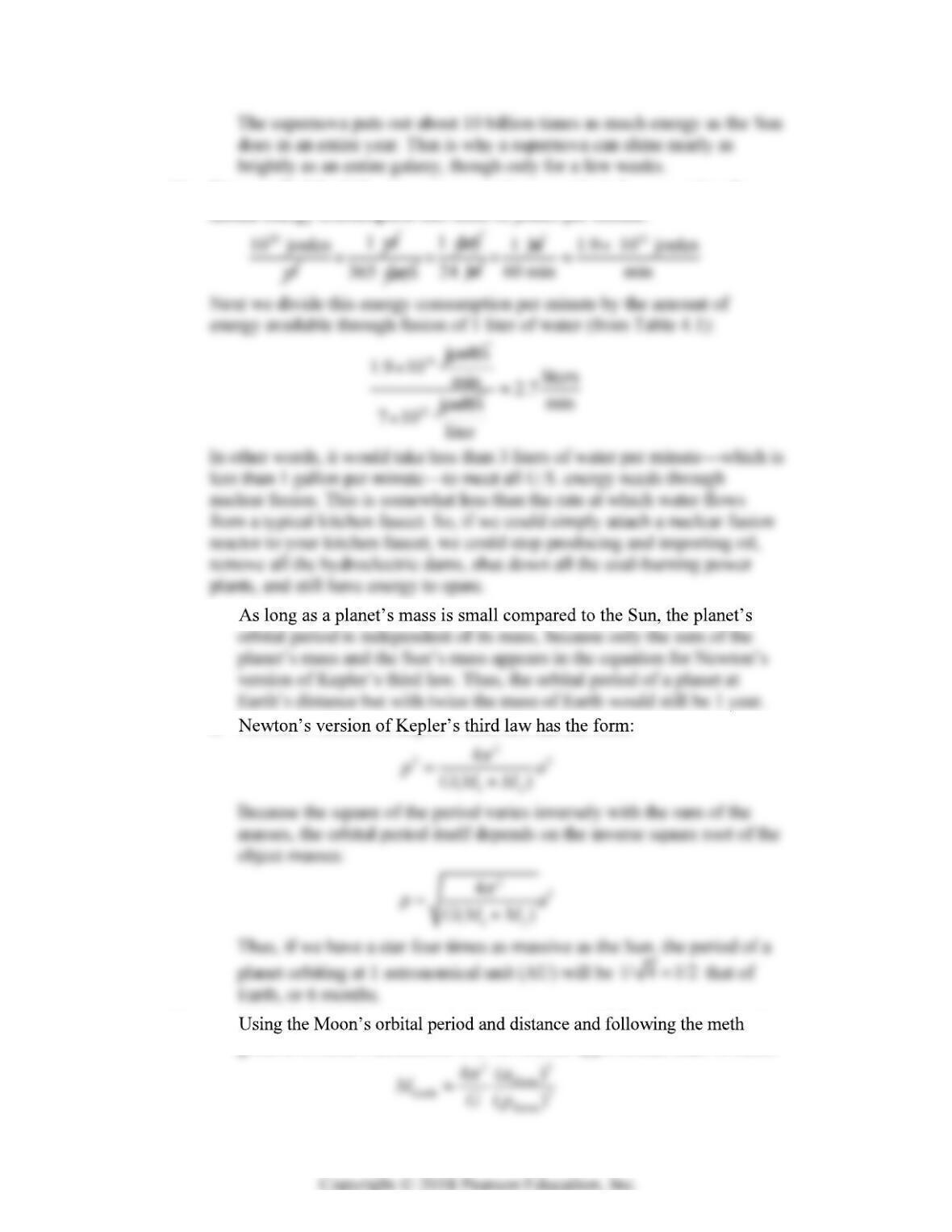
c. of the supernova
by dividing; to be conservative, we use the lower number from the 1044
1046 range for supernova energies:
Instructor Guide for The Essential Cosmic Perspective, Eighth Edition 63
44. First, we find the U.S. energy consumption per minute by converting the
annual energy consumption into units of joules per minute:
45. a.
b.
46. a. od
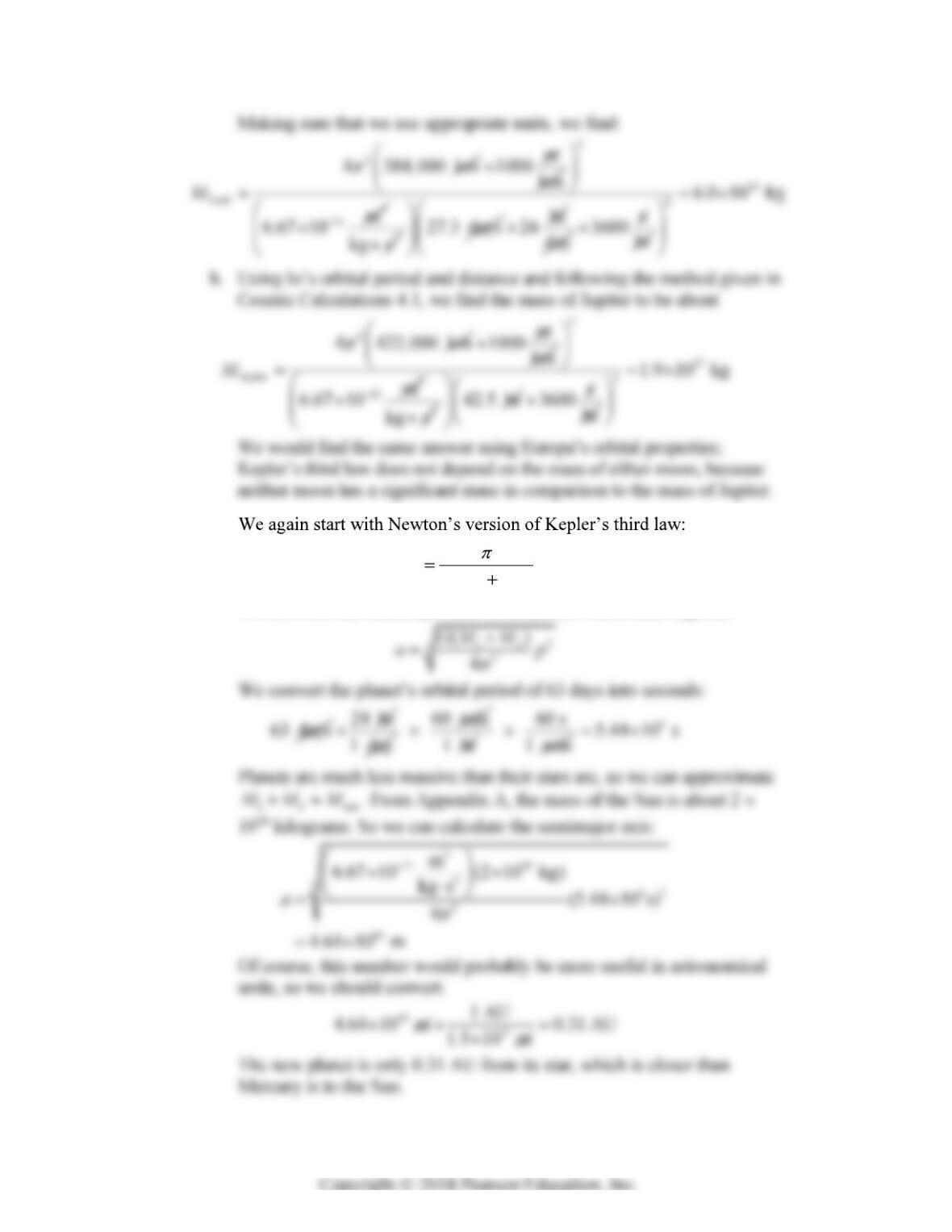
given in Cosmic Calculations 4.1, we find the approximate mass of Earth:
64 Bennett, Donahue, Schneider, Voit
c.
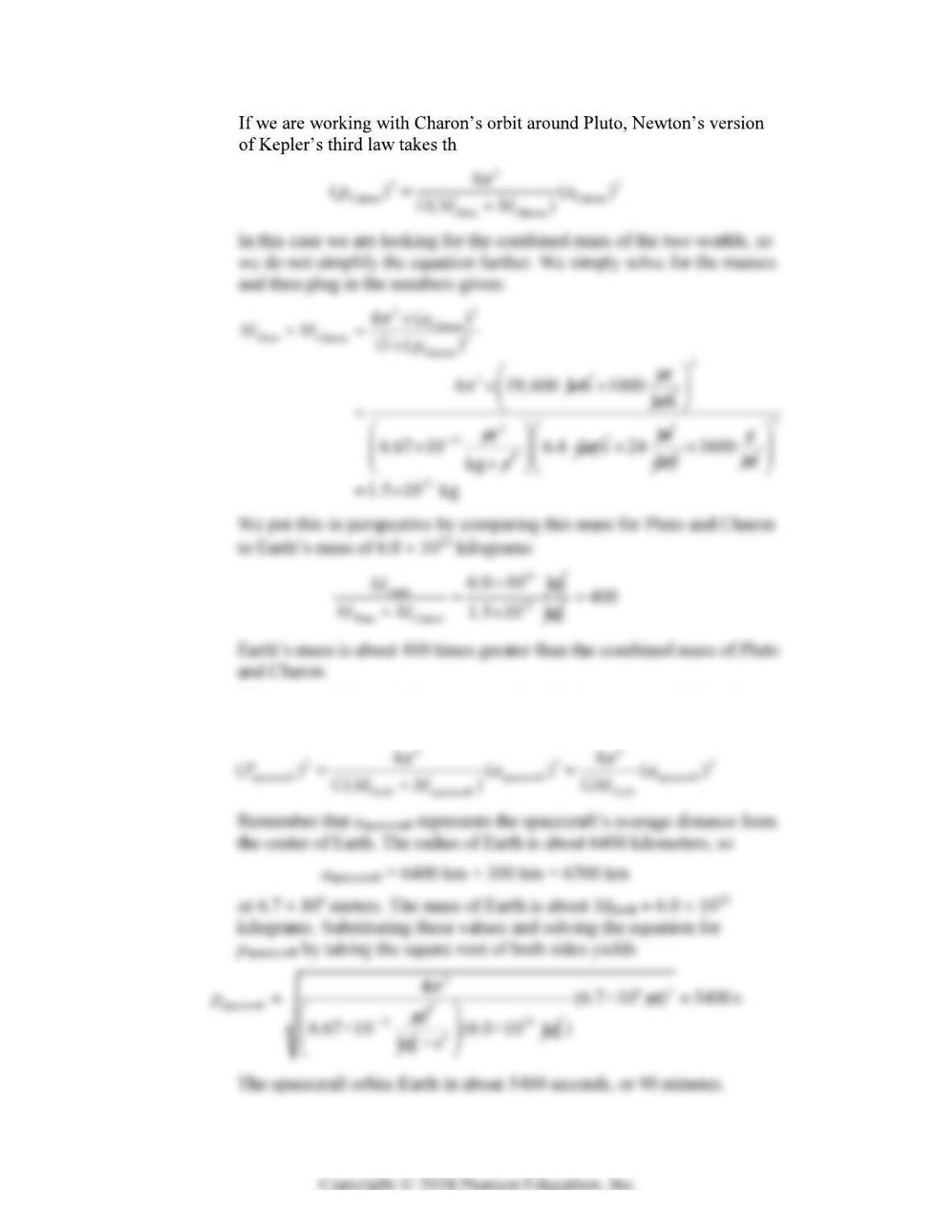
2
2 3
1 2
4
( )
p a
G M M
We solve for the semimajor axis of the planet with a little algebra:
Instructor Guide for The Essential Cosmic Perspective, Eighth Edition 65
d.
is form:
e. The spacecraft is much less massive than Earth, so we can follow the
method of Cosmic Calculations 4.1 to write
66 Bennett, Donahue, Schneider, Voit
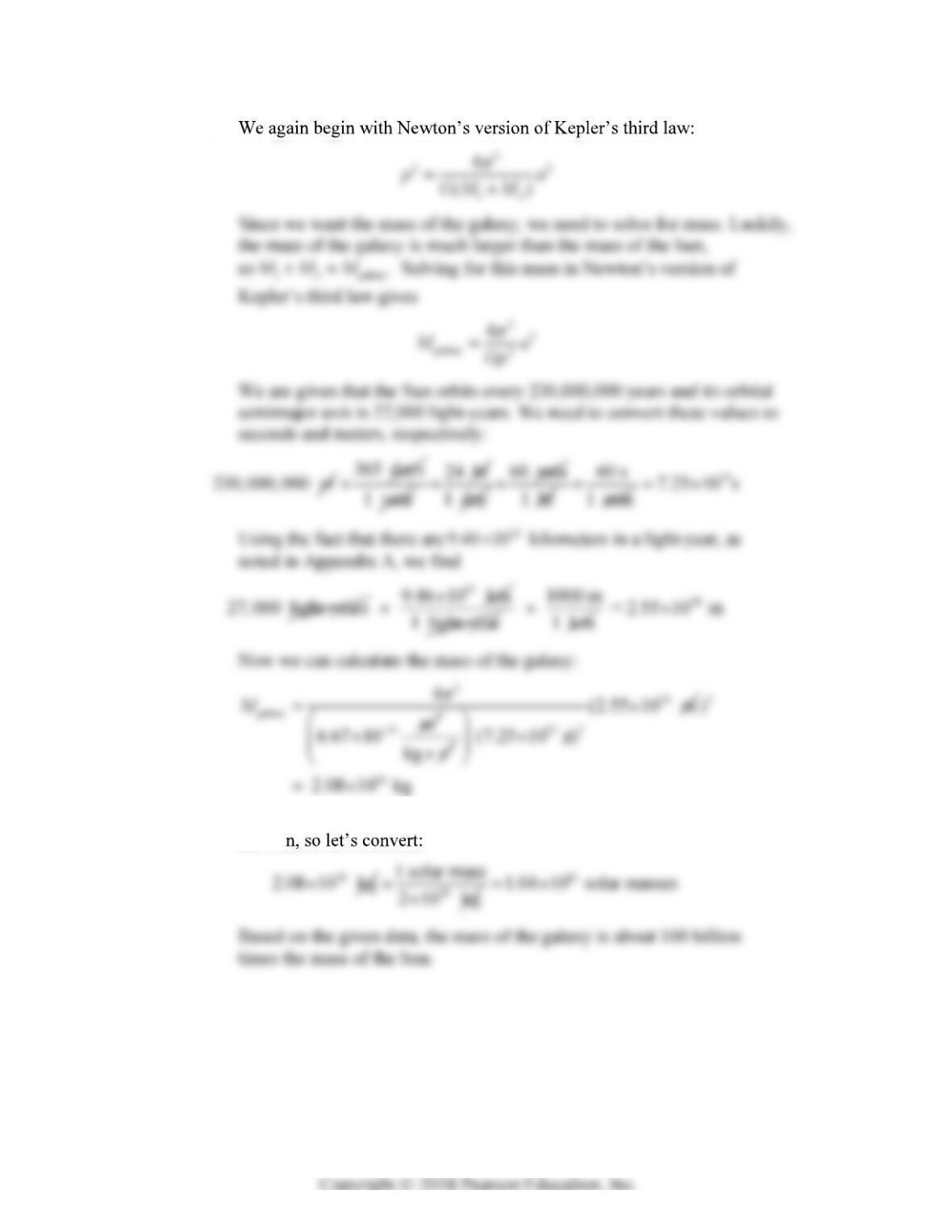
f.
This number is probably easier to understand as multiples of the mass of
the Su