Instructor Guide for The Essential Cosmic Perspective, Eighth Edition 239
Chapter 19. Life in the Universe
This final chapter discusses the fascinating topic of life in the universe and
includes discussion of life on Earth, the search for life in the solar system, SETI,
and interstellar travel and its implications for
that this chapter is essentially a very condensed version of topics covered in the
text Life in the Universe by Jeff Bennett and Seth Shostak. That text can be used
for a full-semester course on life in the universe. For supplemental reading, you
may also be intereste
called Beyond UFOs (Princeton University Press, 2008/2011).
Teaching Notes (by Section)
Section 19.1 Life on Earth
This section covers life on Earth so that students can understand what we are
looking for when we consider the possibilities of life elsewhere.
By necessity, this section introduces the fossil record, the geological time
scale, and the theory of evolution. Sadly, these ideas have become flashpoints
of controversy in our society, so be prepared to answer student objections.
You may particularly wish to emphasize that the scientific view presented
here need not contradict personal religious beliefs. For example, the theory
240 Bennett, Donahue, Schneider, Voit
Section 19.2 Life in the Solar System
This section covers possibilities for finding life elsewhere in our solar system,
with the greatest emphasis on Mars and Europa.
Section 19.3 Life Around Other Stars
This section considers prospects for life on planets around other stars. It includes
Section 19.4 The Search for Extraterrestrial Intelligence
This section provides a very short discussion of SETI efforts.
Note that we use a modified version of the Drake equation that is easier
approval from Frank Drake himself! FYI: There were three key reasons
we created this modified equation rather than using the original:
1. Units: We make a big point throughout the book that units should
2. While all of the terms in the original equation made sense in light of
current knowledge when Drake first wrote it in 1961, they do not all
seem quite as appropriate today. In particular, the term R*, for the rate
3. We believe that the overall equation is easier to understand with fewer
terms, as long as no
therefore combined sets of terms: First, we combined his fplanet ne into
our single term nHP, for the number of habitable planets. We think that it

Instructor Guide for The Essential Cosmic Perspective, Eighth Edition 241
Section 19.5 Interstellar Travel and Its Implications for Civilization
This section offers a brief overview of the difficulty of interstellar travel and
several potential technologies for interstellar travel and
Answers/Discussion Points for Think About It/See It for Yourself
Questions
The Think About It and See It for Yourself questions are not numbered in the
book, so we list them in the order in which they appear, keyed by section number.
Section 19.1
(p. 498) Plants and animals have lived for about the last one-eighth of the
history of life on Earth. Human existence, if we take it to be 100,000 years
(for Homo sapiens), is about 1/2000th of the 200-plus million years since
the emergence of early dinosaurs and mammals.
Section 19.2
(p. 507) A world can be habitable but not have life. Habitability speaks

242 Bennett, Donahue, Schneider, Voit
Section 19.3
(p. 512) This is a discussion question, but note the following key point:
The media have
Section 19.4
(p. 519) For this example we have NHP = 1000; flife = 1/10; fciv = 1/4; and
fnow = 1/5. In that case, we find that the number of civilizations = 1000
Solutions to End-of-Chapter Problems (Chapter 19)
Visual Skills Check
Review Questions
2. We study the history of life on Earth by using fossils, relics of organisms
that lived long ago. The geological time scale is a set of distinct intervals
scale include the following:
Instructor Guide for The Essential Cosmic Perspective, Eighth Edition 243
Carbon isotope evidence for life (3.85 billion years ago)
3. Evidence pointing to an early origin of life on Earth includes 3.5-billion-year-
3.85 billion years ago, although it is difficult to date these rocks.
4. The theory of evolution is the unifying theory through which scientists
understand the history of life on Earth. Evolution means change with time,
Natural selection refers to the
5. Scientists have conducted laboratory experiments in which chemical
ingredients similar to what we think were found on the early Earth are
subjected to sparks or other energy sources. The results show that these
simple processes can produce the major molecules of life, including amino
6. Life began as simple, one-celled organisms. Although plenty of genetic
evolution must have occurred over time, more complex life, such as animals
and plants, evolved much more recently. The evidence that points to a
7. Life may have migrated to Earth from elsewhere, perhaps being carried on
8. Life on Earth has been found in the cold, dry valleys of the Antarctic,
several kilometers underground, and in hot water. We have found organisms
that can survive acidic, alkaline, and salty environments that would be lethal
9. Habitable worlds are worlds that contain the basic necessities for life,
including liquid water. Apart from Earth, the only places that seem
potentially habitable are Mars and some of the large moons of the jovian
10. The search for life on Mars is being conducted primarily by exploring the
past Martian environment through on-the-ground studies with robotic rovers
11. habitable zone is the region around the star in which a terrestrial
planet of the right size could have a surface temperature suitable for liquid
12. Surface habitability is expected only on worlds similar in size to Earth
(or perhaps larger) within habitable zones. However, some super-Earths and
13. The Drake equation gives a simple way to calculate the number of
civilizations capable of interstellar communication that are currently sharing
the Milky Way with us, at least in principle. It calculates this quantity by
multiplying the number of planets capable of bearing life by the probability
14. SETI is the search for extraterrestrial intelligence. SETI researchers
generally use large radio telescopes to search for alien radio signals,
15. Interstellar travel is made difficult by several things. The first is the
enormous energy required to push a spacecraft up to reasonable speeds for
this sort of voyage. This problem is made worse by the fact that fuel is
heavy, adding to the weight of the spacecraft and therefore the amount of
16. says that if it is likely that a galactic civilization already
exists, why have they not yet visited? There are at least three possible
solutions to the paradox:
We are alone: This suggests that our rise to intelligence and civilization
is a remarkable achievement and that humanity is that much more
Fantasy or Science Fiction?
17. The first human explorers on Mars discover the ruins of an ancient
18. The first human explorers on Mars drill a hole into a Martian volcano to
collect a sample of soil from deep underground. On analyzing the soil, they
19. In 2040, a spacecraft lands on Europa and melts its way through the ice
into the Europan ocean. It finds numerous strange, living microbes, along
20. 5. A giant telescope on the Moon, consisting of hundreds
of small telescopes linked together across a distance of 500 km, has just
21. A century from now, after completing a careful study of planets around stars
within 100 light-years of Earth, astronomers discover that the most diverse
22. In 2040, a brilliant teenager working in her garage builds a coal-powered
23. In the year 2750, we receive a signal from a civilization telling us that the
24. Crew members of the matter-antimatter spacecraft Star Apollo, which left
25. Aliens from a distant star system invade Earth with the intent to destroy us
and occupy our planet, but we successfully fight them off when their
26. A single, great galactic civilization exists. It originated on a single planet
long ago but is now made up of beings from many different planets,
Quick Quiz
Process of Science
37. Answers will vary.
38. Answers will vary.
248 Bennett, Donahue, Schneider, Voit
Group Work Exercise (no solution provided)
Short Answer/Essay Questions
40. This is a subjective question, so the key is how well students defend their
41. The largest habitable zone should be around the hottest star, which is Sirius
with spectral type A1; the second largest would be around the second-hottest
Quantitative Problems
46. The number of stars we expect to have to search to find a signal is the
total number of stars in the galaxy divided by the number of civilizations
47. To find out how large a radio disk we would need to detect this signal,
BL
4
d
2
where B is the signal intensity per area at the telescope, L is the absolute
Instructor Guide for The Essential Cosmic Perspective, Eighth Edition 249
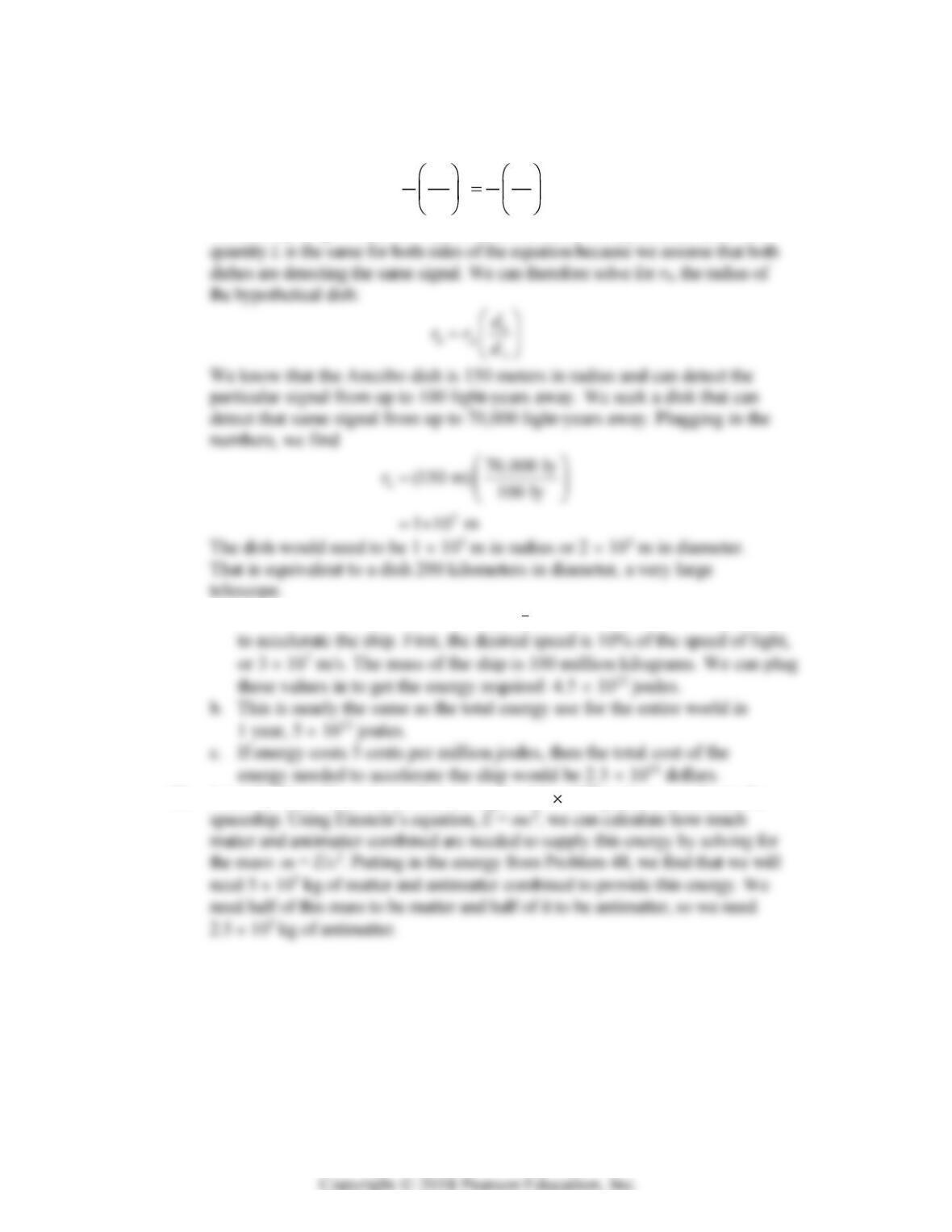
We can now equate the minimum signal that Arecibo can receive to the
minimum signal our hypothetical dish can receive:
2
2
4 4
h
A
A h
r
r
L L
d d
Here the subscript A refers to Arecibo and h refers to the hypothetical dish. The
48. a. Using the formula for kinetic energy, 1
2mv
2
, we can find the energy needed
49. From Problem 48, we know that we require 4.5 1022 joules to accelerate the