226 Bennett, Donahue, Schneider, Voit
Chapter 18. Dark Matter, Dark Energy, and the
Fate of the Universe
This chapter focuses on dark matter and dark energy and their presumed
significance in the universe. Students are likely to find this chapter particularly
relevant because these topics are so often in the astronomical news.
As always, when you prepare to teach this chapter, be sure you are familiar
Teaching Notes (by Section)
Section 18.1 Unseen Influences in the Cosmos
Students have probably heard the terms dark matter and dark energy and will
naturally assume that because we have names for these things we understand
them. Of course, the reality is that these are simply names given to whatever
might be causing particular patterns of observation: high orbital velocities in
Section 18.2 Evidence for Dark Matter
This section presents the evidence for dark matter in galaxies and galaxy
clusters and discusses the possible nature of dark matter, in particular the
evidence that suggests that it is not baryonic, or , We also
discuss the possibility that dark matter does not exist at all and that we are instead
misunderstanding the nature of gravity, but point out that the sheer weight of the
evidence at this point means that any such alternative interpretation of the data
will have to meet many observational constraints (e.g., alternative gravity theories
must do more than simply explain flat rotation curves of spiral galaxies the
current evidence for dark matter is far deeper and more diverse than that).
We include Cosmic Calculations 18.1, on estimating the mass-to–light
ratio in solar units.
In support of discussions of the nature of science, we have included an
Extraordinary Claims feature,
highlighting the history of the discovery of dark matter by Zwicky, Rubin,
and Ford.
Instructor Guide for The Essential Cosmic Perspective, Eighth Edition 227
For simplicity, we define ordinary matter to be baryonic matter (protons
and neutrons) and electrons and exotic matter to be nonbaryonic matter.
We prefer to speak of ordinary matter and exotic matter when possible
because these terms convey the proper impression to that large group of
students who have trouble remembering what a baryon is.
This section includes Figure 18.11, a plot that shows how the primordial
deuterium-to-hydrogen ratio puts constraints on the density of ordinary
Section 18.3 Structure Formation
This section covers large-scale structure in the universe and the role of dark
matter in creating it. The analogy for growth via gravity that we use in class is
that in certain economic systems, the rich get richer and the poor get poorer, and
the dichotomy grows with time. Places in the universe that were a little denser
Section 18.4 Dark Energy and the Fate of the Universe
This section explains how we try to assess the fate of the universe by measuring the
xpansion
rate has changed through time. We emphasize the potential role of dark energy,
presuming it exists.
In the 20th century, we could make a one-to-one correspondence between
three possible models of universal fate (recollapsing, critical, and coasting)
and three possible geometries (closed, flat, open). The introduction of dark
energy breaks this simple correspondence. We therefore find it easiest for
228 Bennett, Donahue, Schneider, Voit
Many popular articles and books have taken the evidence for an
accelerating expansion to suggest that we now know that the universe
will expand forever. The logic is simple: Evidence was already pointing to
an open universe before the acceleration was discovered, so acceleration
would seem only to further seal the case. We take a slightly different
Answers/Discussion Points for Think About It/See It for Yourself
Questions
The Think About It and See It for Yourself questions are not numbered in the
book, so we list them in the order in which they appear, keyed by section number.
Section 18.2
(p. 470) The graph of orbital speeds and distances for the moons orbiting
Jupiter would most resemble Figure 18.1b. The rotation curve for the moons
around Jupiter would decrease with increasing distance, just as the rotation
curve for the planets around the Sun decreases with increasing distance.
Section 18.3
(p. 478) Earth is held together by its own gravity; a hurricane is
not clear (at least as far as the content provided in the textbook) whether
or not the Orion Nebula is gravitationally bound. Certainly at one point
it was, but it loses gas as the stars evolve and now may or may not be
bound. A supernova is not gravitationally bound, because its shock wave
propagates out and does not return. (A piece of a massive star supernova
that may be left behind as a neutron star or a black hole is certainly itself
gravitationally bound.)
Instructor Guide for The Essential Cosmic Perspective, Eighth Edition 229
Section 18.4
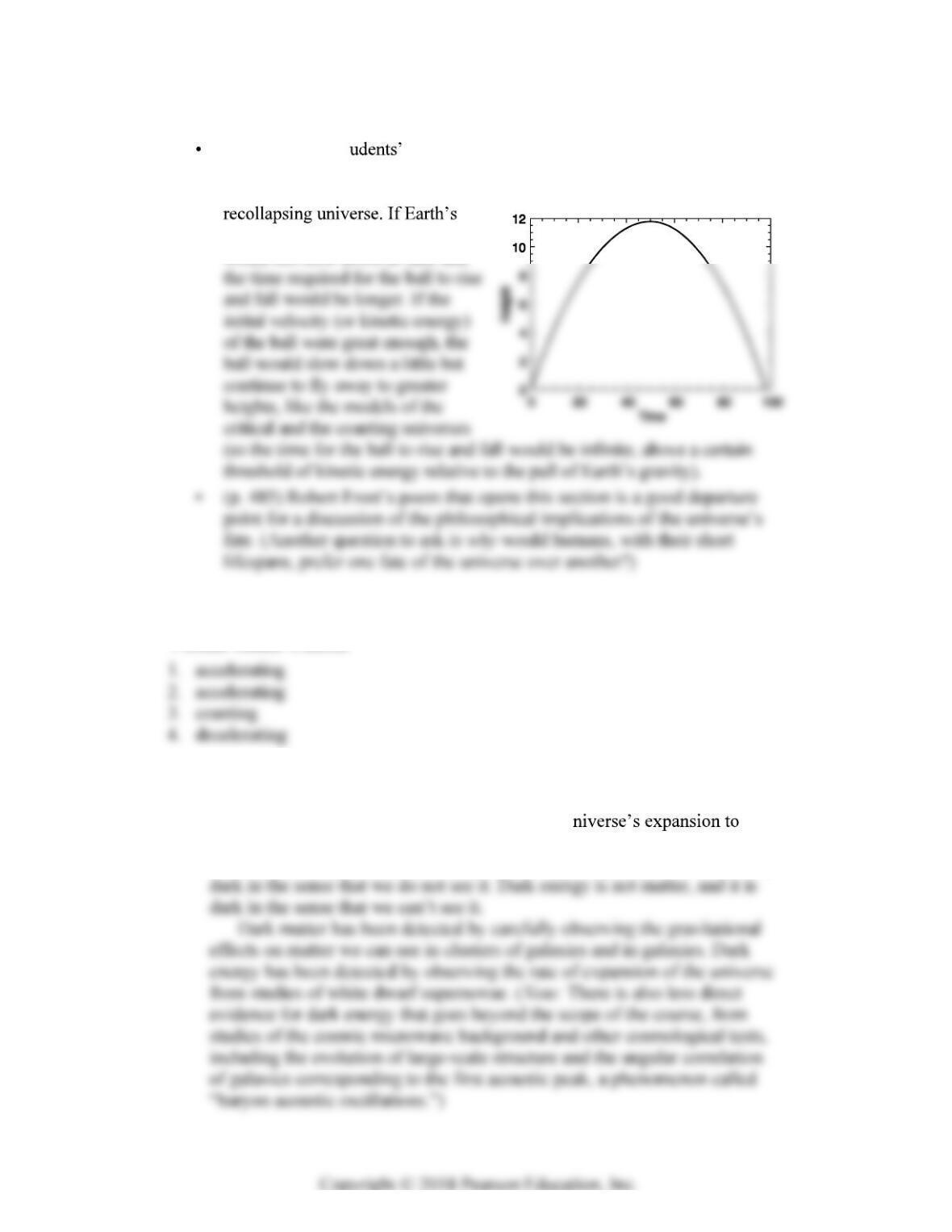
(p. 483, SIFY) St graphs should have the approximate shape of
this figure (units are not required, but time is measured on the x-axis, and
relative height on the y–axis). This curve most closely resembles that of the
gravity were not as strong, the ball
would not slow down as fast, and
Solutions to End-of-Chapter Problems (Chapter 18)
Visual Skills Check
Review Questions
1. Dark matter is matter that gives off little or no light. Dark energy is the
name given to whatever it is that is causing the u
accelerate. While they have similar names, they are not similar in nature.
Dark matter is massive, behaves like something that gravitates, and is really
2. A rotation curve plots the rotational velocity of stars against their distances
from the center of the
as we move out from the center of the galaxy and then more or less levels
3. We construct rotation curves for other spiral galaxies by observing the
4. We measure the masses of elliptical galaxies by measuring how much the
spectral absorption lines of stars in the galaxy are broadened in a spectrum
that includes measurements of many stars at once. The broader the spectral
5. We can measure the masses of clusters of galaxies in three ways. The first
method is to measure the speeds and positions of the galaxies in the cluster
deduce the mass of the cluster. The second method for finding the mass of a
6. Gravitational lensing is the bending of beams of light by massive objects.
This bending occurs because masses distort spacetime, according to general
7. Because we have measured the masses of galaxies and clusters using our
current theories of gravity, it is possible that the masses of the galaxies and
clusters are wrong if our theories of gravity are wrong. However, the
8. Dark matter is dark in the sense that it does not emit enough light for us to
9. Calculations based on the abundance of deuterium, lithium, and helium-3
indicate that the density of baryonic matter in the universe should be about
10. We say that particles such as neutrinos are weakly interacting particles
because they interact only with other objects through gravity or the weak
11. WIMPs, or weakly interacting massive particles, are a form of dark matter
that is made up of particles that do not generally interact with baryonic
12. The large-scale structure of the universe shows galaxies arranged in huge
chains and sheets that span millions of light-years. Between the chains and
sheets are giant voids. This structure probably mirrors the original distribution
of dark matter in the early universe. The denser regions in the early universe
13. There are four possible patterns for the expansion of the universe:
Recollapsing: We get a recollapsing universe if there is enough mass in the
universe. If this were the case, eventually gravity will halt the expansion of
the universe and reverse it. All of the matter in the universe would
eventually be crushed back together again, re-creating the conditions of
14. The cosmic microwave background (CMB) studies indicate that the total
density of matter plus energy in the universe is very close to 100% of the
15. Current studies (and Figure 18.17) indicate that the actual density of the
16. Current evidence indicates that the universe will continue to expand forever.
If the acceleration of the expansion of the universe continues without
declining, dark energy will cause galaxies to eventually separate so far from
Instructor Guide for The Essential Cosmic Perspective, Eighth Edition 233
Does It Make Sense?
17. Strange as it may sound, most of both the mass and the energy in the
universe may take forms that we are unable to detect directly. This
18. A cluster of galaxies is held together by the mutual gravitational attraction
19. We can estimate the total mass of a cluster of galaxies by studying the
20. Clusters of galaxies are the largest structures that we have so far detected in
21. The primary evidence for an accelerating universe comes from observations
22. There is no doubt remaining among astronomers that the fate of the
23.
24. Dark energy is the energy associated with the motion of particles of dark
25. Evidence that the expansion of the universe is accelerating comes from
observations showing that the average distance between galaxies is increasing
26. If dark matter consists of WIMPs, then we should be able to observe photons
produced by collisions between these particles. This statement does not make
234 Bennett, Donahue, Schneider, Voit
Quick Quiz
27. c. we can observe its gravitational influence on visible matter
31. c. gravitational lensing
Process of Science
38. The case for dark energy as presented at this level is the case made by
39. At the minimum, a new theory of gravity should pass all of the tests that
our current theory of gravity (general relativity) has already passed: the
Group Work Exercise
40. a. Students might speculate that
Short Answer/Essay Questions
41. If the acceleration continues, the formation of large-scale structures in the
universe ceases almost completely over the next 10 billion years. The
42. Dark matter allows gravity to make galaxies in a reasonably sprightly time
and gives life a chance to develop (before the nasty boring phase of the
43. We can only describe the rotation curves here:
a. All mass concentrated in the center of the galaxy: Decreasing rotation
44. In this situation, the supernovae turned out to be fainter than expected. (The
45. One possible constituent of dark matter is weakly interacting massive
particles, which do not interact with light. We can detect them in ways
similar to those we use to detect neutrinos or by their gravitational effects on
46. To explain flat rotation curves without dark matter, gravity would have to be
stronger than expected at large distances, because you need more gravity for
Quantitative Problems
47. The mass-to-light ratio of a 1MSun white dwarf with a luminosity of
0.001LSun is the mass over the luminosity:
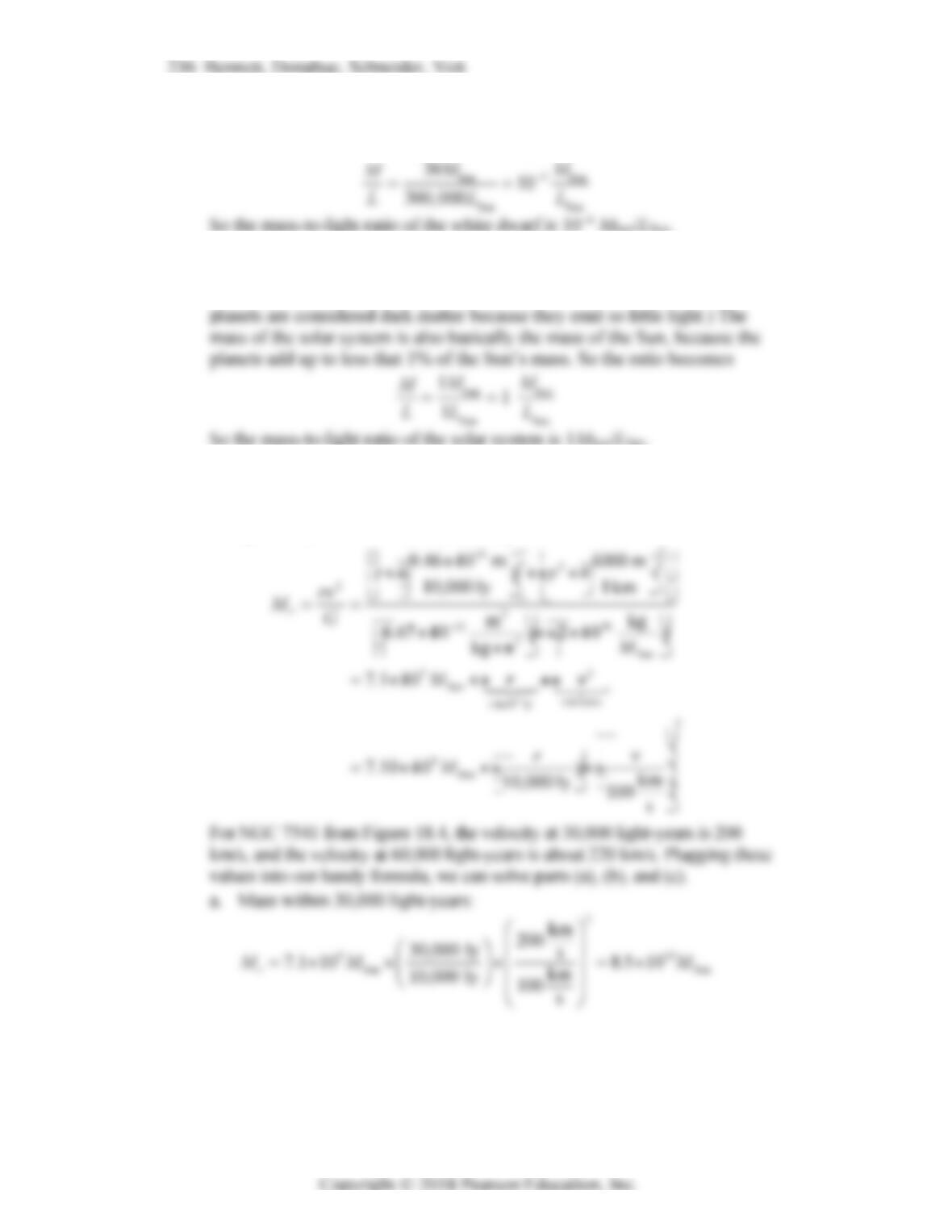
48. The mass-to-light ratio of a 30MSun supergiant with a luminosity of
300,000LSun is the mass over the luminosity:
49. To find the mass-to-light ratio of the solar system, we need the mass and the
luminosity. The luminosity is essentially just that of the Sun, because the
Sun is the only significant light source in the solar system. (Recall that
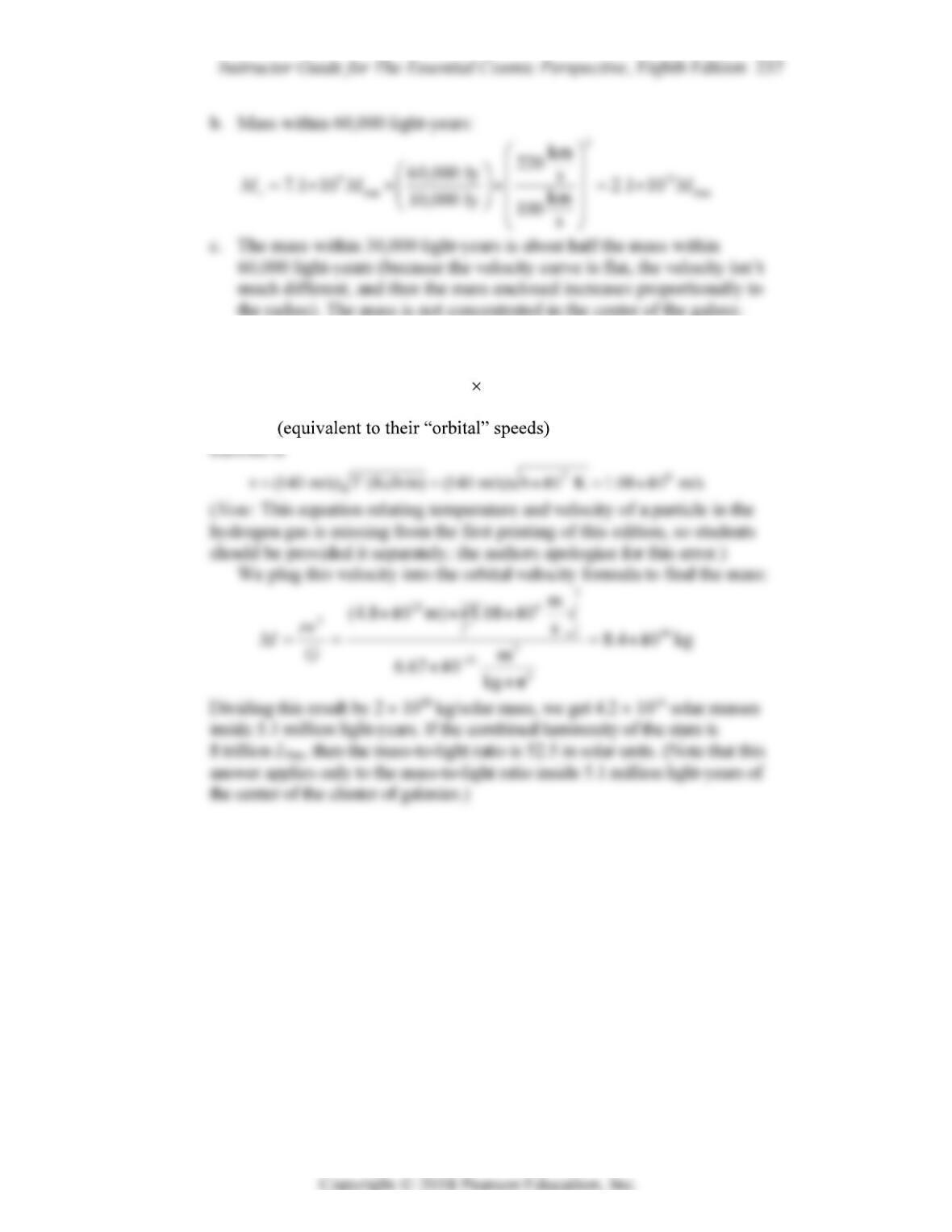
50. We can derive a general-purpose formula for this problem and for the next
problem by using the mass/velocity/radius relation and plugging in 100 km/s
for the velocity and 10,000 light-years for the radius. Then, for this and the
next problem, we need to do fewer computations:
51. For this problem, we assume that the gas in the cluster is all at one
temperature (isothermal) and that we have X-ray data from the cluster out to
at least 5.1 million light-years (4.8 1022 m). The equivalent velocity for the
particles in the gas, from the relationship between speed of the hydrogen
particles and the temperature in