Instructor Guide for The Essential Cosmic Perspective, Eighth Edition 201
Chapter 16. A Universe of Galaxies
This chapter describes the observed properties of galaxies and their implications.
We first examine the morphology and color of galaxies and then explain how
their distances are measured. Rather than postpone the implications of these
Key Changes for the 8th Edition: This chapter has been heavily rewritten to
reflect recent advances in the understanding of galaxy evolution. Following are a
few highlights of the changes:
The eXtreme Deep Field (XDF), obtained by the Hubble Space Telescope
in 2012, now appears in Figure 16.1, with a sketch of a thumb next to it for
perspective.
We have condensed the Learning Goals in Section 16.1 to a single one:
Sections 16.3 and 16.4 have been heavily revised to include research-based
updates on the connections between an active galactic nucleus and its
of the gaseous halos surrounding galaxies (probed by quasars in absorption

202 Bennett, Donahue, Schneider, Voit
Teaching Notes (by Section)
Section 16.1 Islands of Stars
This section introduces students to the subject of galaxies by way of the Hubble
Deep Field.
In our experience, the eXtreme Deep Field (XDF) is an excellent
pedagogical tool for students of all ages. People love the image and often
start classifying the galaxies in it into systems of their own. Consider
having students do some sort of classification exercise with Figure 16.1.
In this book, we do not delve very deeply into galaxy classification
radiates profusely in the X-ray band but is invisible in the optical band.
(Furthermore, elliptical galaxies can have some tiny amounts of dust
and molecular and neutral gas, so saying they have no interstellar medium
is simply incorrect.)
We discuss the modern view of galaxy classification, made possible by
Section 16.2 Distances of Galaxies
In order to know more about galaxies than just shape and color, we need to
know their distances. This section describes the chain of distance measurement
techniques that gives us the distances of galaxies and how we then use distances
to infer ages. An approach used by one of the authors of the textbook is to cover
this topic before going into most of the information in Section 16.1.
We have had success in class likening the Hubble constant to the scale of a
Instructor Guide for The Essential Cosmic Perspective, Eighth Edition 203
decays into cobalt-56 (27 protons, 29 neutrons) with a half-life of 6.1
days. The cobalt-56 then decays into iron-56 (26 protons, 30 neutrons)
with a half-life of 77 days. Because every white dwarf explosion produces
the same amount of nickel-56 about 1 solar mass of it the light curves
of all white dwarf supernovae are nearly identical.
geometric methods reach an increasing number of Cepheid variables, and
Cepheids calibrate many more galaxy distances, the pressure to learn
about all these other methods in an introductory course has decreased.
Explaining why these relations exist remains one of the challenges for
simulations of the formation and evolution of galaxies.
Section 16.3 Galaxy Evolution
This section
also discusses what is currently known about the process of galaxy formation and
evolution. We motivate the material by asking why spiral galaxies have gas-rich
disks while elliptical galaxies do not. We emphasize that astronomers do not yet
know many of the details of galaxy evolution, so the story presented in this
chapter is incomplete, but rapidly developing.
204 Bennett, Donahue, Schneider, Voit
Students are generally captivated by the idea that we can look back in time
by looking deeply into space. When explaining this concept, we find it
Section 16.4 The Role of Supermassive Black Holes
This section discusses the evidence that most galaxies host supermassive black
holes at their cores and examines the role played by active galactic nuclei in the
evolution of galaxies. Astronomical research has shown that the nuclei of virtually
all galaxies might pass through an active stage at least once and that the growth of
the nucleus appears to be intimately linked to the growth of the galaxy itself.
We keep the classification and nomenclature of active galaxies to a
minimum. We call all the most luminous active galactic nuclei quasars,
We retain the detail needed to discuss the evidence for the mechanism
by which active galactic nuclei appear to regulate their environs: the
incredible kinetic energy emerging from nearby radio galaxies shows

Answers/Discussion Points for Think About It/See It for Yourself
Questions
The Think About It and See It for Yourself questions are not numbered in the
book, so we list them in the order in which they appear, keyed by section number.
Section 16.1
(p. 413) The purpose of this classification question is just to get students to
look at the XDF and consider what it means.
Section 16.2
(p. 423, SIFY) The rubber band analogy for a one-dimensional expanding
Section 16.3
(p. 426) Compared to the age of the universe, 20 million years is a very
Solutions to End-of-Chapter Problems (Chapter 16)
Visual Skills Check
Review Questions
1. The three major types of galaxies are spirals, ellipticals, and irregulars.
Spiral galaxies, like our own, are flat white disks with yellowish bulges in
2. The major difference between spiral and elliptical galaxies is that elliptical
galaxies lack a significant disk component, although both types have the
3. The blue cloud is on the left (bluer) side and the red sequence on the right
(redder) side. The red sequence is elongated, going from very low to very high
206 Bennett, Donahue, Schneider, Voit
4. Elliptical galaxies are much more common in large galaxy clusters than they
6. For planets, we can use radar ranging to determine distances. For stars up to a
few thousand light-years away, we can use parallax to determine the
distances directly. For more distant objects, we turn to the techniques of
standard candles. One of the most important of these is the use of Cepheid
7. Hubble was able to see Cepheid variables in the Andromeda Galaxy. When
8.
from us is proportional to their distance. The proportionality factor is called
9. The Cosmological Principle states that the matter in the universe is
10. The expansion of the universe and the expansion of the surface of a balloon
are similar because both expand without having edges or centers. This
analogy shows
Instructor Guide for The Essential Cosmic Perspective, Eighth Edition 207
11. The lookback time to a distant galaxy is the difference between the present
age of the universe and the age of the universe when the light left the
12. The cosmological redshift is the stretching of photons due to the expansion
of the universe. A Doppler shift is caused by motion toward or away from
13. The cosmological horizon is the limit of the observable universe. Light from
14. Galaxy evolution is the study of how galaxies form and develop in our
expanding universe. Telescopic observations allow us to observe the history
15. The basic assumptions used in models of galaxy formation are that the
universe was initially filled more or less uniformly with hydrogen and
helium gas and that some regions of this gas were slightly denser than
16. There are two possible conditions that could lead to the formation of an
elliptical galaxy rather than a spiral:
208 Bennett, Donahue, Schneider, Voit
17. Collisions could result in gas being stimulated to form stars. They could
also remove gas from galaxies, through tidal interactions, ram pressure
from encountering gas clouds in other galaxies, or (indirectly) by inciting
18. A starburst galaxy is a galaxy that is forming stars at a prodigious rate.
Starbursts also mean many supernovae, and this can drive a galactic wind of
19. Quasars are active galactic nuclei that can be hundreds of times more
luminous than our galaxy. Their luminosity is emerging from a relatively
20. Evidence for the existence of supermassive black holes can be found in the
orbits of gas clouds and accretion disks in galaxies like M87 and NGC 4258.
21. A radio galaxy is a galaxy that has powerful radio luminosity compared to
its visible and infrared luminosity arising from stars. Radio galaxies can
22. The masses we measure for central black holes are closely related to the
properties of the galaxies around them, suggesting that the growth of these
black holes is closely tied to the process of galaxy evolution. The outburst of
Does It Make Sense?
23.
24. Cepheids make good standard candles because they all have exactly the
25.
26. The center of the universe is more crowded with galaxies than any other
27.
because then I could see the black void into which the universe is
expanding. This statement does not make sense because if I were living in
28. If someone in a galaxy with a lookback time of 4.5 billion years had a
superpowerful telescope, that person could see our solar system in the
29. Galaxies that are more than 10 billion years old are too far away to see
even with our most powerful telescopes. This statement does not make
30. If the Andromeda Galaxy someday collides and merges with the Milky Way,
31. NGC 9645 is a starburst galaxy that has been forming stars at the same
32. Astronomers proved that quasar 3C473 contains a supermassive black hole
when they discovered that its center is dark. This statement does not make
Quick Quiz
33. a. a galaxy in the Local Group
34. b. a giant elliptical galaxy
Process of Science
43. One hypothesis is that 10% of galaxies have higher peculiar velocities than
other galaxies. One explanation of that is that 10% of galaxies are in
44. Students should consider observations that might help draw out the
connection between supermassive black hole activity and star formation
45. This question asks the student to identify one unanswered question about
Group Work Exercise
46. This is a team-based method for estimating the number of galaxies in the
Short Answer/Essay Questions
47. The reason is similar to the reason a pollster might want to query a sample
48. A large spiral galaxy is more likely to host a massive star supernova,
49. Classification of galaxies in the Hubble scheme is not exact! Even
professional astronomers disagree about the classification of a given galaxy,
often by only one class or so. The instructor should look for a sensible
focus
answer. The classification system is defined only qualitatively in the text.
a. M101 is a face-on spiral with a small bulge; looks like an Sc (not much
of a bar, if any).
50. The Milky Way is near the top of the luminosity range for blue cloud galaxies,
51. From Figure 16.13, we can find the intrinsic luminosity of a Cepheid, given a
52. Galaxy light is dominated by the light from stars, which is the most
53. The surface of a balloon is a good analogy for the expanding universe because
the surface itself has no center (ignoring the input valve), and as
the balloon expands, every piece of the balloon surface stretches, not just
one piece. The analogy is limited because a real balloon is not perfectly
212 Bennett, Donahue, Schneider, Voit
54, 55. These questions ask students to briefly restate and explain ideas presented in
56. Since the mass inside that radius is, to a first approximation, completely
dominated by the mass of the supermassive black hole, we expect the orbits
to be Keplerian like those of the planets around the Sun, which completely
Quantitative Problems
57. Again, the exercise of counting galaxies in the figure will result in answers
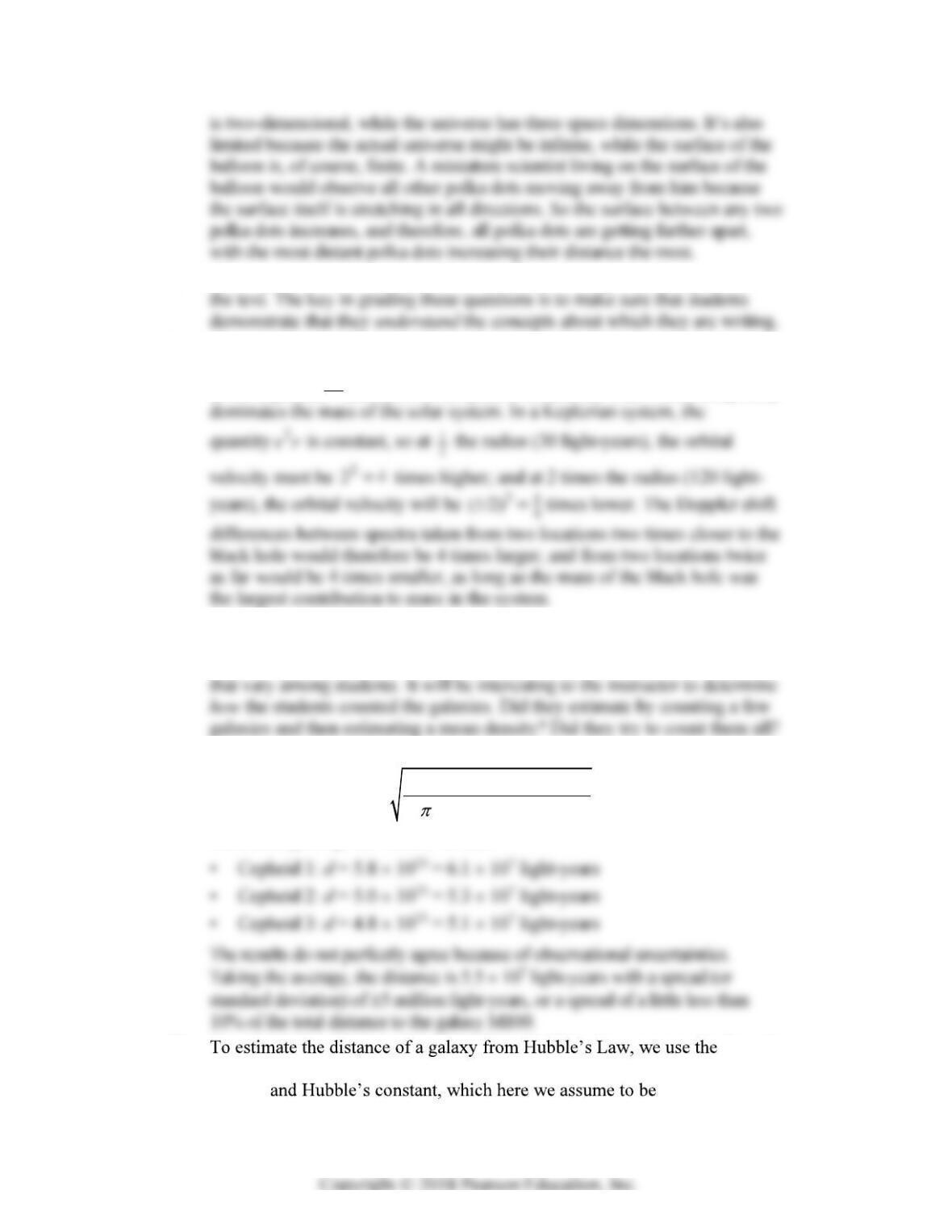
58. We can solve the luminosity-distance formula for the distance d:
dluminosity
4 apparent brightness
Substituting the given values, we find:
59. formula
from Cosmic Calculations 16.2, relating the distance d to the recession
speed v H0 = 22
Instructor Guide for The Essential Cosmic Perspective, Eighth Edition 213
60. a. lb ÷ 2.2 lb/kg = 54.5 kg.
b. A 100-watt light bulb uses 100 joules per second, so we divide the
energy released by the rate of energy release to see how long a bulb
Discussion Questions
61. ucation and culture affected the way he thought the universe should
62. The case for supermassive black holes, as for many aspects of our
astronomical knowledge, rests on inferential evidence, as we will not be able
to visit a black hole in our lifetime. The key to believing that supermassive