
190 Bennett, Donahue, Schneider, Voit
Part V: Galaxies and Beyond
Instructor Guide for The Essential Cosmic Perspective, Eighth Edition 191
Chapter 15. Our Galaxy
Chapter 15 introduces students to galaxies by detailing how our Milky Way
works. The agenda of this chapter is twofold: to inform students about our home
galaxy and to set the stage for the coverage of galaxy evolution in the next
chapter. In our view, galaxies are no less important than stars in preparing the
conditions for life, because a large star system is needed to retain and recycle the
elements created in the cores of stars. We find that students respond positively to
this idea because it connects the behavior of galaxies, and the Milky Way in
Key Changes for the 8th Edition: The basic structure of this chapter remains
unchanged, but we have made a number of scientific updates, in particular to two
key figures:
Teaching Notes (by Section)
Section 15.1 The Milky Way Revealed
This section introduces the Milky Way by summarizing its structure and its
contents. We review and expand on ideas introduced in Part I.
size and scope appears in a Special Topic titled How Did We Learn the
Structure of the Milky Way? Instructors who are pressed for time may
rotation curves to Chapter 18.
Section 15.2 Galactic Recycling
found that tracing the star gas star cycle from stellar mass ejection, through the
subsequent cooling of the gas and its collapse into clouds, to the process of star
192 Bennett, Donahue, Schneider, Voit
formation is an excellent way to tie together the various states of the interstellar
medium and to show the dynamism of our galaxy. Students who understand how
our galaxy cycles gas into stars are well prepared to understand how galaxies
evolve from pristine gas clouds to vast collections of stars enriched with heavy
elements.
We have chosen to avoid the astronomical term metals in this book,
preferring the term heavy elements instead. The term metals may confuse
Section 15.3 The History of the Milky Way
This section discusses the two major stellar populations and how they help lead us
to a model for how our galaxy formed.
We avoid using the terminology of population I and II, instead calling
them by what they are: the disk population and the halo population,
respectively.
Answers/Discussion Points for Think About It/See It for Yourself
Questions
The Think About It and See It for Yourself questions are not numbered in the
book, so we list them in the order in which they appear, keyed by section number.
Instructor Guide for The Essential Cosmic Perspective, Eighth Edition 193
Section 15.1
(p. 390) Stars are so far apart, relative to their sizes, that there is little
chance that a halo star will collide with the Sun or Earth.
Section 15.2
(p. 392) Stars in open clusters are generally much younger than those in
globular clusters, having formed after many heavy elements accumulated
Section 15.3
(p. 402) In the far future, after much of the gas in the disk has been
Section 15.4
Solutions to End-of-Chapter Problems (Chapter 15)
Visual Skills Check
1. brightest: white; lowest levels of brightness: black/dark blue
194 Bennett, Donahue, Schneider, Voit
Review Questions
1. Student sketches should look like Figure 15.1.
4.
version of keeping in
5. Stars are born from collapsing molecular clouds. They shine for millions or
billions of years through their nuclear fusion, turning lighter elements into
6. Bubbles of hot, ionized gas are created by supernova explosions and
7. Cosmic rays are electrons, protons, and neutrons that move at close to the
8. Atomic hydrogen gas is cool enough for atoms of hydrogen to hold on to
their electrons rather than be ionized. Atomic hydrogen gas clouds are not
9. There are several kinds of gas present in the disk of the galaxy. First, there
are hot bubbles, which are composed of low-density hot gas. This gas is best
viewed in the X-ray portion of the spectrum. At lower temperatures, we find
10. Ionization nebulae are colorful, wispy blobs of gas found near hot stars.
11. We know that the spiral arms cannot rotate like pinwheels around the center of
the galaxy because the inner stars would finish several orbits while the outer
12. Stars are created more readily in spiral arms because collisions between gas
clouds compress the gas in the clouds, increasing the strength of gravity and
13. The disk population of stars contains both young and old stars, all of which
14. We think that the protogalactic cloud that formed the Milky Way was
formed from several smaller protogalactic clouds because stars in different
15. Sgr A* is the name of the radio source at the center of our galaxy. The
Does It Make Sense?
16. We did not understand the true size and shape of our galaxy until NASA
17. rst stars because there
were so few heavy elements back then. This statement makes sense because
18. If I could see infrared light, the galactic center would look much more
19. Many spectacular ionization nebulae are
20. The carbon in my diamond ring was once part of interstellar dust grains.
21.
22.
stars near it have vanished over the past several years, telling us that
23. If we could watch a time-lapse movie of a spiral galaxy over millions of
24. The star gas star cycle will keep the Milky Way looking just as bright in
100 billion years as it looks now. This statement makes sense. Star
25. Halo stars orbit the center of our galaxy much faster than the disk stars.
Quick Quiz
26. a. round like a ball
32. c. infrared light
Process of Science
36. The fact that there are many more stars in a band across the sky than there
are perpendicular to that band suggested we are inhabiting a flattened
structure of stars. Because the interstellar gas and dust prevented us from
37. Some observational evidence for the model in Figure 15.18 comes from the
structure of our own galaxy. The halo is full of old stars and is spherical in
shape, which suggests that star formation ceased there many billions of
Group Work Exercise
38. By locating star clusters (open and globular) by their constellation on the
all-sky diagram in Appendix H, the students will make a straightforward
198 Bennett, Donahue, Schneider, Voit
Short Answer/Essay Questions
39. A star made of only helium and hydrogen would have to be among the
first generation of stars ever born, arising out of the primordial mix of
40. If one supernova can blow out all of the interstellar gas from a globular
cluster, no gas remains from which subsequent generations of stars can
41. Because stars that are traveling along with us in the disk of the Milky Way
move at a velocity relative to us of only about 20 km/s, we would reason
42. In 100 billion years, the Milky Way might resemble an elliptical galaxy. The
gas supply for star formation in the Milky Way will have been exhausted.
No new stars will have formed for many billions of years. The only stars
43. From Figure 15.21, the two stars that reach the highest observed orbital
Instructor Guide for The Essential Cosmic Perspective, Eighth Edition 199
44. The angular momentum is what drove the formation of a disk, so a
45. The student is asked to sketch the locations of interstellar clouds (molecular
and atomic hydrogen) and bubbles of hot gas in the plane of the Milky Way
Quantitative Problems
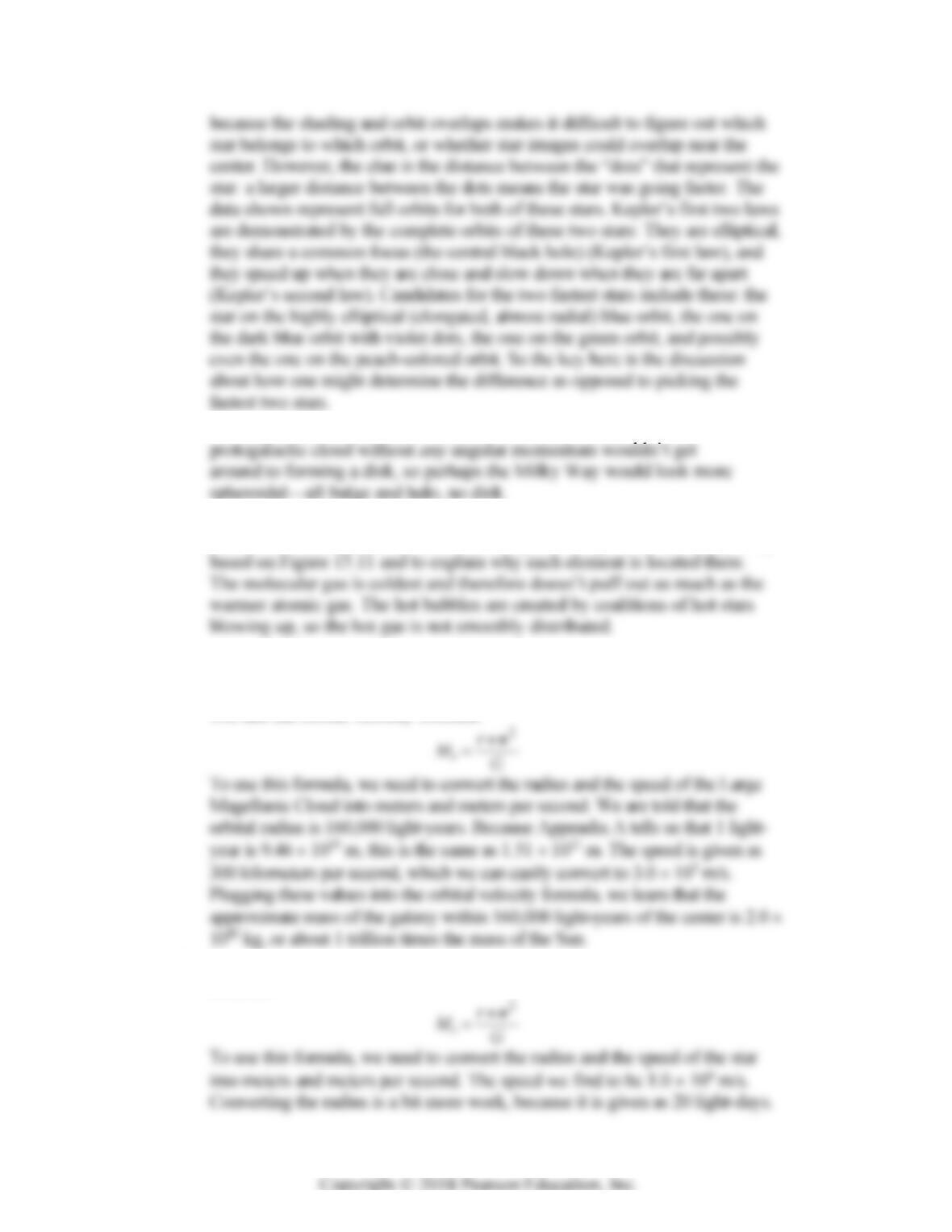
46. To find the mass within 160,000 light-years of the center of the galaxy, we
will use the orbital velocity formula:
47. To find the mass of the central black hole, we will use the orbital velocity
formula:
200 Bennett, Donahue, Schneider, Voit
of the Sun.
48. To find the mass of the globular cluster, we will use the formula for the
orbital velocity formula:
49. To find the mass of Saturn, we will use the orbital velocity formula: