178 Bennett, Donahue, Schneider, Voit
Chapter 14. The Bizarre Stellar Graveyard
This chapter covers the end points of stellar evolution: white dwarfs, neutron
stars, and black holes. Students often enter an astronomy course interested in and
enthusiastic about these objects and may find this to be one of their favorite
chapters in the book. The chapter also addresses the topic of gamma-ray bursts
(GRBs). In the last decade, the locations of GRBs were identified to be distant
galaxies, so the main mystery is no longer where they are, but what causes them.
Our discussion of white dwarf supernovae has been updated in light of
recent discoveries and the hypothesis that white dwarf supernovae result
from the merger of two white dwarfs. We remain (properly) agnostic about
An Extraordinary Claims feature presents stories about the development
of the ideas we discuss in this chapter. While this material was covered in
previous editions, it supports our theme Extraordinary Claims,
Extraordinary Evidence.
Section 14
Instructor Guide for The Essential Cosmic Perspective, Eighth Edition 179
Teaching Notes (by Section)
Section 14.1 White Dwarfs
This section discusses white dwarfs and the consequences of mass transfer in a
close binary that contains a white dwarf. Here is where we cover white dwarf
supernovae (aka Type Ia) and the differences between supernova light curves.
In order to keep the terminology as descriptive as possible, we call
1.4MSun the white dwarf limit rather than the Chandrasekhar limit.
Section 14.2 Neutron Stars
This section covers neutron stars and their manifestations as pulsars, X-ray
binaries, and X-ray bursters.
With regard to neutron star mergers and their role in producing gold,
platinum, and rare earth elements: About half of the heavy elements
beyond iron are produced by the r-process. The other half is produced
180 Bennett, Donahue, Schneider, Voit
Section 14.3
This section introduces students to the weird world of black holes, the highlight of
an astronomy course for many students.
The masses we quote for the Cygnus X-1 system are somewhat smaller than
those you might find elsewhere. We have taken them from the work of
Section 14.4 Extreme Events
This section continues themes from previous sections, from the origins of neutron
stars to the origins of black holes and the speculation regarding what happens
when two black holes merge.
The section discusses the observational phenomena called gamma-ray
bursts. Their energy output suggests that they are produced during the
formation of a black hole, and some gamma-ray bursts have been
associated with supernova explosions in distant galaxies. However, the
Answers/Discussion Points for Think About It/See It for Yourself
Questions
The Think About It and See It for Yourself questions are not numbered in the
book, so we list them in the order in which they appear, keyed by section number.
Section 14.1
Instructor Guide for The Essential Cosmic Perspective, Eighth Edition 181
Section 14.2
(p. 370) If a neutron star is a pulsar but its rotating beams of radiation
Section 14.3
(p. 372, SIFY) Drawing a triangle on the surface of a ball is a classic
Solutions to End-of-Chapter Problems (Chapter 14)
Visual Skills Check
Review Questions
1. Degeneracy pressure is a kind of pressure that arises when subatomic
particles are packed as closely as the laws of quantum mechanics allow.
2. A typical white dwarf has about the mass of the Sun packed into a ball the
radius of Earth. This compact object has a very high density: A teaspoon of
3. As the mass of a white dwarf increases, the pressure must increase to resist
gravity. To do this, the electrons must move faster. However, there is a limit
4. An accretion disk is a disk of orbiting material that is falling toward a
central body, such as a white dwarf. We see these only in close binary
182 Bennett, Donahue, Schneider, Voit
systems (not isolated stars) because they require material to be transferred
5. A nova is the glow from the thermonuclear flash from the onset of fusion in
a hydrogen shell on the surface of a white dwarf. The hydrogen shell comes
6. A white dwarf supernova occurs when the white dwarf gains enough mass
for the carbon interior of the star to begin carbon fusion. The fusion begins
7. A neutron star packs a greater mass than the Sun into a ball about
10 kilometers in radius. Something so massive and compact is extremely
8. We know that pulsars are neutron stars because we have found pulsars at the
centers of supernova remnants, right where we expect to see neutron stars.
We are also confident that pulsars are neutron stars because we know of no
9. In a close binary, a neutron star can accrete matter from its companion. As this
, its potential energy is
converted to heat. This process makes the inner region of the disk so hot that it
10. A black hole is like a hole in spacetime because it represents a part of the
universe we can never observe and from which we could never return if we
11. A singularity is a mathematical concept in which the math becomes
undefined (like division by zero, or infinity). In this chapter, a singularity is
12. If we were to fall into a black hole, we would perceive our own time as
passing normally. We would see the rest of the universe run faster and
13. We think that black holes should sometimes be formed by supernovae
because models indicate that in some supernovae, the outer layers of the star
are not completely blown away. The extra mass can push the core of the
14. Gamma ray bursts are brief but incredibly energetic outbursts of radiation
(primarily gamma rays) coming from locations well outside our galaxy. We
15.
compact objects will lose substantial amounts of energy to gravitational
waves, thereby causing their orbits to decay until the objects ultimately
Does It Make Sense?
16. The white dwarf at the center of the Helix Nebula has a mass three times the
17. I observed a white dwarf supernova occurring at the location of an isolated
white dwarf (not a member of a binary system). This statement does not
18. If you want to find a pulsar, you should look near the remnant of a supernova
described by ancient Chinese astronomers. This statement makes sense. Other
19. Scientists have just learned that there is a 10MSun black hole lurking near
20. If your spaceship flew within a few thousand kilometers of a black hole, you
21. We can detect black holes with X-ray telescopes because matter falling into
22. From your point of view, an object falling toward a black hole will never
23. The best way to search for black holes is to look for small black circles in
24. Gamma-ray bursts are more likely to be observed in galaxies that are
rapidly forming new stars than in galaxies containing only old stars. This
25. Gravitational waves are best observed with the Hubble Space Telescope.
This statement does not make sense. Gravitational waves are not a form of
Instructor Guide for The Essential Cosmic Perspective, Eighth Edition 185
Quick Quiz
26. a. a 1.2MSun white dwarf (It is about Earth size, and the 0.6MSun white dwarf
Process of Science
36. One of the most convincing cases for the existence of a black hole comes
close binary system
37. There are many unanswered questions related to black holes. Here are a few
Group Work Exercise
38. Below are the approximate estimates the groups should derive. Note that in
this Group Work Exercise, the students are assigned roles, but also specific
tasks to complete.
a. Inspection of Figure 12.10 shows that an O-type supergiant is about
100 solar radii in size.
186 Bennett, Donahue, Schneider, Voit
e. It should be clear that it is very difficult for matter to fall into an object
this size.
Short Answer/Essay Questions
39 42. These are extended essays; answers will vary. (Note: Many students really
43. White dwarfs are more common than neutron stars and black holes because
44. If X-ray bursts are not powerful enough to accelerate material beyond the
escape velocity of the surface of a neutron star, any accreted material will
45. In order to fall into a black hole, an object must lose enough of its initial
angular momentum to get close enough to cross the event horizon. The event
46. The life preserver would have to counteract the stretching force of the
Instructor Guide for The Essential Cosmic Perspective, Eighth Edition 187
Quantitative Problems
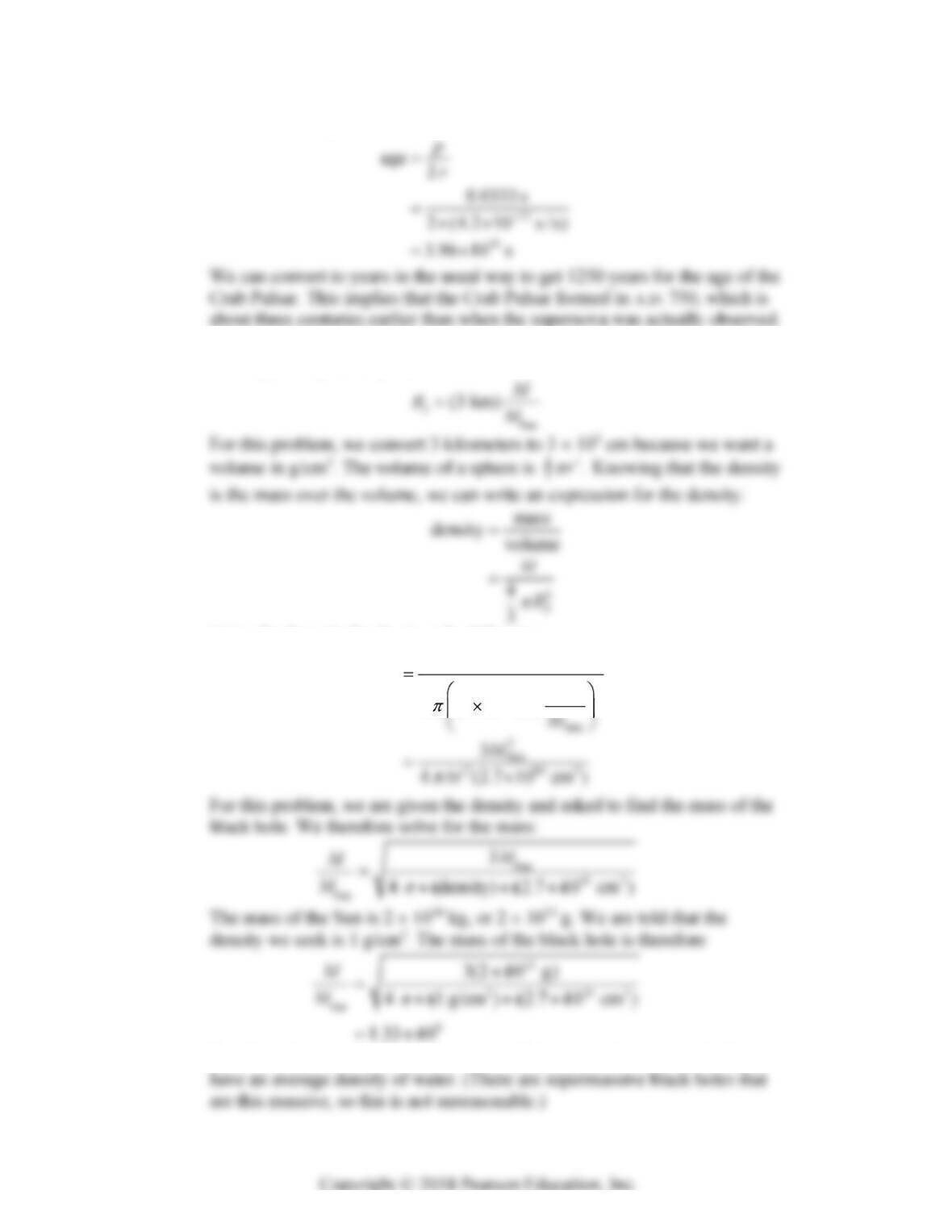
47. a. For the 108MSun black hole, the Schwarzschild radius is
b. The Schwarzschild radius of a 5MSun black hole is
c. The first formula in Cosmic Calculations 14.1 is more useful in this case.
d.
50 kilograms as a typical mass for a person. Then, your Schwarzschild
radius would be about
188 Bennett, Donahue, Schneider, Voit
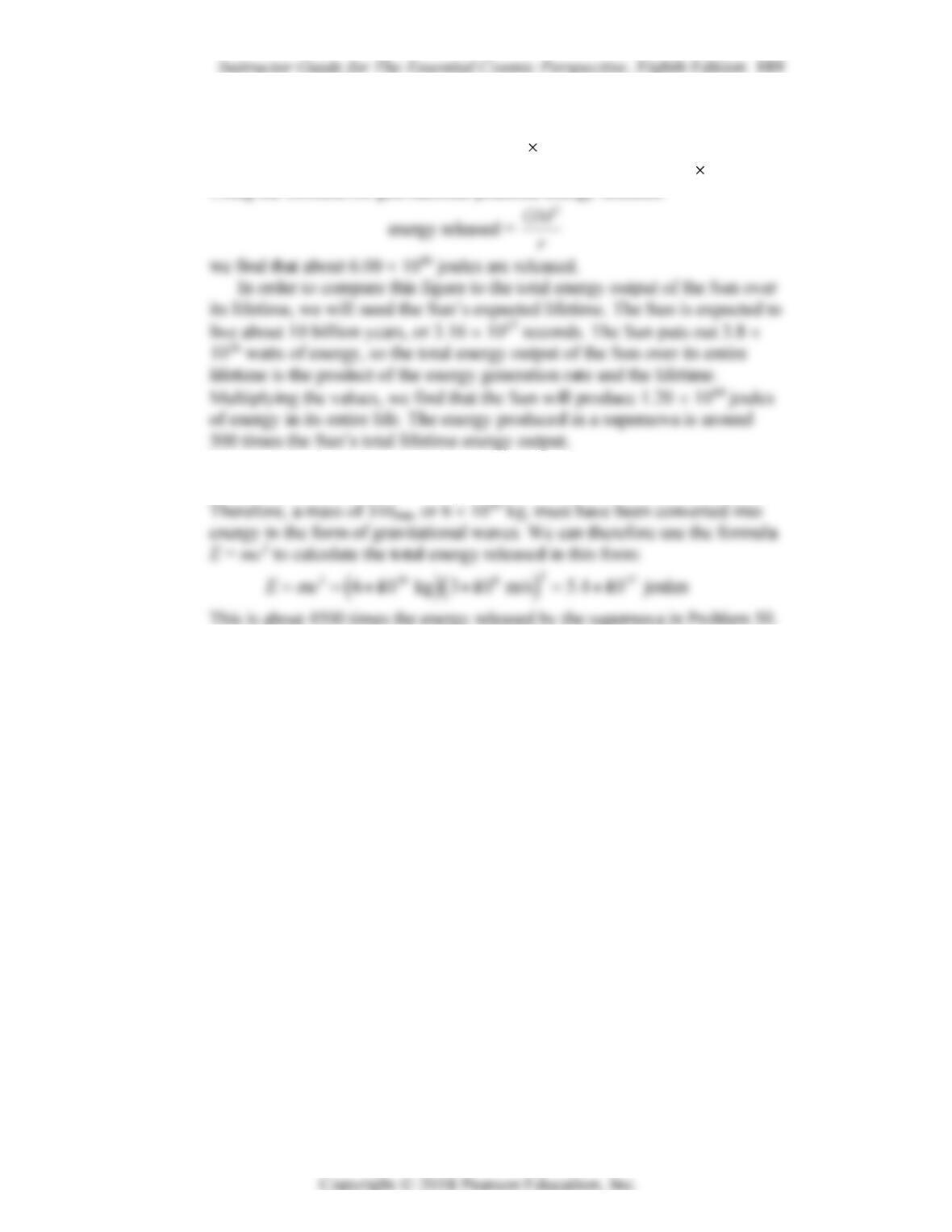
48. The estimated age of the Crab Pulsar is
49. Cosmic Calculations 14.1 tells us that the Schwarzschild radius of a black
hole is given by the expression:
Using the formula for RS gives the following:
3
5
3
density
4 (3 10 cm)
M
M
The black hole would need a mass 133 million times the mass of the Sun to
50. To answer this question, we will use 1.5MSun as the typical mass of a
neutron star. This comes out to be about 3 1030 kg. The radius of the
neutron star is given as 10 kilometers, but we will convert it to 1 104 m.
Using the formula for gravitational potential energy released:
51. The sum of the masses of the individual black holes before the merger was
29MSun + 36MSun = 65MSun. The mass of the merged black hole is 62MSun.