
164 Bennett, Donahue, Schneider, Voit
Chapter 13. Star Stuff
This chapter covers star birth and stellar evolution, highlighting the role that stars
play in creating the elements necessary for life. The battle between pressure and
gravity provides the drama, and the saga of the lives of stars is the main focus of
our discussion. We have reworked the discussion of equilibrium in this chapter,
to better articulate the role of both energy equilibrium (the balance between the
energy rate generated by processes in the star or in the cloud and the luminosity
of the star or cloud) and gravitational equilibrium (pressure balancing gravity).
We begin the chapter with a discussion of star birth, with a focus on the physical
processes occurring inside the molecular clouds. We close that section with a
discussion of the limits on stellar masses (both high and low), and we provide
Key Changes for the 8th Edition: We made no major changes to the structure
or content of this chapter, but we did do minor text updates and figure changes
to improve flow and clarity. We added several new narrated figures on the
MasteringAstronomy website that should help students review and understand
stellar evolution.
Teaching Notes (by Section)
Section 13.1 Star Birth
This section explains where and why stars form. We can now begin to explore
what happens in a gas cloud that is not in energy equilibrium or gravitational
equilibrium.
This is the first chapter in which we use the term thermal pressure instead
of pressure. We will need to distinguish between the various sources of
pressure in order to talk about star birth and stellar evolution in the next
chapter.
Cosmic Calculation 13.1 provides a simple expression (and an example)
for the mass of a molecular cloud that is in balance as a function of its
path through the H-R diagram. We are not avoiding the term evolution.
We simply
individual star through the H-R diagram; students associate evolution
with something that happens during multiple generations of individuals.
Section 13.2 Life as a Low-Mass Star
This section and the next discuss the subject of stellar evolution by returning to
the idea of gravitational equilibrium and explaining that the tug-of-war between
that all the changes a star goes through are driven by the need to balance pressure
and gravity, they will have a much easier time understanding how stars evolve.
For this book, we define low-mass stars as those with mass less than 8MSun and
high-mass stars as those with mass more than 8MSun that is, stars that end their
lives as white dwarfs and stars that end up as supernovae. We do not discuss
intermediate-mass stars between 2 and 8 solar masses explicitly, as single–
semester courses do not allow time to cover this next level of sophistication.
Section 13.2 describes how a low-mass star progresses from birth to death,
covering the transition to the red giant stage, hydrogen shell fusion, helium
fusion, the horizontal branch of the H-R diagram, and planetary nebulae.
You might be interested to add to the discussion the following points if your
course emphasizes the origins of elements:
High-mass stars are often given all the credit for producing the elements
necessary for life, but most of the carbon in the universe does not come
from the stars that explode. Late in their lives, the more massive low-mass
166 Bennett, Donahue, Schneider, Voit
Section 13.3 Life as a High-Mass Star
This section traces the life of a high-mass star. It includes discussions of the CNO
cycle, advanced nuclear fusion, the difficulty of extracting energy from iron, and
supernovae.
The text explains that higher-mass stars fuse hydrogen via the CNO cycle
because their higher core temperatures enable hydrogen to fuse to heavier
nuclei, but it does not explain why lower-mass stars use the proton-proton
chain rather than the CNO cycle. The reason has to do with the need for
protons to decay to neutrons via weak interactions. In the proton-proton
chain, fusion of two protons into deuterium requires this decay to happen
Section 13.4 Stars in Close Binaries
This last section describes how mass transfer in close binary systems can alter the
standard pathways of stellar evolution.
This section helps prepare students for the following chapter, in which
mass transfer onto white dwarfs, neutron stars, and black holes receives
considerable attention.
Instructor Guide for The Essential Cosmic Perspective, Eighth Edition 167
Answers/Discussion Points for Think About It/See It for Yourself
Questions
The Think About It and See It for Yourself questions are not numbered in the
book, so we list them in the order in which they appear, keyed by section number.
Section 13.2
(p. 342) A star grows larger and brighter after core hydrogen is exhausted
because hydrogen then begins to fuse in a shell around the core. Shell
fusion proceeds at a much higher temperature than core fusion, resulting
Section 13.3
(p. 350) If hydrogen had the lowest mass per nuclear particle, nuclear
fusion would be impossible, so stars would not give off any energy other
than that released by gravitational contraction. All stars would be like
Solutions to End-of-Chapter Problems (Chapter 13)
Visual Skills Check
Review Questions
1. A molecular cloud is a collection of the coldest and densest interstellar gas,
typically with low temperatures (10 30 K). At these cold temperatures, not
far above absolute zero, gas is in molecular form, most commonly molecular
168 Bennett, Donahue, Schneider, Voit
2. Protostars rotate rapidly because they form from much larger clouds. Even if
the original cloud was turning only very slowly, the collapsing cloud spins
3. A spinning disk of gas surrounds a protostar because, as a cloud collapses
and spins faster, collisions between the gas particles of the cloud cause the
4. The minimum mass for a star is 0.08 solar mass. Below this mass,
degeneracy pressure halts the collapse of the core before it gets hot enough
5. Degeneracy pressure is a quantum mechanical effect that halts the
contraction of protostars with masses less than 0.08 solar mass. Unlike
6. When the Sun exhausts its core hydrogen, the core will begin shrinking and
hydrogen fusion will begin in a shell around the core. The atmosphere of the
Sun will balloon and redden, hence the term red giant. This stage is called
hydrogen shell fusion. The core eventually shrinks and heats to the point at
7. Because helium nuclei have two protons, and therefore twice the charge of
hydrogen nuclei, they repel one another more strongly. Therefore, the nuclei
9.
10. A life track is the path that a single star takes through an H-R diagram over
the course of its life. The star begins on the main sequence seen in Figure
13.13 and spends most of its life there. Eventually, hydrogen fusion in the
core must end, and the star expands to a subgiant as the core shrinks and the
overall star expands, powered by shell fusion. Over a period of about a
billion years, the star will grow in radius into a red giant. Eventually, the
11. High-mass stars go through their lives more quickly than low-mass stars.
In part this is because, during their main-sequence lifetimes, they fuse
12. The simplest sequences of fusion are helium capture reactions, where
helium nuclei fuse with other nuclei. This builds carbon into oxygen,
oxygen into neon, neon into magnesium, and so on. Also, at the high
13. Iron cannot be fused to release energy because, for elements heavier than
14. One piece of evidence that supports our theories about how the elements
form in high-mass stars is the chemical composition of older stars. Our
theory predicts that the older stars should have fewer heavy elements in
15. When high-mass stars reach the stage of iron cores, degeneracy pressure will
briefly support the core against collapse. However, this situation cannot last
because gravity pushes the electrons past the limits and degeneracy pressure
fails. In a fraction of a second, the iron core shrinks from the size of Earth to a
16. In the binary system Algol, the stars should be the same age, yet the bigger
star is still on the main sequence and the smaller star is in the subgiant
phase. This is called the Algol paradox. Stellar evolution models say that the
more massive star should live its life faster and die more quickly, yet the
reverse appears to have occurred. The resolution to this paradox is that the
subgiant star was once more massive and lived its life faster. As it expanded,
it spilled its mass onto its companion. Mass transfer caused the companion
Instructor Guide for The Essential Cosmic Perspective, Eighth Edition 171
Does It Make Sense?
17. The iron in my blood came from a star that blew up more than 4 billion
years ago. This statement makes sense. The iron in the solar system was
18. I discovered stars being born within a patch of extremely low-density, hot
interstellar gas. This statement does not make sense. Hot interstellar gas has
19. Humanity will eventually have to find another planet to live on, because one
day the Sun will blow up as a supernova. This statement does not make
20. I sure am glad hydrogen has a higher mass per nuclear particle than many
other elements. If it had the lowest mass per nuclear particle, none of us
21. If the Sun had been born 4.5 billion years ago as a high-mass star rather
than as a low-mass star, Jupiter would have Earth-like conditions today,
22.
much higher proportion of helium and a lower proportion of hydrogen than
3.5MSun star when it was a
main-sequence star. This statement makes sense. The 2.5MSun red giant had
24. Globular clusters generally contain lots of white dwarfs. This statement
25. After hydrogen fusion stops in a low-mass star, its core cools off until the
star becomes a red giant. This statement does not make sense. Hydrogen
26. The uranium in nuclear reactors comes from supernova explosions. This
statement makes sense because elements heavier than iron are formed in
supernova explosions. A gold atom is heavier than an iron atom, so gold
falls into this category.
Quick Quiz
27. a. cold and dense
28. a. an object not quite massive enough to be a star
33. a. Supernovae would be more common (because more common, lower-
Process of Science
37. a. The Sun has a finite mass and is radiating energy at a steady rate. Even
b.
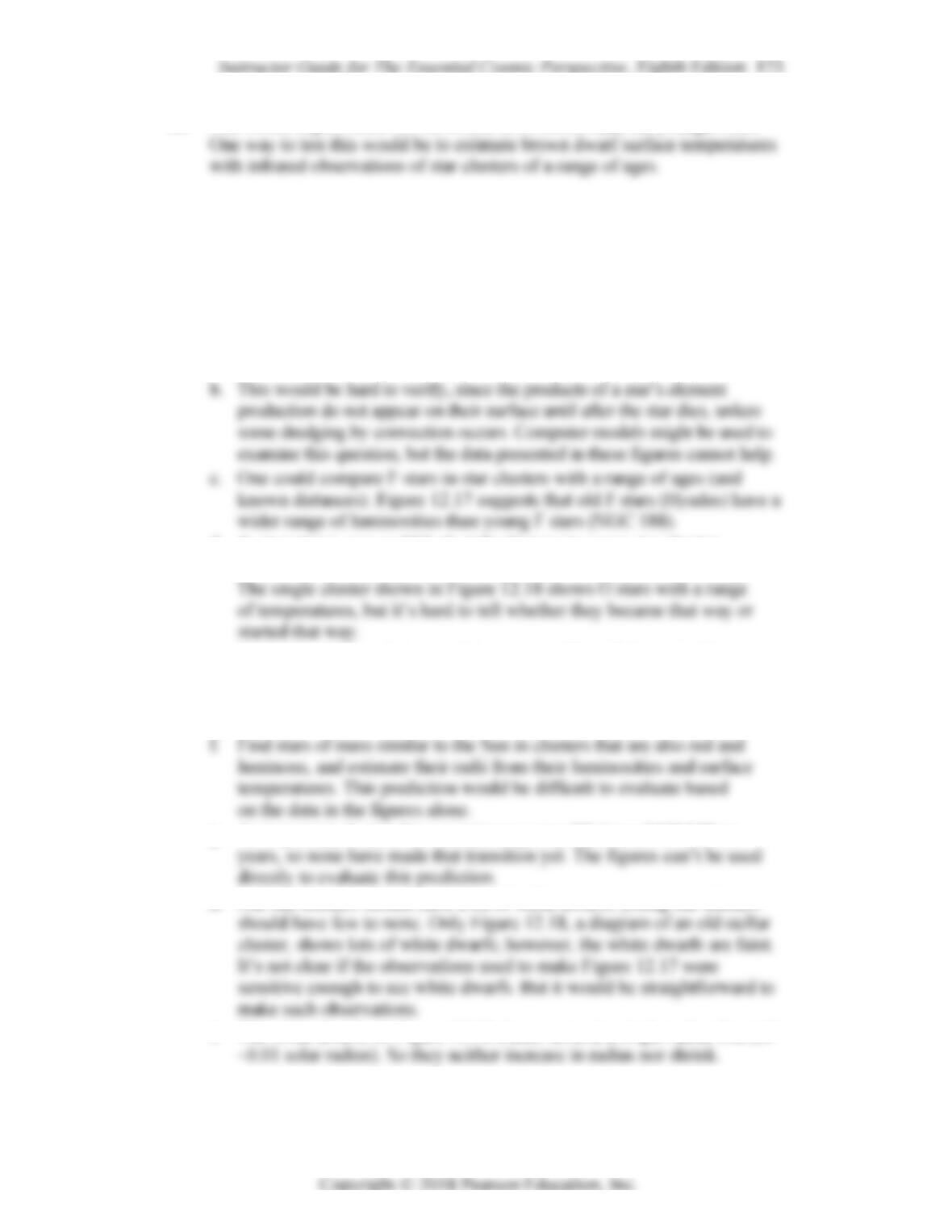
38. One would expect older brown dwarfs to be cooler than the younger ones.
Group Work Exercise
39. These answers given here simply suggest interpretations of the figures that
students might use in assessing the predictions; one needs to be able to
assume that the ages of star clusters indicated on the figures are accurate in
order to evaluate the predictions. This exercise asks students to look back at
figures in Chapter 12.
a. Figure 12.17 shows data from four clusters, and the O stars only appear
in the youngest clusters.
d. As in part (c), one could look at the O stars in young star clusters
and see if their average surface temperature changes with cluster age.
e. Evaluating this prediction is tricky, because K and M stars both have
expected lifetimes longer than the current age of the universe. So all the
K and M stars ever made are still alive. The indirect argument must be
made for the trend in mass, luminosity, and temperature.
g. As in part (e), K stars have a main-sequence lifetime of 100 billion
h. Old star clusters should have a lot of white dwarfs; young star clusters
i. The white dwarfs on Figure 12.18 cluster around a single radius line (of

174 Bennett, Donahue, Schneider, Voit
Short Answer/Essay Questions
40. Both brown dwarfs and jovian planets are formed of hydrogen and helium
gas yet are not massive enough to ignite hydrogen fusion in their cores.
41. The answers to the parts of this question revolve around several features of
stars: their lifetimes compared to the time presumably required to spawn an
advanced civilization and their effects on complex life forms that rely on a
protective environment, such as an atmosphere or an ocean, and a steady
source of energy to survive. Assumptions about all of these features are, of
course, debatable. Informed answers will address the stage of life each star
is in, what stages of life it has passed through, what may have happened to a
planet in that time, and how long the star has lived so far. Here are sample
answers:
a. A 10MSun star has a very short lifetime. It also produces copious
c. A 1.5MSun red giant is a temporary stage of life for a low-mass star. If an
advanced civilization had already developed around this star, which is
42. Helium fuses into carbon when three helium nuclei (atomic number 2)
combine into one carbon nucleus (atomic number 6), therefore bypassing the
elements lithium, beryllium, and boron, with atomic numbers 3 through 5.
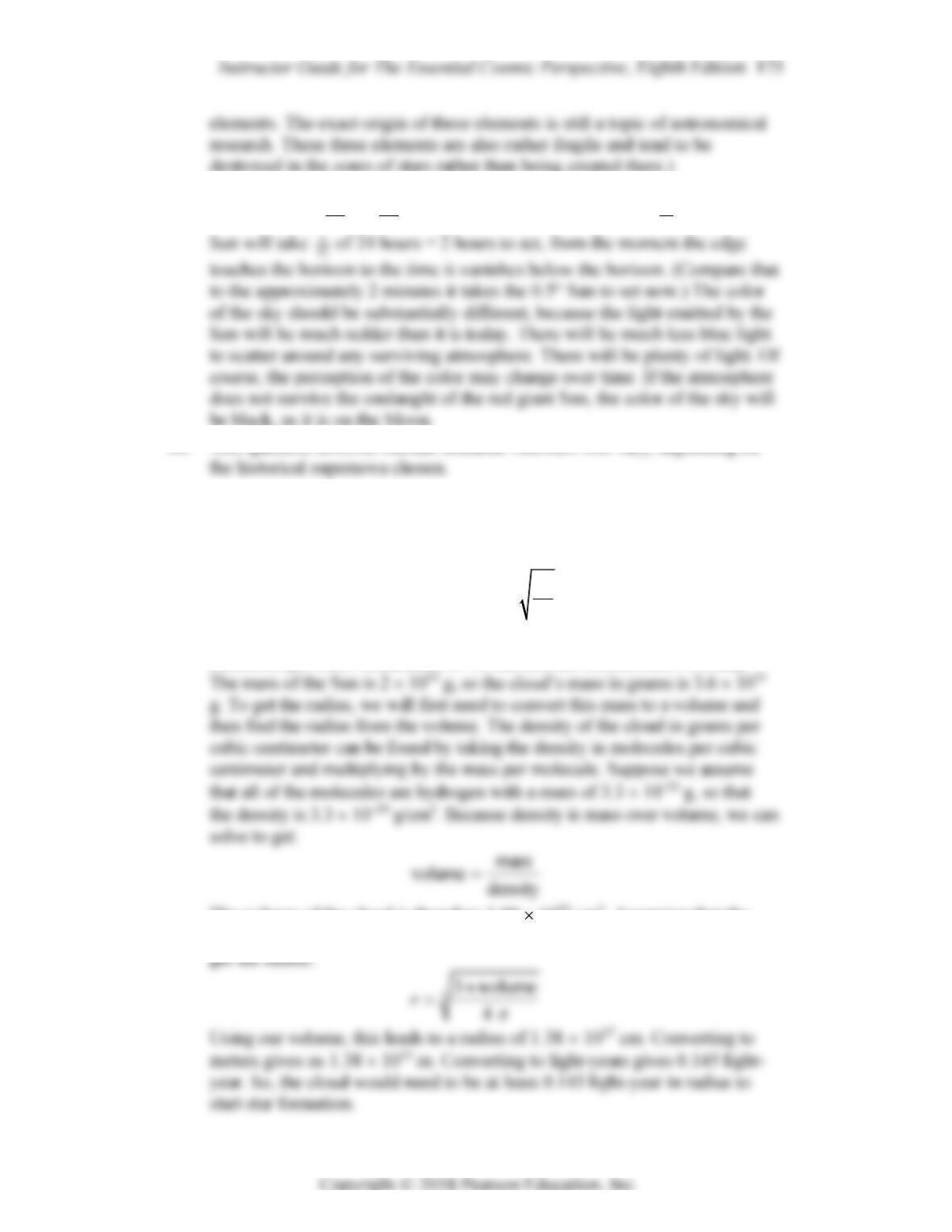
43. The Sun will have an angular size of 30°. The setting position moves
through the sky 360° once every 24 hours. So at 30°, or of 360°, the
be black, as it is on the Moon.
Quantitative Problems
45. From Cosmic Calculation 13.1, we know that the critical mass needed for a
cloud to collapse is
We are told that the temperature, T, is 10 K and the density, n, is 100,000
molecules per cubic centimeter, so we can find the critical mass: 1.8MSun.
The volume of the cloud is therefore 1.09 1052 cm3. Assuming that the
cloud is spherical, we can solve the formula for the volume of a sphere to
12
1
Mbalance 18MSun
T3
n
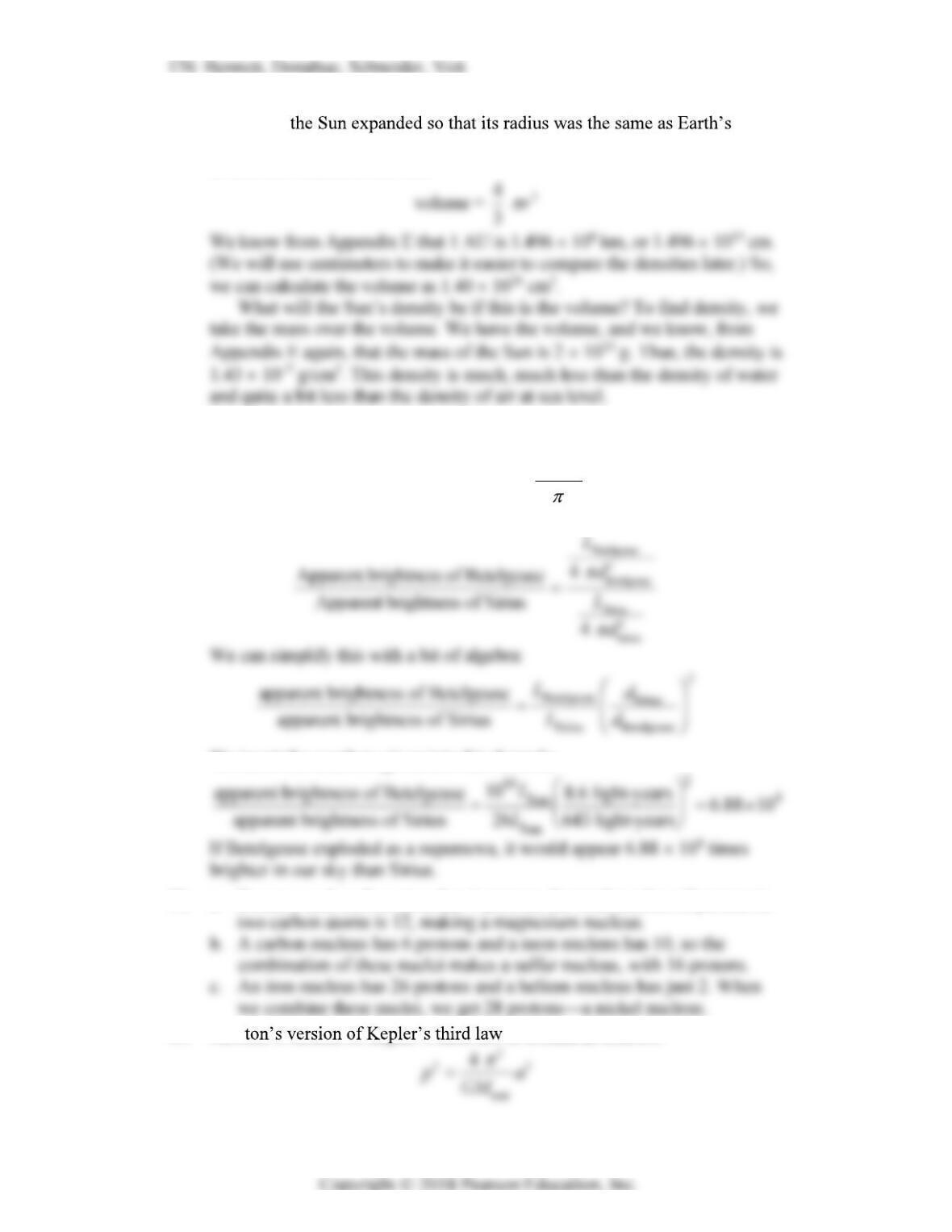
46. Assuming
orbital distance (1 AU), we can use the formula for the volume of a sphere
to find the volume of the Sun:
47. We know from Cosmic Calculation 11.1 that the apparent brightness of a
star is given by the following formula:
We can set up a ratio of the brightness of Betelgeuse to the brightness of Sirius:
We insert the numbers given into this formula:
48. a. Because each carbon atom has 6 protons, the total number of protons in
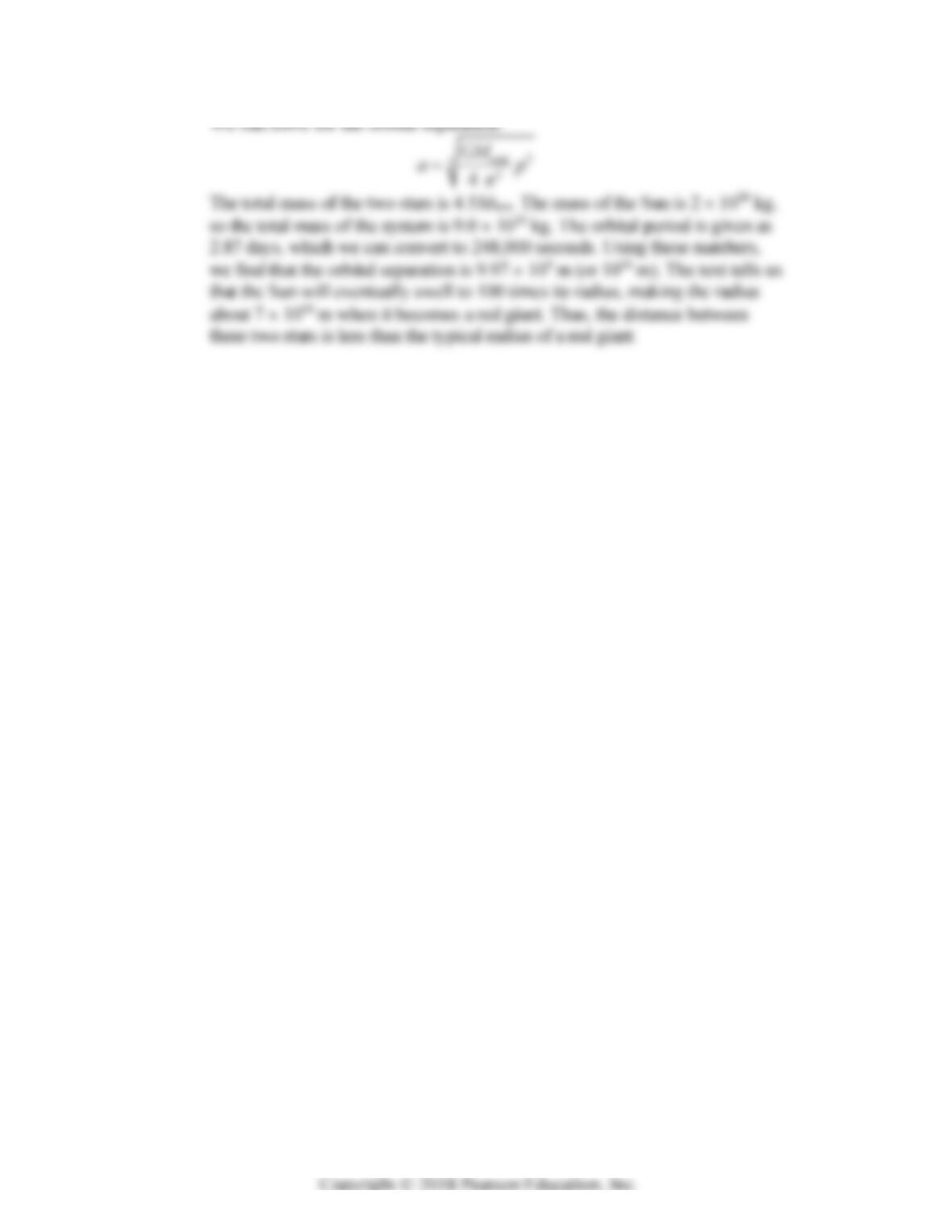
49. New is written as follows:
Apparent brightness =
L
4
d
2
Instructor Guide for The Essential Cosmic Perspective, Eighth Edition 177