128 Bennett, Donahue, Schneider, Voit
Chapter 10. Other Planetary Systems:
The New Science of Distant Worlds
This chapter covers the rapidly advancing science of planetary systems around
other stars, a science that is of major importance.
As always, when you prepare to teach this chapter, be sure you are familiar with
the online quizzes, interactive figures and tutorials, assignable homework, and
other resources available on the MasteringAstronomy website
Teaching Notes (by Section)
Section 10.1 Detecting Planets Around Other Stars
This section goes through the many methods that have been (or will be) used to
detect extrasolar planets. The difficulty of detecting planets directly bears
repeating. The difficulty heightens appreciation for the challenge and ingenuity
required to detect them indirectly.
Section 10.2 The Nature of Planets Around Other Stars
This section focuses on the properties of extrasolar planets that we can currently
measure, how those measurements are made, and what they show about how
extrasolar planets compare to the planets in our own solar system.
We encourage you to emphasize Figure 10.12, which is in some sense an
-R
Instructor Guide for The Essential Cosmic Perspective, Eighth Edition 129
Section 10.3 The Formation of Other Planetary Systems
This section covers what we deduce about solar system formation based on the
observed properties of other planetary systems.
This section presents an important opportunity to draw attention to how
science works. Specifically, the theory of solar system formation that was
developed to explain our own planets completely failed to explain many
Answers/Discussion Points for Think About It/See It for Yourself
Questions
The Think About It and See It for Yourself questions are not numbered in the
book, so we list them in the order in which they appear, keyed by section number.
Section 10.1
(p. 267, SIFY) This experiment can be done with items around the home
in which
the lighter planet moves in a big circle, but the more massive star
Section 10.2
confirmation) and by size (from transit).
Section 10.3
discussion.
130 Bennett, Donahue, Schneider, Voit
Solutions to End-of-Chapter Problems (Chapter 10)
Visual Skills Check
Review Questions
1. Extrasolar planets are difficult to detect directly because they are small
when viewed from Earth, many light-years away. In addition to their tiny
2. There are two main ways extrasolar planets have been found so far: the
3.
on its star is equal and opposite. In fact, the planet and the star
4. Scientists using the astrometric technique watch for tiny movements of a
planets that orbit far from their stars, even though distant planets take longer
5. Scientists using the Doppler method watch for movement in stars by looking
for periodic
close-in orbits. It detects planets in all orbit orientations except face-on. It
6. To use the transit method, we monitor the brightness of a star as a planet
star. Unfortunately, this technique works only in the rare cases when the
-on as seen from Earth, since otherwise the
7. This table shows planetary properties we can measure using each of the
three techniques discussed.
Property Doppler
Astrometric
Transit
Orbital period X X X
Orbital distance X X X
8. Because the Doppler technique detects only movement toward and away
from us, we do not know th
planet with a large inclination will give the same tugs along our line of sight
9. The transit method allows scientists to calculate the fraction of light absorbed;
this value use it to
10. Initial discoveries of extrasolar planets found that many of their orbits were
much more eccentric and much nearer their stars than those of the jovian
11. Planets have been found spanning a wide range of sizes and masses,
12. The figure charts planet size versus planet mass, making it easy to
distinguish planets of different overall composition. Planets that are small
and dense appear in the lower right, and planets that are lar
13. Migration means a planet gradually moves closer to or farther from its
parent star. Many extrasolar planets are much closer to their stars than we
14. Some of the differences between extrasolar planets and our planets probably
just result from multiple rolls of leading to slightly different
15. The nebular theory still accounts for the basic properties of extrasolar
16. This forward-looking question may have a better answer by the time you are
reading this. When the Kepler spacecraft stopped operating in 2013, it had
Instructor Guide for The Essential Cosmic Perspective, Eighth Edition 133
Does It Make Sense?
17. An extraterrestrial astronomer surveying our solar system with the Doppler
method could discover the existence of Jupiter with just a few days of
18. The fact that we have not yet discovered an Earth-size extrasolar planet in an
Earth-like orbit tells us that such planets must be very rare. False. Our
19. Within the next few years, astronomers expect to confirm all the planet
20. The infrared brightness of a star system decreases when a planet goes into
eclipse. Makes sense. T
22. Some extrasolar planets are likely to be made mostly of gold.
sense. We know of no process that enriches gold over other metals.
23. Current evidence suggests that there could be 100 billion or more planets in
24. 2 mission has announced the discovery of
25. –
26.
Quick Quiz
134 Bennett, Donahue, Schneider, Voit
Process of Science
37. According to the hallmarks of science, all theories are subject to
modification as new discoveries are made. Just because Ne
38. This question should inspire students to research new topics in this up-and-
coming field. Many are likely to choose the questions of whether Earth-like
Group Work Exercise (no solution provided)
Short Answer/Essay Questions
40. This essay question asks students to repeat the explanation of the Doppler
41. The Doppler technique has the main advantage of being able to detect
planets in a wide range of orbits as long as the orbit is not face-on. It is
42. We think that hot Jupiters formed beyond the frost line, as jovian planets did
in our solar system, and migrated inward due to interaction with the solar
43. Only Saturn has a low density among our jovian planets, because it is the
smallest planet that is still rich in hydrogen and helium. Among extrasolar
44. This is probably the most challenging observing project in the textbook, but
Quantitative Problems
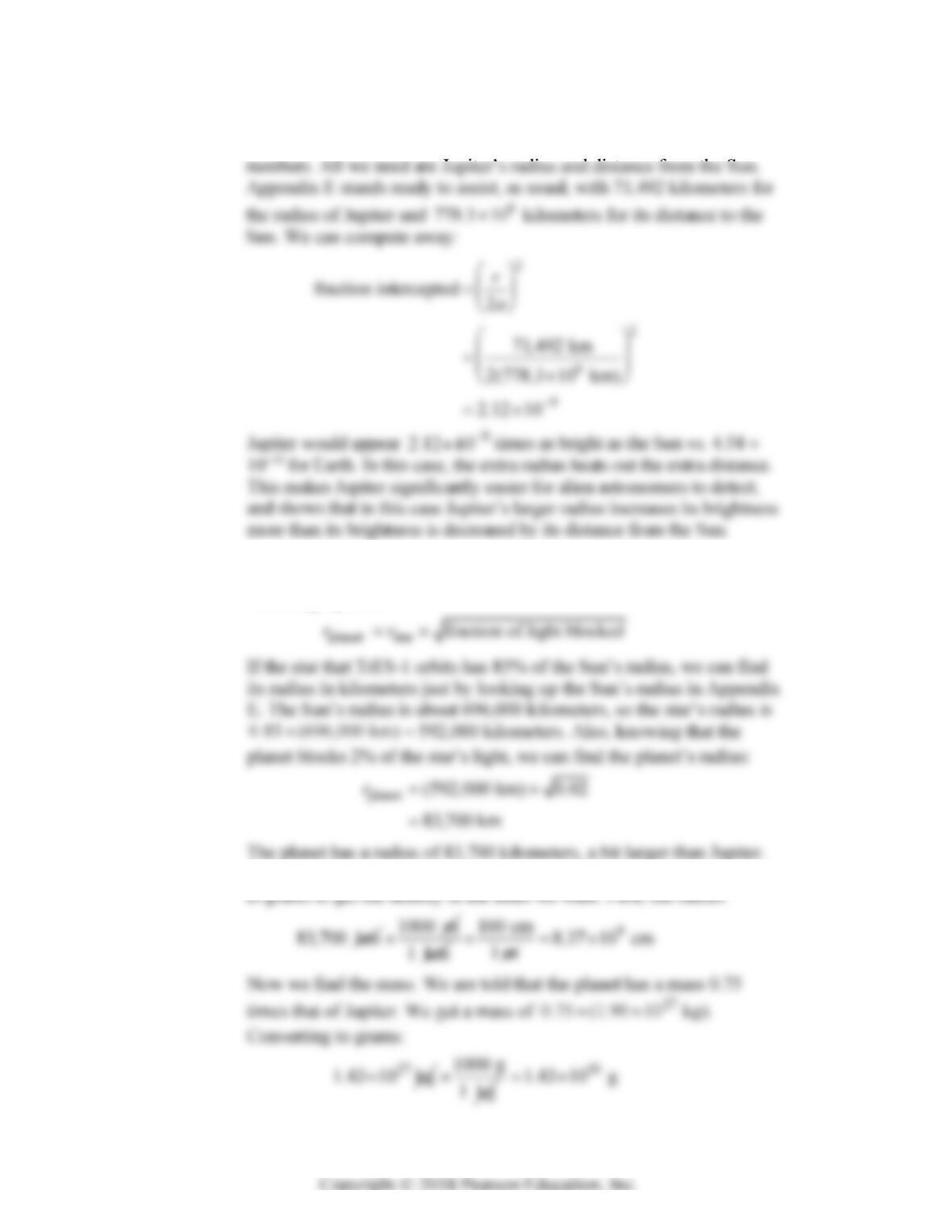
45. a. We start by setting the amount of light emitted by the Sun equal to L.
spread out over a
sphere of radius a
light per unit area is 2
/4L a since the sphere has an area of 2
4 .
a The
amount of light that Earth intercepts is equal to the amount of light per
-sectional area, 2
,
r where r
The amount of light that Earth intercepts is
136 Bennett, Donahue, Schneider, Voit
c. The expression we derived in part (a) will work here as well, since we
did not assume anything specific to Earth until we applied the actual
46. a. From Cosmic Calculations 10.1, we know that we can relate the
fraction of the light that is blocked to the radius of the planet with the
following equation:
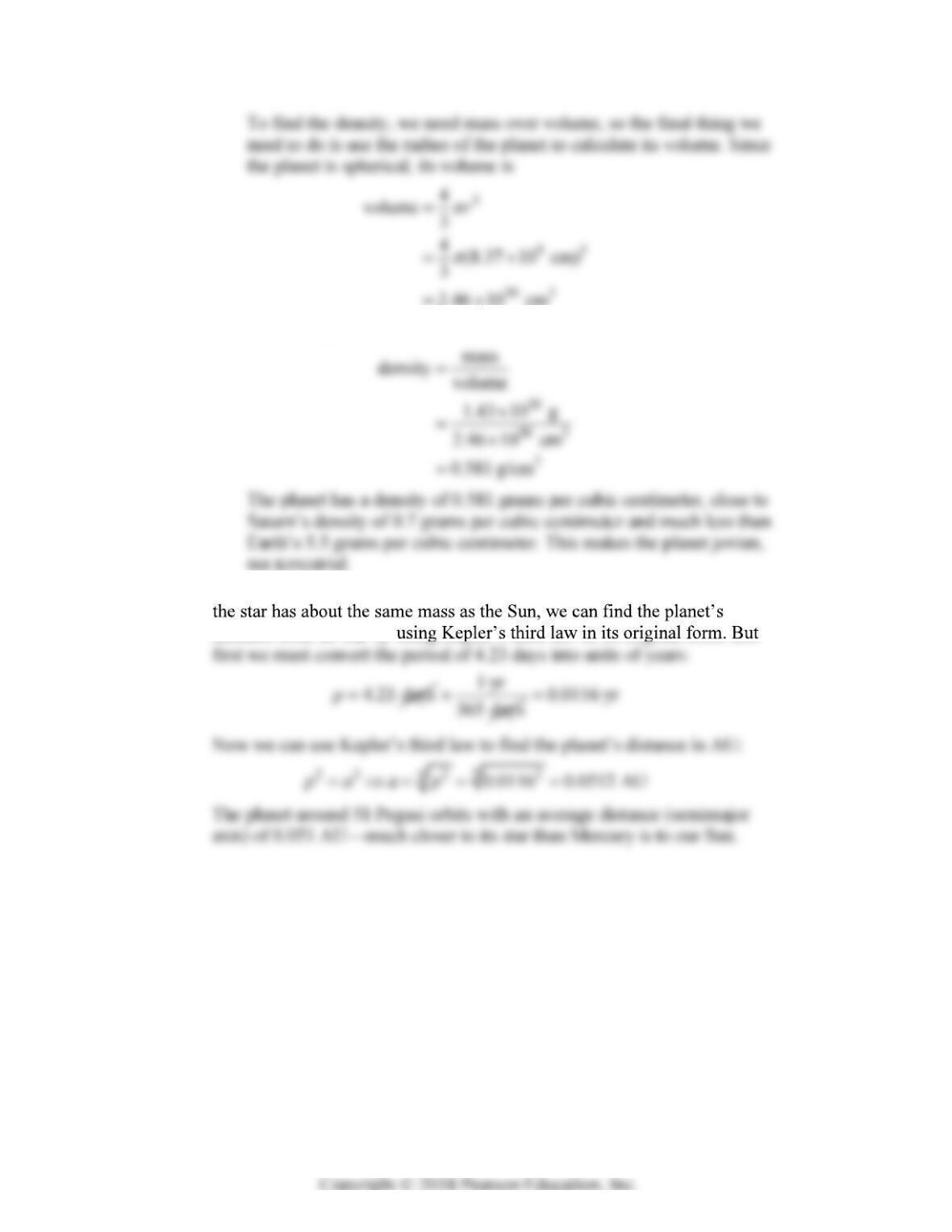
b. We need to convert the radius to centimeters and the mass of the planet
Instructor Guide for The Essential Cosmic Perspective, Eighth Edition 137
2.46 10 cm
The density is
47. The planet orbiting 51 Pegasi has an orbital period of 4.23 days. Because
distance from its star by