
Instructor Guide for The Essential Cosmic Perspective, Eighth Edition 21
Chapter-by-Chapter Guide
Part I: Developing Perspective
The remainder of this Instructor Guide goes through the book chapter by chapter.
Each chapter is organized as follows:
A brief introduction with general comments about the chapter.
Teaching Notes. Organized section by section for the chapter, these are
essentially miscellaneous notes that may be of use to you when teaching
your course.

22 Bennett, Donahue, Schneider, Voit
Chapter 1. A Modern View of the Universe
The purpose of this first chapter is to provide students with the contextual
framework they need to learn the rest of the course material effectively: a general
overview of the scale of the universe (Section 1.1), the history of the universe and
the scale of time (Section 1.2), and an overview of motion in the universe (Section
1.3). We often tell students that, after completing this first chapter, they have
essentially learned all the major ideas of astronomy, and the rest of the course will
build the detailed scientific case for these general ideas.
Key Changes for the 8th Edition: For those who have used earlier editions of
our textbook, please note the following significant changes in this chapter:
Updated definition of galaxies to reflect recent discoveries.
Added emphasis on dark matter and dark energy, so students will be
prepared for the fact that we will be making more use of these ideas in our
discussion of galaxy evolution.
Added clarification on how the age of the universe is related to the
expansion rate of the universe, along with two new end-of-chapter
questions to reinforce this connection. Our classroom experience has shown
that students are less likely to over-think this idea this early in the course,
so introducing it in Chapter 1 aids their understanding when expansion is
covered in more detail later in the book.
Note on Mathematics: The MasteringAstronomy website has a set of Math
Review videos and brief, assignable tutorials that we created to cover basic topics
like fractions, scientific notation, and unit analysis. Those instructors who include
Instructor Guide for The Essential Cosmic Perspective, Eighth Edition 23
Teaching Notes (by Section)
Section 1.1 The Scale of the Universe
This section provides a brief overview of our place in the universe, including the
hierarchical structure of the universe (our cosmic address) and the scale of the
universe.
Our emphasis on scale may seem unusual to those who have not taught
from our book previously. However, we believe it is an extraordinarily
important topic that generally is underappreciated by students. Most
students enter our course without any realistic view of the true scale of the
universe, and without the context of scale, they are likely to misinterpret
Note the box titled
the terms in this box are not discussed immediately, having them here in
the beginning of the book should be helpful to students. All these terms
also appear in the Glossary, but they are so basic and important that we
want to emphasize them in Chapter 1.
This section introduces astronomical distance measurements in AU and
light-years. A couple of notes on our choices and definitions:
There are several different ways to define an average distance between
Earth and the Sun (e.g., averaged over phase, or over time). In defining
an astronomical unit (AU) as the average distance between Earth and the
24 Bennett, Donahue, Schneider, Voit
Note that in discussing distances to very distant galaxies, we give
distances in terms of lookback times; for example, when
light-
definition, the radius of the observable universe is about 14 billion light–
years, corresponding to the age of the universe. Unfortunately, some
media reports instead quote distances as they would be today with the
ongoing expansion, hence saying that the universe is 40+ billion light–
years in radius. As a result, some students may be confused about which is
confusion,
we point out that:
the number of
galaxies in the Local Group, much has been learned about the Local
Group in recent years, and numerous dwarf galaxies have been discovered.
Some of these push the boundaries of our definition: Should they really
, are they groups of stars that have been tidally
For our discussion of scale, we begin by making use of the 1-to-10-billion
scale of the Voyage scale model solar system in Washington, D.C., a
With regard to the count to 100 billion, it can be fun in lecture to describe
what happens when you ask children how long it would take. Young
children inevitably say they can count much faster than one per second.
Instructor Guide for The Essential Cosmic Perspective, Eighth Edition 25
Regarding our claim that the number of stars in the observable universe is
roughly the same as the number of grains of sand on all the beaches on
made:
We are using 1022 as the number of stars in the universe. Assuming that
grains of sand typically have a volume of 1 mm3 (correct within a factor
Section 1.2 The History of the Universe
This section provides a brief overview of our place in time, including an overview
of the history of the universe (our cosmic origins) and the scale of time.
As in the first section, we include a major emphasis on scale in this case,
the scale of time. Be sure to point out the back side of the foldout in the
front of the book,
Section 1.3 Spaceship Earth
focusing on motion in the context of the motions of Earth in space, using R.
Spaceship Earth.
Note that the summary figure for this section, Figure 1.16, comes at the
end.
We use the term tilt, rather than obliquity, as part of our continuing effort
to limit the use of jargon.
26 Bennett, Donahue, Schneider, Voit
the literature offers values over a fairly wide range, for example:
Answers/Discussion Points for Think About It/See It for Yourself
Questions
The Think About It and See It for Yourself questions are not numbered in the
book, so we list them in the order in which they appear, keyed by section number.
Section 1.1
(p. 4) This question is, of course, very subjective, but it can make for a
lively in-class debate.
(p. 6, SIFY) The main goal of this activity is for students to go out and
Section 1.2
(p. 15) This is another very subjective question, similar to the one at the
end of Section 1.1 but focused on our place in time rather than in space.
Section 1.3
Instructor Guide for The Essential Cosmic Perspective, Eighth Edition 27
Solutions to End-of-Chapter Problems (Chapter 1)
(Note: Solutions provided in the Instructor Guide are intended as samples
only; individual answers may vary.)
Visual Skills Check
Review Questions
1. The largest scale is the universe itself, which is the sum total of all matter
and energy. The largest-known organized structures are superclusters of
2. Astronomical unit: the average distance between Earth and Sun, which is
3. Because light travels at a fixed speed, it takes time for it to go between two
points in space. Although light travels very quickly, the distances in the
4. The observable universe is the portion of the entire universe that we can in
principle see; it is about 14 billion light-years in radius, because light from
5. Solar system: On the 1-to-10-billion scale, the Sun is about the size of a
grapefruit, and the planets are the sizes of marbles or smaller. The distances
between the planets are a few meters for the inner solar system to many tens
28 Bennett, Donahue, Schneider, Voit
6. When we say that the universe is expanding, we mean that the average
distance between galaxies is increasing with time. If the universe is
niverse
7. s
except for hydrogen, since our bodies generally do not contain helium) were
8. There are numerous ways to describe how humanity fits into cosmic time,
but here is one straight from the cosmic calendar: If the entire history of the
9. Earth rotates once each day on its axis and orbits the Sun once each year.
The ecliptic plane is the plane d
10. The Milky Way Galaxy is a spiral galaxy, which means that it is disk-
shaped with a large bulge in the center. The galactic disk includes a few
11. Dark matter is matter that does not emit light, and is therefore invisible to our
telescopes, but that we can detect because it has gravity that affects other

12. Edwin Hubble discovered that most galaxies are moving away from our
galaxy, and the farther away they are located, the faster they are moving
away. While at first this might seem to suggest that we are at the center of
13. The expansion rate tells us the age of the universe because it allows us to
Does It Make Sense?
14. Our solar system is bigger than some galaxies. This statement does not
15. The universe is billions of light-years in age. This statement does not make
sense because it uses the term light-years as a time, rather than as a distance.
16. It will take me light-years to complete this homework assignment! This
17. Someday, we may build spaceships capable of traveling a light-year in only
18. Astronomers recently discovered a moon that does not orbit a planet. This
19. NASA will soon launch a spaceship that will photograph our Milky Way
Galaxy from beyond its halo. This statement does not make sense because
20. The observable universe is the same size today as it was a few billion years
21. Photographs of distant galaxies show them as they were when they were
much younger than they are today. This statement makes sense because

22. At a nearby park, I built a scale model of our solar system in which I used
a basketball to represent the Earth. This statement does not make sense.
23. Because nearly all galaxies are moving away from us, we must be located at
the center of the universe. This statement does not make sense, as we can
Quick Quiz
Process of Science
34. Major changes in scientific views are possible because science relies on
physical evidence. Science must be backed by evidence from observations
35. Using the Voyage model scale (1 to 10 billion), Earth is barely 1 mm across,
36. Answers will vary. This question is designed to get students thinking about
Instructor Guide for The Essential Cosmic Perspective, Eighth Edition 31
Group Work Exercise (no solution provided)
Short Answer/Essay Questions
38. This is a short essay question. Key points should include discussion of the
39. There is no danger of a collision between our star system and another in the
near future. Such collisions are highly improbable in any event remember
40. a. The diagrams should be much like Figure 1.15, except that the distances
between raisins in the expanded figure will be 4 centimeters instead of
3 centimeters.
b. Distances and Speeds of Other Raisins as Seen from the Local Raisin
Raisin
Number
Distance Before
Baking
Distance After Baking
(1 hour later) Speed
1 1 cm 4 cm 3 cm/hr
c. As viewed from any location inside the cake, more distant raisins appear
Quantitative Problems
42. a. A light-second is the distance that light travels in 1 second. We know
that light travels at a speed of 300,000 km/s, so a light-second is a
distance of 300,000 kilometers.
b. A light-minute is the speed of light multiplied by 1 minute:
43. Recall that
distance traveled
speed time of travel
a. According to Appendix E, the Earth Moon distance is 3.844 105 km.
Using this distance and the equation above for travel time, we get
b. Appendix E also tells us that the distance between Earth and the Sun is
8
1.496 10 km.
44. We are asked to find how many times larger in diameter the Milky Way
Galaxy is than the rings of Saturn
270,000 kilometers across and that the Milky Way is 100,000 light-years in
Instructor Guide for The Essential Cosmic Perspective, Eighth Edition 33
the diam
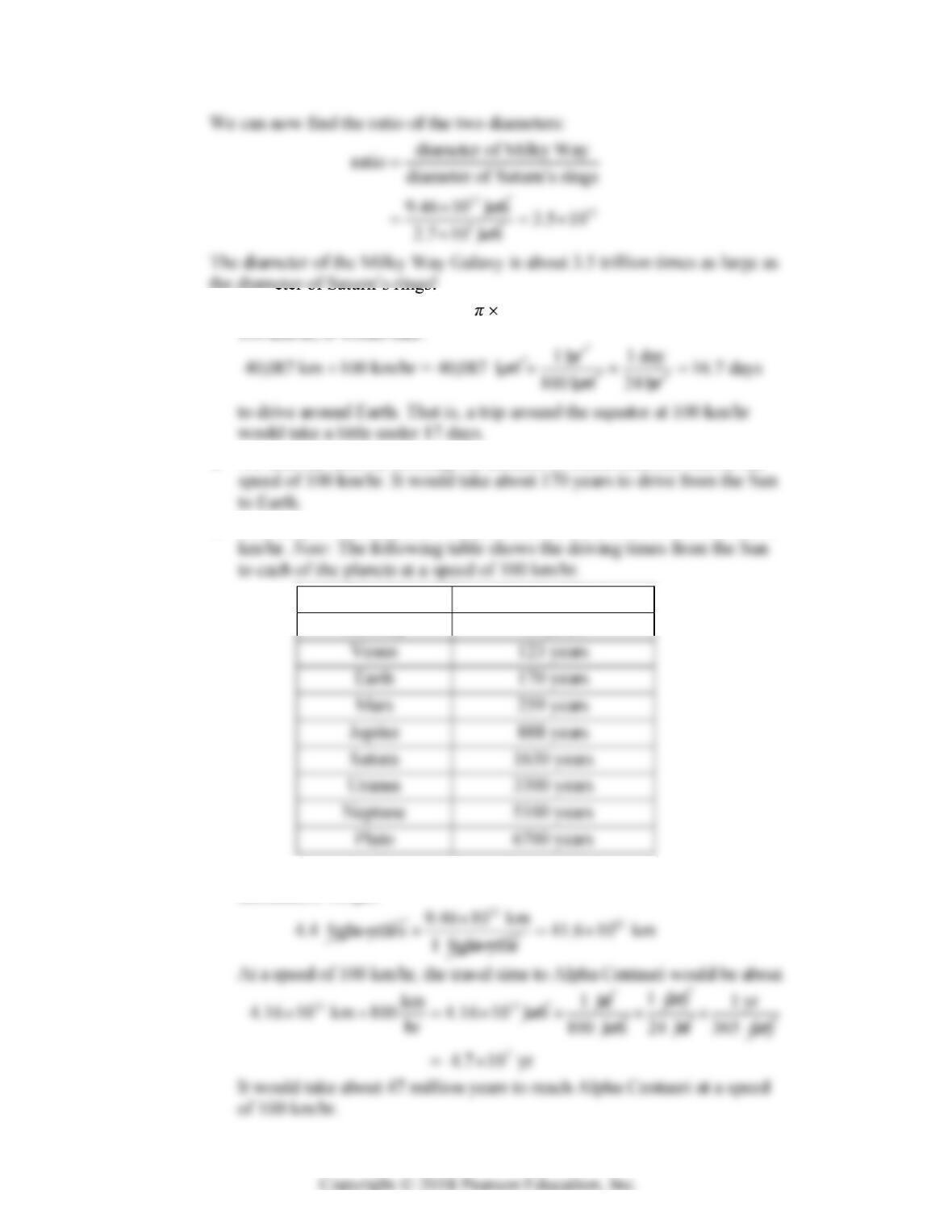
45. a. The circumference of Earth is 2 6380 km = 40,087 km. At a speed of
100 km/hr, it would take:
b. We find the time by dividing the distance to Earth from the Sun by the
c. Similarly, it would take 6700 years to drive from the Sun to Pluto at 100
Planet Driving Time
Mercury 66 years
d. We are given the distance to Alpha Centauri in light-years; converting to
kilometers, we get:

46. a. To reach Alpha Centauri in 100 years, you would have to travel at
47. A faster expansion rate means the universe reached its current size in less
time, so the fact that Allen measured a faster expansion rate means he will