CHAPTER 6 LINES AND LETTERING
PROBLEMS
LINE PROBLEMS
Part 1: Problems 6.1 Through 6.11
1. Using the selected engineer’s layout as a guide only, create
an original drawing following your course objectives. Make
a preliminary sketch if required by your instructor. Draw
only the object lines, centerlines, hidden lines, and phantom
lines as appropriate for each problem. Do not draw dimen-
sions. Keep in mind that the engineer’s sketches are rough
and not meant for tracing.
2. Complete the drawing using the correct line standards de–
scribed in this chapter.
3. Use an appropriately sized ASME sheet and use ASME sheet
blocks. Complete the title block.
a. The title of the drawing is given.
b. The material the part is made of is given.
c. The drawing or part number is the same as the problem
number.
d. Specify the scale and other unspecified information.
4. Reproduce your drawing for checking unless otherwise
specified by your instructor.
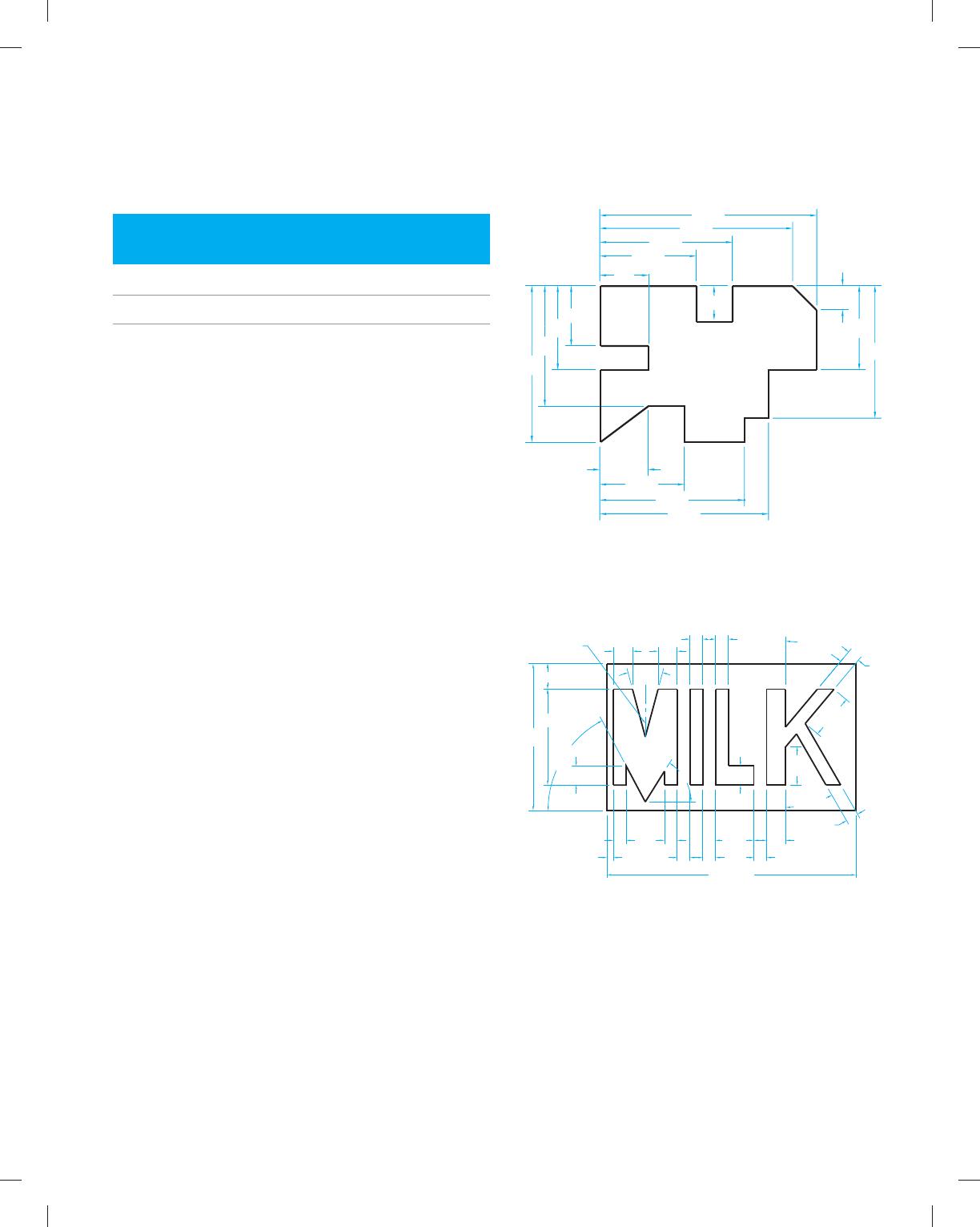
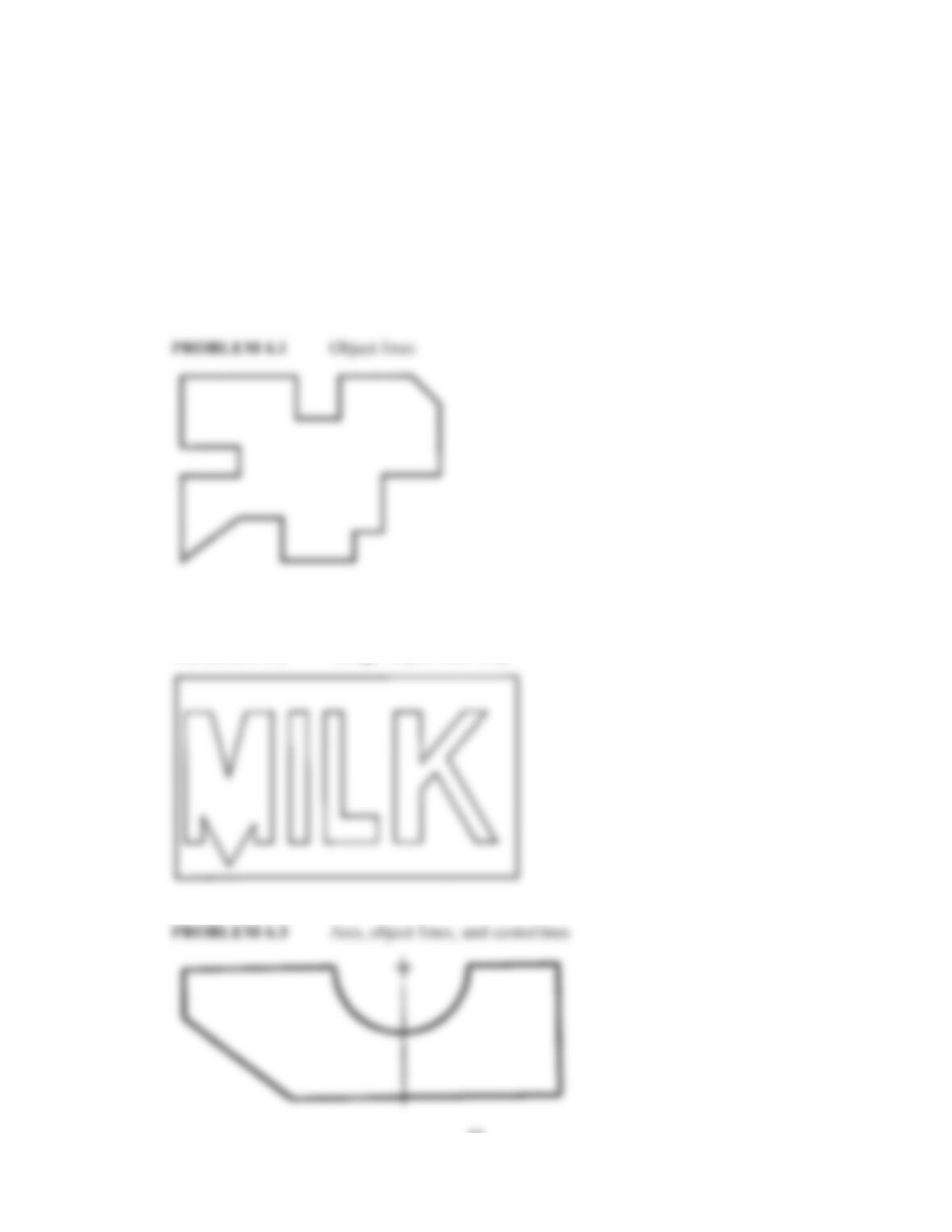
PROBLEM 6.1 Object lines (in.)
Part Name: Plate
Material: .25-in.-thick mild steel (MS)
3.5
9.0
4.0
5.5
8.0
3.5
6.0
6.5
7.0
2.0
3.5
5.5
1.0
1.5
5.0
2.5
2.0
PROBLEM 6.2 Straight object lines only (in.)
Part Name: Milk Stencil
Material: .015-in.-thick wax-coated cardboard. Used as a
stencil to spray paint identification on crates of milk.
(CUT OUT)
(CUT OUT)
(CUT OUT)
(CUT OUT)
1/2
1/4
1/2
1/2 1/2
1 1/2 3/4
1/2
9 3/4
1
3 3/4
3/4
62º
3/4 13/4
1/2 1/2
30º
40º
1/2
1 3/4
1/2
30º
1 1/2
3/4
55º
CENTERLINE
5 3/4
59728_ch06_EOC_ptg01.indd 3 03/02/16 10:23 am
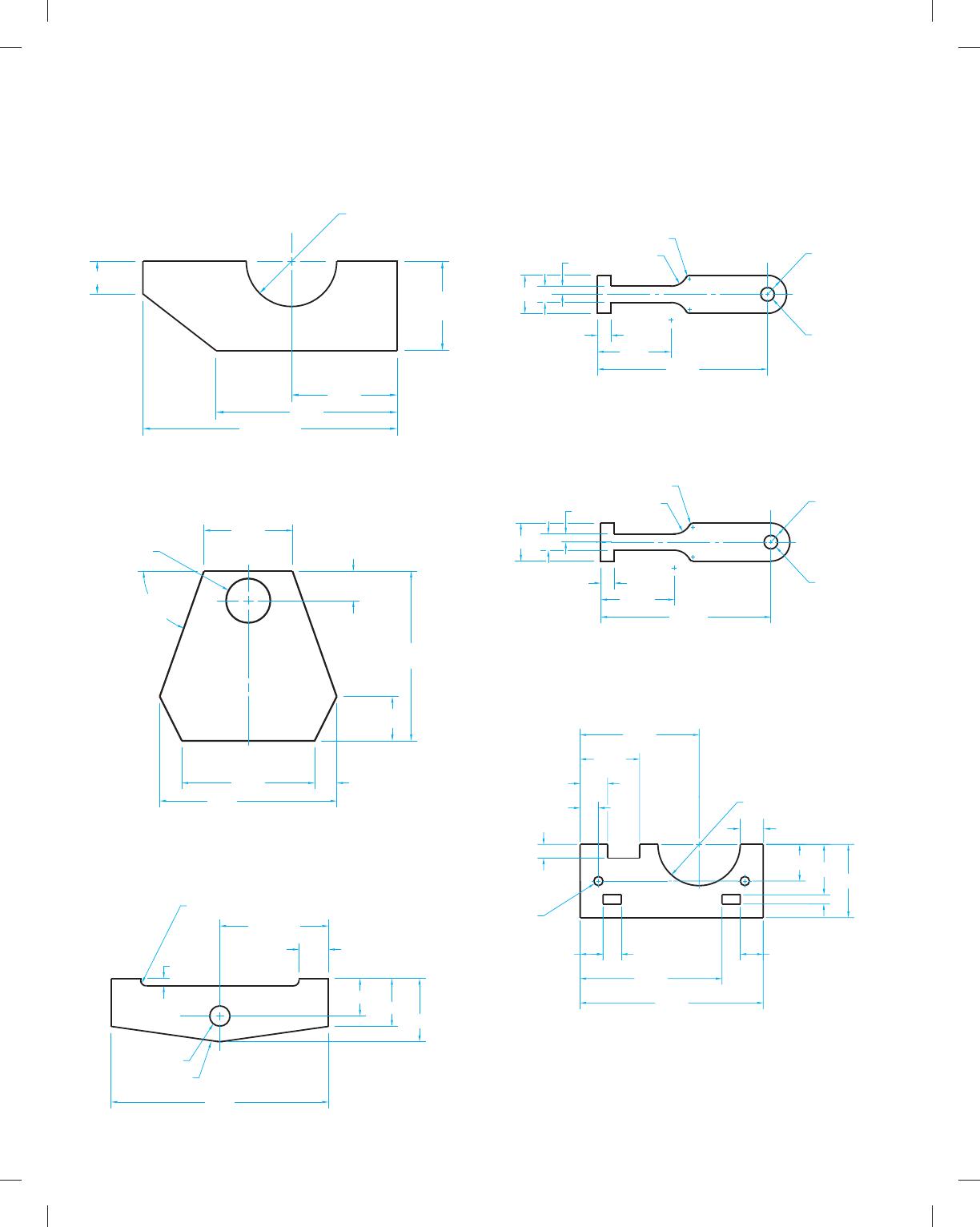
PROBLEM 6.3 Arcs, object lines, and centerlines (in.)
Part Name: Latch
Material: .25-in.-thick mild steel
8 5/8
R12
67 3/8
28
48
23 5/8
PROBLEM 6.4 Circle, object lines, and centerlines (in.)
Part Name: Stove Back
Material: .25-in.-thick mild steel
3.0
6.0
4.0
23.0
18.0
24.0
12.0
708
Ø6.0
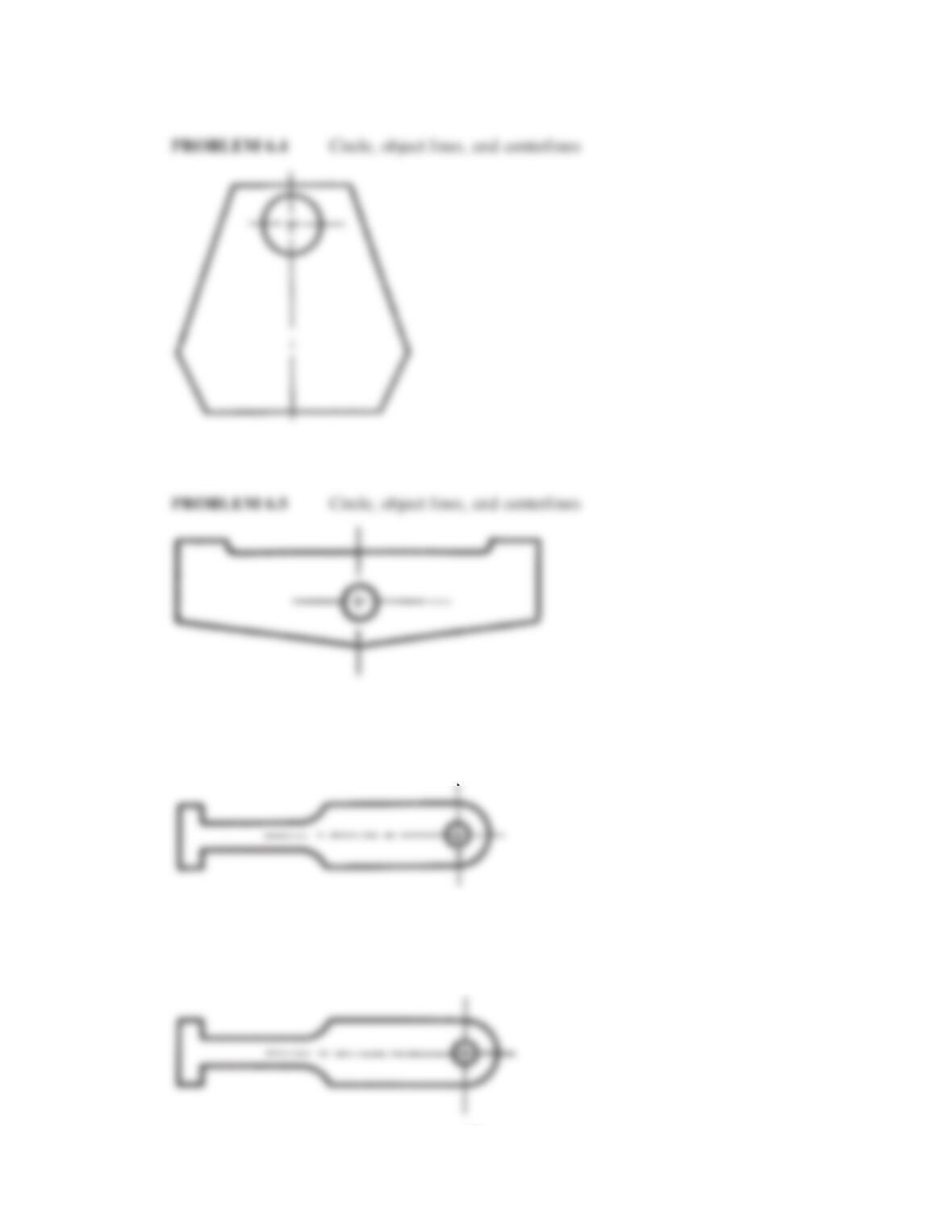
PROBLEM 6.5 Circle and arc object lines and centerlines (in.)
Part Name: Bogie Lock
Material: .25-in.-thick mild steel
10 3/16
13
17 3/16
8
Ø5 1/2
R7
R1 1/2
2
29 1/2
59
PROBLEM 6.6 Circle and arc object lines and centerlines
(metric)
Part Name: T-Slot Cleaner
Material: 6-mm-thick cold rolled steel (CRS)
12
6R13
R3
Ø10
R14
10
125
44
28
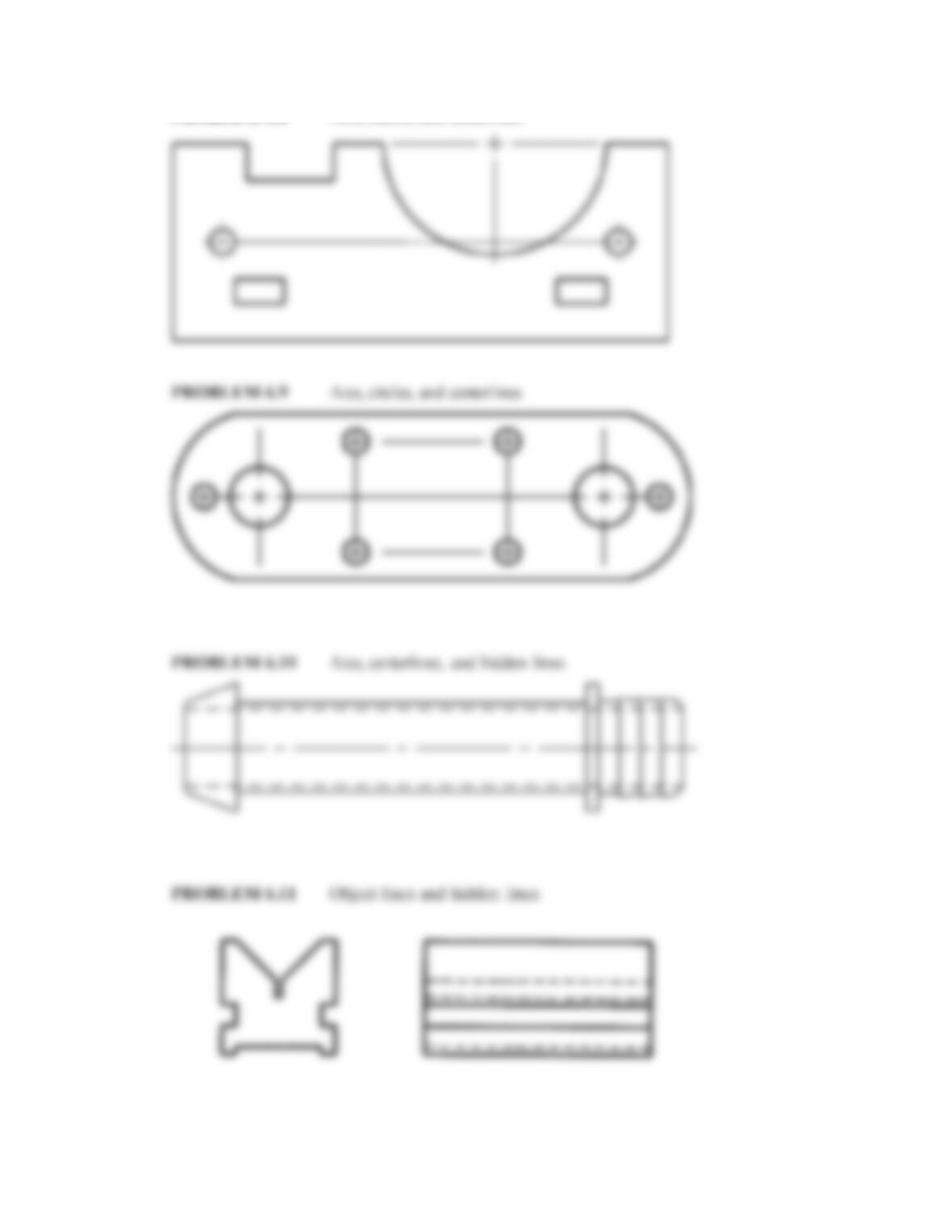
PROBLEM 6.7 Circle and arc object lines and centerlines (in.)
Part Name: T-Slot Cleaner
Material: .25-in.-thick cold rolled steel
.500
.250 R.500
R.125
Ø.375
R.562
4.938
1.750
.375
1.125
PROBLEM 6.8 Arcs, circles, and centerlines (in.)
Part Name: Bracket
Material: Stainless steel
5.000
3.875
R1.125
.500
.500
.625
2X Ø.250
.375
.750
.500
3.250
1. 6 2 5
.625
2.00
.250
1. 3 7 5
1
59728_ch06_EOC_ptg01.indd 4 03/02/16 10:23 am
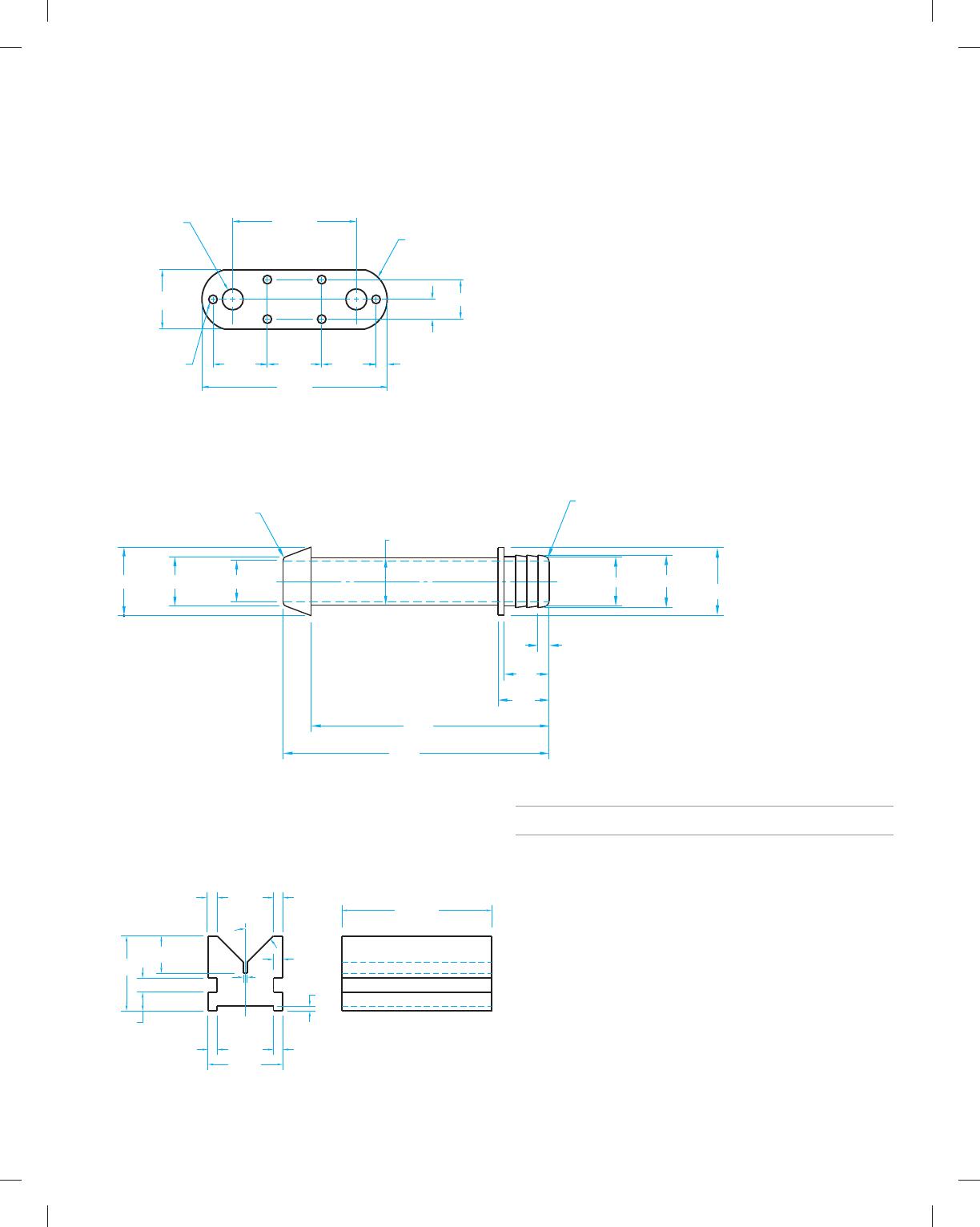
PROBLEM 6.9 Arcs, circles, and centerlines (in.)
Part Name: Bracket
Material: Mild steel
1.375 1.375 1.375
1.50 .531
1.00
.281
3.125
4.687
2X R.781
6X Ø.218
2X Ø.531
PROBLEM 6.10 Arcs, centerlines, and hidden lines (in.)
Part Name: Pin
Material: Phosphor bronze
LETTERING PROBLEMS
Part 2: Problems 6.12 Through 6.14
Use a Gothic lettering style such as Arial, Century Gothic,
RomanS, or SansSerif unless otherwise specified by your instruc-
tor. Use text .12-in. (3-mm) high. Space lines of lettering .12 in.
apart unless otherwise specified by your instructor. Reproduce
your drawing for checking unless otherwise specified by your
instructor.
PROBLEM 6.12
The standard for lettering was established in 1935 by the Ameri-
can National Standards Institute. This standard is now conveyed
by the American Society of Mechanical Engineers Document
ASME Y14.2, Line Conventions and Lettering. Letters and num-
bers should be opaque and clearly spaced. Lettering can be verti-
cal or inclined, but only one style should be used throughout the
Ø.380
4X .090
3X Ø.420
Ø.540
Ø.550 Ø.320
Ø.385
R .020
2.120
1.900
.350
.400
3X Ø.400
R .020
PROBLEM 6.11 Multiviews (2 views), object lines, and hidden
lines (in.)
Part Name: V-block
Material: 4.00-in.-thick mild steel
2.000
.100
.375
.500
1.000
.250
45º
4.000
.250
.250
.125
.250
.250
2.000
59728_ch06_EOC_ptg01.indd 5 03/02/16 10:23 am
drawing. Uppercase letters are used on drawings unless lower-
case letters are required for a specific application. The lettering
style used when revising a drawing should match the original
drawing lettering style.
PROBLEM 6.13
According to ASME Y14.2, the minimum recommended lettering
height depends on the drawing-sheet size and the application on
the drawing. Typically, lettering height on engineering drawings
is .12 in. (3 mm). All dimension numerals, notes, and other let-
tered information should be the same height except for titles,
drawing numbers, section and view letters, and other captions,
which are .24 in. (6 mm) high.
PROBLEM 6.14
NOTES:
1. Unless otherwise specified, all dimensions are in
millimeters.
2. Dimensions and tolerances per ASME Y14.5-2009.
3. Remove all burrs and sharp edges.
4. All fillets and rounds r6.
5. Caseharden 62 rockwell c scale.
6. Areas where material has been removed shall have smooth
transitions and be free of scratches, grind marks, and burrs.
7. Finish black oxide.
8. Part to be clean and free of foreign debris.
MATH PROBLEMS
Part 3: Problems 6.15 Through 6.19
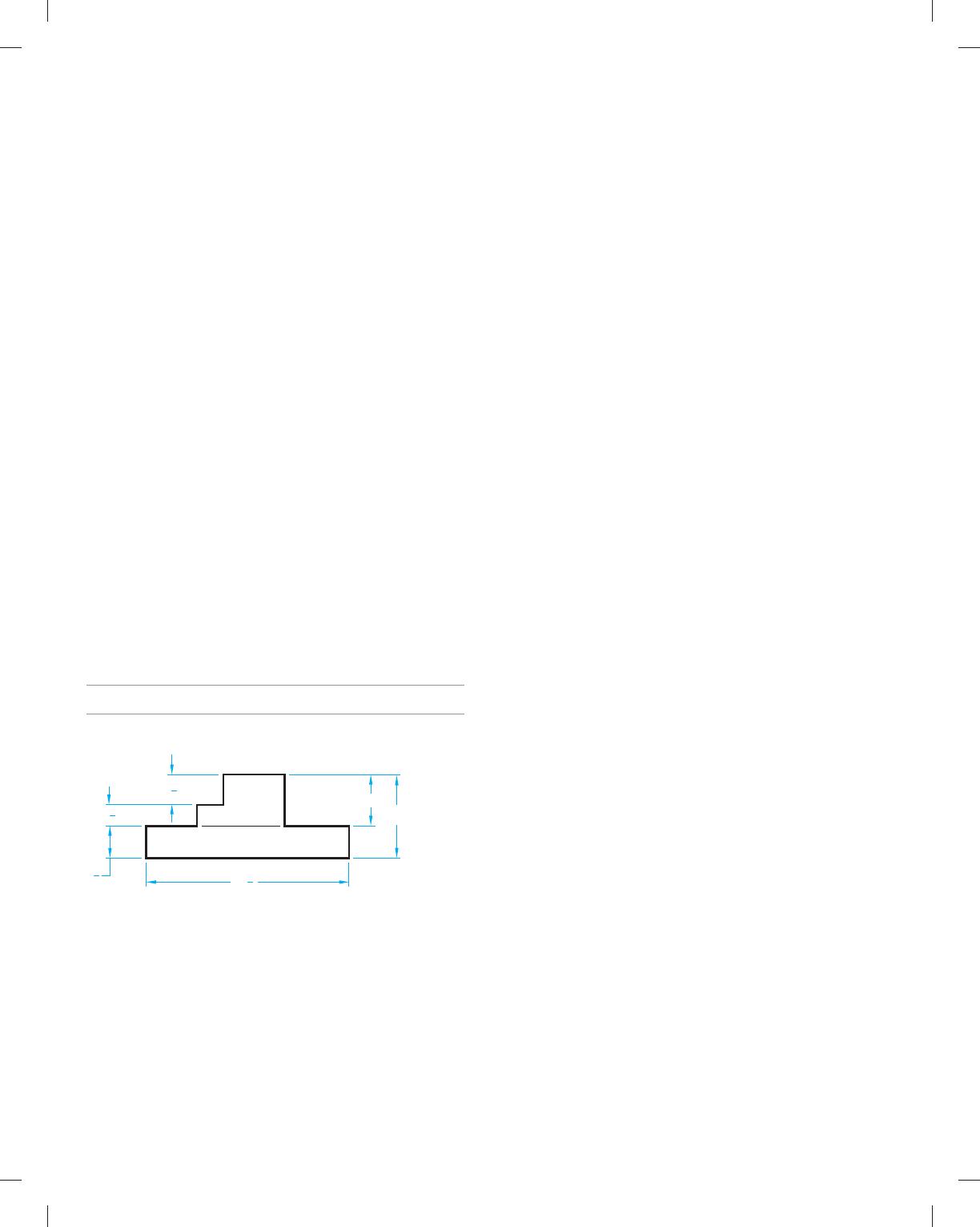
PROBLEM 6.15 For the illustration of the block shown:
21
4
21
8
1
y1
y2
1
2
1
4
14
a. Determine dimension y1.
b. Determine dimension y2.
c. Determine the overall width of 12 of the blocks laid side
to side.
d. Convert each of the four given dimensions of the block to
decimal fractions.
PROBLEM 6.16 Twenty-five pieces of metal are needed for a
job. Each piece is to be 3 3/320 in length. Disregarding the cutting loss,
what length of stock is needed?
PROBLEM 6.17 A piece of stock 25 7/80 long is to be cut into
five equal lengths. Allowing 1/160 lost per cut, what will be the length of
each of the five pieces?
PROBLEM 6.18 A drawing shows a dimension of 4.18750.
Convert this decimal fraction to a common fraction.
PROBLEM 6.19 Convert each decimal fraction to a common
fraction:
a. 2.50
b. .1250
c. 14.43750
d. 5.750
59728_ch06_EOC_ptg01.indd 6 03/02/16 10:23 am
23
Chapter 6
Lines and Lettering
Solutions to End-of-Chapter Problems
Line Problems
Part 1: Problems 6.1 Through 6.11
PROBLEM 6.2 Straight object lines only
24
PROBLEM 6.6 Circle, arc object lines, and centerlines
PROBLEM 6.7 Circle, arc object lines, and centerlines
25
PROBLEM 6.8 Arcs, circles, and centerlines
26
Lettering Problems
Part 2: Problems 6.12 Through 6.14
PROBLEM 6.12
PROBLEM 6.13
PROBLEM 6.14
Math Problem Solutions
Part 3: Problems 6.15 Through 6.19
PROBLEM 6.15
PROBLEM 6.16
PROBLEM 6.17
27
PROBLEM 6.18
PROBLEM 6.19