
CHAPTER 4 MANUFACTURING
MATERIALS AND PROCESSES PROBLEMS
INSTRUCTIONS
This chapter is intended as a reference for manufacturing mate-
rials and processes. The concepts discussed serve as abasis for
further study in following chapters. A thoroughunderstanding of
dimensioning practices is necessary beforecomplete manufac–
tured products can be drawn. Problem assignments ranging
from basic to complexmanufacturing drawings are assigned in
the following chapters.
Part 1: Problems 4.1 Through 4.14
Provide a brief but complete definition for each of the following
terms. Use your own words to describe the appearance of the
actual feature and the related drawing used to represent the
feature.
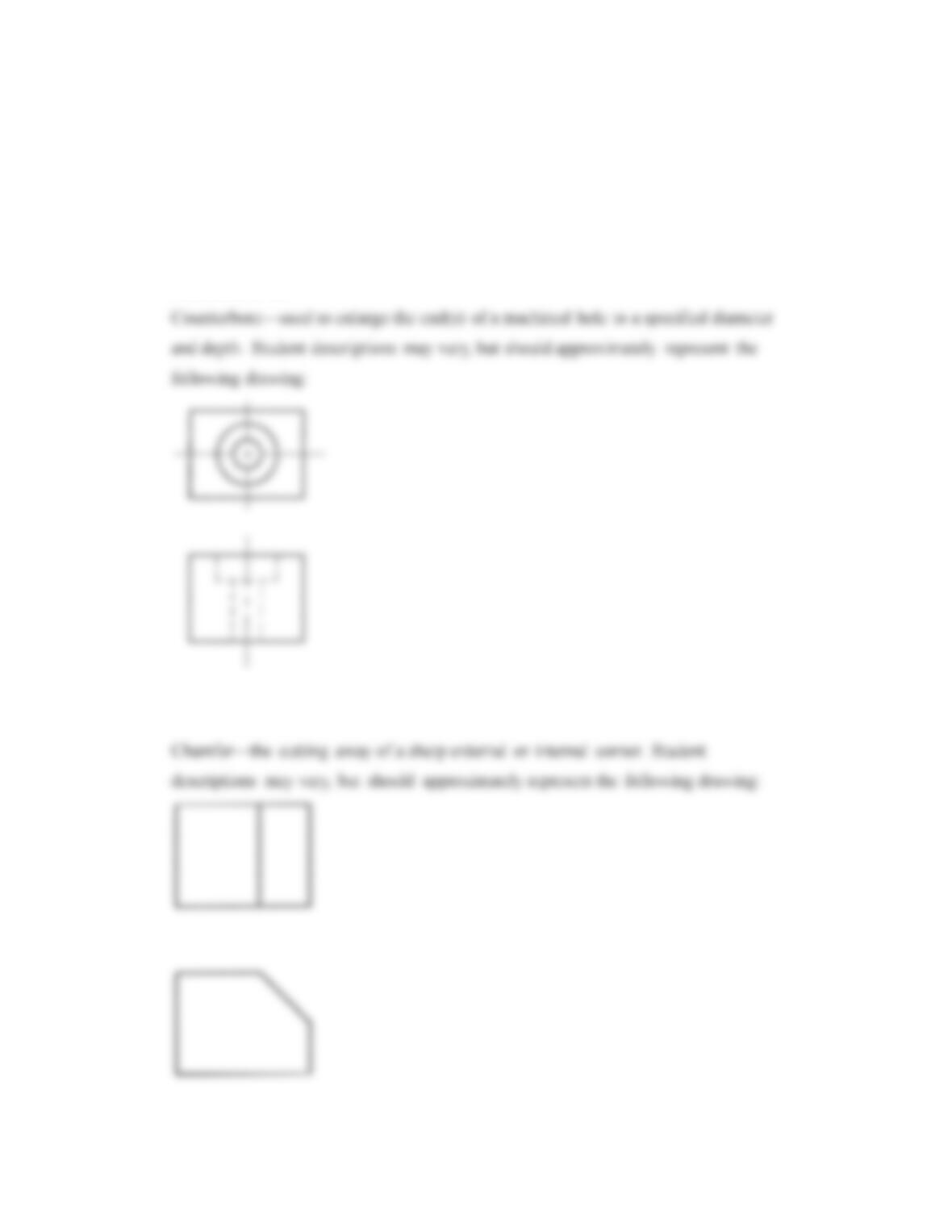
PROBLEM 4.1 Counterbore
PROBLEM 4.2 Chamfer
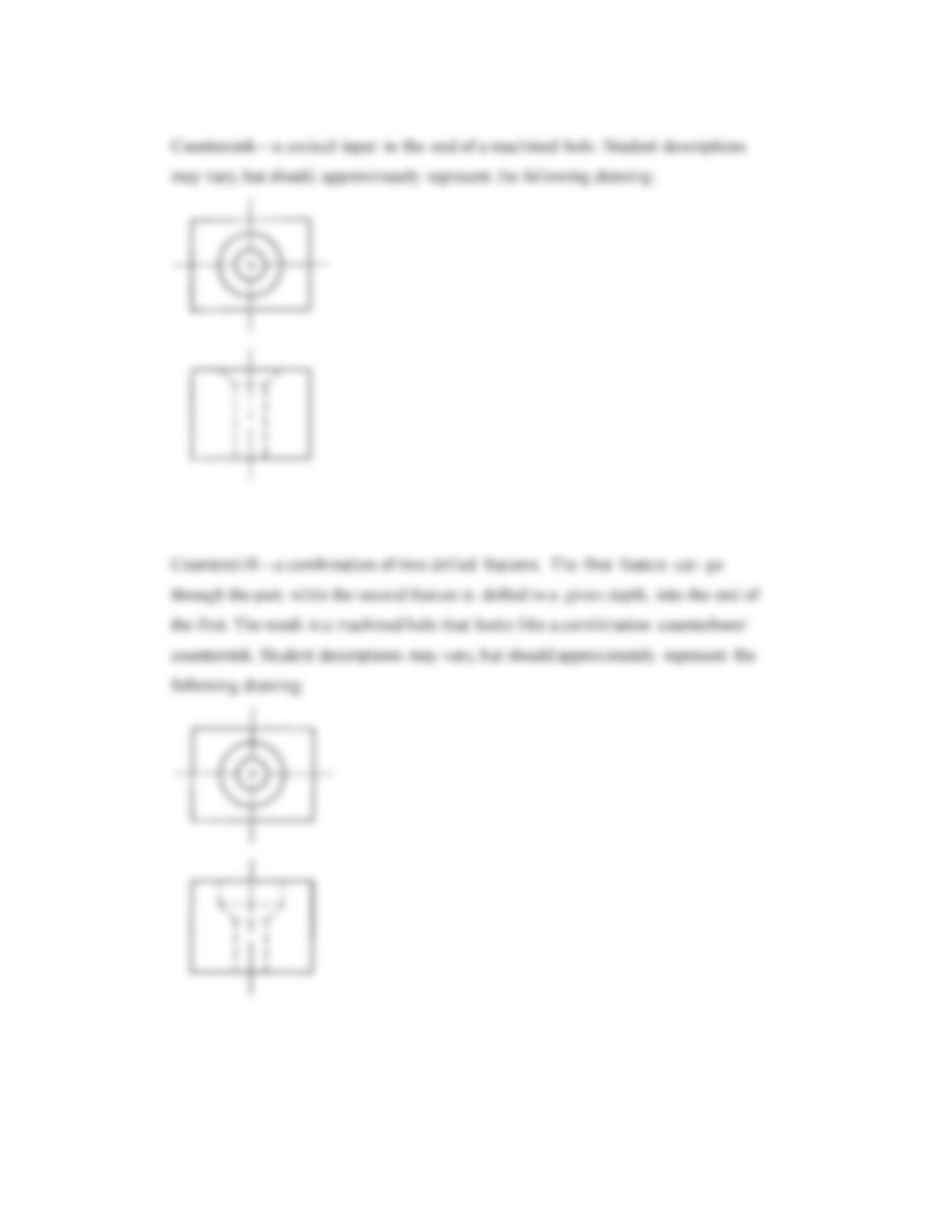
PROBLEM 4.3 Countersink
PROBLEM 4.4 Counterdrill
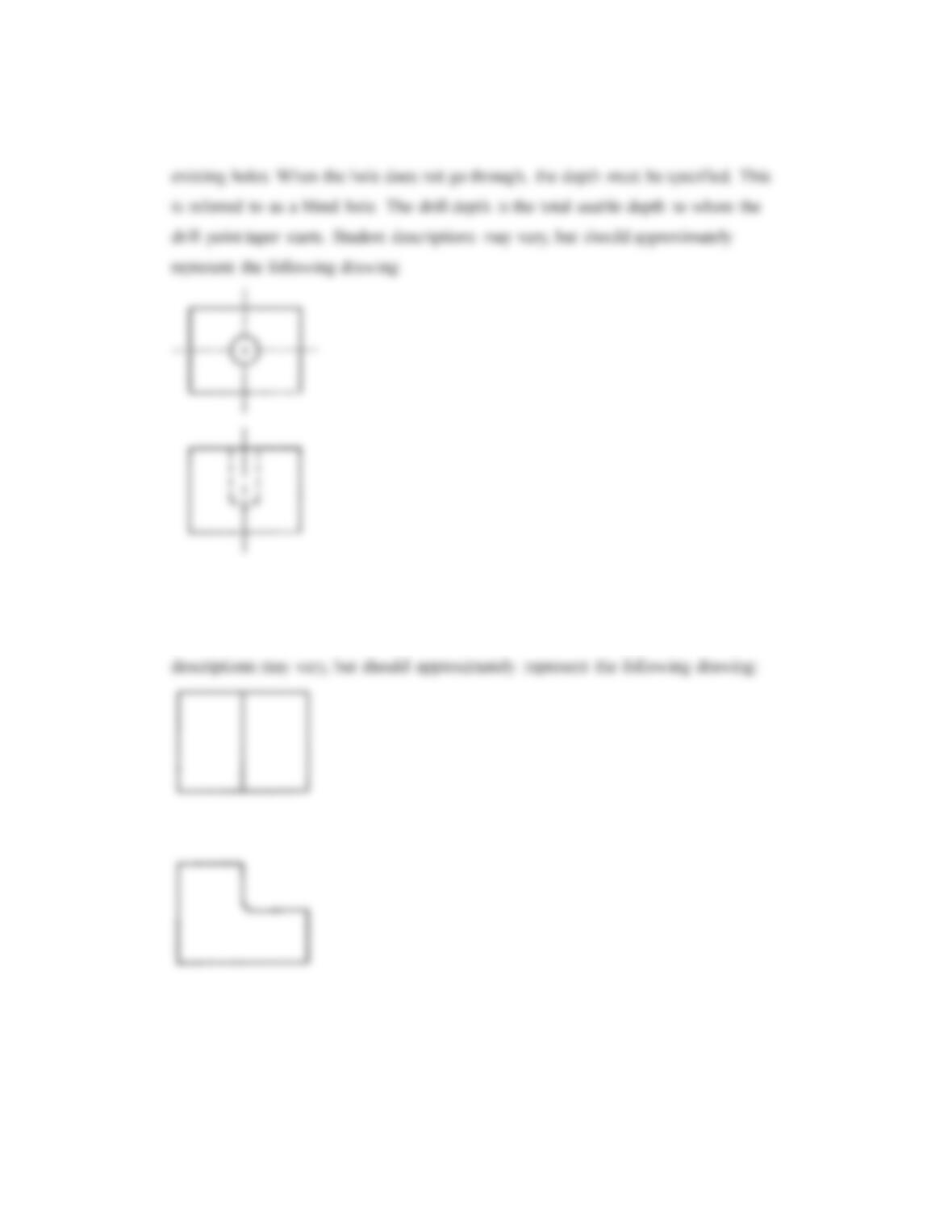
PROBLEM 4.5 Drill (not through the material)
PROBLEM 4.6 Fillet
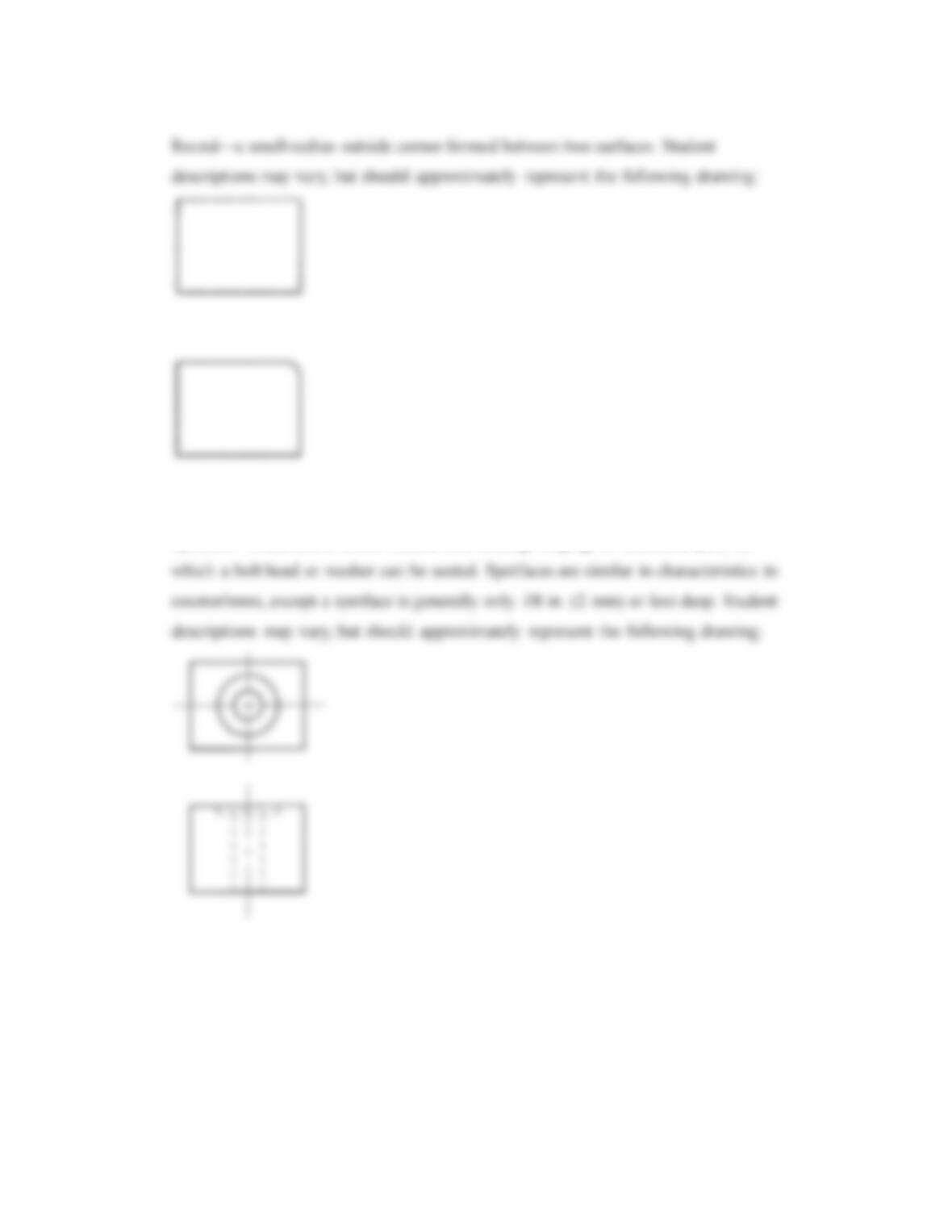
PROBLEM 4.7 Round
PROBLEM 4.8 Spotface
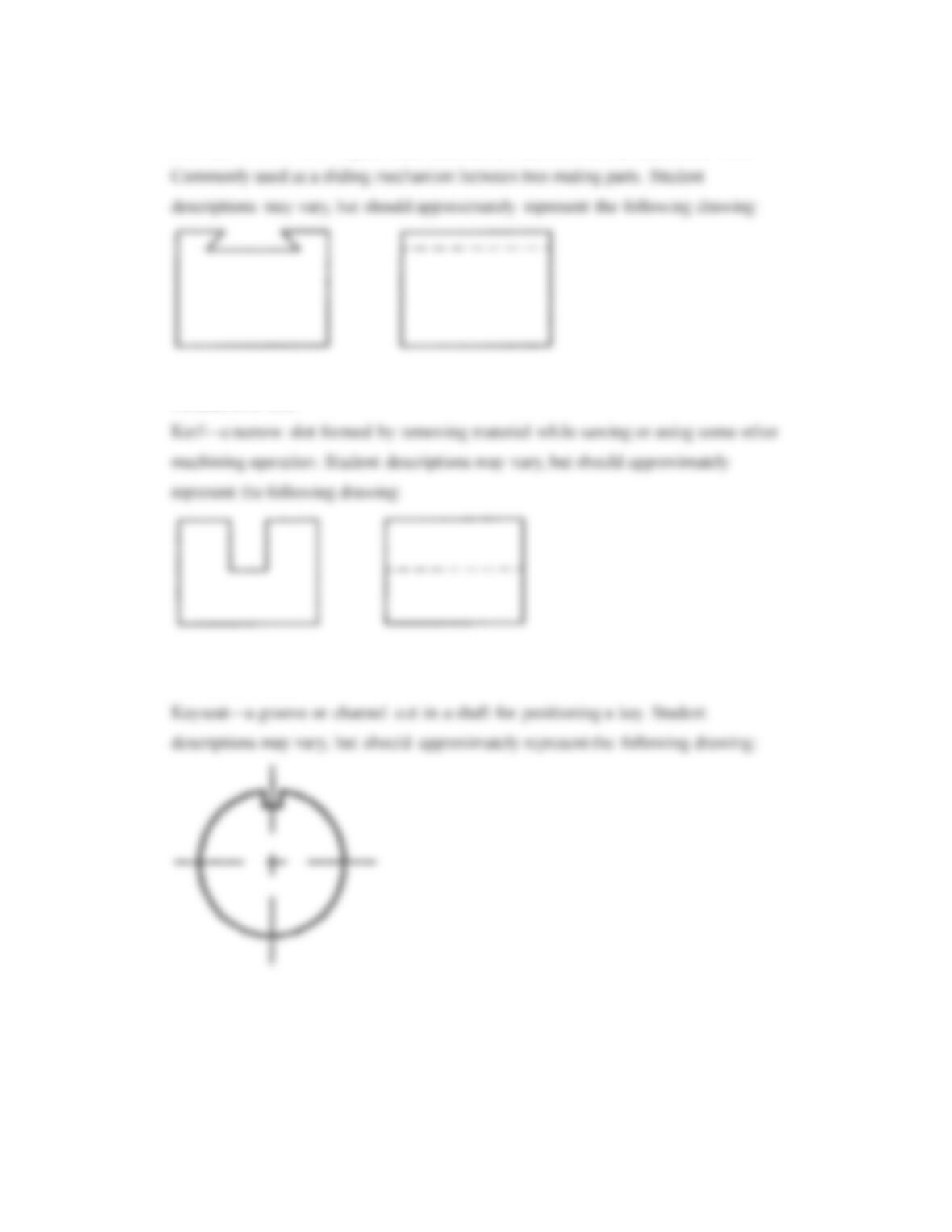
PROBLEM 4.9 Dovetail
PROBLEM 4.10 Kerf
PROBLEM 4.11 Keyseat
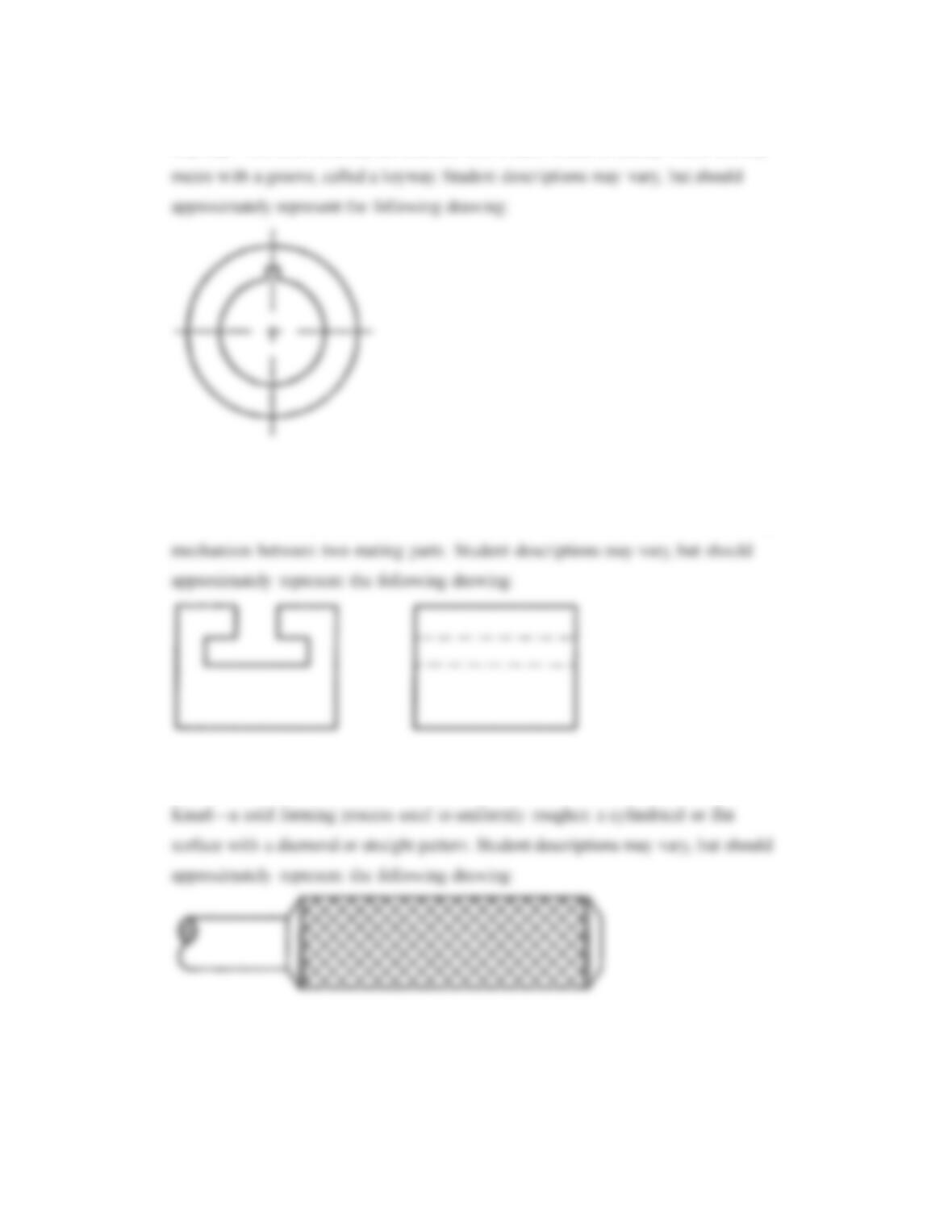
PROBLEM 4.12 Keyway
PROBLEM 4.13 T-slot
PROBLEM 4.14 Knurl
The following topics require research or visits to industry sites
or both. Obtain approval and permission from your instructor
before making a visit to industry. It is recommended that you
research current professional magazines, visit local industries,
or interview professionals in the related field. Give an oral
presentation with graphics covering your selected topic. Your
reports should emphasize the following:
■ Product
■ The process
■ Material selection
■ Special manufacturing considerations
■ The link between manufacturing and engineering
■ Current technological advances
■ Green technology applications
Part 2: Problems 4.15 Through 4.50
Select one or more of the topics listed below or as assigned by
your instructor and write a report of approximately 500 words
for each.
PROBLEM 4.15 Casting
PROBLEM 4.16 Forging
PROBLEM 4.17 Conventional machine shop
PROBLEM 4.18 CNC machining
59728_ch04_EOC_ptg01.indd 4 22/02/16 9:52 am

PROBLEM 4.19 Surface roughness
PROBLEM 4.20 Tool design
PROBLEM 4.21 Chemical machining
PROBLEM 4.22 Electrochemical machining (ECM)
PROBLEM 4.23 Electrodischarge machining (EDM)
PROBLEM 4.24 Electron beam (EB) machining
PROBLEM 4.25 Ultrasonic machining
PROBLEM 4.26 Laser machining
PROBLEM 4.27 Statistical process control (SPC)
PROBLEM 4.28 Thermoplastics
PROBLEM 4.29 Thermosets
PROBLEM 4.30 Elastomers
PROBLEM 4.31 Metal stamping
PROBLEM 4.32 Powder metallurgy
PROBLEM 4.33 Manufacturing thermoplastic products
PROBLEM 4.34 Manufacturing thermoset plastic products
PROBLEM 4.35 Manufacturing composites
PROBLEM 4.36 Cast iron
PROBLEM 4.37 Steel
PROBLEM 4.38 Aluminum
PROBLEM 4.39 Copper alloys
PROBLEM 4.40 Precious and other specialty metals
PROBLEM 4.41 Computer-aided manufacturing
PROBLEM 4.42 Computer-aided engineering (CAE)
PROBLEM 4.43 Computer-integrated manufacturing (CIM)
PROBLEM 4.44 Robotics
PROBLEM 4.45 Computer-aided design
PROBLEM 4.46 Computer-aided drafting
PROBLEM 4.47 Additive manufacturing (AM)
PROBLEM 4.48 CAD/CAM integration
PROBLEM 4.49 Aluminum and steel material selection
PROBLEM 4.50 Finite element analysis (FAE) used for
material selection.
PROBLEM 4.51 The use of plastics as a sustainable product.
PROBLEM 4.52 Aluminum for future generations.
PROBLEM 4.53 The recycle symbol.
MATH PROBLEMS
Part 3: Problems 4.54 Through 4.56
The following is a set of six monthly samples from a process. The
UCL is 5.05, and the LCL is 4.95.
Jan Feb Mar Apr May Jun
5.06 5.03 5.04 5.04 4.95 4.95
4.94 5.04 5.04 5.07 4.95 4.97
4.99 5.05 5.05 5.05 4.93 4.98
4.99 4.99 5.06 5.02 4.92 5.01
5.00 4.98 5.06 5.00 4.95 5.00
PROBLEM 4.54 Find x for each month.
PROBLEM 4.55 Find x for the six-month period.
PROBLEM 4.56 Conclude whether the process was out of
control for any of the months.
59728_ch04_EOC_ptg01.indd 5 22/02/16 9:52 am
12
Chapter 4
Manufacturing Materials and Processes
Solutions to End-of-Chapter Problems
Part 1: Problems 4.1 Through 4.14
PROBLEM 4.1
PROBLEM 4.2
13
PROBLEM 4.3
PROBLEM 4.4
14
PROBLEM 4.5
Drill (not through the material)—a drill is used to machine new holes or enlarge
PROBLEM 4.6
Fillet—a small radius formed between the inside angle of two surfaces. Student
15
PROBLEM 4.7
PROBLEM 4.8
Spotface—a machined, round surface on a casting, forging, or machined part, on
16
PROBLEM 4.9
Dovetail—a slot with angled sides that can be machined at any depth and width.
PROBLEM 4.10
PROBLEM 4.11
17
PROBLEM 4.12
Keyway—the shaft and key are inserted into a hub, wheel, or pulley where the key
PROBLEM 4.13
T-slot—a slot of any dimension cut to resemble a “T,” and can be used as a sliding
PROBLEM 4.14

18
Part 2: Problems 4.15 Through 4.53
Math Problem Solutions
Part 3: Problems 4.54 Through 4.56