
APPENDIX— EVOLUTION OF A TEXTBOOK
Introduction to Chemical Engineering Thermodynamics
HENDRICK C. VAN NESS
Rensselaer Polytechnic Institute •Troy, NY
Rarely does a textbook remain in print for anything ap-
proaching 55 years. Introduction to Chemical Engineering
Thermodynamics is the only chemical-engineering text cur–
rently in print that has passed the half-century mark. Now
extant in a seventh edition, published by McGraw-Hill, and
authored by J.M. Smith, H.C. Van Ness, and M.M. Abbott,
its origin was at Purdue University in 1945 when Joe Mauk
Smith, a newly hired Assistant Professor with a 1943 Sc.D.
from MIT, was asked to develop a course for chemical-
engineering undergraduates to replace a general thermody-
namics course given by Mechanical Engineering. The first
result was a paper-covered lithoprinted volume of lecture
This simple philosophy suffuses all six subsequent editions,
and surely underlies the book’s long-standing appeal to stu-
dents.
I joined the Purdue faculty as an Assistant Professor in
1952, coming from a D.Eng. program at Yale University,
and used the book for several years in teaching the course
for which it had been developed. In doing so I formulated
some ideas on the subject of thermodynamics and on its in-
topics as the properties of fluids, power cycles, and refriger-
ation, but we did not alter in any substantial way the material
unique to chemical thermodynamics. I added a chapter on
the Thermodynamic Analysis of Processes, a feature of
the text in all subsequent editions. Some professors do not
find time to cover this chapter, but for me it expresses the
essence of engineering thermodynamics.
Sixteen years elapsed before publication of the third edi-
tion. During those years chemical engineering, and thermo-
dynamics as a part of it, evolved rapidly owing to the ad-
vent of the computer. In 1959 students were still toting slide
rules and becoming adept at trial-and-error calculations. By
The third edition of 1975 incorporated block diagrams
to outline systematic solution of complex phase-equilibrium
problems, made practical by electronic computation. It also
presented a coherent development of the mathematics of so-
lution thermodynamics, and it introduced the reaction co-
ordinate for the systematic solution of reaction-equilibrium
problems. All this reflected my own education as the result
of an intensive program of thermodynamic research. By this
724
the efficiency of presentation.
By the time thought was given to preparation of a fifth
edition, both Prof. Smith and I had retired from teaching.
We felt it essential to add a third author who still engaged
the treatment and applicaiton of equations of state. The sev-
enth edition provides a modest revision directed at making
the text more easily understood and incorporating an addi-
tional 20% of new end-of-chapter problems.
A comparison of the first edition of 1949 with the seventh
edition of 2005 reveals little that is the same. However, the
in notation and terminology. Although a rather large ar–
ray of symbols is required to accommodate the quantities
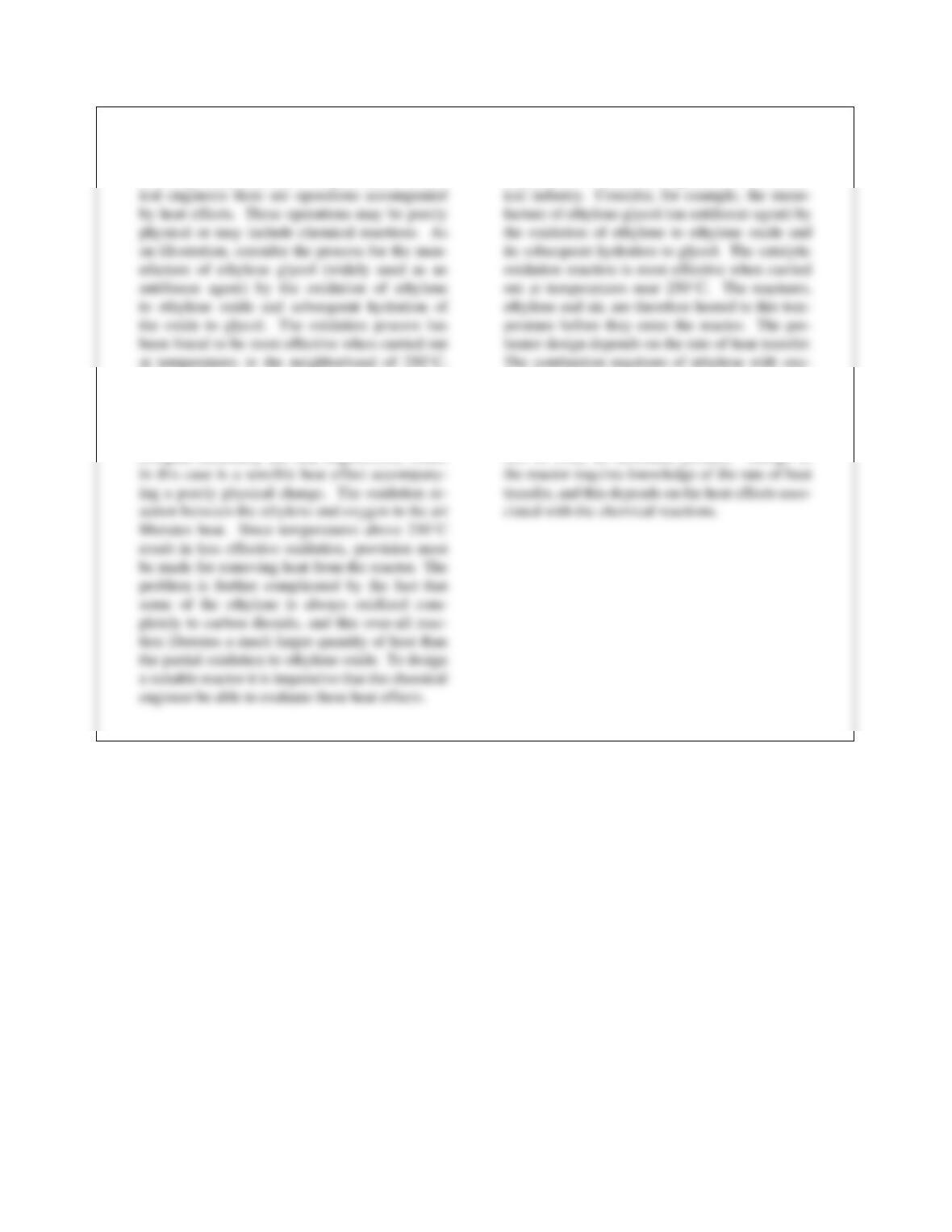
directly comparable introductory passages from the chapter
on Heat Effects shown on the following page. One notes
way, with a typewritten manuscript, review by a profes-
sional editor, typesetting into galleys, and finally rearrange-
ment of the type to incorporate figures, resulting in pages
to be printed. Proof-reading was required at each step, be-
incorporated into the text, and a type-setting program pro-
duced pages exactly as they appear in the published book.
Once proof-read, corrected, and edited, there remained only
the printing and binding. Thus I was responsible for the
is a unique opportunity. If, for example, the SI system of
units is to be established in the United States, it must be
mercially magic word can’t seem to abandon it, even while
teaching from a text in which the totally unambiguous Gibbs
the six editions exceed a half million copies, making it the
best-selling textbook in the history of chemical engineering.
725
First Edition:Seventh Edition:
In nearly every industry of importance to chem-
Therefore, it is necessary to preheat the reactants,
ethylene and air, to this temperature before they
enter the reactor. In order to design a satisfactory
preheater, the chemical engineer must be able to
compute accurately the heat requirement, which
Heat transfer is a common operation in the chem-
gen in the catalyst bed tend to raise the temper-
ature. However, heat is removed from the reac-
tor, and the temperature does not rise much above
250◦C. Higher temperatures promote the produc-
tion of CO2, an unwanted product. Design of
726