Appendix A
Pricing Products and Services
Solutions to Questions
A-1 In cost-plus pricing, prices are set by
adding a markup to a product’s cost. The
markup is usually a percentage.
A-2 The price elasticity of demand measures
the degree to which a change in price affects
A-3 The profit-maximizing price should de-
pend only on the variable (marginal) cost per
unit and on the price elasticity of demand. Fixed
A-4 The markup over variable cost depends
on the price elasticity of demand. A product
A-5 The markup in the absorption costing
approach to pricing is supposed to cover selling
and administrative expenses as well as providing
for an adequate return on the assets tied up in
the product. Full cost is an alternative approach
not discussed in the chapter that is used almost
as frequently as the absorption approach. Under
the full cost approach, all costs—including sell-
ing and administrative expenses—are included in
the cost base. If full cost is used, the markup is
sales regardless of the price that is charged.
This is clearly an unrealistic assumption except
under very special circumstances.
A-8 Target costing is used to price new
products. The target cost is the expected selling
price of the new product less the desired profit
full cost and then add their markup to arrive at
the selling price. In contrast to target costing,
the traditional approach ignores how much cus-
tomers are willing to pay for the product.
.
Exercise A-1 (30 minutes)
1. Kimio makes more money selling the ice cream cones at the lower price,
as shown below:
$1.79 Price
$1.39 Price
Unit sales …………………………..
860
1,340
Sales …………………………………
Cost of goods sold @ $0.41 ……
Net operating income ……………
2. The price elasticity of demand, as defined in the text, is computed as
follows:
d =
ln(1 + % change in quantity sold)
ln(1 + % change in price)
=
1,340 – 860
ln(1 + )
860
1.39 – 1.79
ln(1 + )
1.79
æö
÷
ç÷
ç÷
ç
èø
æö
÷
ç÷
ç÷
ç
èø
Exercise A-1 (continued)
3. The profit-maximizing price can be estimated using the following formu–
las from the text:
d
-1
Profit-maximizing =
markup on variable cost 1 + ε
-1
= = 1.333
1 + (-1.75)
Exercise A-2 (15 minutes)
1.
( )
Required ROI Selling and administrative
+
× Investment expenses
Markup percentage =
on absorption cost Unit product cost × Unit sales
Exercise A-3 (10 minutes)
Sales (50,000 batteries × $65 per battery) …..
$3,250,000
Less desired profit (20% × $2,500,000) ………
500,000
Target cost for 50,000 batteries …………………
$2,750,000
Problem A-4 (45 minutes)
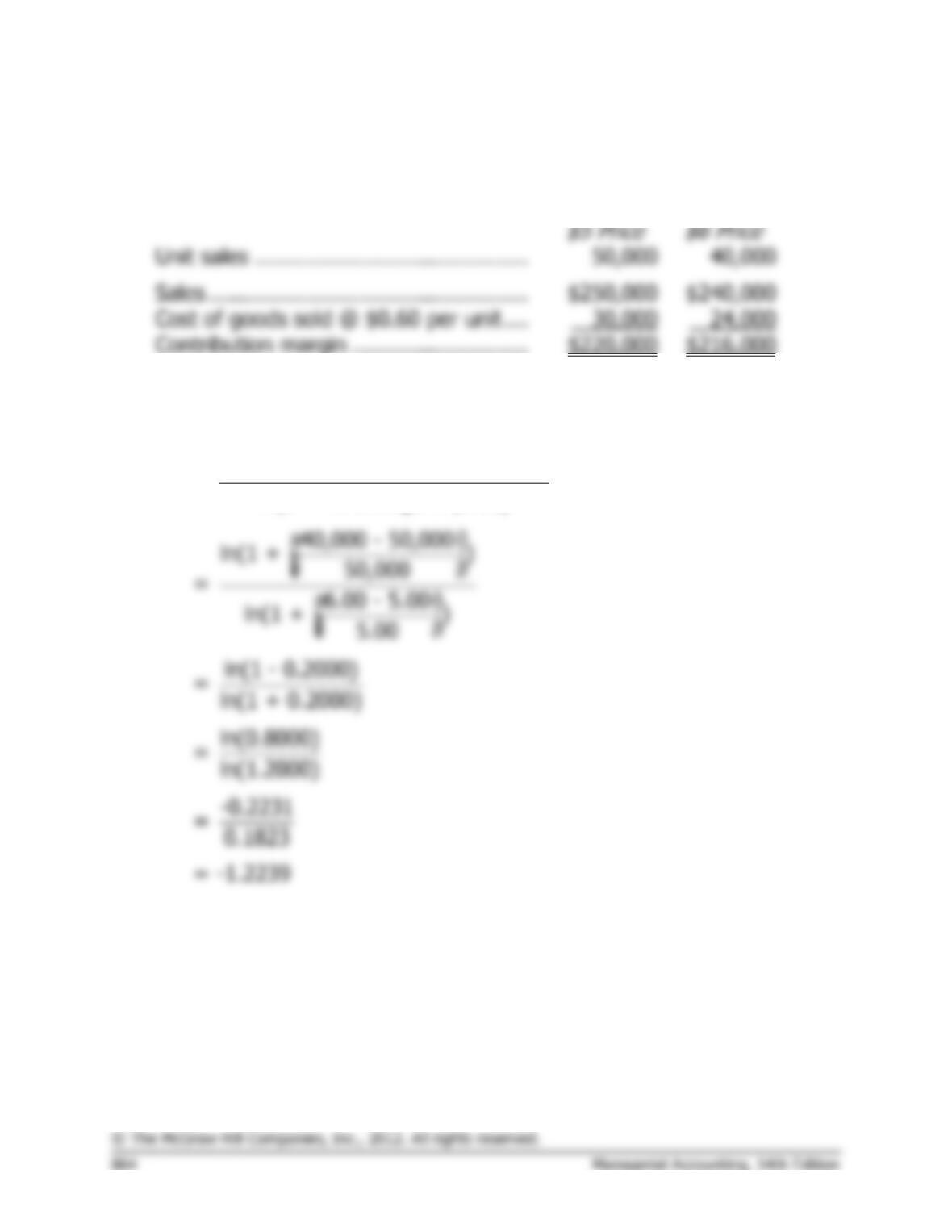
1. The postal service makes more money selling the souvenir sheets at the
lower price, as shown below:
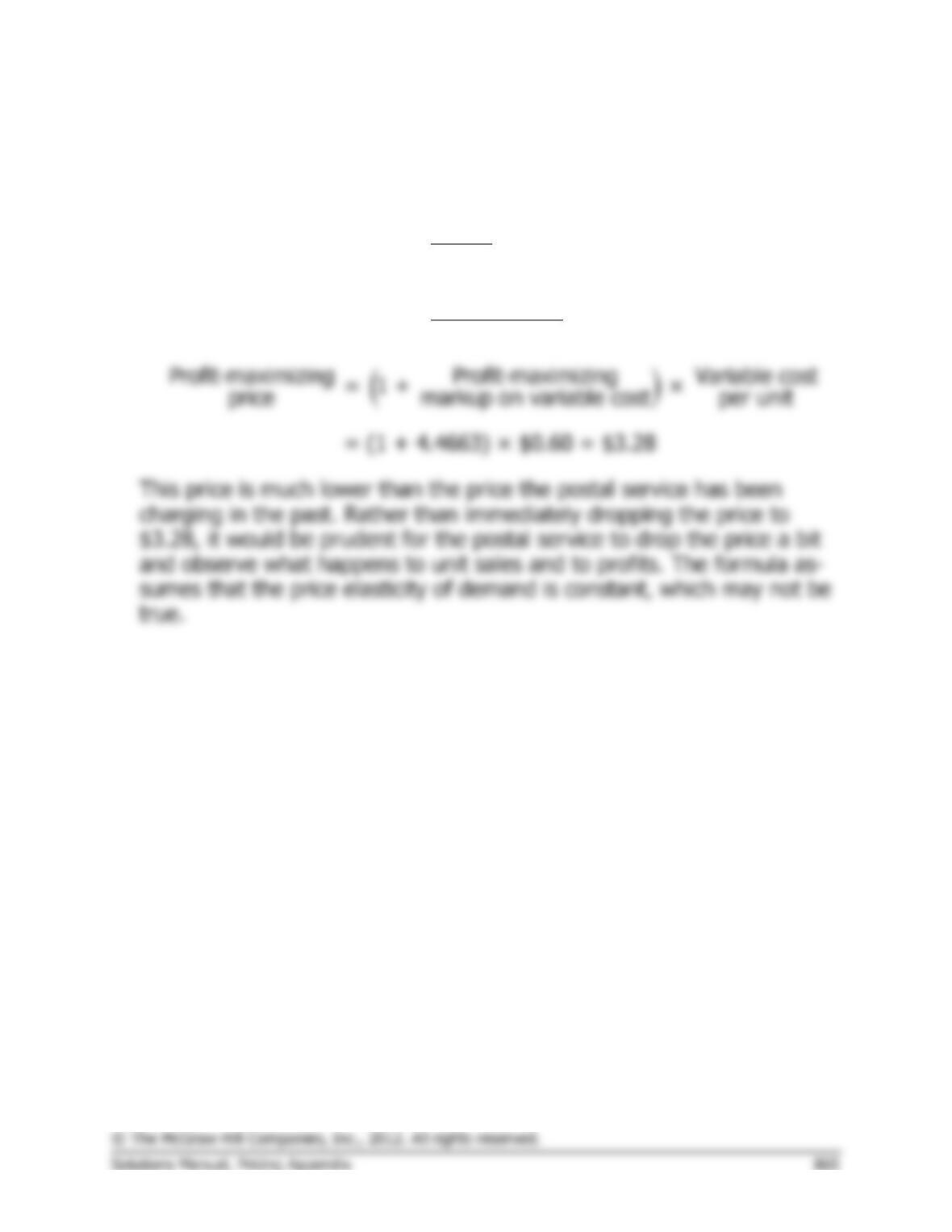
2. The price elasticity of demand, as defined in the text, is computed as
follows:
d =
ln(1 + % change in quantity sold)
ln(1 + % change in price)
Problem A-4 (continued)
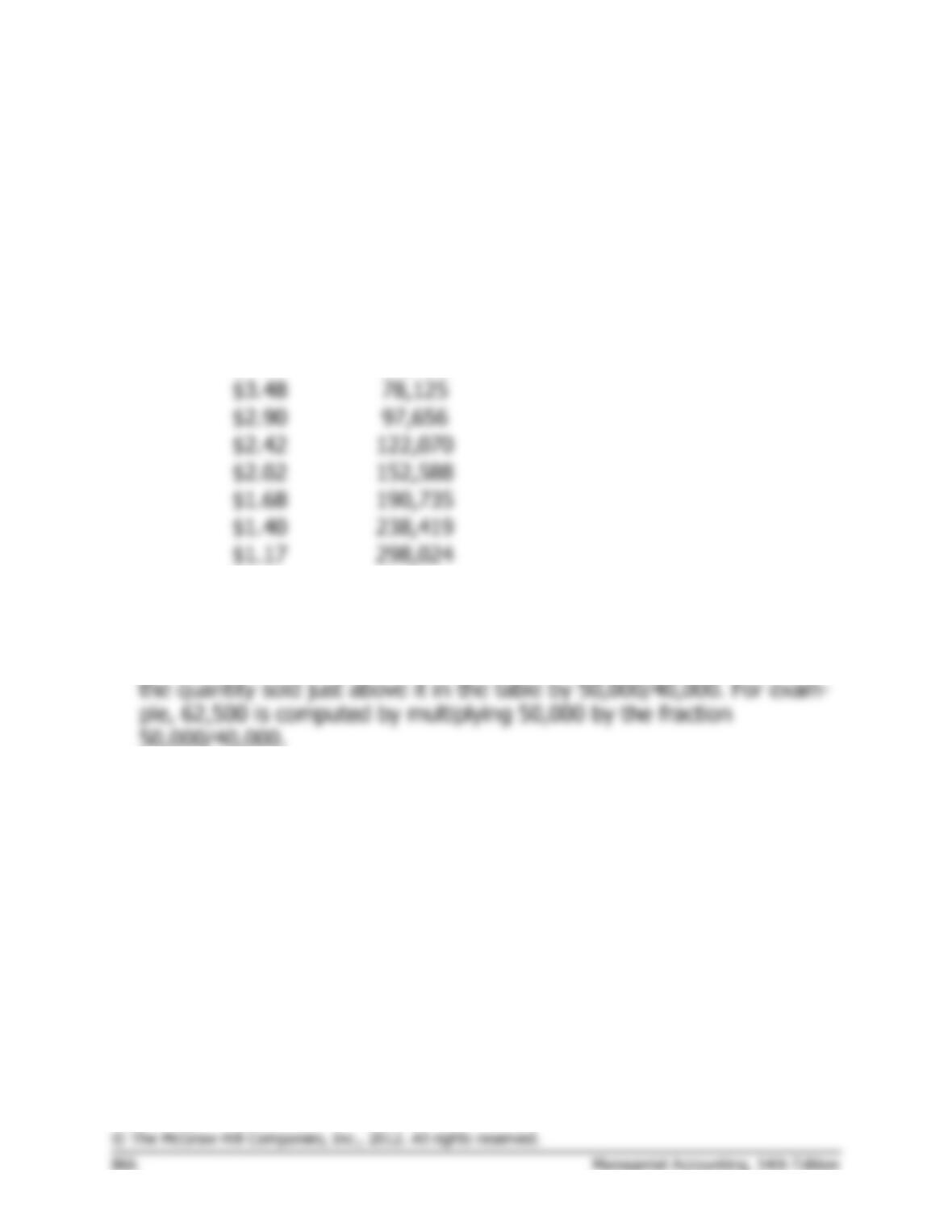
3. The profit-maximizing price can be estimated using the following formu–
las from the text:
d
-1
Profit-maximizing =
markup on variable cost 1 + ε
-1
= = 4.4663
1 + (-1.2239)
Problem A-4 (continued)
The critical assumption in the calculation of the profit-maximizing price
is that the percentage increase (decrease) in quantity sold is always the
same for a given percentage decrease (increase) in price. If this is true,
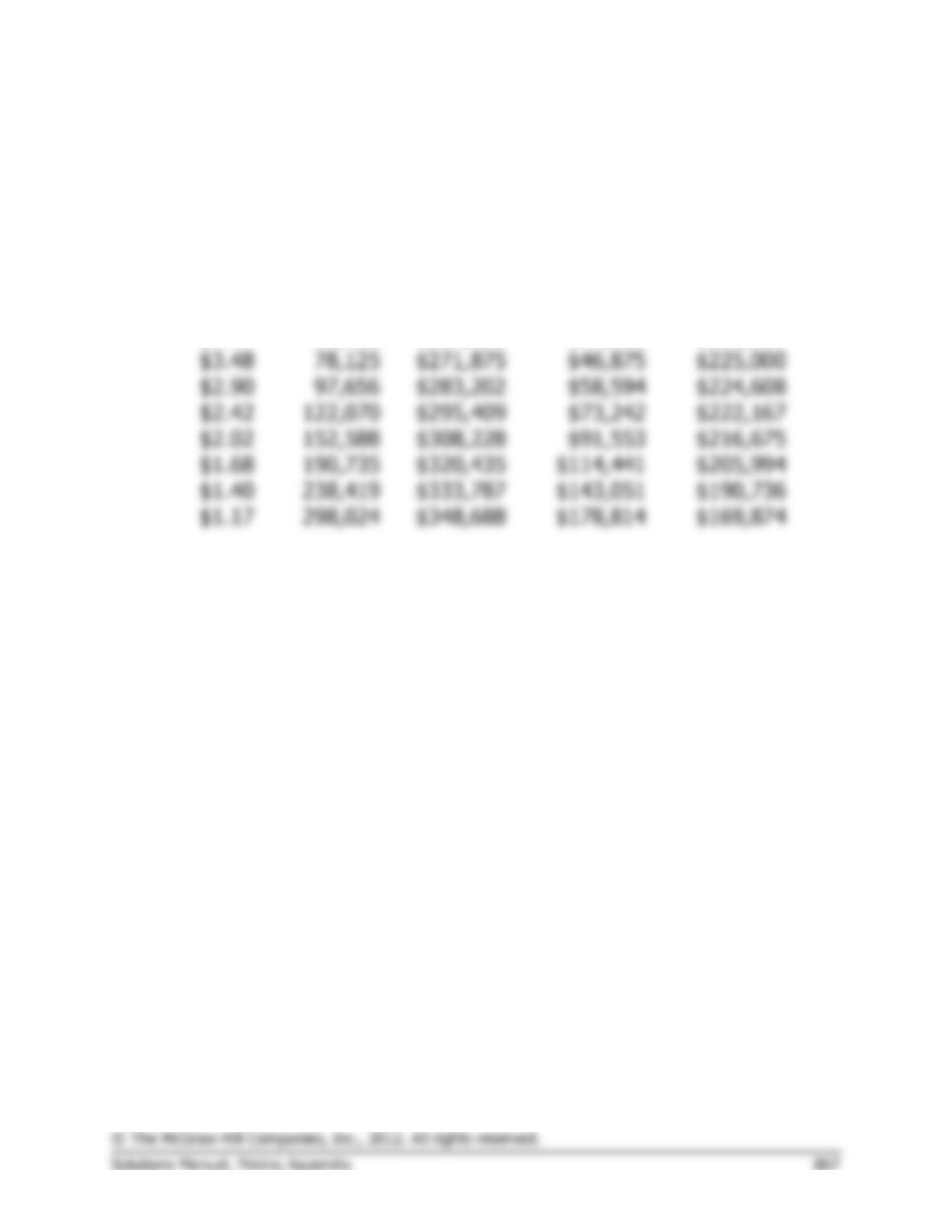
we can estimate the demand schedule for souvenir sheets as follows:
Price
*
Quantity Sold
§
$6.00
40,000
$5.00
50,000
$4.17
62,500
$3.48
78,125
$2.90
97,656
$2.42
$2.02
$1.68
$1.40
$1.17
*The price in each cell in the table is computed by taking 5/6 of the
price just above it in the table. For example, $5.00 is 5/6 of $6.00 and
$4.17 is 5/6 of $5.00.
§The quantity sold in each cell of the table is computed by multiplying
Problem A-4 (continued)
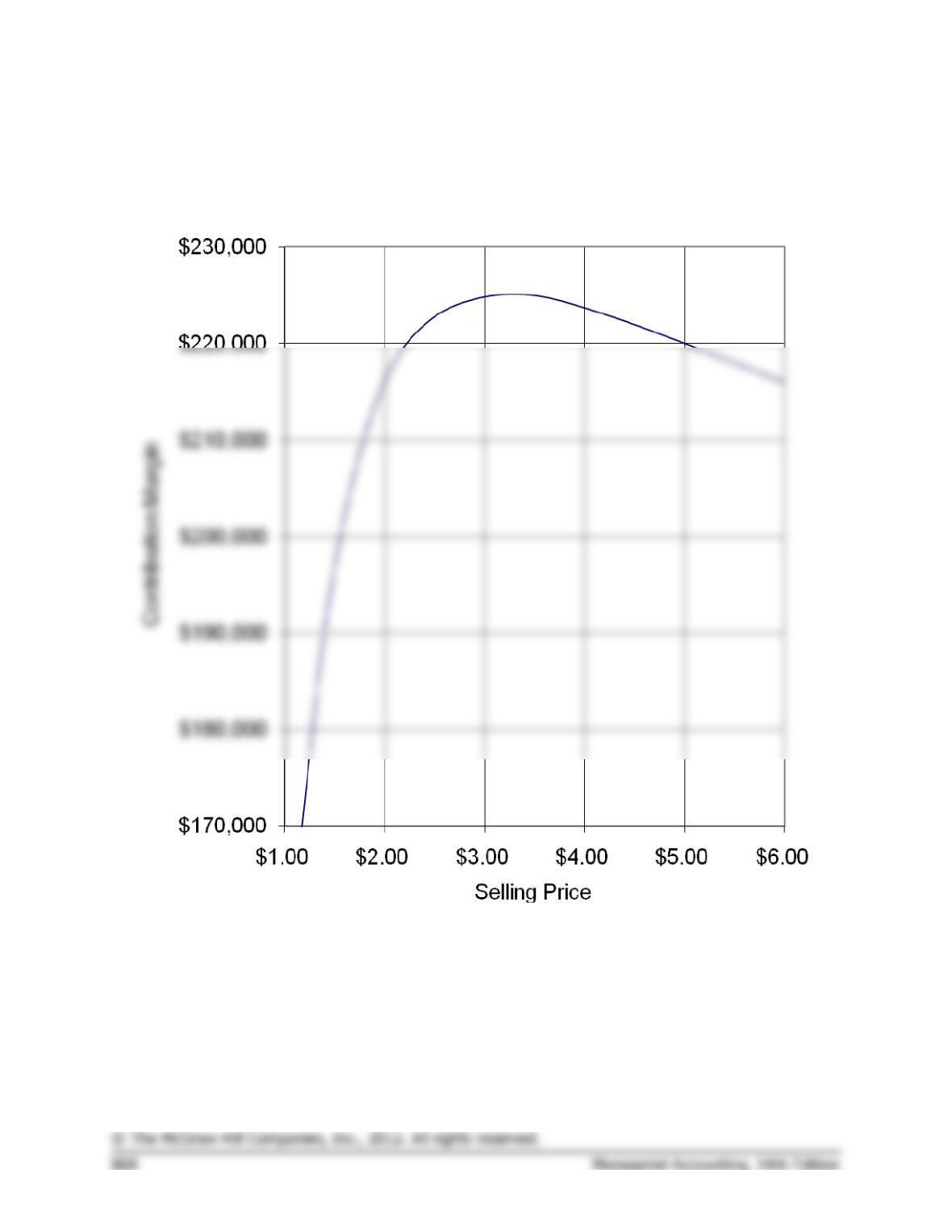
The profit at each price in the above demand schedule can be computed
as follows:
Price
(a)
Quantity
Sold (b)
Sales
(a) × (b)
Cost of Sales
$0.60 × (b)
Contribution
Margin
$6.00
40,000
$240,000
$24,000
$216,000
$5.00
50,000
$250,000
$30,000
$220,000
$4.17
62,500
$260,625
$37,500
$223,125
$2.42
$295,409
$73,242
$222,167
$2.02
$308,228
$91,553
$216,675
$1.68
$320,435
$205,994
$1.40
$333,787
$190,736
Problem A-4 (continued)
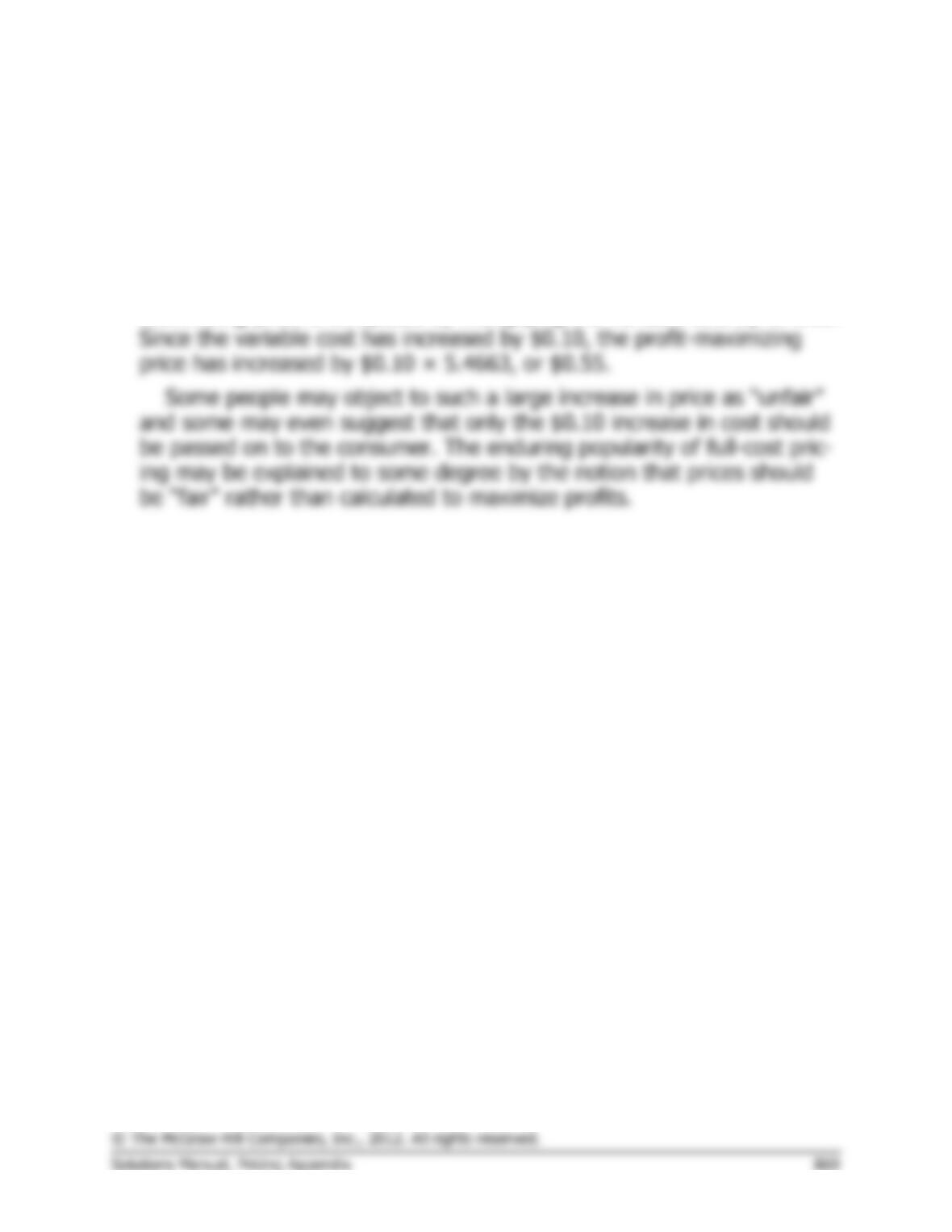
The contribution margin is plotted below as a function of the selling price:
The plot confirms that the profit-maximizing price is about $3.28.
Problem A-4 (continued)
4. If the postal service wants to maximize the contribution margin and
profit from sales of souvenir sheets, the new price should be:
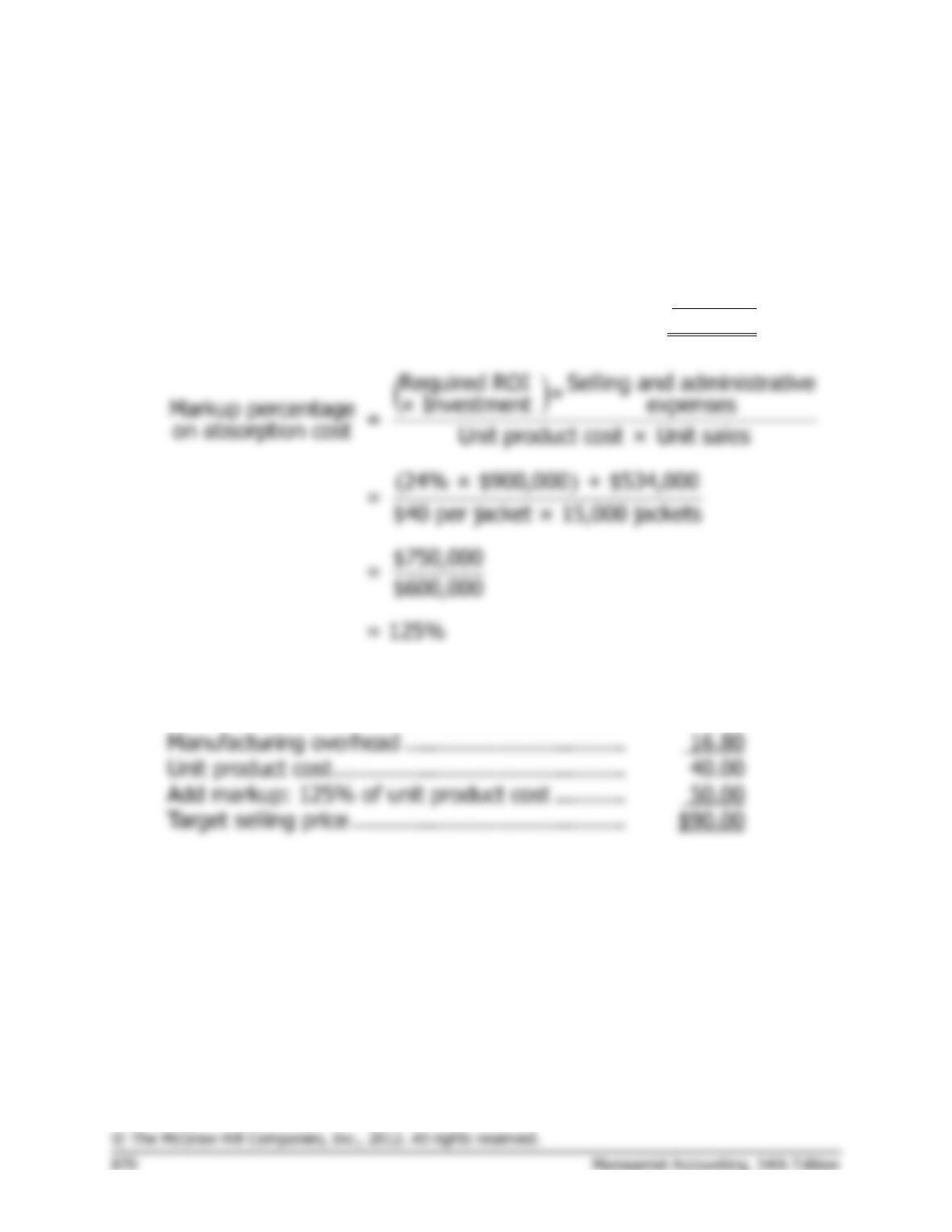
Profit-maximizing price = 5.4663 × $0.70 = $3.83
Note that a $0.10 increase in cost has led to a $0.55 ($3.83 – $3.28) in-
crease in the profit-maximizing price. This is because the profit-
maximizing price is computed by multiplying the variable cost by 5.4663.
Problem A-5 (45 minutes)
1. a. Number of jackets manufactured each year:
21,000 labor-hours ÷ 1.4 labor-hours per jacket = 15,000 jackets.
Selling and administrative expenses:
Variable (15,000 jackets × $4 per jacket) …….
$ 60,000
Fixed …………………………..………………………
474,000
Total ……………………………………………………
$534,000
b.
Direct materials ………………………………………..
$ 9.20
Direct labor ……………………………………………..
14.00
Manufacturing overhead …………………………….
Unit product cost ………………………………………
Add markup: 125% of unit product cost ………..
Target selling price ……………………………………
$90.00