Problem A-5 (continued)
c. The income statement is:
Sales (15,000 jackets × $90 per jacket) ..
$1,350,000
Cost of goods sold
(15,000 jackets × $40 per jacket) ……..
600,000
Gross margin …………………………………..
750,000
Selling and administrative expenses:
Shipping ………………………………………
Salaries ………………………………………..
384,000
Total selling and administrative expense ..
534,000
Net operating income ………………………..
$ 216,000
2. Variable cost per unit:
Direct materials ……………………………………………….
$ 9.20
Direct labor …………………………………………………….
14.00
Variable manufacturing overhead (1/6 × $16.80) ……
2.80
Shipping expense …………………………………………….
4.00
Total variable cost per unit …………………………..…….
$30.00
Problem A-6 (60 minutes)
1. Supporting computations:
Number of pads produced per year:
100,000 labor-hours ÷ 2 labor-hours per pad = 50,000 pads
Standard cost per pad:
$4,000,000 cost of goods sold ÷ 50,000 pads = $80 cost per pad
Standard
Quantity or
Hours
Standard
Price or Rate
Standard
Cost
Direct materials ……………..
5 yards
$6 per yard
$30
Direct labor …………………..
2 hours
$4 per hour
*
8
Manufacturing overhead ….
2 hours
$21 per hour
**
42
Total standard cost per pad
$80
*
Problem A-6 (continued)
2. a.
( )
Required ROI Selling and administrative
+
× Investment expenses
Markup percentage =
on absorption cost Unit product cost × Unit sales
b.
Direct materials …………………..
$ 30
Direct labor ………………………..
8
Manufacturing overhead ……….
42
Unit product cost …………………
80
Add 75% markup ………………..
60
Target selling price ………………
$140
Sales (50,000 pads × $140 per pad) ………………………
Cost of goods sold (50,000 pads × $80 per pad) ………
Gross margin …………………………………………………….
Selling and administrative expense ………………………..
Net operating income ………………………………………….
Problem A-6 (continued)
3. Total fixed cost:
Manufacturing overhead ………………………………………..
$1,750,000
Selling and administrative
[$2,160,000 – (50,000 pads × $5 variable per pad)] …
1,910,000
Total fixed cost ……………………………………………………
$3,660,000
Direct materials …………………………...
Direct labor …………………………………
Variable manufacturing overhead ……..
Problem A-7 (45 minutes)
1.
Projected sales (80 machines × $3,795 per machine) ….
$303,600
Less desired profit (20% × $50,000) ……………………….
10,000
Target cost for 80 machines…………………………………..
$293,600
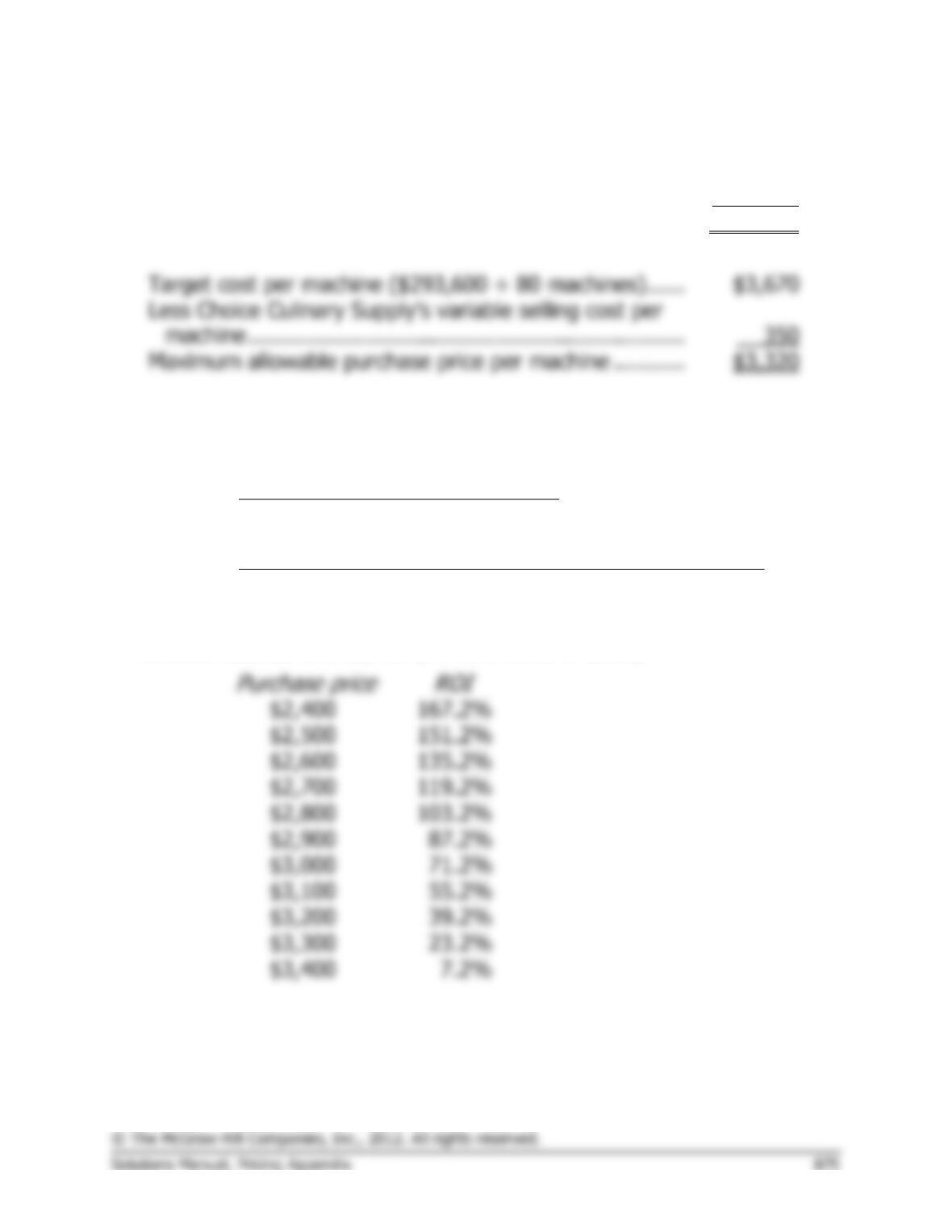
Target cost per machine ($293,600 ÷ 80 machines) ……
Maximum allowable purchase price per machine ………..
2. The relation between the purchase price of the machine and ROI can be
developed as follows:
Total projected sales – Total cost
ROI = Investment
$303,600 – ($350 + Purchase price of machines) × 80
= $50,000
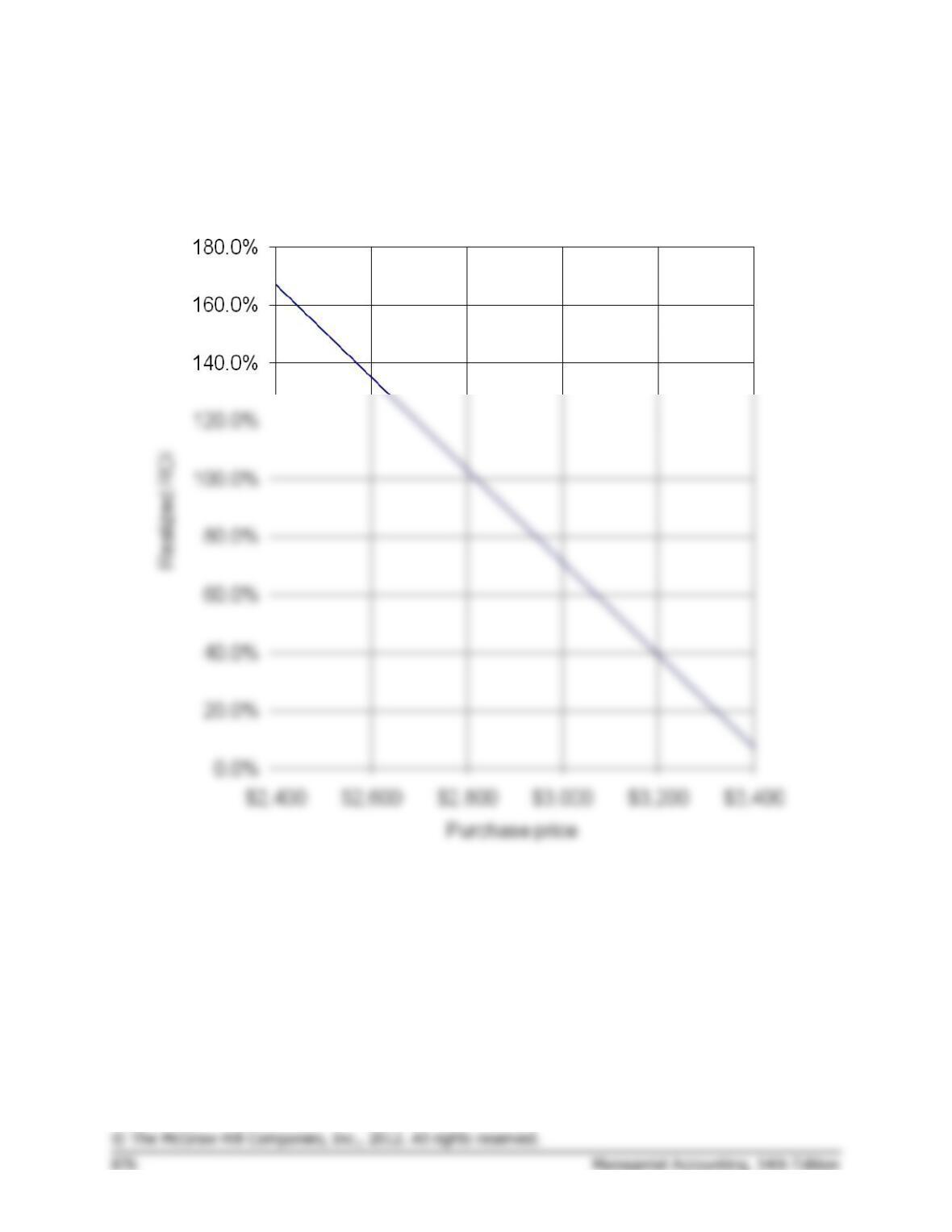
The above formula can be used to compute the ROI for purchase prices
between $2,400 and $3,400 (in increments of $100):
Problem A-7 (continued)
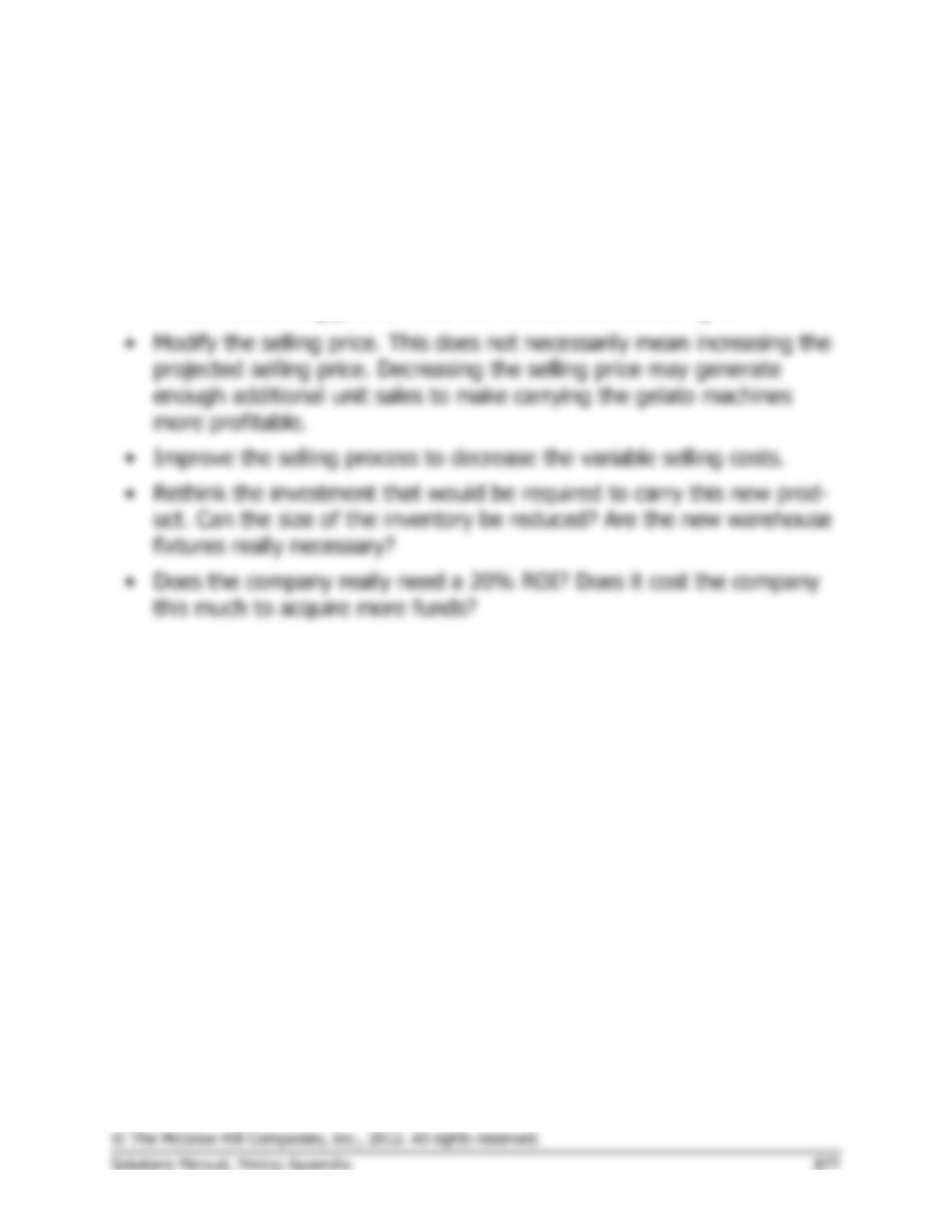
Using the above data, the relation between purchase price and ROI can
be plotted as follows:
Problem A-7 (continued)
3. A number of options are available in addition to simply giving up on
adding the new gelato machines to the company’s product lines. These
options include:
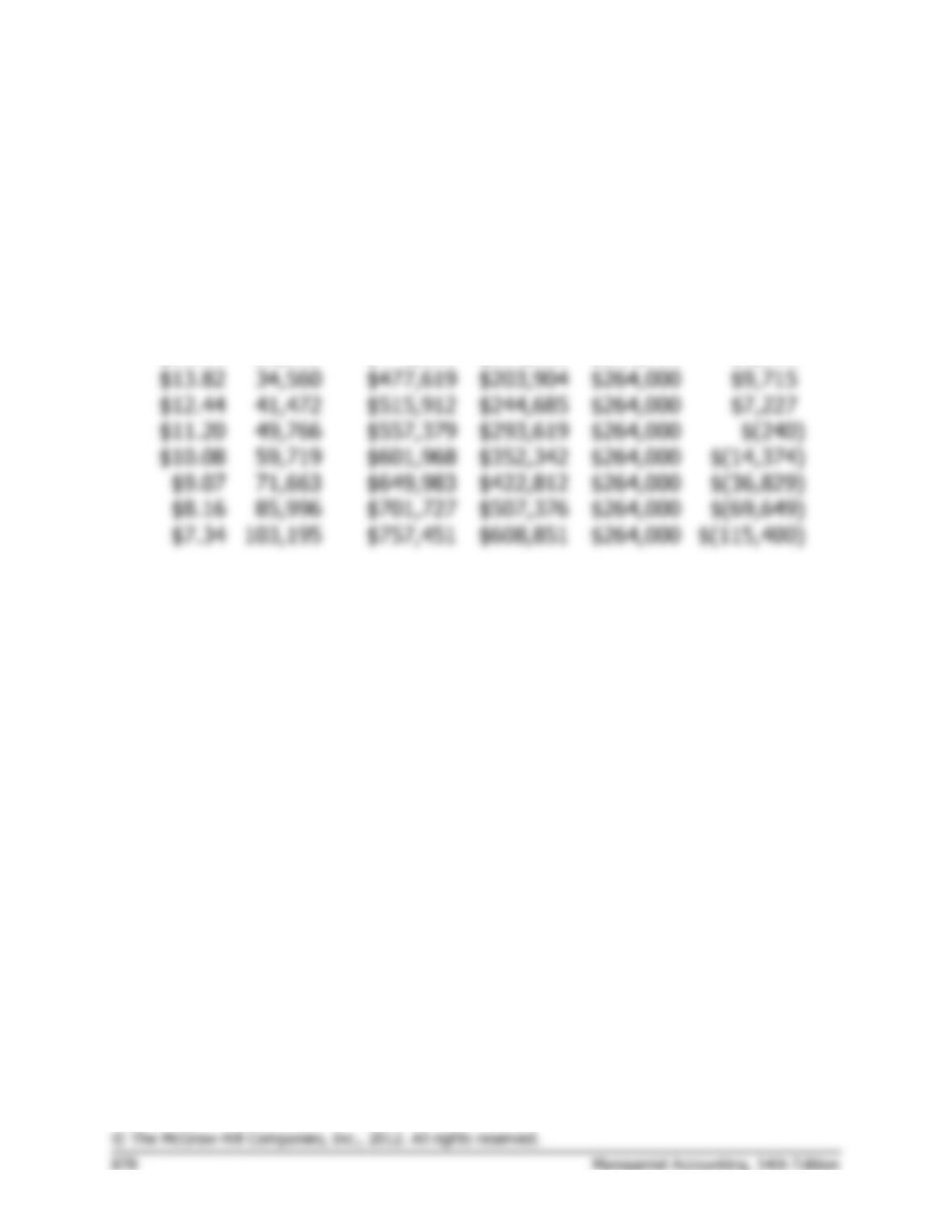
• Check the projected unit sales. Perhaps more units could be sold at the
$3,795 price. However, management should be careful not to indulge
in wishful thinking just to make the numbers come out right.
Problem A-8 (60 minutes)
1. The complete, filled-in table appears below:
Selling
Price
Estimated
Unit Sales
Sales
Variable
Cost
Fixed
Expenses
Net
Operating
Income
$18.95
20,000
$379,000
$118,000
$264,000
$(3,000)
$17.06
24,000
$409,440
$141,600
$264,000
$3,840
$15.35
28,800
$442,080
$169,920
$264,000
$8,160
$12.44
41,472
$515,912
$244,685
$264,000
$11.20
49,766
$557,379
$293,619
$264,000
$10.08
59,719
$601,968
$352,342
$264,000
$(14,374)
71,663
$649,983
$422,812
$264,000
$(36,829)
85,996
$701,727
$507,376
$264,000
$(69,649)
$757,451
$608,851
$264,000
Problem A-8 (continued)
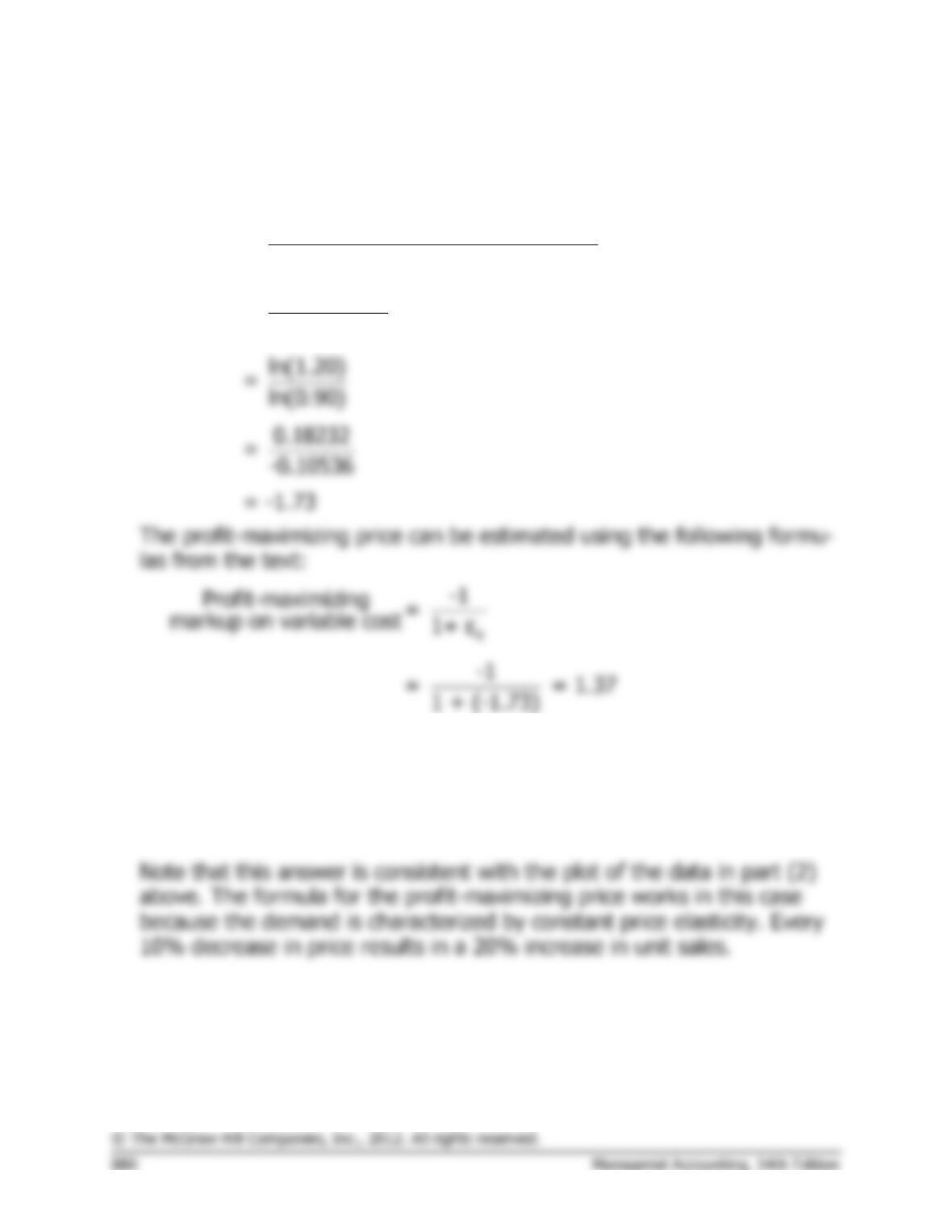
2. The following graph is based on the table in part (1) above:
Problem A-8 (continued)
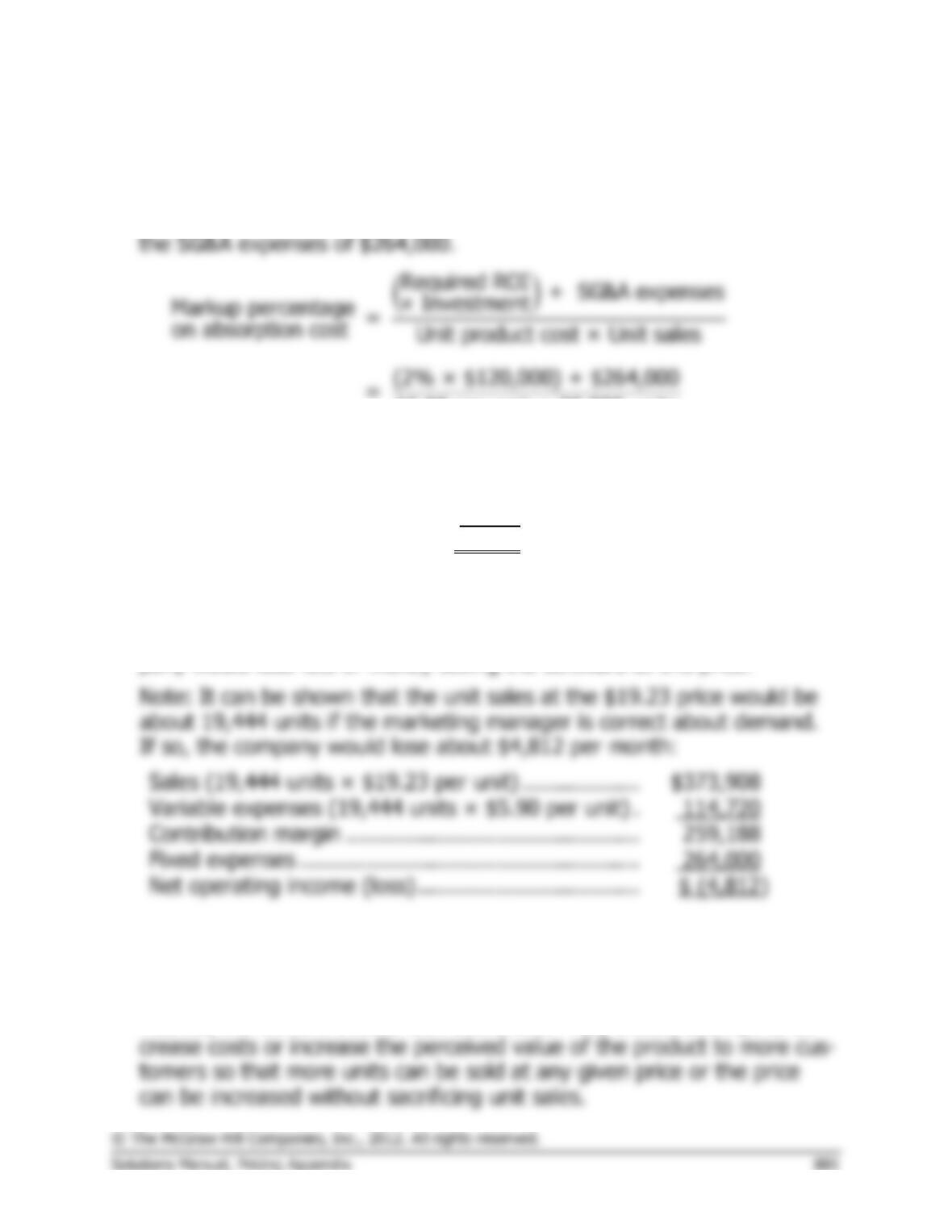
3. The price elasticity of demand, as defined in the text, is computed as
follows:
d =
ln(1 + % change in quantity sold)
ln(1 + % change in price)
=
ln(1 + 0.20)
ln(1 – 0.10)
( )
Profit-maximizing Profit-maximizing Variable cost
= 1 + ×
price markup on variable cost per unit
= (1 + 1.37) × $5.90 = $13.98
Problem A-8 (continued)
4. To apply the absorption costing approach, we must first compute the
markup percentage, which is a function of the required ROI of 2% per
month, the investment of $120,000, the unit product cost of $5.90, and
= 2.26 (rounded) or 226%
Unit product cost ………….
$ 5.90
Markup ($5.90 × 2.26) …..
13.33
Target selling price ………..
$19.23
Charging $19.23 for the software would be a big mistake if the market-
ing manager is correct about the effect of price changes on unit sales.
The graph prepared in part (2) above strongly suggests that the com-
pany would lose lots of money selling the software at this price.
Sales (19,444 units × $19.23 per unit) ………………
Variable expenses (19,444 units × $5.90 per unit) .
Contribution margin ………………………………………
Fixed expenses …………………………………………….
Net operating income (loss) …………………………….
5. If the marketing manager is correct about demand, increasing the price
above $13.98 per unit will result in a decrease in net operating income
and hence in the return on investment. To increase the net operating
income, the owners should look elsewhere. They should attempt to de-