Revised 01/09/2012 Page 1
Virtual Astronomy Labs 2.0
A. Answers to manually graded items
Lab 1:
Exercise 3 (Screen 7): Cepheid Variable Practice Exercise
The answer should be between 2.2 cm and 2.4 cm, giving a final answer in days of 11.63. This problem
Exercise 4 (Screen 8): Sunspots Practice Exercise
The length of the small bar is approximately 2.5 cm, which makes 1 cm equal to about 20 years. The
Exercise 6 (Screen 17): Practice Exercise
The data on the table is to be pulled from the NASA Planetary Data Website; the answers given here are
based upon data pulled in the third quarter of 2011.
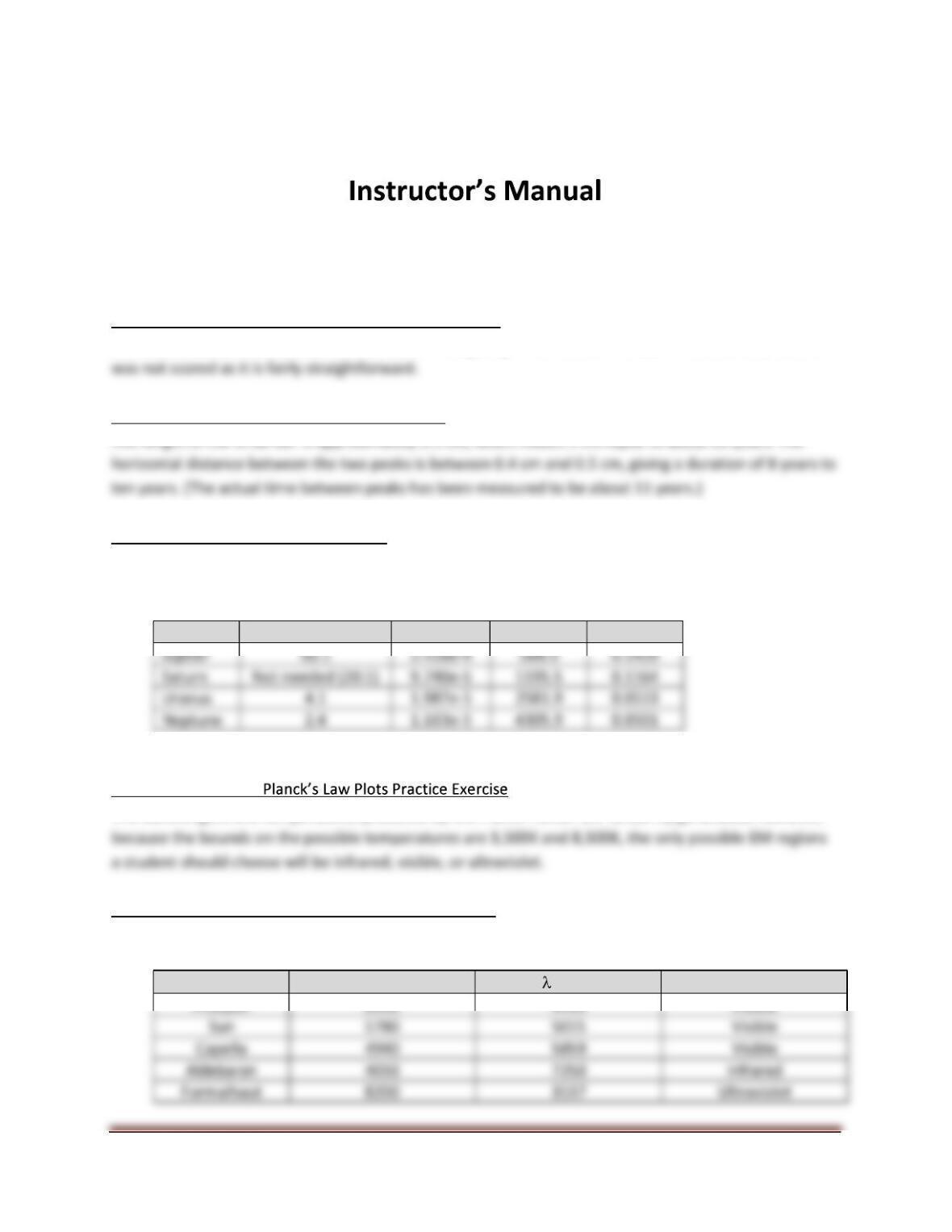
Planet
a (arcseconds)
a (radians)
R (10
6
km)
S (10
6
km)
Lab 2:
Exercise 1 (Screen 8):
The wavelengths and temperatures produced by the Planck Plotter are randomly generated; however,
Exercise 2 (Screen 10): Modeling Stars Practice Exercise
All values given in the table below are approximate.
Star T (K) max (A) EM region
Procyon 6530 4439 Visible
Capella
4940
5859
Visible
Revised 01/09/2012 Page 2
Lab 3:
Exercise 3 (Screen 15): Measuring Shifted Wavelengths Practice Exercise
Exercise 4 (Screen 16): Determining Radial Velocity of Stars Practice Exercise
The data used in this table was pulled from the SIMBAD website in the third quarter of 2011.
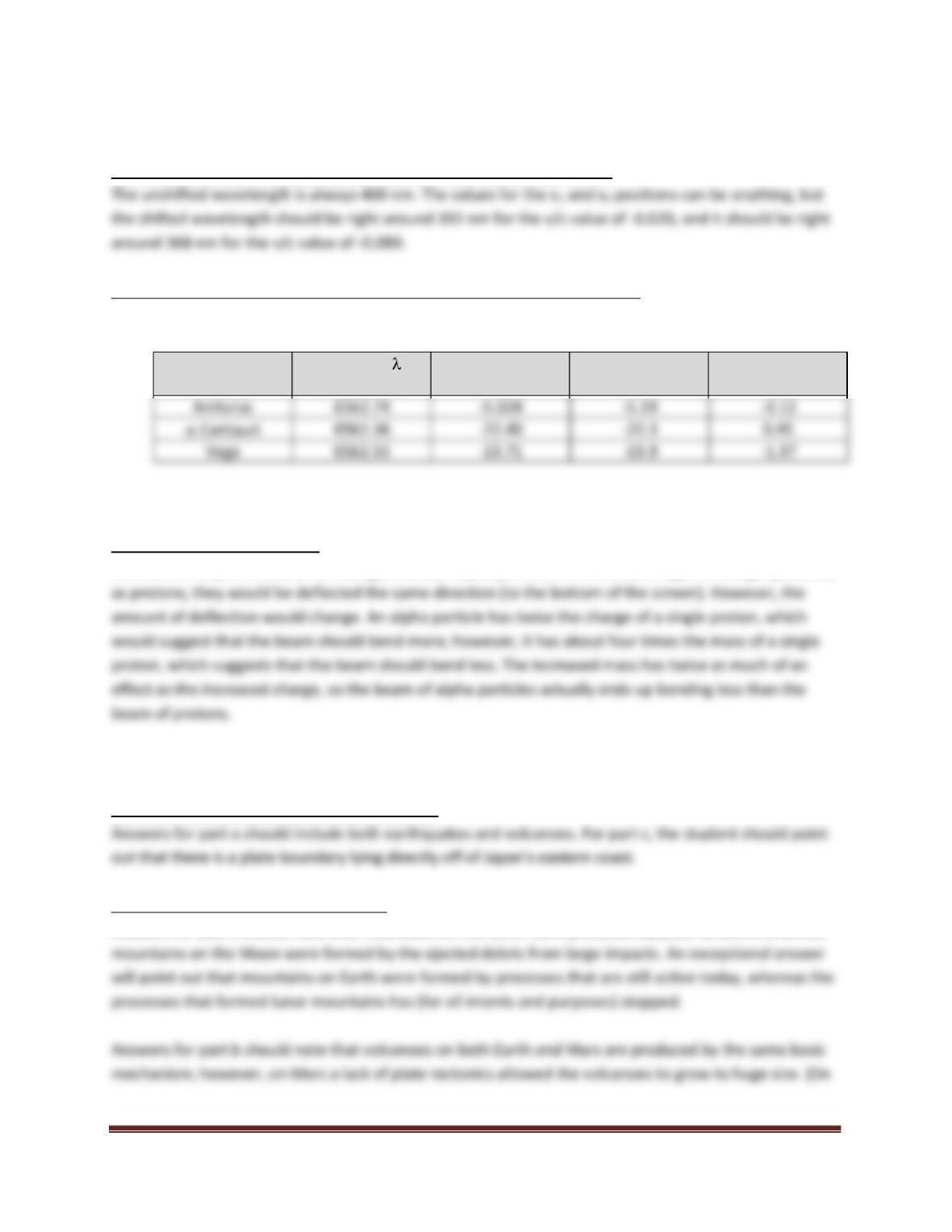
Star Observed
(Angstroms) vc (km/s) vs (km/s) % difference
Lab 4:
Exercise 2 (Screen 8): Exercise
The answer to part b would not change; because alpha particles have the same type of charge (positive)
Lab 5:
Exercise 3 (Screen 14): Plate Tectonics Explorer
Exercise 4 (Screen 22): Practice Exercise
Answers for part a should note that mountains on the Earth were produced by plate tectonics whereas
Revised 01/09/2012 Page 3
Earth the movement of plates shifts the location of the underlying hotspot, causing strings of volcanoes.
An example of this is the Hawaiian island chain.)
Lab 6:
Exercise 1 (Screen 5): Exercise
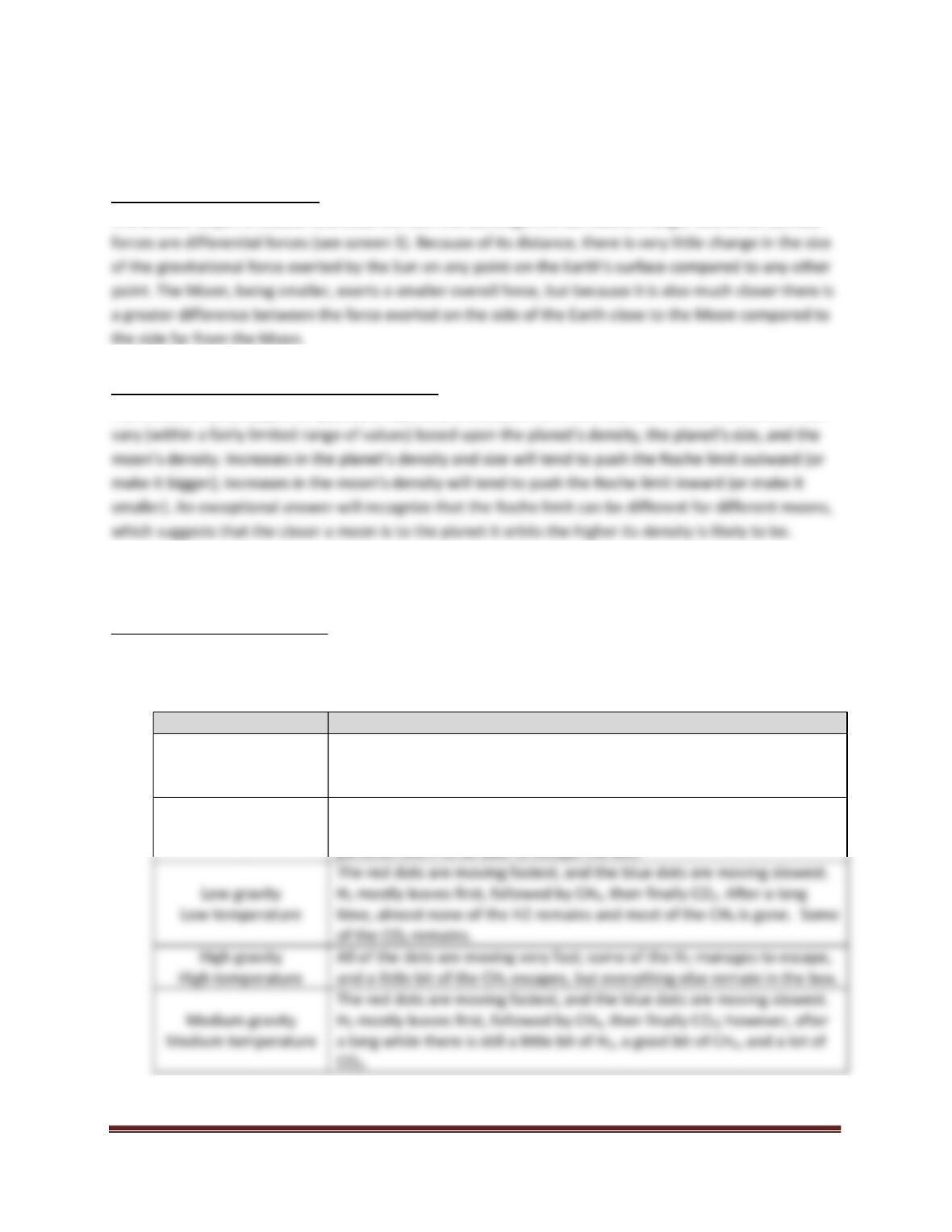
The answer to part c should reference the fact that although the Sun exerts a larger overall force, tidal
Exercise 3 (Screen 11): Plate Tectonics Explorer
Part d asks a fairly subjective question; hopefully the student will have learned that the Roche limit can
Lab 7:
Exercise 6 (Screen 12): Exercise
In the answers given below for part a exact percentages have not been mentioned because of the
random nature of the simulation.
Case: Sample Description:
Low gravity
High temperature
The red dots are moving fastest, and the blue dots are moving slowest.
H2 mostly leaves first, followed by CH4, then finally CO2. Eventually the
box is empty.
High gravity
Low temperature
All of the dots appeared to be moving at about the same speeds; they
all fell to the bottom of the box almost immediately. None of the
particles seem to be able to escape the box.
Revised 01/09/2012 Page 4
The answer for part b should be: Mercury is most like the low gravity, high temperature case; Earth is
similar to the medium gravity, medium temperature case.
The answer for part c should mention that generally the least massive particles (H2) will escape first and
Exercise 7 (Screen 15): Exercise
Answers for part b should point out that although Titan and the Moon have similar escape velocities, the
Moon has a much higher temperature than Titan. This implies that, unlike Titan, gasses near the Moon
will have molecular velocities exceeding the escape velocity and therefore will not stick around to form
an atmosphere.
Lab 8:
Exercise 5 (Screen 16): Exercise
Answers for part a should point out that the density for this planet is smaller than that of a gas giant,
Exercise 6 (Screen 17): Exercise
The data used in this table was pulled from the Extrasolar Planets Encyclopaedia website in the third
quarter of 2011.
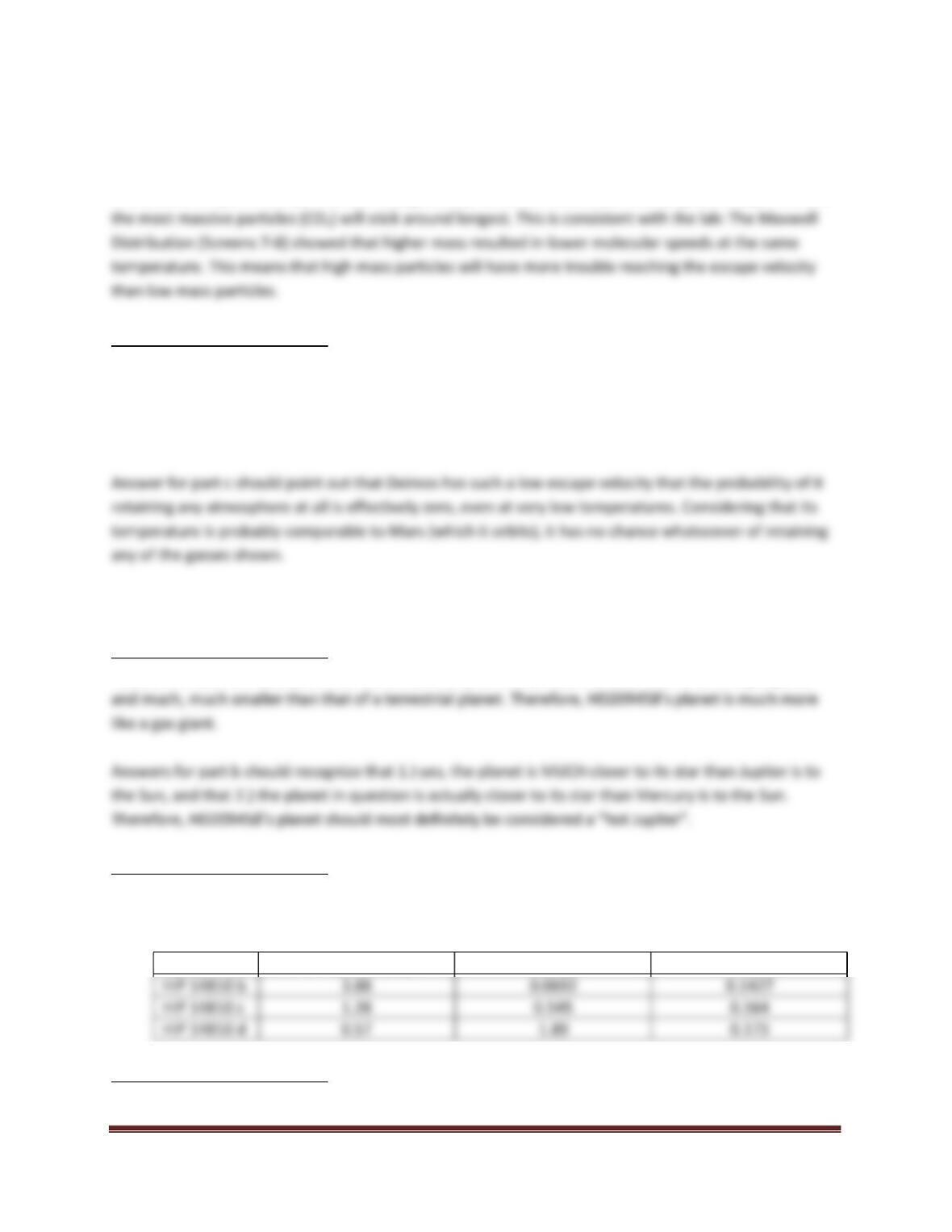
Planet x = mp sin i [MJ] a [AU] e
Exercise 7 (Screen 19): Exercise
Revised 01/09/2012 Page 5
There are several directions the student can go with this question; however, astute students will point
out some of the following observations:
the scale of the solar system.
Lab 9:
Exercise 6 (Screen 15): Exercise
The answer to part i should point out that over the long time frames implied in the question that the
probability of scattering objects that pass close to Neptune is very, very high. Because of this, any object
Lab 10:
Exercise 3 (Screen 12): Exercise
Answers to part c should mention that helium gas molecules have a higher mass than hydrogen gas, so a
Exercise 4 (Screen 14): Exercise
Answers to part b should include that the interior of the Sun rotates as a solid body. (This is actually
given in the answer for part c.)
Lab 11:
Revised 01/09/2012 Page 6
Exercise 5 (Screen 11): Star Evolution Practice Exercise
Answers to part a should point out that the higher the mass the faster the star evolves off of the main
Lab 13:
Exercise 2 (Screen 6): Chandrasekhar Limit Exercise
Answers to part b should point out that it is impossible for a white dwarf to have a mass of 1.5 solar
Exercise 6 (Screen 11): Nova Exercise
Answers should point out that heavier elements (higher atomic mass) and a wider variety of elements
Lab 14:
Exercise 2 (Screen 10): Pulsar Evolution Simulation
Answers to parts b and c cannot be determined directly, as the simulation chooses semi-random
Lab 15:
Exercise 1 (Screen 4): Einstein Ring Practice Exercise
Answers to part a should point out that, first of all, the lens is by necessity closer than the object being
Exercise 4 (Screen 14): Exercise
Revised 01/09/2012 Page 7
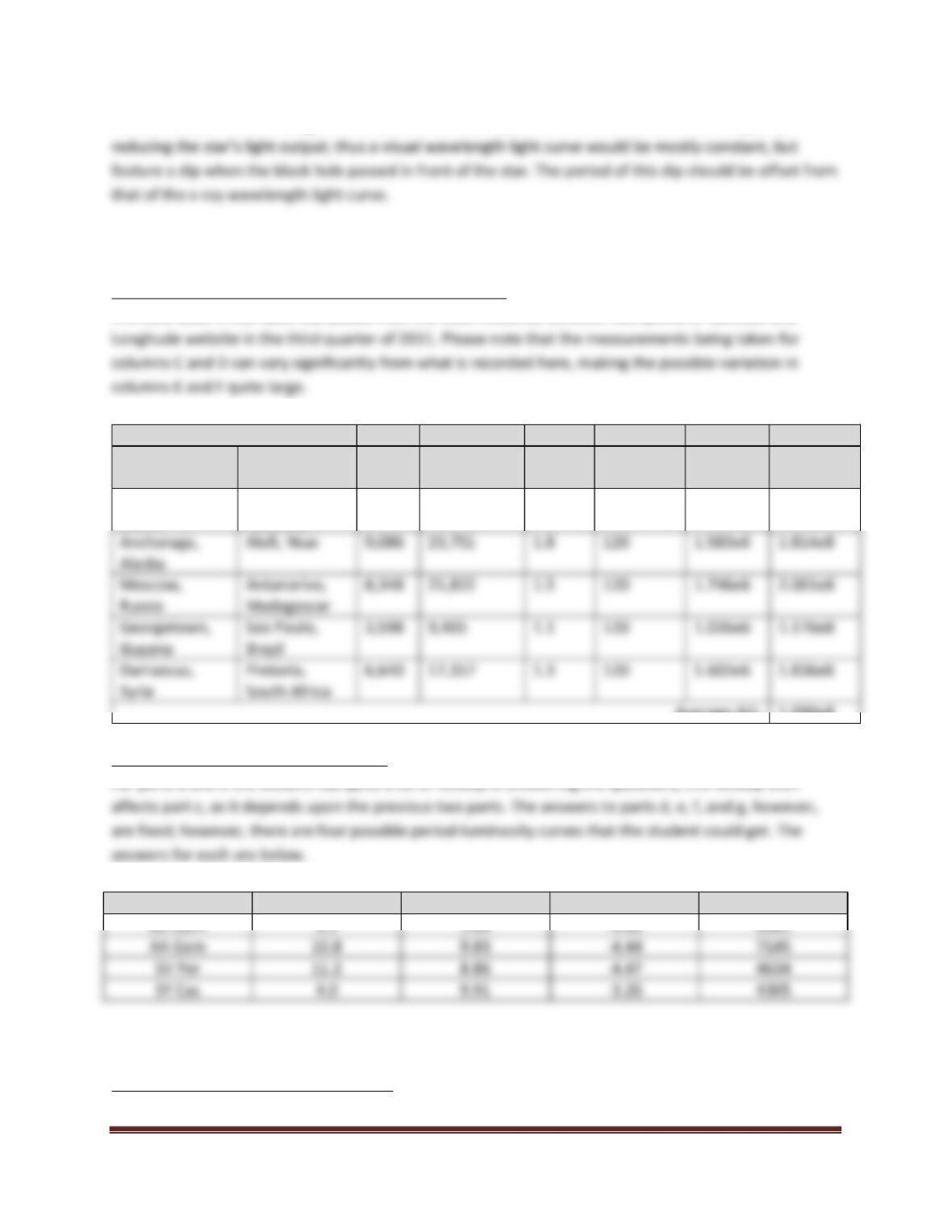
Answers to point b will recognize that as the black hole passes in front of the star it will eclipse it,
Lab 16:
Exercise 2 (Screen 10): An Astronomical Practice Exercise
The data used in this table was pulled from the USDA Distance between two points of Latitude and
A
B
C
D
E
F
N. Hemisphere
City
S. Hemisphere
City
d (km)
d
observed
(
km)
d
(mm)
D
Sun
(mm)
D
Sun
(km)
1 AU (km)
Agana, Guam
Island
Adelaide,
Australia
5,417
14,160
1.2
12
0
1
.
416
e6
1.623e
8
Anchorage,
Alofi, Niue
9,086
23,751
1.8
12
0
1
.
583
e6
1.814e8
Moscow,
Antanarivo,
8,348
21,822
1.5
12
0
1
.
74
6e6
2.001e8
Georgetown,
Sao Paulo,
3,598
9,405
1.1
12
0
1
.
026
e6
1.176e8
Average AU:
1.690e8
Exercise 6 (Screen 19): Practice Exercise
Star Name part d part e part f part g
Lab 17:
Exercise 2 (Screen 7-8): Practice Exercise
Revised 01/09/2012 Page 8
The data from the table is fairly straightforwardly taken; however, the answers are given in the table
below.
R (kpc)
Velocity (km/s)
Total Mass
(billions of MSun)
Visible Mass
(billions of MSun)
Dark Matter = Total
Visible
(billions of MSun)
0.3
259.6
4.5
4.70
–
0.2
2
194
16.73
1.51
15.22
Exercises 3 and 4 (Screen 11): Practice Exercise
The answers to these exercises cannot be checked without doing the same calculations as the student
he Lensing simulation produces values semi-randomly.
Lab 19:
Exercise 2 (Screen 11): Expanding Universe Practice Exercise
Unfortunately the answer to this exercise cannot be checked, as the Universe Expander produces semi-
Exercise 3 (Screen 13): Expansion Center Practice Exercise
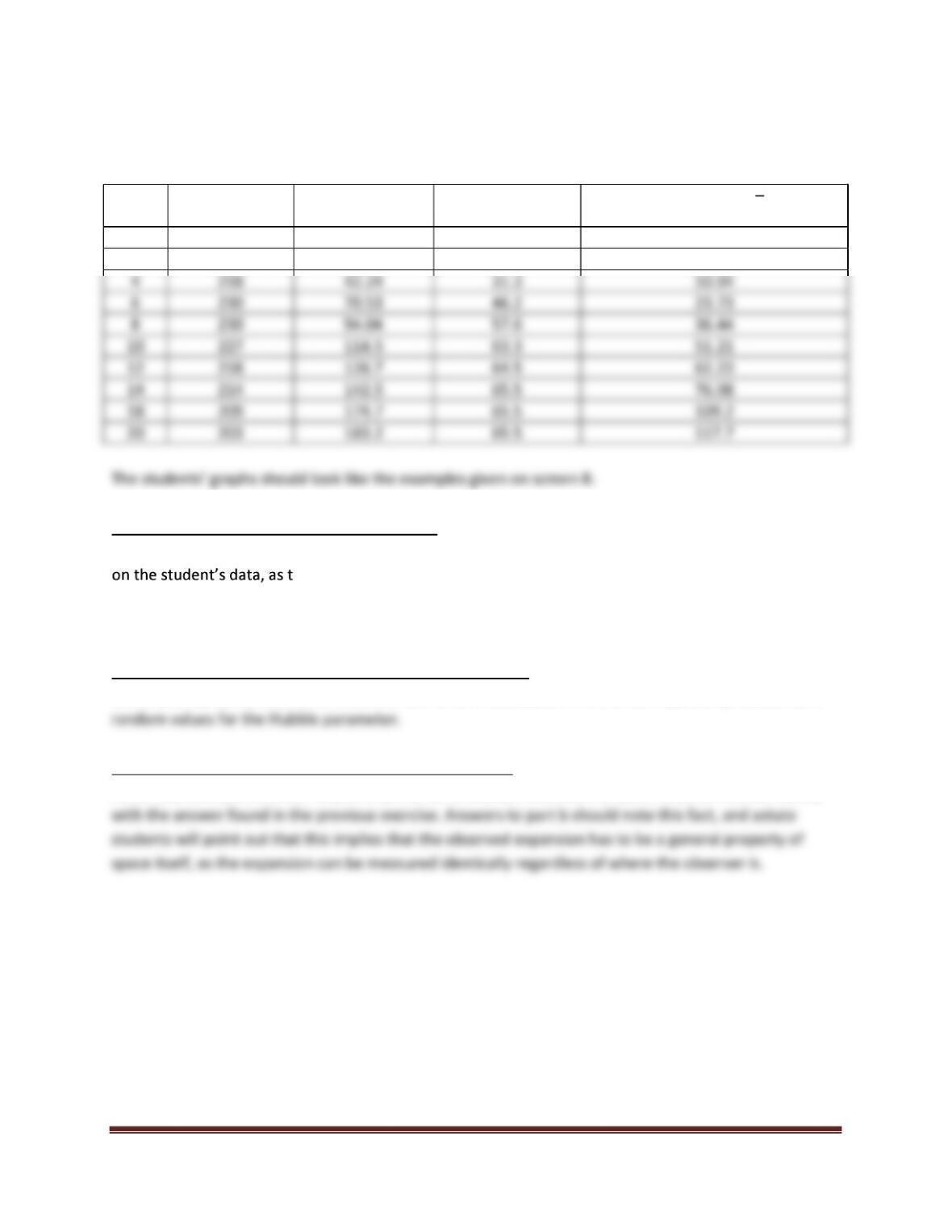
As for exercise 2, the answer to part a cannot be checked; however, it should match somewhat closely
4
218
42.24
31.3
10.94
6
230
70.53
46.2
23.73
8
230
94.04
57.6
36.44
10
227
114.5
63.3
51.21
12
218
126.7
64.5
62.23
14
214
142.5
65.5
76.98
18
209
174.7
65.5
109.2
20
203
183.2
65.5
117.7