Revised 01/09/2012 Page 9
B. Answers to automatically graded items
Lab 1:
Exercise 1 (Screen 4): Length Units Exercise
From left to right, the correct answers are:
Exercise 2 (Screen 6): Unit Conversion Exercise
The correct setup is as follows:
Exercise 5 (Screen 11): Scientific Notation Exercise
(a) 3.51 x 108 = 351000000
(Screen 12): Exercise 5 Continued
(f) 92340000 = 9.234 x 10⁷
Lab 2:
Exercise 3 (Screen 18): Atom Building
Case # of protons # of neutrons # of electrons
in the 1st shell
# of electrons
in 2nd shell
# of electrons
in 3rd shell
Lab 3:
Exercise 1 (Screen 9): Ambulance Exercise
(a) How fast is the ambulance moving in meters per second?
(b) What frequency does the woman hear?
(c) What speed (vs) would the ambulance be traveling in order for the woman to hear the siren at
an approaching frequency of 350 Hz?
Revised 01/09/2012 Page 10
(d) What frequency would she hear as the siren moves away from her at the same speed (as in part
Exercise 2 (Screen12): Visible Light Exercise
Color
F (10
14
Hz)
(nm)
Red
4.41
680
Orange
4.88
614
Yellow
Green
Blue
Violet
7.43
403
Lab 4:
Exercise 1 (Screen 6): Exercise
(c) What percentage of the solar wind is metals
(d) Astronomers are frequently interested in metalicity,
which is defined as the logarithm of the ratio of iron
to hydrogen particles. What is the metalicity of the
Exercise 2 (Screen 8): Exercise
(a)
Particle Type Magnetic Field Direction Particle Deflection Direction
Protons
Into the Screen
Out of the
Screen
(b) Suppose a stream of proton entered the magnetic field from left to right, with the magnetic field
pointing out of the screen. In what direction would the protons be deflected, if at all?
To the bottom of the screen
Exercise 3 (Screen 12): Energies of Particles Exercise
Revised 01/09/2012 Page 11
Which of the following answers is closest to the flux of cosmic rays with the same energy as an apple
dropped from 7 meters?
Exercise 4 (Screen 15): Air Showers Exercise
Air Shower
Energy
Direction
1
2
3
4
5
Lab 5:
Exercise 1 (Screen 6): Earth Explorer
(a) What is the temperature at the center of the Earth in K?
(b) Approximately how thick is the mantle in km?
(c) Approximately how much mass in kg is the liquid outer core?
Exercise 2 (Screen 7): Planetary Interior Simulator
(a) Does the unknown planet have a liquid region in its interior?
(c) What is the S-wave velocity in the planets mantle in km/s?
Exercise 3 (Screen 14): Plate Tectonics Explorer
Lab 6:
Exercise 1 (Screen 5): Exercise
Revised 01/09/2012 Page 12
Exercise 2 (Screen 8): Tidal Plot Exercise
(a) Date of Spring Tide 20100924
Date of Neap Tide 20101001
(b) Date of New Moon 20101007
(c) What phase of the Moon occurs closest in time to the spring tide listed to the left?
(d) What phase of the Moon occurs closest in time to the neap tide listed to the left?
(e) Do the dates for these phases of the Moon generally come before or after the dates on which
the spring and neap tides occurred at the Juneau station?
Before
Exercise 3 (Screen 11): Exercise
(a) 3 and the Moon density as 3.34 g/cm3, determine the
Roche limit for the Moon orbiting the Earth (in Earth radii) and place your answer in the blank.
(b)
(c) What is the Roche limit in Earth radii for the real Moon if the Earth were made entirely of iron?
Lab 7:
Exercise 1 (Screen 6): Ideal Gas Law Exercise
(a) How many moles of O2 gas were produced?
(b) After a few hours, the 750mL flask cools to a temperature of 293K. What is the new pressure
due to the O2 gas?

Revised 01/09/2012 Page 13
Exercise 2 (Screen 8): The Maxwell Distribution Exercise
(a) What is the most likely speed (location of the maximum of the peak) for methane gas (labeled as
CH4 in the menu) as a temperature of 100 K?
What about 500 K?
(b) Which has more higher-speed particles, as gas of hydrogen molecules (labeled as H2) at 500 K, or
as gas of carbon dioxide (labeled as CO2) at 200K?
Exercise 3 (Screen 9): Comparison Exercise
High
Velocity
Medium
Velocity
Low
Velocity
Largest Temp Smallest Temp
Exercise 4 (Screen 9): Comparison Exercise
H
C
H
CO
Exercise 5 (Screen 11): Escape Velocity Exercise
(a) Find the escape velocity for the Earth.
(b) Find the escape velocity for Mars.
(c) Based solely on these answers, would Mars or Earth be more likely to retain an atmosphere?
Exercise 7 (Screen 15): Velocity vs. Temperature Exercise
(a) Judging from the diagram, which atom or molecule listed in the diagram is the most likely to be
here?
CO2
Lab 8
Exercise 1 (Screen 4): Center of Mass Exercise
(a) Using the second equation, what is R in terms of d1, given the value for d2 above?
R = 1048 d1
(b) If R, the total distance between the Sun and Jupiter, is 7.783 x 10⁸ km (5.2 AU), what is d1?
Revised 01/09/2012 Page 14
(c) The Sun has a radius of 6.96 x 10⁵ km. Is the center of mass for the Sun-Jupiter system inside or
outside the Sun?
Exercise 2 (Screen 9): 51 Pegasi Exercise
(a) What is the period P from the graph?
P = 378000 s
(b) What is the semi-amplitude of the radial velocity K from the graph?
(c) What is the mass of the planet, mp sin i, in units of kg?
(d) What is the mass of the planet, mp sin I, in units of Jupiter masses, MJ?
(a) Using you answer for the mass of the planet, mp (answer 2c) in kilograms, and the period, P, find
(b) Now find a, the semimajor axis of the orbit. This value will be in units of meters.
(c) Convert this answer to units of kilometers.
(d) Convert this answer to units of AU (1.496 x 10⁸ km = 1 AU).
Exercise 4 (S
(a) How long does it take for light to fall from full light to minimum light during the transit?
1740 s
(b) From the Doppler observations on HD209458 in an earlier section, it was known that the
semimajor axis or radius of this planet 9 m. What is the circumference of
the orbit?
(c) From the Doppler measurements the orbital period is known to be about P = 3×10⁵ s. What is
the average speed of the planet as it orbits the star HD209458?
(d) What is the diameter of the planet in meters?
(e) What is the radius of the planet in Jupiter radii?
(f) What is the volume V of the planet?
Revised 01/09/2012 Page 15
(g) From the Doppler measurements, the mass of the planet is known to be about 1.33×1027 kg.
172.1761 kg/m3
Lab 9:
st Law
What is the distance from of the foci of the ellipse to its center?
Exercise 3 (Screen 7): Ellipse Exercise
(a) What is the length of the semimajor axis of the ellipse below?
(b)
rd Law Exercise
The distant Kuiper belt object Quaoar, discovered in June 2002, has a semimajor axis of 43.4 AU. What
Exercise 5 (Screen 13): Kirkwood Gap Exercise
(a) What is the semimajor axis (in AU) of an asteroid in 1:2 resonance with Jupiter?
riod = 11.8681 yr
(b) Find the corresponding semimajor axis of the two central gaps and calculate what resonance
each is associated with.
Semimajor axis in AU Corresponding resonance
Exercise 6 (Screen 15): Plutino Exercise
(a) What is the resonance ratio of a Plutino?
2:3
(b)
(c) How close does this KBO ever get to Neptune?
(d) Is this KBO at risk for scattering?
(e) Does the orbit of this KB
(f) How close does this KBO ever get to Neptune?
Revised 01/09/2012 Page 16
(g) Characterize this asteroids risk of scattering:
(h) Do you think this KBO is at risk of being scattered?
Exercise 7 (Screen 20): Albedo Exercise
Suppose an astronomer observes an asteroid and finds
What is the albedo of this asteroid?
Exercise 8 (Screen 22): Size from Albedo Exercise
What is the approximate radius of the asteroid?
Exercise 9 (Screen 25): Exercise
(a) Calculate the combined mass of the 1998 WW31 system using the equation.
(b) Use the Hubble result (given in the instructions) to find the mass of the larger KBO (M) in kg.
(c) Find the smaller mass, m, in kg.
Lab 10
Exercise 1 (Screen 7): Solar Dopplergram Exercises
Which side is moving toward us (negative velocities) and which side is moving away from us (positive
velocities)?
Exercise 2 (Screen 7): Solar Dopplergram Exercises
(a) At about what speed is the right edge of the Sun moving away (receding) from us at the
equator?
(b) At about what speed is the right edge of the Sun receding at a latitude of 45 degrees?
(c)
diameter of the Sun is 1,391,980 km at the equator. Use the speed from part (a) to calculate the
Revised 01/09/2012 Page 17
Exercise 3 (Screen 12): Verification by Helioseismology Exercise
(a) What is the largest fractional deviation in %?
(b) At what approximate radii are the deviations largest?
Exercise 4 (Screen 14): Differential Rotation Exercise
(a) Use the graph to estimate the rotation rates for each of the solar latitudes. Place your answers
in the boxes below in units of nHz.
Latitude
R/R
Sun
= 0.9
R/R
Sun
= 0.5
0
°
30
°
60
°
(c) At what fractional radius (R/RSun) does the Sun begin to rotate like a solid body (all latitudes
rotating at about the same speed)?
Lab 11:
Exercise 1 (Screen 5): Stellar Magnitude Exercises
Archenar
Algol
Sirius
Sun
Most Luminous
Least Luminous
Exercise 2 (Screen 5): Stellar Magnitude Exercises
Sun Sirius Archenar Algol
Most Apparent Brightness Least Apparent Brightness
Exercise 3 (Screen 8): Hyades Cluster Exercise
(a) Enter the apparent magnitude.
(c) Enter the distance modulus m-M.
(d) Determine the distance d in parsecs to the Hyades cluster.
Revised 01/09/2012 Page 18
Exercise 4 (Screen 9): Pleiades Cluster Exercise
(a) Enter the apparent magnitude.
(b) Enter the absolute magnitude
(c) Enter the distance modulus m M.
Exercise 6 (Screen 13): Turnoff Point Exercise
(a) Based on the HR diagram, which cluster contains the largest percentage of high mass main
sequence stars?
(b) Which cluster do you suppose is the oldest?
Exercise 7 (Screen 14)
Lab 12:
Exercise 1 (Screen 3): Center of Mass Exercise
(a) What is the distance of m1 to the center of mass?
(b) What is the distance of m2 to the center of mass?
(c) Now change the distance R to 30 AU and find d1 and d2.
(d) What is the ratio of d2 to d1? This should be the same for either value of R (within the
uncertainty of making the above determinations).
ercise
(a) What is the mean separation distance, a, between Sirius A and B?
(b) What is the total mass M of the two stars?
(c) What is the mass of Sirius A?
(d) What is the mass of Sirius B?
Revised 01/09/2012 Page 19
Exercise 3 (Screen 8): Algol System
(a) What is the mean separation distance between the two stars in milliarcsecconds (mas)?
(b) What is the mean separation distance between the two stars in AU?
Exercise 4 (Screen 11): Exercise
(a) Record the shifted wavelengths for both stars.
(b) Now record the change in wavelength ( ) for each star?
(c) Determine the orbital speeds for the two stars?
(d) What is the mass ration of the two stars?
Lab 13:
Exercise 1 (Screen 3): Density Exercise
(a) What is the volume of the Earth in centimeters?
(b) What is the density of an average white dwarf?
Exercise 2 (Screen 6): Chandrasekhar Limit Exercise
(a) What is the radius, in solar units, of a white dwarf with a mass of 1 solar unit?
Exercise 3 (Screen 11): Nova Exercise
From the chart in the simulator, which of the following isotopes are involved in the hot CNO cycle?
Revised 01/09/2012 Page 20
Exercise 4 (Screen 11): Nova Exercise
Use your mouse to drag and drop the isotopes below into the correct order from least abundant to most
abundant isotopes produced 1 second after the nova explosion.
Exercise 5 (Screen 11): Nova Exercise
Use your mouse to drag and drop the isotopes below into the correct order from least abundant to most
abundant isotopes produced 7.94 seconds after the nova explosion.
Nitrogen
–
13
Oxygen
–
14
Oxygen
–
16
Flourine
–
17
Least Abundant
Most Abundant
Exercise 7 (Screen 14): Distance to NGC 4526 Using SN 1994D Exercise
(a) What is the peak apparent magnitude of SN 1994D?
(b) How far away is the galaxy NGC 4526 in parsecs?
Lab 14:
Exercise 1 (Screen 8): The Lighthouse Model Exploration Exercise
Magnetic Axis
Angle
Inclination
Cone Angle
Pointed Toward
Me
Pulsar A
37
41
7
Pulsar C
78
90
12
Exercise 2 (Screen 10): Pulsar Evolution Simulator
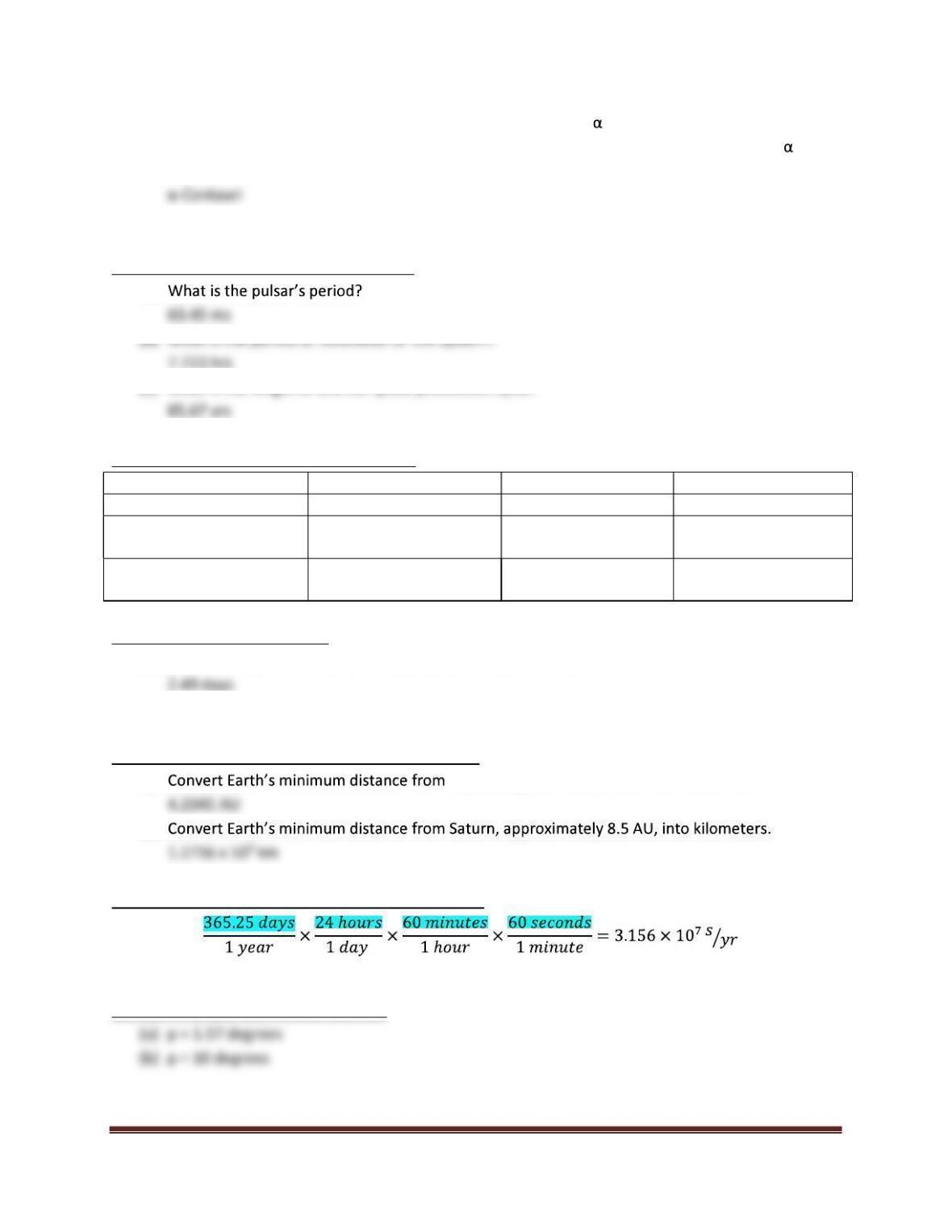
(a) As time passes, is the period of the pulsar increasing, decreasing, or staying the same?
increasing
Exercise 3 (Screen 13): Distribution of Periods Exploration Exercise
(a) Find the ranges of pulsar attributes and fill out the table below:
Shortest Period (s)
Longest Period (s)
Largest Spindown
Rate (s/s)
Smallest Spindown
Rate (s)
Pulsar Name
Value
(b) How many times longer is the longest period than the shortest period?
(c) Where do most pulsars reside on the diagram?
middle
Nitrogen
–
13
Oxygen
–
14
Flourine
–
17
Oxygen
–
16
Least Abundant
Most Abundant
Revised 01/09/2012 Page 21
(d) Stars like our Sun come one at a time while the closest to us, -Centauri, is in a multiple star
system. Is the typical pulsar in the lower-left corner of the diagram more like the Sun or –
Centauri?
Lab 15
Exercise 2 (Screen 7): Binary Pulsar Exercise
(a)
7.723 hrs
(c) What is the length of one complete precession cycle?
Exercise 3 (Screen 10): Black Hole Simulator
Object
Mass
Schwarzschild Radius
Photon Sphere Radius
Earth
5.97×10
24
kg
0.008865 m
0.0133 m
Sun
1 Solar Mass
(1.99 x1030 kg)
2955 m
4432 m
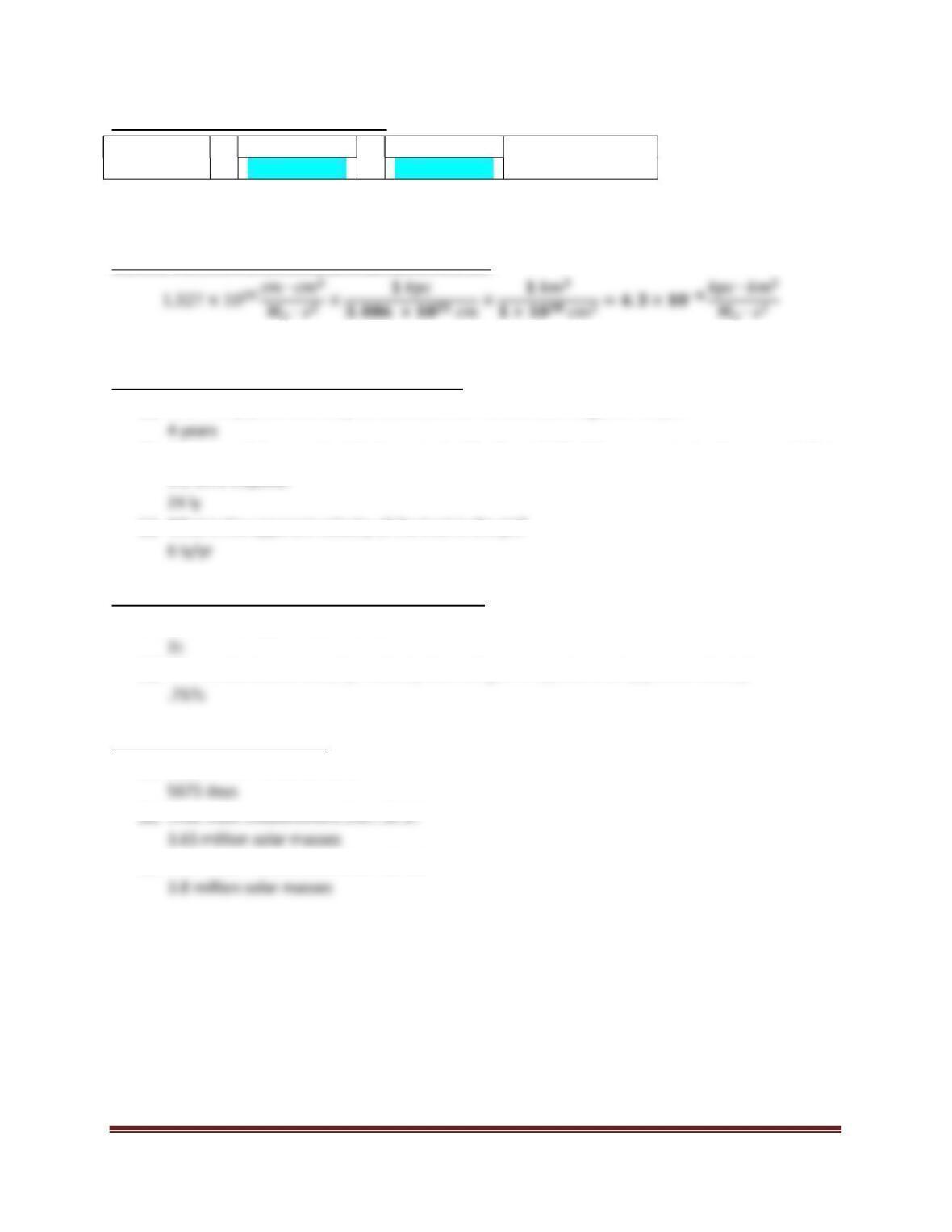
The black hole at the
center of the Milky Way
4.3 Million Solar
Masses
1.271×10
10
m
1.906 x 10
10
m
Exercise 4 (Screen 14): Exercise
(a) What is the period of the black hole system in the simulator?
Lab 16
Exercise 1 (Screen 2): The Astronomical Unit Exercise
(a) Jupiter, approximately 6.29 x 10⁸ km, in AU.
(b)
Exercise 3 (Screen 12): Length of a Light-Year Exercise
Exercise 4 (Screen 16): Parallax Exercise
Revised 01/09/2012 Page 22
Exercise 5 (Screen 16): Parallax Exercise
1 arcsecond
X
1 arcminute
X
1 degree
= 0.000278
degrees
60 arcseconds
60 arcminutes
Lab 17
Exercise 1 (Screen 4): Converting Length Units Exercise
Lab 18
Exercise 1 (Screen 7): Superluminal Motion in M87
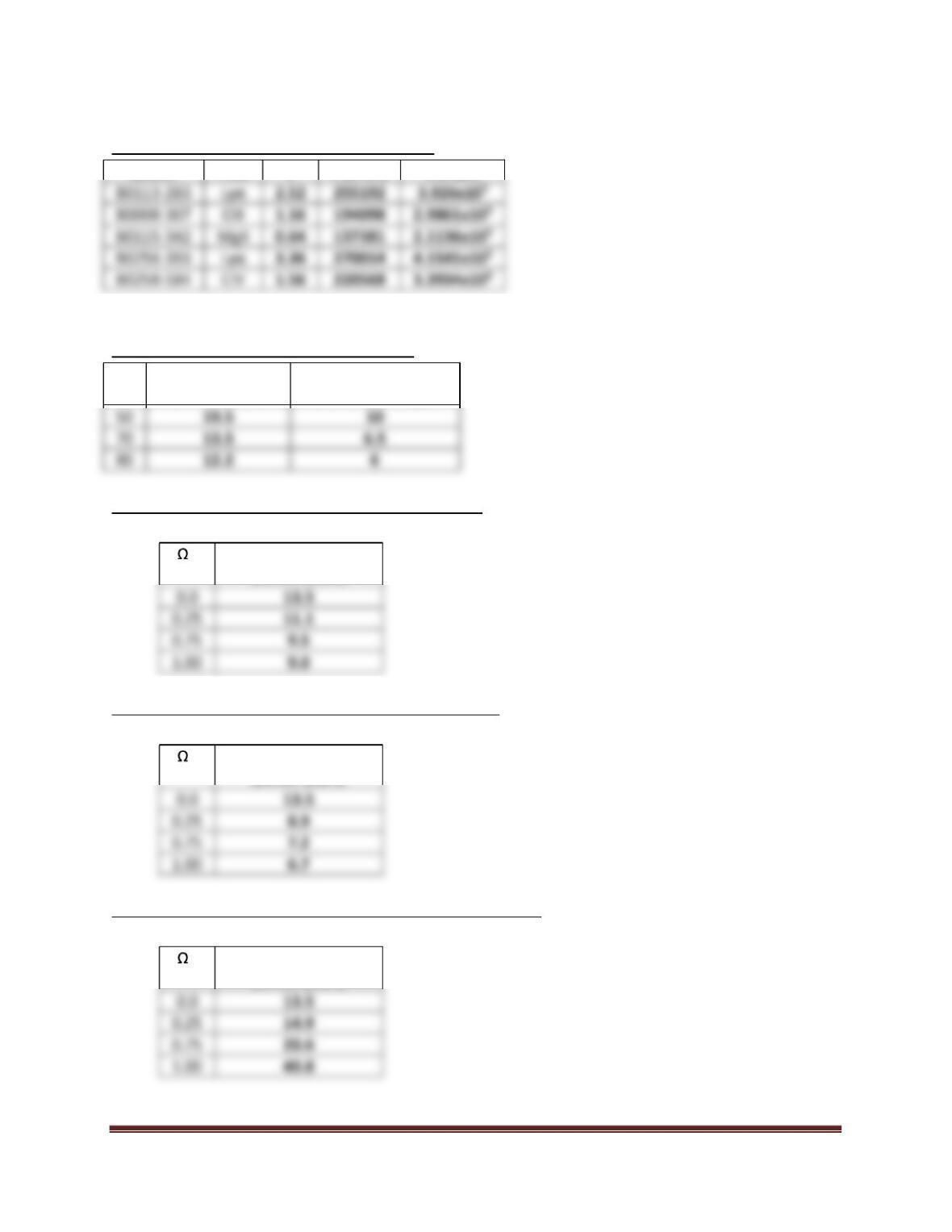
(a) How many years have elapsed between the first and last images of the jet?
(b) How many light-years has the knot, marked by the solid black line, appeared to have traveled in
the time elapsed?
(c) What is the apparent velocity of the knot in the jet?
Exercise 2 (Screen 9): Superluminal Motion Calculator
(a) What is the apparent jet velocity?
(b) What is the lowest actual jet velocity that will give a superluminal apparent velocity?
Exercise 3 (Screen 12): Exercise
(a) Best Orbital Period for S0-2?
(b) Final mass measurement from S0-2?
(c) Final mass measurement from S0-16?
Revised 01/09/2012 Page 23
Lab 19
Exercise 1 (Screen 1): Quasar Redshift Exercise
Quasa
r
Peak
z
v (km/s)
d (Mpc)
Lab 20
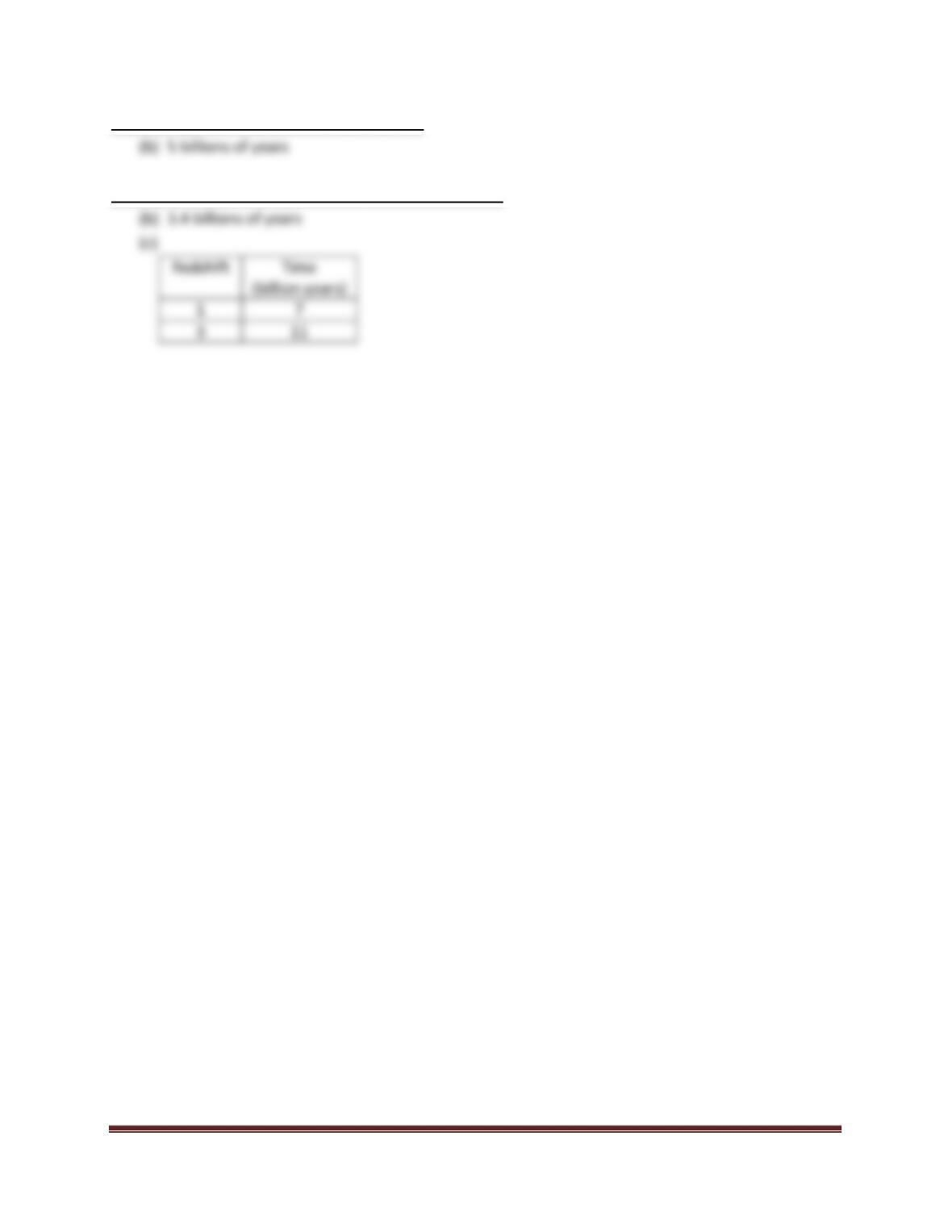
Exercise 1 (Screen 13): Hubble Law Exercise
H
0
Age of Universe
(billion years)
Time of Redshift = 1
(billion years ago)
50
70
80
Exercise 2 (Screen 14): Pure Matter Universe Exercise
(b)
m
Age of the Universe
(billion years)
0.0
0.25
0.75
Exercise 3 (Screen 15): Pure Radiation Universe Exercise
(b)
m Age of the Universe
(billion years)
Exercise 4 (Screen 16): Pure Vacuum Energy Universe Exercise
(b)
m Age of the Universe
(billion years)
1.00
B0113
–
283
L
B0008
–
307
CIII
B0115
–
342
MgII
B0256
–
393
L
B0258
–
184
CIV
Revised 01/09/2012 Page 24
Exercise 5 (Screen 14): General Case Exercise
Exercise 6 (Screen 15): Best Current Parameters Exercise