
Confidential Teaching Materials
Homework 8 Criteria, Page 1 of 9
Homework 8 Grading Criteria
Note: To receive any credit whatsoever, your answers must be legible and readily readable in the
judgment of the grader. Add brief explanatory comments as necessary to make sure your answers
are clear and unambiguous to the grader.
[p1] 80 points
Arrays are useful in that they allow to access elements by an index. The drawback to arrays is that their size
must be fixed. This can cause some problems in software design because it forces the programmer to guess the
maximum number of elements he/she may need.
To get around this limitation, object-oriented languages such as Java allow a programmer to use a Vector class.
Through its public methods, a Vector allows random access to a dynamically-allocated data structure. Elements
in the data structure are accessed by their position. The first element in the structure is position 1, the second is
2, etc.
Your job is to implement a vector class. Since a user should be able to make a vector of any data type, your
class must use a generic parameter. Your vector class should use a linked list as its data structure to store the
elements in the vector, and should implement the following functionality:
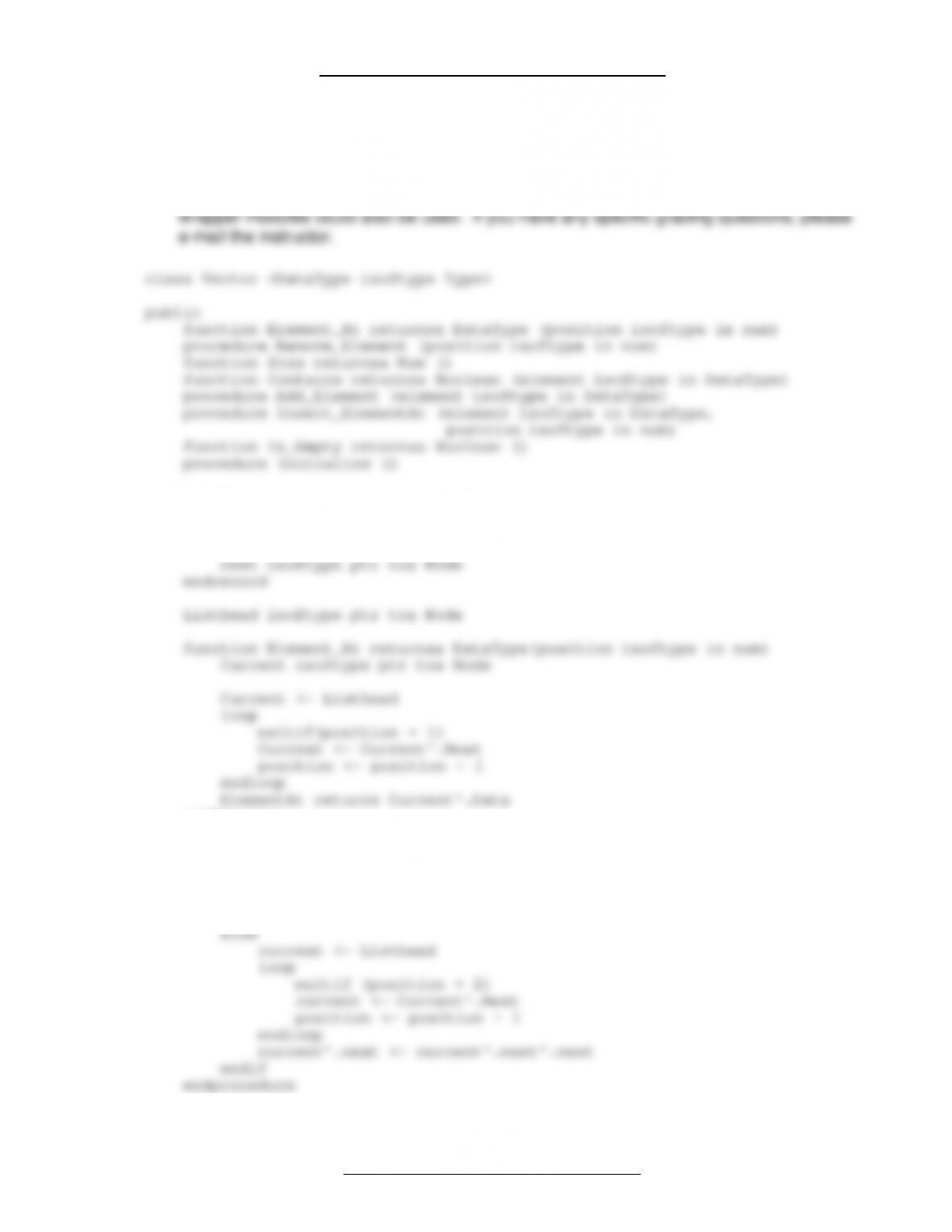
function Element_At returnsa DataType (position isoftype in num)
Given a position, returns the element at that position.
You do not have to worry about the position being invalid.
procedure Remove_Element (position isoftype in Num)
Removes the element in the given position in the vector.
You do not have to worry about the the position being invalid.
function Size returnsa Num ()
Returns the number of elements in the vector.
function Contains returnsa Boolean (element isoftype in DataType)
Returns true if element is found in the vector; otherwise,
returns false.
procedure Add_Element (element isoftype in DataType)
Adds the given element to the end of the vector.
procedure Insert_Element_At (element isoftype in DataType,
position isoftype in num)
Adds the given element before the given position.
You do not have to worry about the position begin invalid.
function Is_Empty returnsa Boolean ()
Returns true if the vector has no elements; false is returned
otherwise.
Note that DataType in the above module headers indicates your class’s generic parameter. In modules that have
a position parameter, you may assume that the position will always be passed as a valid integer. Also assume
that the = operator will work on any type of generic parameter.
Feel free to add any “helper” modules in the protected section
Confidential Teaching Materials
Homework 8 Criteria, Page 2 of 9
of your class. The public headers of your class must match those given exactly, i.e. you may not add or remove
any parameters. Also assume that the = operator will work on any type of generic parameter.
[c1] 80 points
Sample Solution:
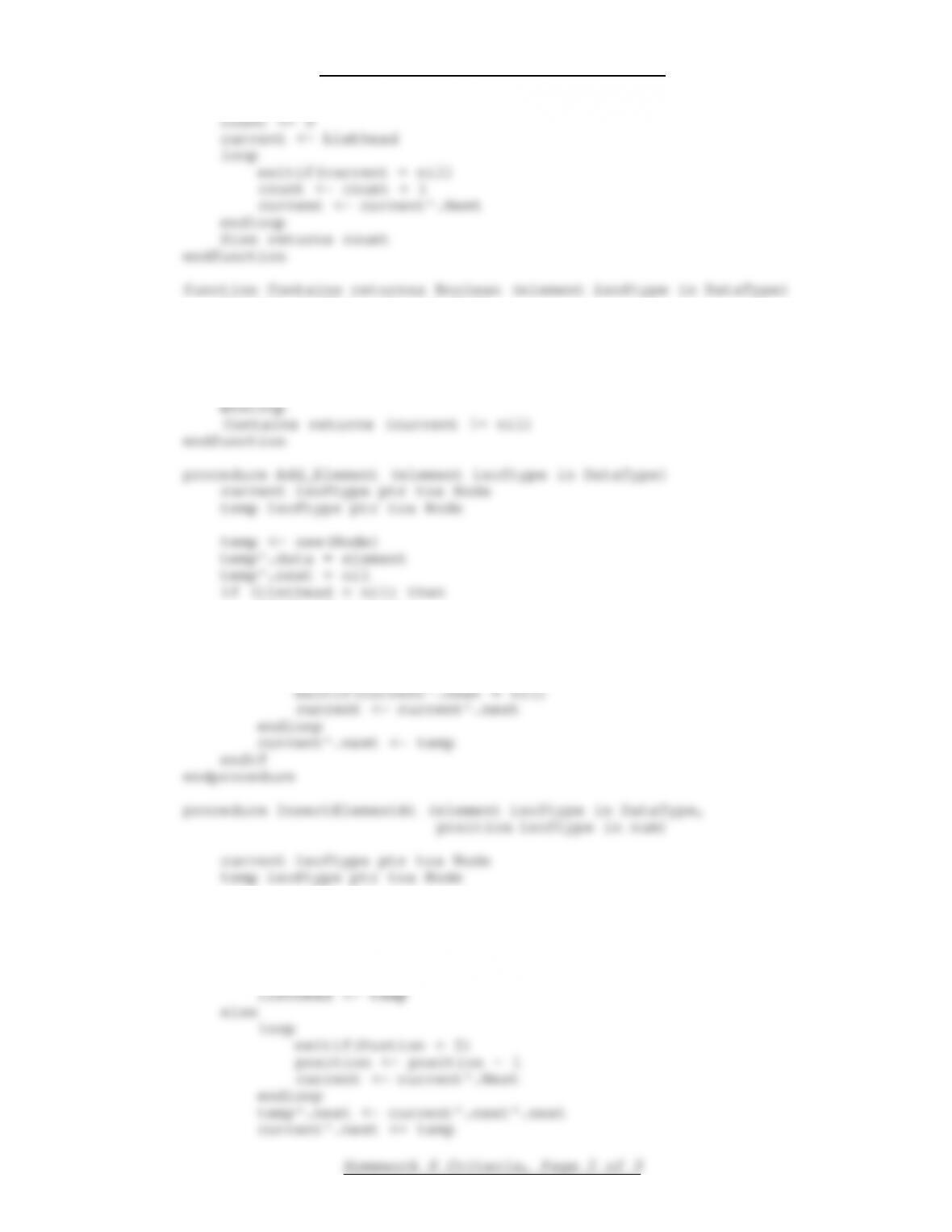
Again, there are several ways to do this one. This solution uses loops; recursion and
protected
Node definesa record
data isoftype DataType
endfunction
procedure RemoveElement(position isoftype in num)
current isoftype ptr toa Node
if (position = 1) then
listhead <- listhead^.Next
function Size returnsa Num ()
current isoftype ptr toa Node
Confidential Teaching Materials
count isoftype num
Current isoftype ptr toa Node
current <- listhead
loop
exitif (current = nil) or (current^.data = element)
current <- current^.Next
listhead <- temp
listhead^.next <- nil
else
current <- listhead
loop
temp <- new(Node)
temp^.data <- element
if (position = 1) then
// special case, add to front
temp^.next <- Listhead

Confidential Teaching Materials
endif
endprocedure
GRADING: 80 points
Public
~~~~~~
-2 for not having the “class Vector” part (bdc)
-2 for the Node declaration (rec)
-2 for not having tie proper pointer (ptr)
-4 for not having Listhead (nav)
ElementAt:
-1 for not returning the correct element (log)
RemoveElement:
-3 for losing the list in the process (log)
Size:
-2 for not finding the size of the Vector
Confidential Teaching Materials
Homework 8 Criteria, Page 5 of 9
(log)
-2 for not returning the size (ret)
Contains:
-2 for not walking down the list (log)
-2 for not setting up new node correctly (nwp)
-2 for not finding the end (log)
-2 for not setting up the new node correctly (nwp)
-2 for not finding the place to insert (log)
-3 for not returning the correct value (ret)
[p2] 5 points
Searching through a full and balanced binary tree of N elements for a particular element.
[c2] 5 points
CRITERIA FOR ALL BIG-O PROBLEMS:
-2 if they got the Big-O wrong.

Confidential Teaching Materials
Homework 8 Criteria, Page 6 of 9
[p3] 5 points
Searching through a linked list (of P elements) of arrays (of N elements each) for the largest value.
[c3] 5 points
[p4] 5 points
//N and P are constants
i, j isoftype Num
i <- 1
loop
exitif (i > N)
j <- P
loop
j <- j – 1
exitif (j = 1)
endloop
i <- i + 1
j <- N+P
loop
exitif (j > 0)
j <- j – 1
endloop
endloop
[c4] 5 points
[p5] 5 points
Popping data off a stack of height N.
[c5] 5 points
[p6] 5 points
Searching through a linked list (of P elements) of ordered arrays (of N elements each) for the smallest value.
[c6] 5 points
[p7] 5 points
Performing a bubblesort on an array of N elements.
[c7] 5 points

Confidential Teaching Materials
Homework 8 Criteria, Page 7 of 9
[p8] 5 points
Searching an ordered array of N elements for a given value if the value being sought is not in the array.
[c8] 5 points
[p9] 5 points
Searching for an element in a linked list (of N elements) of full and balanced binary search trees (of P elements)
for a particular value.
[c9] 5 points
[p10] 5 points
Adding a node to a full and balanced binary search tree of N nodes.
[c10] 5 points
[p11] 5 points
Adding P elements to the beginning of a linked list of N nodes.
[c11] 5 points
[p12] 20 points
Compare and contrast reasonable and unreasonable algorithms. Give an example of a each, and list some
examples of Big-O’s which indicate that an algorithm is reasonable or unreasonable.
GRADING:
[p13] 20 points
Explain the 4 different types of algorithmic errors, and give an example of each.
[c13] 20 points

Confidential Teaching Materials
Homework 8 Criteria, Page 8 of 9
Semantic errors – errors in the meaning of instructions
[p14] 10 points
Compare and contrast a greedy algorithm with an algorithm that employs dynamic planning. What are the
advantages and disadvantages of each?
[c14] 10 points
Greedy algorithms produce a solution by processing the data in the easiest manner, by
[p15] 20 points
Consider the following graph. It represents the graph of several cities and the distances between them.
(A)——14——(B)——-37——(C)
/ | / \ | \
9 | 18 16 | 14
/ | / | | \
(E) |11 (D)-11–(F) 18 (G)
\ | | \ | | /
6 | 14 21 43 | 9
\ | | \ | | /
(H)–12–(I) ——(J)——24—–(K)
You work for the phone company and are responsible for finding the way to connect each of these cities with the
smallest amount of cable possible.

Confidential Teaching Materials
Homework 8 Criteria, Page 9 of 9
Using the greedy algorithm, choose the links that you would use to connect the cities. List these links along with
their distances in the order you selected them. Also, calculate your total distance. Your answer should be in the
following format:
EH 6
JK 24
…
TOTAL: (total goes here)
[c15] 20 points
Sample Solution:
GRADING: