5.21 ________________________________________________________________________________
Solve the following problem graphically. Check necessary and sufficient conditions for candidate
local minimum points and verify them on the graph for the problem.
Minimize (1,2)= 41
2+ 32
2−512−81
subject to 1+2≤4
Solution
Minimize
( )
04 subject to ;8534 21121
2
2
2
1≤−+−−+= xxxxxxxf x
.
( )
( )
2
21121
2
2
2
1
48534 , sxxuxxxxxuL +−++−−+=x
;056 ;0858
122211
=+−=∂∂=+−−=∂∂ uxxxLuxxxL
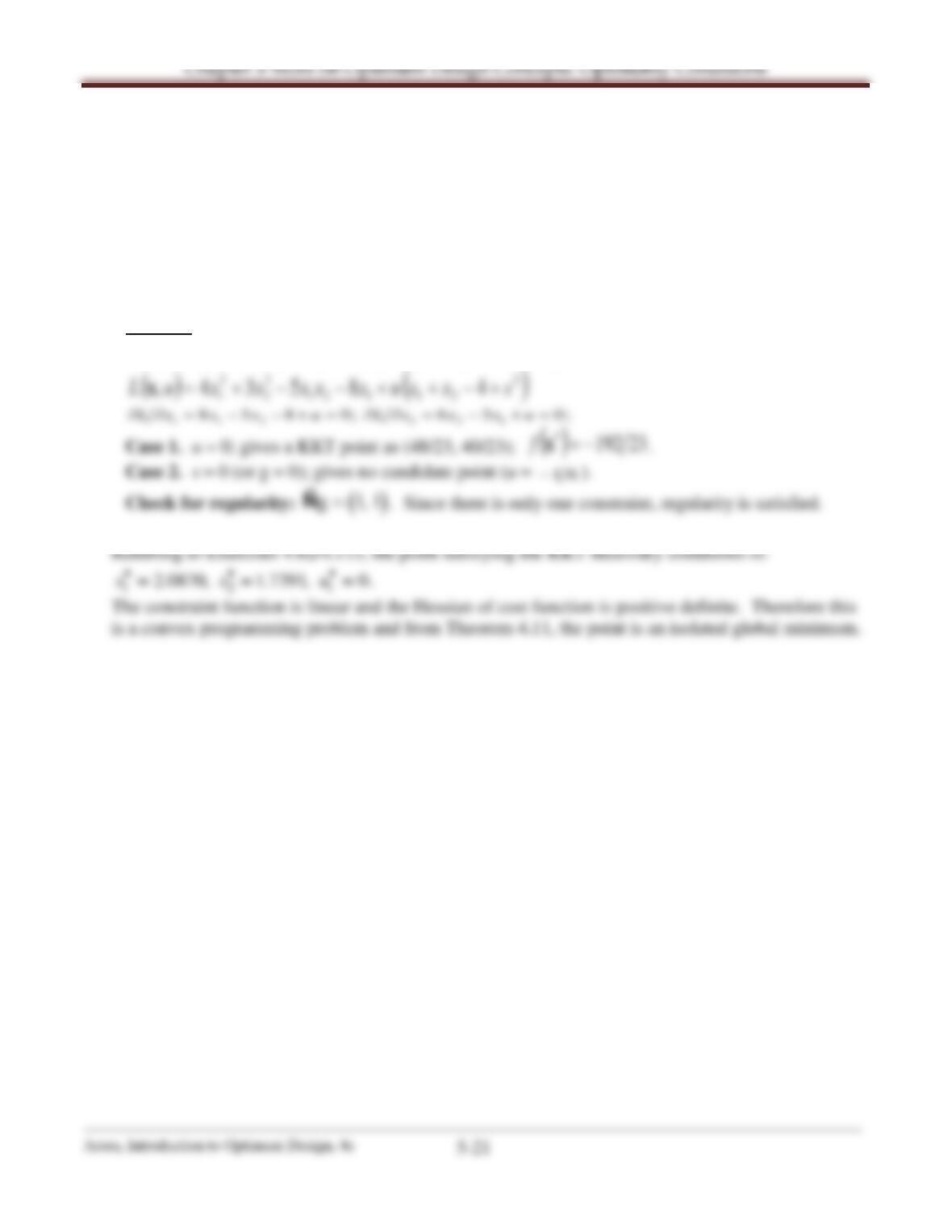
Case 1. u = 0; gives a KKT point as (48/23, 40/23);
( )
23192−=
∗
xf
.
Case 2. s = 0 (or g = 0); gives no candidate point (u =
61−
).
Check for regularity:
( )
g 1, 1=Ñ
. Since there is only one constraint, regularity is satisfied.
5.22 ________________________________________________________________________________
Solve the following problem graphically. Check necessary and sufficient conditions for candidate
local minimum points and verify them on the graph for the problem.
Minimize (1,2)=1
2+2
2−41−22+ 6
subject to 1+2≥4
Solution
Minimize
( )
624 ,
21
2
2
2
121
+−−+= xxxxxxf
; subject to
12
g 40xx=−− +≤
.
( )
022 ;042
4624
2
2
1
1
2
2121
2
2
2
1
=−−=∂∂=−−=∂∂
++−−++−−+=
uxxLuxxL
sxxuxxxxL
2
12
4 0; 0, 0x x s us u−− ++ = = ≥
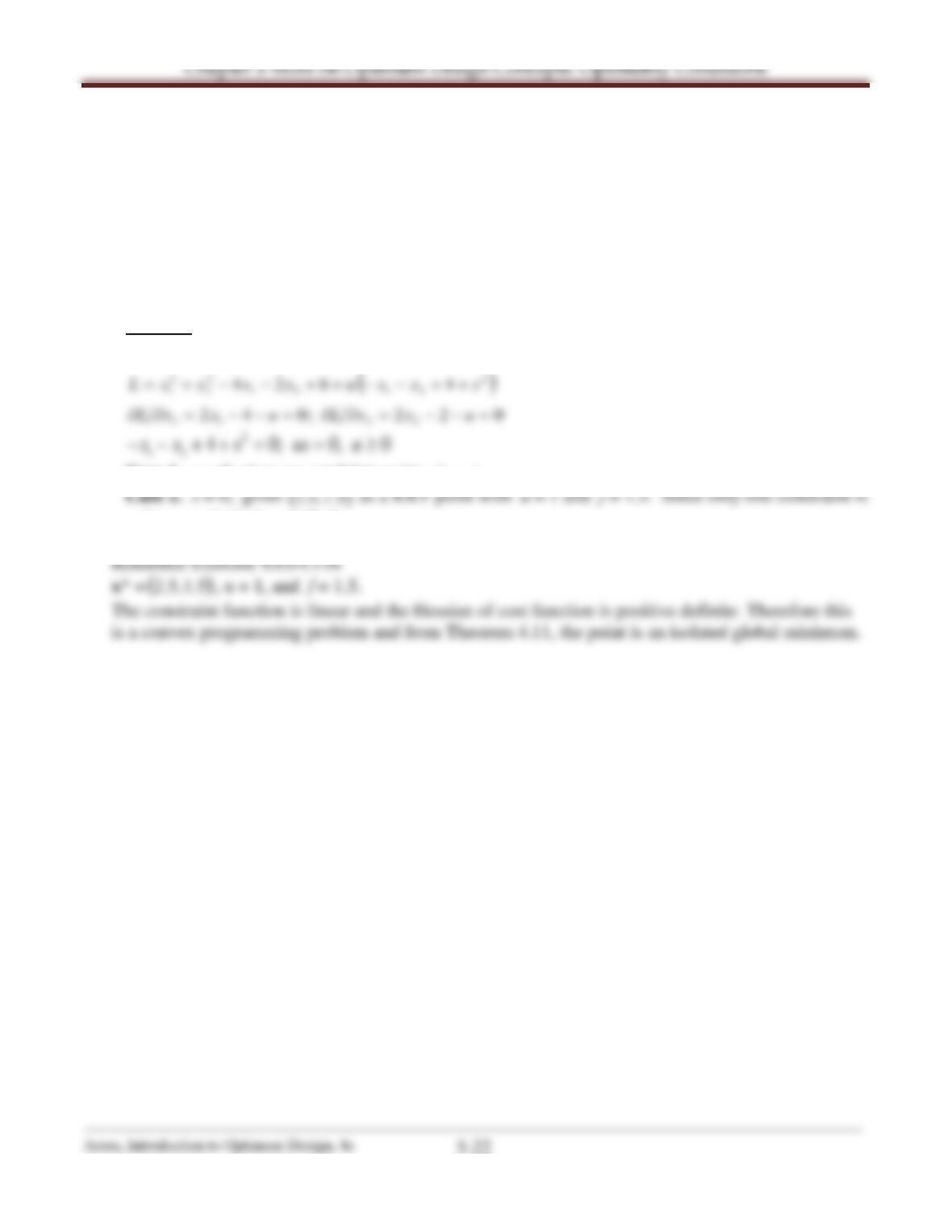
Case 1. u = 0; gives no candidate point
1
2−=s
.
active, regularity is satisfied.
Chapter 5 More on Optimum Design Concepts: Optimality Conditions
5.23 ________________________________________________________________________________
Solve the following problem graphically. Check necessary and sufficient conditions for candidate
local minimum points and verify them on the graph for the problem.
Minimize (1,2)= 21
2−612+ 92
2−181+ 92
subject to 1+ 22≤10
41−32≤20
≥0; = 1,2
Solution
Minimize
( )
,918962
21
2
221
2
1
xxxxxxf +−+−=x
subject to
11 2
g 2 10 0,xx=+ −≤
2 12 3 1 4 2
g 4 3 20 0, g 0, g 0xx x x= − − ≤ =−≤ =−≤
.
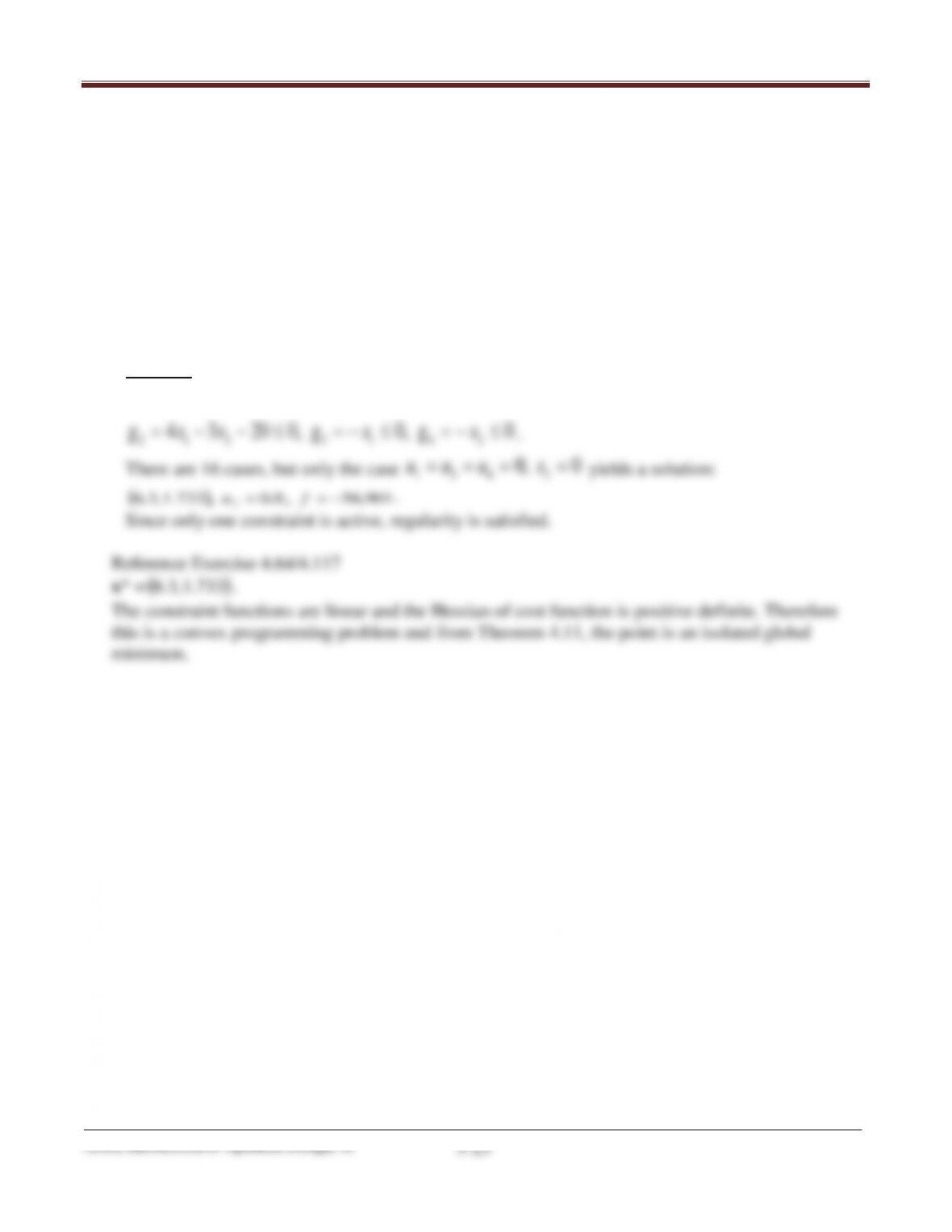
There are 16 cases, but only the case
134 2
0, 0uuu s= = = =
yields a solution:
( )
90156801.733 ,36
2
.,.,. −== fu
.
Since only one constraint is active, regularity is satisfied.
Reference Exercise 4.64/4.117
x* =
( )
1.733 ,36.
.
The constraint functions are linear and the Hessian of cost function is positive definite. Therefore
this is a convex programming problem and from Theorem 4.11, the point is an isolated global
minimum.
5.24________________________________________________________________________________
Solve the following problem graphically. Check necessary and sufficient conditions for candidate
local minimum points and verify them on the graph for the problem.
Minimize (1,2)= (1−1)2+ (2−1)2
subject to 1+2−4≤0
Solution
Minimize
( ) ( ) ( )
22
12 1 2
, 1 1fxx x x=−+ −
, subject to
112
g 40xx= + −≤
( ) ( )
( )
2
1211
2
2
2
1411 sxxuxxL +−++−+−=
( )
( )
;012
;012
122
111
=+−=∂∂
=+−=∂∂
uxxL
uxxL
0 ;0 ;04
111
2
121
≥==+−+ ususxx
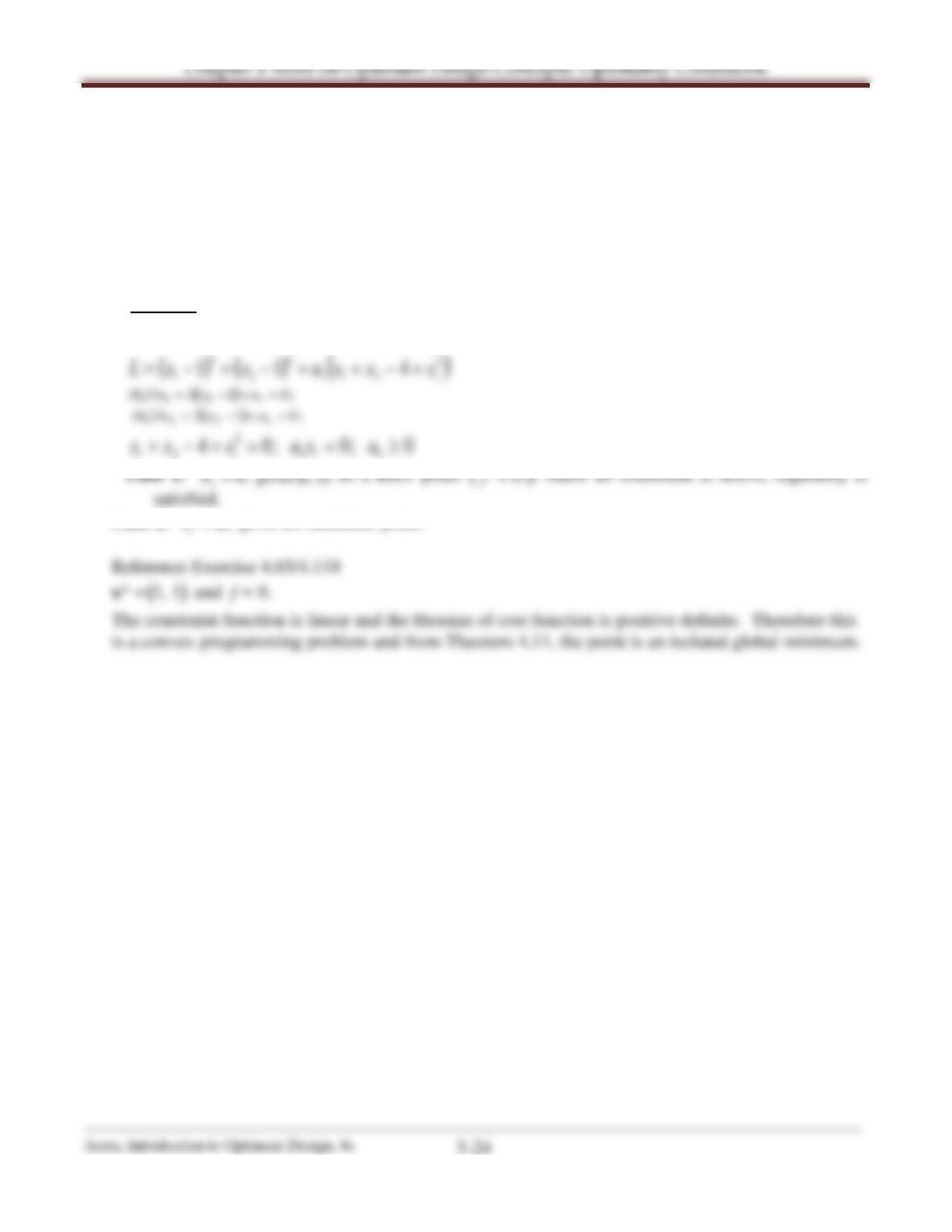
Case 2.
;0
1
=s
gives no candidate point.
Chapter 5 More on Optimum Design Concepts: Optimality Conditions
5.25________________________________________________________________________________
Solve the following problem graphically. Check necessary and sufficient conditions for candidate
local minimum points and verify them on the graph for the problem.
Minimize (1,2)= (1−1)2+ (2−1)2
subject to 1+2−4≤0
1− 2−2≤0
Solution
Minimize
( ) ( ) ( )
22
12
11fx x=−+ −x
; subject to
112
g 4 0;xx= + −≤
2 12
g 20xx= − −≤.
( ) ( )
( ) ( )
2
2212
2
1211
2
2
2
12411 sxxusxxuxxL +−−++−++−+−=
( ) ( )
012 ;012
21222111
=−+−=∂∂=++−=∂∂ uuxxLuuxxL
;02 ;04 2
221
2
121 =+−−=+−+ sxxsxx
0 ,0 ;0 ,0
212211
≥≥== uususu
Case 1.
;0 ,0
21
== uu
gives
( )
1 1,
as a KKT point,
0=f
Case 2.
;0 ,0
21
== su
no candidate minimum.
Case 3.
;0 ,0
21
== us
no candidate minimum.
Case 4.
;0 ,0
21
== ss
no candidate minimum.
Chapter 5 More on Optimum Design Concepts: Optimality Conditions
5.26 ________________________________________________________________________________
Solve the following problem graphically. Check necessary and sufficient conditions for candidate
local minimum points and verify them on the graph for the problem.
Minimize(1,2)= (1−1)2+ (2−1)2
subject to 1+2−4≤0
2− 1≤0
Solution
Minimize
( ) ( ) ( )
22
12
11fx x=−+ −x
; subject to:
112 2 1
4 0; 2 0g xx g x= + −≤ =− ≤
.
( ) ( )
( ) ( )
2
212
2
1211
2
2
2
12411 sxusxxuxxL +−++−++−+−=
( ) ( )
012 ;012 1222111 =+−=∂∂=−+−=∂∂ uxxLuuxxL
02 ;04
2
21
2
121
=+−=+−+ sxsxx
;
0
11 =su
,
0
22
=su
,
0
1
≥u
,
0
2
≥u
0 ,0 ;0 ;0 212211 ≥≥== uususu
Case 1.
;0 ,0
21
== uu
no candidate minimum point
( )
0
2
2
<s
.
Case 2.
;0 ,0
21
== su
gives
( )
1 2,
as a KKT point with
1 ,2
2
== fu
.
Case 3.
0 ,0
21
== us
; no candidate minimum
( )
0
1
<u
.
Case 4.
0
21
== ss
; no candidate minimum
( )
0
1
<u
.
Case 2 yields a KKT point. This point is regular since there is only one active constraint.
Reference Exercise 4.67/4.120
5.27 ________________________________________________________________________________
Solve the following problem graphically. Check necessary and sufficient conditions for candidate
local minimum points and verify them on the graph for the problem.
Minimize (1,2)= 91
2−1812+132
2−4
subject to 1
2+2
2+ 21≥16
Solution
Minimize
( )
413189 , 2
221
2
121 −+−= xxxxxxf
, subject to
( )
22
1 12 1
g 16 2 0xx x=− ++ ≤.
( )
2
11
2
2
2
11
2
221
2
1
216413189 sxxxuxxxxL +−−−+−+−=
022618 ;0221818
21212111211
=−+−=∂∂=−−−=∂∂ xuxxxLuxuxxxL
02 ;04
2
21
2
121
=+−=+−+ sxsxx
;
0
11 =su
,
0
22
=su
,
0
1
≥u
,
0
2≥u
0 ,0 ;0162 111
2
11
2
2
2
1≥==++−−− ususxxx
2
Chapter 5 More on Optimum Design Concepts: Optimality Conditions
2
16 3006 18
L
−−
=
.
Ñ
4. At point (4),
12
3 7322 3 8790..xxu=− =−=, ,
2.1222,
2
13 7556 18
18 21 7556
L−
=
−
.
.
Ñ
1
g⋅dÑ
= 0 gives d = c
( )
0.8848 ,1 −
.
( )
22
62 6402
T
QL c= =d d.Ñ
> 0. The sufficient condition is
satisfied. Thus, the point is an isolated minimum point.
5.28 ________________________________________________________________________________
Solve the following problem graphically. Check necessary and sufficient conditions for candidate
local minimum points and verify them on the graph for the problem.
Minimize (1,2)= (1−3)2+ (2−3)2
subject to 1+2≤4
1−32= 1
Solution
Minimize
( ) ( ) ( )
2
2
2
133 −+−= xxxf
; subject to
12
h 3 1 0;xx= − −=
12
g 40xx= + −≤.
( ) ( ) ( )
( )
2
2121
2
2
2
1
41333 sxxuxxvxxL +−++−−≤+−+−=
( ) ( )
0332 ;032 2211 =++−=∂∂=++−=∂∂ uvxxLuvxxL
2
1 2 12
h 3 1 0; 4 0; 0, 0.x x x x s us u= − −= + −+ = = ≥
Case 1. u = 0; no candidate minimum
( )
0
2
<s
.
Since
( )
h 1, 3= −Ñ
and
( )
g 1, 1=Ñ
are linearly independent, regularity is satisfied.
Chapter 5 More on Optimum Design Concepts: Optimality Conditions
5.29 ________________________________________________________________________________
Solve the following problem graphically. Check necessary and sufficient conditions for candidate
local minimum points and verify them on the graph for the problem.
Minimize (1,2)=1
3−161+ 22−32
2
subject to 1+2≤3
Solution
Minimize
( )
2
221
3
121 3216 , xxxxxxf −+−=
, subject to
12
g 30xx= + −≤
.
( )
2
21
2
221
3
1
33216 sxxuxxxxL +−++−+−=
2
11 2 2
3 16 0; 2 6 0;Lx x u Lx x u∂∂= − += ∂∂ =− +=
2
12
3 0;xx s+ −+ =
g 0, 0.uu= ≥
Case 1. u = 0; gives
( ) ( )
96724 ,31 ,34 and 324 ,31 ,3
4.. =−−= ff
, as KKT points.
Case 2. s = 0; gives
( )
3 ,0
, u = 16, f =
21−
;
( )
1 ,2
, u = 4, f =
25,−
as KKT points.
∗
1
x
∗
2
x
∗
u
(1)
2.3094
0.3333
0
(2)
2.3094−
0.3333
0
(3)
0
3
16
(4)
2
1
4
The Hessian of the Lagrangian and gradient of the constraint are
1
260 1
06 1
x
Lg
= =
−
; ÑÑ
1. At point (1),
1
x
= 2.3094,
2
x
= 0.3333,
2LÑ
is indefinite. Since no constraint is active, this is an
2. At point (2),
1
x
=
2.3094−
,
2
x
= 0.3333, Hessian of Lagrangian is negative definite. Since no
3. At point (3),
1
x
= 0,
2
x
= 3, u = 16, Hessian of Lagrangian is negative semidefinite, so this point
4. At point (4),
1
x
= 2,
2
x
= 1, u = 4,
2
12 0
06
L
=
−
Ñ
.
g⋅dÑ
= 0 gives d = c
( )
1 ,1 −
where c
≠
0 is any constant.
( )
22
6
T
Q Lc= =dd∇
> 0, for c
≠
0. Since
Q > 0, sufficient condition is satisfied. Thus the point is an isolated local minimum point.
5.30 ________________________________________________________________________________
Solve the following problem graphically. Check necessary and sufficient conditions for candidate
local minimum points and verify them on the graph for the problem.
Minimize (1,2)= 31
2−212+ 52
2+ 82
subject to 1
2− 2
2+ 82≤16
Solution
Minimize
( )
2
2
221
2
121
8523 , xxxxxxxf ++−=
, subject to
22
12 2
g 8 16 0xx x=−+ −≤
( )
2
2
2
2
2
12
2
221
2
1
1688523 sxxxuxxxxxL +−+−+++−=
.0828102 ;0226
22121211
=+−++−=∂∂=+−=∂∂ uuxxxxLuxxxxL
0 ,0 ;0168
2
2
2
2
2
1
≥=≤+−+− uussxxx
Case 1. u = 0; gives
( )
76 ,72 −−
as a KKT point
( )
724−=f
.
Case 2. s = 0; no candidate minima
( )
0<u
.
For case 1, since there is no active constraint, the regularity is satisfied.
5.31 ________________________________________________________________________________
Solve the following problem graphically. Check necessary and sufficient conditions for candidate
local minimum points and verify them on the graph for the problem.
Minimize (,)= ( − 4)2+ ( − 6)2
subject to + ≤ 12
≤ 6
, ≥ 0
Solution
Minimize
( ) ( ) ( )
22
1
, 4 6 ; subject to g 12 0;f xy x y x y= − + − =+− ≤
2 34
g 6 0; g 0; g 0;x xy=−≤ =−≤ =−≤
( ) ( )
()
( ) ( )
( ) ( )
( ) ( )
22 22
1 12 2
22
3 34 4
123 14
4 6 12 6
2 4 0; 2 6 0;
L x y uxy s u x s
u xs u ys
Lx x u u u Ly y u u
= − + − + +− + + −+
+ −+ + −+
∂∂= − + + − = ∂∂= − + − =
22 22
1234
12 0; 6 0; 0; 0;xy s x s xs ys+−+= −+= −+= −+=
;0 ;0 ≥= iii usu
i = 1 to 4 (there are 16 cases).
Case 1.
1234
0;uuuu= = = =
gives
( )
4, 6
as a KKT point ; f
0=
.
123 4
Case 3.
124 3
0, 0;uuu s= = = =
gives no candidate point.
Case 4.
134 2
0, 0;uuu s= = = =
gives no candidate point.
Case 5.
234 1
0, 0;uuu s= = = =
gives no candidate point.
;0 ,0 4321 ==== ssuu
Case 7.
;0 ,0 4231 ==== ssuu
gives no candidate point.
Case 8.
;0 ,0
3241
==== ssuu
gives no candidate point.
;0 ,0 4132 ==== ssuu
Case 10.
2 4 13
0, 0;uu ss= = = =
gives no candidate point.
;0 ,0 4321 ==== sssu
Case 13.
;0 ,0 4312 ==== sssu
gives no candidate point.
Case 14.
0 ,0
4213
==== sssu
; gives no candidate point.
Case 15.
0 ,0
3214
==== sssu
; gives no candidate point.
Case 16.
0
4321
==== ssss
; gives no candidate point.
Check for regularity: Only the first case gives a solution that satisfies all the KKT necessary
conditions. Since no constraint is active, regularity is satisfied.
Referring to Exercise 4.72/4.125, the point satisfying the KKT necessary condition is
46 0xy u= = =, ,
.
The constraint functions are linear and the Hessian of cost function is positive definite. Therefore
this is a convex programming problem and from Theorem 4.11, the point is an isolated global
minimum.
5.32 ________________________________________________________________________________
Solve the following problem graphically. Check necessary and sufficient conditions for candidate
local minimum points and verify them on the graph for the problem.
Minimize (,)= ( − 8)2+ ( − 8)2
subject to + ≤ 12
≤ 6
, ≥ 0
Solution
Minimize
( ) ( ) ( )
22
1
, 8 8 ; subject to g 12 0;f xy x y x y= − + − =+− ≤
2 34
g 6 0; g 0; g 0;x xy=−≤ =−≤ =−≤
( ) ( )
()
( ) ( )
( ) ( )
( ) ( )
22 22
1 12 2
22
3 34 4
123 14
8 8 12 6
2 8 0; 2 8 0;
L x y ux y s u x s
u xs u ys
Lx x u u u Ly y u u
= − + − + +− + + −+
+ −+ + −+
∂∂= − + + − = ∂∂= − + − =
22 22
1234
12 0; 6 0; 0; 0;xy s x s xs ys+−+= −+= −+= −+=
;0 ;0 ≥= iii usu
i = 1 to 4 (there are 16 cases).
123 4
Case 3.
124 3
0, 0;uuu s= = = =
gives no candidate point.
Case 5.
234 1
0, 0;uuu s= = = =
gives
( )
6, 6
as a KKT point with u1 = 4; f
8=
.
Case 10.
2 4 13
0, 0;uu ss= = = =
gives no candidate point.
8=
Chapter 5 More on Optimum Design Concepts: Optimality Conditions
Case 15.
0 ,0
3214
==== sssu
; gives no candidate point.
Case 16.
0
4321
==== ssss
; gives no candidate point.
Check for regularity: For case 5, there is only one active constraint, so regularity is satisfied. For
Chapter 5 More on Optimum Design Concepts: Optimality Conditions
4, 0
0, 6
6, 6
0, 0
6, 0
5.33 ________________________________________________________________________________
Solve the following problem graphically. Check necessary and sufficient conditions for candidate
local minimum points and verify them on the graph for the problem.
Maximize (,)= ( − 4)2+ ( − 6)2
subject to + ≤ 12
6≥
, ≥ 0
Solution
Minimize
( ) ( ) ( )
22
1
, 4 6 ; subject to g 12 0;f xy x y x y=− − − − =+− ≤
2 34
g 6 0; g 0; g 0;x xy=−≤ =−≤ =−≤
(
) ( )
()
( ) ( )
( ) ( )
( )
( )
22 22
1 12 2
22
3 34 4
123
14
4 6 12 6
2 4 0;
2 6 0;
L x y ux y s u x s
u xs u ys
Lx x u u u
Ly y u u
=− − − − + +− + + −+
+ −+ + −+
∂∂=− −++−=
∂ ∂=− − + − =
2
1
2
2
2
3
2
4
12 0;
6 0;
0;
0;
xy s
xs
xs
ys
+− + =
−+ =
−+ =
−+ =
;0 ;0 ≥= iii usu
i = 1 to 4 (there are 16 cases).
Case 1.
1234
0;uuuu= = = =
gives
( )
4, 6
as a KKT point ; F
0=
.
2
gÑ
4
gÑ
3
gÑ
gÑ
Case 11.
;0 ,0 2143 ==== ssuu
gives
( )
6, 6
as a KKT point with u1 = 0, u2 = 4; F
4=
.
0 ,0
4213
Case 15.
0 ,0
3214
==== sssu
; gives no candidate point.
Case 16.
0
4321
==== ssss
; gives no candidate point.
Check for regularity: For cases 1, 2, 3, 4 and 5, there is only one active constraint, so regularity is
satisfied. For case 6,
( ) ( )
34
g 1, 0 , g 0, 1=−=−ÑÑ
. Since
3
gÑ
and
4
gÑ
are linearly independent,
5.34 ________________________________________________________________________________
Solve the following problem graphically. Check necessary and sufficient conditions for candidate
local minimum points and verify them on the graph for the problem.
Maximize (,)= ( − 8)2+ ( − 8)2
subject to 10 ≥ +
≤ 5
, ≥ 0
Solution
Minimize
( ) ( ) ( )
22
1
, 8 8 ; subject to g 10 0;f rt r t r t=− − − − = +− ≤
2 34
g 5 0; g 0 ; g 0;t rt= − ≤ =− ≤ =−≤
( ) ( )
()
( ) ( )
( ) ( )
( ) ( )
22 22
1 12 2
22
3 34 4
13 12 4
8 8 10 5
2 8 0; 2 8 0;
L r t urt s ut s
u rs u ts
Lr r u u Lt t u u u
=−−−−++−++−+
+ −+ + −+
∂∂=− − + − = ∂∂=− − + + − =
22 22
1 2 34
10 0; t 5 0; 0; 0;rt s s rs ts+−+= −+= −+= −+=
;0 ;0 ≥= iii usu
i = 1 to 4 (there are 16 cases).
Case 1.
1234
0;uuuu= = = =
gives no candidate point.
123 4
Case 3.
124 3
0, 0;uuu s= = = =
gives no candidate point.
Case 5.
234 1
0, 0;uuu s= = = =
gives no candidate point.
Case 6.
;0 ,0 4321 ==== ssuu
gives
( )
0, 0
as a KKT point with u3 = 16, u4 = 16; F =128.
;0 ,0 4231 ==== ssuu
;0 ,0 3241 ==== ssuu
;0 ,0 4132 ==== ssuu
Case 10.
2 4 13
0, 0;uu ss= = = =
gives no candidate point.
;0 ,0 2143 ==== ssuu
Chapter 5 More on Optimum Design Concepts: Optimality Conditions
Case 15.
0 ,0
3214
==== sssu
; gives no candidate point.
Case 16.
0
4321
==== ssss
; gives no candidate point.
case 6,
( ) ( )
34
g 1, 0 , g 0, 1=−=−ÑÑ
. Since
3
gÑ
and
4
gÑ
are linearly independent, regularity is
4
gÑ
Chapter 5 More on Optimum Design Concepts: Optimality Conditions
5.35 ________________________________________________________________________________
Solve the following problem graphically. Check necessary and sufficient conditions for candidate
local minimum points and verify them on the graph for the problem.
Maximize (,)= ( − 3)2+ ( − 2)2
subject to 10 ≥ +
≤ 5
, ≥ 0
Solution
Minimize
( ) ( )
( )
22
1
, 3 2 ; subject to g 10 0;f rt r t r t=− − − − = +− ≤
2 34
g 5 0; g 0 ; g 0;t rt= − ≤ =− ≤ =−≤
( ) ( )
()
( ) ( )
( ) ( )
( ) ( )
22 22
1 12 2
22
3 34 4
13 12 4
3 2 10 5
2 3 0; 2 2 0;
L r t urt s ut s
u rs u ts
Lr r u u Lt t u u u
=−−−−++−++−+
+ −+ + −+
∂∂=− − + − = ∂∂=− − + + − =
22 22
1 2 34
10 0; t 5 0; 0; 0;rt s s rs ts+−+= −+= −+= −+=
;0 ;0 ≥= iii usu
i = 1 to 4 (there are 16 cases).
( )
3, 2
Case 2.
123 4
0, 0;uuu s= = = =
gives
( )
3, 0
as a KKT point with u4 = 0; F
4=
.
( )
0, 2
Case 4.
134 2
0, 0;uuu s= = = =
gives
( )
3, 5
as a KKT point with u2 = 6; F
9=
.
Case 6.
;0 ,0 4321 ==== ssuu
gives
( )
0, 0
as a KKT point with u3 = 6, u4 = 4; F =13.
;0 ,0 4231 ==== ssuu
Case 8.
;0 ,0 3241 ==== ssuu
gives
( )
0, 5
as a KKT point with u2 = 6, u3 = 6; F
18=
.
( )
5, 5