Chapter 4 Optimum Design Concepts: Optimality Conditions
Section 4.5 Necessary Conditions: Equality Constrained Problem
4.43________________________________________________________________________________
Find points satisfying the necessary conditions for the following problem; check if they are optimum
points using the graphical method (if possible).
Minimize (1,2)= 41
2+ 32
2−512−81
subject to 1+2−4 = 0
Solution
Minimize
( )
121
2
2
2
121 8534 , xxxxxxxf −−+=
subject to
12
h 40xx= + −=
;
( )
48534
21121
2
2
2
1
−++−−+= xxvxxxxxL
;
The necessary conditions give
1 1 2 2 2 1 12
8 5 8 0; 6 5 0; h 4 0Lx x x v Lx x x v x x∂ ∂= − −+= ∂ ∂ = − += = + −=
The solution of these equations is
.6/1 ,6/11 ,6/13 21 −=== vxx
Therefore, (13/6, 11/6) is a KKT point;
3/52−=f
Check for regularity:
h∇
= (1, 1). Since
h∇
is the only vector, regularity of feasible points is
satisfied.
The problem is solved graphically in Exercise 3.12. The graph shows that the stationary point is
actually a local as well as a global minimum point for the function. The problem is also solved
graphically in Exercise 4.97.
4.44________________________________________________________________________________
Find points satisfying the necessary conditions for the following problem; check if they are optimum
points using the graphical method (if possible).
Maximize (1,2)= 41
2+ 32
2−512−81
subject to 1+2−4 = 0
Solution
Maximize
( )
121
2
2
2
1
21
8534 , xxxxxxxF −−+=
subject to
12
h 40xx= + −=
;
( )
48534 21121
2
2
2
1−++++−−= xxvxxxxxL
;
The necessary conditions give
1 1 2 2 2 1 12
8 5 8 0; 6 +5 0; h 4 0Lx x x v Lx x x v x x∂ ∂=− + ++= ∂ ∂ =− += = + −=
The solution of these equations is
.6/1 ,6/11 ,6/13 21 === vxx
Therefore, (2.166667, 1.833333) is a KKT point;
3/52−=F
Check for regularity:
h∇
= (1, 1). Since
h∇
is the only vector, regularity of feasible points is
satisfied.
The problem is solved graphically in Exercise 3.12. The graph shows that the stationary point is
not a local maximum point for the function. There is no local maximum point; the function is
actually unbounded. The problem is also solved graphically in Exercise 4.98.
Arora, Introduction to Optimum Design, 4e
4-22
4.45________________________________________________________________________________
Find points satisfying the necessary conditions for the following problem; check if they are optimum
points using the graphical method (if possible).
Minimize (1,2)= (1−2)2+ (2+ 1)2
subject to 21+ 32−4 = 0
Solution
Minimize
( ) ( ) ( )
22
12 1 2
, 2 1fxx x x=−++
4.46________________________________________________________________________________
Find points satisfying the necessary conditions for the following problem; check if they are optimum
points using the graphical method (if possible).
Minimize (1,2)= 41
2+ 92
2+ 62−41+13
subject to 1−32+ 3 = 0
Solution
Minimize (1,2)= 41
2+ 92
2+ 62−41+13
Chapter 4 Optimum Design Concepts: Optimality Conditions
Arora, Introduction to Optimum Design, 4e
4-23
4.47________________________________________________________________________________
Find points satisfying the necessary conditions for the following problem; check if they are optimum
points using the graphical method (if possible).
Minimize ()= (1−1)2+ (2+ 2)2+ (3−2)2
subject to 21+ 32−1 = 0
1+2+ 23−4 = 0
Solution
Minimize
( ) ( ) ( ) ( )
222
12 1 2 3
, 1 2 2fxx x x x=−+ + + −
Chapter 4 Optimum Design Concepts: Optimality Conditions
4.48________________________________________________________________________________
Find points satisfying the necessary conditions for the following problem; check if they are optimum
points using the graphical method (if possible).
Minimize (1,2)= 91
2+1812+132
2−4
subject to 1
2+2
2+ 21−16 = 0
Solution
Minimize
( )
413189 ,
2
221
2
121
−++= xxxxxxf
subject to
22
12 1
h 2 16 0xx x=++ −=
( )
( )
2 2 22
1 2 1 12 2 1 2 1
1121 2 1 21
22
12 1
, , 9 18 13 4 2 16
18 18 2 2 0; 18 26 2 0
h 2 16 0
L x x v x xx x v x x x
L x x x vx v L x x x vx
xx x
= + + −+ + + −
∂∂= + + + = ∂∂ = + + =
=++ −=
;
These equations are nonlinear, which can be solved numerically. Using any nonlinear equation
solver, we can find the following KKT points:
1.
244.528 ,15150317
,27203 ,50881 21 =−=== f.v.x.x
(local maximum)
4.49 ________________________________________________________________________________
Find points satisfying the necessary conditions for the following problem; check if they are optimum
points using the graphical method (if possible).
Minimize (1,2)= (1−1)2+ (2−1)2
subject to 1+2−4 = 0
Solution
Minimize
( ) ( )
2
2
2
111 −+−= xxf
subject to
12
h 40xx= + −=
( ) ( ) ( )
411 21
2
2
2
1−++−+−= xxvxxL
; the KKT necessary conditions are
( ) ( )
1 1 2 2 12
2 1 0; 2 1 0; h 4 0Lx x v Lx x v x x∂∂ = − += ∂∂ = − += = + −=
Solution of these equations is
2 ,2 ,2 21 −=== vxx
. Therefore,
( )
2 ,2
is a KKT point; f = 2.
Check for regularity:
( )
h 1, 1∇=
. Since
h∇
is the only vector, regularity of feasible points is
satisfied.
The problem is solved graphically in Exercise 4.103.
Arora, Introduction to Optimum Design, 4e
4-26
4.52________________________________________________________________________________
Find points satisfying the necessary conditions for the following problem; check if they are optimum
points using the graphical method (if possible).
Maximize (1,2)= 41
2+ 32
2−512−8
subject to 1+2= 4
Solution
Minimize
22
1 2 12
435 8f x x xx=−−+ +
subject to
12
h 40xx= + −=
( )
22
1 2 12 1 2
435 8 4L x x xx v x x=− − + ++ + −
The KKT necessary conditions are
1 1 2 2 2 1 12
8 5 0; 6 5 0; h 4 0Lx x x v Lx x x v x x∂∂ =− + += ∂∂ =− + += = + −=
Solution of these equations is
12
11/ 6, 13 / 6, 23 / 6xx v= = =
.
Therefore,
( )
11/ 6, 13 / 6
is a KKT point; F = -1/3.
Check for regularity:
( )
h 1, 1∇=
. Since
h∇
is the only vector, regularity of feasible point is
satisfied.
The problem is also solved graphically in Exercise 4.106.
Chapter 4 Optimum Design Concepts: Optimality Conditions
Section 4.6 Necessary Conditions for a General Constrained Problem
4.53 ________________________________________________________________________________
Answer True or False
1. A rectangular point of the feasible region is defined as a point where the cost function gradient is
independent of the gradients of active constraints. False
2. A point satisfying KKT conditions for a general optimum design problem can be a local max-
3. At the optimum point, the number of active independent constraints is always more than the
4. In the general optimum design problem formulation, the number of independent equality
5. In the general optimum design problem formulation, the number of inequality constraints cannot
6. At the optimum point, Lagrange multipliers for the “≤ type” inequality constraints must be
8. While solving an optimum design problem by KKT conditions, each case defined by the switching
10. Optimum design points for constrained optimization problems give stationary value to the
11. Optimum design points having at least one active constraint give stationary value to the cost
12. At a constrained optimum design point that is regular, the cost function gradient is linearly
15. Design problems with equality constraints have the gradient of the cost function as zero at the
( )
g 1, 1=Ñ
4.54________________________________________________________________________________
Find points satisfying KKT necessary conditions for the following problem; check if they are
optimum points using the graphical method for two variable problems.
Maximize (1,2)= 41
2+ 32
2−512−8
subject to 1+2≤4
Solution
Minimize
22
1 2 12
435 8f x x xx=−−+ +
subject to
12
g 40xx= + −≤
( )
22 2
1 2 12 1 2
435 8 4L x x xx u x x s=− − + ++ + −+
; the KKT necessary conditions are
1 12 2 21
2
12
8 5 0; 6 5 0;
4 0; 2 0
Lx x x u Lx x x u
Lu x x s Ls us
∂∂=− + += ∂∂ =− + +=
∂∂= + −+ = ∂∂= =
Case 1. u = 0; gives a KKT point as (0, 0);
*8F= −
.
Case 2. s = 0 (or g = 0); gives a KKT point as (11/6, 13/6);
* 23 / 6, * 1 / 3uF= = −
.
Check for regularity:
( )
g 1, 1=Ñ
. Since there is only one constraint, regularity is satisfied.
The problem is also solved graphically in Exercise 4.107.
4.55________________________________________________________________________________
Find points satisfying KKT necessary conditions for the following problem; check if they are
optimum points using the graphical method for two variable problems.
Minimize (1,2)= 41
2+ 32
2−512−8
subject to 1+2≤4
Solution
Minimize
22
1 2 12
435 8fxxxx=+− −
subject to
12
g 40xx= + −≤
( )
22 2
1 2 12 1 2
435 8 4Lxxxx uxx s= + − −+ + −+
; the KKT necessary conditions are
112 2 21
2
12
8 5 0; 6 5 0;
4 0; 2 0
Lx x x u Lx x x u
Lu x x s Ls us
∂∂= − += ∂∂ = − +=
∂∂= + −+ = ∂∂= =
∗
Chapter 4 Optimum Design Concepts: Optimality Conditions
4.56________________________________________________________________________________
Find points satisfying KKT necessary conditions for the following problem; check if they are
optimum points using the graphical method for two variable problems.
Maximize (1,2)= 41
2+ 32
2−512−81
subject to 1+2≤4
Solution
Minimize
22
1 2 12 1
435 8f x x xx x=−−+ +
subject to
12
g 40xx= + −≤
( )
22 2
1 2 12 1 1 2
435 8 4Lxxxxxuxx s= + − − + + −+
; the KKT necessary conditions are
1 12 2 21
2
12
8 5 8 0; 6 5 0;
4 0; 2 0
Lx x x u Lx x x u
Lu x x s Ls us
∂∂=− + ++= ∂∂ =− + +=
∂∂= + −+ = ∂∂= =
∗
Chapter 4 Optimum Design Concepts: Optimality Conditions
4.60________________________________________________________________________________
Find points satisfying KKT necessary conditions for the following problem; check if they are
optimum points using the graphical method for two variable problems.
Minimize (,)= (−4)2+ ( −6)2
subject to 12 ≥ +
≥ 6, ≥ 0
Solution
Minimize
( ) ( )
22
(, ) 4 6f xy x y=− +−
;
3
11 2 2 3 3
123
0, 0, 0
0.
us us us
uuu
= = =
≥,,
Case 2.
12 3
0, 0uu s= = =
; no candidate minimum.
Arora, Introduction to Optimum Design, 4e
4-32
4.61________________________________________________________________________________
Find points satisfying KKT necessary conditions for the following problem; check if they are
optimum points using the graphical method for two variable problems.
Minimize (1,2)= 21+ 32−1
3−22
2
subject to 1+ 32≤6
51+ 22≤10
1,2≥0
Solution
( )
32
1 21 2
11 2
Minimize 2 3 2 ;
subject to g 3 6 0;
f x xx x
xx
= + −−
= + −≤
x
212 3 1 4 2
g 5 2 10 0; g 0; g 0;xx x x= + − ≤ =−≤ =−≤
( ) ( ) ( )
( ) ( )
32 2 2
121 2112 1 212 2
22
3 13 4 24
2
1 1 1 23
2 2 1 24
2 3 2 3 6 5 2 10
2 3 5 0;
3 4 3 2 0;
L xxx xuxx suxx s
u xs u x s
Lx x u u u
Lx x u u u
= +−− + +−++ +−+
+ −+ + − +
∂∂=− + + − =
∂∂ =− + + − =
;0 ;0 ;01025 ;063
2
42
2
31
2
221
2
121
=+−=+−=+−+=+−+ sxsxsxxsxx
;0 ;0 ≥=
iii
usu
i = 1 to 4 (there are 16 cases).
Case 1.
0
4321
==== uuuu
.There are two possible solution points:
( )
0.75 ,8160.−
and
( )
0.75 ,8160.
. For
( )
0.75 ,8160.−
, g3 = 0.816 > 0 (violation). For
( )
0.75 ,8160.
, g1 =
9342.−
< 0,
g2 =
424.−
< 0, g3 =
8160.−
< 0, g4 =
750.−
< 0. All the KKT conditions are satisfied; therefore
(0.816,0.75) is a KKT point ( f = 2.214 ).
Case 2.
0 ,0
4321
==== suuu
.
42
g0 0x=→=
;
±=
1
x
0.816, u4 = 3 > 0.
13
0 816 gx=−→.
> 0
0 ,0
3421
Case 4.
0 ,0
2431
==== suuu
. Candidate points:
( )
1.2317 9.8407,−
and
( )
1.2317 .5073,1
; first
Case 8.
;0 ,0
3241
==== ssuu
gives no candidate point.
Chapter 4 Optimum Design Concepts: Optimality Conditions
Case 9.
;0 ,0
4132
==== ssuu
gives no candidate point.
;0 ,0
2143
0073880 ;6260 ,6330
21
... −=== fuu
.
Case 12.
;0 ,0
4321
==== sssu
gives no candidate point.
;0 ,0
4312
Case 14.
0 ,0 4213 ==== sssu
; gives no candidate point.
Case 16.
0
4321
==== ssss
; gives no candidate point.
From the above investigation, Cases 1, 2, 3, 4, 5, 6, 7, 10, 11 generate KKT points.
Check for regularity: For cases 1, 2, 3, 4 and 5, there is only one active constraint, so regularity is
Chapter 4 Optimum Design Concepts: Optimality Conditions
4.62 ________________________________________________________________________________
Find points satisfying KKT necessary conditions for the following problem; check if they are
optimum points using the graphical method for two variable problems.
Minimize (1,2)= 41
2+ 32
2−512−81
subject to 1+2≤4
Solution
Minimize
( )
04 subject to ;8534
21121
2
2
2
1
≤−+−−+= xxxxxxxf x
.
( )
( )
2
21121
2
2
2
1
48534 , sxxuxxxxxuL +−++−−+=x
;056 ;0858
122211
=+−=∂∂=+−−=∂∂ uxxxLuxxxL
Case 1. u = 0; gives a KKT point as (48/23, 40/23);
( )
23192−=
∗
xf
.
Case 2. s = 0 (or g = 0); gives no candidate point (u =
61−
).
Check for regularity:
( )
g 1, 1=Ñ
. Since there is only one constraint, regularity is satisfied.
The problem is also solved graphically in Exercise 4.115.
4.63________________________________________________________________________________
Minimize (1,2)=1
2+2
2−41−22+ 6
subject to 1+2≥4
Solution
Minimize
( )
624 ,
21
2
2
2
121
+−−+= xxxxxxf
; subject to
12
g 40xx=−− +≤
.
( )
022 ;042
4624
2
2
1
1
2
2121
2
2
2
1
=−−=∂∂=−−=∂∂
++−−++−−+=
uxxLuxxL
sxxuxxxxL
2
12
4 0; 0, 0x x s us u− − ++ = = ≥
Case 1. u = 0; gives no candidate point
1
2−=s
.
Chapter 4 Optimum Design Concepts: Optimality Conditions
Arora, Introduction to Optimum Design, 4e
4-35
4.64________________________________________________________________________________
Minimize (1,2)= 21
2−612+ 92
2−181+ 92
subject to 1+ 22≤10
41−32≤20
≥0; = 1,2
Solution
2
2
2 12 3 1 4 2
There are 16 cases, but only the case
134 2
0, 0uuu s= = = =
yields a solution:
( )
90156801.733 ,36 2.,.,. −== fu
.
Since only one constraint is active, regularity is satisfied.
The problem is also solved graphically in Exercise 4.117
4.65________________________________________________________________________________
Minimize (1,2)= (1−1)2+ (2−1)2
subject to 1+2−4≤0
Solution
Minimize
( ) ( ) ( )
22
12 1 2
, 1 1fxx x x= −+ −
, subject to
112
g 40xx= + −≤
( ) ( )
( )
2
1211
2
2
2
1411 sxxuxxL +−++−+−=
( )
( )
;012
;012
122
111
=+−=∂∂
=+−=∂∂
uxxL
uxxL
0 ;0 ;04
111
2
121
≥==+−+ ususxx
Chapter 4 Optimum Design Concepts: Optimality Conditions
4.66________________________________________________________________________________
Minimize (1,2)= (1−1)2+ (2−1)2
subject to 1+2−4≤0
1−2−2≤0
Solution
Minimize
( ) ( ) ( )
22
12
11fx x= −+ −x
; subject to
112
g 4 0;xx= + −≤
2 12
g 20xx= − −≤.
( ) ( )
( ) ( )
2
2212
2
1211
2
2
2
1
2411 sxxusxxuxxL +−−++−++−+−=
( ) ( )
012 ;012
21222111
=−+−=∂∂=++−=∂∂ uuxxLuuxxL
;02 ;04
2
221
2
121
=+−−=+−+ sxxsxx
0 ,0 ;0 ,0 212211 ≥≥== uususu
21
Case 4.
;0 ,0 21 == ss
no candidate minimum.
4.67________________________________________________________________________________
Minimize(1,2)= (1−1)2+ (2−1)2
subject to 1+2−4≤0
2−1≤0
Solution
Minimize
( ) ( ) ( )
22
12
11fx x= −+ −x
; subject to:
112 2 1
4 0; 2 0g xx g x= + −≤ =− ≤
.
( ) ( )
( ) ( )
2
212
2
1211
2
2
2
12411 sxusxxuxxL +−++−++−+−=
( ) ( )
012 ;012 1222111 =+−=∂∂=−+−=∂∂ uxxLuuxxL
02 ;04 2
21
2
121 =+−=+−+ sxsxx
;
0
11 =su
,
0
22
=su
,
0
1
≥u
,
0
2
≥u
0 ,0 ;0 ;0 212211 ≥≥== uususu
Case 1.
;0 ,0 21 == uu
no candidate minimum point
( )
0
2
2
<s
.
Case 2.
;0 ,0
21
== su
gives
( )
1 2,
as a KKT point with
1 ,2
2
== fu
.
21
1<u
Case 2 yields a KKT point. This point is regular since there is only one active constraint.
Chapter 4 Optimum Design Concepts: Optimality Conditions
4.68________________________________________________________________________________
Minimize (1,2)= 91
2−1812+132
2−4
subject to 1
2+2
2+ 21≥16
Solution
Minimize
( )
413189 ,
2
221
2
121
−+−= xxxxxxf
, subject to
( )
22
1 12 1
g 16 2 0xx x=− ++ ≤.
( )
2
11
2
2
2
11
2
221
2
1216413189 sxxxuxxxxL +−−−+−+−=
022618 ;0221818
21212111211
=−+−=∂∂=−−−=∂∂ xuxxxLuxuxxxL
02 ;04
2
21
2
121
=+−=+−+ sxsxx
;
0
11 =su
,
0
22
=su
,
0
1
≥u
,
0
2
≥u
0 ,0 ;0162
111
2
11
2
2
2
1
≥==++−−− ususxxx
Case 1.
;0
1
=u
no candidate minimum
( )
0
2
1
<s
.
Case 2.
;0
1
=s
Solving the nonlinear system of equations, we get the following KKT points:
( )
2.5945, 2.0198
,
1
u
= 1.4390,
=f
15.291;
( )
;.,.. 97215288523 ,3.1754 ,6303
1
==− fu
( ) ( )
37.877.,12222 ,08793 ,73223 ;53244 ,150317 ,27203 1.5088, 11 ==−−==− fufu ......
Since only one constraint is active, regularity is satisfied.
The problem is also solved graphically in Exercise 4.121.
4.69________________________________________________________________________________
Minimize (1,2)= (1−3)2+ (2−3)2
subject to 1+2≤4
1−32= 1
Solution
Minimize
( ) ( ) ( )
2
2
2
133 −+−= xxxf
; subject to
12
h 3 1 0;xx= − −=
12
g 40xx= + −≤.
( ) ( ) ( )
( )
2
2121
2
2
2
1
41333 sxxuxxvxxL +−++−−≤+−+−=
( ) ( )
0332 ;032
2211
=++−=∂∂=++−=∂∂ uvxxLuvxxL
2
1 2 12
h 3 1 0; 4 0; 0, 0.x x x x s us u= − −= + − + = = ≥
Case 1. u = 0; no candidate minimum
( )
0
2
<s
.
Case 2. s = 0; gives
( )
0.75 3.25,
as a KKT point with
1255 ,750 ,251 .f.u.v ==−=
.
Chapter 4 Optimum Design Concepts: Optimality Conditions
4.70________________________________________________________________________________
Minimize (1,2)=1
3−161+ 22−32
2
subject to 1+2≤3
Solution
Minimize
( )
2
221
3
121 3216 , xxxxxxf −+−=
, subject to
12
g 30xx= + −≤
.
( )
2
21
2
221
3
1
33216 sxxuxxxxL +−++−+−=
2
11 2 2
3 16 0; 2 6 0;Lx x u Lx x u∂∂= − += ∂∂ =− +=
2
12
3 0;xx s+ −+ =
g 0, 0.uu= ≥
Case 1. u = 0; gives
( ) ( )
96724 ,31 ,3
4 and 324 ,31 ,34 .. =−−= ff
, as KKT points.
Case 2. s = 0; gives
( )
3 ,0
, u = 16, f =
21−
;
( )
1 ,2
, u = 4, f =
25,−
as KKT points.
4.71________________________________________________________________________________
Minimize (1,2)= 31
2−212+ 52
2+ 82
subject to 1
2−2
2+ 82≤16
Solution
Minimize
( )
2
2
221
2
121 8523 , xxxxxxxf ++−=
, subject to
22
12 2
g 8 16 0xx x=−+ −≤
( )
2
2
2
2
2
12
2
221
2
1
1688523 sxxxuxxxxxL +−+−+++−=
112 1
2 12 2
62 2 0
2 10 8 2 8 0.
L x x x ux
L x x x ux u
∂∂= − + =
∂ ∂ =− + +− + =
22 2
12 2
2
8 16 0
0
,0
xx x s
us
su
−+ −+=
=
≥
Case 1. u = 0;
KKT conditions reduce to
61−22= 0 −21+102+ 8 = 0
Chapter 4 Optimum Design Concepts: Optimality Conditions
Arora, Introduction to Optimum Design, 4e
4-39
Case 2. s = 0; no candidate minima
( )
0<u
.
We solve the following KKT conditions for x1, x2, and u
12 1
12 2
62 2 0
2 10 8 2 8 0.
x x ux
x x ux u
−+ =
− + +− + =
22
12 2
8 16 0xx x−+ −=
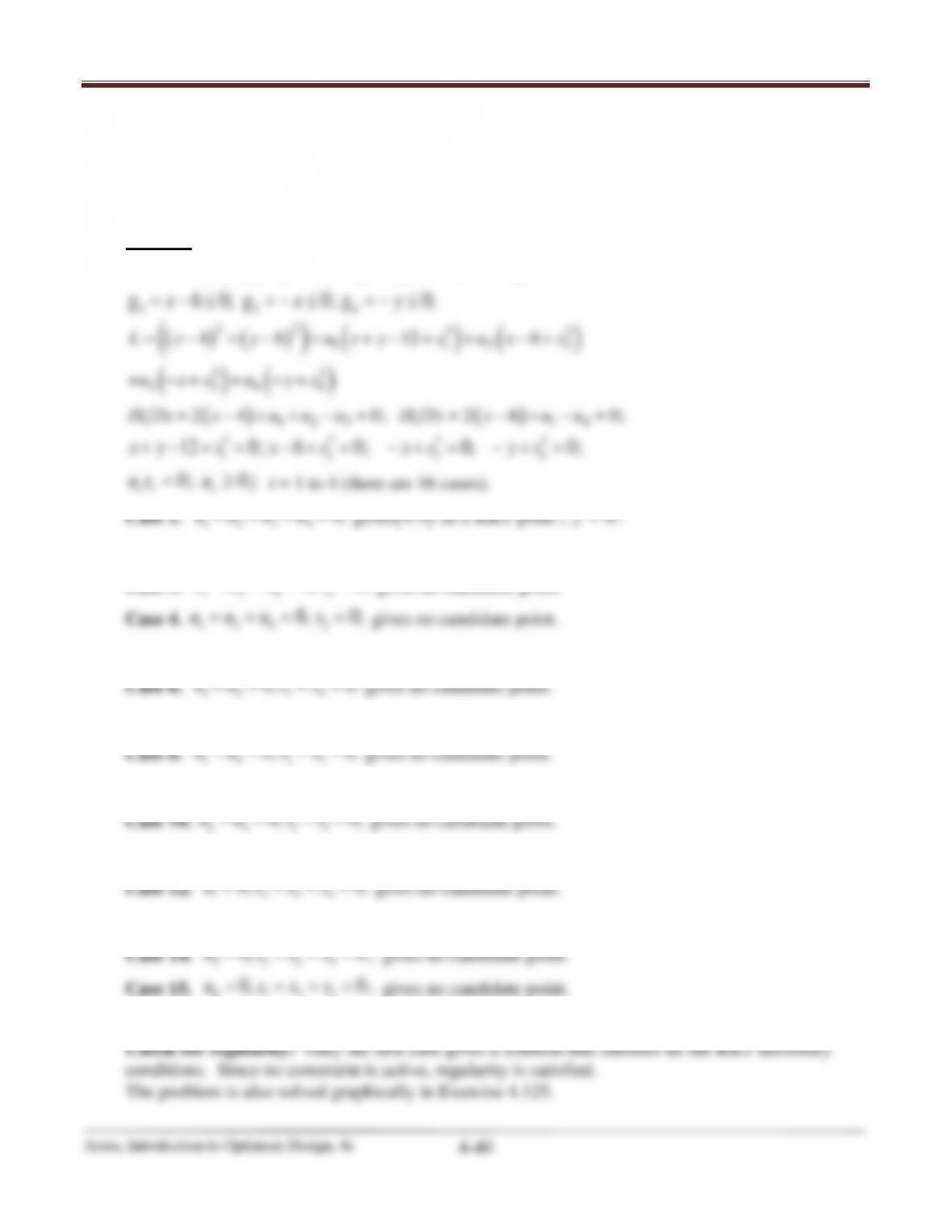
The Excel Solver gives a solution for these equations as
1= 2.8, 2= 1.2, =−2.57 < 0
Therefore this case does not give any KKT point.
For case 1, since there is no active constraint, the regularity is satisfied.
The problem is also solved graphically in Exercise 4.124.
Chapter 4 Optimum Design Concepts: Optimality Conditions
0, 0;uuu s= = = =
4.72________________________________________________________________________________
Minimize (,)= (−4)2+ ( −6)2
subject to + ≤ 12
≤ 6
, ≥ 0
Solution
Minimize
( ) ( ) ( )
22
1
, 4 6 ; subject to g 12 0;f xy x y x y= − + − =+− ≤
2 34
g 6 0; g 0 ; g 0;x xy=−≤ =−≤ =−≤
( ) ( )
()
( ) ( )
( ) ( )
( ) ( )
22 22
1 12 2
22
3 34 4
123 14
4 6 12 6
2 4 0; 2 6 0;
L x y ux y s u x s
u xs u ys
Lx x u u u Ly y u u
= − + − + + − + + −+
+ −+ + −+
∂∂= − + + − = ∂∂= − + − =
22 22
1234
12 0; 6 0; 0; 0;xy s x s xs ys+−+= −+= −+= −+=
;0 ;0 ≥=
iii
usu
i = 1 to 4 (there are 16 cases).
Case 2.
123 4
0, 0;uuu s= = = =
gives no candidate point.
Case 3.
124 3
0, 0;uuu s= = = =
gives no candidate point.